Category: Uncategorized

  • The Second Energy Level: The Nearest Reality Beyond the Physical World

    The Second Energy Level: The Nearest Reality Beyond the Physical World

    How the space that consciousness enters during sleep and out-of-body experiences is structured, why thought becomes an active force there, and how to distinguish what we observe from images created by our own minds.

    A map of reality becomes meaningful only when we begin to examine each of its levels separately. We can draw an elegant diagram of the universe, name invisible regions, and offer persuasive explanations. But until that framework is supported by repeated observations and personal experience, it remains a philosophical construction.

    For more than twenty years, I have explored states in which consciousness functions outside the physical body. During that time, I have experienced many conscious exits, returned to the same environments, tested my early conclusions, and gradually assembled a coherent picture. Some of my ideas changed. Others were confirmed again and again.

    I call the realm closest to the physical world the second energy level. Traditional esoteric literature often calls it the astral plane, but that term has accumulated too many conflicting meanings. For some, the astral plane is the world of the dead. For others, it is the realm of dreams. Still others imagine it as a domain inhabited by fantastic beings. All of these ideas touch on aspects of the second level, but none fully explains its structure.

    The second energy level is far more complex. It is not one uniform territory. It is an immense reality that includes an energetic reflection of the physical world, a realm of collective and personal thought-forms, and independent worlds that are not reflections of our universe.

    In my understanding, this is where human consciousness goes during sleep. Most people do not remain aware and remember nothing in the morning. Sometimes, however, memory breaks through as an unusually vivid dream, a sensation of flying, vibrations, falling, or a sudden awakening accompanied by absolute certainty that the person had just been somewhere else. Some people see their sleeping body from the outside. For most, this remains a single unexplained episode. For me, such an experience became the beginning of a long investigation.

    Not Another Place, but Another Level of Reality

    When I speak of the second energy level, I do not mean a place above the clouds or somewhere at the edge of the physical universe. It is not “far away.” It exists beside us—effectively within the same space, but in a different state of energy and matter.

    We are accustomed to treating as real only what our senses and physical instruments can detect. Yet our senses perceive only a narrow range of what is happening around us. We do not see radio waves, hear ultrasound, or sense most of the processes continually passing through space. That does not mean they do not exist. It means the human body is tuned to a particular range of perception.

    In my model, the physical world is the first and densest energy level. The second level exists in the next range. The physical body cannot enter it, but consciousness can shift its perception and function there independently.

    During a conscious exit, that shift feels completely real. A person is not merely imagining that they have left the body. They retain their sense of self, their ability to make decisions, and their capacity to see, hear, and analyze. At times, perception becomes even clearer than it is in ordinary life, while the physical body remains asleep.

    For me, this is one of the strongest reasons to regard consciousness as an independent form of life and the brain as its instrument for interacting with the physical world. When that instrument is temporarily removed from the process of perception, consciousness itself does not disappear. It continues to observe, learn, and act.

    Three Regions of the Second Energy Level

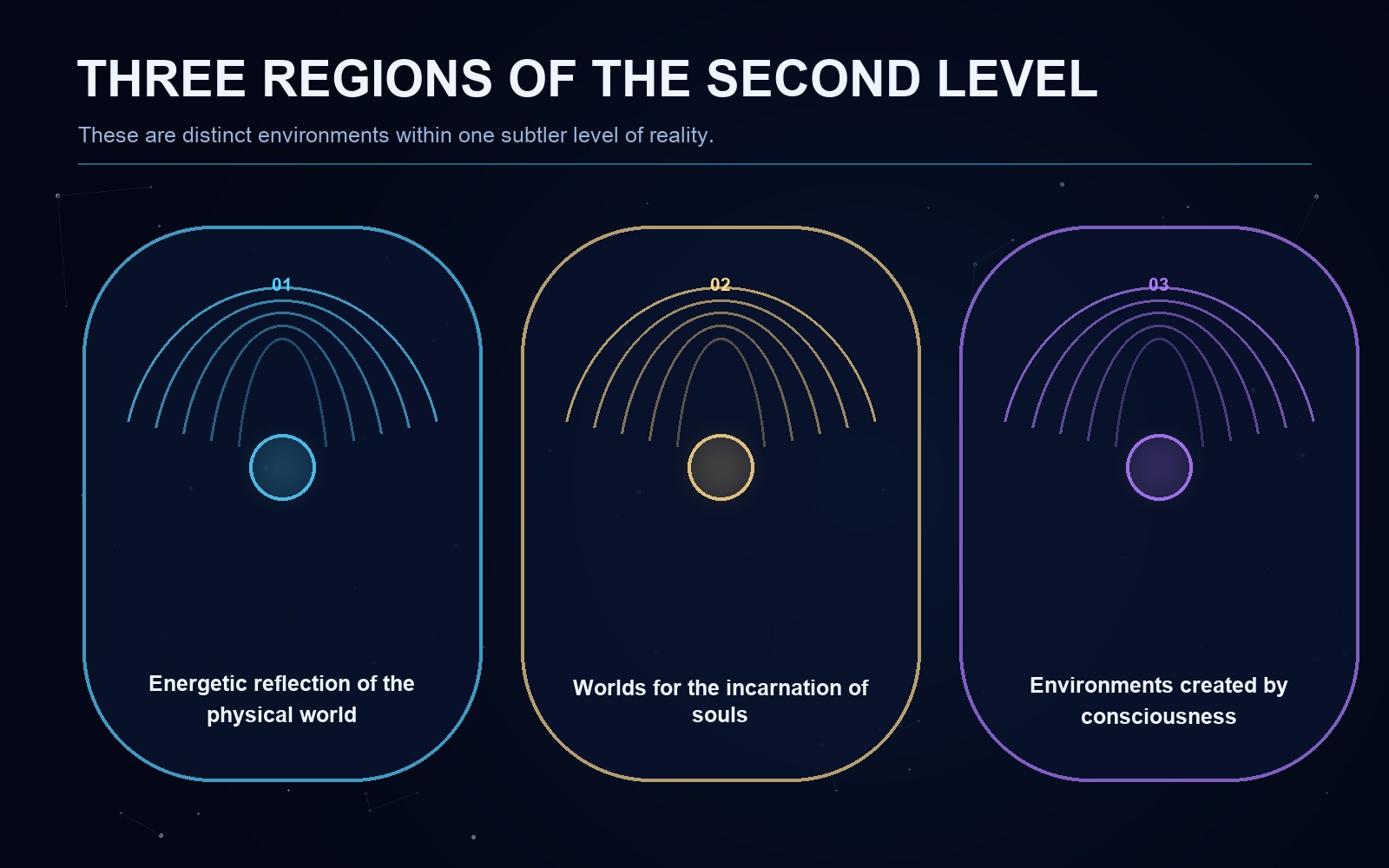
    The second level is not uniform. Based on my observations, I divide it into three broad regions. There are no walls or official boundaries between them. They can overlap and intersect, which makes it difficult for an inexperienced explorer to understand exactly where they are.

    The First Region: An Energetic Reflection of the Physical World

    This region is an almost complete copy of the reality we know. It contains reflections of houses, streets, cities, nature, planets, and our entire universe. When a person finds themselves there near the physical body, they usually see a familiar room. The walls, doors, and furniture are in their usual places. The same city lies beyond the window, and the same Moon, Sun, and stars appear in the sky.

    Yet this is not a photographically exact copy. A wall may be a slightly different color. A chair may have a different shape or texture. An object recently brought into the room may be missing, while something removed long ago may still appear in its old place. The more strongly an object is connected to people’s attention and habitual perception, the more stable its reflection seems to be. The less importance we give it, the more easily differences arise.

    Early in my practice, these discrepancies confused me. If the environment was real, why did its details change? Over time, I came to understand that I was not seeing the physical world itself but its energetic reflection. It is connected to physical matter, yet it is also influenced by the perception, memory, and attention of the consciousnesses that interact with it.

    By default, this reflection behaves much like familiar reality. The floor remains solid, walls seem impenetrable, and the body appears to have weight. A person keeps walking, opening doors, and moving around obstacles simply because that is how they have behaved throughout physical life. But as soon as they understand that they are outside the physical body, those familiar limits are no longer mandatory.

    They can pass through a wall, rise into the air, or descend to the bottom of a body of water without needing to breathe. The laws of space do not vanish on their own. They yield to directed intention.

    The Second Region: The Realm of Thought-Forms

    This is the most fluid and deceptive part of the second level. Here, thoughts, expectations, memories, desires, and fears can become a complete surrounding environment.

    By mental, I mean everything created by the mind—by our intellectual capacity to form thoughts, images, expectations, and inner scenarios. A mental environment is therefore a realm in which the contents of the mind can take on the appearance of external reality. An image created there can look convincing and be experienced as something outside us, even though its source is the person’s own mind.

    In the physical world, thought usually remains within us. Turning an idea into reality requires action, time, and material resources. In the second region, the distance between a thought and its visible form becomes dramatically shorter. The moment a person becomes afraid, the environment can begin filling with what they fear. The moment they remember a familiar place, it may appear around them. Religious beliefs can generate corresponding settings and figures. Images from movies, books, and games can be perceived as living beings.

    This is one reason accounts of out-of-body experiences differ so widely. Each person may be honestly describing what they saw, but that does not mean everything they saw existed independently of their consciousness. A person can enter their own thought and fail to recognize that they are helping create the scene around them.

    Ordinary dreams unfold primarily in this region. Consciousness remains near the body while a fluid environment forms around it from memories, emotions, and unresolved experiences. The story appears external, although much of it is being generated by the person’s own stream of thought.

    When someone becomes aware within a dream, they gain the ability to observe this process. Yet lucid dreaming does not always mean they have left the mental region. A person may clearly understand that the body is asleep while still remaining inside a reality created by the mind.

    Serious exploration requires learning to stop the automatic flow of images. Calm attention makes the environment more stable. Emotional chaos can change the scene instantly. This is why control of thought on the second level is not merely an appealing spiritual concept. It is a practical necessity.

    The Third Region: Independent Worlds

    The most difficult part of the second level to access includes worlds that are neither copies of our universe nor products of an explorer’s personal imagination. They have their own forms of life, laws, civilizations, and paths of development.

    Reaching them is far more difficult than moving to a familiar place. Movement in the second level requires a destination—an image, a memory, an energetic trace, or contact with someone who knows the way. We cannot simply decide to visit an unknown world when we have no information about it. Consciousness has nothing to connect with, so it returns us to familiar territory.

    That changes after the first contact. A reference point now exists in memory, and the path can be found again, either independently or with help from that world’s inhabitants.

    One of my most important contacts was with an explorer named Limiy. He introduced himself as an inhabitant of another world and showed me aspects of his civilization. The encounter lasted a long time and contained a great deal of information. It deserves a separate article because it concerns not only the structure of the second level, but also the capacities of other forms of life, movement between worlds, and their relationship to humanity.

    The larger point is this: the second energy level does not end with a reflection of our planet or with human dreams. It opens into a reality whose scale is far greater than the familiar idea of the astral plane.

    Thought Becomes an Active Force

    The central difference between the second level and the physical world is the role of thought. Here, thought can alter not only our mood, but the perceived environment itself.

    If a person expects to fall, they begin to fall. If they are certain that a wall is solid, it stops them. If they remember the physical body and begin worrying about it, their connection to the body immediately strengthens and the experience ends. But when attention is calm and intention is clear, the environment becomes manageable.

    This does not mean that a person gains absolute power over the entire second level. What they control first is their own point of presence and the part of the environment directly connected to their perception. An independent world or another consciousness is not required to obey their wishes. That is an important boundary between an independent reality and a personal thought-form.

    Thought makes it possible to fly, pass through walls, sharpen vision, travel toward a chosen destination, and change the mode of perception. Yet the same power can turn the experience into chaos. Fear creates frightening images, emotional excitement disrupts concentration, and the desire to explain everything immediately replaces observation with a ready-made story.

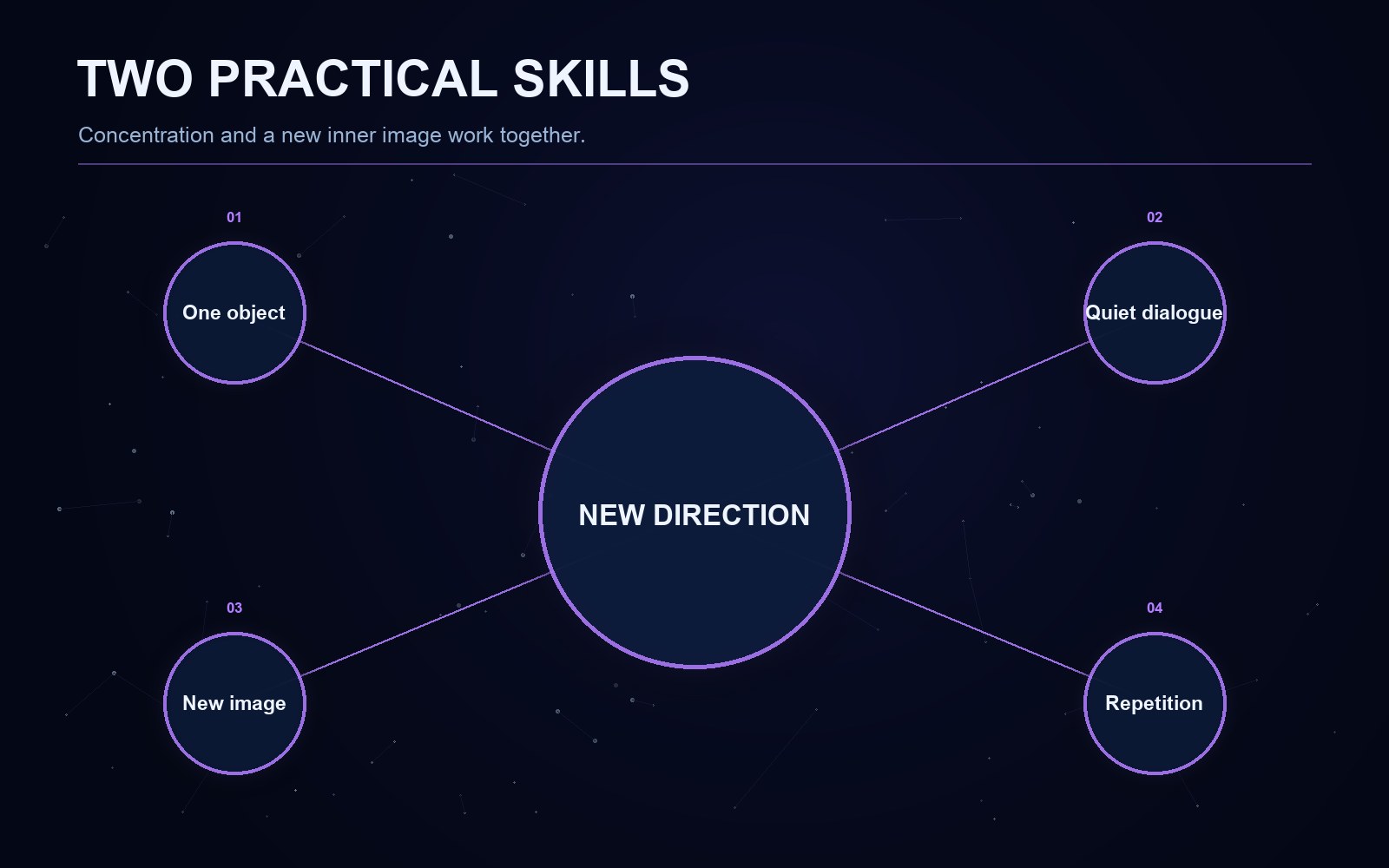
    Real preparation for exploration therefore does not begin with a technique for leaving the body. It begins with the ability to direct attention. Anyone who cannot quiet the inner noise of ordinary life carries that noise beyond the body as well.
    Explanatory diagram for the article
    Three regions of the energy level nearest to the physical world.

    How Movement Works

    At first, almost everyone moves as though they were still in a physical body. We walk across the floor, use the stairs, and try to open doors with our hands. This is natural: consciousness reproduces familiar patterns of behavior.

    Eventually, we understand that movement is determined by intention.

    The first method is directed flight. I hold a destination in my attention and move toward it. The speed can be enormous, especially in space, but I must not lose the reference point. If my attention wanders, I may arrive somewhere completely different—usually a place that is deeply familiar. It is as though consciousness selects the nearest stable image and transfers the explorer there.

    The second method is instantaneous relocation. I form a clear image of a place and join it with the intention to be there. The transition happens without any sense of crossing the distance between two points. Sometimes an exit begins this way: instead of finding themselves beside the body, a person immediately appears in a childhood home, on a familiar street, or in another emotionally significant place.

    Physical distance matters far less in the second region than the precision of attention. A person can quickly approach the Moon or the Sun and still be unable to reach an unknown galaxy because consciousness has no coordinates for it. The decisive factor is not the number of miles, but the connection to the destination.

    Sensation and Time

    The absence of the physical body does not mean the absence of sensation. On the second level, I have felt touch, the resistance of water, moving air, scents, coolness, and warmth. I have heard sounds and seen colors. I could intensify or reduce perception through intention.

    During one exit, I rose above Earth and traveled toward the Moon. On its surface, I scooped up brownish dust with my hand and felt it pass between my fingers. I saw a dark landscape, hills, and the blue Earth in the sky. A physical body would have needed protection and oxygen there. My consciousness experienced neither cold nor suffocation.

    That episode showed me that sensation on the second level is connected not to physical organs, but to consciousness’s ability to perceive energy and translate it into an intelligible experience. Hands, eyes, clothing, and breathing remain as a familiar image of oneself, even though they are no longer physically necessary.

    Time is experienced differently, but that does not mean we can freely travel into the past or future. A memory may unfold around a person as a complete scene, creating the impression of having returned to another time. But this occurs within the mental space of memory. Events on the second level still unfold in sequence, even though the duration of the experience and the amount of time that passes for the physical body may feel very different.

    The Central Challenge: Bringing the Memory Back

    Leaving the body is only half the work. The other half is preserving the experience after returning.

    The physical brain did not participate in the journey, so the memories must be transferred into it. If I immediately open my eyes, get up, look at my phone, or begin thinking about daily tasks, much of what happened disappears within minutes. Only the feeling that something important occurred remains.

    I have learned not to move or open my eyes immediately after returning. I first reconstruct the final event, then work backward through the memory and recover the entire route. After that, I replay the experience from beginning to end and only then write it down.

    A single vivid episode can be impressive, but by itself it explains very little. A coherent picture emerges through repetition. When the same properties of an environment appear dozens of times under different circumstances, they can become part of a working model. This is how I came to divide the second level into three regions and understood how strongly thought participates in shaping perceived reality.

    Who Is Present on the Second Level?

    Most sleeping people remain unaware. Their consciousness stays near the body while dream narratives unfold around them. Trying to speak with someone in this state rarely produces meaningful contact: the person is absorbed in their own story and may become frightened or vanish instantly as they return to the body.

    Conscious travelers are much less common. Rarer still are people who use out-of-body experiences not for entertainment, but for systematic exploration.

    The recently deceased can also sometimes be encountered on the second level. In my observations, they do not remain there forever. The second level serves as a transitional region before the soul returns to the third level—the place where it lives between incarnations and gradually regains a fuller memory.

    On one occasion, I rose through the roof of my house and saw a young man nearby. He noticed me and seemed surprised that I had not used the stairs. I made a joke, and he replied that he had assumed I was dead too.

    He looked young, but he told me that he had lived a long life and was very tired. He was waiting for his funeral so he could say goodbye to his body; after that, he intended to go where his loved ones were already waiting for him. A few days later, I learned that my elderly neighbor—a man I had occasionally seen on his balcony—had died.

    For me, this encounter became an important confirmation: the appearance of consciousness does not have to match the age of the physical body, and death does not always result in an immediate transition to the next level. For a time, the soul may remain close to the familiar world.
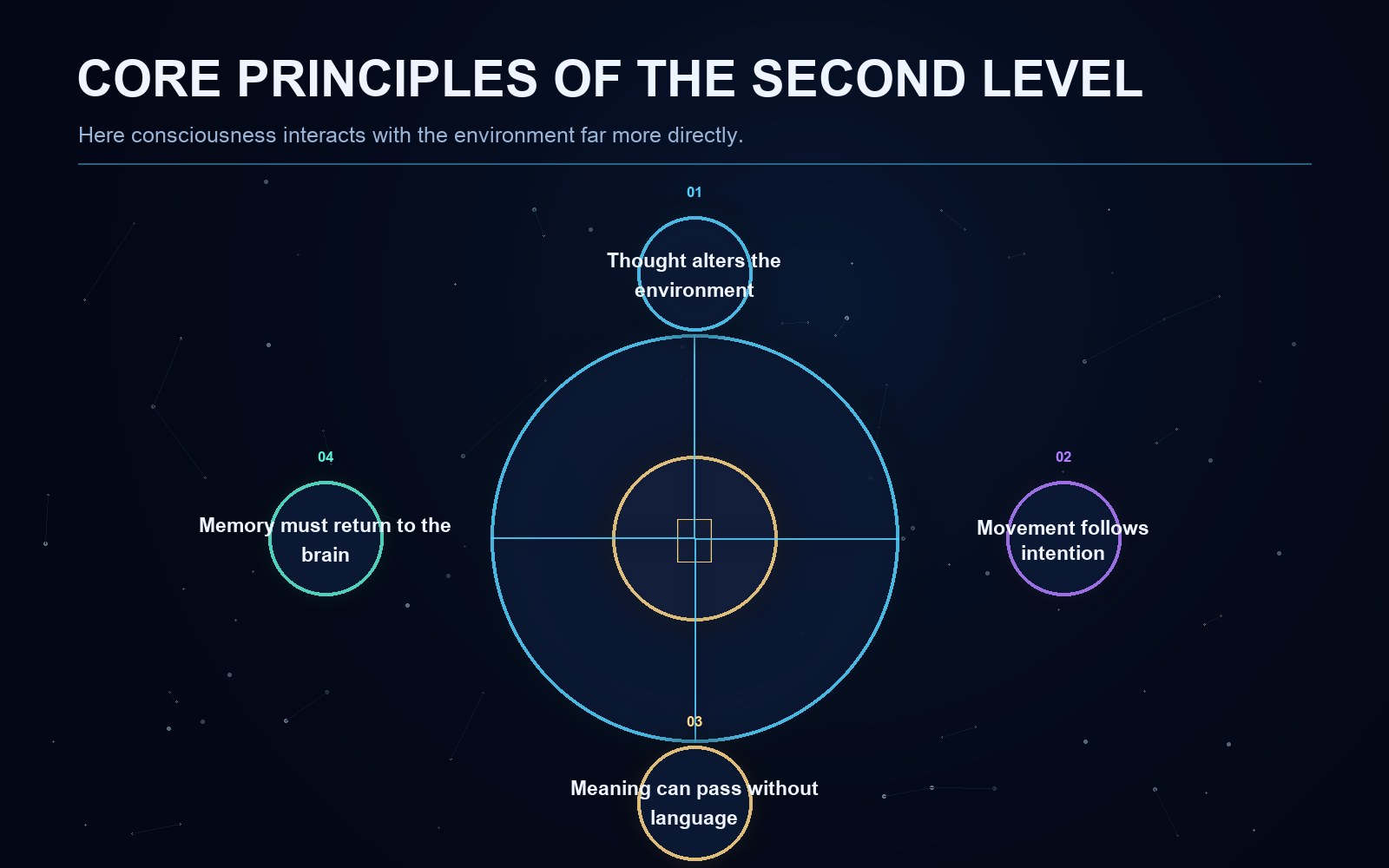
    Explanatory diagram for the article
    Core principles of perception and action on the second level.

    Communication Without Language

    People can speak with words on the second level, especially when they share a language. But spoken language there is more a habit carried over from physical life. There is no need to move the lips, exhale air, or produce sound waves.

    The more natural form of communication is through thought and a direct transmission of meaning.

    A thought conveys specific content. A direct transmission communicates an entire state at once: meaning, feeling, imagery, intention, a question, and one’s relationship to what is happening. Something that would take minutes to explain in ordinary conversation can be understood instantly.

    We sometimes experience faint traces of this kind of communication in physical life. People who are close may understand each other from a single look. We can sense someone’s mood before they speak. At times, we feel that someone is watching us. On the second level, this mode of perception becomes much clearer.

    Yet the force of an impression does not guarantee that a message is true. A thought-form can also speak, answer questions, and behave convincingly. I therefore evaluate a contact not by how dramatic it feels, but by a combination of signs.

    Distinguishing an Independent Reality from a Created Image

    This is one of the most difficult questions in the entire field of exploration.

    A thought-form usually depends heavily on expectation. It changes quickly under the influence of fear, desire, or a prepared scenario. Its behavior often repeats familiar religious, cultural, or personal images. When attention weakens, the scene may dissolve or transform into something else.

    An independent contact behaves differently. The other being can respond unexpectedly, refuse to follow my scenario, and communicate something I did not expect to hear. The environment maintains its own internal continuity and does not change simply because I want it to look different. I encounter something with its own will and logic, not merely an extension of myself.

    Even so, I do not treat these signs as a reason to declare every unusual image an external being. I preserve the details, record the conversation, compare it with later experiences, and only then draw conclusions. What distinguishes an explorer from a fantasist is not the absence of bold ideas, but the refusal to replace observation with a preferred explanation.

    Safety and Responsibility

    Many fears surround out-of-body experience. One of the most common is the fear of being unable to return to the body. Another is the belief that a foreign entity might take possession of it. In more than twenty years of practice, I have found no reason to regard these scenarios as a genuine threat.

    The connection between consciousness and the body is extraordinarily strong. A thought of the body, a sudden emotion, or an external disturbance returns a person almost instantly. Even when I was far from a familiar location, I could end the experience with a single intention.

    Most frightening beings arise in the mental region. Fear gives them form, and attention sustains their existence. The harder a person tries to escape an image they have created, the more convincing that image becomes. When the fear ends, much of the threat disappears with it.

    This does not mean aggression or outside interference is impossible on the second level. But the best protection is not a magical ritual. It is clarity, calm, control of attention, and a readiness to end the experience immediately.

    Ethics matter as well. The ability to travel outside the body does not give anyone the right to intrude into another person’s life. The practice should not be used for surveillance, pressure, the pursuit of power, or attempts to investigate loved ones without their consent. Expanding our abilities without expanding our sense of responsibility makes us more dangerous, not more evolved.

    Sobriety matters in the most literal sense. Alcohol and psychoactive substances disrupt concentration, memory, and the ability to distinguish observation from fantasy. Altered perception is not the same as awareness. Exploration requires a clear mind, healthy sleep, emotional stability, and the ability to stop when one’s inner state becomes unstable.

    Why This Level Matters

    The second energy level is the nearest frontier of a much larger reality. It reveals that consciousness does not cease to exist when the physical senses shut down. It shows both the power of thought and the danger of an uncontrolled stream of thinking. It reveals a connection between the living and the dead, makes communication without language possible, and offers a first experience of a reality in which physical distance is no longer the primary limitation.

    Yet its greatest lesson is not found in flight, extraordinary encounters, or journeys to other planets.

    Its greatest lesson is responsibility for our own consciousness.

    In physical life, we often fail to notice how fears, habits, and other people’s ideas shape our perception. The density of the material world conceals the consequences of inner chaos: a thought does not turn into an object before our eyes. On the second level, this process becomes visible. A person confronts the contents of their own mind and can no longer pretend those contents do not affect their reality.

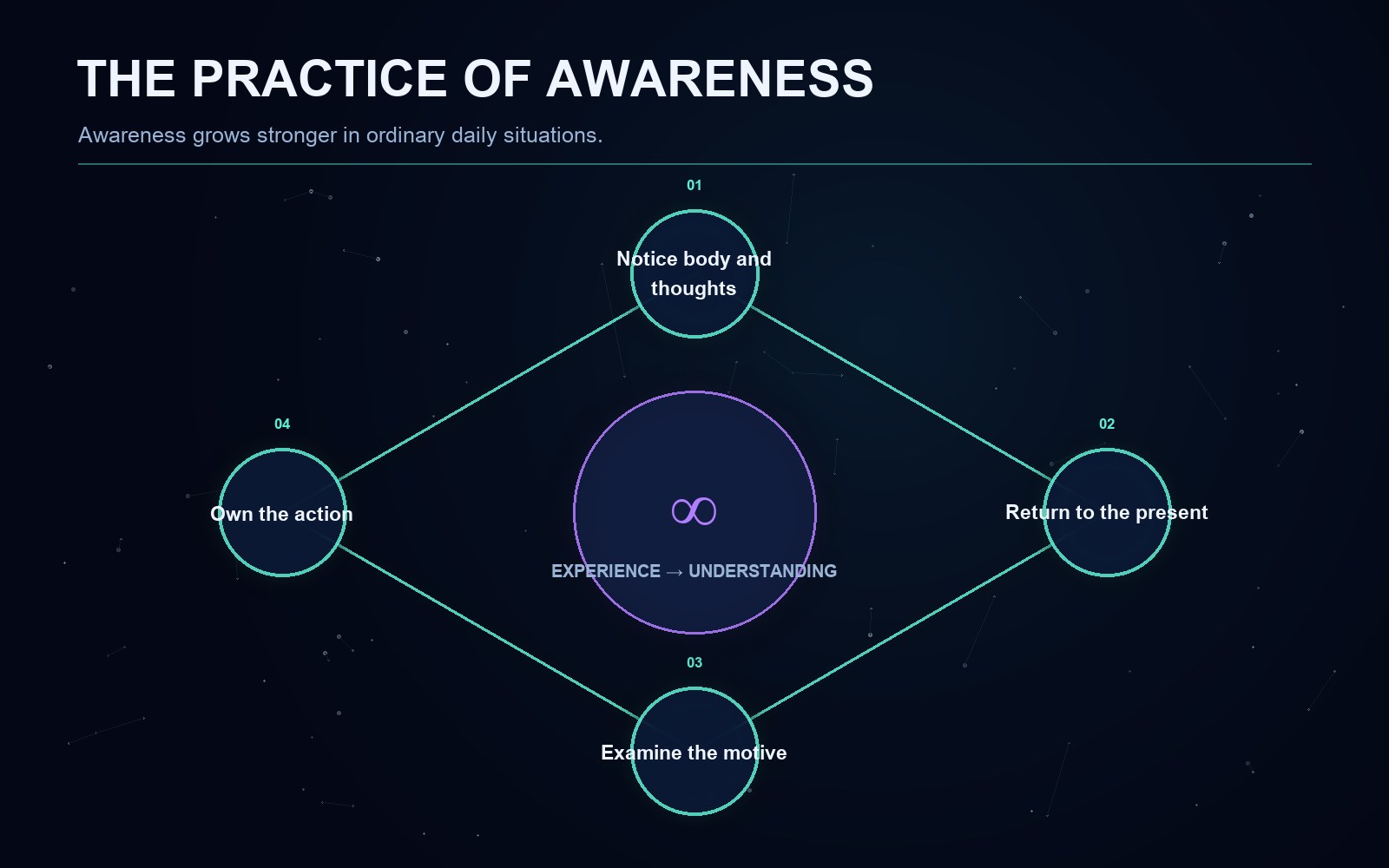
    This is why awareness matters more than technique. Anyone can leave the body by accident. Anyone can see a vivid scene. To explore, however, means remaining clear, asking questions, returning to one’s observations, testing conclusions, and being willing to revise an explanation when a new experience reveals a more complete picture.

    The second energy level is not the final destination. It is the first door. Beyond it begins a far more complex system of worlds and levels in which humanity must rediscover the nature of life, death, memory, and our own origins.

    In the next article in this series, I will examine the energetic reflection of the physical world in detail: why a familiar room can look slightly different, how human attention affects the stability of objects, and where the boundary lies between a reflection of reality and a thought-form created by the mind.

    You can read more about these observations, personal experiences, and practical conclusions in my book, The Phenomenon of Consciousness Beyond the Body.

    English editions:

  • A Map of Reality: Four Levels of Existence and Our Place Within Them

    A Map of Reality: Four Levels of Existence and Our Place Within Them

    We are accustomed to treating the physical world as the whole of reality. Whatever can be seen, measured, or detected by instruments is accepted as real. Everything else is usually dismissed as belief, fantasy, or a product of the human brain.

    But what if our senses perceive only the part of reality that the physical body was designed to experience?

    The human eye can see only a narrow range of the electromagnetic spectrum. The ear detects only a small portion of existing sound frequencies. We do not doubt the existence of radio waves simply because we cannot hear them without a receiver. We understand that our inability to perceive something directly does not mean it is absent.

    I am convinced that the same principle applies to reality itself. The physical world exists, but it is not the only world. It is one of several levels that occupy the same space, interact with one another, and differ in their energetic density, laws of perception, and possibilities available to consciousness.

    Over twenty years of out-of-body exploration, I gradually developed my own map of these levels. It did not arrive as a finished revelation, nor did I borrow it from a religion or esoteric tradition. It emerged through repeated experience. I observed, compared, returned to the same states, noticed recurring differences, and tried to understand the underlying patterns.

    This map contains four primary levels of reality. I do not consider the fourth level the final boundary of existence. Other states may lie beyond it, but I do not yet know enough about them. These four levels, however, explain much of what happens during out-of-body experiences, between incarnations, and after the death of the physical body.

    Reality Extends Beyond Physical Perception

    Our bodies are made for life in a dense material world. They allow us to navigate space, interact with objects, experience pain and pleasure, recognize danger, and make decisions. At the same time, the body limits the range of what we can perceive.

    A person may look around a room and feel certain that they see everything in it. In fact, they see only its physical dimension. Other levels may be present in the very same space while remaining invisible to ordinary sight.

    Radio frequencies offer a useful comparison. Signals from dozens of radio stations, television broadcasts, cell networks, and wireless devices can pass through one room at the same time. They do not collide with or displace one another. A device receives a particular signal only when it is tuned to the corresponding frequency.

    This is only an analogy, but it illustrates the central principle: moving between levels of reality does not necessarily mean traveling to a distant place. What changes is the state of consciousness and the energetic frequency with which it can interact. The space remains the same, while the reality being perceived changes.

    During an out-of-body experience, a person does more than leave the physical body. Consciousness is no longer restricted by the body’s senses and can perceive a broader range of existence.

    Matter Is Energy in a Dense Form

    My model begins with the understanding that matter and energy are not opposites. Matter is energy in a very dense and stable state.

    The denser the level, the more slowly change occurs and the less immediate the power of thought becomes. The subtler the energetic environment, the more quickly it responds to consciousness.

    In the physical world, imagining a house does not cause one to appear. A design must be created, materials acquired, and time and labor invested. On less dense levels, an image held in consciousness can alter the surrounding environment almost immediately. Thought becomes more than an internal process. It becomes an active creative force.

    The levels therefore differ in more than appearance. Each operates according to its own rules. Our perception of distance and time changes, as do our means of movement, the stability of our surroundings, and the degree to which thought can affect them.

    The First Level: Physical Reality

    The first level is our material world. It is the densest reality I have explored.

    This is where space and time behave as we know them. Objects hold their form. The body has weight and limitations. Every action requires energy, and its consequences cannot be erased by a simple wish.

    That stability is precisely what gives physical life its importance.

    In a less dense reality, a person may alter an image, redirect attention, or leave an unpleasant situation. Here, we must live with the consequences of our choices. Spoken words cannot be taken back. Broken trust cannot be restored instantly. The body requires care. Creating anything demands consistency, work, and patience.

    The physical world is a realm of genuine choice. Here our inner qualities become actions. Love must appear not only as a feeling, but as something we do. Compassion requires involvement. Courage emerges in the presence of real fear. Responsibility arises where decisions have consequences.

    The first level should therefore never be considered “lower” in the sense of being bad or unnecessary. The density of matter creates unique conditions for growth. Life on Earth is difficult precisely because it matters.

    We do not come here merely to escape into a spiritual world as quickly as possible. We come to gain experience that cannot be acquired outside physical incarnation.

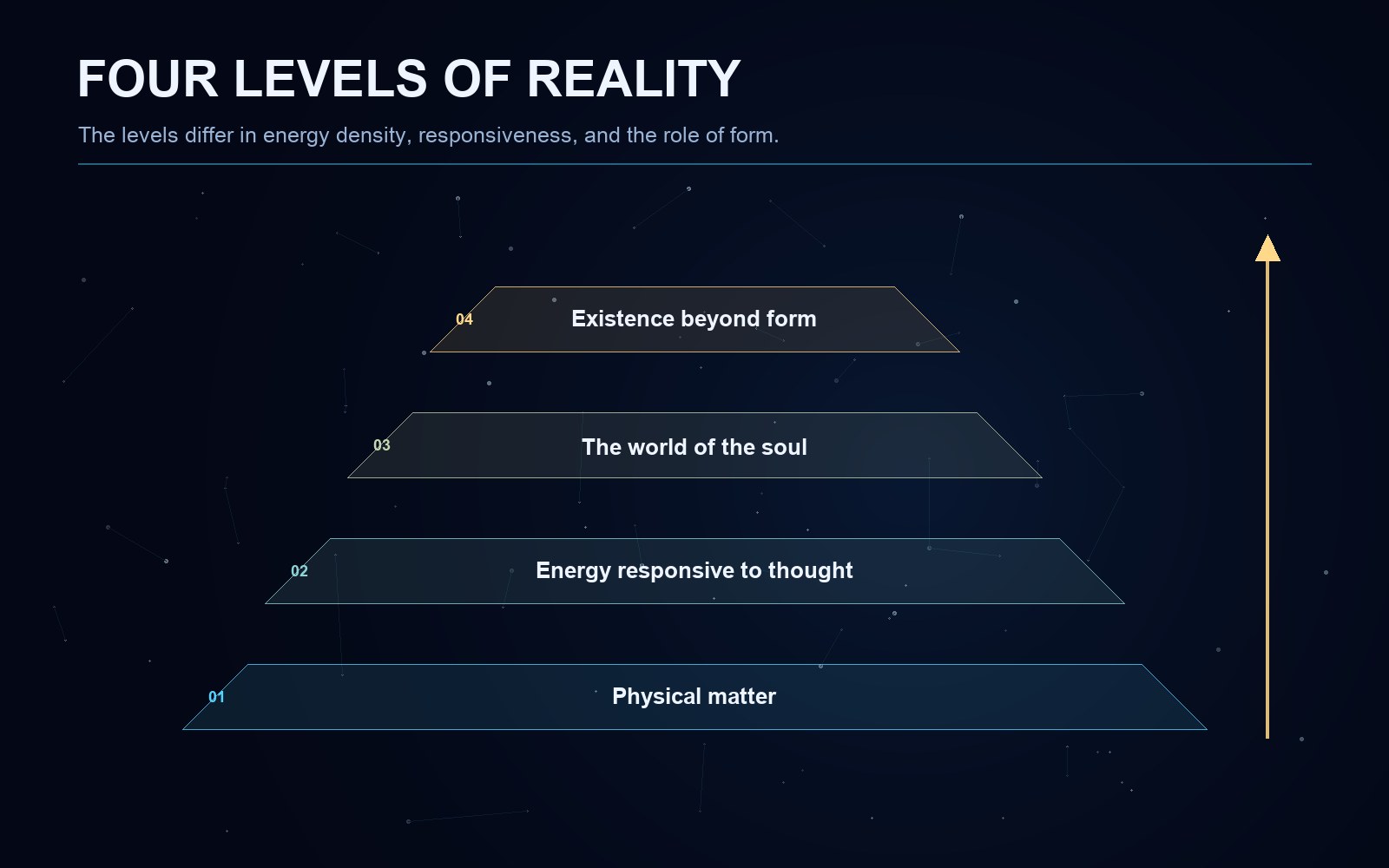
    Explanatory diagram for the article
    Four levels of reality in Andrey Chsherbakov’s working map.

    The Second Level: A Reality That Responds to Thought

    The second level is often called the astral realm. It is a less dense energetic reality in which consciousness has far greater freedom.

    At this level, a person can move without a physical body, pass through walls, fly, and cross enormous distances. The familiar limitations of matter weaken. Yet this freedom brings a new kind of responsibility: the environment begins to respond to thoughts, expectations, and emotions.

    When a person is calm and able to hold their attention steady, perception remains clear. When fear takes control, an emerging image can quickly assume form and appear to be an independent reality. Learning to guide the stream of thought is therefore one of the central requirements for consciously exploring the second level.

    In my model, the second level contains several distinct regions.

    The first is an energetic reflection of the physical universe. A person may see a familiar room, house, street, the Earth, and the surrounding cosmos. This reflection does not always match the physical original exactly. Objects that no longer exist in the material world may still appear there, while recent physical changes may be absent. It is not a photographic copy, but an energetic layer of reality.

    The second region contains independent worlds that are not copies of our universe. They have their own conditions, forms of life, and environments in which souls may undergo other kinds of experience.

    The third is the mental region. It is created by human thoughts, fears, beliefs, and fantasies. This part of the second level is especially important because it can produce experiences that are extraordinarily vivid and, at the same time, deeply contradictory.

    Mental Reality: When Thought Becomes an Environment

    Human thought does not simply vanish. Repeated images and powerful emotions create energetic structures. When millions of people sustain the same fears, hopes, and religious ideas over generations, these structures join together and form stable regions within mental reality.

    A person who enters such a region may see exactly what they have been conditioned to believe. One may encounter a familiar religious figure. Another may enter a world shaped by fear. Someone else may see a landscape resembling a dream or fantasy. The experience can feel entirely convincing because the surrounding environment truly does respond to consciousness.

    This may explain why accounts of out-of-body experiences and postmortem reality often contradict one another. People are not necessarily lying. They may be describing their experiences honestly while visiting different regions or interacting with material generated by their own stream of thought.

    The ability to leave the body does not make anyone all-knowing. Beyond the body, we must still learn to observe, verify, and distinguish a stable reality from a structure created by thought.

    The mental region deserves a detailed discussion of its own. No serious exploration of out-of-body experience is possible without understanding its nature.

    The Third Level: The Soul’s Home

    The third level differs fundamentally from the energetic reflection of our world. It is not a copy of the physical universe, and familiar concepts of distance and time begin to lose their meaning.

    I understand this as the level to which the soul returns between physical incarnations. It is our true home, not in a geographical sense, but in the deepest sense of who we are.

    During earthly life, a person experiences the self as a separate personality. Memory is limited to the current incarnation, attention is centered on the body, and the soul’s previous experience remains hidden. When physical life ends, these restrictions gradually fall away. The soul regains a fuller understanding of itself, reunites with closely connected souls, reflects on the life just completed, and prepares for further development.

    Stable realities created by large groups of souls can exist on the third level. They are not comparable to brief, chaotic mental images. They possess internal structure and endure through the coordinated participation of many consciousnesses.

    A soul can assume a familiar appearance so that others can perceive it. An encounter does not require a physical body, but consciousness may use an image that everyone involved can understand. Form becomes a means of communication rather than a biological necessity.

    Time does not move here as it does on Earth. We are accustomed to sequence: the past is over, the present is unfolding, and the future has not yet arrived. On the third level, perception becomes broader. Events and relationships can be understood as a whole rather than divided into separate moments.

    Remaining in this state during out-of-body exploration is considerably more difficult. It requires steady attention and the ability to avoid automatically returning to the familiar habits of earthly perception.

    The Fourth Level: Existence Beyond Form

    The fourth level is the most difficult to describe in human language. Our language evolved to describe objects, actions, distances, and time. Here, familiar forms almost completely disappear.

    This is a reality of pure energy. There is no body in the familiar sense, no room, landscape, or separate source of light. Perception becomes whole: you see, know, and understand at once. Information is not communicated through individual words. It is present immediately as complete knowledge.

    At this level, the sense of isolation that accompanies physical embodiment disappears. Consciousness does not lose its identity, but experiences a far deeper connection with the reality around it.

    I associate the fourth level with highly developed souls that no longer need earthly incarnation. Their development continues, but under conditions I cannot yet explore completely or describe in full detail.

    I do not consider the fourth level an ultimate summit. Reality does not have to end where my ability to perceive it ends. Other levels probably exist, but I will not construct a detailed account of them without sufficient experience.

    For me, an honest boundary of knowledge matters more than an elegant but artificial system.

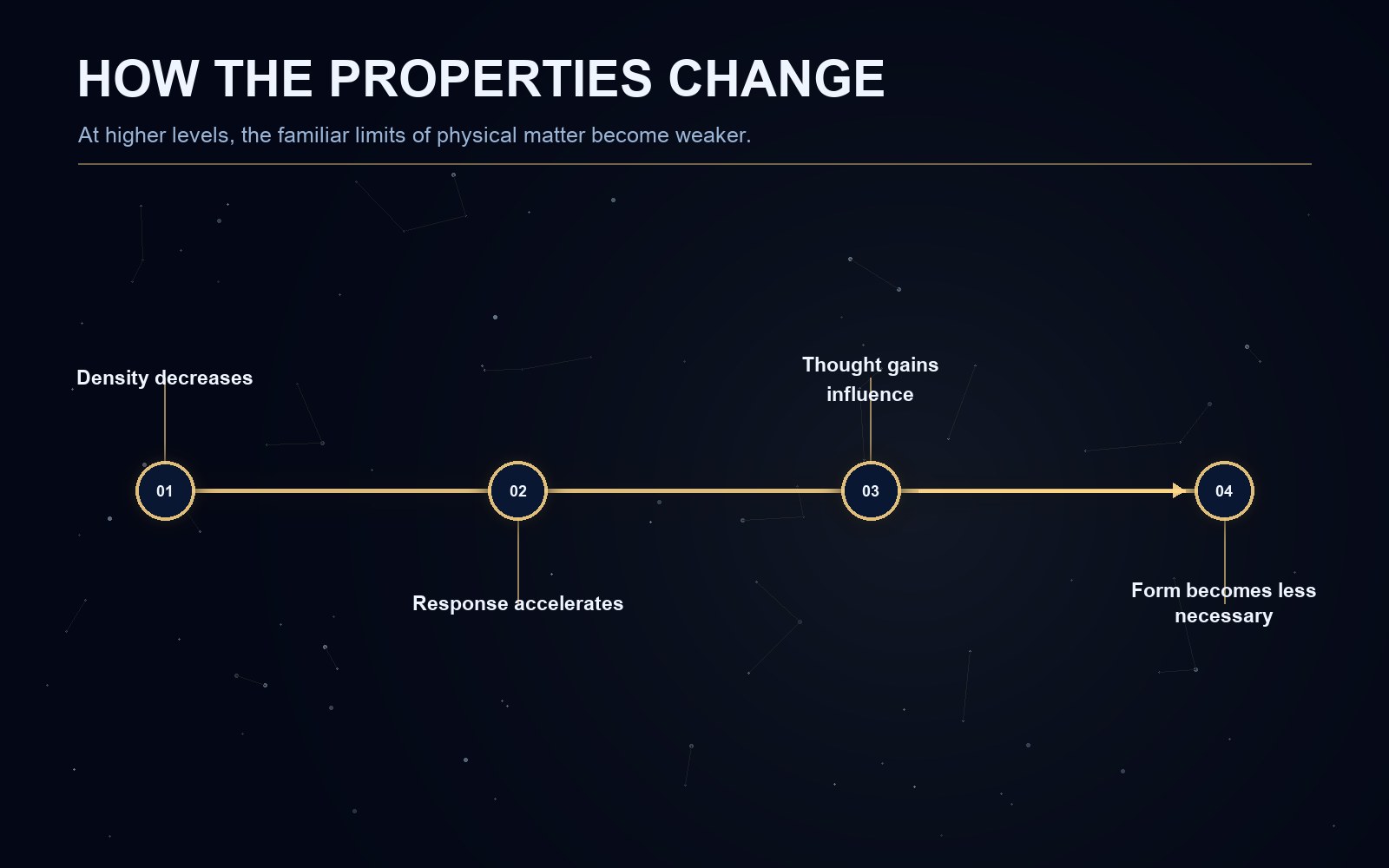
    Explanatory diagram for the article
    Across the levels, density decreases while the influence of thought increases.

    The Levels Are Not a Measure of Human Worth

    The words “first,” “second,” “third,” and “fourth” are simply a way to describe the model. They do not mean that a person who has experienced a higher level is better than anyone else.

    Spiritual development is not measured by the number of extraordinary experiences a person has had. Someone may leave the body many times and remain selfish, cruel, or irresponsible. Another person may never have a conscious out-of-body experience and still live with love, dignity, and a profound understanding of others.

    This map is not meant to establish a new hierarchy. Its purpose is to clarify the conditions in which consciousness exists and develops.

    Each level serves a purpose. Physical reality provides the experience of embodied choice. The second level teaches the direction of attention and thought. The third restores the soul’s wholeness and broader memory. The fourth opens existence beyond familiar form.

    How This Map Changes Our Understanding of Death

    If the physical body is considered the source of consciousness, death appears to be the final destruction of the person. But if the body is an instrument through which consciousness interacts with the first level, then the body’s death ends one mode of interaction. It does not erase the human being.

    After death, consciousness does not fall into absolute nothingness. It stops perceiving the physical world through the body and continues on another level. At first, a person may retain their familiar sense of identity and connection to earthly life. Then memory expands, perception changes, and the soul returns to a more complete understanding of itself.

    This does not diminish grief or eliminate the pain of separation. We truly do lose the physical presence of someone we love. But we do not lose that person forever.

    Understanding the layered nature of reality restores hope. Death becomes a transition between forms of existence rather than disappearance.

    Why This Map Matters While We Are Alive

    It may seem that levels of reality matter only to people interested in out-of-body experience or life after death. In fact, this map changes how we understand the life we are living now.

    If a human being is a consciousness that continues to develop beyond a single incarnation, then every decision carries deeper meaning. We do not take money, titles, or social standing with us. What remains is what we have become: our capacity to love, understand, choose, move through fear, and accept responsibility for our actions.

    Physical life is no longer a random interval between birth and extinction. It becomes an important stage in a much larger journey.

    This map also teaches responsibility for the stream of thought. In the material world, thought often seems private and inconsequential. On subtler levels, its creative force becomes immediate. Learning to observe the activity of the brain, resist automatic fear, and consciously direct attention prepares us for existence beyond the body.

    Finally, the map teaches us not to mistake every extraordinary image for ultimate truth. The intensity of an experience does not guarantee that our interpretation is accurate. A serious explorer must remain clear, compare experiences, and learn to distinguish among levels of reality.

    This Is a Map for Exploration, Not a Dogma

    I am confident in the reality of my experience and in the central patterns I have observed over twenty years. But I do not claim that my map describes the whole of existence.

    A map is never the territory itself. It helps us find our way, but it cannot replace direct knowledge.

    My understanding will continue to grow as my exploration continues. If future experience reveals details I cannot see today, I will expand the model. A willingness to learn does not mean doubting the path already traveled. It means remaining honest as a researcher.

    I am not asking the reader for blind belief. I am offering another way of seeing reality—one that can be examined, compared with personal experience, questioned, and used as a foundation for further exploration.

    We Are More Than Our Bodies

    We are not bodies that accidentally learned to become conscious. We are consciousness temporarily experiencing life through a physical body.

    The first level gives us dense matter, limitations, and consequences. The second reveals the power of thought and the diversity of energetic worlds. The third restores the soul’s memory and the sense of returning home. The fourth leads toward existence beyond familiar form.

    All these levels are parts of one reality. They are not divided by impenetrable walls. We are already connected to them, even while physical life limits our awareness to the material world.

    We did not come here by accident. Our lives are not brief flashes between two stretches of eternal nothingness. This is one stage of a far greater journey—difficult, valuable, and filled with meaning.

    Death does not close that path. It changes the level on which the journey continues.

    In the articles that follow, I will explore each level in detail, examine the mental region, explain the transition between states, and discuss how we can distinguish a stable reality from an environment created by human thought.

    You can read more about my experiences and research in my book, The Phenomenon of Consciousness Beyond the Body.

    English editions:
  • What Do We Remember When We Die? The Return of Memory and the Soul’s Journey Home

    What Do We Remember When We Die? The Return of Memory and the Soul’s Journey Home

    Much of our fear of death comes from the belief that when the body stops, the person disappears. As if our entire life—our love, memory, and accumulated experience—could turn into nothing in a single moment.

    My experience tells me otherwise.

    After twenty years of out-of-body practice, I have come to understand that death does not destroy a person. It completes one stage of existence and begins another. We do not disappear. We are released from the body, gradually recover our memory, and remember who we are beyond a single earthly life.

    But memory does not return all at once. Between the final moment of physical life and the full recovery of self-awareness, the soul passes through several stages. Each one has its own purpose.

    Why We Enter Life Without Our Memory

    Before we can understand what a person remembers after death, we must understand why we forget in the first place.

    Before incarnation, the soul knows far more than the embodied personality. It knows where it came from, sees the purpose of the coming life, recognizes the souls connected with it, and becomes familiar with the major events of the path ahead. But when it enters earthly life, it willingly closes that memory.

    Forgetting is neither a punishment nor a mistake. It is a necessary condition of authentic experience.

    If we remembered the world of the soul from birth—its freedom, the way we felt there, and those to whom we were connected—earthly life might feel like a narrow prison. We would know that we existed before birth and would continue after death. We would remember the entire scenario, anticipate every major trial, and know where pain awaited us and where the way out could be found.

    Our decisions would no longer be real. We would not truly live the life before us; we would simply follow instructions we already knew.

    Incarnation has a different purpose. We must face circumstances directly and make our decisions from inside the life we are living: without hints, without a prepared answer, and without turning to the final page to see how everything ends.

    That is why the rules are hidden and the memory is closed.

    Why We Do Not Remember Past Lives

    People sometimes assume that memories of previous incarnations would make them wiser and prevent them from repeating old mistakes. But knowledge would not return alone. It would bring an enormous emotional burden with it.

    Across many lives, every soul has lost loved ones and endured betrayal, violence, illness, and war. It has also made mistakes, caused pain, and made choices it later regretted. The complete memory of all of this could place more weight on the human mind than it could bear.

    Imagine remembering the death of every child, parent, spouse, brother, or sister you had lost in other lives. Imagine remembering every person you failed to save, every harmful act you committed, and every weakness you once surrendered to. Imagine recognizing in someone you know today the person who once betrayed or killed you. What would become of your present choices? Would a new life simply become an extension of old grief, guilt, and revenge?

    We are given the opportunity to begin a new path without that pressure. The stories of former lives are concealed, but the qualities developed through them remain: the soul’s tendencies, its strength, its weaknesses, and its capacity to love, feel compassion, and choose. The experience remains within us even when we no longer remember the circumstances in which it was acquired.

    We do not arrive empty. We arrive without biographical memory, but we carry the result of everything we have lived before.

    Death Begins with Separation from the Body

    The first stage of death is the separation of the soul from the physical body.

    This separation is not experienced in exactly the same way by everyone. A person who has been ill for a long time or has prepared inwardly for death will often recognize the transition more quickly. After a sudden death, the soul may not immediately understand that the body is no longer alive. A person may continue to perceive the surroundings, see the people nearby, and try to speak to them without understanding why no one responds.

    In other cases, the soul understands what has happened but refuses to accept it. This can be especially difficult after the sudden death of a young person whose life was filled with plans, desires, and strong bonds with loved ones.

    Several years ago, I was told about a young man who died in a hospital during the pandemic. After his death, unusual events began occurring in the hospital rooms: objects fell or moved, and a distinct presence could be felt. A physician who had been near him during his final days believed that he had not understood or accepted his death. She began reading my book aloud, explaining what had happened to his body, that the life of the soul continued, and where he needed to go next. A few days later, the disturbances stopped completely.

    For me, this story shows why an understanding of death can matter even while we are alive. Knowledge does not erase the pain of separation, but it can help a soul avoid becoming trapped in fear and confusion.

    Explanatory diagram for the article
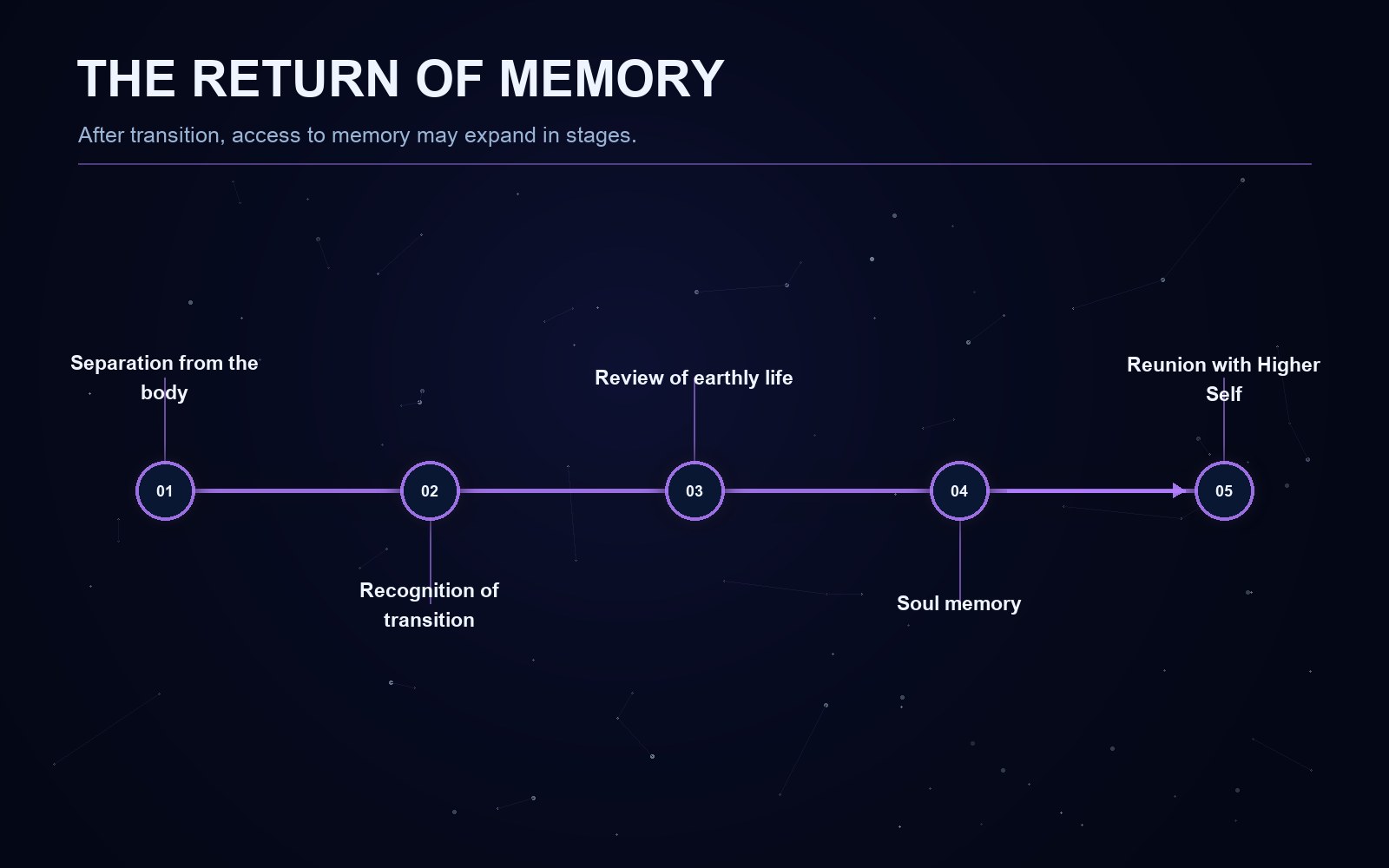
    A proposed sequence for the return of memory after death.

    Accepting the Fact of Death

    After separation comes the next stage: acceptance.

    For someone convinced that nothing exists beyond death, the continuation of his or her own awareness can be overwhelming. The person discovers that perception and thought continue even though the body no longer functions. An entire worldview collapses in an instant.

    For many people, however, death feels like release. Physical pain disappears. The weight of an old or sick body is gone. People who return after a near-death experience often say they did not want to come back. They experienced separation as freedom and as a return to a more natural state of being.

    The soul’s experience matters greatly at this stage. A soul that understands the nature of death accepts the transition more quickly. A confused soul is met and assisted by kindred souls, who offer support and explain what comes next.

    No one is left alone.

    The Memory of This Life Returns First

    Once death is accepted, memory begins to return—but it returns gradually.

    The person first remembers the life that has just ended. Events, emotions, and decisions that were forgotten or only partly understood during incarnation become available again. The person sees the life as a whole and recognizes connections between events that once seemed accidental.

    This may explain the familiar account of an entire life passing before someone’s eyes during a near-death experience. It is more than a series of images. The person regains a complete perception of the life that was lived.

    Out-of-body experiences that did not remain in ordinary waking memory are also recovered. The person begins to see the life from beyond the perspective of the earthly personality, although the soul’s full memory has not yet returned. At this stage, the individual still feels like the person who lived on Earth. Loved ones, unfinished relationships, and events in the physical world still matter deeply.

    Saying Goodbye to Loved Ones

    The next stage is farewell.

    After separation, the soul remains close to the earthly world for a period of time. It visits loved ones and tries to communicate that it still exists and that it is all right. People in the depths of grief may be unable to perceive these attempts, but the soul still wants to comfort those it loves.

    In my experience, this period usually lasts up to ten days. This is not a rigid deadline or an identical rule for every soul. The length of the transition depends on the soul, the circumstances of death, the strength of earthly attachments, and the soul’s readiness to move forward.

    Love does not disappear after death. Gradually, however, the soul understands that its earthly stage is complete. It releases the former personality and begins the journey home.

    Returning to the World of Souls

    The return does not happen in a single instant. It is a gradual transition into a more complete state of being.

    The soul first meets a teacher or guide. Together they examine the life that has just ended: the decisions that were made, what was understood, where the person showed strength, and where fear, anger, or habitual patterns took control.

    This is not a trial, and no sentence is imposed. The soul is not punished. What takes place is an honest understanding of experience.

    On Earth, we often evaluate a life through outward results: success, wealth, recognition, victories, and defeats. After the return, the inner motives behind our actions become visible, along with the ways those actions changed the quality of the soul. A choice unnoticed by everyone else may matter more than a celebrated achievement. What looked like failure on Earth may sometimes bring the soul more growth than an easy victory.

    The soul sees where another choice was possible. It also understands why it made the choice it did. The entire chain of circumstances, emotions, and consequences becomes clear.

    Explanatory diagram for the article
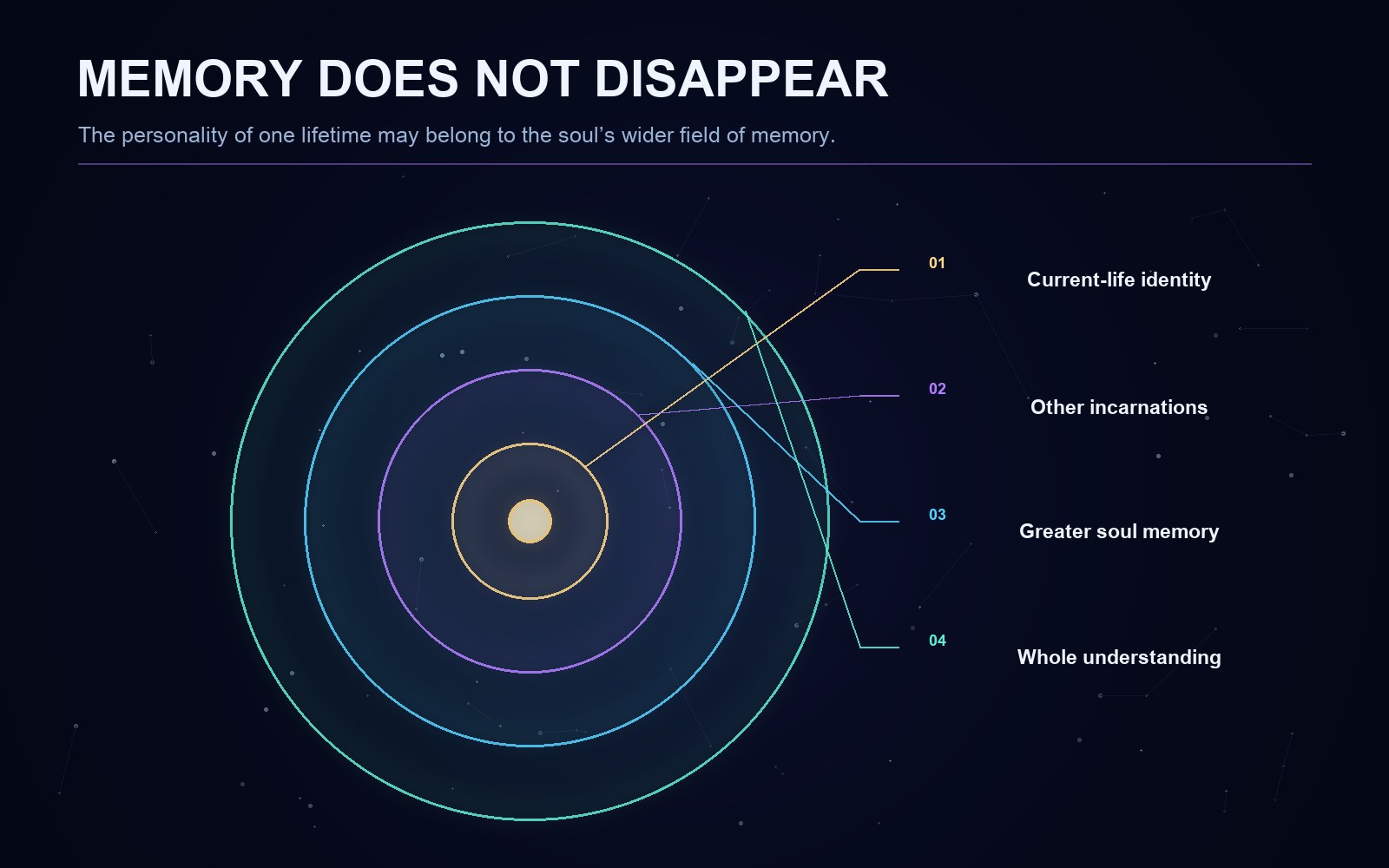
    The personality is not erased; it becomes part of the soul’s fuller memory.

    Restoring Inner Harmony

    Earthly life leaves an imprint on our energy. Pain, fear, difficult relationships, and inner conflict create imbalance. After returning, the soul goes through a period of restoration.

    Some experience this stage as a special place of healing. Others describe a connection with light or with a powerful source of energy. The images may differ, but the purpose is the same: the soul’s energy is restored to harmony.

    That energy is not exhausted or destroyed. Energy never disappears; it changes form and quality. Everything we lived becomes part of the soul, but pain no longer controls it as it controlled the embodied person.

    Reuniting with the Higher Self

    The most complete restoration of memory occurs later, when the incarnated part of the soul reunites with the Higher Self.

    Only part of our greater being enters an earthly life. The larger part remains in the world of souls, retaining a much wider consciousness and its connection with all accumulated experience. While living in the body, a person experiences the self as a separate personality. After death, that personality is not erased. It returns to its own wholeness.

    At the moment of reunion, memory of other incarnations returns, along with the preparation for the earthly life, its purposes, and its place within the soul’s much longer journey. Experiences that once appeared unjust or meaningless can now be seen within a larger picture.

    We remember more than events. We remember the principles behind incarnation itself. We understand why we agreed to forget, why we met particular people, what we came to transform within ourselves, and what experience we gained.

    This is the true meaning of returning home. It is not merely movement to another place. It is the restoration of our own wholeness.

    Why Those Who Have Died Do Not Fix Our Lives

    People often ask: if deceased relatives continue to exist, why do they not help us more openly? Why do they not warn us of danger, tell us which choice to make, or remove our problems?

    After full memory is restored, the soul understands the reason.

    We came here to make our own decisions. If a departed soul continually intervened, removed every difficulty, and directed every step, it would deprive us of the experience for which we incarnated. That would not be help. It would diminish the meaning of our path.

    The souls who love us do not become indifferent. The connection remains, but they see our lives from a wider perspective. They understand that certain trials cannot be completed on behalf of another person. Support is possible, but the decision must arise within us.

    One day, we too will return, recover our memory, and understand this just as clearly.

    Life Continues in Another Form

    After restoration, the soul returns to its kindred group—to those with whom it has shared many incarnations. There is no earthly sense of urgency there. No one forces the soul to choose another life immediately. It reflects, communicates, learns, and remains in that state for as long as it needs.

    A new incarnation begins when the soul recognizes that it is ready for another experience. It sees the qualities it wants to reveal, chooses the conditions, and enters earthly life again.

    This is how development continues: not as punishment and not as an endless repetition of the same mistake, but as the gradual unfolding of the soul through experience, love, choice, and transformation.

    No One Disappears

    Death remains painful for those who continue living. The loss of physical presence is real. We miss the voice, the touch, the familiar conversations, and the ability to see someone we love beside us.

    But the person does not become nothing.

    The soul separates from the body, accepts the transition, remembers the life that was lived, says goodbye to loved ones, returns to the world of souls, restores its inner harmony, and reunites with its greater being.

    We fear death because we view it from the perspective of the body. For the soul, it is not the end. It is the return of memory and the journey home.

    Death as the destruction of the person does not exist. There is transition. And one day, each of us will remember why we came, whom we loved, what we learned, and who we have always been.


    For a deeper account of my experience and research, see my book The Phenomenon of Consciousness Beyond the Body.

    English editions:
  • You Cannot Defeat Fear—But You Can Take Control of It

    You Cannot Defeat Fear—But You Can Take Control of It

    Why fear remains even after we gain experience—and how to stop letting it make our decisions

    Fear can stop us before any real danger appears. We may be prepared, know exactly what to do, and possess every ability required to succeed. Then the decisive moment arrives, and the body seems to stop cooperating. Muscles tighten, breathing changes, attention narrows, and the brain begins repeating the same alarming scenario.

    At that point, fear is no longer simply warning us. It is trying to make the decision for us.

    I have observed this many times—in life, in sports, and in my exploration of out-of-body experience. I eventually reached a conclusion that may sound surprising: fear cannot be permanently defeated. Nor should it be. Fear is part of human nature, and it serves an essential protective function.

    But fear can be brought under control.

    It may remain in the body as nervous energy, tension, or a slight sensation in the stomach, yet lose its power over our actions. We can learn to stay clear, assess what is happening, and act even while fear is present.

    That is what I call real courage.

    My First Serious Lesson About Fear

    When I was seventeen or eighteen, I had to speak in front of a group of people. The audience was very small—only about five people. There was no real danger. What was there to fear?

    Yet the fear was so strong that I forgot what I wanted to say. My thoughts scattered, the words I had prepared disappeared, and the entire presentation fell apart. That was the first time I clearly understood how much power fear can have over us. It can cut us off from knowledge and abilities that were fully available only moments before.

    Later, I learned to speak before audiences of several hundred people. I gained experience, learned how to prepare, and stopped allowing nervousness to destroy my presentations. That does not mean the fear vanished completely. I could still feel tension before walking onstage.

    What changed was that the tension no longer determined my actions.

    That experience taught me something important. Confidence does not always mean the absence of fear. Very often, confidence means being able to continue doing what matters while fear remains beside you.

    Even Professionals Feel Fear

    More than ten years of my life were connected with competitive tennis. I watched talented athletes perform brilliantly in practice. They moved freely, struck the ball with precision, and displayed an impressive level of skill.

    Then a real match began, and the same athlete sometimes could not demonstrate even half of what they had shown during practice. Their movements became restricted. Their muscles seemed to stiffen. They made mistakes that almost never appeared in training. Their technique had not disappeared. Their physical condition had not suddenly changed. Their inner state had.

    Fear of losing, fear of making a mistake, and fear of being judged had taken control.

    I asked professional athletes whether experience eventually made the fear disappear. The answer was almost always the same: no. Even extensive experience does not completely eliminate nervousness. It teaches us how to act while feeling it.

    Fear is therefore not proof of weakness. Beginners and professionals feel it. Ordinary people and accomplished masters feel it. The difference lies in who makes the final decision: the person or the fear.

    Why We Need Fear

    Fear is a natural response to danger, threat, or the unknown. It makes us stop at the edge of a cliff, look more carefully before moving forward, prepare for a possible problem, or reject an unnecessary risk.

    Without this mechanism, human beings would not survive for long. We would fail to notice danger, ignore consequences, and continually make choices that threatened our lives.

    Fear itself is not the enemy. The problem begins when a useful signal becomes the master. Instead of warning us, it begins dictating what to think, where to go, and what to abandon. It stops protecting life and starts making life smaller.

    A person refuses to begin something new because of the possibility of failure. They remain silent because they fear judgment. They do not defend their interests because they fear conflict. They refuse to explore the unknown because they have already created an image of danger in their mind.

    Fear gradually becomes a constant companion—and sometimes a cage the person carries everywhere.

    Explanatory diagram for the article
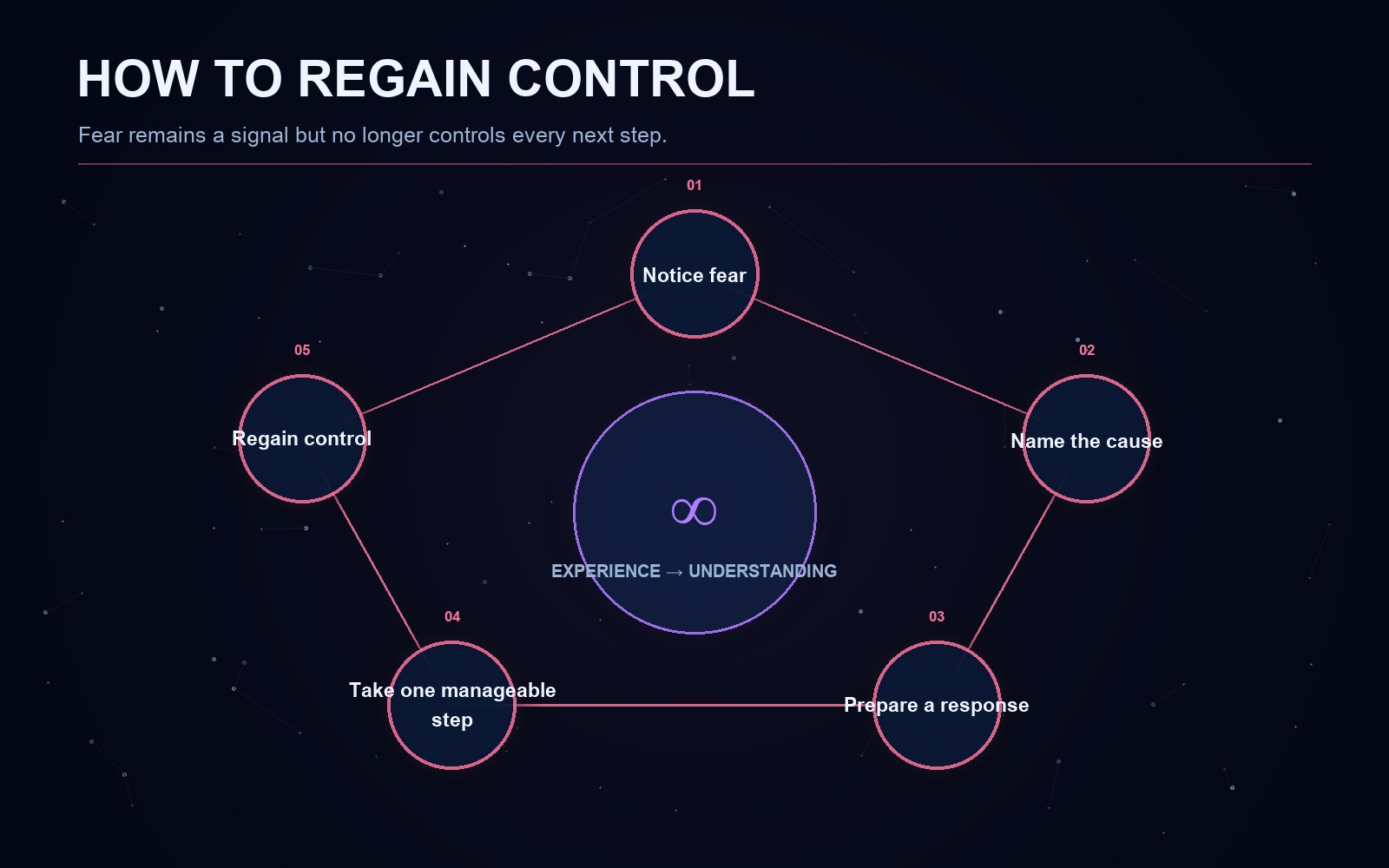
    Fear becomes manageable when it is treated as information rather than a verdict.

    Why Fear Does Not Need to Be Defeated

    Many people pursue the wrong goal: they want to eliminate fear completely. They imagine that one day they will become so strong, experienced, or spiritually developed that they will never be afraid again.

    I do not believe in that goal. In twenty years of personal investigation, I have never met anyone who completely lost the capacity for fear. Experienced practitioners may still feel it before an unfamiliar experience. Professional athletes still feel nervous before an important match. People accustomed to speaking before large audiences may still feel tension before stepping onto a stage.

    When we demand complete fearlessness from ourselves, we begin fighting our own nature rather than addressing the real problem. Every new wave of nervousness feels like defeat: “I am afraid again, so I must not be ready.”

    Readiness is not defined by the absence of fear.

    It is defined by the ability to remain clear and act consciously.

    My goal is not to make sure I never feel fear again. My goal is to stop fear from making decisions for me. Fear may be present in my body, but I choose the direction.

    The First Step Is to Admit the Fear

    We cannot control something whose existence we refuse to acknowledge.

    People often hide fear even from themselves. They call it caution, lack of interest, bad timing, or a reasonable refusal. Sometimes those explanations are accurate. But sometimes one simple sentence stands behind all of them: “I am afraid.”

    Saying those words is not surrender. It is the beginning of regaining control.

    We need to identify exactly what we fear. Making a mistake? Losing money? Being ridiculed? Facing the unknown? Losing control of the body? Seeing something we are not yet prepared to see?

    Without a precise answer, fear remains shapeless, and everything shapeless appears enormous. Once we give fear a name, it becomes a specific problem we can examine and address.

    Accepting fear does not mean obeying it. It means that we stop wasting energy denying it and redirect our attention toward action.

    Look Fear in the Eye

    Many fears arise from rumors, other people’s stories, memories, and images the brain constructs on its own—not from an immediate danger. Nothing has happened yet, but we have already lived through dozens of catastrophic versions of the event in our thoughts.

    The next step is therefore to use reason.

    Ask yourself:

    • What exactly am I afraid of?
    • What facts support this fear?
    • Have I seen verified examples of what I expect to happen?
    • Am I merely repeating someone else’s assumptions?
    • What could realistically happen?
    • What will I do if it does happen?

    Reason may not instantly remove the physical sensation of fear. But it breaks through the fog in which imagination disguises itself as reality.

    At the same time, we should not declare every fear groundless. Sometimes fear points to a real risk. If a person is unprepared, does not understand what is happening, and has no idea what to do, the fear has a legitimate basis. The answer in that situation is not bravado. It is preparation.

    Preparation Restores Your Grounding

    Imagine someone sitting behind the wheel of a car for the first time. No responsible person would immediately send that student onto a crowded freeway. The student first learns the rules, becomes familiar with the vehicle, practices with an instructor, and only then moves gradually into more difficult conditions.

    Every serious undertaking should be approached in the same way.

    Knowledge reduces the empty space that the brain usually fills with alarming scenarios. Once people understand the sequence of events, they no longer feel completely helpless. They know what may happen, what sensations are possible, and how to respond.

    Preparation does not guarantee that fear will disappear. It restores a sense of inner support.

    Before exploring unusual states of consciousness, it is therefore important to study the subject, understand its main stages, learn to relax and direct attention, and begin with small steps. Attempting something far beyond our preparation can intensify fear and destroy the desire to continue.

    Courage without preparation can easily become recklessness. Prepared courage becomes an instrument of investigation.

    Explanatory diagram for the article
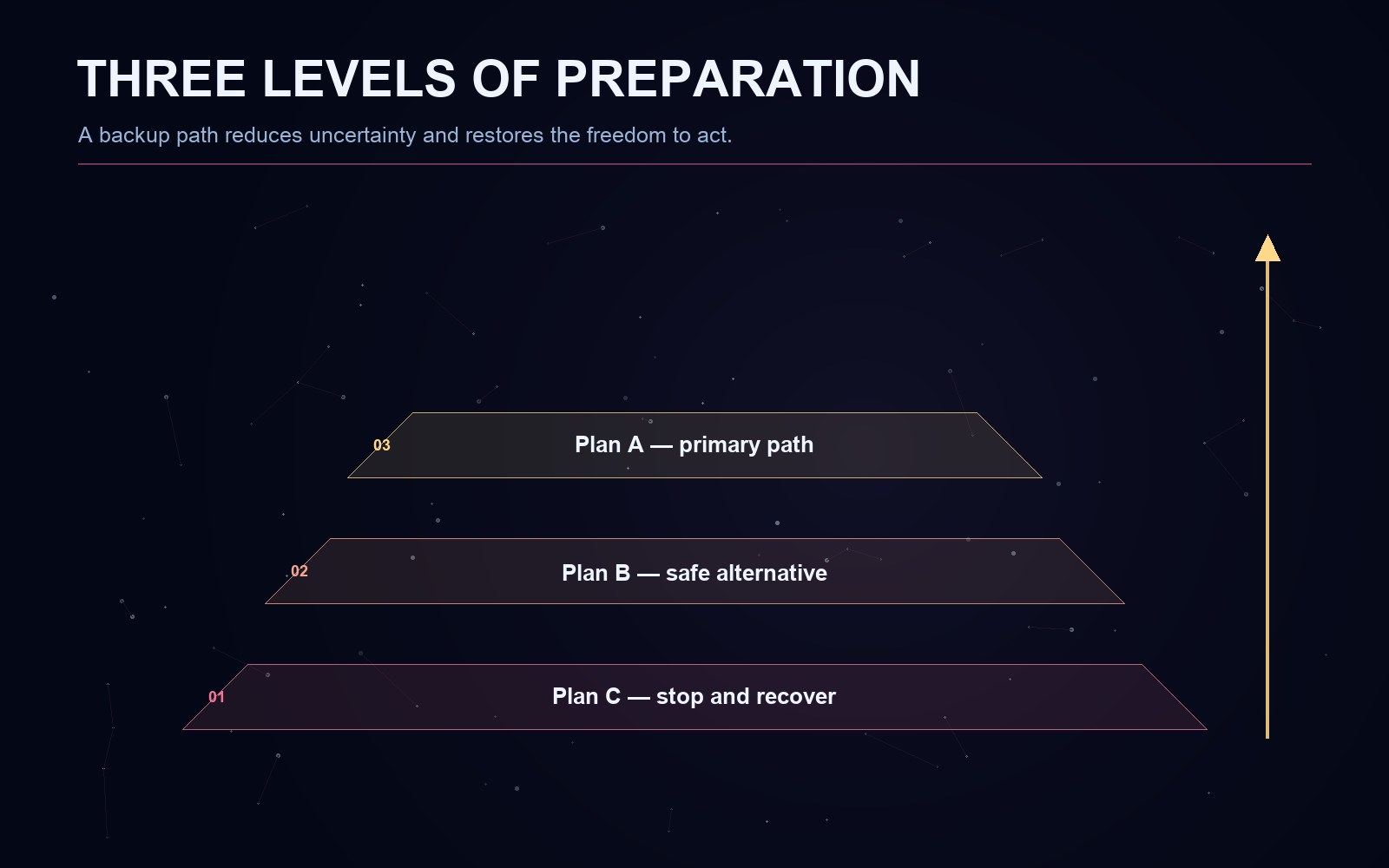
    Three levels of preparation preserve both courage and caution.

    Experience Changes Fear More Than Theory

    We can read dozens of books about swimming, but we cannot learn to swim without entering the water. Fear works the same way.

    Theory explains what may be ahead. Practice gives us knowledge of our own.

    During my first successful attempts to leave the body, I encountered not only fear but, at times, overwhelming terror. Unusual sounds, vibrations, a sense of someone’s presence, or the feeling of being touched can make it seem as though we have encountered something incomprehensible and dangerous.

    The moment of separation itself can produce particularly intense fear. The brain has no familiar model for this experience, so it responds to the unknown with an alarm.

    But every time I moved through that moment, I saw the same thing: the frightening sensations belonged to the transition. Once separation occurred, they stopped. I remained able to observe, make decisions, and return.

    Every new experience weakened fear’s influence. This did not happen because I forced myself to feel nothing. It happened because the unknown gradually became familiar territory.

    We cannot bring fear under control while remaining lifelong theorists. Practice, however, should be gradual and conscious. One small firsthand experience can create more confidence than hundreds of stories told by other people.

    The Main Fears Surrounding Out-of-Body Experience

    One of the most common fears is that we may not be able to return to the body. People worry that the connection could break, that they could become lost in an unknown space, or that the physical body could somehow cease to belong to them.

    In twenty years of practice, I have never encountered a situation in which I was unable to return. My experience has led me to a firm conclusion: consciousness maintains its connection with the body. Sometimes simply remembering the body or directing attention toward it is enough for the return to happen almost immediately.

    In fact, thinking about the body too early often ends an interesting experience sooner than I would have preferred.

    Another fear is that while consciousness is away, someone or something else may enter the body. I do not consider this fear justified. In my model, part of consciousness always remains connected with the physical body. The body does not become an empty shell available to the first being that passes by. In my book, I explain in greater detail why I consider a complete replacement of consciousness or accidental “possession” impossible.

    People may also fear unusual sounds, touch, presences, or images. Here it is especially important to understand that the brain tries to explain the unknown through ideas it already recognizes. The more strongly a person expects a threat, the more easily any unusual signal becomes proof of danger in their perception.

    Fear can create its own picture of what is happening. An investigator must therefore remain attentive and distinguish the observation itself from the immediate interpretation placed upon it.

    Plan A, Plan B, and Plan C

    Helplessness intensifies fear. When we know what we can do, fear loses much of its power.

    Before any serious practice, I believe we should have several responses prepared in advance.

    Plan A—the protective sphere. If a situation creates anxiety, visualize a dense protective sphere around yourself and fill it with a clear intention that no unwanted influence will be permitted to enter.

    Plan B—relocation. In an out-of-body state, attention can be directed toward another place. There is no obligation to continue interacting with something that produces fear.

    Plan C—returning to the body. This is the simplest and most reliable way to end the experience. Remember the physical body, think about it, or decide to return. The investigation may end, but you will preserve your sense of control and can continue another time.

    You can also ask your Higher Self, teachers, or kindred souls for help in thought. My practice has led me to believe that we are not left without support, especially when we sincerely ask for it.

    This principle reaches far beyond out-of-body experience. We enter any difficult situation with greater calm when we know several acceptable ways out. A disrupted first plan no longer feels like a catastrophe because other options remain.

    Caution Is Not the Opposite of Courage

    Bringing fear under control does not mean ignoring danger, abandoning common sense, or trying to prove that we are fearless.

    Caution and panic are different states.

    Caution preserves our ability to observe and evaluate. Panic narrows attention and demands immediate escape, often before we have even understood what we are escaping from. Caution helps us choose an action. Panic chooses for us.

    A real investigator does not have to continue every experience at any cost. We have the right to stop, change direction, return, and try again later. That decision is not a defeat. It is an expression of control.

    My task is not to force myself through everything. My task is to remain the author of my decision.

    What to Do When Fear Takes Hold

    When fear begins taking control, move through this simple sequence:

    1. Stop and name the fear. Tell yourself honestly what you are afraid of.
    2. Separate facts from scenarios. Identify what has actually happened and what exists only in your imagination.
    3. Evaluate your preparation. Do you have enough knowledge and understanding? If not, step back and prepare.
    4. Choose one small action. You do not have to overcome the entire challenge at once. Take the next manageable step.
    5. Define Plans A, B, and C. Decide in advance how you will change or leave the situation.
    6. Keep the right to stop. Control includes the ability to continue and the ability to end an experience at the right moment.
    7. Review what happened. Once you are calm, identify what was real, what was expectation, and what the experience taught you.

    This process will not destroy fear forever. It will do something more valuable: it will return control to you.

    Do Not Wait for Fear to Disappear

    Fear often stands at the edge of a new experience. It appears precisely where familiar territory ends and the unknown begins. If we retreat every time, that boundary will never move.

    But when we proceed gradually, prepare, examine our assumptions, and accumulate direct experience, the territory of the known begins to expand. What seemed frightening and inexplicable yesterday becomes part of our personal map of reality tomorrow.

    Fear may remain as a mild physical sensation, but it no longer has to block the road.

    Do not wait for the day when you are no longer afraid. That day may never come. Begin acting while fear is still present but the decision once again belongs to you.

    That is freedom: fear may speak, but you choose the direction.


    Continue the Investigation

    In my book The Phenomenon of Consciousness Beyond the Body, I explore my earliest experiences, the unusual sensations that can accompany separation from the body, preparation, the protective sphere, and methods for ending an experience safely. This article presents the central principles of working with fear; the book places them within the larger story of my experience and my model of reality.

  • What Is Consciousness? Between the Brain, Philosophy, and Lived Experience

    What Is Consciousness? Between the Brain, Philosophy, and Lived Experience

    Why modern science still cannot explain the source of subjective experience—and what twenty years of my own research have taught me

    By Andrey Chsherbakov Format: Research overview and author’s model

    The Closest and Most Difficult Question

    Consciousness is the one reality we know directly. Everything else reaches us through it. We see the world, hear sounds, feel the body, remember the past, make plans, and contemplate the universe. But every fact must first appear within our field of awareness. Without a perceiving subject, there would be neither experience nor any knowledge that experience exists.

    And yet we still have no widely accepted answer to a simple question: What is it that is aware?

    The brain can be examined with instruments. We can observe electrical activity among neurons, changes in blood flow, signal transmission, memory processes, and responses to external stimuli. But the one who experiences pain, love, fear, beauty, or existence itself never appears on a brain scan. The scan reveals processes. The experience itself remains available only to the person living through it.

    This distinction lies at the heart of the consciousness problem. Science is becoming increasingly precise in describing the mechanisms associated with perception, attention, memory, and decision-making. Yet describing a mechanism does not tell us why its operation is accompanied by an inner life. Why does a person not merely process wavelengths of light but actually see red? Why does a biochemical reaction become pain? Where does the sense arise that “this is happening to me”?

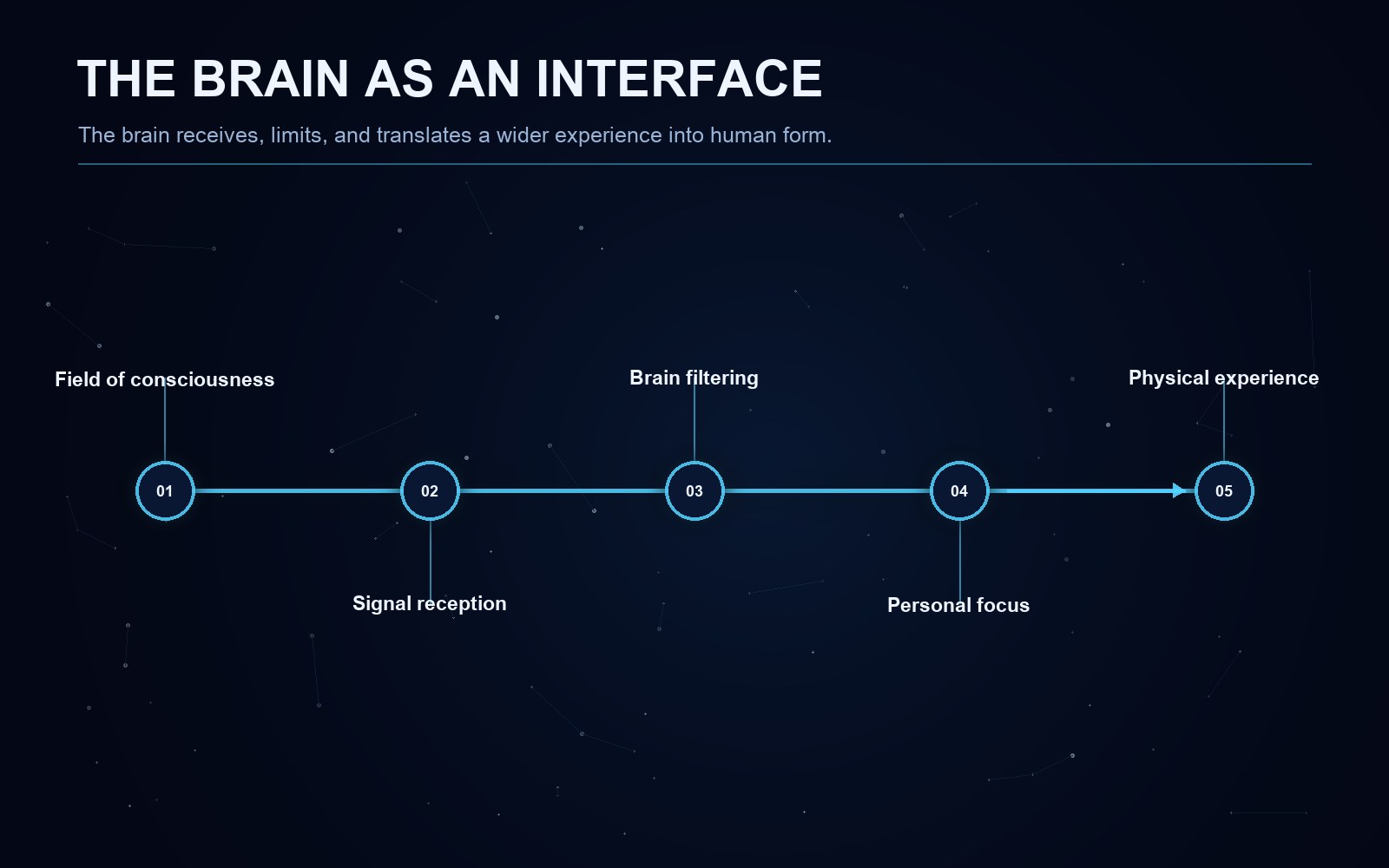
    I have spent twenty years investigating this question. My understanding grew from personal out-of-body experience, observation of transitional states, study of other researchers’ work, and a continual comparison between what I experienced and the theories already available. I came to the conclusion that the brain participates in the expression of human consciousness, but it does not create consciousness. Consciousness belongs to the soul, while the brain serves as an interface connecting the soul, the body, and the physical world.

    This is my working model. I do not ask anyone to accept it on faith. I ask that we first examine what current scientific and philosophical models explain, where their limits lie, and why lived experience should not be excluded from inquiry simply because it is difficult to place inside a laboratory instrument.

    Consciousness Is Not the Stream of Thought

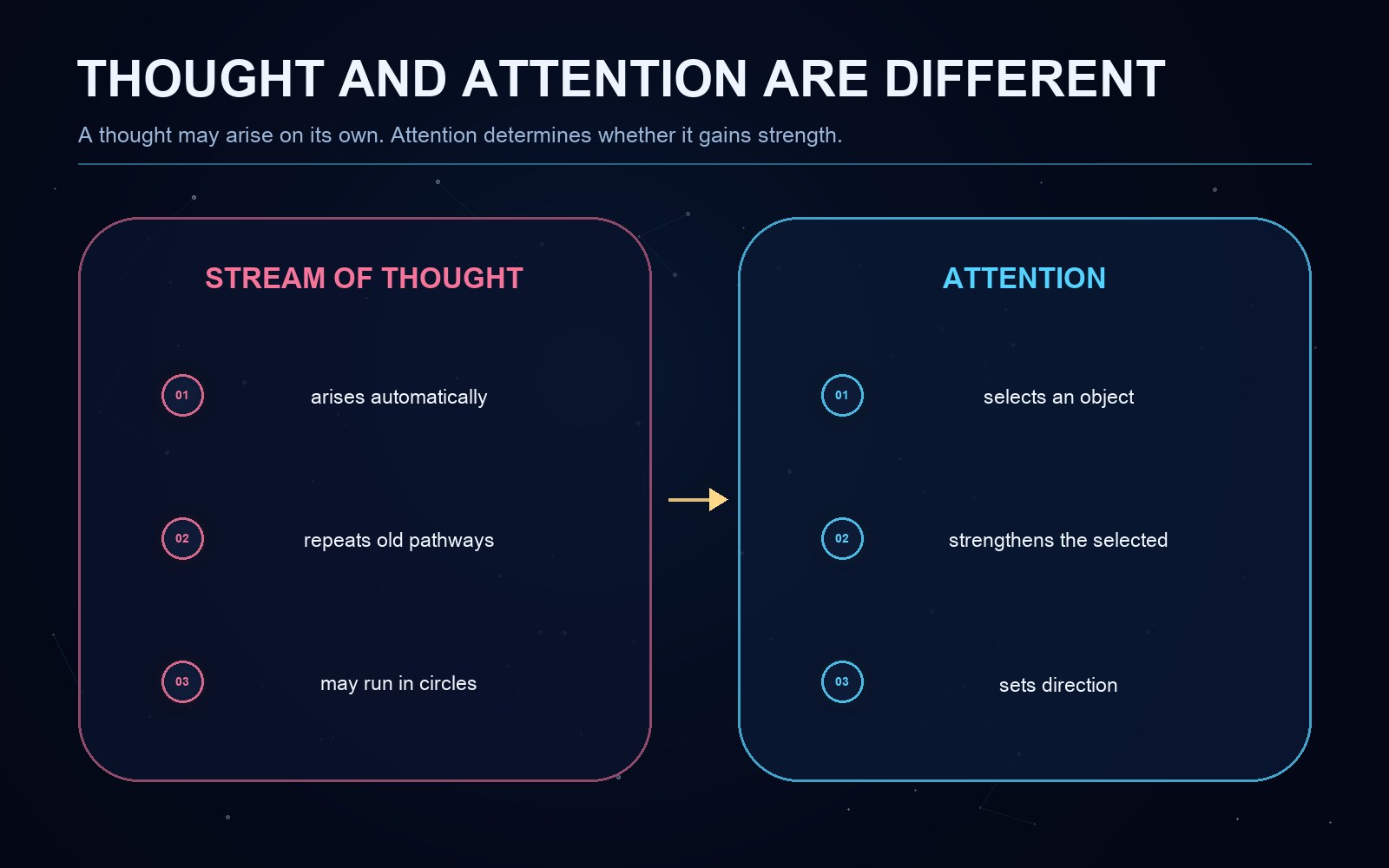
    People often use the word consciousness for everything happening in the mind: thoughts, inner dialogue, memories, fantasies, and emotional reactions. But the stream of thought is content. Consciousness is that within which the content appears—and that which can notice it.

    A thought arises, changes, and disappears. The observer can see it appear. The observer can agree with it, reject it, redirect attention elsewhere, or let it pass. If a person can observe a thought, then the thought and the observing consciousness are not identical.

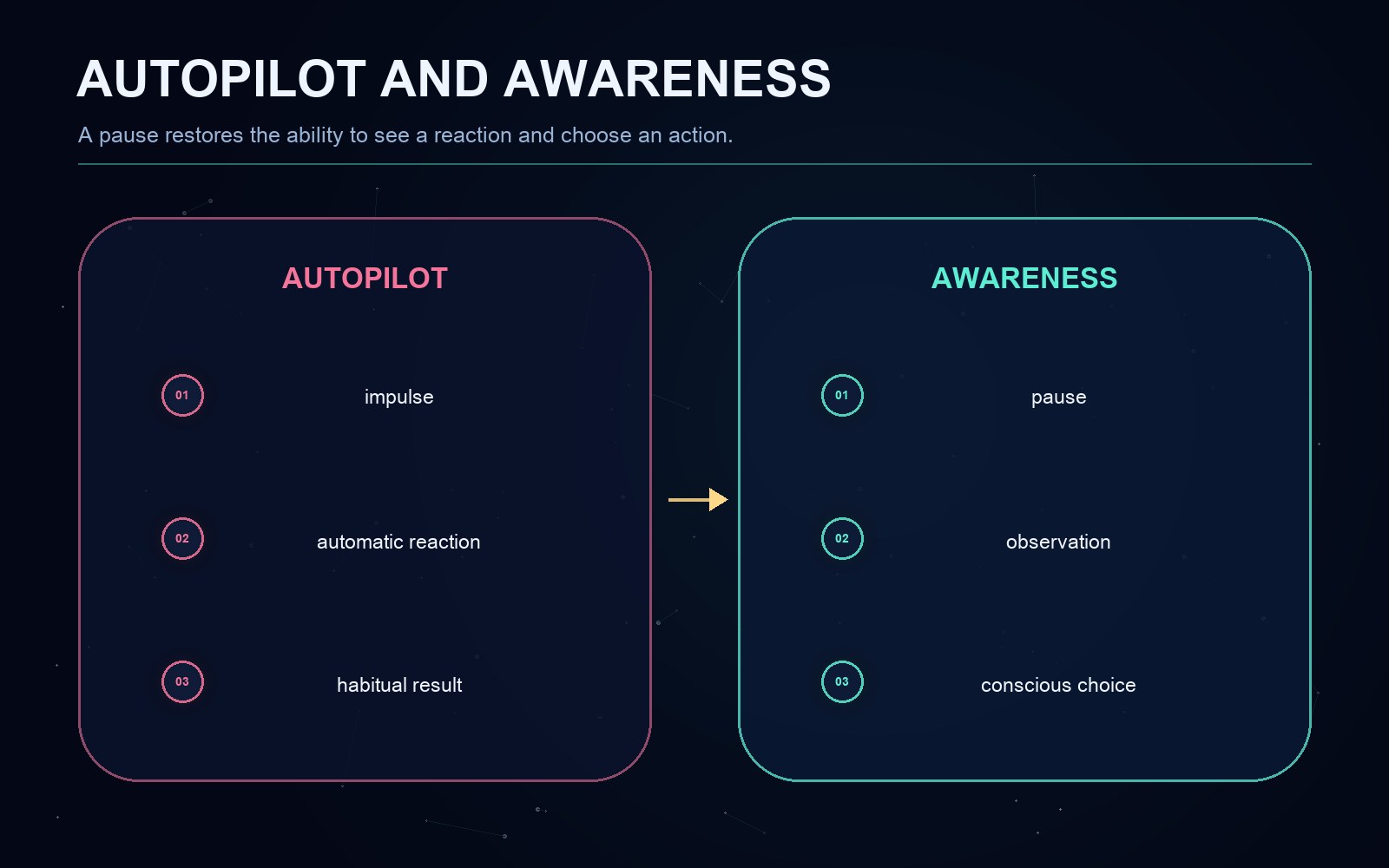
    The same is true of emotion. I can experience fear while understanding that I am afraid. I can notice irritation before it becomes an action. I can recognize a habitual reaction and choose a different response. This ability to observe our own condition creates a space for freedom.

    The brain forms and repeats familiar pathways. It compares new information with memory, predicts danger, proposes familiar solutions, and can keep thoughts moving in circles. All of this is necessary for life. But a person does not have to follow every impulse of the brain automatically. Consciousness can direct attention and choose which thought will become action.

    The question of consciousness therefore cannot be reduced to the question of thinking. A computer also processes information, sorts data, and performs complex operations. But computation by itself does not explain the existence of a subject who knows that it exists.

    What Neuroscience Has Learned to Explain

    Modern neuroscience has established a deep relationship between the state of the brain and the experience available to a person. Damage to particular regions can disrupt speech, memory, facial recognition, the sense of owning a body, or the ability to sustain attention. Anesthesia alters communication among large-scale brain networks and temporarily removes ordinary access to experience. Sleep, medication, injury, oxygen deprivation, and neurodegenerative disease can also change conscious states.

    These findings cannot be ignored. The brain is necessary for the normal expression of the earthly personality. Through it, a person perceives the physical world, retains memories, controls the body, and expresses inner decisions.

    From this evidence, the materialist model takes one further step: if changes in the brain change consciousness, then the brain must produce consciousness. For many researchers, this is the most economical explanation. It does not require the introduction of a soul or another level of reality, and it lends itself to testable experiments.

    But observed dependence is not the same as demonstrated origin. Altering an instrument always changes its output. Damage to a camera distorts an image; damage to a radio distorts sound. That does not mean the external object was created by the camera or that the broadcast originated inside the receiver.

    This analogy does not prove that consciousness exists independently of the brain. It demonstrates something more modest but essential: the close relationship between brain and experience does not logically establish a single possible model. The brain may generate consciousness. It may function as an interface, filter, or converter. The relationship may be more complex than any concept currently available to us.

    Research on anesthesia illustrates the present boundary of knowledge. Scientists are steadily improving their descriptions of the networks associated with wakefulness, information processing, and the recovery of conscious access, yet the authors of modern reviews continue to identify unresolved questions about the mechanisms of consciousness. We have learned to suppress and restore particular functions—an extraordinary practical achievement. But controlling the expression of a phenomenon is not the same as fully understanding its nature.

    Explanatory diagram for the article
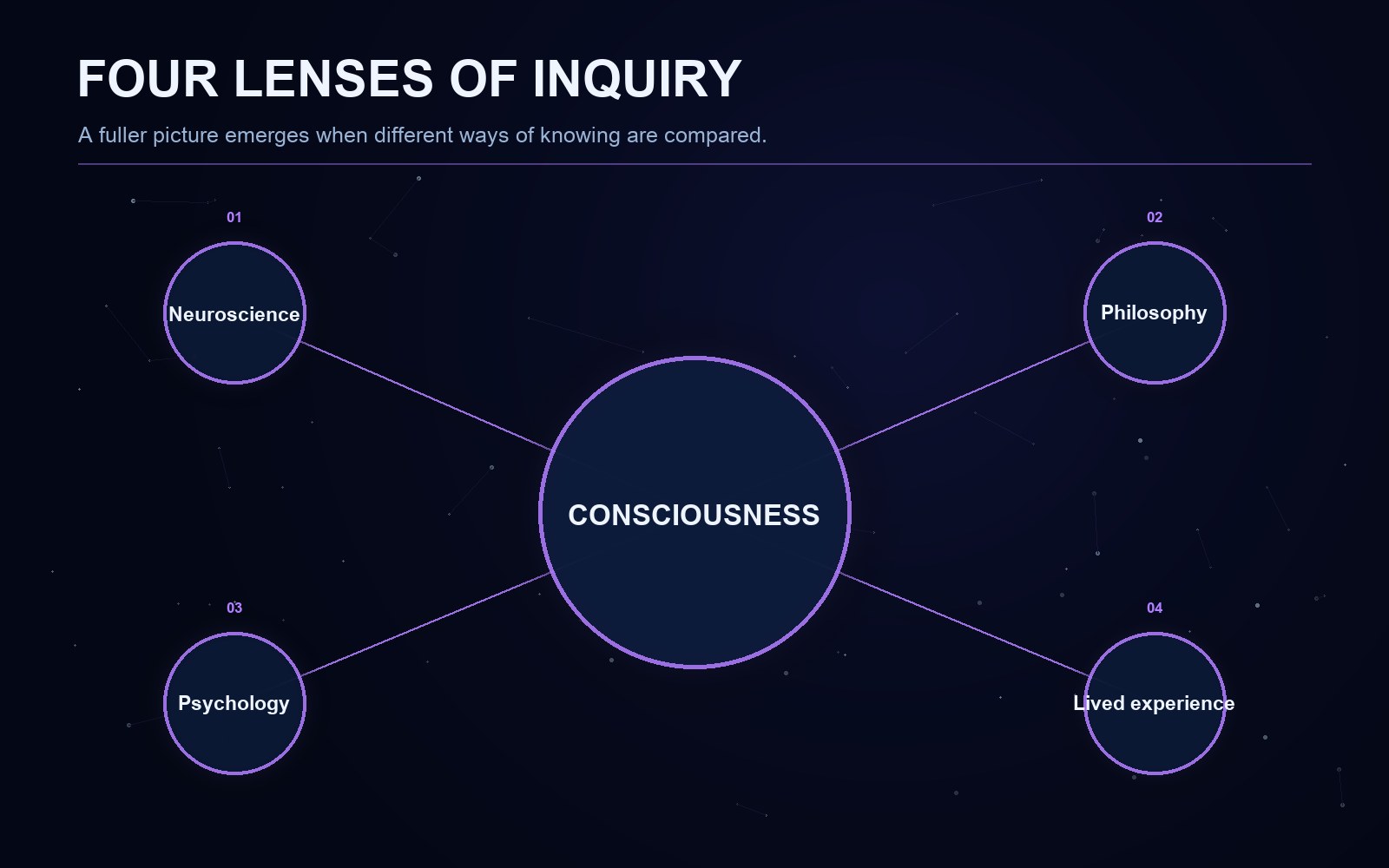
    Consciousness requires the combined lens of science, philosophy, psychology, and lived experience.

    Theories of Consciousness Describe Different Parts of the Process

    Contemporary neuroscience has no single accepted theory of consciousness. Several influential models exist, each emphasizing a different mechanism.

    Global Neuronal Workspace Theory associates conscious access with the moment information becomes available to many specialized systems across the brain. While a signal is processed locally, it may remain outside awareness. When information is broadly distributed across brain networks, its content becomes available to memory, language, planning, and voluntary action.

    This model helps explain why so much processing remains unconscious and why certain information suddenly enters attention. But it primarily describes access to information. It does not explain why the global distribution of a signal should be accompanied by an inner experience.

    Integrated Information Theory begins with properties of experience itself: every conscious moment is unified while also containing differences. The theory attempts to connect the presence and structure of experience with a system’s ability to form an irreducible causal whole. It is a serious effort to derive measurable properties from phenomenology, but its conclusions and proposed measures remain contested.

    In 2025, Nature published the results of a large, direct comparison between Global Neuronal Workspace Theory and Integrated Information Theory. The project combined functional MRI, magnetoencephalography, and intracranial recordings from 256 participants. Some predictions received support, while other central claims of both theories faced serious challenges. To me, the meaning of this result is clear: science is advancing, but it still does not have a complete theory of consciousness.

    Other approaches associate consciousness with recurrent processing, prediction, attention, higher-order representation, or particular dynamic states of the brain. These models help us investigate the conditions under which information becomes available to a person. They create maps of correlations and produce testable hypotheses. But a map of the process and the source of experience are not the same thing.

    The Hard Problem of Consciousness

    The philosopher David Chalmers called this distinction “the hard problem of consciousness.” Some questions can be addressed by investigating functions: how the brain distinguishes stimuli, combines information, directs attention, generates reports, and controls behavior. But another question remains: Why should any of these functions be accompanied by subjective experience at all?

    We can describe the passage of a light signal from the retina to the visual cortex in great detail. We can identify which regions become active when a person recognizes a face. Yet that description does not contain the experience of color, depth, recognition, or presence. An explanatory gap remains between an external account of brain activity and the inner life of the subject.

    Sometimes this gap is closed by declaring that subjective experience simply is brain activity. But the word is does not explain the transition. It merely labels two very different descriptions as the same phenomenon. Future science may discover a convincing bridge between them. Today, no such bridge has achieved general acceptance.

    The claim that “science has already proved the brain creates consciousness” therefore goes beyond what the evidence establishes. Science convincingly demonstrates that familiar human experience depends on the brain. It has not yet established how a physical process becomes a subjective experience or why there is anyone to whom that process is given from the inside.

    Four Philosophical Pictures

    Philosophy offers several major responses to the problem of consciousness.

    Physicalism treats physical reality as fundamental and consciousness as something that emerges from the organization of matter or can ultimately be described entirely through physical processes. Its strength is its close connection with experimental science. Its difficulty is explaining how subjectivity arises from processes that are themselves described without any inner point of view.

    Dualism holds that the mental and physical cannot be reduced to one another. Consciousness and the body belong to different categories of reality, even though they interact. This position preserves the independent status of inner experience, but it must explain how the two levels influence each other.

    Panpsychism regards the mental as a fundamental and widespread feature of nature. Consciousness, on this view, does not suddenly emerge from matter that is entirely devoid of interiority. Its central difficulty is explaining how elementary forms of experience combine into a unified human self.

    Idealism goes further and treats consciousness or mind as the foundation of reality. In its various forms, the material world is understood as the content, structure, or expression of a more fundamental consciousness. This picture comes closest to the idea of a living universe, but it must still explain the stability of a shared world and the relationships among individual subjects.

    There are also intermediate positions: neutral monism, dual-aspect theory, and cosmopsychism. Their diversity shows that the debate is not simply one between “science” and “superstition.” It is a serious disagreement about what reality is made of and which facts a complete theory of the human being must explain.

    What Twenty Years of Personal Experience Changed

    Before my conscious out-of-body experiences began, the question of the soul was a matter of belief. I could read books, accept religious teachings, or doubt them, but I had no personal basis for a conclusion.

    Practice changed the nature of the question itself.

    In an out-of-body state, I did not stop being myself. I retained my sense of identity, the ability to observe, set an intention, make decisions, move, compare events with memory, and later analyze the experience. The familiar location of perception within the physical body disappeared, but the subject did not.

    This was crucial for me. If personality were nothing more than the operation of the ordinary waking brain, I would expect clarity to break down when the connection to physical perception weakened. Instead, in some experiences clarity became stronger. I felt no less real than I do in everyday life and, at times, more focused and freer from the automatic stream of thought.

    A single unusual episode can be explained in many ways. My conclusion does not rest on one event. It developed from recurring observations over twenty years: the preservation of self-awareness, intention, memory, the ability to investigate, the capacity to return to a chosen objective, and the comparison of different states.

    I understand the difference between personal experience and laboratory proof. But an experience does not become meaningless simply because it is available from the inside. Pain, love, meaning, and the very existence of the self are also known directly before they are measured. A science of consciousness that excludes inner testimony removes the very phenomenon it is trying to explain.

    Research into experiences during cardiac arrest shows how difficult this field is. In the multicenter AWARE II study, some survivors reported memories and experiences associated with resuscitation. No participant identified the visual target, and one identified the auditory stimulus. These findings do not provide definitive proof that consciousness exists independently of the brain. They do show that the boundary among life, the interruption of ordinary brain function, resuscitation, and conscious experience is more complex than the simple formula “the brain stopped, therefore the person no longer existed.”

    Personal experience should not replace verification. But verification should not begin by forbidding the question.

    Explanatory diagram for the article
    A model of the brain as an interface for a wider field of consciousness.

    My Model: The Brain as an Interface for Consciousness

    My model proceeds from consciousness to matter, rather than from matter to consciousness.

    At its foundation is the Source—a unified living consciousness from which all the diversity of reality arises and within which it exists. An individual soul is not separated from the Source by an absolute boundary. It is an independent center of experience and, at the same time, part of a larger whole.

    The soul is individual consciousness with memory, a direction of development, and the capacity to accumulate experience. It is greater than a single earthly biography.

    The Higher Self is the fuller dimension of the soul, not limited to one physical personality. An incarnated person receives only the range of memory and perception needed for a particular life. The connection with the Higher Self does not disappear, although it usually remains beyond ordinary attention.

    The earthly personality forms through the interaction of the soul, body, brain, family, culture, upbringing, and personal choice. It is real and valuable, but it does not exhaust the whole human being.

    The brain and nervous system provide the working interface with the physical world. The brain receives sensory signals, controls the body, organizes the memories of earthly life, makes predictions, and limits the flow of information to what a person can use here and now.

    The model can be represented this way:

    Source → soul → Higher Self → earthly personality → brain and body → physical experience.

    The arrow does not imply one-way control. Experience moves in both directions. The soul expresses intention through personality and body; physical life returns experience, choices, and new understanding to the soul.

    In this model, the brain is not a disposable shell. It is as necessary for incarnation as a musical instrument is for a musician performing within physical space. The quality of the instrument shapes the sound. Damage to it may make expression almost impossible. But the musician and the instrument are not the same thing.

    Why We Do Not Constantly Feel Our Greater Nature

    If consciousness is broader than the brain, why does a person normally perceive only the physical world and a single biography?

    Because the limitation of attention is a condition for fully participating in earthly experience. We could not live one specific life if we simultaneously perceived the entire experience of the soul, multiple levels of reality, and the consequences of every possible choice. Focus creates depth of participation.

    The brain sustains this focus. It selects information, maintains a stable model of the world, and returns us to the needs of the body. Most events never reach conscious access because they are not required for immediate action.

    But the filter is not completely sealed. During sleep, trance, deep meditation, transitional states, and out-of-body experiences, the brain’s ordinary control changes. At times, a person gains access to information and forms of perception that do not fit the everyday model.

    I do not treat every unusual sensation as a message from the soul. The brain can create vivid imagery, distort memory, fill in missing information, and turn expectation into experience. This is why observation, repetition, inner discipline, and a willingness to revise interpretations are necessary. But caution should not become an automatic denial of everything that lies outside the accepted model.

    The Limits of Modern Science

    Science is one of humanity’s greatest instruments of knowledge. It has taught us to distinguish impressions from measurements, test claims, and correct mistakes. But every instrument has a domain for which it was designed.

    Contemporary experimental science is especially strong when a phenomenon can be observed from the outside, repeated, measured, and compared among independent researchers. Consciousness has external expressions, but experience itself is given from the inside. An instrument records brain activity; a person experiences meaning, color, pain, and presence.

    This does not place consciousness beyond investigation. It means the method must account for both sides: objective measurement and disciplined description of subjective experience. If one side is dismissed as irrelevant, we may build a detailed science of neural correlations without necessarily building a science of consciousness as lived reality.

    The direction of research also depends on which questions society chooses to fund. Grant programs, medical priorities, technological interests, and institutional goals all influence what is studied, by which methods, and for how long. This does not mean all scientists are hiding the truth or following a single agenda. It means the scientific system, like every human system, allocates attention and resources selectively.

    Questions that cannot be quickly converted into a technology, treatment, or measurable outcome receive fewer opportunities. Research into consciousness beyond ordinary states is particularly vulnerable: replication is harder, funding is scarce, and reputational risk is greater. The absence of a large body of evidence therefore sometimes tells us not that a phenomenon is impossible, but that few resources have been devoted to investigating it honestly.

    Lived Experience Is Part of the Data

    Every study of consciousness begins with a person’s report: “I see,” “I feel,” “I remember,” or “I experienced nothing.” Even in a rigorous laboratory experiment, instruments are compared with the participant’s report. Without that report, researchers cannot determine whether a stimulus was consciously perceived.

    Subjective experience can be mistaken. Memory distorts events, expectations influence perception, and language simplifies what was lived. But objective measurements also require interpretation, and theories change as new data arrive. Reliability is improved not by banning inner experience, but by developing better ways to record and compare it.

    We need observation journals, clear criteria for distinguishing states, comparisons among independent accounts, physiological measurements, predetermined targets, and studies in which competing explanations are tested against the same evidence. This approach does not promise quick answers. It preserves both the courage of the question and the discipline of inquiry.

    For me, personal experience is primary material, not the final authority. I trust recurring observations, but I continue to compare them with other accounts and models. Confidence in one’s understanding does not require closing oneself to new knowledge. Real confidence can withstand examination.

    What Changes If Consciousness Is Greater Than the Brain

    The nature of consciousness is not an abstract philosophical question. The answer changes how a person relates to life.

    If someone sees the self as a temporary biological mechanism, meaning can easily become limited to survival, status, and the short interval between birth and death. If the earthly personality is the expression of a deeper consciousness, every choice becomes part of the soul’s continuing development.

    This does not diminish physical life. It gives life greater responsibility. The body matters because we act through it. Relationships matter because they reveal the quality of consciousness. Another person’s pain matters because our separation is not absolute. Freedom matters because experience does not merely happen to us—we participate in creating it.

    This understanding offers hope, but it is not an easy consolation. The continuation of consciousness does not release us from the consequences of our decisions. Development cannot be delegated, purchased, or replaced with the correct words. It occurs through choice, attention, honesty, and the willingness to become more aware.

    For me, death ceased to mean the proven disappearance of the person. It became a transition whose nature humanity still has to investigate. Fear of the unknown may remain, but it no longer has to govern an entire life.

    Investigating the Observer

    We are accustomed to searching for answers in the outer world. We build telescopes to witness the birth of galaxies and microscopes to examine a cell. Yet the instrument through which we know all of this remains our greatest unanswered question.

    Science demonstrates how closely earthly consciousness is linked to the brain. Philosophy shows that several different pictures of reality can be built from that relationship. Lived experience suggests that the limits of ordinary perception are not necessarily the limits of consciousness itself.

    My position is clear: consciousness is primary. It is not a by-product of the brain. Individual consciousness belongs to the soul, the brain is the interface of physical life, and every soul exists within a greater living consciousness that I call the Source.

    I remain open to research and willing to refine the language of this model. But twenty years of experience do not allow me to return to the idea that a human being is merely an accidental collection of neural processes. Behind thoughts, emotions, and biography stands an observer. It uses the brain, but it is not exhausted by the brain.

    We will not understand consciousness while we study only the mechanism of its expression and avoid asking who is looking through that mechanism.


    Continue the Exploration

    Sources and Further Reading

  • How Affirmations Work—and Why Words Alone Aren’t Enough

    How Affirmations Work—and Why Words Alone Aren’t Enough

    Affirmations are often presented as a simple way to get what we want. People are told to repeat every day that they are wealthy, successful, healthy, or happy, with the promise that reality will eventually begin to match those words.

    The promise is attractive because it sounds easy. It allows us to expect a significant result without profound inner change, sustained effort, or concrete action. Say the right phrase, believe it, and life is supposed to rearrange itself.

    I believe this understanding distorts the real meaning of affirmations. Words can influence us. Intention can influence the direction of our lives. Consciousness possesses creative power. But between a spoken phrase and a change in physical reality lies an entire process: attention, inner state, decisions, actions, time, and responsibility.

    An affirmation can become part of that process. It cannot replace it.

    What Is an Affirmation?

    An affirmation is a brief positive statement that a person repeats regularly in order to establish a particular inner orientation. In psychology, it is commonly treated as a form of self-suggestion that can help create a desired mindset and support a chosen direction of behavior.

    There is practical value in this. Whatever repeatedly receives our attention gradually occupies a more important place in our stream of thought. A repeated idea becomes familiar. The brain begins to retrieve it more easily, connect events with it, and notice things that previously passed outside our awareness.

    But a phrase is not an action. It creates an inner direction from which action can emerge.

    If someone repeats an affirmation mechanically and then spends the rest of the day living in the opposite state, making the same decisions, and following the same habits, the words remain only words. They gain no continuation in reality.

    Why Affirmations Have Become Surrounded by So Much Exploitation

    Human beings naturally look for the shortest road to what they want. We want to gain more while spending less time, effort, and risk. Promises of instant wealth, rapid success, and effortless fulfillment appeal directly to this weakness.

    Financial pyramids are marketed in the same way. So are many “secret methods” that supposedly allow money, love, and opportunity to appear as long as a person thinks correctly.

    Spiritual ideas are especially easy to exploit. People are told that consciousness affects reality, and then a convenient conclusion is added: if they imagine the result long enough, the physical world is obligated to provide it without any further effort.

    The first part of that claim is true according to my understanding: consciousness does participate in shaping our lives. The mistake begins when everything else is removed from the process.

    An affirmation will not create money inside a closed drawer. You can spend a week convincing yourself that one hundred dollars is lying there, but it will not appear when you open the drawer. Physical reality does not respond to every thought with an immediate material result.

    This does not mean that consciousness is powerless. It means that its influence operates differently in our world.

    What Actually Happens Through Repetition

    Every repeated thought creates a stable mental route. The brain returns more easily to familiar content, while attention begins selecting things in the surrounding world that are connected with it.

    When someone lives for years with the conviction that nothing can be changed, that person rejects many possibilities before exploring them. They may overlook a useful offer, avoid starting a conversation, refuse to try a new path, or stop after the first setback. The inner belief becomes visible through decisions and behavior.

    When the inner orientation changes, the same circumstances begin to look different. The person notices other options, allows for the possibility of success, and acts with greater confidence. The chain of events gradually changes because their participation in it changes.

    This is not magic. It is the interaction between an inner direction and real life.

    It is important here to distinguish consciousness, the brain, and the stream of thought. The brain reinforces familiar pathways, processes information, and offers again what a person has repeated many times. The stream of thought reflects memory, fear, habits, and incoming information. Consciousness can observe this process, choose the direction of attention, and decline to follow every thought automatically.

    An affirmation can serve as an instrument of that choice. It reminds us where we have decided to go. But the phrase does not make the journey. The person does.

    Explanatory diagram for the article
    Words begin to change life only through imagery, choice, and action.

    Consciousness as a Creative Force

    My understanding is based not only on reflection but also on many years of investigating consciousness and exploring out-of-body experience.

    I perceive consciousness as part of the Source. It carries the ability to influence energy, give it direction, create forms, and dissolve them. This ability manifests at different levels of reality with different degrees of speed and power.

    A person participates continuously in creating the direction of life, even without realizing it. Attention, beliefs, emotional reactions, and actions shape the path being followed. We can create order or intensify chaos, support our development or destroy our own possibilities.

    One of the important tasks of human life is therefore to learn how to direct this power. This does not mean suppressing thoughts and emotions. It means understanding where they come from, choosing a direction consciously, and seeing the consequences of that choice.

    An affirmation has meaning within this context. It is not a spell for controlling the world. It is one way to tell ourselves which direction we have chosen and which inner position we intend to strengthen.

    Why Physical Reality Changes Slowly

    Our world is made from a very dense form of energy. Everything here possesses stability: bodies, objects, social systems, the consequences of previous decisions, and circumstances that have already taken shape.

    This reality can be compared to hard modeling clay. It can be reshaped, but the process requires time and continuous pressure. At other times, it resembles stone from which a person gradually carves a form. A single strike does not produce a sculpture, but many directed strikes change the material.

    Life changes in a similar way. Intention establishes the image of a future form. Attention helps us maintain the direction. Decisions and actions gradually change existing circumstances.

    The delay between thought and result is often treated as proof that inner intention has no meaning. I see a different purpose in this delay. It protects us from the immediate manifestation of every fear, accidental desire, and contradictory impulse.

    Imagine that every thought instantly became a physical event. Most people have not yet learned to hold their attention or manage their stream of thought. Fears, grievances, fantasies, and opposing desires would all begin taking form around us at the same time. The world would quickly descend into chaos.

    The density of physical reality creates a necessary pause. Within that pause, we learn to understand our intentions and confirm them through consistency.

    What I Have Observed in Out-of-Body Experience

    During out-of-body states, the surrounding space responds to thought much more quickly. An image, expectation, or fear can alter the perceived environment almost immediately. Think of a place, and the direction of movement can change. Imagine an object, and it may appear. Lose control of attention, and the space begins reflecting the resulting inner chaos.

    At first, this responsiveness feels like unlimited freedom. Very quickly, however, it becomes clear how unprepared a person is for it. The stream of thought is unstable. One intention replaces another. Desire collides with fear, while an image that has been created dissolves under the influence of doubt.

    This experience helped me look at the physical world differently. Here, a thought does not turn into form instantly. We have time to stop, change a decision, recognize a mistake, and learn how to maintain a direction.

    The slow manifestation of results should therefore not be viewed as a flaw in our world. It is part of our education.

    Earthly Life as a Place of Learning

    We are learning to use creative power under conditions in which every change requires a sustained intention. Wanting something once is not enough. We must return to the chosen direction, act, and accept the consequences of our decisions.

    Responsibility develops through this process. We begin to understand that life is not created by one thought or one event. It is shaped by countless repeated choices.

    An affirmation can help maintain a chosen direction, especially when old habits pull us back toward familiar fears and limitations. Its purpose is not to persuade the universe to grant a request. It helps us remember what we have decided to develop within ourselves.

    The physical world then responds to that direction through a chain of real circumstances. Opportunities, encounters, ideas, and challenges appear. We must still make use of them. An opportunity does not automatically become a result.

    Explanatory diagram for the article
    The conditions that turn an affirmation into a working practice.

    What Affirmations Can Actually Change

    Affirmations can strengthen an inner direction. They help return attention to a goal when the mind drifts back into familiar doubts. Over time, they can weaken an assumption that has been treated as an unquestionable truth for years.

    Regular repetition can support confidence before an important action, remind us of a decision, and help us avoid abandoning it when difficulty appears. We begin noticing our own reactions more clearly and recognizing the situations in which an old program is trying to regain control.

    An affirmation, however, does not replace:

    • knowledge and learning;
    • real action;
    • discipline;
    • the ability to make decisions;
    • the willingness to correct mistakes;
    • the time required for a result.

    Someone who wants to improve their financial situation must examine their abilities, work, spending, and opportunities. Someone who wants to build a relationship must learn to listen, speak honestly, and take responsibility for their own behavior. Someone pursuing inner development needs more than a beautiful phrase; that path requires daily work with attention and action.

    Words become powerful when they begin changing the way a person participates in life.

    Why an Affirmation Sometimes Fails

    The first reason is mechanical repetition. A person says the words without connecting them to an inner decision. The phrase becomes background noise and quickly loses its meaning.

    The second reason is contradictory action. A person can declare a new direction indefinitely while continuing to reinforce the old habit every day. Reality receives the action rather than the declaration.

    The third reason is a borrowed goal. Sometimes people try to convince themselves to want something because society considers it correct or prestigious, even though the desire is not truly theirs. Resistance appears because the words do not match the actual direction of the soul.

    The fourth reason is impatience. A person repeats a statement for several days, sees no immediate result, and decides that the method is useless. Yet stable inner programs were formed over years. Changing them also requires time.

    The fifth reason is using an affirmation to avoid solving a problem. A positive statement should not make us close our eyes to debt, illness, conflict, or our own mistakes. A conscious intention brings us into contact with reality rather than leading us away from it.

    Turning an Affirmation Into a Practice

    The first step is to identify the real intention. This is not an external symbol of success but a change that a person is genuinely prepared to support in daily life.

    That intention is then expressed through a brief affirmative statement. It should be repeated consciously rather than automatically, bringing attention back to the chosen direction.

    The next step is to connect the words with an inner state. Instead of imagining the miraculous arrival of a result, we should imagine ourselves living and acting in accordance with the decision. How does our behavior change? Which habits no longer belong to that person? What action confirms the intention today?

    Then an action is required. It may be small, but it must be real. Action is what connects an inner decision with the physical world.

    The practice must continue long enough for the new direction to stop being an occasional thought and become part of life. During this process, it is important to observe resistance. Resistance reveals the fears and old beliefs that still hold us in place.

    This is how an affirmation changes from a repeated phrase into an instrument of conscious transformation.

    Responsibility for the Direction of Thought

    The ability to influence our lives is not only an opportunity. It is also a responsibility. Creative power can support development, or it can reinforce destructive programs.

    When someone repeatedly returns to hatred, fear, or the desire to harm, that person strengthens the corresponding inner route. Even when the thought does not immediately appear as an external event, it changes their state, perception, and subsequent decisions.

    Directing attention therefore has spiritual meaning. We learn to see a thought before it becomes an action. We choose what receives our energy and what we turn our lives into.

    An affirmation can assist with that choice. But the important element is not a collection of correct words. It is the consciousness that makes the decision and the human being who embodies it through action.

    Words Alone Do Not Create a New Life

    Affirmations work because they can change a person’s inner direction, not because the world is obligated to obey a spoken command.

    A repeated thought holds attention. Attention influences decisions. Decisions become actions. Actions repeated over time change circumstances and gradually create a different life.

    Consciousness gives this process its direction, but dense physical reality requires time. There is no injustice in this. Time allows us to learn how to use our inner power responsibly.

    We should not expect words to do the work for us. Their purpose is to remind us which work we have chosen.

    When intention joins with attention, discipline, and action, an affirmation stops being the promise of a miracle. It becomes part of genuine creation.


    In my book The Phenomenon of Consciousness Beyond the Body, I explore the nature of consciousness, subtle reality, and our responsibility for directing attention and inner power in greater depth.

  • How to Break Free from Intrusive Thoughts: Two Skills That Help You Regain Control of Your Thinking

    How to Break Free from Intrusive Thoughts: Two Skills That Help You Regain Control of Your Thinking

    An intrusive thought rarely comes only once. It returns to the same conversation, replays an old grievance, forces us to relive a loss, or imagines a disaster that has not happened. We understand that the repetition will tell us nothing new, yet we cannot stop the inner dialogue.

    Reliving the past cannot change it. Constant anxiety cannot make the future safe. Still, the brain keeps sending the same thoughts around in circles, while the body responds each time as if the event were happening now.

    As a result, we become exhausted not only by the original problem but also by its thousands of mental repetitions.

    I have spent many years exploring the nature of consciousness and practical ways of directing the flow of thought. In my experience, simply ordering ourselves, “Don’t think about it,” is useless. A thought cannot be displaced by emptiness for long. We can interrupt it, but the attention we free must then be directed somewhere else.

    Working with intrusive thoughts therefore involves three connected actions:

    1. Interrupt the automatic inner dialogue.
    2. Hold your attention on a chosen object.
    3. Replace the old mental route with new content.

    This is not self-deception or an escape from reality. It is the recovery of our right to decide what we allow to remain in our stream of thought.

    Thought and Attention Are Not the Same Thing

    We do not choose every thought that enters the mind. Memory, habits, fear, conversations, the news we watch, the condition of the body, and the events of the day all influence what appears. Sometimes a single phrase, smell, or photograph is enough for the brain to retrieve an old episode instantly.

    But the appearance of a thought does not mean that we must follow it.

    The first reaction may be automatic. What happens next depends on attention. If we reconstruct every detail of an old grievance, invent a new response to someone from the past, and prove our case in an imaginary argument, we reinforce that mental chain. It grows stronger and becomes easier to activate the next time.

    An intrusive thought draws its power not only from the event that once occurred. It is also sustained by our repeated participation.

    That is why attention becomes the primary instrument. It resembles a beam of light: out of the enormous number of signals within and around us, it selects one and makes it part of our present experience. Whatever holds our attention for a long time begins to shape our emotional state, our decisions, and our relationship with life.

    Managing our thoughts does not mean gaining absolute control of the mind or never remembering anything unpleasant again. It means recognizing sooner when the stream of thought has entered a familiar loop and learning not to keep traveling along it.

    Why Ordinary Distraction Provides Only Temporary Relief

    People instinctively feel the need to switch their attention. Some turn on a show. Others bury themselves in work, scroll endlessly through their phones, or stay busy until they are completely exhausted.

    For a while, this can help. Attention receives a powerful external object, and the inner dialogue becomes quieter. But as soon as the movie ends, the work stops, and the surroundings become silent, the old thought returns.

    The reason is simple: the person has occupied their attention without learning to direct it. The entertainment did the work for them.

    I do not consider distraction useless. Sometimes we need to give the nervous system a break. Lasting change, however, begins when switching and holding attention become skills of our own. Like muscles, these skills can be trained.

    The First Skill: Concentration Interrupts the Inner Dialogue

    Concentration is the ability to choose one object voluntarily and return attention to it whenever the mind begins to wander.

    The simplest exercise is to focus on your breathing.

    Sit or lie down comfortably, close your eyes, and make your breath the sole object of attention for several minutes. There is no need to alter its rhythm. Notice the inhale and exhale, the movement of the chest, the passage of air, and the brief pause between cycles.

    A different thought will appear within seconds. This does not mean that the exercise has failed. The moment you notice that your attention has wandered and bring it back to the breath is the exercise itself.

    Some people find it easier to focus on sound: rain, rustling leaves, birdsong, or calm music without words. Others prefer a candle flame or a simple stationary object. The object itself is not important. What matters is that it allows you to gather scattered attention in one place, again and again.

    For the duration of the exercise, everything else becomes secondary. A thought appears; you notice it, decline to develop it, and return to the chosen object.

    There is no need to fight the thought, criticize yourself, or force the mind into absolute emptiness. Fighting a thought still keeps attention fixed on the very thing from which we want to be free. Our task is quieter: to stop feeding the automatic stream.

    Ten to fifteen minutes a day is enough to begin building this skill. Gradually, the gap between the arrival of an unwanted thought and our recognition of it becomes shorter. We begin to notice not only the thought itself but also the moment when it tries to capture all of our attention.

    That is the point at which choice returns.

    Explanatory diagram for the article
    A thought may arise on its own, but attention determines what gains strength.

    Emptiness Does Not Remain Empty

    Concentration can interrupt the inner dialogue, but interruption alone is not enough. After several minutes, we end the exercise and return to ordinary life. If attention has no new direction, the old stream will occupy the space we have cleared.

    This is one of the central principles of working with thought: removing the old content is easier than preserving an empty space.

    We therefore need to know in advance where we will direct our thinking after we interrupt it. Otherwise, the brain returns to the most familiar and emotionally charged material.

    This is where the second skill becomes necessary: the ability to maintain a chosen stream.

    The Second Skill: Mental Reconstruction Holds a New Direction

    In the video on which this article is based, I call this stage visualization. I am not referring to fantasy or to imagining an ideal future. This is an exercise in accurately reconstructing a real experience.

    For three to five minutes, walk through a room, go outside, or follow a short path. Do not move automatically. Notice the color of the walls, the shape of objects, the light, the texture of surfaces, the temperature of the air, the smells, and the sounds. You might open a door, touch its handle, turn on the water, look at a tree, or listen to the street.

    Then sit down, close your eyes, and reconstruct those few minutes in sequence. Recall the route, your movements, the colors, sounds, sensations, and the order in which they appeared. Try not to jump to unrelated subjects or add imagined details.

    This exercise develops several abilities at once:

    • maintaining a chosen direction of thought;
    • noticing more detail in the present moment;
    • using memory more accurately;
    • distinguishing observation from imagined additions;
    • returning attention when it wanders.

    Concentration helps us interrupt the old stream. Mental reconstruction teaches us to hold our thoughts in a new channel. The two skills reinforce each other.

    What Should Replace the Intrusive Thought?

    The replacement should not be random. If we respond to an anxious thought by simply trying to think of something pleasant, the new image may be too weak. It is better to prepare several meaningful directions toward which attention can move.

    If a memory of someone you lost keeps returning, you do not have to relive the moment of loss every time. You can deliberately reconstruct an episode in which you were together, heard that person’s voice, laughed, or felt close. This does not deny grief. It refuses to reduce the person’s entire story to its final tragedy.

    If the mind keeps repeating a problem at work or at home, replace the question “Why is everything so terrible?” with “What specific action can I take next?” A problem becomes a task only when an action appears.

    If your anxiety concerns someone you love who is far away, separate known facts from an imagined catastrophe. What do you actually know right now? Does the person need real help? Can you call, arrange a check-in, or do something useful? If action is possible, take it. If you have already done everything available to you, repeatedly creating frightening scenarios protects no one.

    Useful replacements might include:

    • a calm memory that restores a sense of stability;
    • a practical plan for solving a problem;
    • a creative idea;
    • something you are studying;
    • an image of the next useful action;
    • gratitude for something good that exists now.

    The new thought should not be an empty slogan. It must have meaning for you and contain enough substance to hold your attention.

    Our Stream of Thought Reflects What We Feed the Brain

    We cannot fill the mind with fear, conflict, and other people’s aggression for hours and then expect it to offer us only calm and lucid thoughts when the surroundings become quiet.

    News, movies, short videos, conversations, and our social environment all become material for the inner dialogue. The brain continues processing this information even after we turn to something else. If much of what enters is built around danger, outrage, and conflict, that emotional background gradually begins to feel like the natural condition of the world.

    This does not mean closing our eyes to difficult events or surrounding ourselves with artificial positivity. My point is different: the flow of information should be our choice rather than an uncontrolled invasion.

    We can spend less time in news feeds. We can replace some entertainment noise with a book, a serious investigation, meaningful work, or a conversation that leaves us with greater clarity. We can become more careful not only about what we eat but also about the information we feed the brain and use to construct our stream of thought.

    Change comes gradually. The mind gains more meaningful material to draw upon after the intrusive stream has been interrupted.

    Explanatory diagram for the article
    Two skills that help redirect the stream of thought.

    A Daily Practice

    I recommend a simple cycle that takes about fifteen minutes.

    1. Five to Ten Minutes of Concentration

    Choose the breath, a sound, or a visual object. Whenever you notice another thought, return your attention calmly. Do not measure success by the number of thoughts that appeared. Measure it by the number of times you recognized what had happened and returned deliberately.

    2. Three Minutes of Attentive Perception

    Follow a short route and collect as many real sensations as possible: colors, shapes, sounds, smells, physical contact, and movement.

    3. Three to Five Minutes of Reconstruction

    Close your eyes and reproduce the experience in the correct sequence. If attention wanders, return to the last detail you remember accurately.

    4. Prepare Three Directions for Replacement

    Write down one supportive memory, one problem you want to approach constructively, and one useful action for the near future. When the intrusive stream appears during the day, you will not have to invent its replacement while already under pressure.

    With experience, the entire process becomes faster. I now need only a few seconds to recognize an unwanted thought, interrupt its development, and redirect my attention. That speed is not a special gift. It is the result of repeated practice.

    Not Every Difficult Thought Is an Enemy

    Managing attention should not become a ban on every unpleasant feeling. Sometimes a thought returns because there is an unresolved problem, unprocessed grief, or a decision we keep postponing.

    In that situation, we need to do more than switch our attention. We need to understand the signal. What requires action? Do we need to speak with someone, establish a boundary, admit a mistake, seek support, or allow ourselves to grieve?

    Awareness does not mean replacing every painful feeling with a pleasant picture. It allows us to distinguish a useful signal from a repetition that no longer solves anything.

    There are also times when individual exercises are not enough. If thoughts consistently prevent sleep or work, cause panic, involve harming yourself or someone else, or feel uncontrollable, help from a qualified professional is necessary. Seeking that help is also an act of responsibility for your inner state.

    The Spiritual Meaning of Directing Attention

    A human being is not identical to every thought that appears in the mind. If we can see a thought, then there is someone observing it. For me, that observer is consciousness connected with the deeper nature of the soul.

    Automatic thoughts are formed by memory, the body, upbringing, and the surrounding environment. Conscious attention allows us to avoid dissolving into them completely. It creates enough inner distance to ask: Do I want to continue this thought? Does it correspond to who I am and who I am trying to become? What kind of action will it produce?

    This is the spiritual value of the practice. We are doing more than making life more comfortable and reducing unnecessary distress. We are learning to distinguish ourselves from a stream of automatic programs and restoring consciousness to an active role.

    Freedom does not begin with the ability to do whatever we want. It begins with the ability to choose what receives our attention and which thoughts we turn into actions.

    We Do Not Have to Repeat the Same Pain

    Intrusive thoughts can create the impression that an unstoppable mechanism is operating within us. But this mechanism responds to training. The more often we notice the automatic stream, interrupt it, and deliberately choose a new direction, the weaker the old habit becomes.

    We do not need to wait for instant silence. It is enough to reclaim a few minutes of direction each day. At first, attention does not remain steady for long. Gradually, the inner dialogue stops feeling continuous and inevitable. A space opens between thought and reaction.

    Within that space, we become participants in our own lives again.


    In my book The Phenomenon of Consciousness Beyond the Body, I explore the nature of consciousness, the development of attention, and the inner work of the human being in greater depth.

  • What Is Awareness? How to Leave Autopilot and Take Back Control of Your Life

    What Is Awareness? How to Leave Autopilot and Take Back Control of Your Life

    Sometimes a person suddenly realizes that several months have passed while they were barely present in their own life. They woke up, carried out familiar responsibilities, reacted to the same irritations, worried about the same problems, and returned each evening to the same familiar thoughts. Many things happened on the outside, yet almost nothing changed within.

    This is how autopilot works.

    We continue moving, working, communicating, and making decisions, but much of our behavior is controlled by automatic reactions. We respond not to the situation itself but to our habits, fears, upbringing, social expectations, and old inner programs. We believe we are choosing, even though many of our decisions were prepared long before we began consciously thinking about them.

    Awareness begins when this automatic pattern becomes visible.

    For me, awareness is not a fashionable psychological exercise, the ability to observe one’s breathing for a few minutes, or an appealing spiritual image. It is the capacity to understand what is happening within and around us, recognize the forces influencing our decisions, and consciously choose the direction of our lives.

    Yet its meaning goes further. Genuine awareness requires us to confront deeper questions: Who am I? Where did I come from? Why am I in this reality? Where am I going when physical life ends?

    Without these questions, we may learn to experience the present moment more attentively while still failing to understand the larger journey to which that moment belongs.

    The Two Dimensions of Awareness

    In psychology, awareness is usually associated with being present here and now: noticing our thoughts, feelings, physical sensations, and immediate circumstances without automatically reacting to them. This is an important definition. Once we can see our reaction, we gain the possibility of choosing whether to follow it.

    Consider an ordinary conflict. Someone says something hurtful, and irritation immediately rises within us. On autopilot, we respond with aggression, become defensive, or try to cause the other person the same pain.

    Awareness creates a small space between the event and our response. Within that space, we can see our hurt, understand where it came from, and choose an answer that does not deepen the conflict.

    The spiritual meaning of awareness, however, is much broader.

    From this perspective, it is not enough to notice what is happening to me today. I must understand myself as a soul passing through a particular stage of development. The physical personality is part of our existence, but it is not our entire nature. It has a name, a biography, a profession, a character, and a social role. The soul existed before this personality appeared and will continue its journey after the body dies.

    Spiritual awareness therefore includes an understanding of our place within a much longer continuum of existence. We begin asking: What experience am I receiving through this life? What qualities am I developing? Why do certain situations keep repeating? Which decisions bring me closer to my spiritual nature, and which ones return me to fear and automatic behavior?

    Psychological awareness gives us presence. Spiritual awareness gives us direction. Together, they allow us not only to see the present moment but also to understand its meaning.

    Autopilot Makes Life Feel Shorter

    Time moves slowly in childhood. Almost every day brings new impressions, knowledge, and discoveries. As we grow older, life often seems to accelerate. Weeks and months blur together, and each year passes faster than the one before it.

    Age is not the only reason. The more actions we perform automatically, the fewer experiences consciousness truly inhabits. Repetitive days leave almost no inner trace. The brain relies on established patterns, conserves energy, and stops recording familiar reality in detail.

    Automatic behavior is necessary. Without it, we would have to relearn every movement and spend our attention on thousands of minor actions. The problem begins when autopilot takes over not only everyday routines but also our relationships, beliefs, moral choices, and the direction of our entire lives.

    We automatically adopt the views of our families, societies, religious environments, or political cultures. We automatically choose a career because it is expected. We automatically remain in destructive relationships because we fear change. We automatically submit to authority because we were taught that obedience is a virtue.

    As a result, a person may live according to someone else’s script and discover only near the end that they rarely asked what their own soul truly wanted.

    Awareness Is Never a Permanent Achievement

    Awareness is not a title we earn once and keep forever. We cannot complete a course, declare ourselves awakened, and consider the inner work finished.

    It is more like a moving scale. In one part of life, a person may be attentive and mature; in another, they may remain completely controlled by automatic reactions. Someone may understand politics while remaining blind to their own fear. They may know a great deal about spirituality while still depending on approval. They may condemn social manipulation while manipulating the people closest to them.

    This is why I do not measure awareness by the number of books someone has read, the length of their meditation practice, or their command of spiritual language. Awareness reveals itself in how a person makes decisions, responds to the consequences of their actions, and reacts when reality contradicts their beliefs.

    An aware person can admit a mistake. They do not treat a change of mind as defeat. When new knowledge reveals that their former picture was incomplete, they expand it. Their purpose is not to protect their self-image but to move closer to truth.

    Explanatory diagram for the article
    The movement from automatic reaction to conscious choice.

    Conscience as a Connection with a Greater Part of Ourselves

    I consider conscience one of the clearest inner signs of awareness.

    Conscience is influenced by upbringing, culture, and social norms. Different societies and historical periods have defined acceptable behavior in different ways. Yet conscience cannot be reduced entirely to external rules. Sometimes a person recognizes that an action is wrong even when society justifies it, the law permits it, and everyone around them approves.

    I connect this deeper moral orientation with the experience of the soul and the influence of the Higher Self. The greater part of the soul sees consequences from a wider perspective than the human personality. It perceives not only the immediate benefit of an action but also what that action is turning us into.

    Conscience is different from fear of punishment. If I refrain from doing harm only because I fear the law or other people’s judgment, I am still being controlled from the outside. Conscience acts even when no one will ever know what I have done. It arises from an inner understanding: I do not want to create this kind of reality or become a person capable of this choice.

    The Higher Self does not dictate detailed instructions or take away our freedom. Its influence feels like a clear recognition of direction. We can ignore it, invent an excuse, and choose the more convenient path. But the more often we betray this inner understanding, the less clearly we hear it.

    Awareness clears the channel. We learn to distinguish conscience from guilt, inner clarity from fear, and the knowledge of the soul from the desire to look good in the eyes of others.

    Education Begins When We Learn to Think

    Awareness is closely connected with education, but I am not referring to a diploma.

    Formal education may provide a profession and a body of knowledge, but it does not guarantee the ability to understand what is happening. A person can hold several degrees and repeat other people’s opinions without examining them. Another person may have no prestigious credentials yet continue learning, compare evidence, and see the world with far greater depth.

    To make independent decisions, we need to understand the world in which we live. History helps us recognize recurring mechanisms of power. Economics reveals the interests behind decisions. Knowledge of the law allows us to defend our rights. Psychology helps us recognize manipulation through fear, shame, and the need to belong to the majority.

    An uninformed person is easy to control. Give them a simple enemy, a ready-made explanation, and an emotional slogan, and they may stop asking questions. The less they know, the more easily they mistake confidence for truth and volume for evidence.

    An aware person does not have to be an expert in everything. But they understand the limits of their knowledge, know how to ask questions, and do not surrender their right to think to whoever speaks most convincingly.

    Society Shapes the Limits of Our Awareness

    No one develops in a vacuum. Culture, tradition, law, the information environment, political institutions, and the behavior of the people around us all influence who we become.

    A society can support awareness. It can teach citizens to think, respect one another’s rights, examine the decisions of those in power, and face difficult questions without fear. In such a society, law restricts arbitrary power, education develops independence, and people understand that they are responsible not only for their private lives but also for the shared world around them.

    A society can also do the opposite. A government built on fear and unconditional obedience has no interest in aware citizens. An aware citizen asks questions. They notice when their rights are violated, demand explanations, compare words with actions, and refuse to treat authority as proof of truth.

    It is harder to make such a person support something that violates their conscience. They are less easily controlled through propaganda, guilt, or the image of an external enemy. This is why systems seeking total control often weaken real education, encourage dependence on ready-made answers, and portray independent thinking as dangerous.

    The level of awareness in a society is visible not only in its public declarations. It appears in ordinary details: how people behave on the road, whether they follow rules, whether they respect the vulnerable, where they leave their trash, how they treat shared spaces and nature, and whether they consider it acceptable to benefit from something everyone shares while leaving the cost to others.

    For me, behavior on the road is an especially revealing measure. Behind the wheel, a person’s attitude toward rules, responsibility, and other people becomes visible very quickly. When a driver believes that personal convenience matters more than everyone else’s safety, that attitude says more than polished statements about morality.

    Awareness always becomes visible in what people do when they believe no one is watching.

    Spirituality Is Not Religious Submission

    We need to distinguish spirituality from religious automatic behavior.

    Faith can support a person, remind them of moral responsibility, and open a path toward inner work. But it stops being spiritual when it demands that people abandon their questions and surrender their conscience to an external authority.

    A person may attend religious services regularly, perform every ritual, and repeat all the approved words while remaining unaware. If they act only because they were told to, fear doubt, and condemn everyone who sees the world differently, their behavior is being governed not by the soul but by fear of leaving the system.

    Living spirituality does not fear investigation. It does not demand that we defend God from questions. It makes a person freer, more honest, and more responsible. Fanaticism makes a person dependent on ready-made answers, divides the world into insiders and outsiders, and allows cruelty to be justified by a higher purpose.

    The number of religious symbols in a society therefore tells us nothing by itself about spiritual maturity. What matters is whether faith develops conscience and love or is used as an instrument of control and submission.

    Explanatory diagram for the article
    A simple daily practice for reclaiming attention.

    Responsibility Is the Clearest External Sign

    Awareness cannot be separated from responsibility.

    Every serious decision creates consequences beyond our own lives. Choosing a partner, becoming a parent, and deciding how we relate to health, money, work, and nature all affect other people and help shape the future.

    The decision to become a parent, for example, should not be reduced to tradition, pressure from relatives, or the need to resemble an idealized family. A child needs safety, attention, love, education, and room to develop. The number of children in a family proves nothing by itself. The real question is whether the parents understand the scale of their responsibility and can create the conditions each child needs for a full life.

    The same principle applies everywhere. An aware person does not make promises they have no intention of keeping. They do not force others to carry the consequences of their decisions. They do not demand freedom only for themselves while denying it to everyone else. They understand that freedom without responsibility quickly becomes the privilege of the strong.

    What Awareness Gives Us

    The greatest benefit of awareness is that it returns control of our lives to us.

    We begin to understand why we are in a particular relationship, why we do a certain kind of work, why we live where we do, and why we make one decision instead of another. We recognize when we are acting from love and when we are acting from fear of losing approval, money status, or familiar security.

    This does not mean that we gain total control over external circumstances. The physical world, society, and other people will always limit our options. Yet even within those limits, there remains a space for choice. We can choose our attitude, our direction, our way of acting, and who we become in response to what happens.

    An aware person can defend their rights because they understand them. They can refuse to participate in a lie even when that lie is convenient for the majority. They can change professions, end a destructive relationship, move somewhere new, begin learning, or admit that they have spent years moving in the wrong direction.

    From a spiritual perspective, awareness turns earthly life into an active process of development. We stop merely accumulating events and begin to understand the experience they offer us, the qualities they reveal, and the person we are becoming through our own decisions. The more aware we become, the less control our automatic programs have over us and the more fully the soul can express itself through our actions.

    Awakening Has a Price

    Awareness does not always make life more comfortable.

    As long as we do not see the contradictions around us, it is easier to preserve the familiar order. Awakening forces us to confront deception, both social and personal. Empty relationships, meaningless work, dependence on approval, and decisions made from fear become impossible to ignore.

    These discoveries can be painful. Sometimes we have to change what we spent years building. Sometimes our social circle becomes smaller because the old closeness depended on an unspoken agreement never to ask important questions. Sometimes we feel alone because we can no longer participate sincerely in conversations or actions we consider destructive.

    Returning to sleep, however, does not solve the problem. What has been seen cannot be entirely forgotten. Inner freedom requires the courage to live according to what we understand.

    Awareness does not guarantee that every decision will be correct. It gives us something more important: the ability to recognize an error, learn from it, and change direction without defending the past simply because we have already invested so much in it.

    How to Develop Awareness

    Awareness is an ongoing process, not a single discovery. I see five main directions for this work.

    1. Strengthen the Connection with the Higher Self

    This requires inner silence. While the mind constantly comments on everything that happens, it is difficult to distinguish the influence of the deeper soul from fear and desire. Meditation, quiet observation, and an honest inner question help clear the channel of perception.

    An answer does not always arrive in words. Sometimes it comes as a complete understanding that we translate into thought only afterward. The goal is not to demand an immediate sign but to learn to recognize quiet clarity.

    2. Keep Working on Yourself

    Awareness requires us to see not only the failures of society but also our own weaknesses. It is easy to blame the government, our environment, or our circumstances. It is much harder to recognize our envy, fear, dependence on recognition, or desire to control other people.

    Working on ourselves does not mean hating ourselves. It means seeing our present condition honestly and steadily developing character, moral strength, and the ability to take responsibility for our actions.

    3. Never Stop Learning

    We can devote part of every day to learning something new. The purpose is not to accumulate random information but to expand our picture of reality. Read positions you disagree with. Check sources. Study the history of ideas. Compare different explanations.

    The more a person understands, the harder it becomes to control them through primitive fear.

    4. Care for the Physical Body

    The condition of the body directly affects attention, emotional stability, and the ability to think clearly. Chronic exhaustion, inactivity, lack of sleep, and addiction narrow consciousness until immediate problems occupy the entire field of perception.

    Spiritual development does not require us to neglect the body. It is the instrument of this incarnation, and caring for it is part of the soul’s responsibility for the life it has been given.

    5. Turn Understanding into Action

    We can spend years reading about awareness without changing anything. The real work begins when understanding influences a decision.

    If I see that a relationship is built on fear, what do I do with that knowledge? If I recognize that I am being manipulated, do I continue to obey? If I notice my own injustice, can I admit it and repair the harm?

    Awareness that never changes behavior remains an intellectual game.

    The Central Task Is to Awaken While We Are Alive

    I consider awareness one of the central purposes of earthly incarnation.

    The soul enters the physical world not simply to pass through a series of events. It receives an opportunity to become aware of itself within a dense reality where its spiritual nature is not directly visible and where fear, instinct, and social programming exert enormous power.

    To awaken under these conditions is to remember that we are more than a biography and a body. It is to see our automatic patterns, restore our connection with the soul, learn to guide our attention, and make decisions consistent with our inner understanding.

    Until we become aware, the same lessons may repeat themselves again and again. The setting, relationships, and circumstances change, but the inner pattern remains the same. Awareness allows us to break that cycle and rise to the next stage of development.

    This work is difficult. It requires knowledge, honesty, discipline, and courage. Yet there is no other path to inner freedom.

    Awareness begins the moment we stop asking who will control our lives and accept that responsibility ourselves.


    In my book The Phenomenon of Consciousness Beyond the Body, I explore the nature of the soul, the Higher Self, the purpose of earthly incarnation, and the development of consciousness in greater depth.

  • The Higher Self: Who We Are Beyond the Personality—and How to Reconnect with the Soul

    The Higher Self: Who We Are Beyond the Personality—and How to Reconnect with the Soul

    Sometimes we face a decision and suddenly know what we need to do. Not because we have calculated every possibility. Not because someone gave us advice. A quiet clarity appears within us and takes in the whole situation at once. It does not argue, persuade, or make demands. We simply know.

    At other times, the opposite happens. We can think for hours, compare options, listen to other people’s opinions, and still have no idea which way to go. Our thoughts grow louder, but clarity never comes. Fear proposes one decision, desire another, and pride a third. In all that noise, it is easy to lose our own direction.

    Where does the deeper understanding that feels different from ordinary thought come from? Why do some choices restore our inner integrity while others—even when they look advantageous—leave us feeling that we have betrayed ourselves? What within us is able to see beyond the limits of the human personality?

    I connect this form of perception with the Higher Self.

    For me, the Higher Self is not a beautiful spiritual image or an invisible adviser who occasionally intervenes in our lives. It is the greater part of our own soul. It existed before our present incarnation, remains connected with us throughout our earthly life, and receives the experience we have gained when the physical body dies.

    We do not have to create this connection. It already exists. Yet we can live an entire lifetime while barely noticing it.

    What I Mean by the Higher Self

    This is how I understand the structure of consciousness.

    There is a single Source of life—God, Higher Intelligence, or primary consciousness. The name matters less than the central idea: nothing that exists is truly separate from this Source, and everything carries its nature within it. Individual souls emerge from this unified consciousness. They follow their own paths, gather experience, and develop their capacity to become aware of themselves and reality.

    A soul is far greater than a single earthly personality. To incarnate, it directs part of its energy and consciousness into the physical world. This incarnated aspect connects with a body, uses the brain and nervous system, forms a human personality, and lives a particular life with all its circumstances, relationships, decisions, and trials.

    The greater part of the soul remains beyond the physical level. This is what I call the Higher Self.

    In my model, it exists on the third energetic level, in the reality many people call the world of souls. From there, it remains connected with its incarnated aspect and perceives earthly experience within a much wider context. It sees not only a single moment in our life but also the direction of the incarnation as a whole.

    This means that the Higher Self is not a foreign being. It does not stand above us like a strict supervisor. It is a wider dimension of who we are—the part of us that can see beyond one biography, one body, and one system of beliefs.

    We are used to identifying the self with our character, profession, name, memory, habits, and social history. All of these matter, but they belong to the personality of this incarnation. The Higher Self includes this experience without being limited by it.

    A Connection That Cannot Be Broken

    There is a constant connection between the incarnated aspect of the soul and the Higher Self. Some spiritual traditions call it the silver cord. That expression does not entirely work for me: a cord can be imagined as thin, fragile, and capable of being severed. The soul’s connection with its Higher Self is different. It does not depend on distance, and it does not disappear when a person can no longer feel it.

    It can be compared to a channel through which energy and information are continuously exchanged. The channel may be perceived clearly or barely noticed, but it never ceases to exist.

    I sometimes use quantum entanglement as an image: entangled particles remain correlated regardless of the distance between them. This is an analogy, not scientific proof of my model. It simply helps illustrate the central idea: incarnated consciousness and the Higher Self do not become independent of one another merely because they exist on different levels of reality.

    At death, the soul’s connection with the physical body comes to an end. Its connection with the Higher Self does not. Consciousness returns to the greater soul and brings the experience of the life it has lived. Our earthly life does not vanish or become a meaningless episode. It becomes part of a much longer journey.

    This is why a person is never completely cut off from their spiritual nature. Even during periods of profound crisis, disbelief, or loss of direction, the connection remains. We can close ourselves to its influence, but we cannot erase our belonging to the soul.

    Why I Have Never Met My Higher Self Face-to-Face

    During my out-of-body practice, I tried many times to approach my Higher Self. I wanted not only to feel its influence but to see it as clearly as I perceived other beings and environments outside the physical body.

    That meeting never happened.

    I came fairly close to the level I associate with the presence of the Higher Self, but I was never able to cross the boundary and see it as a separate personality. Over time, I arrived at an explanation that corresponds with my experience.

    The Higher Self and the incarnated aspect of the soul share the same nature. When they draw too close, a natural process of reunification may begin. But earthly life has not yet ended. The experience of incarnation is still unfolding, so the final return must happen later.

    A similar principle operates in out-of-body practice. After separating, I try to move away from the physical body immediately. Looking at it—or even thinking about it—can return consciousness to it at once. The body draws back the aspect of consciousness connected with it because the link between them remains active.

    I believe a similar mechanism may operate at a higher level: approaching the Higher Self intensifies the movement toward reunification, so a necessary distance is maintained until the incarnation is complete.

    That does not mean communication is impossible. What has remained unavailable to me is a literal face-to-face meeting. I perceive the influence of the Higher Self in another way—through states of consciousness, inner clarity, expanded perception, and an understanding of the essence of what is happening.

    The Higher Self Does Not Speak Through the Stream of Thought

    One of the most common mistakes is treating every unusual thought as a message from above.

    Thoughts arise in the human mind. They are connected with the brain, memory, personality, emotions, upbringing, fears, and desires. The mind constantly compares, judges, protects itself, makes plans, and repeats familiar reactions. It is essential for life in the physical world, but its activity is easily mistaken for deeper knowledge.

    The Higher Self works differently.

    Its influence does not resemble a loud internal voice dictating instructions. It does not argue with other thoughts or try to defeat them by force. It is perceived as a complete understanding that arrives before words. First we know; only afterward do we attempt to express that knowledge through language and logic.

    It is close to intuition but deeper than an ordinary hunch. It contains no nervous anticipation, emotional surge, or urgent need to prove ourselves right. Instead, the situation seems to become transparent. Its essence is visible without a long chain of reasoning.

    The mind can then analyze what has been understood, find a way to act on it, and examine the consequences. The brain remains an important instrument. A connection with the Higher Self does not require us to abandon thought. It helps thought take its proper place: as an executor and translator rather than the only possible source of truth.

    How to Distinguish Clarity from Desire and Fantasy

    We are capable of mistaking our desires for spiritual guidance. This is especially easy when we are deeply attached to a particular outcome. The mind creates a convenient explanation, gives it an elevated meaning, and calls it the voice of the soul.

    Inner perception therefore requires honesty.

    A genuine connection with the Higher Self does not flatter us. It does not tell us that we are better than others, chosen for a special mission, or exempt from responsibility. It does not strengthen a craving for admiration, power, or recognition. On the contrary, a wider understanding reveals the consequences of our decisions and asks us to take an adult responsibility for our lives.

    I recognize several signs of this influence.

    First, it arrives quietly. Even when the decision is difficult, there is no hysterical internal pressure. Fear may still exist at the level of the human personality, but beneath it there remains a clear direction.

    Second, it expands perception. We begin to see not only our own advantage but also the effect our choice will have on other people.

    Third, it does not cancel freedom. The Higher Self does not compel. It may reveal a direction, but the decision and responsibility remain ours.

    Fourth, deeper understanding remains consistent. Emotional impulses change quickly: something feels right today and completely wrong tomorrow. Inner clarity may deepen, but its foundation does not disappear with a change in mood.

    Fifth, this connection leads toward creation. I associate the nature of the Higher Self with love—not sentimental emotion, but the principle of unity, respect, and the development of life. Anything that demands the humiliation of others, feeds hatred, or destroys for the sake of self-importance does not arise from this level of consciousness.

    One vivid thought is not enough to declare that we have received a message from the Higher Self. Inner understanding must be tested through time, action, and consequences. The more honestly we observe ourselves, the more precisely we can distinguish the voice of fear from the knowledge of the soul.

    What a Connection with the Higher Self Gives Us

    Above all, it restores awareness.

    We begin to understand that we are not accidental biological organisms temporarily appearing between birth and death. Physical life becomes part of a much larger path. The body, social role, and present biography are no longer the final boundaries of our existence.

    This changes our relationship with fear. A person who believes they are only a body can easily be controlled through the threat of loss, rejection, and death. When a person begins to recognize themselves as a soul, external authority no longer owns their entire reality. It may affect circumstances, but it can no longer define the meaning of their existence.

    The connection with the Higher Self provides inner strength during trials. It does not promise a life without difficulty. On the contrary, many circumstances may be part of the experience for which the incarnation took place. Yet we stop interpreting every obstacle as proof that life is meaningless. We begin to ask: What is this situation revealing within me? What is it teaching me? What choice is it making possible?

    We gain the ability to sense the direction of our lives. It does not always appear as a detailed plan. The Higher Self does not hand us a schedule for the coming years. It helps us recognize choices that correspond with the soul’s path and feel when we are moving away from it.

    The greatest benefit is not supernatural advice but the restoration of authority over our own lives. An aware person acts less automatically. They notice when fear, resentment, the need for approval, or imposed goals are controlling them. They regain the ability to choose.

    The Two Natures Within Us

    Physical and spiritual natures are both present within us.

    Our physical nature is connected with the body, brain, instincts, and human personality. It helps us survive, build relationships, learn, work, and navigate the material world. There is nothing inferior or wrong about it. Incarnation would be impossible without the body and mind.

    Our spiritual nature is expressed through the incarnated aspect of the soul and its connection with the Higher Self. It perceives life on a wider scale and reminds us that our existence is not limited to satisfying physical needs.

    These two natures do not have to be at war. The problem begins when the human personality declares itself to be the whole of reality and stops listening to the soul. Fear becomes our primary adviser, thoughts fill the entire inner space, and external circumstances completely determine our state.

    The Higher Self does not try to break the personality. Its influence is gentle. It invites us to widen our perception and allow our spiritual nature to participate in earthly life. The clearer this connection becomes, the calmer the mind, the more precise our decisions, and the less inner chaos we experience.

    Explanatory diagram for the article
    Signs that help distinguish inner clarity from desire and fantasy.

    How to Strengthen the Connection

    We cannot create a connection with the Higher Self because it has never disappeared. But we can develop our ability to perceive it.

    The first step is inner silence. While the mind continuously comments on everything that happens, deeper understanding is difficult to notice. Meditation helps us not to destroy thought but to stop following every thought automatically. Space appears between impulse and reaction, and within that space we begin to perceive ourselves differently.

    The second step is a calm threshold state. During deep meditation or trance, attention is partially released from the ordinary work of the senses. The brain no longer occupies the entire field of perception, and the connection with the soul can be felt more clearly. This is why practices involving altered states of consciousness can open access to a wider understanding.

    The third step is a precise inner question. We do not need to ask dozens of questions at once and demand immediate answers. It is better to choose one, formulate it honestly, and remain in silence for a time. The response may not arrive in words. Sometimes it appears later as understanding, a change in perspective, or a clear decision.

    The fourth step is to test it through life. If inner guidance is truly connected with the greater soul, acting on it will increase integrity, responsibility, and clarity. If a decision produces only self-deception, dependency, and the destruction of relationships, we need to examine our motives again.

    The fifth step is consistency. The channel of perception resembles an ability that grows stronger through use. If we turn toward inner silence only during a catastrophe, it is difficult to distinguish deep knowledge from panic. Regular practice establishes an inner point of reference.

    Some people use regression hypnosis to enter a trance and approach the memory of the soul. This method can become part of an exploration, but no intermediary can replace our own awareness. The essential work still takes place within us.

    Why Difficulty Sometimes Awakens Us

    Most people do not begin asking the deepest questions when everything is familiar and comfortable. It usually happens during loss, crisis, illness, disappointment, or an inner turning point.

    Difficulty breaks the old picture of reality. Familiar explanations stop working, and for the first time we seriously ask: Who am I? Why am I here? Where did I come from, and what will remain after death?

    Suffering alone does not make anyone aware. It can make a person bitter and closed. But it creates a break in the habitual noise. Through that opening, we may hear what everyday concerns had previously drowned out.

    The Higher Self does not send punishment. It helps us use every experience for the development of consciousness. Even in difficult circumstances, we remain free to choose who we become in response to what has happened.

    The Higher Self and Human Freedom

    The stronger our connection with the soul, the less we need external permission to be ourselves.

    We remain capable of listening to others, learning, and changing our minds, but we no longer hand them the authority to define our inner reality. We notice manipulation through fear, refuse to mistake popularity for truth, and stop obeying simply because the majority has accepted a convenient version of the world.

    This is why awakening is always connected with responsibility. We cannot seek inner freedom while shifting the consequences of our decisions onto society, fate, a spiritual teacher, or the Higher Self. A wider consciousness will not live our lives in our place.

    The Higher Self offers direction, energy, and understanding. We turn them into action.

    A genuine spiritual connection does not make us passive. It restores our ability to act without constant fear, defend human dignity, create something new, and build relationships based on love rather than dependency.

    We Are Already Connected

    The Higher Self is not somewhere far away in the universe. We do not have to wait for a special sign, earn its attention, or become perfect. The greater soul is already present in our lives through an unbreakable inner connection.

    Our task is not to invent that connection but to remove what prevents us from perceiving it: the constant noise of thought, fear, self-deception, other people’s expectations, and the habit of treating the physical personality as the only form of our existence.

    Every step toward awareness widens this channel. Every honest observation makes our inner perception more precise. Every decision made from clarity strengthens the soul’s ability to express itself in earthly life.

    When we begin to hear the soul, we do not become someone else. For the first time, we begin to become who we truly are.


    In my book The Phenomenon of Consciousness Beyond the Body, I explore my model of consciousness, the energetic levels of reality, the nature of the soul, meditation, and the practice of out-of-body experience in greater depth.

  • Vibrations During an Out-of-Body Experience: What They Feel Like, What They Mean, and Why They Matter

    Vibrations During an Out-of-Body Experience: What They Feel Like, What They Mean, and Why They Matter

    Vibrations are among the most distinctive sensations reported by people who have out-of-body experiences. They are discussed often, yet the descriptions are frequently so vague that almost any bodily sensation gets labeled a vibration: goosebumps, trembling, a pulse, muscle tension, or an ordinary noise inside the head.

    In my experience, true vibrations are difficult to confuse with anything else. Once you have experienced them, you know what people are referring to. This is not a metaphor or a dramatic name for an unusual mood. The vibrations are felt physically, deep inside the body, as though the entire nervous system has temporarily shifted into a completely different mode.

    I have observed this state many times during twenty years of practice. In this essay, I want to explain what I mean by vibrations, what they feel like, why they arise, whether they are always necessary, and what to do when they appear.

    What Happens to Consciousness

    This is how I understand the process.

    By its nature, the soul belongs to a higher energetic level than the physical body. When it incarnates, it connects with the material organism and uses the brain and nervous system as its means of communication. This connection allows consciousness to perceive the physical world, direct the body, and receive information through it.

    In an ordinary state, consciousness is tuned to the level of reality occupied by the body. We do not notice this tuning because it remains constant. Just as a person eventually stops hearing a steady background sound, consciousness does not perceive its own frequency while it remains in its familiar condition.

    During an out-of-body experience, that tuning changes. Consciousness is no longer fully bound to the physical level and shifts into another range of perception. The nervous system responds to that transition, and we experience its response as vibrations.

    For me, then, vibrations are not a mysterious force that somehow pushes a person out of the body. They are the reflection of a deeper process. Consciousness changes levels, and the body registers that change in the only way available to it.

    The process can be compared to tuning a radio from one frequency to another. While the receiver is aligned with a station, the sound is stable. As it moves between frequencies, noise appears. Something similar happens here: the vibrations arise during the transition itself.

    Once the transition is complete, they may stop. Consciousness has already entered another state and is no longer moving through the threshold between levels.

    What True Vibrations Feel Like

    The essential distinction is that these vibrations are felt inside the body, not on the surface of the skin.

    They are not goosebumps running down your arms or back. They are not chills or trembling from cold. They are not a pulse in the blood vessels or a small involuntary muscle twitch. The sensation is much deeper and may involve the entire body.

    The closest comparison I can offer is electrical muscle stimulation, when electrodes are placed on the body and deliver rapid impulses. During an out-of-body transition, however, the source does not feel external. The fast, rhythmic impulses seem to arise from within and move through the nervous system.

    The vibrations may begin in different places for different people. In my case, they often start around the solar plexus or chest. Sometimes they begin in the head. When that happens, the sensation can interfere with my concentration, so I move my attention lower, toward the chest, and the vibration follows my attention.

    With practice, a person begins to understand that the vibration can be directed. It can be moved through the body, expanded, intensified, and brought to a level at which separation becomes much easier.

    The first weak signs may feel like a distant tingling or a barely perceptible inner tremor. At that point, the state has not yet reached its full strength. Attention, visualization of moving energy, or breathing can intensify it. The faint impulse gradually spreads through the body and becomes clear, powerful, and unmistakable.

    Words cannot reproduce the sensation completely. But after experiencing it once, a person will recognize it again without needing further explanation.

    What Is Often Mistaken for Vibrations

    One common misunderstanding involves the muscles around the ears and jaw. When people yawn or intentionally contract these muscles, they may hear a rumbling sound inside the head. Some believe they have learned to produce the vibrations this way.

    That is a different phenomenon.

    Muscle tension does create an internal sound, and it can faintly resemble one of the effects that accompanies the transition. But the sound itself is not the deep vibration that occurs as consciousness changes state.

    True vibrations are not created simply by tensing muscles. They are not confined to the area around the ears, and they do not disappear like an ordinary muscular sound. They move through the body from within and are experienced as part of the larger transition.

    The following should not be confused with them either:

    • the pulse of blood;
    • goosebumps;
    • chills;
    • trembling from fatigue or cold;
    • involuntary muscle twitching;
    • ringing or familiar background noise in the ears.

    The confusion occurs because the mind tries to explain an unfamiliar state by comparing it with something familiar. What makes a true vibration distinctive is precisely its unfamiliarity. Under ordinary conditions, most of us do not experience anything like it.

    Explanatory diagram for the article
    Three signs that separation from the physical body may be possible.

    A Noise Like a Passing Train or Jet Engine

    Vibrations are often accompanied by a powerful internal sound. It may seem as though a train is passing nearby or a jet engine is running beside you. The sound can be so strong that the first experience may be startling or frightening.

    I understand this noise as another expression of the same transition. The nervous system and the organs of perception continue to transmit information, but consciousness is already leaving its ordinary mode. As a result, the transition is perceived not only as vibration but also as an intense internal sound.

    The vibration and the noise often appear together, although this is not an absolute rule. Sometimes only the noise is present. This happens especially often when a person enters the state between waking and sleep very quickly.

    After extreme fatigue, for example, a person may begin falling asleep almost immediately. If awareness can be preserved during that descent, a growing noise may appear before any noticeable vibration. This is also a signal: the transition has begun and can be used for separation.

    Are Vibrations Required?

    No. An out-of-body experience is possible without them.

    In my practice, vibrations and internal noise accompany approximately eight out of every ten separations. The remaining experiences unfold differently. Sometimes consciousness separates so smoothly that the body does not register the transition as a strong vibration. Sometimes the person becomes aware only after separation has already occurred.

    Vibrations are therefore not a required mechanism. They are a consequence of the process and, at the same time, a useful point of reference.

    Their value lies in their clarity. When they appear, I understand that the state has been reached, the transition is underway, and it is time to act. This is not the moment to continue waiting, analyze every sensation, or wonder whether the vibrations are strong enough. It is the moment to use a separation technique.

    If the vibrations stop, there are two possibilities. Consciousness may have returned to its ordinary state and the opportunity may have passed. Or the separation may already be complete, while the person still assumes that he or she is lying in the physical body.

    When the vibrations end, it is therefore useful to test the state. Try to rise without using the physical muscles, turn, roll out, float upward, or move attention to another location. A person may discover that consciousness is already outside the body and simply has not moved away from it.

    Three Signs That Separation Is Possible

    Over the years, I have identified three especially clear signs of transition.

    1. A Deep Internal Vibration

    This is the most obvious signal. It may begin in one part of the body, spread, and become stronger. When it is clearly present, the moment for separation is either close or has already arrived.

    2. A Powerful Internal Sound

    The noise may accompany the vibration or appear on its own. Its growing intensity indicates that consciousness is in a transitional state. Sometimes this signal alone is enough to begin a separation technique.

    3. Seeing With Closed Eyes

    For a long time, this third sign seemed especially strange to me. I would be lying down with my eyes closed, yet I could see the room around me. At first, I assumed I had already fallen asleep or entered a dream. Later, when I learned to leave the body directly from this condition, I understood that separation had already occurred.

    Consciousness is no longer perceiving in the ordinary physical way, but it still occupies the same position as the body. The person therefore assumes that he or she is still lying there. The vibrations may already be gone because the transition is complete.

    If you can see the surroundings while your eyes remain closed, there is no reason to wait for another sign. Move away from the body: rise, roll out, float upward, or direct your attention toward a chosen location.

    This third sign explains many experiences that occur without vibrations. The person does not feel the transition because awareness returns only after it has taken place.

    How Vibrations Arise

    Sometimes the vibrations appear spontaneously. In my own practice, this has happened after a demanding day, a long drive, or intense fatigue. I would lie down and relax deeply, and the transition would begin without any special preparation.

    There is no reason, however, to deliberately exhaust yourself for the sake of practice. Fatigue may help the body relax quickly, but it also makes it more likely that awareness will simply fade and the person will fall asleep.

    A more deliberate approach begins with relaxation. The body must gradually stop demanding attention. Meditation, quiet observation of the inner state, or any familiar relaxation method can help.

    The next step is working with attention and visualized energy. I describe these exercises in detail in my book. The purpose is not merely to lie still and wait for something unusual to happen. It is to direct consciousness inward, sense the movement of energy, and prepare for the transition.

    Breathing can strengthen the process. It is not required; vibrations can arise without it. But when the sensation begins faintly and remains weak, breathing may help intensify it and spread it through the body.

    At first there may be only a subtle impulse. It then grows denser and involves a larger area. At a certain point, the person clearly understands that the body has entered the appropriate state. That is the moment to move toward separation.

    Waiting for vibrations should not become a tense pursuit of results. Intention helps establish a direction, but constantly asking, “Has it started yet?” holds consciousness in its ordinary mode. The process requires physical relaxation combined with clear awareness.

    Explanatory diagram for the article
    A calm sequence of actions when vibrations begin.

    Why Morning Is Easier Than Evening

    In the evening, the transitional state often comes quickly. After a demanding day, the body wants to sleep, so relaxation, noise, and even vibrations may appear almost immediately. The difficulty is that the window between wakefulness and sleep can be extremely brief.

    A person notices the first signs but loses awareness and falls asleep seconds later. Using the evening transition successfully requires experience.

    Early morning offers different conditions. The body has rested, yet consciousness remains close to sleep. I do not mean nine or ten in the morning, but the time of a natural early awakening—perhaps four, five, or six o’clock. The exact time differs from one person to another.

    The morning transition window is usually wider. A person can awaken, remain still, relax again, and enter the border state without losing awareness too quickly. Even if the first attempt ends in sleep, another awakening may provide a new opportunity.

    Several such opportunities can arise in a single morning. For that reason, a beginning practitioner will often find it easier to notice the vibrations, recognize the transition, and use a separation technique in the morning.

    With experience, the dependence on timing decreases. A person learns to relax, direct attention, and enter the necessary state during the day or evening. At the beginning, however, morning usually provides the most natural conditions.

    What to Do When the Vibrations Appear

    The most common mistake is to continue waiting.

    A person prepares for a long time and finally feels the vibrations, but instead of acting, begins observing them, measuring their strength, comparing them with other people’s descriptions, and wondering whether they are real. The state may disappear while all this analysis is taking place.

    Vibrations are a signal to act.

    If they are still weak, attention can be directed toward their center. You can imagine them spreading through the entire body or strengthen them with breathing. Once the sensation becomes clear and stable, use a separation technique.

    There are several possible approaches:

    • rise without engaging the physical muscles;
    • roll to one side;
    • imagine floating upward;
    • feel yourself climbing an imaginary rope;
    • move your attention to a location chosen in advance.

    No single technique is equally natural for everyone. One person may find it easy to rise, while another will find it easier to roll out or float upward. It helps to know several methods in advance and use whichever comes to mind first during the transition.

    Once separation has occurred, move away from the physical body. Remaining close to it can quickly return consciousness to its ordinary state.

    From a Mysterious Sensation to a Practical Sign

    The first vibrations may feel inexplicable. A person does not know what is happening, searches for a familiar comparison, and may be frightened by the intensity. With practice, the uncertainty disappears.

    Gradually, the vibrations become a familiar signal. A person learns where they begin, how they spread, what strengthens them, and when to act. Later, it becomes possible to guide them with attention while maintaining awareness through the transition.

    For me, vibrations stopped being a goal long ago. I do not consider an experience unsuccessful when they fail to appear, and I do not try to produce them at any cost. They remain one of several signs that help me recognize the state of consciousness.

    The out-of-body experience itself matters far more than the sensations surrounding it. Vibrations may open the door, but the investigation begins beyond that door.

    What These Observations Reveal

    Vibrations reveal how closely consciousness, the body, and the nervous system are connected. They arise at the boundary between two states, where the familiar mode of perception loosens and another becomes possible.

    My explanation is not based on one accidental experience. It developed through repeated observation over twenty years of practice. I have seen which signs arise together, which can appear independently, when vibrations lead to a successful separation, and when they disappear without one.

    These observations led me to several conclusions:

    • vibrations reflect the transition of consciousness but do not create it;
    • they are not required for an out-of-body experience;
    • internal noise and seeing with closed eyes can indicate the same process;
    • the appearance of vibrations means that the time for waiting is over and the time for action has arrived;
    • the ability to recognize the transition develops through practice.

    The essential point is to rely on direct observation. Other people’s descriptions can provide direction, but they cannot replace personal experience. When a person encounters true vibrations for the first time, an inner point of reference appears—something that cannot be acquired from books or videos alone.

    Vibrations are not the destination. They are one of the languages through which the body tells us that the familiar boundary of perception is changing and consciousness is ready to move beyond it.


    This essay explores only one aspect of out-of-body practice. In Phenomenon of Consciousness Outside the Body, I discuss my model of consciousness, energetic levels of reality, meditation, visualization, breathing, and separation techniques in greater depth. The book places individual experiences within a larger system and explains the path that led me to these conclusions.