Two people can follow the same preparation and receive completely different results. Even one practitioner’s experiences never repeat in exactly the same way. In this article, I answer four questions that help explain this variability while also pointing toward the patterns behind the changing forms.
What is the energetic trace of a fossil?
*Short answer: I use the term energetic trace for a preserved reflection of a material object’s form and history on a subtler level of reality. It is not the ancient creature itself, and it does not prove that the creature continues to live.*
My observations have led me to conclude that matter in the physical world produces an energetic reflection on the nonphysical level closest to us. This reflection repeats the source object’s form, but it is not a fixed and perfect copy. It may preserve an earlier state, gradually weaken, or change under the influence of consciousness.
A fossil is especially interesting because it carries the form of a being that lived millions of years ago. In the physical world, we see mineralized remains or an impression. On the energetic level, not only the present stone but also a deeper trace of the form connected with its origin may remain.
It is easy to mistake such a trace for a living being or a scene from the past. A vivid image alone is therefore not enough. We need to observe whether it reacts to the researcher, displays independent behavior, changes as we approach it, and corresponds with information that can later be checked.
I classify an energetic trace as a form of matter’s memory, rather than the consciousness of a dead organism. It resembles an event imprinted in the structure of space. How long such traces remain and how much information they can preserve are still open questions for research.
How does age affect the vividness of conscious experiences?
Consciousness across different stages of life
*Short answer: age affects the condition of the body, sleep patterns, and stability of attention, but it does not by itself determine a person’s capacity for a vivid out-of-body experience. Awareness and skill are often more important than the number of years lived.*
Children have more flexible perception. They have not yet fully accepted society’s belief that only the physical world is real. Unusual states can therefore arise naturally. Yet children often lack the experience, language, and control needed to understand and preserve what happened.
An adult has a different advantage. The mind is more stable, and the person can define a task, compare observations, and keep systematic records. At the same time, habits, fears, and a constant stream of thought can make transition more difficult.
Later in life, the body may tire more quickly, sleep patterns can change, and medication or health conditions may affect perception. This does not mean the path is closed. Reduced external pressure, accumulated life experience, and a calmer relationship with death may help a person perceive the experience more deeply.
I do not consider age the main limitation. Practice needs to match the condition of the body, and results should never be forced through exhaustion. Consistency, calmness, clear intention, and the ability to sustain attention provide a more reliable foundation than searching for the “ideal age.”
Can we change the familiar laws of perception in an out-of-body state?
Changing movement and perception through intention
*Short answer: yes. In an out-of-body state, intention can change the way we move, the form of the perceived body, the intensity of the senses, and the way we interact with space. It is more accurate, however, to speak of entering a different set of rules than of abolishing the laws of the universe.*
In the physical world, movement is constrained by mass, distance, and the resistance of matter. On the second energy level, thought influences form and direction much more quickly. A person can rise, pass through a familiar barrier, change the point of view, or move toward an object by focusing on it.
Sight, touch, and other senses can be intensified, and we can temporarily stop using the familiar human form. Most practitioners continue to perceive themselves as human because this form is deeply embedded in their sense of identity.
Not everything obeys a passing wish. Space has its own structure, other consciousnesses possess their own will, and the practitioner’s awareness is limited. If someone expects complete omnipotence, that expectation itself begins to distort perception.
I therefore test changes gradually: I form one intention, observe the result, and distinguish actual interaction from an image created by my own mind. The ability to influence perception makes exploration richer, but it also demands stricter discipline over thought.
Why does the same preparation sometimes lead to different regions of experience?
Different directions that can follow the same preparation
*Short answer: a technique creates the conditions for transition, but it does not determine the exact destination. Direction is shaped by intention, emotional state, expectations, degree of awareness, and whatever holds our attention at the moment of separation.*
Two experiences may begin in the same way: relaxation, a change in the perception of the body, sound, vibrations, and separation. One person then enters a reflection of the bedroom, another moves instantly into an unfamiliar space, and a third loses awareness and slips into an ordinary dream.
The reason is that our inner setting never repeats perfectly. Even a carefully chosen goal competes with background thoughts. Fear pulls us back to the body. Strong expectation creates a thought-form. Remembering someone may direct us toward that person—or toward an image the mind has constructed from memory.
The quality of the transition also matters. When awareness is weak, a person follows familiar scripts. With clear attention, there is a greater ability to maintain direction and examine the environment. Sometimes an experience leads somewhere other than the intended destination, yet that very surprise produces the most valuable information.
A technique should not be treated like a ticket with the destination already printed on it. It is a way to open a door. The route beyond that point depends on the researcher’s condition and the structure of the space being entered.
To recognize patterns, record not only the result but also the conditions: the time, degree of fatigue, mood, goal, features of the transition, and first thoughts after separation. A series of such records reveals more than a single spectacular experience.
Differences between experiences do not mean that no order exists. They reveal how many factors take part in the interaction between consciousness and nonphysical reality. The researcher’s task is not to force every experience to repeat the last one, but to learn to recognize stable patterns beneath changing forms.
For a deeper discussion of the energy levels, the properties of perception, and my research method, see The Phenomenon of Consciousness Beyond the Body: Kindle Edition or Paperback.
The transition between physical and out-of-body states is often accompanied by sensations that are difficult to describe in familiar language. In this article, I answer three practical questions: why pain may remain after returning, where buzzing and ringing come from, and why a vivid experience can disappear from memory so quickly.
Can pain from an unusual experience remain after returning?
*Short answer: yes, the sensation of pain can sometimes remain for a while after a person returns, even though the physical body did not sustain a corresponding injury during the out-of-body experience.*
Outside the body, we can perceive touch, pressure, temperature, and pain. These sensations can be completely convincing. Consciousness does not need a physical wound to produce a full experience of pain. It uses the familiar language of sensation that it has relied on throughout earthly life.
After returning, the experience does not always disappear instantly. Attention is connected with the body again, but the memory of pain may still be active. The brain continues translating it into a familiar bodily sensation. This resembles the way the heart and breathing can continue reacting after an emotional event has already ended.
The intensity of the sensation depends partly on how deeply the person was involved in what was happening. Fear amplifies pain because all attention becomes focused on the threat. Calm observation often weakens it. In an out-of-body state, a person can remember that the perceived form is not the physical body, redirect attention, and sometimes turn off the unpleasant sensation completely.
At the same time, we should not automatically explain every pain as the result of an unusual experience. If it is severe, keeps returning, or does not go away, ordinary physical causes need to be examined. The body may have been in an uncomfortable position, muscular tension may have developed, or a condition may require medical attention.
A reasonable researcher does not decide in advance between a spiritual and a physical explanation. The first step is to record the observation; the next is to examine both possibilities.
Why do buzzing or ringing sounds occur during the transition between states?
Internal sounds and vibrations during the transition
*Short answer: I regard buzzing, ringing, humming, and vibrations as signs that perception is being reorganized when attention is no longer fully connected with the physical senses.*
While falling asleep, waking, or consciously separating from the body, a person may hear an intensifying hum, electrical crackling, a high-pitched ring, wind, or something resembling a powerful machine. The sound may seem external even though no one else in the room can hear it.
I do not believe there is one mandatory sound of transition. Consciousness translates an unfamiliar process into a language it can understand. One person hears noise, another feels vibrations, and a third notices a shift in pressure or flashes of light. Several sensations may also appear at the same time.
The sound itself is not dangerous. Fear creates the problem. A person decides that something terrible is happening, tenses up, and immediately returns to ordinary perception. When the sound is understood as a temporary stage of transition, it becomes possible to observe it calmly, without feeding it with fear or attempting to fight it physically.
Again, a basic physical check matters. Persistent ringing in the ears, hearing changes, dizziness, or sounds that occur during the day independently of practice may have a physical cause. They should not automatically be attributed to an out-of-body experience.
Transitional sound is useful as an orientation point rather than as proof. It tells the practitioner that the familiar setting of perception is changing. What follows depends on calmness, attention, and the ability to remain aware.
Why does the memory of an experience disappear during the first minutes after waking?
A vivid nonphysical memory fading as a person wakes
*Short answer: the memory of an out-of-body experience is connected with a different state of perception and often has not been fully encoded in the physical brain. After waking, bodily sensations and everyday thoughts quickly displace it.*
A person may return with the sense of having just lived through a long and important event. The place, conversation, and sequence of actions are still clear. Then the eyes open, attention turns to the time, the phone, or the coming day—and within minutes, only the feeling that “something happened” remains.
This does not necessarily mean that the experience was imaginary. A similar mechanism operates with dreams: the memory exists, but access to it depends on the state in which it was formed. An abrupt change in the mode of perception makes retrieval more difficult.
The first seconds after returning are therefore especially important. Do not move immediately or open your eyes. Maintain the body’s position, recover the final event, and then work backward: What happened before I returned? Where was I? Who was I speaking with? What did I see before that? This backward reconstruction often restores entire sections of memory.
The experience should then be written down or recorded immediately. Include not only major events but also colors, phrases, sensations, direction of movement, and emotional state. Later, a small detail may help explain the structure of the experience or make verification possible.
Memory can be trained. When a person regularly revisits an experience immediately after waking and records it, the connection between states becomes more stable. We are not inventing the memory again; we are learning to carry it across the boundary between states.
Unusual transitional sensations should not cause panic, and they should not be treated as proof by themselves. Their value lies elsewhere: they help us understand how perception changes, where memory is lost, and how consciousness reconnects experience with the physical body.
For a deeper exploration of transitions between states, memory, and out-of-body practice, see The Phenomenon of Consciousness Beyond the Body: Kindle Edition or Paperback.
In this series of concise answers, I examine three questions about connections between consciousnesses beyond the physical body. My answers are based on more than twenty years of out-of-body research and the conclusions that developed through that work. I do not ask anyone to accept them on faith. They should be read as a map of observations that can be compared with personal experience and future research.
Can the grief of the living prevent someone who has died from moving on?
*Short answer: intense grief can hold the attention of someone who has died close to earthly life, but it cannot permanently deprive a soul of the ability to move forward.*
When the physical body dies, the connection between loved ones does not disappear instantly. Love, shared memory, and emotional closeness continue to exist. I regard this connection as a real interaction between consciousnesses, rather than merely a memory held by the living person.
When grief contains love, gratitude, and a peaceful farewell, it does not become an obstacle. The grieving person is essentially saying, “I love you, and I accept your path.” That kind of love does not bind anyone. It preserves the relationship while allowing both people to continue moving forward.
A desperate inner demand has a different effect: “Do not leave,” “Come back,” or “I cannot live without you.” If a living person continually reaches toward the deceased from a state of panic, guilt, or emotional collapse, the soul’s attention may be drawn back again and again. This may be especially noticeable during the first period after death, while the person who has died is still processing the transition and retains a strong connection with the earthly personality.
This does not mean that a grieving person is guilty or can harm a soul simply by feeling pain. Grief is natural. We are not required to become calm and enlightened immediately. Over time, however, love needs to become free of the demand to restore the past.
The best thing we can do for someone who has died is to thank that person inwardly, ask forgiveness for what remained unresolved, offer our own forgiveness, and allow the person to continue. We can say, in our own words, “Our love remains. I release you in peace.”
The connection is not broken. It becomes clearer. Real love does not confine consciousness near the physical world. It helps consciousness move forward.
Why is a meeting with another conscious practitioner considered rare?
The synchronization required for two conscious practitioners to meet
*Short answer: it is not enough for two people to leave the body at the same time. They must align in their level of perception, degree of awareness, intention, and region of experience—and after returning, both must independently retain the memory of the meeting.*
In the physical world, two people can agree on a place and time. In an out-of-body state, familiar geography works differently. Space responds to attention and thought, and movement follows intention. Even if two practitioners begin an experience on the same night, each may enter a different region of perception.
One person may remain highly aware while the other quickly slips into sleep or a personal stream of thought. One may intend to meet but, at the moment of separation, remember a fear, a family member, or another task—and the direction changes. A meeting may even occur, yet one participant may fail to retain it after waking.
There is another difficulty. Our expectations can create an image of someone we know. Recognizing a face does not prove that we are interacting with an independent consciousness. A genuine meeting needs to be tested. The participants can agree beforehand on an action, word, symbol, or piece of information unknown to one of them, and then record their results separately.
Even a match should not immediately be declared proof. It becomes meaningful when similar results recur and include specific details that are difficult to explain through chance or prior agreement.
The rarity of such meetings does not disprove their possibility. It reveals how difficult it is to synchronize two conscious observers in a space that responds directly to each person’s inner state.
Can we meet a guide simply by asking?
Meeting a guide while distinguishing an independent presence from a thought-form
*Short answer: yes, such a meeting is possible, but a request does not function as a command, and the first figure that appears is not necessarily a guide.*
Intention has considerable power in an out-of-body state. If a person calmly and clearly asks to meet a being who can support his or her development, the space may respond. The answer can be direct: a guide or conversation partner appears. It can also arrive in another form—a movement into a needed place, an unexpected understanding, a symbolic situation, or a sequence of events.
The central mistake is to design the guide’s appearance in advance and then mistake our own thought-form for an independent consciousness. The more precisely we expect a white-haired elder, an angel, or another familiar spiritual figure, the easier it becomes for the mind to create exactly that image.
I believe a neutral request is more effective: “I want to meet someone who can truly support my development and offer useful knowledge.” Then we need to quiet the internal dialogue, observe, and avoid feeding the space a preferred script.
A genuine guide does not demand blind obedience, inflate a person’s sense of being special, or take away personal responsibility. The guide’s presence usually brings clarity. The information may be unexpected and may even challenge our expectations, but it does not push us toward cruelty, fear, or dependence.
Every piece of guidance must be tested through life, reason, and conscience. Even an encounter we believe to be genuine does not eliminate personal choice. A guide may illuminate part of the road, but the person must still walk it.
Connections between consciousnesses do not end where physical perception ends. Yet the subtler the field of inquiry, the more important clarity becomes: to love without holding on, to verify without dismissing, and to listen without surrendering authority over our own lives.
For a deeper account of life beyond the body, the soul’s world, and my out-of-body research, see The Phenomenon of Consciousness Beyond the Body: Kindle Edition or Paperback.
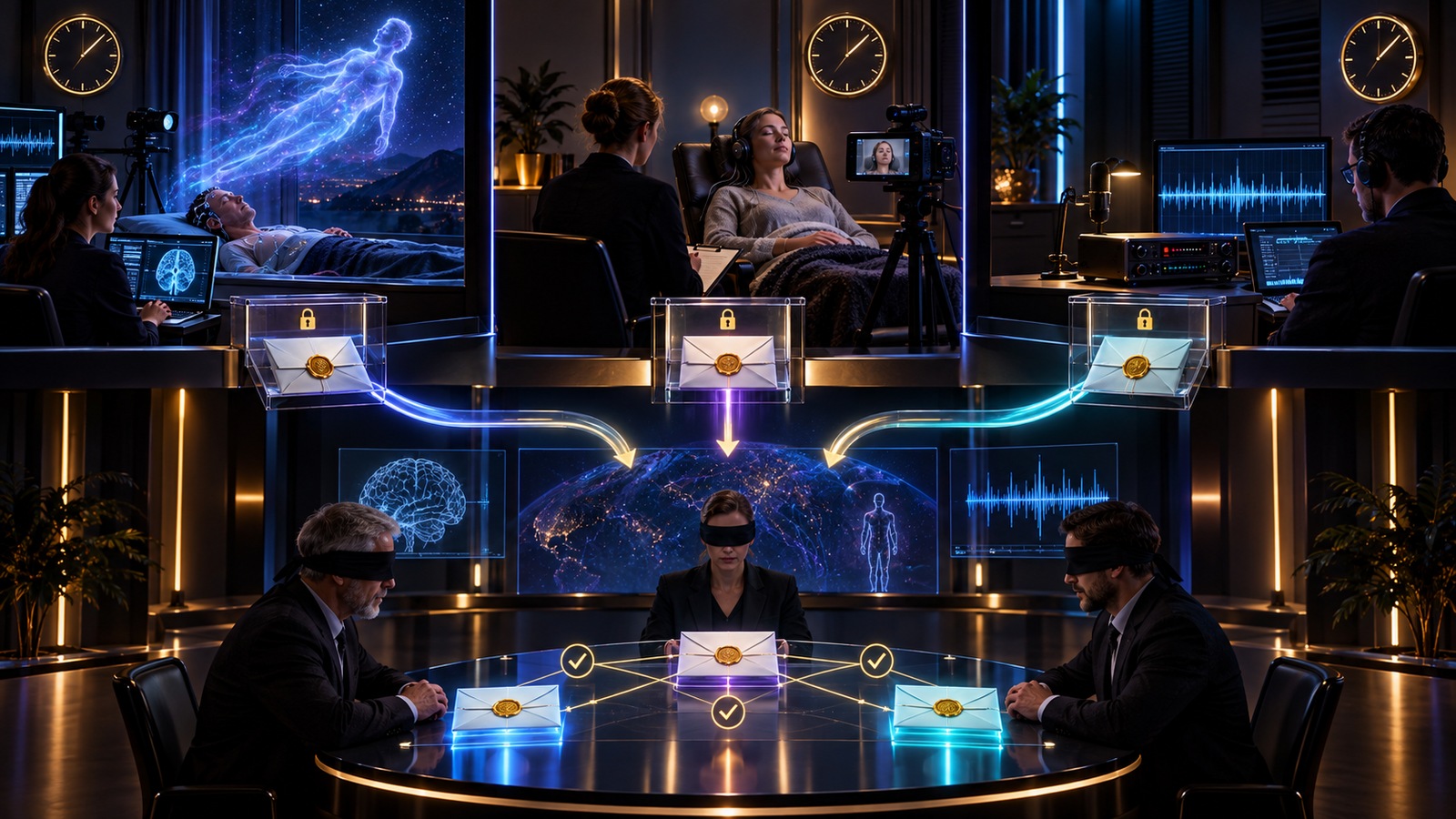
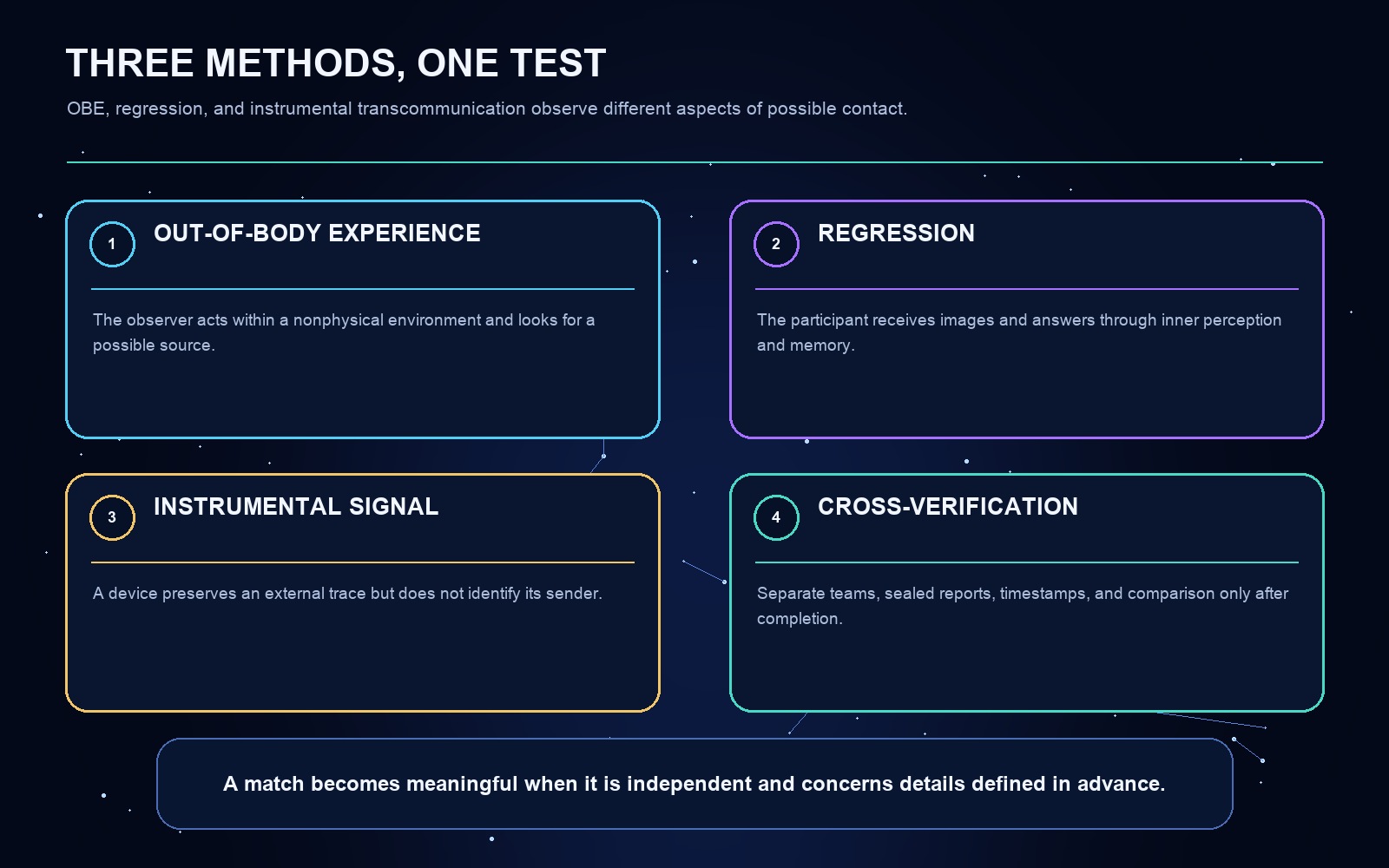
Researchers of consciousness often work within a single method. An out-of-body practitioner observes nonphysical environments. A regression practitioner helps a person access memory and imagery in an altered state. A specialist in instrumental transcommunication searches for meaningful signals in audio and video recordings.
Each field develops its own evidence, vocabulary, and disagreements. Yet if all three methods touch the same reality, they need to be brought together—not by blending the results into a beautiful story, but by using each method to test the others.
Three Different Windows
Out-of-body experience provides the perspective of a participant-observer. A person experiences separation from the body, moves, searches for an object or being, and can change the direction of the investigation.
Regression opens access through inner perception. A person remains connected with the body but receives images, emotions, and knowledge that may relate to other incarnations or nonphysical realms.
Instrumental transcommunication uses a technical medium. The researcher records sound, images, or another signal in which a possible message is later identified.
Each window has an advantage. Each also has its own distortions.
The Central Mystery of Instrumental Contact
Even when a clear phrase can be heard in a recording, one question remains: Who said it?
The source might be a deceased person, another independent consciousness, a guide, a thought-form, the researcher’s expectation, or random noise to which the brain has assigned familiar meaning. A technical recording makes the signal external, but it does not establish the identity of the sender.
I do not have a complete explanation for the mechanism of instrumental transcommunication. Out-of-body experience can, however, add another point of observation. A practitioner can attempt to see what is occurring in the nonphysical environment during a session, who approaches the participants, and how the signal is formed.
That does not guarantee an answer. Illusions and mental constructions also arise in an out-of-body state. One practitioner’s observation must therefore be compared with other data.
What Regression Can Add
Regression allows participants to ask questions about the nature of the contact and receive a connected description of the process. It is accessible to a larger number of people and can help collect several independent accounts of the same event.
The regression practitioner must not suggest the expected answer. If a participant is told in advance that a particular deceased person is present, the mind can easily create the corresponding image.
A clean experiment requires that the participant know neither the content of the recording, the proposed identity of the communicator, nor the results obtained by other participants.
Why a Simple Match Is Not Enough
Suppose researchers hear a name on an audio recording. An OBE practitioner reports seeing someone with that name, and a regression participant describes a similar figure. The agreement seems persuasive, but information exchange, a shared cultural image, and influence from the organizer must first be excluded.
The result is stronger when each report is created separately and time-stamped. Comparison takes place only after every stage has ended. Agreement is evaluated by predetermined details rather than a general impression.
A Possible Combined Protocol
I envision the following research design:
An independent coordinator selects a person, event, or item of verifiable information and keeps it concealed.
The instrumental transcommunication team conducts several sessions and preserves the original recordings without providing preliminary interpretations to the other groups.
At an agreed time, OBE practitioners investigate the location or source without knowing the expected answer.
Regression participants work with a neutral question and receive no information about the OBE reports or recordings.
Every account is recorded before group discussion.
Independent evaluators compare specific features: names, appearance, events, object locations, recurring phrases, and facts unknown to the participants.
Agreements, contradictions, and null results are all published.
Such a project would not immediately settle the question of life after death. It could show whether different methods can independently obtain related information.
Attempting to Affect Matter
During my own out-of-body experiences, I have tried to move physical objects and extinguish a candle. In nonphysical perception, the action could appear successful. After I returned, however, the object had not moved and the candle was still burning.
This illustrates how difficult it is to transfer action directly between levels. An instrumental signal is therefore especially interesting. If information truly appears in a physical device, we need to understand the mechanism of that transition.
Perhaps the process does not involve mechanical force but an influence on probability, noise, the operator’s perception, or an electronic device. These remain hypotheses and should be separated and tested individually.
A Larger Picture Emerges at the Intersection
No method has a monopoly on truth. OBE offers immediacy but depends on the practitioner’s level of awareness. Regression can produce a large amount of material but is vulnerable to suggestion. Instrumental transcommunication creates a record but leaves the source of the signal uncertain.
The weakness of one method can be partly offset by another. A technical recording tests whether an external event occurred. OBE can help investigate a possible source. Regression allows additional questions and comparison of recurring structures.
Combining methods requires maturity. Participants must be willing to receive different answers and resist forcing them into one narrative. The value of the research lies not in an attractive agreement but in an honest picture.
I am convinced that different practices touch different parts of one greater reality. If we stop defending the names of our schools and begin testing observations together, we may understand the mechanism of contact, the nature of memory, and the structure of consciousness much more deeply.
For more on energy levels, contact, and the investigation of consciousness, see my book *The Phenomenon of Consciousness Beyond the Body*.
We are accustomed to imagining science as a free search for truth. A scientist asks a bold question, conducts an experiment, and reports the result to society. In reality, funding stands between the question and the experiment.
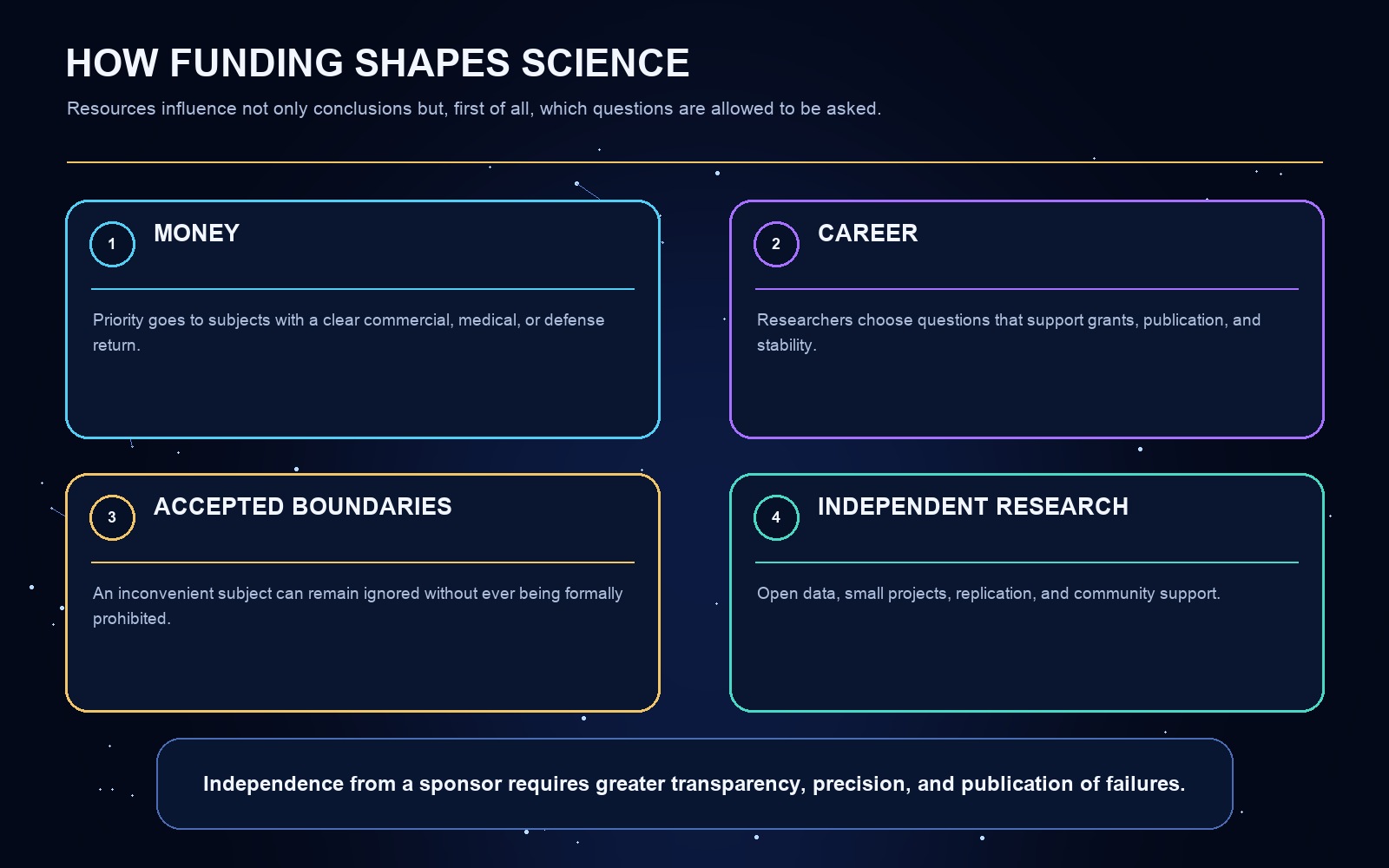
Research requires equipment, facilities, staff, time, access to data, and the ability to publish. As a result, we do not investigate everything that matters. We investigate, first of all, what someone is willing to fund.
The person who pays does not always dictate the conclusion. But the music is chosen earlier, when institutions decide which subjects will be allowed onto the stage.
Money Determines the Map of Questions
The greatest resources go to fields with a recognizable return: new drugs, defense technologies, computing systems, and commercial products. That is understandable. Society needs practical results.
Human importance and financial attractiveness are not the same. Research into the independent existence of consciousness could transform our understanding of life, death, and responsibility. It does not promise a quick patent or an obvious market.
It is therefore easier to secure a grant for measuring a familiar brain process than for testing whether perception can operate outside the body.
Funding Exerts Influence Before an Experiment Begins
Dependence is not limited to direct pressure from a sponsor. Researchers learn in advance which questions will appear “serious,” which vocabulary will pass a review panel, and which result will support the next application.
This produces self-censorship. A scientist may sincerely care about an unusual phenomenon but choose a safer subject because a laboratory must be maintained and a career must be built.
The public then sees few publications on consciousness beyond the body and concludes that there is nothing to study. In reality, the absence of research often reflects the absence of resources and institutional permission.
Power Prefers a Predictable Person
The study of consciousness is not limited to philosophy. When people stop viewing themselves as accidental biological machines, their relationship with life changes. They are less easily controlled by fear of death, more attentive to the consequences of their actions, and more willing to question established authorities.
An aware person can think independently and refuses to obey merely because an order was given. Such a person is less convenient for any system of power.
I am not claiming that a single center exists to prohibit consciousness research. Control works in a more complex way. Governments, corporations, universities, and foundations support fields aligned with their goals. Research capable of radically changing how human beings understand themselves is pushed to the margins without any formal ban.
Reputation Is Also a Form of Currency
Even with modest independent funding, a researcher needs journals, conferences, and colleagues. If a subject has already been labeled unacceptable, work may fail peer review regardless of its quality.
A convenient circle appears: the field is called unscientific because rigorous studies are scarce, while rigorous studies are not funded or published because the field is considered unscientific.
Only real projects with open methods and accessible data can break that circle.
Independence Does Not Mean Abandoning Rigor
Criticism of academic science sometimes leads to the opposite extreme. A person decides that personal conviction is enough and that verification is evidence of closed-mindedness. Free inquiry is then replaced by another belief system.
If a project is funded by viewers, a private foundation, or the participants themselves, its transparency should be even stronger:
a question defined in advance;
clear criteria for a result;
documentation of unsuccessful attempts;
access to de-identified source data;
separation of observation from explanation;
independent analysis;
open disclosure of conflicts of interest.
Freedom from institutional pressure is not freedom from honesty.
A New Model for Research
I see an opportunity to build consciousness research from the ground up. Experienced practitioners, regression professionals, psychologists, physiologists, and data analysts can create small collaborative projects. A community can support a specific experiment when people understand its purpose and receive a transparent report on expenses.
Results should be published openly, including negative findings. Several independent groups can repeat the same protocol. This approach will not replace a major laboratory, but it can build a body of evidence and show which questions deserve larger resources.
International collaboration is especially important. When people from different cultures obtain similar results using the same criteria, the influence of a shared cultural narrative becomes smaller.
Boundaries Should Protect People, Not a Worldview
Research ethics are essential. A participant must never be placed in danger, misled about risk, deprived of confidentiality, or exploited while vulnerable. Those boundaries protect the human being.
Refusing to ask a question merely because a possible answer contradicts a materialist worldview is not ethics. It is protection of the model.
Science must retain the right to investigate and the possibility of being wrong. Practitioners must also be prepared for an experiment not to confirm their expectations. Only then can the encounter be honest.
Investigating the Whole of Reality
I value the scientific method, but I do not regard the present scientific system as neutral. It is influenced by money, power, reputation, and the boundaries of the accepted worldview.
That is not a reason to reject science. It is a reason to make science more independent.
Society funds countless methods for making people more productive, controllable, and predictable. It is time to invest in understanding what a human being actually is.
If consciousness is not confined to the body, that discovery will matter more than another device. That is precisely why the question deserves more intellectual courage, not less.
For more about my observations, verification methods, and model of consciousness, see my book *The Phenomenon of Consciousness Beyond the Body*.
Millions of people describe out-of-body experiences, near-death states, encounters with deceased loved ones, and information they could not have obtained through ordinary means. These accounts appear across cultures and historical periods. They can completely transform a person’s relationship with life and death.
Why does modern science devote so little attention to this phenomenon?
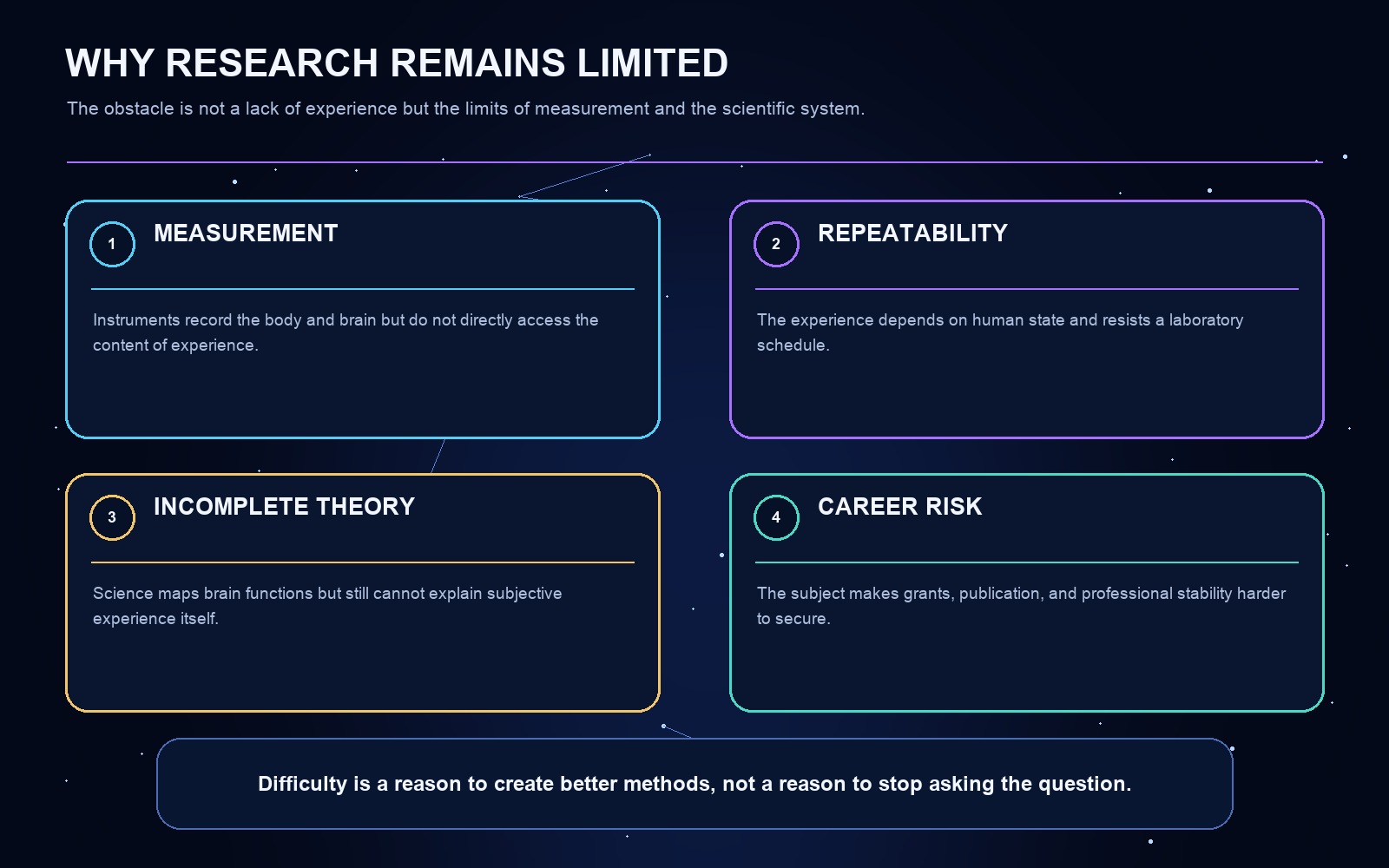
The reason is not a lack of material. Consciousness beyond the body is difficult for the existing research system: it cannot easily be produced on schedule, it resists familiar instruments, and studying it can be risky for a scientific career.
Instruments Measure the Brain, Not the Experience Itself
During an unusual state, researchers can record electrical brain activity, pulse, eye movement, breathing, and blood oxygen. These measurements matter. They show what is happening in the physical organism.
They do not answer the central question: Where is the perceiving person, and what exactly is that person experiencing?
A brain scan shows correlation. It connects a state of the brain with a participant’s report. That connection does not automatically prove that the brain fully created the content of the experience. A radio receiver changes its electrical activity when music plays, but measuring its circuitry does not describe the broadcast or prove that the music originated inside the receiver.
I am not claiming that the brain is merely a receiver. My point is narrower: present measurements alone do not resolve the origin of consciousness.
Science Still Has No Unified Theory of Consciousness
We can connect regions of the brain with speech, memory, attention, and perception. We still do not understand how physical processes become subjective experience—why a person does not merely process a signal but sees red, feels pain, and knows that they exist.
Without a satisfactory theory of consciousness, out-of-body experience is often explained within a model that does not yet explain the primary phenomenon.
A researcher may say, “It is brain activity,” and consider the matter settled. Yet brain activity accompanies every earthly experience. It does not explain why people report stable environments, similar stages of transition, and, at times, information that can be checked.
Out-of-Body Experience Does Not Obey a Laboratory Schedule
Science values repeatability. Ideally, a phenomenon appears at a specified time, under the same conditions, in different participants.
OBE depends on many factors: physical condition, energy level, sleep, emotional state, preparation, the ability to remain aware, and the strength of intention. Even an experienced practitioner cannot always reach the necessary depth at an appointed hour while unfamiliar people observe.
A laboratory adds pressure. Wires, cameras, expectations, and the desire not to disappoint the researchers alter the participant’s state. Failure to separate under those conditions does not prove the phenomenon impossible. It may show that the conditions were poorly designed.
Subjective Data Is Mistakenly Treated as Useless
Science already works with subjective reports. Pain, anxiety, quality of life, and therapeutic outcomes are assessed largely through personal testimony. Extraordinary experiences, however, are often dismissed before analysis begins.
Subjectivity certainly creates risks of memory error, expectation, and interpretation. The answer is better methodology, not the elimination of experience:
precise documentation immediately after the event;
standardized questions for all participants;
a separation between observation and conclusion;
comparison of independent reports;
predetermined verification targets;
publication of unsuccessful as well as successful attempts.
This is how subjective material becomes researchable.
Reputation Shapes the Questions Scientists Ask
Scientists do not exist outside society. They need grants, laboratories, publications, positions, and the respect of colleagues. Research on consciousness beyond the body can endanger all of them.
A young researcher understands that it is safer to study a narrow question inside an accepted model than to risk a career on a phenomenon colleagues already label pseudoscience. Serious studies remain scarce, and the scarcity is then used as evidence that the subject is not serious. The result is a closed loop.
This is not a conspiracy involving every scientist. Many researchers sincerely search for answers. The scientific system, however, rewards certain questions and makes others professionally expensive.
A Conflict of Languages Prevents Cooperation
Practitioners speak about the soul, energy levels, guides, and the Higher Self. Scientists speak about dissociation, sleep stages, neural networks, and body models. Sometimes different words describe different aspects of the same phenomenon. Sometimes the same word conceals opposing ideas.
Instead of translating between these languages, the two sides often ridicule each other. The practitioner sees a closed-minded materialist. The scientist sees someone without a method.
Progress begins with observable characteristics. What did the person feel? Was awareness preserved? Could the participant change direction? What was perceived? What could be verified? What was happening in the body and brain? These questions create common ground.
What We Can Study Today
We do not need to wait for an instrument that displays the soul on a screen. We can already:
conduct blinded experiments with hidden targets;
compare experienced practitioners with beginners;
study memory before, during, and after transition;
align physiological data with the precise timing of reported events;
build large standardized databases of accounts;
test matches between independent participants;
study the long-term influence of the experience on fear of death and behavior.
No single experiment will settle the question. A sustained program can gradually distinguish stable patterns from error and imagination.
Science Needs to Recover Its Courage
The scientific method remains one of our best tools for testing claims. The problem does not begin when a scientist doubts. It begins when doubt becomes a prohibition against asking the question.
Twenty years of personal practice have convinced me that consciousness can exist and perceive outside the physical body. I do not ask science to accept my conclusion on faith. I ask it to do what it was created to do: investigate the phenomenon without fear of the consequences.
When an observation does not fit the current worldview, the observation is not the only thing that should be tested. Sometimes the worldview itself needs to expand.
For more about the nature of consciousness and my path as a researcher, see my book *The Phenomenon of Consciousness Beyond the Body*.
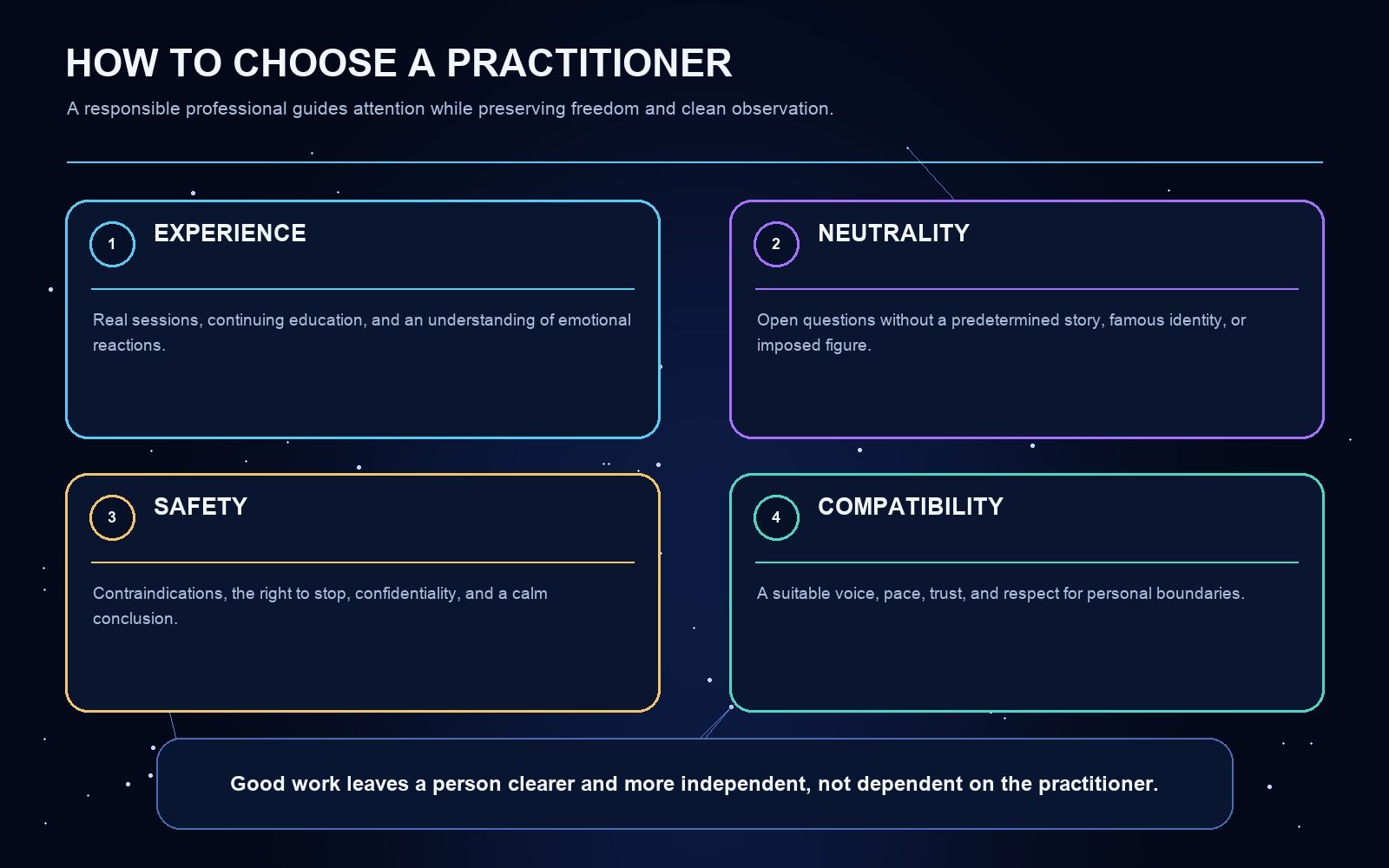
Regression requires trust. A person closes their eyes, relaxes ordinary control, and allows another professional into a deeply private area of experience. That is why a practitioner should never be chosen solely because of an attractive website, a promise to “show you a past life,” or one enthusiastic testimonial.
A good practitioner does not sell a miracle. The practitioner creates conditions in which the client retains freedom, clarity, and the right to disagree with any interpretation.
Experience Matters More Than an Impressive Title
A regression practitioner should have real experience conducting sessions. Ask how many years the person has worked, approximately how many sessions they have conducted, what kinds of concerns they address, and how they continue their education.
A background in psychology, medicine, or another helping profession can be valuable. It does not guarantee quality, but it helps a practitioner understand emotional reactions, trauma, professional boundaries, and responsibility for a client’s condition.
A certificate alone is not proof. What matters is how the practitioner thinks, communicates, and guides the session.
Neutral Questions Instead of a Predetermined Script
The quality of a regression practitioner is often most visible in the questions they ask.
“Look at who killed you” has already introduced a murder. “What is happening?” leaves room for an actual answer. “Your spiritual guide is coming to you now” imposes a guide. “Do you independently perceive anyone or anything nearby?” is much cleaner.
A practitioner should not use the client to prove a personal theory. The task is to support attention, not write the story.
Be Wary of Promises of Exceptional Results
Warning signs appear when a practitioner promises in advance to:
reveal a past life with absolute certainty;
identify the exact cause of any illness;
discover a famous incarnation;
eliminate every problem in one session;
obtain an infallible answer from higher powers;
prove that people around you are enemies, karmic debtors, or energetic aggressors.
Such promises intensify expectation and dependency. If nearly every client turns out to have been a pharaoh, priest, or major historical figure, that says more about the method than the scale of the discovery.
Questions to Ask Before a Session
Before paying, arrange a short conversation and ask direct questions:
How should I prepare?
What conditions would make a session inappropriate?
How do you respond to a strong emotional reaction?
Will the session be recorded, and who owns the recording?
What happens if I see nothing?
How do you distinguish observation from fantasy and suggestion?
Can I stop the process at any time?
Is there time for a calm return and discussion afterward?
How is confidentiality protected?
A professional answer will be clear and specific. Irritation, pressure, and vague language are poor signs.
Personal Compatibility Matters
Even a good practitioner will not suit everyone. One person responds best to a calm, low voice. Another feels more comfortable with a woman, and someone else with a man. Some people need a gentle pace; others need more structured guidance.
Notice whether you feel calmer in the practitioner’s presence. Does the person hear your actual concern? Respect your boundaries? Or try to impress you with stories about personal abilities?
A friend’s recommendation is useful, but it does not replace your own judgment. A method that helped someone else may not be right for you.
What a High-Quality Session Looks Like
Good work is not measured by the number of vivid images. Sometimes the most valuable result is one clear image or insight that connects events that had long seemed unrelated.
During a session, a responsible practitioner:
does not rush or judge the answers;
asks open-ended questions;
does not replace the client’s words with their own;
helps distinguish sensation, image, and interpretation;
monitors the person’s condition;
does not use fear;
calmly accepts the absence of a result;
returns responsibility for conclusions to the client.
After the session, the practitioner should not declare one mandatory explanation. It is more useful to discuss what was directly experienced and what remains a hypothesis.
Verification Continues After the Eyes Open
A powerful regression can feel completely real. The intensity of the experience does not verify every detail.
When verifiable information appears, write it down before searching online or discussing it with other people. If the information may influence an important decision, return to it later, compare it with other sources, and examine its consequences in ordinary life.
Never accuse a relative, end a relationship, refuse treatment, or make a major financial decision solely because of a regression scene.
A Practitioner Should Never Become the Owner of Your Reality
The central measure of quality is not the practitioner’s power but the growth of your awareness. Work with a good practitioner should help you understand yourself more clearly and become more independent.
If someone insists that only this particular master can protect you, cleanse you, interpret your experience, or connect you with the Higher Self, dependency is being created. That is the opposite of development.
A regression practitioner can guide you through part of the path. You must still walk it, verify what you received, and make your own decisions.
Choose someone who can accompany you carefully into the unknown without claiming the right to decide what you must see.
For more on consciousness, the soul’s memory, and the verification of extraordinary experience, see my book *The Phenomenon of Consciousness Beyond the Body*.
Self-regression is appealing because it offers freedom. A person does not need to find a practitioner, explain a private question, or depend on someone else’s schedule. Inner memory can be explored at a convenient time and at a personal pace.
That freedom also creates the central difficulty: the same person asks the question, directs the process, receives the image, and interprets it. If expectation quietly replaces observation, no one else is present to point it out.
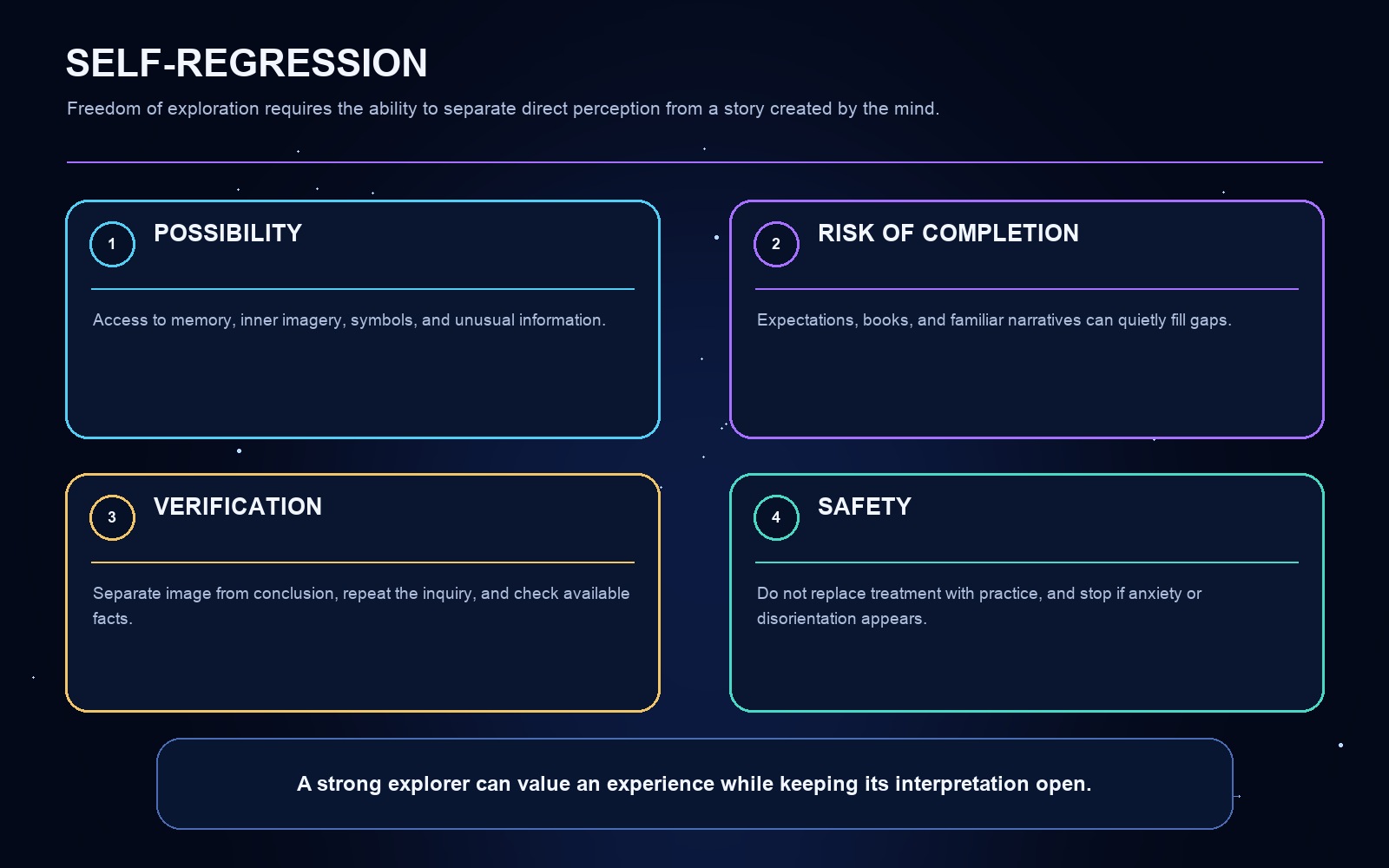
Self-regression is possible. I do not consider it useless or automatically imaginary. It should, however, be approached as an investigation rather than a factory for beautiful stories.
What Independent Practice Can Offer
In a lightly altered state, the usual control of the thought stream weakens. Unexpected images, emotions, physical reactions, and fragments of information can appear. Sometimes a person remembers a long-forgotten event from the current life. Sometimes a scene feels like an episode from another incarnation. Sometimes the person enters what appears to be the realm of the soul between lives.
The value of the practice does not always depend on the literal historical accuracy of every image. Even a symbolic story can reveal a hidden fear, a recurring pattern, or an internal conflict. But symbolic meaning and the memory of an actual event belong to different categories. They should not be confused.
Why the Mind So Easily Completes a Story
The mind dislikes gaps. It joins fragments into a coherent narrative using memory, movies, books, expectations, and suggestion. In ordinary life this ability helps us understand the world. In regression it can create an extremely convincing construction.
A person sees old clothing and immediately decides that the scene belongs to a particular country and historical period. The mind then adds a home, a family, an occupation, and a dramatic ending. The scene grows more vivid, but vividness says nothing about its source.
It is especially risky to begin with a predetermined answer: “I know I was this person,” “I am under an ancient curse,” or “My present relationship must be explained by a past life.” Such a question does not investigate. It demands confirmation.
How to Reduce Self-Deception
A useful question remains open. Instead of asking, “Show me why this person was my enemy in a past life,” ask, “What do I need to understand about this relationship?” Instead of searching for a famous identity, ask to see the experience that is genuinely relevant to the present issue.
During the practice, separate three layers:
what appeared directly—an image, emotion, word, or immediate knowing;
what was added through reasoning;
what conclusion was formed only after returning.
If an answer matters, revisit it on another day with a differently worded question. Stable information may not return in the same pictures, but its central meaning should remain recognizable.
Whenever external verification is possible, use it. A historical detail, geographic name, or family fact becomes more meaningful after independent confirmation.
The Higher Self and the Researcher’s Responsibility
In my own practice, I address the Higher Self and set a clear intention to receive only the information that supports growth and that I am capable of understanding correctly.
For me, this does not mean abandoning critical thought. Even a powerful inner knowing passes through the perception of an earthly personality. I compare, repeat, and avoid building a major decision on a single episode.
The image of a spiritual guide does not remove personal responsibility. A beautiful appearance, impressive name, and confident voice are not proof of wisdom.
Where the Safety Boundary Lies
Self-regression should never replace medical care or psychotherapy. It is not a method for independently treating severe trauma, a psychiatric disorder, or a condition in which a person is losing contact with everyday reality.
The practice should be postponed during an acute crisis, panic attacks, severe insomnia, confused perception, or the use of mind-altering substances.
Stop and seek appropriate support if the following persist after a session:
strong anxiety or disorientation;
a feeling that ordinary life has become unreal;
an obsessive urge to repeat the practice immediately;
fear of the images that interferes with sleep or work;
certainty that another person is guilty of something based only on a regression scene.
In those situations, restoring stability and consulting a qualified professional matters more than continuing the experiment.
When a Regression Practitioner Is Helpful
A practitioner is useful when a person struggles to sustain attention, repeatedly returns to analysis, or approaches emotionally difficult material. A responsible regression practitioner does not dictate the story. The practitioner preserves direction, asks neutral questions, and notices when the participant begins to construct an answer.
Professional support is also important when the purpose is research. A second person can record the wording of questions, note physical reactions, and separate the original account from later interpretation.
A Practice of Mature Awareness
Self-regression can become a valuable way to explore memory, consciousness, and the deeper structure of the personality. Its strength lies in direct personal access. Its weakness is the absence of an external observer.
The solution is not to reject the method but to develop research discipline: open questions, a written record, repeated sessions, external verification, and a willingness to admit uncertainty about a particular image.
True spiritual maturity is not the ability to believe every extraordinary scene. It is the ability to remain open without losing discernment.
For a deeper discussion of memory, mental constructions, and the exploration of consciousness, see my book *The Phenomenon of Consciousness Beyond the Body*.
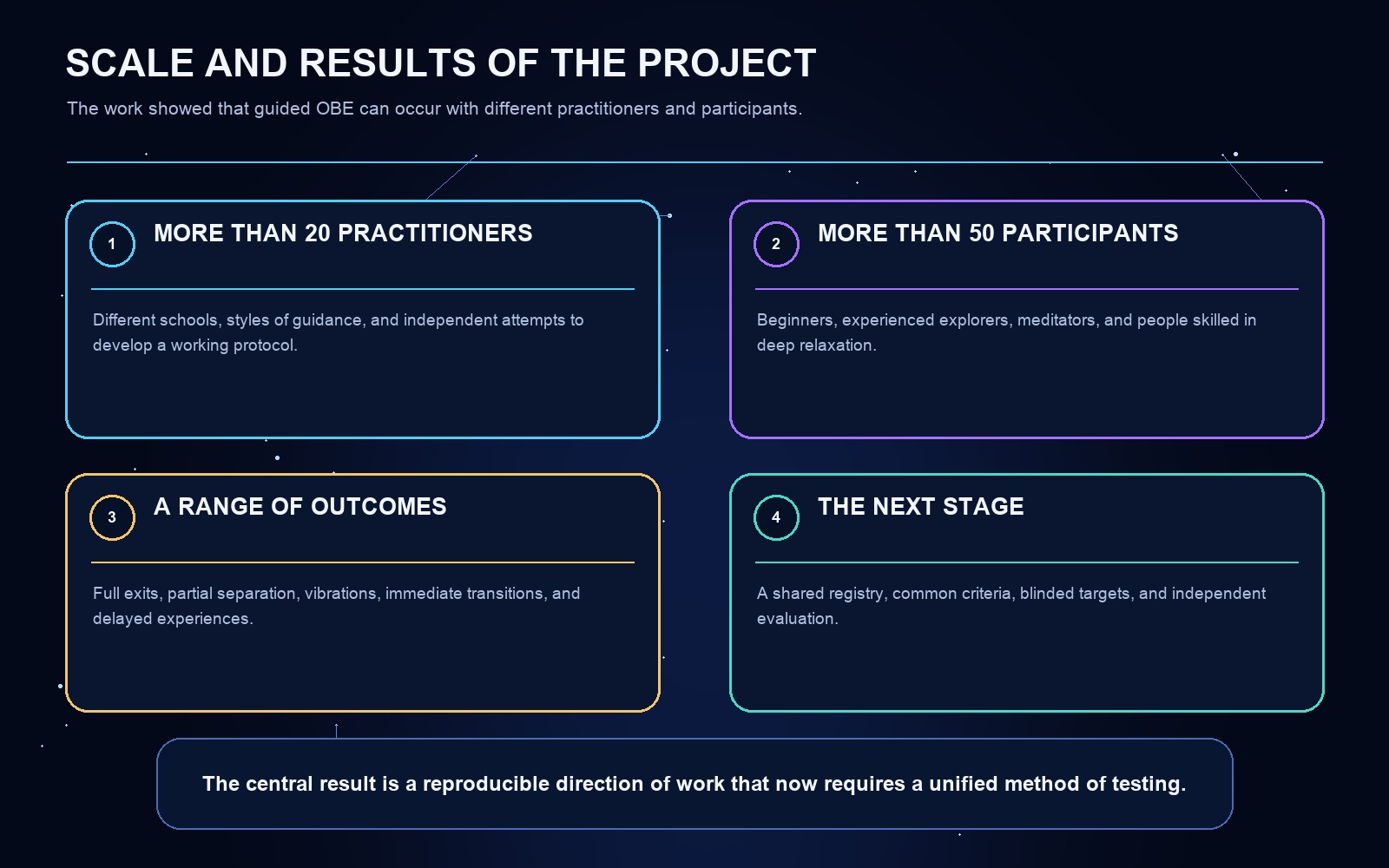
Can a regression practitioner help another person have a genuine out-of-body experience? Several years ago, that question became the foundation of a large practical project. More than twenty regression practitioners and over fifty participants took part. The practitioners used different methods, conducted individual sessions, exchanged observations, and gradually identified conditions under which guided separation of consciousness from the body may become possible.
Oleg Saifuddinov was only one member of this work. His statistics are valuable, but they represent a separate series of sessions rather than the project as a whole. The larger picture was much broader: successful and unsuccessful attempts, full exits, partial separation, vibrations, immediate arrival in another environment without the usual sensation of leaving, delayed results, and early attempts to verify the information participants perceived.
The project did not provide a final answer about the nature of consciousness. It did something else: it demonstrated that combining out-of-body practice with regression is a workable field of investigation capable of producing results with different practitioners and different participants.
Why the Project Was Created
To enter an out-of-body state consciously, a person needs to relax the physical body deeply, preserve clarity, and pass through the transitional state without losing awareness. Many independent attempts end at precisely this threshold. The person falls asleep, becomes frightened by unfamiliar sensations, returns attention to the body, or begins analyzing the experience too actively.
A regression practitioner already knows how to guide someone into deep relaxation, help the person sustain attention, and move calmly through unusual states. This led to the idea of combining the experience of OBE practitioners with the tools of regression. The purpose was not to suggest a ready-made image. It was to help a participant reach the point of separation and then provide space for independent experience.
A Project Larger Than One Method or One Practitioner
More than twenty regression practitioners joined the working group, and over fifty participants went through sessions. The practitioners represented different schools and levels of experience. The participants varied as well: some had already experienced OBE, some encountered transitional states for the first time, and others had never left the body but practiced meditation and knew how to relax deeply.
This diversity made a single statistical summary more difficult, but it gave the project an important strength. The results were not tied to one voice, one script, or one personality. Positive cases appeared with different practitioners. Unsuccessful attempts were valuable as well because they revealed the conditions that interfere with transition and the elements of preparation that needed to change.
It gradually became clear that an ordinary regression script cannot simply be given a new objective. In regression, the practitioner often continues to lead through questions. In an out-of-body experience, too much guidance after transition may interfere. The practitioner’s task is to prepare the participant, help the person cross the threshold, and then step back at the right moment so that independent action can begin.
The Range of Results
The experience cannot be reduced to two outcomes—“left the body” or “did not leave.” The reports revealed a spectrum of states:
full separation with clear perception;
partial separation involving the hands, legs, or upper part of the energy body;
vibrations, tingling, and changes in the perceived size or position of the body;
sudden arrival in another environment without a noticeable separation process;
an exit that occurred later, after the session or early the next morning;
an independent repeat experience after the participant first crossed the threshold with a practitioner;
images and information that were later compared with external facts.
This is a significant observation. Strong classical vibrations do not occur in every case. Sometimes a person does not feel the act of leaving at all and simply discovers that awareness is present in another reality. If a dramatic physical sensation is treated as the only valid result, meaningful cases will be lost.
Natalia Talyzina’s Series: Fifteen Sessions and Three Full Exits
Regression practitioner Natalia Talyzina conducted fifteen experimental sessions. She classified three as successful full exits. She emphasized that fifteen cases were not enough for final conclusions, but the results were strong enough to justify continuing the investigation.
Natalia’s central conclusion concerned participant preparation. Her most successful participants had no prior OBE, but they did have experience with meditation and other practices. They knew how to relax the body, quiet the stream of thought, and sustain attention. Before a session, they learned about the nature of OBE, read my book, and studied material on transitional states.
Natalia first guided the participant and then stopped speaking completely for ten to twenty minutes. This period of silence allowed independent action. The practice revealed an important principle: the practitioner’s voice may be necessary up to a certain boundary, but beyond that boundary it can distract the participant from the new environment.
One participant, a twenty-five-year-old man, felt neither strong vibrations nor a clearly defined separation. He experienced only mild tingling and then simply found himself in another reality. This became one indication that transition does not have to follow a single script.
Early Attempts to Verify Perception
In one session, the same participant first perceived himself inside a dark liquid and then understood the environment as a person’s lungs. He associated what he saw with the father of a friend. The following day, he learned that doctors suspected cancer. Seventeen days later, the man died of lung cancer.
This case cannot be treated as controlled proof. The participant had taken the man to a doctor the day before and could have unconsciously noticed signs of a serious condition. The correspondence was nevertheless strong enough to document and to show why future investigations must exclude possible ordinary sources of information in advance.
In another task, the participant was asked to visit a large memorial park in another state that he had never physically visited. During the experience, he described a parking area, an unusual structure, and a tall statue that he believed represented Benjamin Franklin. Later, online maps and photographs revealed a similar area containing parking, a structure, and a large statue of Thomas Jefferson.
This was not yet a clean blinded experiment because the participant had been shown photographs and video of the park before the session. The case cannot therefore serve as final confirmation of distant perception. It did, however, clarify how verification should develop: the target must be selected in advance; neither the participant nor the practitioner should receive visual information about it; the description must be recorded before the target is revealed; and an independent evaluator should judge the match.
What Alexey Kuleshov’s Experience Added
Alexey Kuleshov’s report was valuable because he openly analyzed an unsuccessful attempt. His participant came to the exercise after a long session, was tired, knew very little about OBE, and was not adequately prepared. Vibrations appeared, but full separation did not occur.
The negative result revealed several critical mistakes. A participant must understand the purpose of the session and recognize the signs of a transitional state. The work is better conducted when the person is rested and able to sustain attention. The practitioner and participant should agree in advance on a signal indicating that separation or return has begun. Time distortion must also be considered: a few minutes may seem to pass internally while a much longer period passes externally.
Alexey’s experience further confirmed that a single script will not suit everyone. One participant continues to hear the practitioner; another stops perceiving the voice. One needs support all the way to the threshold; another needs a long period of silence. A future protocol should therefore be standardized in its definitions and documentation while remaining flexible in the guidance itself.
Oleg Saifuddinov’s Separate Series
Psychologist and regression practitioner Oleg Saifuddinov later continued the work and reported statistics from his own series of thirty-nine sessions:
nine resulted in full out-of-body experiences;
twenty-six produced vibrations or partial separation;
four produced no noticeable result.
The average rate of full exits in this series was approximately 23 percent. Seven of the nine participants had previous experience, while two had their first full exit. In some cases, the result occurred after the guided session—later that day or early the next morning.
The change after introducing a preliminary questionnaire was especially notable. Among the first twenty-two sessions conducted without detailed screening, the full-exit rate was about 13 percent. In the next group of better-prepared participants, it approached 40 percent. These figures should not be generalized to the entire project, but they support the conclusion reached by other practitioners: preparation has a major effect on the outcome.
The Project’s Main Patterns
When the reports are compared, several shared patterns become visible.
Preparation matters more than a particular school of regression. Success appeared more often among people who understood the objective, knew how to relax, could quiet the thought stream, and could sustain attention.
The practitioner cannot leave the body for the participant. The practitioner helps the person cross the most difficult part, reduces fear, and maintains direction. Separation and subsequent action remain the participant’s responsibility.
External guidance should decrease after transition. Continuous questions and instructions can return attention to the physical body or replace direct perception with a mental narrative.
The absence of powerful vibrations does not mean that no OBE occurred. Some participants found themselves in another environment almost immediately.
Unsuccessful sessions are part of the result. They revealed the influence of fatigue, insufficient preparation, internal dialogue, fear, and poorly timed guidance.
A verification task should be established in advance. Without one, even a vivid experience remains personal. The project took early steps toward external verification, but the next stage should be considerably more rigorous.
What the Project Actually Demonstrated
More than twenty regression practitioners and over fifty participants constitute more than one person’s story. The project demonstrated that guided out-of-body experience is possible with different practitioners using different methods. It identified recurring transitional signs and conditions associated with a higher likelihood of success. It also showed that a person without previous OBE can have a first experience with appropriate preparation.
The project was not yet a single controlled scientific experiment. Not every practitioner used the same script. Definitions of full separation could differ. There was no unified registry in which every attempt was documented in the same format. Verification tasks were not always blinded, and most of the material consists of personal reports.
This does not erase the results. It shows how the accumulated experience can be taken to the next level.
What the Next Stage Should Include
The next stage should preserve the living, practical character of the project while adding shared research rules:
Register every session, including unsuccessful attempts.
Use standardized questionnaires before and after the experience.
Separate beginners from participants with previous OBE experience.
Record levels of outcome: relaxation, transitional sensations, vibrations, partial separation, full separation, retained memory, and completion of the assigned task.
Select blinded targets unknown to both participant and practitioner.
Record every description before revealing the target.
Use independent evaluators to compare the reports with the targets.
Track delayed experiences and later independent exits.
Publish positive, partial, and negative results.
This structure would allow us to ask not only whether a guided exit is possible, but which conditions actually improve the probability, which techniques can be reproduced by different practitioners, and what information a person may obtain beyond the familiar channels of perception.
A Project That Should Continue
The project’s main result is not one number or one successful case. It created a practical research environment in which more than twenty professionals searched for a way to help people cross the boundary of physical perception consciously. Over fifty participants contributed material for comparison. The work produced full exits, partial results, methodological discoveries, and early verification attempts.
We did not finish this investigation. We only began to see its true scale.
It is now clear that regression can become a bridge to out-of-body experience. The bridge must be strengthened by consolidating the reports, establishing a shared protocol, conducting blinded tests, and inviting more independent researchers.
I am convinced that consciousness possesses far greater capacities than we have been taught to expect. The “Out-of-Body Experience and Regression” project did not give us a final answer. It gave a researcher something more valuable: a direction, real results, and a reason to continue.
For more about the nature of out-of-body experience and methods for investigating consciousness, see my book *The Phenomenon of Consciousness Beyond the Body*.
Out-of-body experience and regression are often treated as separate fields. Practitioners use different terminology, explain what happens in different ways, and rarely compare their results. Yet beneath those differences lies the same set of questions: What is consciousness? Can memory extend beyond a single earthly life? Can human perception receive information outside the ordinary senses?
I have spent many years practicing out-of-body exploration and studying regression. The longer I compare these methods, the more clearly I see that they are not competing schools. They are two points of entry into one vast area of reality.
Two Different Ways of Shifting Attention
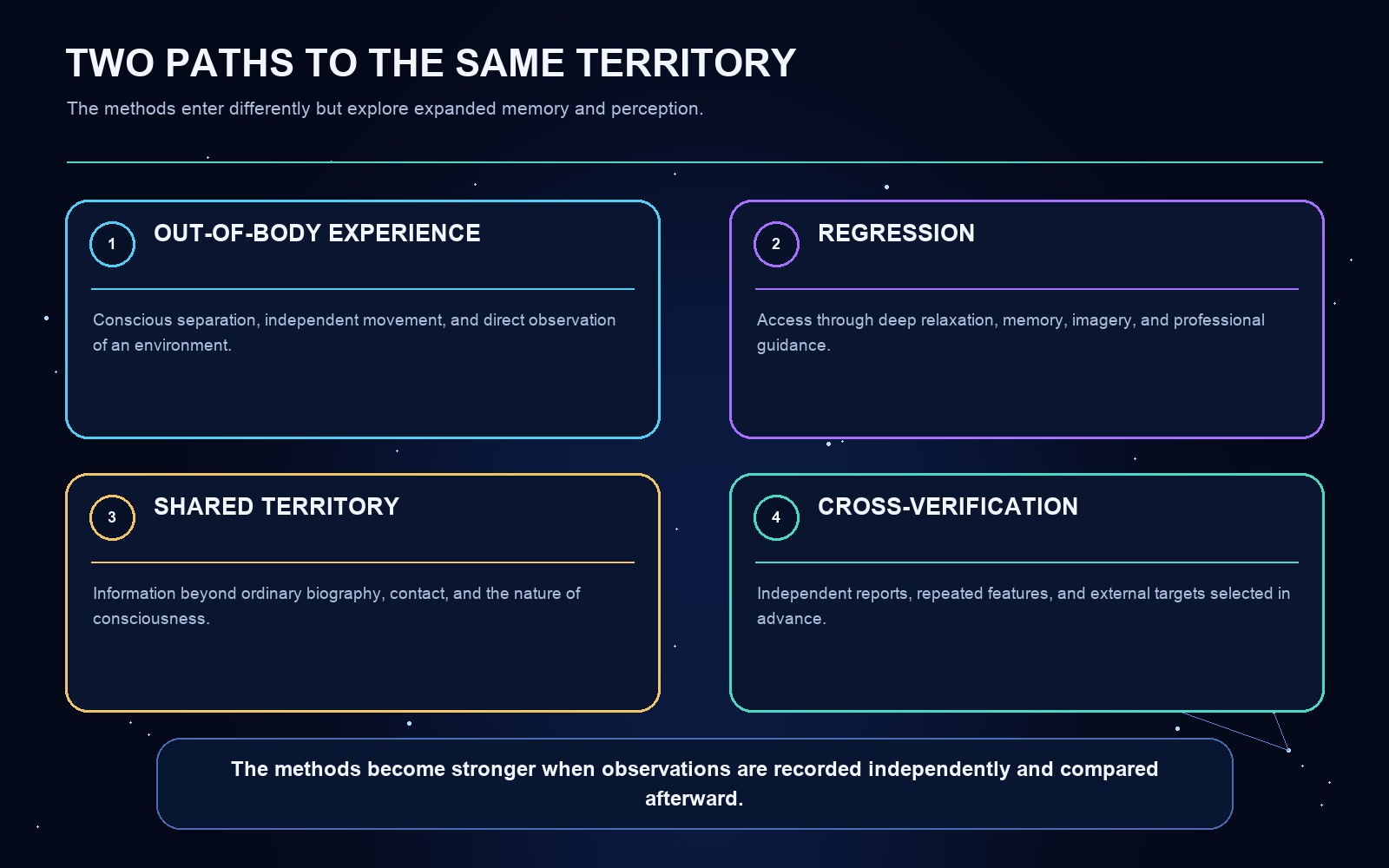
In an out-of-body experience, a person seeks to separate perception from the physical body. The individual retains a sense of self, moves through an environment, observes, encounters other beings, and can pursue predetermined verification tasks. When awareness is strong, the experience does not feel like a memory or an inner movie. It feels like direct presence.
Regression moves attention in another way. The person remains connected to the body and enters an altered state, either with a practitioner’s guidance or independently. Images, episodes, emotions, and knowledge may emerge that appear connected with childhood, possible past lives, or the period between lives.
In one method, the explorer steps into the field of experience. In the other, the explorer accesses information through memory, imagery, and inner perception.
The Shared Foundation
Both methods require physical relaxation, stable attention, and a temporary quieting of the ordinary stream of thought. In both, expectations can influence what a person perceives. A vivid scene does not automatically guarantee an accurate interpretation, whether it appears during regression or an out-of-body experience.
There is a deeper similarity as well. Both methods suggest that human memory and perception may extend beyond the boundaries of one familiar biography. People report information about unfamiliar places, experience themselves outside their current identity, meet deceased loved ones, and describe the organization of nonphysical realms. A single case can be dismissed as imagination. Repeating structures across many independent experiences deserve serious investigation.
The Main Difference: The Brain’s Influence
During regression, the connection with the body and brain remains stronger. Personal expectations, familiar narratives, a practitioner’s wording, and cultural imagery can therefore enter the experience more easily. The mind may fill gaps and create a coherent story where the original information was fragmentary.
In an out-of-body experience, the brain’s influence may weaken, especially after full separation. It does not disappear automatically. Habits of perception, fear, and belief continue to operate. A person can construct a mental environment and mistake it for an independent reality.
For that reason, I do not consider one method infallible and the other secondary. Each has distinctive possibilities and distinctive sources of distortion.
What Each Method Can Offer the Other
A regression practitioner knows how to guide attention, help a person remain engaged, and work through internal barriers. This can be especially useful for people who struggle to reach a deep state on their own.
An experienced out-of-body practitioner, in turn, knows how to test the stability of an environment, change the point of observation, search for a predetermined target, and distinguish a personal thought from an event that resists expectation.
Combining these skills creates a powerful research model. Regression can help a person approach the threshold of separation, while OBE methods can add awareness, independent action, and verification.
A Matching Answer Is Not Yet Proof
When a regression participant and an OBE practitioner obtain similar information, the overlap matters. It must still be evaluated carefully. People may have read the same books, absorbed the same cultural narratives, or unintentionally communicated expectations to one another.
Independent observations are stronger. A precise question is established first. Several participants then use different methods without discussing their results. Their reports are recorded before any group conversation. Only afterward are the details compared.
The most valuable information can be checked in ordinary reality: a description of an unknown location, the contents of a concealed image, a fact from a deceased person’s life, or a specific match that none of the participants knew in advance.
Why We Need a Shared Map
Each field currently tends to defend its own vocabulary. Some speak only of a field of memory, others of astral levels, and still others of the subconscious. As a result, potentially related observations can appear incompatible.
I suggest beginning with the experience itself rather than its label:
How aware was the person?
Did the person retain a connection with the body?
Could the person independently change the direction of the investigation?
How strongly did thought influence the environment?
Was any verifiable information obtained?
Could the result be repeated?
This type of map does not require us to accept one philosophy in advance. It allows us to compare phenomena by their observable characteristics.
Two Paths That Need to Meet
Out-of-body experience offers freedom of direct exploration, but it requires serious preparation. Regression is accessible to more people, but its reliability depends heavily on the quality of the guidance and the care used in interpretation.
Bringing the two together should not create a new dogma. Its purpose is to expand human possibility while making verification stronger. If two different methods lead into the same territory, we have a chance to see that territory in greater depth.
I am convinced that consciousness is far greater than the physical body and one earthly biography. Conviction, however, does not release a researcher from the need for precision. It demands bolder questions and methods capable of separating a genuine discovery from a compelling story.
That is exactly how out-of-body experience and regression can strengthen one another.
For a deeper account of my observations and twenty years of consciousness research, see my book *The Phenomenon of Consciousness Beyond the Body*.