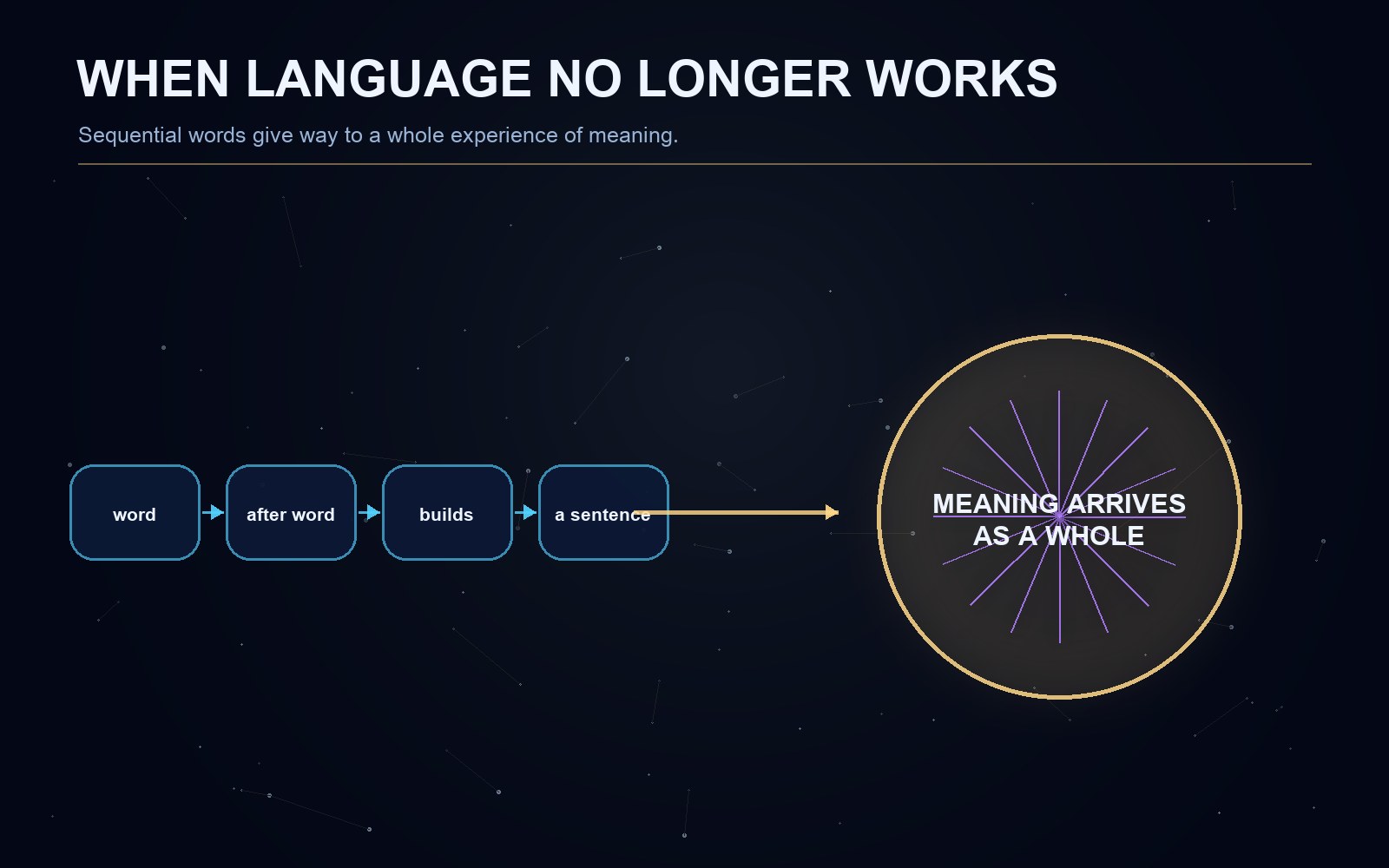
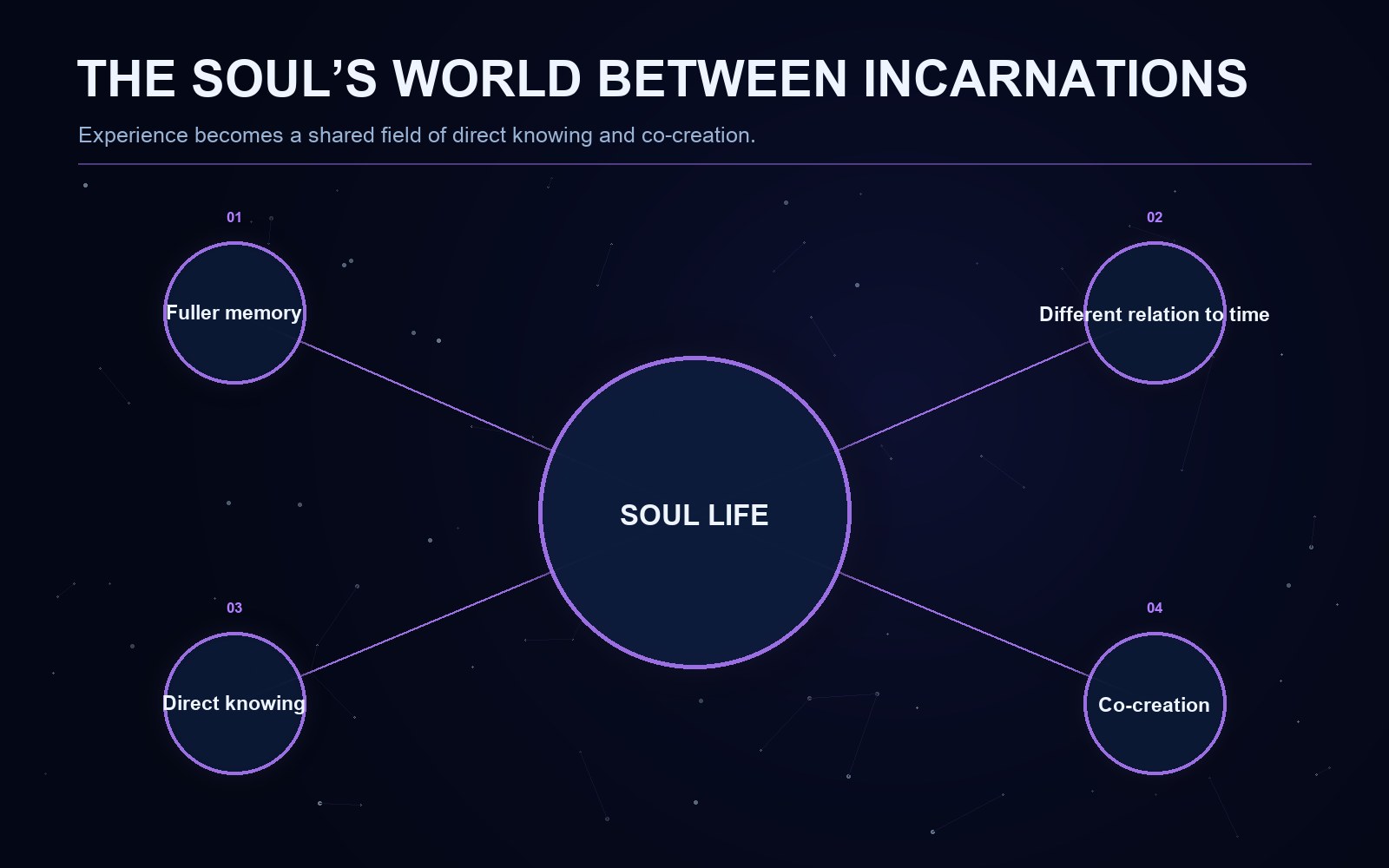
Channeling is usually described as receiving information from a being, teacher, Higher Self, deceased person, or representative of another civilization. A message may come in words, images, sensations, or as an entire block of meaning received at once.
I do not believe that this form of communication is impossible. Consciousness can perceive and transmit information outside our usual physical channels. I have observed communication without speech and encountered different forms of consciousness myself.
But the possibility of contact does not establish the identity of the speaker, and it does not guarantee that the message is true.
Different signals can travel through the same channel
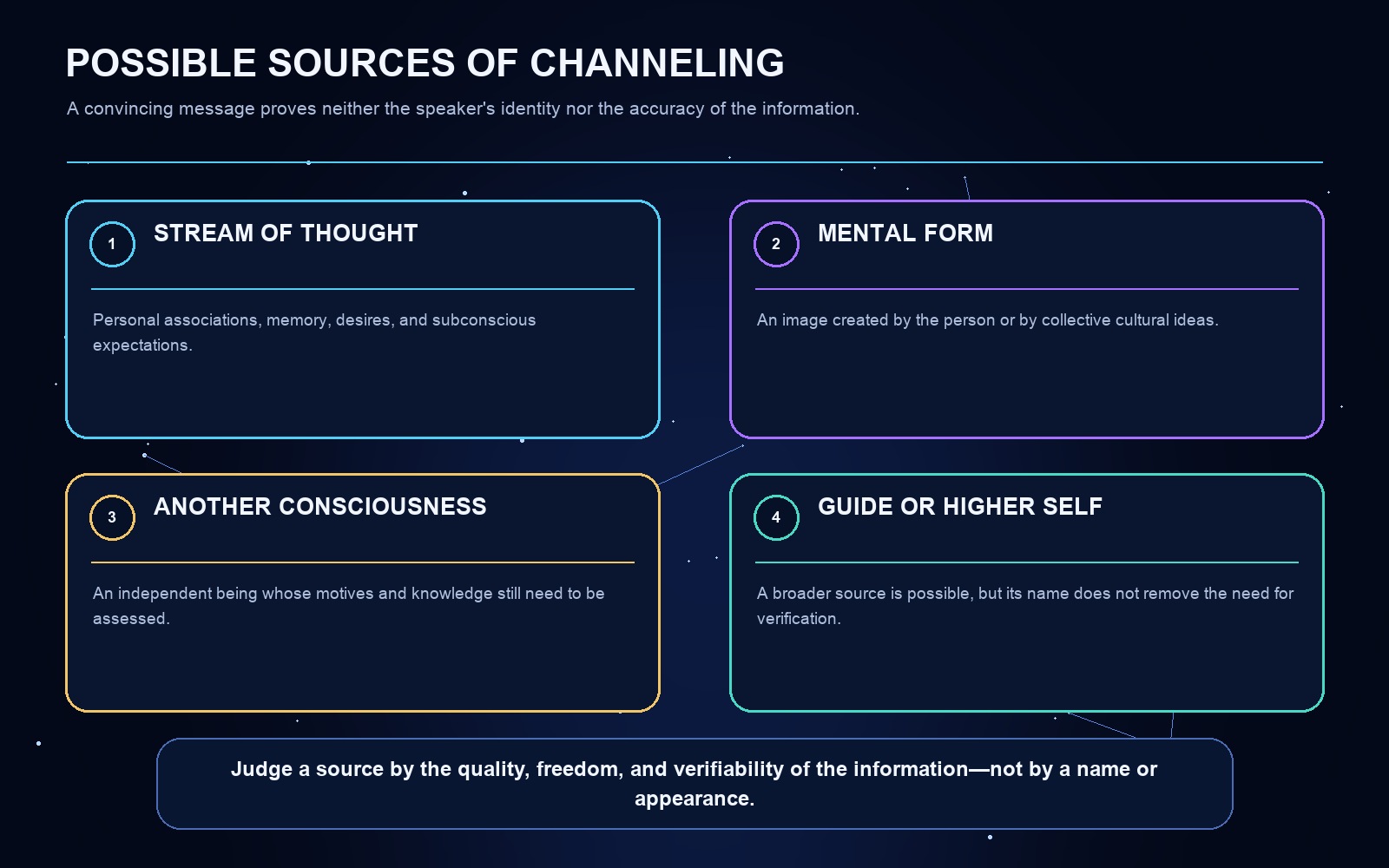
When a person hears an inner voice or receives unusual information, several sources are possible:
his own stream of thought and subconscious associations;
memory, expectation, and desire;
a mental form created by the person himself;
collective religious or cultural imagery;
the consciousness of another being;
a guide, teacher, or Higher Self;
a mixture of several sources.
Subjectively, all of these can feel equally convincing. That is why saying “I heard it clearly” does not answer the central question: Whom—or what—did the person hear?
Why a source can claim any identity
In mental space, form readily adjusts to the observer’s expectations. An entity or thought-form may assume a recognizable appearance, adopt an impressive name, and speak with confidence.
A name is not identification. A luminous appearance is not proof of spiritual stature. Beautiful words about love do not guarantee wisdom.
The more strongly someone wants to meet a particular teacher, saint, or extraterrestrial being, the easier it is for the mind to create the corresponding form. And if contact is taking place with an independent consciousness, that consciousness may also use the person’s expectations to establish trust.
I therefore evaluate the quality of the information and the consequences of the contact, not the appearance of the messenger.
Warning signs
I approach messages cautiously when the source:
repeatedly emphasizes its own greatness;
declares the channeler a chosen savior;
demands unconditional obedience;
frightens people with an approaching catastrophe and offers the only path to safety;
divides humanity into the spiritually superior and inferior;
forbids the recipient to verify information;
flatters, promises power, or grants supposedly exceptional abilities;
makes endless predictions that cannot be tested;
dictates decisions about money, health, or intimate relationships;
becomes the central authority in the person’s life.
An advanced consciousness does not need worship. A genuine teacher helps a person become clearer and more independent; he does not turn that person into a dependent follower.
Why messages reflect their era
Throughout history, channeled sources have spoken in the language of their culture. In earlier centuries, people encountered angels, saints, and prophets. Later, cosmic teachers, star federations, and guardians of new frequencies became increasingly common.
This does not prove that every message is invented. It does show how strongly information is filtered through the recipient’s consciousness. Even a real meaning may assume a form that the channeler and his audience can understand.
A person is not a transparent wire. The brain, vocabulary, education, religious background, and expectations all take part in translating received meaning into human language.
How to evaluate channeling
The first rule is not to follow an important instruction merely because it supposedly came from a higher level.
Ask several questions.
Can specific information be checked? If the source makes a claim about the physical world, that claim must withstand ordinary verification.
Is the message logically consistent? Contradictions cannot be explained forever by a “shift in the timeline.”
Does information agree across independent sources? People who know one another repeating the same ideas is not independent confirmation.
Does the message preserve freedom? Mature knowledge can be offered without threats.
Where does the contact lead? Toward clarity, responsibility, and growth—or toward fear, superiority, and dependence?
Can the channeler question his own interpretation? If every doubt is treated as an attack by dark forces, investigation has already ended.
Valuable information does not make a source infallible
A source may offer one useful insight and be wrong about something else. A person may receive a meaning accurately and translate it poorly. A real contact may become mixed with personal expectations.
We do not need to choose between two extremes: “Everything channeled is true” or “It is all fantasy.” Reality is more complex. Knowledge, interpretation, and mental construction may coexist in the same stream.
The investigator’s task is to separate them.
The Higher Self does not speak through a torrent of random thoughts
A common mistake is to treat every unusual thought as a message from above. The brain continually produces associations, forecasts, fears, and desires. Most inner dialogue belongs to this stream.
Connection with a broader part of consciousness usually feels different. It brings clarity rather than verbosity. Information may arrive instantly, as a whole understanding, without pressure or drama. Even then, the experience still requires reflection and verification.
An inner voice should never be given authority over a person’s life merely because it calls itself the Higher Self.
My principle: listen without automatic obedience
I remain open to information from nonphysical sources. Without that openness, an investigation of consciousness would be impossible. But openness is not gullibility.
I treat every message as material for further work. I compare it with my experience, test its internal consistency, look for confirmation, and observe its effects.
Truth is not afraid of examination. A source that asks us to turn off reason is offering a new form of dependence, not knowledge.
You can read more about mental forms, guides, and communication beyond the physical body in my book The Phenomenon of Consciousness Beyond the Body.
When familiar explanations stop providing answers, an enormous landscape of ideas opens before us. Energy, chakras, past lives, astral worlds, teachers, channeling, karma, vibrations, other civilizations—esotericism offers an explanation for almost every unusual phenomenon.
The problem is that an explanation is not the same as knowledge.
Esoteric traditions contain valuable observations gathered by generations of practitioners. Alongside them, however, are fantasies, contradictory systems, commercial promises, and beliefs that cannot be tested. If we accept everything, we do not expand our understanding of reality. We simply replace one closed system with another.
Complicated words do not make an idea profound
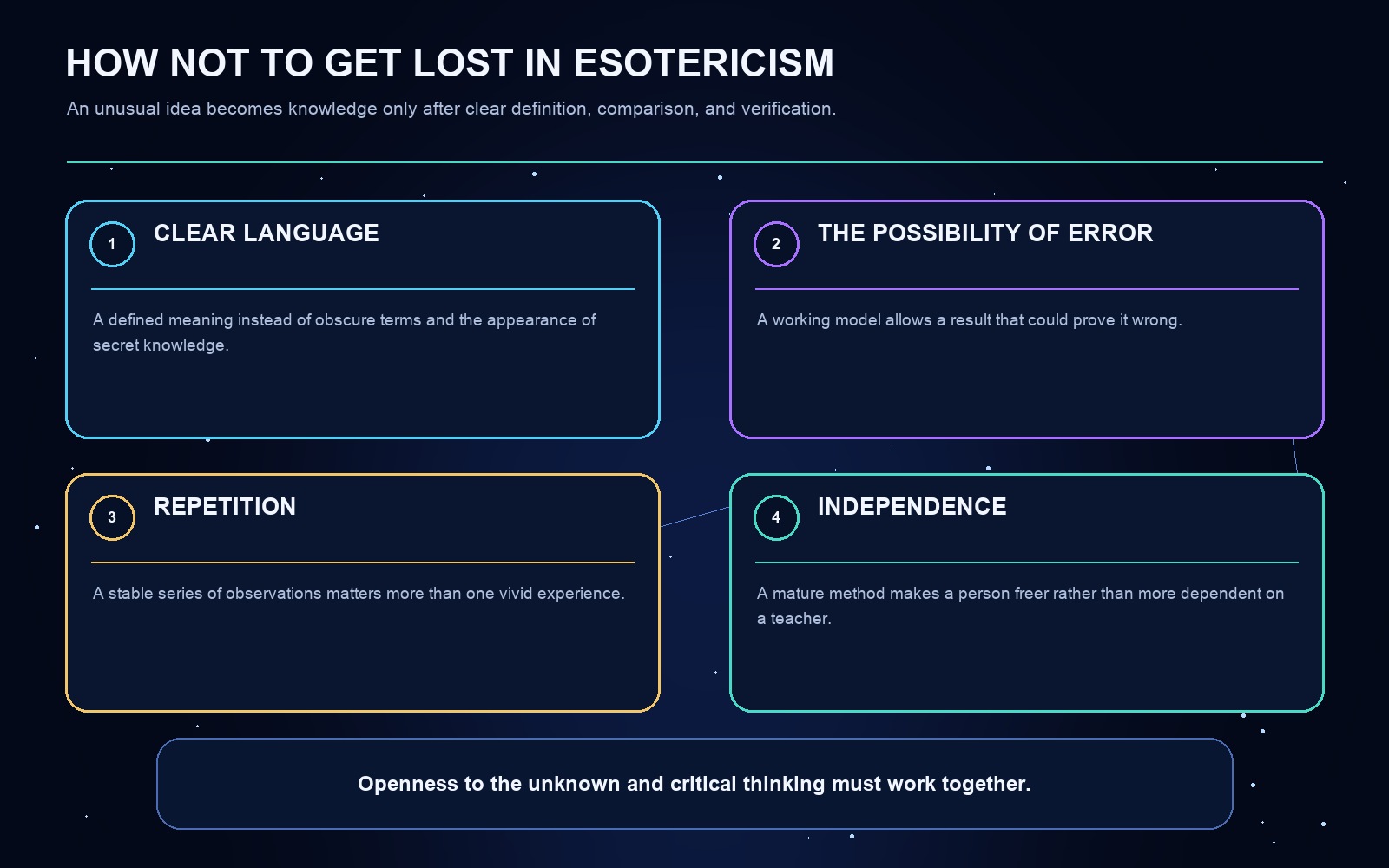
I deliberately try to speak about consciousness in simple, contemporary language. Complex terminology often creates an impression of depth where there is no clear content.
If an author cannot explain what he actually observed but constantly uses words such as “quantum,” “high-vibrational,” “multidimensional,” or “energy-information,” that proves nothing. Every term needs a clear meaning.
I use the phrase “energy level” because it identifies a specific part of my model of reality. I explain what I mean by it and which characteristics allow me to distinguish one level from another. Without a definition, the phrase becomes decoration.
The first rule of an investigator is simple: if you do not understand what a statement means, do not rush to declare it profound.
A system that explains everything explains nothing
A dangerous feature of many esoteric teachings is that every outcome supposedly confirms them.
If a prediction comes true, the teacher possesses special knowledge. If it fails, the energy timeline changed. If a method helps, it works. If it does not, the student lacked faith, had low vibrations, or was not ready.
Such a system cannot be tested because it is protected in advance from every objection. That is no longer investigation; it is faith in one’s own infallibility.
A useful working model must allow the possibility of error. I can speak confidently about something I have observed repeatedly while leaving room to refine the mechanism. Reality is under no obligation to conform to my terminology.
Personal experience can also mislead us
An unusual experience can feel more vivid than physical life. The force of an impression, however, does not guarantee that our explanation of it is accurate.
During an out-of-body experience, a person may enter a mental layer—a space shaped by the mind, memory, fear, and expectation. A religious person may see figures from his tradition. Someone devoted to cosmic teachings may see representatives of other civilizations. A person expecting an attack may create a frightening form himself.
The experience may be real. The interpretation may be wrong.
I therefore separate three levels:
The event: what happened and what I directly perceived.
The interpretation: how I explained what I perceived.
The conclusion: the general rule I attempted to draw from it.
The farther we move from the event, the greater the chance that belief has been mixed into the experience.
Signs of a spiritual trap
Be cautious when a teaching or teacher:
claims to be the sole source of truth;
asks you to give up independent verification;
treats doubt as spiritual weakness;
continually promises a rapid ascent to a “new level”;
uses fear, guilt, or the idea of being chosen;
charges ever more money for the next secret;
separates followers from loved ones and other sources of information;
promises to solve every physical, psychological, or practical problem with one universal method;
makes people dependent on a continuing stream of messages and instructions.
A real teacher increases a student’s independence. A manipulator increases dependence.
How to evaluate unusual information
I use several simple principles.
Compare sources. Agreement among independent observations does not prove a claim, but it deserves attention.
Look for repetition. One vivid episode may be chance or a mental construction. A series of similar observations provides firmer ground.
Separate the experience from the promise. A person may honestly describe an experience and still misunderstand it. Sincerity is not accuracy.
Examine the consequences. Knowledge should increase clarity, responsibility, and the ability to live. If a teaching makes a person anxious, arrogant, and helpless without a teacher, that is a serious warning.
Do not abandon common sense. Spiritual growth does not require us to stop checking health information, financial decisions, contracts, or the facts of physical life.
Skepticism must not become blindness
Critical thinking is essential, but it too can become a dogma. If a person declares everything he has not experienced impossible, he is no longer investigating reality. He is defending a materialist worldview.
My approach is neither to believe everything unusual nor to deny it. I propose investigation: gain experience, compare it with other observations, repeat, correct mistakes, and do not be afraid to say, “I do not know yet.”
At the same time, do not be afraid to say, “I have observed this many times and I am certain of the fact, even though the mechanism still needs to be studied.”
The main point of reference is not a school or a teacher
Esotericism becomes dangerous when a person searches within it for a new external authority. He continues living by someone else’s explanations; he has merely exchanged sacred books for courses and prophets for popular guides.
An investigator follows a different path. Books, teachers, and methods are tools, but none of them receives his right to see, think, and decide.
Unusual reality exists independently of our schools and labels. To keep from getting lost in it, we need clear awareness, disciplined observation, and honesty with ourselves—not mysterious language.
You can read more about the difference between observation, mental construction, and objective experience in my book The Phenomenon of Consciousness Beyond the Body.
I know the religious world from the inside. I spent seven years studying at a theological academy, was ordained, and served as a pastor for nearly a decade. I lived according to my faith, sincerely tried to help people, and believed that religion would give me answers to the most important questions: Who are we? Why are we here? What happens after death?
That path gave me a great deal. It taught me discipline, responsibility, and attentiveness to a person’s inner life. Over time, however, I began to see another side of it: a ready-made system of answers can guide us, but it can also confine us. At some point, a person may stop investigating reality and begin defending a worldview received from others.
That is when faith becomes religiosity—and religiosity becomes a cage.
Faith and religiosity are not the same
Faith can be a living inner trust in the world, in the Source, and in the meaning of life. It can sustain us through difficult periods, help us remain honest, and keep hope alive.
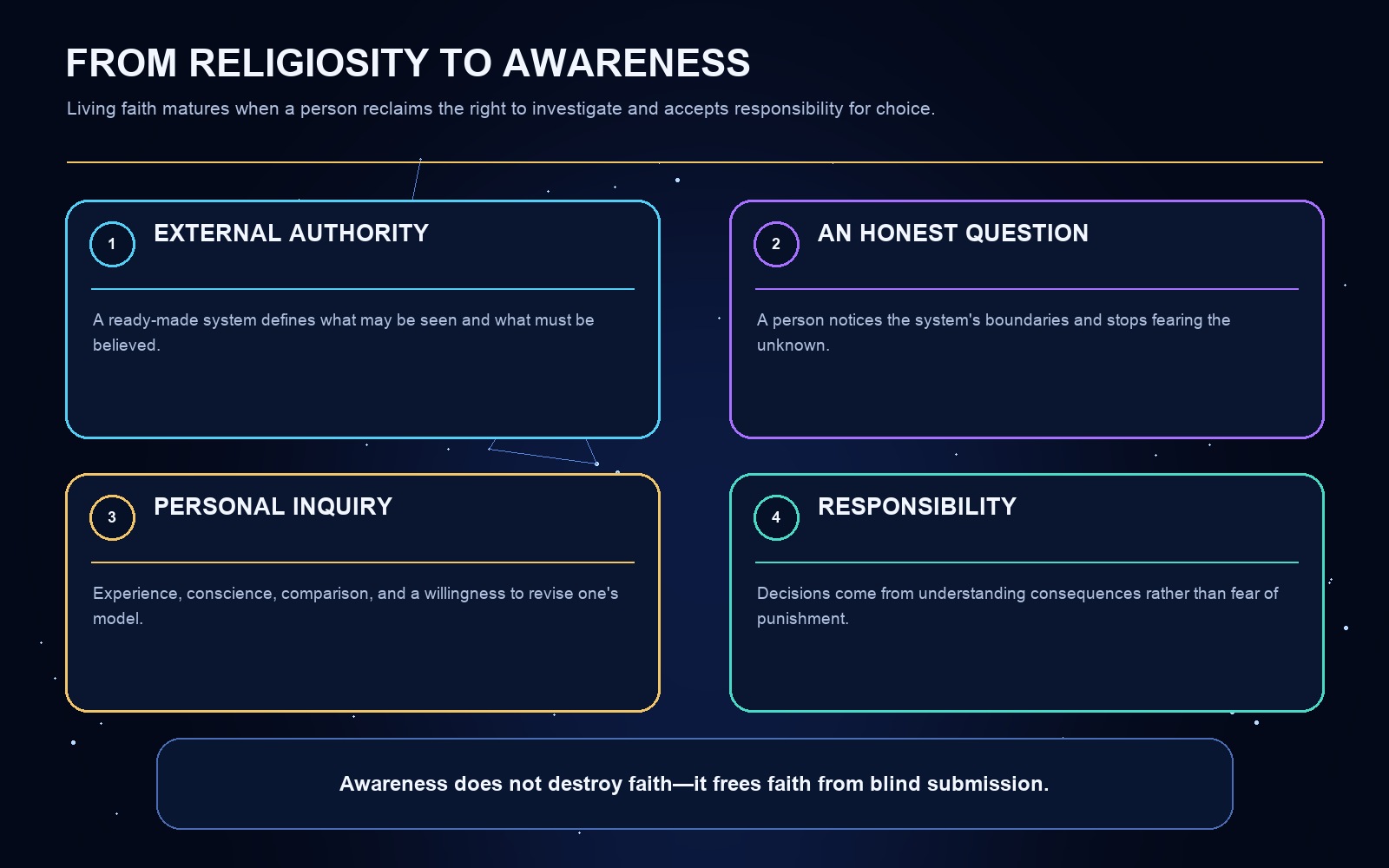
Religiosity, as I use the word here, begins when a person gives away the right to think and verify. He receives ready-made answers, a ready-made hierarchy, and a ready-made image of God. From then on, every personal experience is judged not by what it contains, but by whether it agrees with doctrine.
If an experience fits the system, it is accepted as spiritual. If it does not, it is labeled delusion, temptation, or danger. In this way, the system protects its own boundaries rather than the truth.
Awareness works differently. It does not require us to abandon faith. It requires us to take responsibility for what we believe and why we believe it.
Why a ready-made answer is so appealing
Uncertainty frightens people. It is easier to hear, “This is exactly how reality works,” than to admit that reality may be far larger than our ideas about it.
A religious system gives a person clear coordinates: what is good, what to fear, whom to trust, and what will happen after death. Along with answers, it often provides belonging and security. But the price of that security may be the surrender of one’s own investigation.
A person becomes accustomed to seeking truth not within consciousness or lived experience, but in an authoritative text, an office, or a tradition. Obedience is mistaken for spirituality, fear of punishment for conscience, and repetition of someone else’s words for inner knowledge.
Awareness begins with an honest question
An aware person may believe in God, the Source, the soul, and the continuation of life. The difference is that he does not hide behind those words. He asks questions and is willing to revise his understanding when new experience reveals that the old model was too narrow.
Inner knowledge does not grow out of a desire to feel chosen. It grows through observation, personal practice, comparison of facts, and the ability to admit one’s own mistakes.
That is why awareness is inseparable from personal responsibility. If I say that I have had a spiritual experience, I must ask myself:
What did I actually experience, and what did I add later?
Did fear, expectation, or a religious image shape what I saw?
Can the observation be repeated?
Does the experience help me see reality more clearly?
Does it make me more responsible, or merely give me a sense of superiority?
These questions do not destroy spiritual experience. They refine it.
Fanaticism is not limited to religion
I did not leave a religious system in order to replace one set of dogmas with another. A person can believe with the same fanaticism in an esoteric teacher, a political ideology, or a materialist explanation of consciousness.
Fanaticism does not begin with a particular idea. It begins with the refusal to test that idea. The moment a person treats his worldview as final, he stops seeing what contradicts it.
Religiosity can therefore exist without a church. It appears wherever there is an infallible authority, a prohibition against doubt, and fear of stepping outside prescribed boundaries.
Conscience is stronger than an external prohibition
A religious person often looks to an external rule: permitted or forbidden, reward or punishment. Awareness moves the center of decision-making within the person.
This does not mean that anyone may justify any action by saying, “That is how I feel.” Real inner freedom demands more responsibility than external obedience. A person learns to see the consequences of his choices, to feel another person’s pain, and to act not from fear of punishment but from an understanding of the connection among all living beings.
Conscience is not a list of prohibitions. It is the soul’s ability to recognize what destroys life and what helps it grow.
Spirituality does not require an intermediary
A teacher, tradition, or book may illuminate part of the path. But each person must walk that path for himself. No one can become aware of reality on our behalf.
I am not calling on people to abandon religion. I am asking them to stop granting a religious organization the exclusive right to speak for God. If the Source truly lies at the foundation of all life, then a connection with it cannot belong to one denomination, one nation, or one intermediary.
A person has the right to investigate consciousness, ask uncomfortable questions, and build understanding from personal experience. He also has a duty to remain honest: not to mistake wishful thinking for reality or declare a personal impression to be a universal law.
A faith strong enough to be examined
I did not lose faith when I moved beyond the religious system. On the contrary, my understanding of the Source became broader. I stopped seeing God as an external ruler who distributes rewards and punishments. To me, the Source is a living consciousness of which everything that exists is a part.
Such faith is not afraid of questions. If an idea collapses under honest investigation, what has collapsed is not truth, but our limited model of it.
Awareness does not require us to know everything. It requires us not to deceive ourselves. It allows us to believe, investigate, question our explanations, and still move confidently toward what repeated personal experience confirms.
This is what I consider mature spirituality: neither blind submission nor the denial of everything unseen, but a living connection with the Source, tested through life, conscience, and one’s own consciousness.
You can read more about my path from religious ministry to the study of consciousness in my book The Phenomenon of Consciousness Beyond the Body.
After someone close to us dies, we are left with questions that cannot be answered through an ordinary phone call, letter, or meeting: Can they hear me now? Do they know I still love them? Do they see my pain? Can they remain close to me?
For me, this is not an abstract philosophical question. Over twenty years of out-of-body investigation, I have repeatedly encountered a reality in which the death of the physical body does not mean the disappearance of the person. The form of existence changes. The way perception works changes. Familiar communication through voice, hearing, and the body comes to an end. But the soul, its memory, and its connection with loved ones are not destroyed.
Those who have died can still perceive us. But they do not hear us in the same way they did during physical life. On other levels of reality, thought, feeling, and intention can be communicated directly.
To understand this connection, we need to consider what happens to a person after death, why the relationship changes over time, and why we so rarely receive an answer that leaves no room for doubt.
Death Ends the Work of the Body, Not the Life of Consciousness
We are accustomed to recognizing a person through the body. We see a face, hear a voice, and feel a touch. When the body dies, it can therefore seem that the person has disappeared as well. Our physical senses can no longer find the one we love, and the brain reaches a natural conclusion: they are gone.
But the body was a means of interacting with the physical world. It was not the source of the soul itself.
After death, a person continues to be aware of who they are. At first, they remain in many ways the same personality: they remember their name, character, loved ones, and the life that has just ended. Later, perception expands. A deeper memory of the soul returns, and the earthly personality reconnects with a larger part of itself. This happens gradually.
The early stages of this transition are especially important when we are trying to understand the bond between the living and those who have died. The soul does not necessarily vanish immediately into some inaccessible realm. For a time, it may remain close to the physical world, processing what has happened, observing loved ones, and saying goodbye.
This may help explain why people in many different cultures independently report sensing the presence of someone who has recently died. That does not mean every such impression is necessarily a genuine contact. The human mind can produce vivid images, especially during grief. But it would be equally mistaken to dismiss every experience as fantasy simply because our current worldview cannot yet explain it.
My Encounter With a Neighbor Who Had Died
One of my clearest experiences occurred during an out-of-body state.
I left my body and rose through the ceiling and the roof of my building. A man was sitting nearby. At first, I assumed he was another out-of-body traveler. He looked young, calm, and fully aware of what was happening.
We began to talk. He was surprised that I had passed through the roof, and I jokingly asked whether he still used the stairs. At one point, he told me that he had initially taken me for someone who had died. Only then did I understand: he was the one who had died.
I asked what had happened to him and why he was there. He replied that he was actually very old, although he now appeared young. He had lived a long life, he was tired, and he knew that he would soon return home, where his family was waiting for him. For the moment, however, he wanted to say goodbye to his body. His funeral would take place soon.
I offered to deliver a message to his relatives who remained in the physical world. He declined. He was peaceful, did not feel abandoned, and clearly understood that he had others with whom he could communicate. I continued my exploration.
A few days later, I learned that my neighbor across the landing had died—an elderly man whom I had occasionally seen stepping onto his balcony.
An artistic reconstruction of my encounter with a deceased neighbor during an out-of-body experience.
This encounter became important evidence for me that the soul does not necessarily leave the vicinity of earthly life immediately after death. For a time, a person may remain nearby, retain the familiar personality, observe what is happening, and prepare to return home.
But that person is already perceiving reality in a different way.
What Does It Mean to Say They Can “Hear” Us?
When we ask whether those who have died can hear us, we instinctively imagine a person standing somewhere and listening to our words. But physical hearing belongs to the body. After death, the way information is transmitted changes.
Words can still be used in an out-of-body state, especially when the people involved are accustomed to human speech. Yet meaning can also be communicated without language. At times, you do not hear a sentence one word at a time. You understand the whole thought at once, together with the feeling, intention, and context that would require a long explanation in an ordinary conversation.
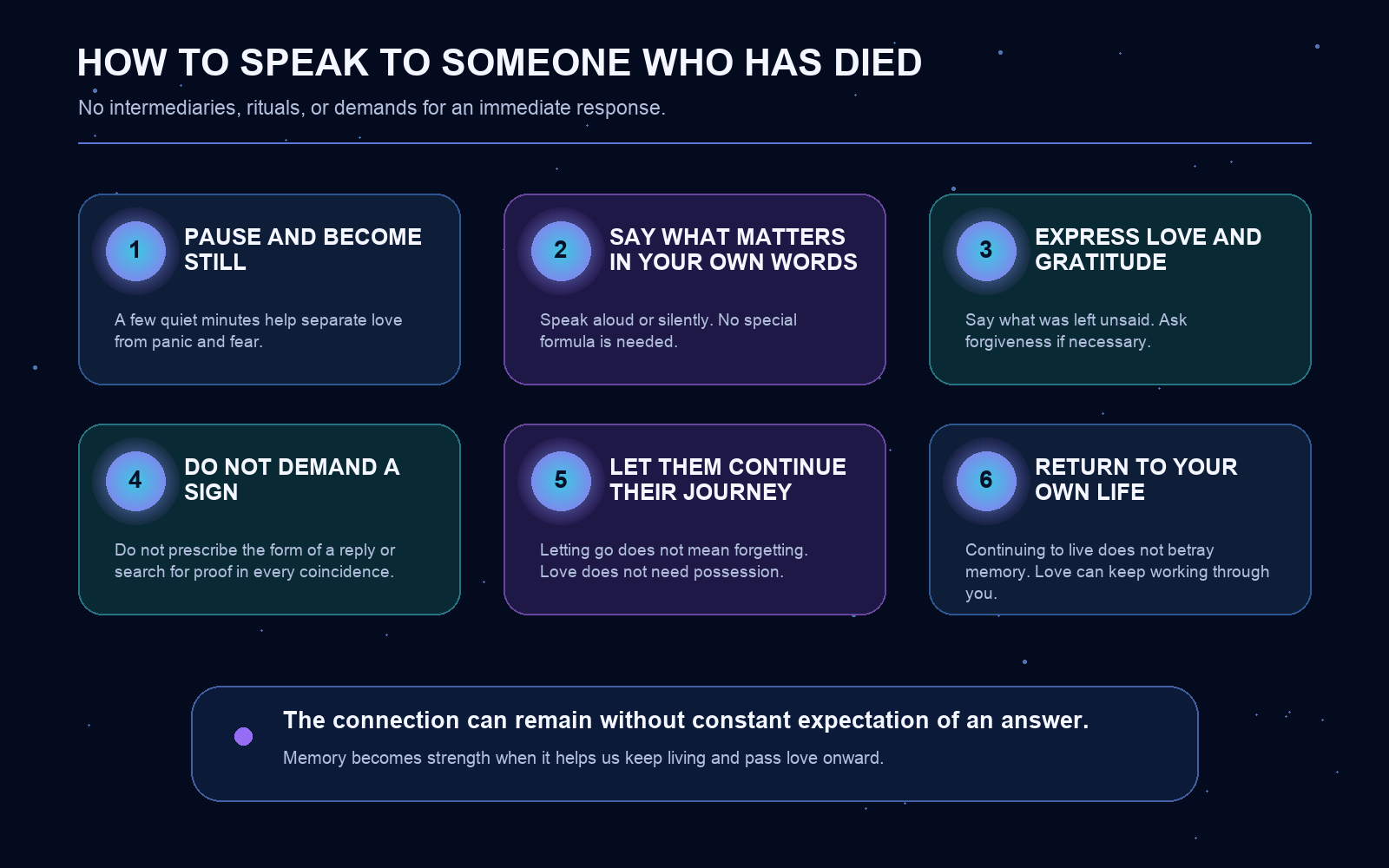
For that reason, a sincere inner message may matter more than a carefully composed statement. No special prayers, magical formulas, or intermediaries are required in order to express love, gratitude, or a request for forgiveness. You can speak to someone who has died in your own words—aloud or silently.
I cannot promise that every message will be perceived immediately. The soul continues its own journey and is not required to remain constantly beside an earthly family. But a sincere inner message does not become meaningless simply because we have no physical way to verify its receipt.
The connection between souls is not governed by distance in the same way the body is.
Why Some People Remain Near the Physical World for a Time
After death, a person may not immediately understand what has happened. This may be especially likely after a sudden death, a powerful attachment to the body, or a lifelong conviction that nothing exists beyond physical life.
Others understand the transition quickly. They see their own body, perceive their loved ones, and recognize that the earthly stage has ended. Often, the soul remains nearby not because it is unable to leave, but because it wants to say goodbye and support the people it loves.
The living, meanwhile, are experiencing shock, pain, and confusion. The person who has died may try to communicate that they still exist and that they are all right. But someone immersed in acute grief is rarely able to perceive anything beyond the force of that pain.
This is not the grieving person’s fault. The loss of physical presence is real. No knowledge about the continuation of life can replace a familiar voice, a touch, or the ability to see someone we love beside us. Grief cannot be erased by beautiful words. It has to be lived through.
It is still important to understand that a departed soul is not left alone. The person is met, guided, and helped to recover a fuller understanding of who they are. Even if someone dies confused, frightened, or unprepared for the transition, they are not abandoned in emptiness.
Why We Rarely Receive an Unmistakable Answer
If those who have died can perceive us, why do they not answer in a way that removes every doubt?
The main obstacle may not be on their side, but on ours. The physical brain is designed to process signals from the material world. It receives light, sound, pressure, temperature, and other physical influences. Information that arrives outside the familiar senses must pass through a very narrow channel, and it quickly becomes mixed with memory, expectation, and imagination.
We also tend to demand a particular form of response. We ask a loved one to turn on a light, move an object, send a specific sign, or appear in a dream. Then we begin watching every coincidence. In that state, it is easy to mistake what we want to see for what is actually there.
A real connection does not have to stage a performance in order to prove that it exists.
There is another reason. Those who have died are not meant to direct every part of our lives. We came into this world to make decisions, make mistakes, learn, and become more aware. If a loved one warned us about every danger and dictated every next step after death, that person would deprive us of much of our own experience.
Love is not always expressed through intervention. Sometimes love means remaining connected while allowing another person to walk their own path.
The absence of an obvious sign does not mean that someone has disappeared, forgotten us, or stopped loving us.
Can Our Grief Hold a Soul Back?
People who have lost someone close sometimes become afraid of their own emotions: Are my tears preventing them from moving on? Am I holding them here? Am I causing them pain?
Love itself does not trap anyone. Natural grief is not a prison for the soul either. We cannot lose someone we love and feel no pain.
But there is a difference between love and a desperate demand that the person continue to live only through our earthly life. When someone refuses for years to accept what has happened, constantly calls the dead person back, demands signs, and turns that memory into the only meaning of life, a heavy emotional attachment is being continually reinforced.
A recently departed soul may perceive this pain and try to comfort the person who remains. But there comes a time when that soul needs to continue its own journey and return to the world of the soul. The living person must also continue their earthly life.
Letting go does not mean forgetting. It is not betrayal, and it is not the end of love. Letting go means accepting that the form of the relationship has changed. We can no longer hold the person through a body, a voice, and a shared daily life, but we can preserve gratitude, respect, and an inner connection.
I love you. Thank you for the life we shared. I will remember you. You may continue your journey, and I will continue mine.
Letting go does not mean forgetting. The connection remains, even as each person continues their own journey.
Should We Try to Summon the Dead?
I do not believe that communicating with someone who has died requires séances, elaborate rituals, or people who promise guaranteed contact in exchange for money.
The desire to obtain an answer at any cost makes a person vulnerable. Intense longing can lead us to see confirmation where none exists, and dishonest people can exploit that need. In addition, the energetic level nearest to ours contains more than our own relatives. It may include thought-forms, people who have recently died, beings with different intentions, and reflections of our own expectations.
Receiving unusual information does not by itself prove that it came from the person the source claims to be.
For this reason, I am cautious about any contact that demands worship, money, submission, fear, or unconditional belief. A genuine connection with someone who loves you should not weaken your will, inflate a sense of being specially chosen, or require you to abandon sound judgment.
You do not need an intermediary to speak to someone you love. Speak calmly and honestly. Say what you did not have time to say. Express gratitude. Ask forgiveness if necessary. Then return to your own life.
Do not turn love into an endless wait for an answer.
How to Think About Possible Signs
At times, a person suddenly senses a familiar presence, receives a very clear inner knowing, or encounters a coincidence with deep personal meaning. I am not suggesting that such experiences should be dismissed. But we should not declare every event a message from beyond either.
It is better to ask a few questions:
Did the experience arise naturally, without intense expectation?
Did it leave clarity and calm rather than fear and dependence?
Am I forcing a coincidence to confirm something I desperately want to believe?
Does the presumed source demand unquestioning obedience?
Does the experience help me live with greater awareness and responsibility?
Genuine contact does not cancel the ability to think. Spiritual experience and critical perception are not enemies. The more important an experience is, the more calmly and honestly it should be examined.
Ordinary dreams should not automatically be turned into messages either. During sleep, the brain freely combines memories, fears, desires, and fantasies. A vivid dream may be personally meaningful, but that alone does not prove that a real meeting occurred. For me, what matters is not only the emotional power of an image, but the quality of awareness, the consistency of the experience, and the possibility of at least partial verification.
Why Those Who Have Died Do Not Fix Our Lives for Us
Continuing to exist after death does not instantly turn a person into an all-knowing guide. Someone who has recently died still perceives themselves through the life that has just ended. They also need time to understand what has happened and recover a fuller memory of the soul.
Even later, when understanding expands, our loved ones do not begin to manage us. They recognize that our lives have their own meaning. Some decisions cannot be made for us. Some qualities cannot be delivered as ready-made advice; they can only be developed through our own choices.
We often ask, “If you can hear me, tell me what I should do.” But the love of someone who has died should not replace our own awareness and responsibility.
Support may appear in subtler ways: an unexpected inner steadiness, a sense that we are not alone, or a reminder of the good that person taught us. Yet we still determine the direction of our lives.
How to Preserve the Connection and Continue Living
Memory becomes destructive when we use it only to return again and again to the moment of loss. But it can become a source of strength when it helps us continue the best of what the relationship created.
We can speak to someone who has died without demanding a reply. We can keep photographs and meaningful objects without turning the home into a place of permanent waiting. We can continue shared work, pass along the kindness we received, support the family, and live in a way that allows love to take form through our actions.
New joy does not erase memory. New love does not cancel the love that came before it. The desire to keep living is not a betrayal of the dead.
If someone we love can truly perceive us, it is difficult to imagine that they would want the rest of our life to become a monument to pain. It is far more natural to believe that they want us to grow, recover our inner strength, and become capable of joy again.
We preserve the connection not by refusing to live without someone, but by allowing their love to keep working in the world through us.
Love Does Not End With the Body
Those who have died do not cease to exist. They become inaccessible to ordinary physical perception, pass through a transitional stage, and return to a fuller state of the soul. For a time, they may remain close to the earthly world. Later, the connection changes form, but it is not destroyed.
We can speak to them. We can express gratitude, ask forgiveness, and tell them that we love them. But we do not need to hold them beside us, demand proof, or build our lives around the expectation of signs.
Love is not measured by the number of supernatural events we experience. It is revealed through what another person changed within us, what they taught us, and what continues to live through our decisions.
Death separates bodies, but it does not destroy the experience we have gathered or the connection between souls. One day, each of us will complete the earthly stage, recover our memory, and meet again those we believed we had lost.
Until then, our task is to live: to remember those who have died with gratitude, to continue our own path, and to transform the love we received from them into something we can give to others.
For a deeper account of my experiences, encounters, and investigation of other levels of reality, continue with my book, The Phenomenon of Consciousness Beyond the Body.
A practical perspective from a researcher of consciousness beyond the body
Does the brain create consciousness—or is the brain an instrument through which consciousness expresses itself in the physical world?
At first, this may sound like an abstract philosophical question. Yet almost everything depends on how we answer it: what we believe a human being is, how we understand life and death, what we call personality, how we approach mental and physical illness, what we teach our children, and where we direct science and technology.
If consciousness is produced entirely by the brain, then the human being ends with the body. Our sense of self is only a temporary effect of neural activity, and death is the final end of the individual.
But if the brain does not create consciousness—if it receives, limits, and translates consciousness into the forms of physical life—then the entire picture changes. A human being is no longer only a biological organism. We become a union of the physical body and a wider living reality that can exist independently of it.
That is the conclusion I have reached after twenty years of investigating out-of-body experience, meditation, regression work, and altered states of perception.
Why I Began Looking Beyond Conventional Explanations
My interest in the nature of consciousness began when I was young. I wanted to understand how reality is structured, what a human being truly is, and what actually lies behind the word soul.
At eighteen, I entered a theological academy. I studied theology for seven years and served as a pastor for ten. I lived according to my faith and took the spiritual search seriously. Over time, however, I realized that the religious system did not give me all the answers I was seeking. It offered established explanations, while I needed an understanding grounded not only in belief, but also in direct experience.
I left church ministry and continued searching. I practiced meditation, breathwork, and energy work. Eventually, conscious out-of-body experience became the main focus of my research.
I did not build my model of consciousness on one unusual event. It emerged from many recurring observations. When a phenomenon can be repeated, displays recognizable patterns, and allows different states to be compared, it is no longer merely an impression. It becomes material for investigation.
What Remains When Perception Separates from the Body
I define an out-of-body experience as a conscious separation from the physical body. In that state, a person continues to exist as an individual. They see, hear, move, make decisions, retain memory, and know who they are.
Sometimes the separation feels so realistic that, at first, the person does not notice anything has changed. They may believe they have stood up, walked across the room, or begun an ordinary activity. Only later do they discover something impossible in the physical state: they see their body from the outside, pass through a wall, rise into the air, or interact with space in an unfamiliar way.
The central point is not that the experience is unusual. The central point is that the aware self remains present.
The physical body stays motionless, yet the person continues to perceive, act, and accumulate experience. For me, this became one of the strongest reasons to regard consciousness as an independent phenomenon that cannot be reduced entirely to the activity of the brain.
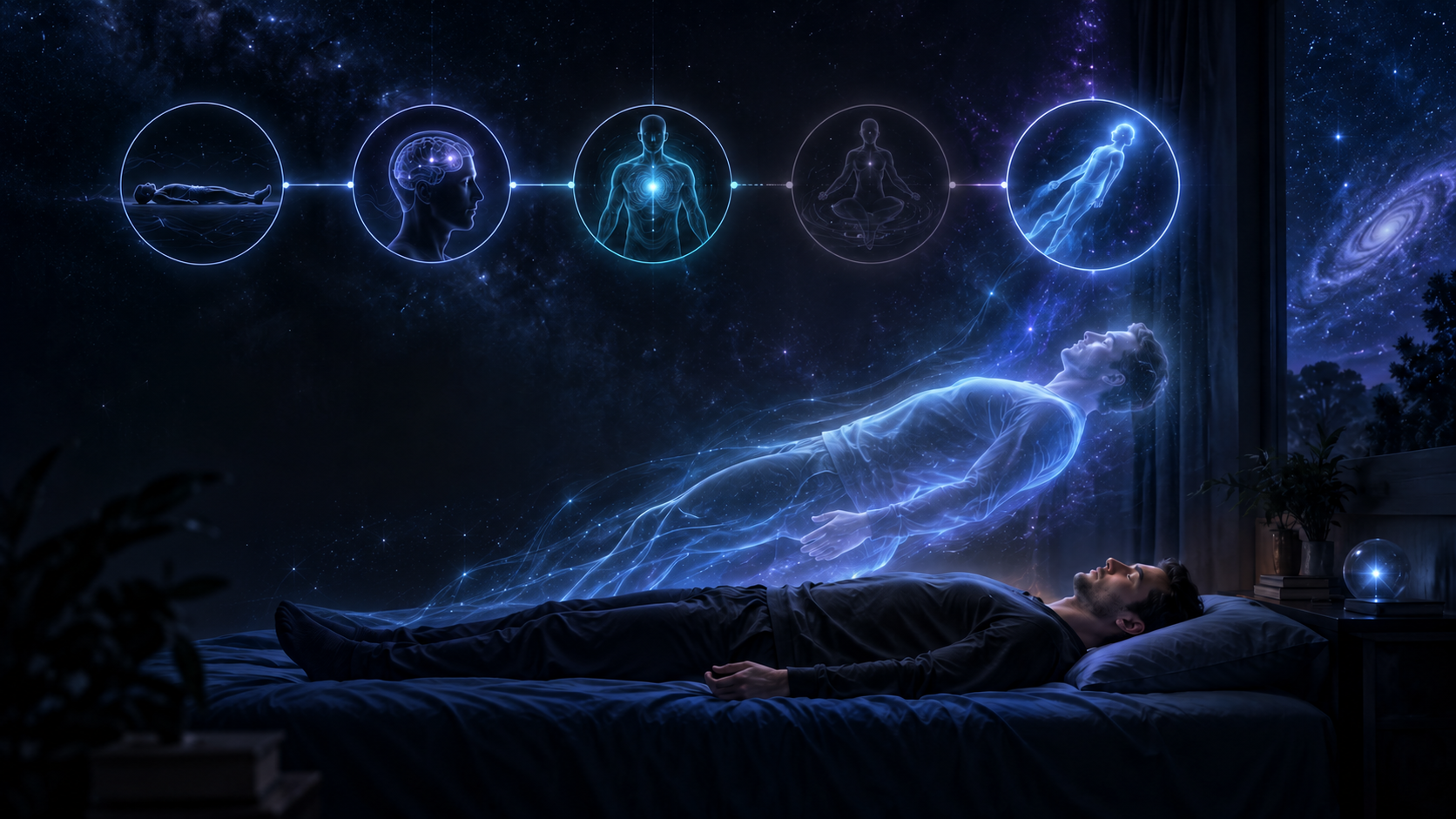
The human being as the meeting point of the physical body, the brain, personality, and a wider field of consciousness.
Not Every Out-of-Body Experience Is the Same
To understand consciousness, we must distinguish between different qualities of perception. Not every vivid experience is an objective exploration of reality.
I identify three primary states.
The first is an ordinary dream. In my model, this is a weak form of separation in which awareness is largely absent and the brain produces chaotic images from stored impressions, emotions, fears, and memories.
The second is a conscious out-of-body experience within a mental layer. Here, mental means created by the mind through its capacity for thought and imagery. The person knows they are outside the body, can direct their actions, and experiences everything with extraordinary realism. Yet much of the surrounding environment is shaped by the brain—by expectations, beliefs, fears, religious imagery, and events from the previous day.
The third state is what I call a clear, or objective, out-of-body experience. Awareness and control remain strong, while the perceived environment no longer responds to personal fantasy. In this state, a person may obtain information that can be compared with physical reality: the location of objects, the actions of other people, the content of conversations, or details they could not have known in advance.
These states are much less common. They are also especially important when investigating whether consciousness can function independently of the body.
Consciousness Is Not the Stream of Thought
One of our greatest mistakes is to equate consciousness with thought.
Thoughts arise in the brain. The brain compares, remembers, predicts, repeats fears, generates internal dialogue, and sends familiar patterns around the same loops. This stream of thought can be useful, but it is not consciousness itself.
Consciousness is that which can observe thought, direct attention, make a decision, and interrupt an automatic response.
Based on my practice, I understand consciousness as a living energy. It possesses attention and intention, can acquire experience, and preserves individuality. We do not yet have instruments that can measure this energy directly, but the absence of a measuring device does not erase the phenomenon we observe.
There was a time when humanity could not detect radio waves, electricity, or invisible forms of radiation. They did not come into existence when the instruments were invented. The instruments simply allowed us to recognize what had already been there.
I believe something similar is happening with consciousness. We observe its effects, but we do not yet possess an instrument capable of directly identifying its scope, quality, condition, or way of interacting with matter.
The Human Being as a Union of Two Forms of Life
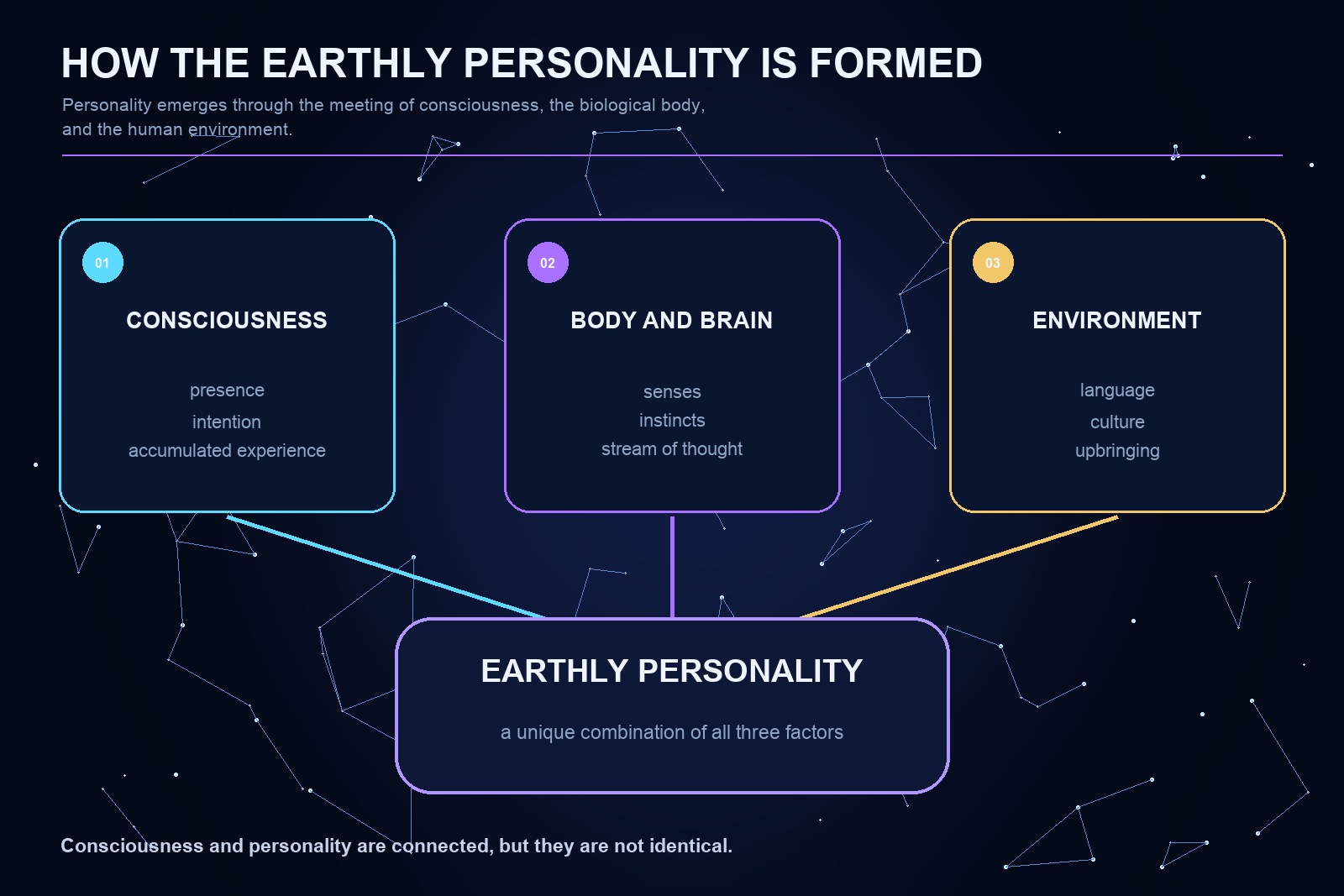
A human being is neither only a body nor only consciousness. The earthly personality emerges through their union.
Consciousness brings inner presence, awareness, intention, and accumulated experience. The body provides the senses, the nervous system, hormonal responses, instincts, and the ability to act in a physical environment. The brain processes incoming information, constructs mental models, and connects nonphysical experience with the specific conditions of human life.
Then come upbringing, language, culture, religion, education, fear, trauma, and social rules. Together, these elements shape the personality a person develops during an incarnation.
Consciousness and personality are therefore not the same. Consciousness is the deeper living foundation; the earthly personality also includes the brain, the body, and the entire body of human experience accumulated in this life.
The earthly personality emerges through the union of consciousness, body, brain, and human environment.
The Brain as an Interface, Not the Source
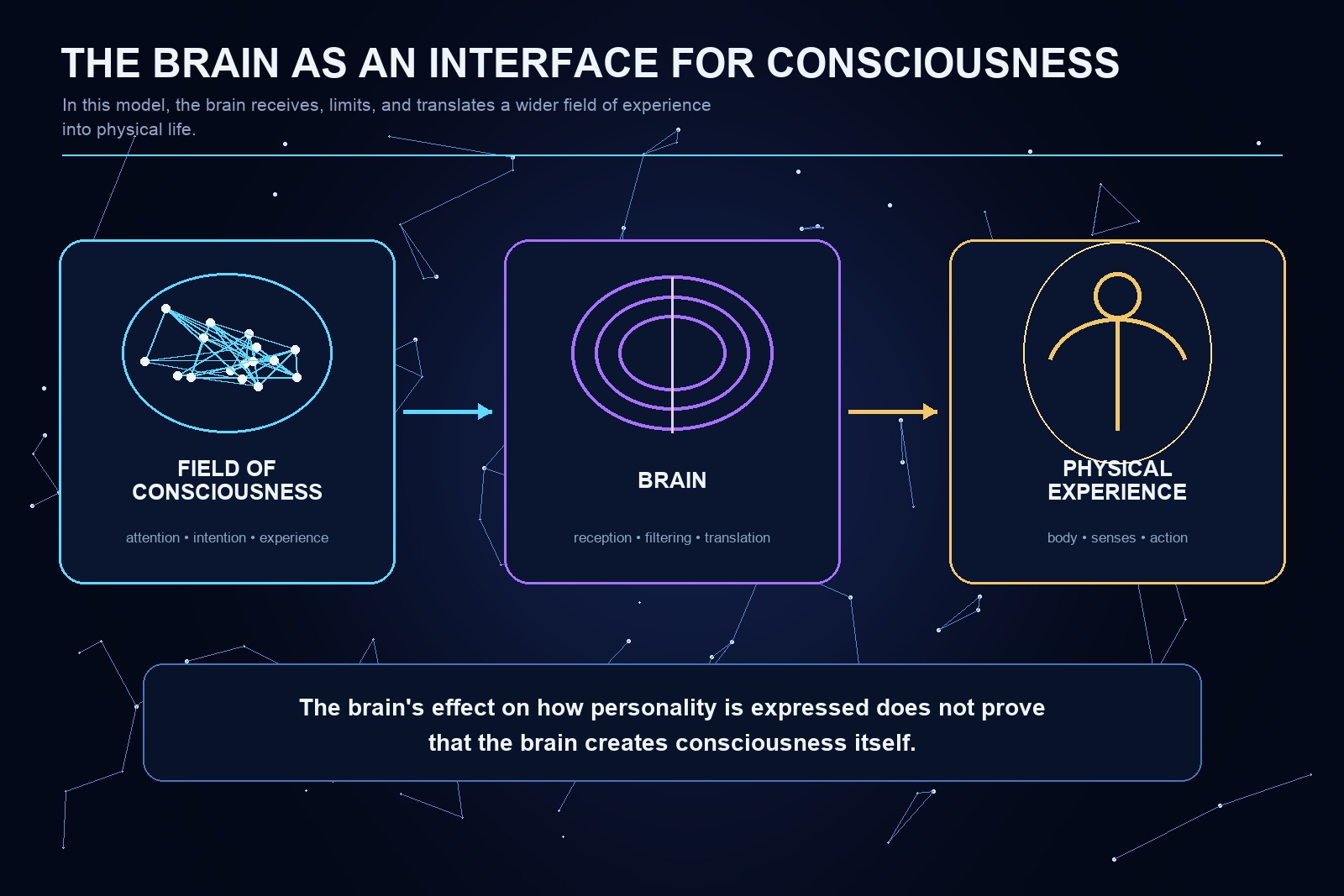
I see the brain and nervous system as the interface through which consciousness interacts with the physical body.
One useful analogy is a radio receiver. The receiver does not create the broadcasting station or the music. It receives a signal, converts it into an audible form, and allows it to appear in a particular place. If the receiver is damaged, the sound may weaken, become distorted, or disappear altogether. But damage to the device does not prove that the device created the signal being transmitted.
In the same way, the condition of the brain strongly affects how consciousness expresses itself through a human being. Illness, injury, chemical changes, or disruption of the nervous system can alter memory, speech, behavior, and the quality of perception. That is evident, and acknowledging it does not require us to reject the achievements of medicine.
Yet the brain’s influence on the expression of personality does not prove that the brain is the source of consciousness itself. The brain may instead determine the quality of the connection, the amount of information available, and the ways consciousness can manifest in the physical world.
This hypothesis deserves serious investigation rather than automatic rejection simply because it does not fit the prevailing materialist model.
A proposed model of interaction among the field of consciousness, the brain, and physical experience.
Why We Lose Awareness
Consciousness does not express itself through the body without resistance. Biological impulses, automatic brain responses, and the surrounding environment exert constant pressure on it.
From childhood, a person receives ready-made ideas about what is possible and impossible, what to fear, whom to obey, and who they are expected to become. Family, school, religion, culture, media, and social institutions establish durable programs of behavior in the brain.
Eventually, those programs begin to operate automatically. A person wakes, works, reacts, becomes irritated, consumes information, and makes decisions along familiar pathways. Weeks, months, and years pass while they barely notice their own presence in their life.
This is how autopilot takes over.
Consciousness is not what imposes limiting thoughts on a person. The brain reproduces them because it conserves energy by following routes it already knows. Consciousness can observe these programs and gradually regain direction, but doing so requires awareness.
Awareness Means Reclaiming Direction in Your Life
Awareness is more than paying attention to your breath or noticing objects around you. It means understanding who you are, what is happening within you, and which forces are shaping your decisions.
An aware person can notice a thought before it becomes an action. They can distinguish a real decision from an automatic response. They can recognize the influence of fear, upbringing, social pressure, and habit. They do not overcome every limitation instantly, but they cease to carry out those patterns without question.
Awareness can be developed. It grows through concentration, self-observation, meditation, honest examination of our reactions, and deliberate practice in directing attention.
The more fully consciousness can express itself, the less automatically a person lives and the more actively they participate in shaping their own life.
What the Psychology of the Future Could Investigate
Modern psychology has learned a great deal about behavior, emotion, memory, motivation, and the brain. Yet it primarily studies the expressions of personality without having a widely accepted answer to the nature of the aware subject itself.
If consciousness exists independently of the brain, an entirely new field of inquiry opens before psychology:
the structure and states of consciousness;
the boundaries of ordinary perception;
the mechanisms through which consciousness and the brain interact;
lucid dreams and out-of-body experience;
phenomena of expanded perception;
the effects of concentration and intention on the human condition;
methods for restoring inner wholeness.
Psychology could then study not only the behavioral consequences of inner processes, but the participant in those processes.
I am not proposing that we abandon neuroscience, diagnosis, or existing methods of care. I am proposing that we expand the subject of investigation. A human being is more complex than the brain, and the study of humanity should not end at neural activity.
How Medicine Could Change
Recognizing consciousness as an independent reality would not invalidate medicine. It could deepen it.
This is especially important when caring for people who are approaching death. If the individual disappears entirely with the body, death appears to be an absolute ending. But if consciousness continues, dying becomes a transition from one state of existence to another.
Research into near-death experiences, out-of-body experience, and altered states could help create a more complete model of end-of-life care. Medical support would then include not only the relief of physical pain, but also preparation for transition, work with fear, and the restoration of inner calm.
The effects of attention, emotional state, will, and meditative practice on the body also deserve focused study. No one should use these practices as a substitute for professional diagnosis or treatment. At the same time, medicine should not ignore the capacities of consciousness simply because it cannot yet explain how they work.
The future lies in cooperation: physical medicine works with the body, psychology works with personality and behavior, and consciousness research broadens our understanding of the being who is moving through illness and recovery.
What Would Change in Society
A materialist model inevitably directs people toward material goals. If life happens only once, personality is temporary, and death destroys everything, then accumulating resources, power, pleasure, and social status can begin to seem like the highest purpose of existence.
Understanding consciousness as a wider and continuing form of life changes the system of values.
A person begins to view their actions differently because life is no longer a random interval between birth and death, but one stage in a larger process of development. Personal responsibility grows. Self-knowledge becomes more important than endless consumption. Inner maturity acquires the same value as intelligence and professional success.
Our relationship with nature changes as well. If life is an expression of a unified field of consciousness, destroying the environment is more than an economic mistake. It is the destruction of the space in which life itself develops.
Technology also receives a different purpose. Its role should extend beyond increasing production, profit, and systems of control. It should help human beings grow, expand knowledge, and free time for creativity, exploration, and inner development.
Without the development of consciousness, technological progress may make civilization more powerful without making it wiser. Power without awareness always becomes dangerous.
Science and Spiritual Knowledge Must Meet
I have deep respect for science. But science must not turn the limits of today’s instruments into the limits of reality itself.
The study of consciousness requires cooperation among neuroscientists, psychologists, physicians, philosophers, researchers of altered states and near-death experiences, representatives of spiritual traditions, and experienced practitioners.
This does not mean that every mystical claim should be accepted on faith. Experience must be tested, compared, classified, and separated into stable patterns and personal fantasy. But dismissing an enormous body of human experience simply because it does not yet fit the established model is not a scientific response either.
Real inquiry begins when we can say: “We do not know yet, but we are willing to investigate.”
Science offers methods of verification. Spiritual traditions preserve observations accumulated across thousands of years. Practitioners contribute direct experience. Bringing these approaches together can move us toward a more complete understanding of consciousness.
Can People Be Taught to Work with Consciousness?
Reading and writing were once available to only a small part of society. Today they are basic skills. Perhaps the ability to direct attention, observe the activity of the brain, and enter altered states consciously will one day feel equally natural.
But we should not begin with mass instruction in out-of-body travel.
A person must first learn to concentrate, understand their emotions, observe thoughts, and avoid obeying every inner impulse. Ethical preparation is equally necessary: responsibility for the knowledge one receives, respect for other people, and the ability to preserve psychological stability.
Advanced practices produce unusual experiences and open new ways of obtaining information. Without maturity, those experiences can confuse a person, intensify fear, or become a means of escaping ordinary life.
Training should therefore proceed in stages:
directing attention;
concentration;
self-observation;
emotional stability;
ethical responsibility;
meditative practices;
only then, deeper investigation of altered and out-of-body states.
The purpose of practice is not to collect unusual experiences. It is to understand consciousness more deeply and become a more aware human being.
A New Model of the Human Being
The origin of consciousness is not a secondary question. It determines the direction in which our entire civilization develops.
If the brain creates consciousness, the human being is a temporary biological system. If the brain serves as an interface for a wider living energy, then we belong to two worlds at once: the physical world and the world of consciousness.
My experience has led me to the second understanding.
I see the human being not as a body that somehow acquired consciousness, but as consciousness temporarily using a body for life, experience, and development.
I am not asking anyone to accept my view on faith. I am asking us to widen the field of inquiry: to observe, compare, test, develop awareness, and refuse to let established theories define the limits of what is possible in advance.
Perhaps the central question is not whether consciousness can exist beyond the brain. Perhaps it is this: are we willing to investigate the human being without fearing that our familiar picture of reality may prove too narrow?
Author: Andrey Chsherbakov
Researcher of consciousness beyond the body and author of The Phenomenon of Consciousness Outside the Body.
For a deeper account of my experiences and my model of reality, see my book on Amazon:
If you can already relax deeply and experience unusual sensations or vibrations, but separation still does not happen, you probably do not need to start over. You need to identify the stage where the process breaks down and strengthen that specific skill.
Many beginners encounter the same situation. They have learned how to relax, meditate, and hold their attention. Sometimes they feel vibrations, changes in the perceived size of the body, or a sense that they are approaching an inner threshold. It seems as if only one final step remains, yet separation never happens.
The person then begins to doubt himself. He assumes that he lacks the necessary ability, that the technique does not work, or that out-of-body experience is available only to a select few.
Most often, the real reason is something else entirely.
If you can already reach deep relaxation, feel a shift in your state, and approach the vibrations, then you are completing a large part of the process correctly. You do not need to start from the beginning. You need to determine where the sequence stops and develop the corresponding skill separately.
Practice is like tuning a radio
Imagine an old radio receiver. At first, you hear only static. As you turn the tuning dial, isolated sounds, voices, and fragments of music begin to emerge through the noise.
The signal already exists. You are close to the correct frequency, but the tuning is not yet precise enough.
One more small adjustment—and the static disappears. The music becomes clear and distinct.
Something similar happens in out-of-body practice. The first unusual sensations, a change in body perception, vibrations, and a sense of inner movement all indicate that the process has begun. But for full separation to occur, the necessary elements must connect in the correct sequence.
Sometimes a person does not need a new technique. He needs to fine-tune the practice he already has.
The chain breaks at its weakest link
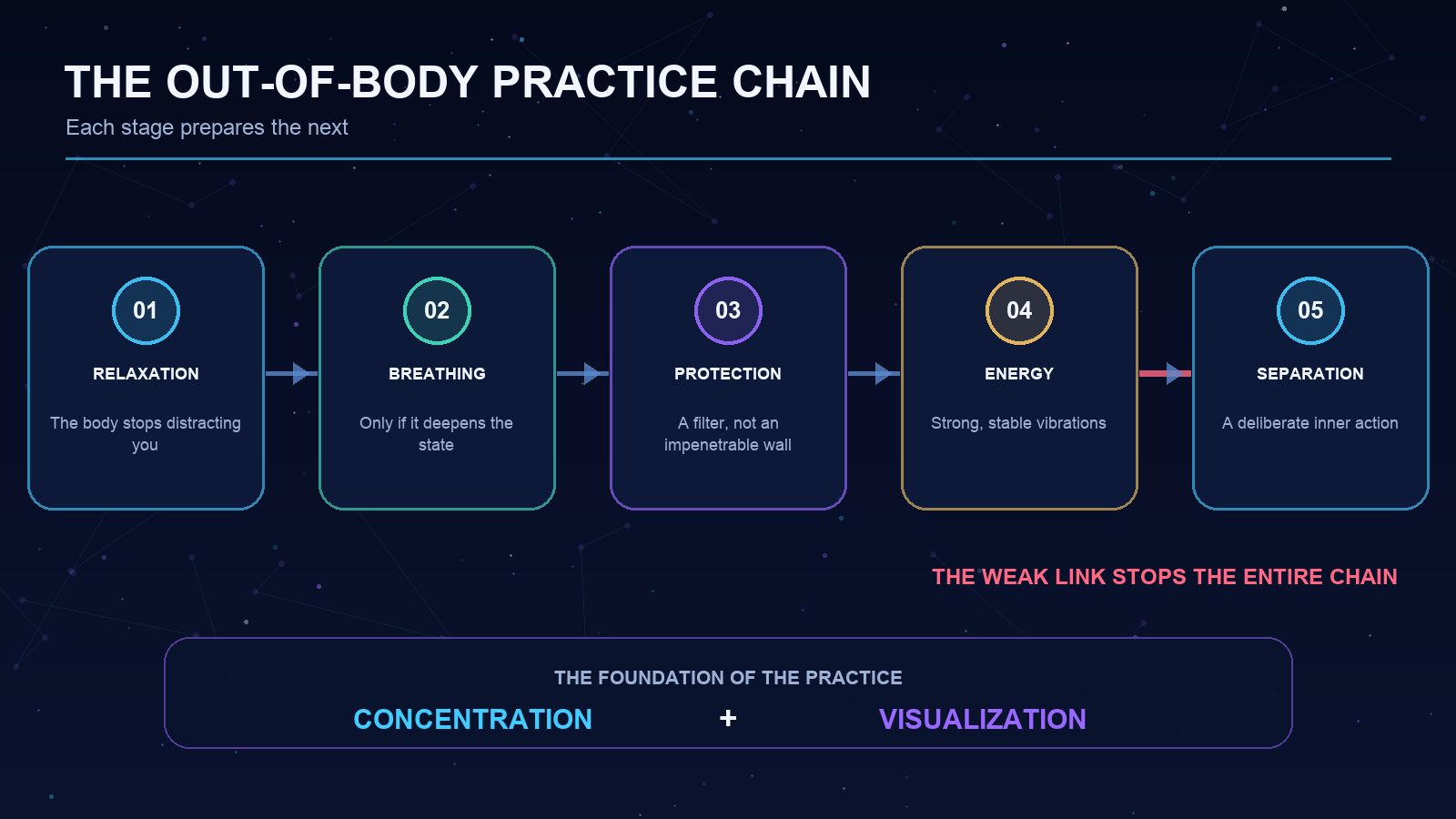
Out-of-body practice consists of a sequence of stages, and each stage requires a specific skill.
You may be good at relaxing but unable to sustain attention. You may have strong visualization but move to separation too early. You may reach the vibrations without knowing what to do next. You may complete almost the entire process correctly, only to begin analyzing at the last moment and return to your ordinary state.
The practice resembles a chain. If one link is too weak, that is where the entire process stops.
Each stage prepares the next. A weak link stops the entire sequence.
After an unsuccessful attempt, it is more useful to ask a precise question instead of asking, “Why can’t I do this?”
At exactly which stage did the process stop?
That question turns failure into diagnosis.
The two foundational skills
Two main skills lie at the foundation of out-of-body practice: concentration and visualization.
Concentration
Concentration is the ability to hold your attention on one image, sensation, or action without allowing the brain to keep switching to unrelated thoughts.
If your attention jumps every few seconds to a sound, the position of your body, tomorrow’s plans, or an evaluation of what is happening, the process loses stability. The energy of attention becomes scattered, and the required state has no time to form.
Concentration develops gradually. You can train it separately without attempting a full exit every time. Choose one image, sound, sensation, or point of focus and learn to remain with it for as long as possible.
Visualization
Visualization is the ability to create an inner image and fill it with sensation.
Many people believe that visualization always means seeing a vivid, detailed picture with closed eyes. That is not true.
Visualization may appear as:
a sense of movement;
a memory of the body’s position;
a feeling of touch;
an impression of weight or lightness;
a sense of rotation;
the direction of movement;
an inner knowing of where you are.
For practice, the beauty of the image matters far less than how convincing it feels to your perception. You should not merely picture movement. You must experience it internally.
Concentration sustains the action you create, while visualization gives that action substance. Together, they become a powerful instrument.
The complete practice sequence
In my practice, the main sequence looks like this:
relaxation → breathing practice, if it helps → creating protection → building energy and raising vibrations → separation.
Each stage prepares the next. You cannot complete one step mechanically and expect everything else to happen automatically.
Move forward according to your state, not only according to elapsed time. You must learn to recognize when the current stage is truly complete.
The first mistake: the body is not ready
The first stage is deep relaxation.
Its purpose is not simply to get some rest. The body must stop constantly drawing attention to itself, while the brain becomes less active and stops running the same thoughts in circles.
Relaxation usually takes about fifteen to twenty minutes. Some people need more time; others need less. The number is not what matters. The state you reach is what matters.
If you want to turn over, move a leg, scratch an itch, change the position of an arm, or adjust the pillow, the body is still actively involved. It is too early to move to the next stage.
In sufficiently deep relaxation, the body becomes heavy and almost motionless. Its boundaries feel less distinct and may disappear from perception altogether. You no longer want to move because the physical body has stopped occupying your attention.
There is also an opposite mistake.
If you remain in relaxation too long, you may simply fall asleep. You need to find the point where the body has withdrawn from active perception but attention remains clear.
Do not rush this stage, but do not prolong it indefinitely.
Music can also interfere
Some practitioners use relaxing music. It can help, but the wrong soundtrack becomes another distraction.
Potential problems include:
sudden sounds;
loud transitions;
percussion;
a prominent melody;
piano or guitar passages that pull at your attention;
unexpected changes in volume.
As you enter an altered state, sensitivity to sound increases. Music that seemed quiet at first may begin to feel extremely loud.
If you use music, make it so quiet that you have to listen carefully to hear it clearly. It should provide a background, not direct your attention.
If music continues to distract you even at that volume, try practicing without it.
Breathing practices are not for everyone
Breathing is a supporting tool. It is entirely possible to reach an out-of-body state without it.
If a breathing exercise relaxes you, deepens the trance, and helps you maintain attention, include it in the sequence. If it energizes you, creates tension, or makes you control the body too closely, leave it out.
A common mistake is spending too long on breathing. The relaxation achieved in the previous stage then begins to disappear.
In my practice, two or three minutes are enough. I first breathe slightly more deeply than usual. After several breaths, I hold the breath comfortably at the top of an inhalation. There should be no struggle with the body, no strain, and no attempt to hold the breath for as long as possible. After several calm cycles, I return to natural breathing.
This is only one possible method. The main criterion is simple: breathing should deepen the state, not destroy it.
Protection should be a filter, not a wall
The next stage is creating protection.
In my understanding, the space of the second energy level responds to a person’s thoughts, expectations, beliefs, and fears far more quickly and precisely than the physical world. If a practitioner enters that space with intense fear, the surrounding environment may reflect that fear and give it a perceptible form.
Protection reduces the influence of such states and helps make the experience cleaner.
I create a protective sphere of energy around myself and define its properties in advance. It should:
protect me from outside influence;
reduce the effect of fear and random thoughts on the surrounding space;
support the stability of my state;
allow pure energy to pass through;
nourish and strengthen me.
There is an important potential mistake here. If you imagine protection as a completely impenetrable wall, it may block not only unwanted influence but also the energy needed for the next stage.
Protection should therefore work selectively. It filters out what may interfere with the practice while remaining open to the energy used to raise your vibrations.
A slight tingling sensation is not enough
After creating protection comes the stage of building energy and raising vibrations.
In my model of reality, different energy levels have different frequency characteristics. To shift perception from the physical level to a subtler one, you must change your own state and bring it closer to the frequency of the next level.
This is achieved through concentration, visualization, and work with energy.
One of the most common mistakes is attempting separation too early.
Light tingling, warmth, or faint waves indicate that the process has begun, but they do not always mean that you are ready. The energetic state must become strong and stable enough. Vibrations begin to intensify, fill your entire perception, and gradually separate it from the familiar sensation of the physical body.
Each person must learn to recognize his or her own degree of readiness. That comes with experience.
If there is not enough energy, a separation attempt may produce nothing. This does not mean the entire practice was wrong. You may simply have moved to the final stage a little too soon.
Separation does not necessarily happen on its own
This is one of the most important points.
A person may relax correctly, quiet the stream of thought, create protection, build energy, and feel strong vibrations. Even then, separation is not guaranteed to happen automatically.
Separation is a skill in its own right. It must be trained.
Many people reach the vibrations and simply wait. They hope that at some point they will be pushed out of the body automatically. That sometimes happens, but relying on chance is not a sound method.
Once the necessary state has been reached, you need to perform an inner action: rise, roll out, lift off, fall through, shift your point of perception, or use another suitable method.
If this skill has never been trained, the brain may interpret the command literally and attempt to move the physical muscles. The person rolls over with the ordinary body, and the state collapses.
The rolling exercise
You can practice separation independently of the full sequence.
Lie down in the position you normally use for meditation. Close your eyes and relax slightly.
Then physically roll onto your side. Notice every sensation that appears:
how the movement begins;
how pressure shifts across different parts of the body;
how the weight moves;
how the position of the head changes;
what the turn feels like;
the moment when the body comes to rest on its side.
Return to the starting position.
Now repeat the same movement inwardly while the physical body remains still. Recreate the remembered sensation of rolling without tensing the muscles.
The purpose of this exercise is to teach perception to perform a movement independently of the physical body.
One repetition is not enough. The movement must become familiar. Then, when the vibrations begin, you will not have to figure out how to separate. You will already know the required inner action.
Use several separation methods
If the first attempt does not work, do not stop.
You can try, one after another:
rolling out;
rising upward;
lifting off;
falling or sinking through;
rotating;
climbing an imaginary rope;
moving your point of perception to another place in the room;
trying to sit up or stand without engaging physical muscles.
You can test several methods within one or two minutes. One may produce no response while the next triggers separation immediately.
There is no single technique that works equally well for everyone. Even for the same person, different methods may work on different days.
Do not begin analyzing at the final moment
Imagine that you have completed the entire sequence, reached the vibrations, and tried to roll out. The first attempt does not work.
Then the brain begins:
“Why didn’t it work?”
“What did I do wrong?”
“Were the vibrations not strong enough?”
“I guess it won’t happen today either.”
As soon as analysis begins, the state changes. Attention returns to the physical body, the stream of thought becomes active, and you leave the deep phase of relaxation.
During separation, do not analyze.
If rolling does not work, try the rope. If the rope does not work, try lifting off. Then try rotation, falling, or shifting perception.
Move directly from one action to the next.
You can analyze the practice after it ends. Then you can calmly reconstruct the sequence and determine which stage needs additional training.
During the process itself, act.
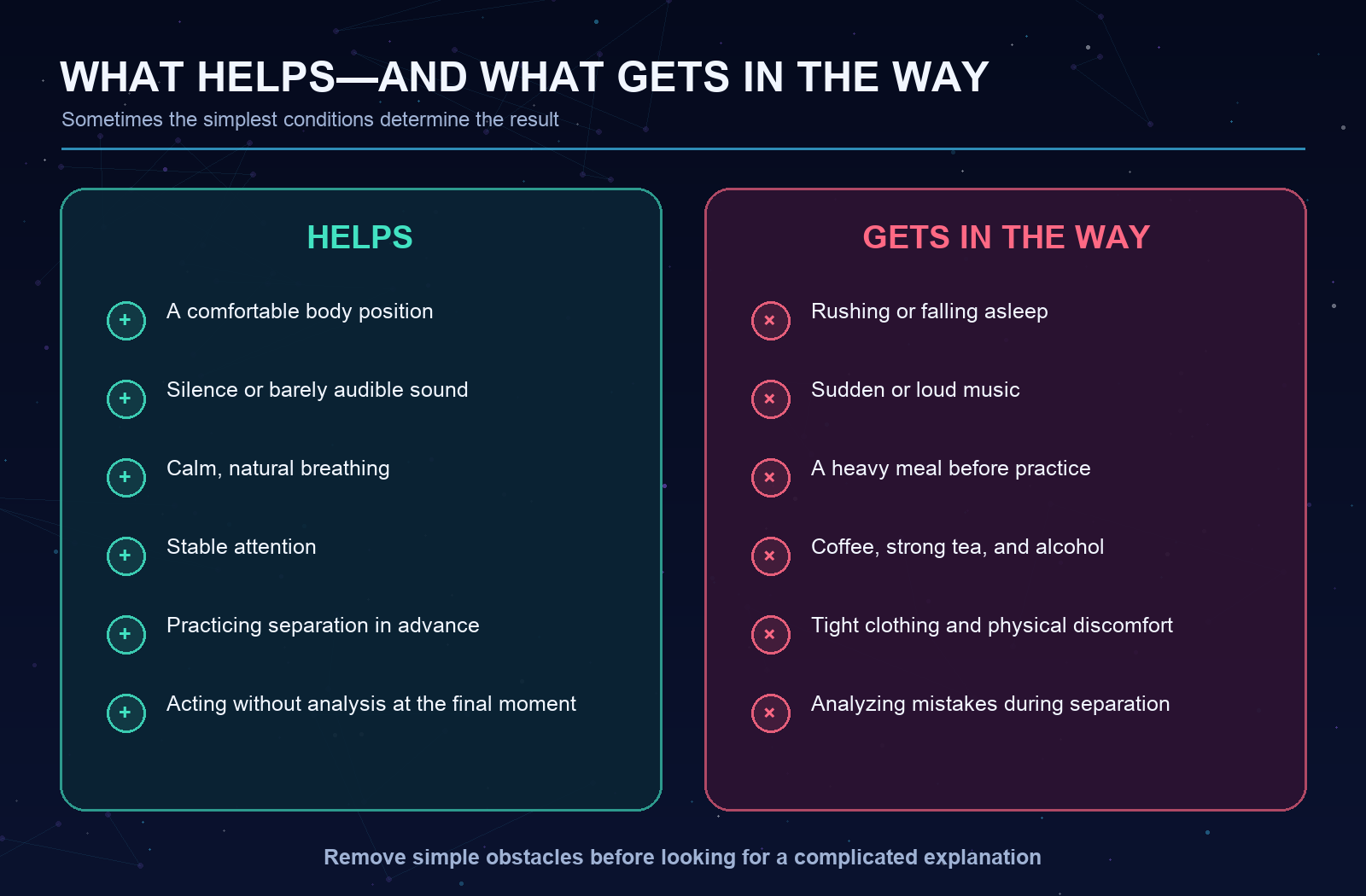
Simple physical reasons for failure
Sometimes a person looks for a complicated spiritual or energetic explanation when the practice was interrupted by ordinary physical discomfort.
A heavy meal
Immediately after eating, a significant share of the body’s resources is directed toward digestion. Heaviness, sleepiness, and greater awareness of the body follow.
Do not begin practice when you are extremely hungry or immediately after a heavy meal.
Coffee and strong tea
Caffeine may interfere with deep relaxation and keep the brain in an active state. Coffee affects me so strongly that serious practice after drinking it becomes nearly impossible.
If you drink coffee, try avoiding it before practice and observe the difference.
Alcohol
Alcohol reduces clarity of perception and disrupts the energetic state. Conscious practice requires stability, attention, and inner discipline.
Uncomfortable clothing
Tight clothing, elastic bands, belts, buttons, and anything else that constricts the body will keep pulling attention back to it.
Everyday interruptions
Before practice, turn off notifications, remove unnecessary sources of sound, choose a comfortable temperature, and take care of the body’s basic needs.
A single phone alert can destroy a state that took forty minutes to create.
Remove simple obstacles before looking for a complicated explanation.
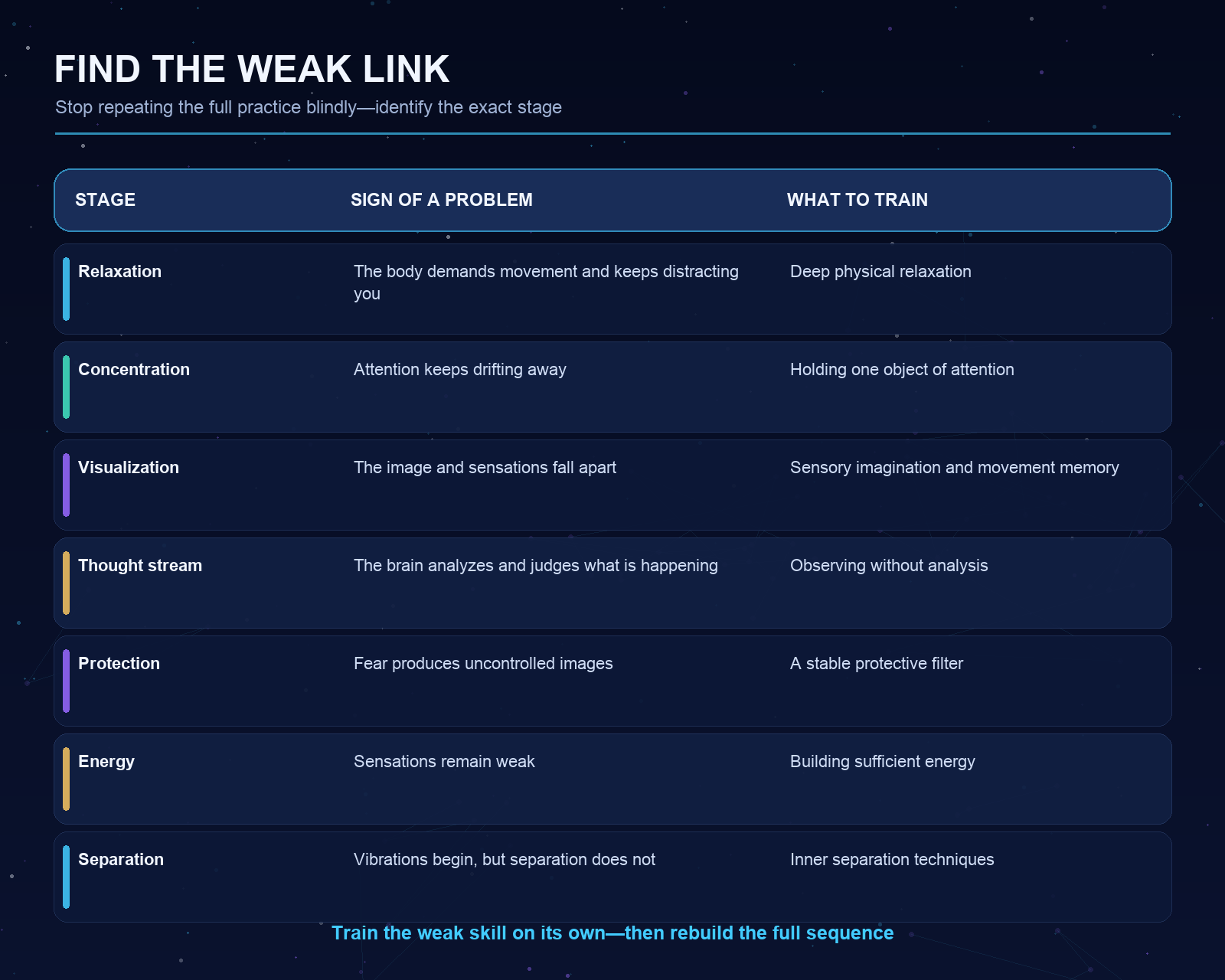
How to find the weak link
After each session, briefly record how far you progressed and what happened at each stage.
Identify the exact stage and train the corresponding skill separately.
This kind of diagnosis helps you stop treating every unsuccessful attempt as defeat. Practice becomes a comprehensible system that can be studied and improved.
Train the elements separately
Once you have identified the weak link, you do not need to repeat the complete sequence every time.
If relaxation is the problem, spend some time training only relaxation.
If maintaining attention is difficult, work on concentration.
If inner movement does not happen, practice rolling, rotating, and rising separately.
If you reach the vibrations but do not separate, focus on separation techniques.
When each element becomes stable enough, connect them again into one sequence.
This develops the practice faster than repeatedly completing the same full routine with the same unresolved mistake.
Results come through preparation
In twenty years of practice, I have often seen people come very close to a result and stop because one skill was not developed enough.
They can already hear the signal, but it is still mixed with static.
In that situation, it is wrong to conclude that nothing is working. The first sensations show that the direction is correct. The process simply needs more precise tuning.
Out-of-body experience requires preparation, knowledge, discipline, and regularity. Every necessary skill can be developed. Every mistake can be identified. Every stage can be studied separately.
If your practice did not end in separation, determine exactly where the chain broke. Strengthen that link, then rebuild the full sequence.
An unsuccessful attempt does not close the path. It shows you what to work on next.
Author: Andrey Chsherbakov Researcher of consciousness beyond the body and author of The Phenomenon of Consciousness Beyond the Body.
Why thought becomes visible beyond the physical body, how personal and collective thought-forms arise, and why learning to direct our attention becomes a matter of personal responsibility.
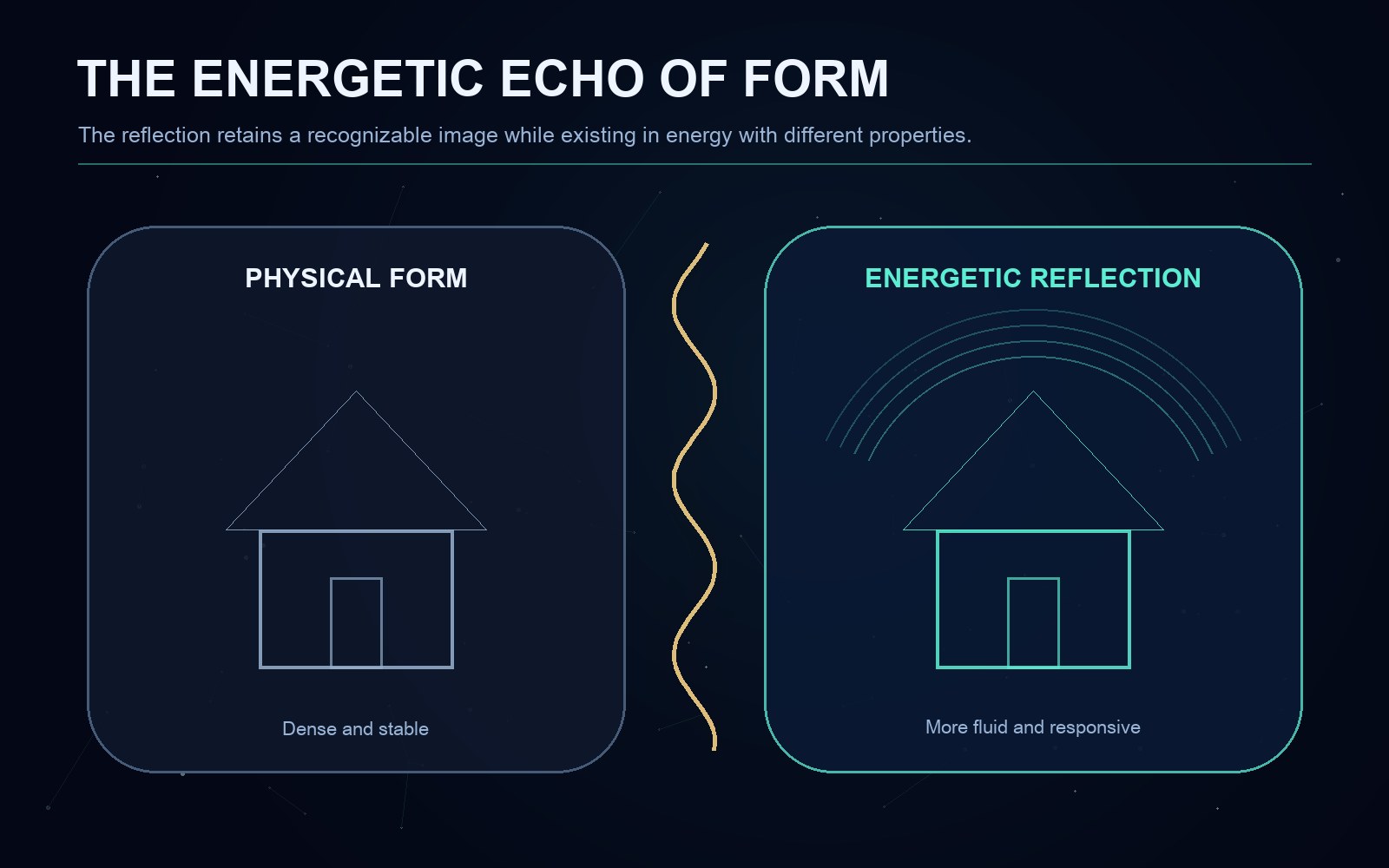
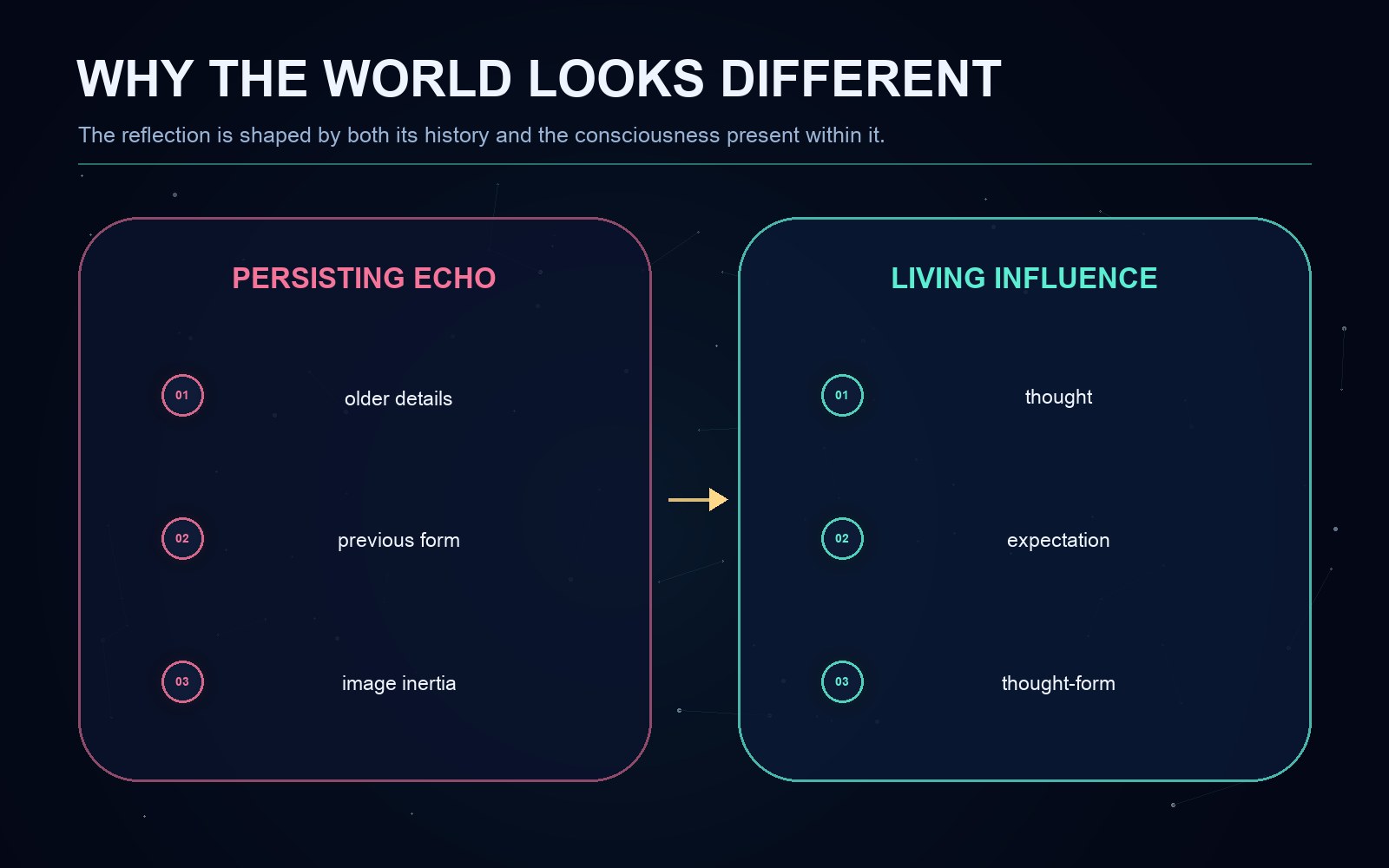
In the previous article, I described the energetic reflection of the physical world. This is why, at the beginning of a conscious out-of-body experience, we often see a familiar room, house, street, or city. Physical matter leaves an energetic echo in the region of the second level closest to us.
But that is only one part of the second energy level.
Alongside this energetic reflection lies a vast mental realm. Its objects, beings, scenes, and entire environments arise not from physical matter, but from thoughts, memories, beliefs, desires, expectations, and fears.
Here, thought ceases to be invisible noise inside the head. It takes on form.
What “Mental” Means
The word mental is often used as though it refers to something vague or esoteric. In my understanding, it has a very specific meaning.
Mental means created by the mind—by our intellectual capacity to form thoughts, images, expectations, and inner scenarios.
At the same time, we must distinguish consciousness from the thinking process. Consciousness is living, perceiving energy. It can observe, direct attention, make decisions, and act. The brain and mind process information, create associations, replay memories, and initiate habitual thoughts.
An intrusive thought is not created by consciousness itself. The brain and the habitual stream of thought keep driving it in circles. Consciousness can notice this process, stop feeding it with attention, and choose a different direction.
This, to me, is the foundation of inner freedom.
How Thought Becomes Form
In physical reality, we do not see a thought-form being created. A thought appears and disappears without leaving a visible trace. It seems to have no weight, volume, or force.
On the second energy level, everything happens much faster. The surrounding energy is responsive and highly sensitive to a mental impulse.
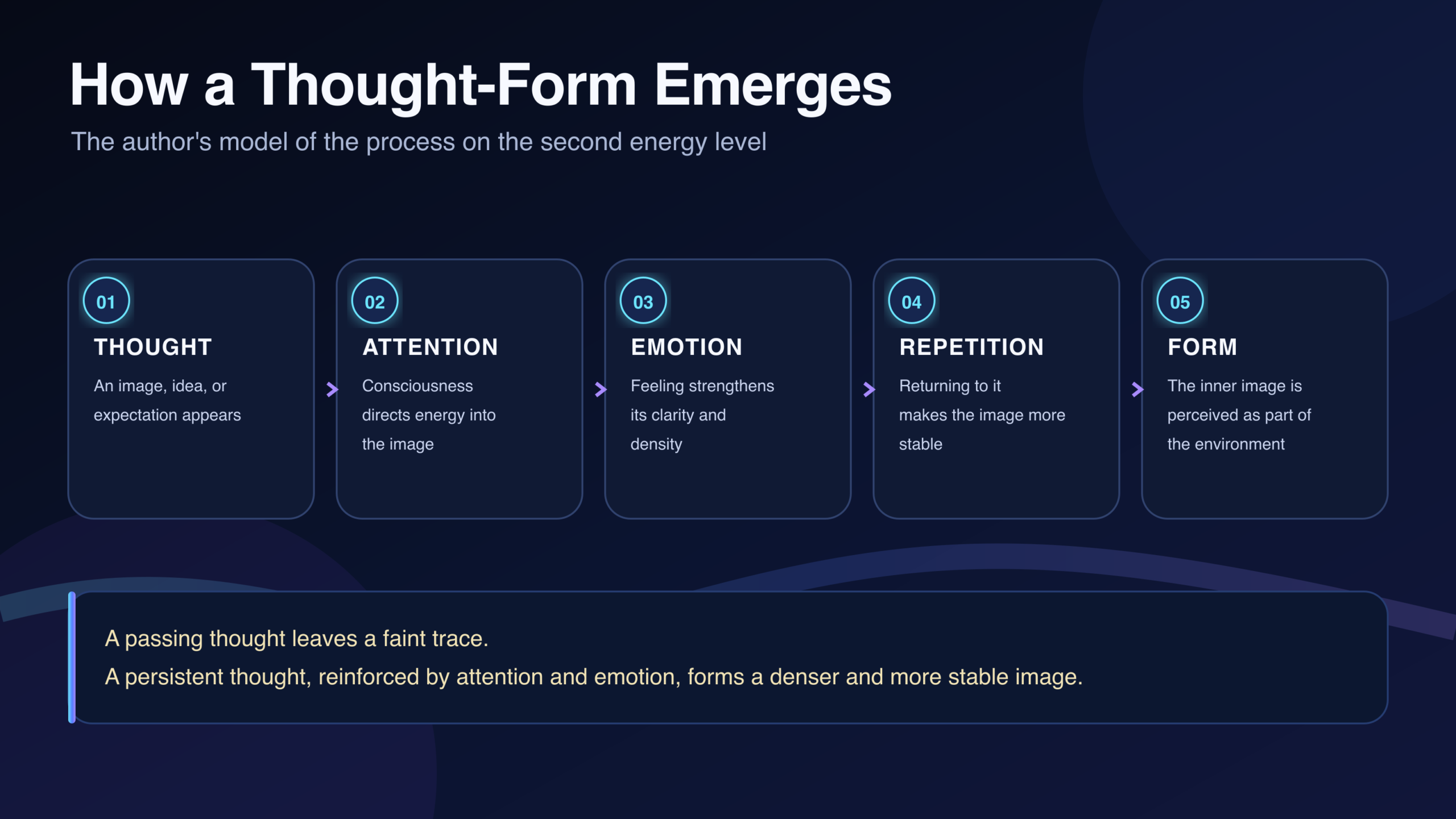
First, a thought or image appears. Attention fills it with energy. Emotion intensifies it. Repetition makes the form more stable. At a certain point, an inner image begins to exist as an external object.
A passing thought usually creates a weak and short-lived form. A thought that is repeated continuously and reinforced by strong emotion can create a dense and stable image.
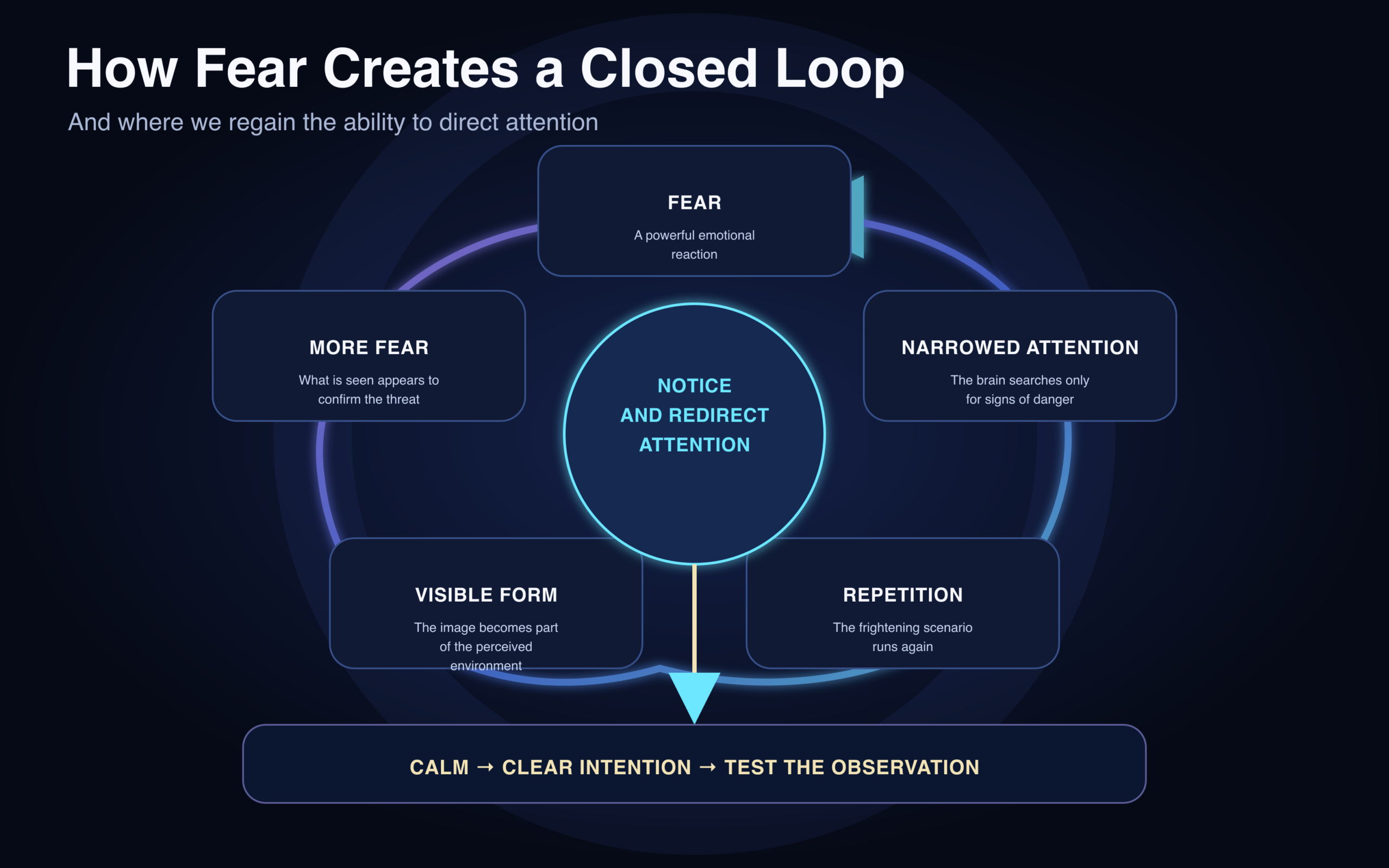
This is why fear acts with such power. It captures attention, produces strong emotion, and compels the brain to replay the same scenario again and again. On the second level, that scenario rapidly becomes the reality surrounding the observer.
Personal Thought-Forms
A personal thought-form is created by one individual. It may arise from a memory, desire, trauma, religious image, habitual pattern, or expectation of what is “supposed” to happen.
During an out-of-body experience, a person may see someone familiar who is not actually present in that place. They may find themselves in a childhood home surrounded by objects that disappeared long ago. They may encounter a frightening being that grew out of their own fear.
This happens especially often when a person has already absorbed other people’s stories. They have been told that dangerous entities are certain to be waiting beyond the body. They leave the body expecting an attack. Expectation creates an image. The image triggers another wave of fear. Fear makes the thought-form denser.
The person then treats this chain of events as proof that the danger was objectively real, even though their own attention is sustaining it.
A thought-form can appear alive. It may move, speak, answer questions, and react to the observer. But its behavior is governed by the scenario embedded within it. The image of a dangerous being will behave like a dangerous being. The image of a helper may perform the role of a helper. Detail and persuasiveness do not make such an image an independent living being.
Realistic Does Not Necessarily Mean Objective
The human brain is accustomed to judging reality by the density and detail of perception. If we can see, hear, and touch something, we almost automatically assume that it exists independently of us.
That rule does not work on the second level.
A thought-form can have color, volume, sound, scent, and density. It can be touched. A person can move within it. It can present an entire unfolding story. The observer may be absolutely convinced that they have entered an objective reality.
But the intensity of an experience does not explain the origin of what is being perceived.
An explorer must look for other signs. Does the object remain when we stop thinking about it? Can we return to it on another occasion? Does it immediately obey our intention? Does it possess a history and characteristics we did not already know? Does it provide new information that can be verified?
None of these questions offers an absolute guarantee. What matters is their combined weight, the repeatability of the experience, and our willingness to revise our conclusions.
A personal thought-form is sustained by one person’s attention. A collective structure gains stability through the participation of many minds.
Collective Thought-Forms
If one person can create a thought-form, what happens when thousands or millions of people feed the same image for decades?
A collective thought-form emerges.
Shared belief, emotion, ritual, repeated imagery, and continuous attention fill it with an enormous amount of energy. It can become far more stable and complex than a personal image. Buildings, landscapes, symbols, characters, and entire scenarios may appear within it.
Such forms can include religious visions of the afterlife, cultural archetypes, mythological beings, images of saints and demons, and places associated with collective fear, tragedy, or hope.
This helps explain why people from different cultures may encounter different images during out-of-body or near-death experiences. The differences do not necessarily mean that one person is telling the truth while everyone else is mistaken. People may enter different collective constructions that correspond to their beliefs, expectations, and inner attunement.
Yet a collective thought-form does not become an independent world simply because it is vast and stable. Its continued existence still depends on the attention and energy invested in it. Independent worlds have their own development, history, inhabitants, and laws. They do not disappear when someone’s beliefs change.
Thought-Forms Around Sleeping People
During my out-of-body research, I have observed shifting scenes around sleeping people that resembled three-dimensional holographic images. Faces, places, emotions, memories, and unfinished thoughts from the day were woven together within them.
I do not consider such scenes to be literal recordings of dreams. Dreaming is a complex activity involving the brain, memory, and the stream of thought. On the second level, I see an energetic expression of some of these processes.
The brightest forms tend to arise around intense emotions, anxiety, and recurring thoughts. A sleeping person’s thought stream does not stop. The brain continues to process experience, while the surrounding energy responds to the images it generates.
This is not a reason to begin interpreting every dream endlessly. It is far more important to recognize how the brain and the stream of thought continually create and repeat inner scenarios.
Information Clouds Around a Person
I have observed similar phenomena around people who are awake but deeply absorbed in television, a phone, or another stream of information.
A kind of cloud may form around the viewer, filled with their reactions, associations, memories, and emotions. The image extends beyond the screen and continues in a space being created by the mind.
This observation has a direct bearing on everyday life.
The information we consume does not vanish without a trace. It becomes material for the stream of thought. The brain continues processing what it has seen, replaying what it has heard, and using it to construct new scenarios.
If a person fills themselves every day with aggression, fear, scandal, and images of catastrophe, they give the mind material from which it will build their inner environment. The same principle applies to ideas that bring strength, clarity, and hope.
Attention is not merely a passive reaction to the outside world. It is a means of transferring energy.
Religious and Esoteric Expectations
Other people’s descriptions can exert an especially powerful influence on out-of-body experience. Once a person has been told what the spiritual world is “supposed” to look like, the brain has a ready-made library of images.
A Christian may encounter familiar Christian imagery. A person from another tradition may see the symbols of their own culture. Someone immersed in esoteric teachings and already convinced of the presence of particular entities may experience exactly those entities.
After returning, each person may sincerely say, “I saw it myself.” And they will be telling the truth. They really did see, hear, and feel what happened.
But a personally experienced reality does not guarantee that all of its forms existed independently of the observer. This is why an explorer must learn to set prior experience aside, suspend ready-made explanations, and enter a new experience without a script already written.
Someone else’s map may help us take the first step. It must not replace our own investigation.
Fear as a Factory of Images
Fear is not the only emotion capable of creating thought-forms, but it does so with exceptional speed.
Fear narrows attention. The brain stops noticing anything unrelated to danger and begins repeating a frightening scenario. Attention directs energy into it. The second level gives that scenario a visible form. The visible form then intensifies the fear.
A closed loop is created.
The way out does not begin with trying to destroy the image. It begins with reclaiming control of attention. Once a person understands that the image is being fed by their reaction, they can stop sustaining the process. Calmness, clear intention, and a deliberate shift of attention deprive the thought-form of its energetic fuel.
This does not mean that every frightening image is necessarily created by the observer. The second level is inhabited by many kinds of beings and contains independent worlds. But before assigning independent will and an external origin to every disturbing image, an explorer must determine whether they themselves are sustaining it.
How to Direct the Stream of Thought
Controlling thought does not mean violently forcing all inner speech to stop. The harder we try to forbid the brain from thinking about something, the more often it tends to return to the same thought.
The task is different:
notice the thought as it arises;
do not confuse it with your own will;
do not continue developing it through inner dialogue;
remain calm;
return to a clear intention;
consciously redirect attention.
It is essential to distinguish a thought from a decision. The brain can offer hundreds of scenarios. Consciousness does not have to follow every one of them.
We do not always choose the first thought that appears. But we can choose whether to feed it, repeat it, and allow it to shape the direction of our lives.
Responsibility for Attention
On the second energy level, responsibility for the stream of thought becomes visible. What seemed insignificant within us reveals itself as a force capable of changing the surrounding environment.
A passing thought does not define a person. Responsibility begins with what we do next. Do we give the thought our attention? Do we repeat it? Do we make it part of our view of reality? Do we pass it on to other people?
Every time we direct attention, we choose which thought-form to strengthen.
In physical life, this process unfolds over time. A thought does not become a wall or a being before our eyes. Yet a continuous stream of thought shapes our perception. Perception influences decisions. Decisions become actions. Actions build our lives.
The second energy level simply reveals this connection much faster.
We Do Not Have to Live Inside Automatic Thoughts
A thought is not harmless noise inside the head. It is an energetic impulse capable of taking form, influencing perception, and changing the space around us.
On the second energy level, we see this almost immediately. In physical life, the result appears more slowly, but the principle remains the same: attention feeds whatever it is directed toward.
If the brain keeps driving thoughts in circles, that does not mean we must follow them endlessly. We can recognize the process, reclaim our attention, and stop feeding what we do not want to strengthen.
Directing attention does not make a person unfeeling, nor does it require denying real problems. It restores our right to decide what we will give our energy to.
This is one of the central meanings of awareness: refusing to let an automatic stream of thought determine who we will become and what kind of reality we will sustain.
I explore the second energy level, thought-forms, fear, and my out-of-body observations in greater depth in my book, The Phenomenon of Consciousness Beyond the Body.
What exists in the nearest region of the second energy level, why familiar objects retain their form, where the discrepancies come from, and how our thoughts begin to alter the space around us.
The second energy level is an extraordinary realm. It opens remarkable possibilities to anyone who reaches it consciously. Based on more than twenty years of personal practice and my familiarity with the experiences of other practitioners, I estimate that roughly 95 percent of conscious out-of-body experiences take place in this region closest to our reality.
Yet proximity does not make it simple or easy to understand. On the contrary, it may be the most mysterious level I have encountered. It resembles our world while continually violating our assumptions about it. You may see your own room, step onto a familiar street, and recognize the houses around you. Yet the walls may be a different color, an object removed long ago may stand in its former place, and a perfectly solid door may cease to be an obstacle the moment you decide to pass through it.
That is why I continue to investigate the second energy level. I return to the same questions, repeat observations, and compare results. The more I learn, the more clearly I see the scale of this reality—and the more new mysteries it presents.
A Familiar Room That Is No Longer Quite Familiar
At the beginning of a conscious separation, people often find themselves beside their sleeping bodies. They see the bed, walls, doors, windows, and furniture. Everything looks so familiar that, for the first few seconds, they may not even realize the separation has already occurred.
The floor feels solid. The wall seems dense. You instinctively reach for the door in the usual way. We continue to behave as we have throughout physical life because we do not yet know another way to interact with the surrounding world.
Then the differences begin to appear. The wallpaper may be lighter or display an older pattern. A favorite chair may look different. An object that has been gone for years may reappear, while something recently purchased and placed in plain sight may be missing. The furniture may have shifted. At times the entire setting is recognizable yet carries a difficult-to-explain impression: this is the same room, but it exists in another state.
Such discrepancies can easily be taken as proof that the entire experience is imaginary. When I began practicing, I too needed to understand why a space that felt completely real did not match the physical world in every detail.
The answer did not come at once. It emerged after many separations and repeated observations: on the second energy level, we do not see the physical world itself. We see its energetic reflection.
What I Mean by an Energetic Echo
How does the reflection of our reality arise on the second level? My honest answer is that I do not know.
I do not know the final mechanism, and I cannot claim to know which law underlies this phenomenon. I can describe what I have observed, compare recurring features, and offer a model that accounts for those observations. I call this model the energetic echo.
My hypothesis is that matter and energy on the physical level have the capacity to produce a subtler energetic reflection. It preserves the original object’s outward form, position, and certain properties, but exists as a different quality of energy.
Think of an ordinary echo. A sound originates in one place, reflects from a surface, and continues as a repetition of the original signal. The energetic echo I am describing is far more complex. It reflects more than a single sound or movement; it reproduces the form of objects, natural environments, and immense regions of the physical universe.
I believe the energy of this reflection has a subtler and faster pattern of vibration. The emerging echo may enter into resonance with the energy of the original object. The quality of its vibration then changes, and the reflection manifests in an adjacent region of reality. It becomes invisible and intangible to our physical senses while continuing to exist in the form of its source energy.
This is a working hypothesis, not a mechanism I consider conclusively established. My purpose is not to give the unknown an attractive name, but to find an explanation for a consistent phenomenon I have encountered again and again.
My observations lead me to another conclusion: the reflection moves upward, from the denser physical level to a subtler one, rather than the other way around. The nearest region of the second level is therefore secondary to physical reality. It is connected to our world, reproduces its forms, and responds to changes occurring here, but the response is not always immediate or perfectly exact.
Why the Reflection Is Not an Exact Copy
If the second level reflects the physical world, why can the color of a wall or the shape of a chair be different?
Because this is not a mechanical duplicate, a photograph, or a live video feed. The reflection is connected both to the physical object and to the perception of the beings who interact with it.
An object used every day by many people usually has a more stable reflection. Its form is continuously reinforced by attention, habit, and repeated interaction. A personal possession that receives little attention may appear differently. Minor details that people rarely notice change even more easily.
Intense attention can also distort the reflection. When a place or object carries powerful emotions, expectations, and memories, its energetic reflection begins to overlap with thought-forms. It can then be difficult to determine which features belong to the relatively stable reflection of a physical object and which have been created by the observer’s mind or by the collective attention of other people.
The reflection has another mysterious quality: it can lag behind.
Imagine that you have replaced the wallpaper in a room. The physical wall now looks entirely different, yet during an out-of-body experience you may still see the old pattern. If a tree has burned down or been cut down, its energetic reflection may continue to exist for a time. The physical object is gone, but its former shape remains in the neighboring region of reality and fades only gradually.
I do not yet know what determines how long such a trace remains. The age of the object, the energy invested in its existence, the attention it received, people’s emotional connection to it, and the manner of its destruction may all play a role. I continue to investigate this feature. But the recurrence of such observations suggests that changes in the physical world are not transmitted to its energetic reflection as instantly as data refreshes on a computer screen. The process has its own inertia.
An energetic echo preserves the general physical form while remaining changeable.
Why Familiar Laws Seem to Apply at First
When people enter the second energy level, they do not usually begin by flying or sinking through the floor. By default, the environment behaves much like the physical world.
We feel gravity. Matter seems solid. Walls appear impenetrable. We walk around a table, open a door, and take the stairs, even though none of this is necessary anymore.
The reason lies not only in the properties of the reflection but also within us. An entire physical lifetime has taught us that the floor supports the body, a wall stops movement, and leaving a room requires using the door. These assumptions are so deeply embedded in our perception that they continue to operate even after we separate from the body.
On the second level, however, a familiar limitation exists only as long as we continue to support it.
Once a person clearly understands where they are, they can change how they interact with the environment. They can pass through a wall, rise into the air, descend underwater without breathing, or travel into space. There is no need to break the wall or overcome gravity. They need only stop treating these conditions as mandatory limits on movement.
This reveals the defining difference of the second energy level: its environment responds to thought and intention far more quickly.
Thought Becomes a Law of the Environment
In the physical world, a long chain of actions usually stands between desire and result. Imagining a house is not enough to build one. Materials, knowledge, labor, and time are required. Dense matter accepts a new form slowly.
On the second energy level, the distance between a thought and its manifestation becomes dramatically shorter. At times it disappears almost completely.
Expect an obstacle, and it becomes impassable. Decide with certainty to move through a wall, and its density ceases to matter. Recall a familiar place and hold it as your intention, and you may be able to move there. Fear can produce a frightening image, while strong expectation can transform the surrounding scene.
I understand this through the nature of consciousness itself. To me, consciousness is not a product of the physical brain. It is an independent energy, a particle of the Source, the Superconsciousness, or God—the name is a matter of personal choice. A creative power exists within our nature. In the physical world it manifests slowly because dense matter resists change. On the second level, energy is more responsive, and the influence of thought becomes rapid and unmistakable.
We are therefore continually constructing part of the reality we perceive there, whether deliberately or unconsciously.
This is both an immense possibility and a serious challenge. A person with a clear intention can direct movement, sharpen perception, and carry out investigations. A person who cannot regulate the flow of thought can quickly become trapped in chaos created by expectations, fears, and habitual images.
Fear changes the environment. The altered environment intensifies the fear. A closed loop develops and usually ends with an immediate return to the body.
This is why I speak so often about clarity of perception, inner calm, and setting previous experience aside. An explorer must learn, at least temporarily, to release religious imagery, other people’s stories, and personal expectations. Otherwise, the first thing they see will be what they already believed.
What a Person Looks Like Without the Physical Body
During an out-of-body experience, the physical body remains on the first energy level. Consciousness—a living energy capable of perceiving and acting independently—enters the second.
Why, then, do people continue to see hands, legs, and a familiar human form?
Because that is how they perceive themselves. The human form is the foundation of our earthly self-identity. We are accustomed to seeing through eyes, touching with hands, and moving with legs. Consciousness therefore reproduces this image even when the physical body is no longer participating in the experience.
This form does not have to match the body exactly. It can change with our sense of self. People often perceive themselves as younger, healthier, and more harmonious. Illness, age-related changes, and physical limitations may disappear because they belong to the body, not to the nature of consciousness itself.
With sufficient control, a person can alter this appearance far more radically or stop maintaining a familiar form altogether. Most practitioners, however, retain a human appearance because it is familiar, practical, and requires no additional intention.
The same principle applies to the senses. On the second level, there are no physical eyes or ears in the ordinary sense, yet a person continues to see and hear. They may perceive touch, temperature, scent, or movement. Perception can be intensified, softened, and directed. The limitations of a physical organ give way to the capacities of consciousness itself, although learning to control them takes time.
Where the Reflection Meets the Thought-Form
To understand what occurs on the second energy level, we must distinguish the energetic reflection of the physical world from mental formations.
By mental, I mean created by the mind—by our capacity to form thoughts, images, expectations, and inner scenarios. A mental form may be personal or collective. It can arise from one person’s memory or be sustained by the belief and attention of a vast number of people.
The energetic reflection has relative stability. A house remains a house, a street retains its direction, and objects occupy recognizable places. A thought-form is more fluid. It changes with a person’s attention, fear, or desire.
In actual experience, however, these phenomena often overlap. You may be standing in the reflection of your own room while seeing an object created by memory. You may step onto a familiar street and then, without noticing the transition, enter a space shaped by expectation. No visible line marks the boundary, and no voice announces that the surrounding scene has just changed its origin.
For this reason, vividness and realism prove nothing by themselves. A thought-form can be detailed, convincing, and completely tangible. What matters to investigation is stability, repeatability, and the environment’s ability to preserve its properties independently of the observer’s immediate wishes.
Why familiar surroundings may look different during an out-of-body experience.
Why Books and Screens Cannot Be Read as They Are in the Physical World
The fluid nature of information is especially apparent in books, televisions, phones, and computers. The outward form of an object may remain recognizable while its contents change easily.
I have repeatedly tried to read books during out-of-body experiences. The result differed every time. The text might vanish, change into different words, or become images that had never appeared in the book.
During one experiment, I opened a copy of my own book. I knew its contents perfectly because I had written it. Yet instead of the familiar text, I saw a map. No such map existed in the physical copy. It showed the route of a journey I intended to make during that experience. I used the information that appeared and set out to carry out my plan.
That experience revealed an important distinction: the energetic reflection of a book and the information within it are not the same thing. The book’s form may be connected to a physical object, while its contents at that moment are supplied by the observer’s intention, memory, or mental request.
Something similar happens with television. During my practice, I have repeatedly encountered people watching programs. A kind of cloud formed around each viewer, filled with that person’s perception of what was being seen. Images moved beyond the screen and became an entire performance around the individual. The viewer was not merely sitting in front of a television but inhabiting a space made from personal reactions, associations, and thoughts.
I have observed a similar effect around sleeping people. Their stream of thought created moving scenes around them, resembling holographic images. This already belongs to the realm of thought-forms, yet it can enter the reflection of the physical world and alter the space around a person.
How to Investigate a Reality That Responds to the Investigator
The central difficulty is that the observer is not separate from what is observed. The observer’s thoughts can influence the result.
One impressive experience is therefore not enough. I return to familiar places, compare details, and look for recurring properties. I examine what remains stable and what changes with my attention. At times I deliberately create an expectation and then observe whether the environment conforms to it. After returning, I record what I saw and compare it with earlier experiences.
I separate direct observation from interpretation. If I see old wallpaper in the reflection of a room, the old wallpaper is the observation. My explanation for why its energetic trace remained is an interpretation. It may prove correct, partially correct, or in need of revision.
Admitting that I do not yet know the exact mechanism does not diminish the result. It allows the investigation to continue without forcing new observations into a predetermined answer.
I am certain that the energetic reflection exists because I have repeatedly encountered its characteristic properties. I continue, however, to seek an explanation for how a physical object produces its trace, why some reflections update quickly while others remain after the original object is gone, and how the object’s energy, human attention, and thought-forms interact.
Why This Reflection Exists
I do not regard the nearest region of the second energy level as an accidental by-product of physical matter.
I am convinced that it forms part of a much larger architecture of life. It was created through the wisdom of the Superconsciousness, the Oversoul, or God to support the development of beings living on the first energy level. This extends beyond Earth and humanity. Our universe is immense, and physical life is not limited to the forms familiar to us.
The energetic reflection allows us to investigate the first level from a perspective unavailable to the physical body. Here, we can study the organization of life and the properties of space, communicate, gather information, cross immense distances almost instantly, and move closer to understanding the laws of the universe.
Its purpose, however, is not limited to extraordinary travel. The second level reveals the power of a person’s inner state. Here, mental disorder cannot remain hidden behind outward discipline for long. Fear takes form. Expectation becomes an obstacle. Clear intention opens a path.
In the physical world, the consequences of inner chaos emerge slowly, and a person may spend years without recognizing their connection to their own thinking. On the second level, that relationship becomes almost immediate. A controlled out-of-body experience can therefore become a school of awareness and responsibility.
We learn more than how to use unusual abilities. We learn how to govern ourselves.
Reality Is Far More Alive Than It Appears
A familiar room on the second energy level becomes the first indication that reality extends far beyond the physical world. Walls and objects retain their outlines but cease to be final and unchangeable. Matter reveals an energetic trace. Space responds to thought. The human form becomes an expression of self-perception rather than a limitation imposed by the body.
I do not know every law governing this reflection. That is precisely why I continue the investigation. But I know that what stands before us is neither meaningless scenery nor a collection of random images. It is a complex realm of life, connected to our universe and possessing its own patterns, possibilities, and mysteries.
Humanity is accustomed to exploring the world by building increasingly sophisticated instruments. Yet there is another direction of inquiry in which consciousness itself becomes the primary instrument. By learning to use it, we may not only see the space beyond the body differently but also gain a deeper understanding of the nature of our own lives.
The energetic reflection of the physical world is only the first region of the second energy level. Beside it lies the realm of thought-forms, created by the mind, imagination, fear, belief, and humanity’s collective attention. That will be the subject of the next article in this series.
I explore the second energy level, out-of-body investigation, and my personal observations in greater depth in my book, The Phenomenon of Consciousness Beyond the Body.
What happens to perception when the body, the senses, and ordinary distance disappear; why the fourth level is separated from the soul’s world by an energetic membrane; and what I experienced during my meeting with the elder Eloney and my union with the light of the Oversoul.
The farther an explorer moves from physical reality, the harder it becomes to describe what was experienced.
The second energy level can still be discussed in familiar terms. It contains rooms, houses, streets, cities, and reflections of the physical world. Its environment differs from ours, but it retains points of reference that a human being can understand.
Familiar forms also remain present on the third level. There I saw fields, mountains, houses, gardens, animals, and entire communities of souls. These worlds are not copies of Earth, but their structure can still be conveyed, at least approximately, through human language.
The fourth energy level begins where ordinary language starts to fail.
Our language was developed to describe bodies, objects, colors, sounds, and distances. We construct sentences in sequence: one thought follows another, one event happens after another. But how can we describe a reality in which there is no physical body, the eyes no longer determine the direction of sight, communication occurs without words, and knowledge is perceived all at once in its entirety?
I can describe the transition, the sensations, and the individual images my memory retained. I can share the conclusions I reached after returning. But I understand that words inevitably reduce the experience. They break a unified event into separate pieces.
Even so, this experience needs to be shared. The fourth level reveals that the form of the soul known to us is not its final state. Beyond the world of souls lies another stage: a realm of pure energy, direct knowledge, and a far deeper unity with the Source.
The Boundary Between Two Orders of Existence
The transition from the second energy level to the third can occur through attunement to a particular environment or by increasing the frequency of one’s own energy. Sometimes a person can cross into the third level without fully understanding how the transition happened.
The fourth level is different.
Between it and the first three levels, I felt an actual barrier. It was not a symbolic boundary or an imagined door, but an energetic membrane that had to be crossed. As I approached it, my movement stopped almost as clearly as it would against a physical wall.
This experience led me to conclude that the first, second, and third levels belong to one vast system. They differ in the density of their energy, the laws of their environments, and the possibilities available to consciousness, but they remain internally connected. The fourth level belongs to another order of existence.
It cannot be entered by accident.
To pass through the membrane, a soul must deliberately raise the frequency of its energy and come into precise alignment with the realm beyond it. Imagining a destination or simply wishing to move is not enough. The entire state of the soul must change.
I found it difficult to do this without assistance. Despite years of practice and experience working with energetic vibrations, I needed the support of a teacher from the third level during my earliest visits. His energy helped mine enter the necessary resonance and sustained me where my own strength and experience were not yet sufficient.
My First Passage Through the Membrane
During my first transition, the teacher took my hands and slowly began to raise the frequency of his energy. I felt his vibrations changing and worked to keep pace, bringing my own state into alignment with his.
Within moments, I felt movement. Almost immediately, I struck an invisible wall.
The teacher was still holding my hands. I continued to feel his energy and followed it. When the frequency of my vibrations reached the necessary level, the resistance changed. I began to pass through the barrier, slowly, as though moving through a dense but yielding membrane.
Another moment passed, and all heaviness disappeared.
“Weightlessness” only approximates what I felt. We usually use that word in relation to a body. There, consciousness itself became weightless. The sense of shape, weight, and boundaries vanished. The space around me glowed, but there was no familiar source of light and no objects from which that light could reflect.
It was as though I had entered a cloud of pure energy.
This was not an empty space. On the contrary, it felt extraordinarily full—alive, powerful, and saturated with information. Yet this fullness existed without familiar objects. There were no houses or trees before me, no ground beneath my feet, and no sky overhead. The very ideas of “above,” “below,” “ahead,” and “behind” had disappeared.
My perception changed together with the reality around me.
What the Soul Looks Like Without a Body
On the third energy level, I usually perceived myself in human form. I had arms, legs, a face, and clothing. The body appeared younger and lighter than my physical body, but it remained recognizable. That form allowed me to act, communicate, and preserve my familiar sense of self.
On the fourth level, the human form disappeared.
I could perceive everything around me at once. I no longer needed to turn my head or shift my gaze. I had no eyes, yet my ability to see had expanded. It had no fixed direction.
I became curious about what I looked like. At that instant, my point of perception divided, and I saw myself from the outside.
I resembled a brilliant white star, a small concentration of luminous energy with subtle iridescent movement. It was not a body made of light shaped like a human being. It was truly a cloud of energy. The teacher remained beside me. His energy looked different from mine and carried a violet tone. He continued to support my state and helped me remain at the necessary frequency.
That experience changed my understanding of the soul’s form.
The human image is not its eternal body. It is connected with the experience of incarnation and remains present on the levels closest to us because this is how we are accustomed to perceiving ourselves and one another. Beyond a certain boundary, that image is no longer necessary. The soul does not lose itself when it loses its human outline. It remains itself, recognizes other beings, and retains the ability to perceive, understand, and communicate.
The form changes. The essence remains.
Passing beyond the boundary of form into direct perception of knowledge.
Perception Without Physical Senses
In the physical world, perception is divided into separate channels. We see with our eyes, hear with our ears, feel touch through the skin, and recognize scent through the nose. The brain collects these signals and assembles them into a unified picture of reality.
There was no such division on the fourth level.
I did not see the light through eyes or hear the teacher through ears. I perceived the surrounding energy with my entire being. Sensation could not be separated from understanding. To see something was also to feel it and know it. Information did not pass through physical senses and did not require later processing.
This is difficult to imagine while living in a physical body. We can close our eyes and stop seeing. We can move too far away and stop hearing. Our perception depends on the body’s location and the limits of its organs.
There, the point of perception was not confined to a body. The surrounding reality therefore opened all at once, without the blind spots familiar to human experience.
This did not mean that I became omnipotent or instantly understood the whole structure of existence. My abilities were still limited by my level of development and my capacity to remain in that state. Yet the mode of perception itself was incomparably broader than human perception.
A Realm Saturated with Knowledge
The most extraordinary quality of the fourth level was the presence of knowledge.
In ordinary life, we first formulate a question. We then search for information, compare different answers, reflect, and eventually arrive at a conclusion. Knowledge comes to us as the result of a sequential process.
There, questions did not arise.
This was not because I was forbidden to ask them or because curiosity had disappeared. The environment itself was filled with understanding. I simply knew. Information was not stored somewhere apart from me—in a book, in another being’s memory, or in a repository I had to reach. It was present within the energy that my consciousness had entered.
The state felt like omniscience, but after returning I recognized an important distinction. An immense field of information had been available to me on the fourth level, but my ability to carry it back into physical memory remained extremely limited.
The brain cannot contain this kind of knowledge in its original form. To preserve it here, unified information must be translated into words, images, and sequential thoughts. Much of it is lost during that translation.
I did not return with an encyclopedia of answers. I retained the state, the central meanings, and the knowledge that such a source exists. The experience itself mattered more than any collection of facts.
Communication Through Direct Transmission
On the third level, I had already encountered communication without ordinary speech. A thought could be conveyed directly and received faster than a spoken sentence.
On the fourth level, even that method seemed too slow.
Communication occurred through a complete, direct transmission. This is the closest expression I have for what I experienced, although it still cannot convey the full nature of the process.
I could send the teacher not a sequence of sentences, but everything I was feeling, seeing, and understanding at once. He received it as a single whole. His response arrived in the same way. I did not separate it into individual parts. I immediately perceived the meaning, the emotional state, the personal experience, and the path through which he had reached that understanding.
Imagine that instead of telling you about an experience, someone could transmit the experience itself—not only the final conclusion, but also the circumstances, emotions, inner changes, and the full history through which it developed. And instead of taking hours of conversation, all of it would be received in a single act of communication.
Such a transmission does not need to be memorized. The knowledge becomes part of you.
This is why ordinary language seems especially limited in that realm. Words arrive one after another. They require interpretation and always leave room for misunderstanding. Direct transmission conveys the whole.
After returning to the body, I once again had to divide the experience into sentences. Every article I write is therefore a translation. I work to preserve the meaning, while knowing that the original experience was far larger than the text.
Who the Elders Are
My experience shows me that the soul’s development does not end on the third energy level.
Souls learn, acquire experience, work with energy, and gradually move toward a more complex mode of existence. I refer to those who have reached the next stage as elders.
The word does not indicate age in the earthly sense. There is no aging physical body there. It refers to the depth of accumulated experience and the soul’s level of development.
The elders are not rulers, judges, or masters over other souls. I perceived them as teachers who can see far more and work with energy at a level that remains difficult for me to access.
Their strength can be felt directly. To communicate with a less prepared soul, an elder must reduce the intensity of his or her energy. Otherwise, remaining nearby would be too difficult.
Every soul develops. I therefore do not see the fourth level as a closed realm reserved for a chosen few. I see it as the next stage of existence, one that souls gradually reach after completing the experience they need on earlier levels.
Beyond sequential speech, meaning is experienced as a unified whole.
The Journey to a Point of Entry
I visited the fourth energy level several times. One of those visits became especially important to me.
During another meeting, Ilrin told me that he wanted to show me a place connected with the soul’s memory and knowledge. He asked me to take his hands and focus on his energy.
I already knew these vibrations. Entering resonance with Ilrin was easier than it had been during my first transition. Once again, I felt movement, similar to the instant of a rapid descent when everything inside you briefly drops. Then I encountered the familiar barrier. This time, we passed through the membrane much more easily.
When the movement ended, I opened my eyes and was surprised.
Instead of a formless realm of luminous energy, I found myself in a garden. Majestic trees grew around us. I heard birdsong, the sound of surf, and even the rhythm of cicadas. A narrow path climbed a hill toward a building surrounded by columns, resembling an ancient Greek temple. From above, I could see a rocky shoreline and a turquoise sea stretching toward the horizon.
My appearance was human again.
After my previous visits to the fourth level, I had not expected to see anything like this. I later understood that a recognizable form does not contradict the energetic nature of the realm. It creates a point of entry—an environment that consciousness can perceive more easily and in which different souls can interact through familiar forms.
There may be many such places, each with a different appearance. The garden and temple do not mean that the fourth level is structured like an earthly landscape. They show that energy can assume the form needed for a particular purpose.
We followed the path and entered a large, luminous building. Brilliant light passed through a transparent dome overhead. The walls were decorated with images of natural landscapes. Massive open doors stood on both sides of the hall.
A man emerged from one of them and walked toward us.
My Meeting with Eloney
He appeared older than any being I had encountered on the third level. He had gray hair and a beard. He was dressed in a white himation, a heavy ancient Greek mantle draped over one shoulder. Perhaps my perception gave him this form because this is how a human mind imagines an elder. But something far more significant could be felt beyond his appearance.
When he approached and looked into my eyes, I experienced a feeling for which I still cannot find an exact comparison. It was like meeting someone deeply loved after an immeasurably long separation.
His energy was so powerful that I could clearly feel him consciously reducing its intensity so I could remain near him. The support of Ilrin and the elder himself helped me sustain my state. Without it, I would have returned to my body almost immediately.
“My name is Eloney,” he said.
I did not need to introduce myself. I felt that Eloney already knew who I was.
I asked why their names sound unusual to us and what those names mean. Eloney explained that such names are used for our understanding. To beings who communicate through energy, a name is not a sequence of sounds.
A true name is the energetic signature of a soul.
It carries far more information than a word. It reflects the soul’s qualities, experience, and development. As the soul grows, its energetic signature changes, and so does what might be called its name.
Even in the physical world, a name is only a coordinate. When we first meet someone, we need to know how to address them. Over time, however, that name becomes connected in our awareness with the person’s character, voice, actions, and energy. When we hear a familiar name, we no longer perceive a collection of letters. We perceive an entire person.
On the fourth level, this principle is fully revealed. A soul is recognized directly, without the need for an external label.
The Corridor and the Open Door
Eloney invited us to follow him. We crossed the hall and approached an open doorway. Beyond it was a long corridor with many doors on both sides. Nearly all of them were closed. Only one doorway gave off a soft blue glow.
Eloney told me that beyond that door I would be able to understand a great deal. He warned me to treat the knowledge I received responsibly. Knowledge is not an ornament or a means of placing oneself above others. It requires inner maturity and thoughtful use.
I moved toward the luminous doorway.
My emotions were extremely strong. The support of my companions held me on the fourth level while I worked to preserve calm and clarity. As I came closer, I saw that there was no room beyond the threshold. There were no walls, floor, ceiling, or objects.
There was only light.
I felt no fear. I knew that nothing there could harm me, and I stepped forward.
Inside the Light
The light surrounded me, and the sense of my own form disappeared.
I was not merely standing inside it. I became part of it. The division between me and the surrounding energy ceased to exist. In place of the familiar sense of a separate self came a profound union with the Source of life—the Oversoul.
I was filled with absolute peace and balance. Inner tension vanished, along with the need to prove anything or struggle toward understanding. Everything was in its place and belonged to one living process.
The word “bliss” may sound like emotional exaggeration, but I know no better word. This was not pleasure and not excitement produced by a beautiful scene. It was a state of complete belonging, a return to that of which I had always been a part.
I perceived the scale of the Oversoul and the interconnection of countless journeys of consciousness. I saw my own experience as part of the soul’s much larger history. I felt my connection with those who had been beside me across different lives, and I could no longer perceive one incarnation as an isolated fragment of existence.
The central result of this experience was not a list of facts. I understood the way connection with the source of knowledge could occur.
I later called it the key to direct knowing.
By direct knowing, I do not mean the ability to answer every ordinary question without error, nor the right to declare every passing thought an absolute truth. I mean an inner channel of connection with a wider level of consciousness. Using it requires a clear intention, calmness, and the ability to distinguish deep understanding from the desires, fears, and fantasies produced by the brain.
This key does not replace reflection or learning. It expands the source from which understanding can arise.
Returning to the Physical Body
I do not know how long I remained inside the light.
Perhaps only a few moments passed. To me, it felt as though an entire lifetime could have fit within that state. Time was not experienced as a sequence of minutes. It had stopped functioning as a frame separating one event from another.
But I could not remain there.
I opened my eyes and returned to my physical body. Tears rose in my eyes. I felt both the profound bliss of what I had experienced and the pain of returning to a dense world.
The body had weight again. Time moved in only one direction again. Perception narrowed to the physical senses, while the immense field of unified knowledge began to break into separate fragments.
After an experience like this, a person cannot simply get up and pretend that nothing happened. The inner understanding of reality has already changed. One must learn again how to live in the ordinary world, communicate with people, and carry out daily responsibilities while preserving the memory of a far wider existence.
This is why out-of-body practice requires psychological stability. It is not enough to enter an extraordinary state. A person must also be able to return, accept the limitations of physical life, and continue to live fully here.
Spiritual experience should not pull a person away from reality. It should make earthly life deeper, more conscious, and more meaningful.
Why the Knowledge Fades After We Return
After returning, I spent a long time reconstructing what had happened.
I understood that a significant part of what I had perceived was already gone. This was not because someone had deliberately erased the information. The physical brain simply could not reproduce it in its original form.
A unified transmission has to be converted into a sequence of thoughts. Multidimensional perception must become separate images. Direct knowledge must become words. With every conversion, some of the original content is lost.
It is like trying to convey an immense three-dimensional world through a few photographs. The photographs may be accurate, but the space between them disappears.
Even so, the most important part remained with me.
I retained the memory of the fourth level, of my energetic nature, of my meeting with Eloney, and of the state of unity with the Oversoul. I understood that consciousness can receive information through more than the physical senses and the brain’s sequential processes.
After this experience, the Source was no longer an abstract religious concept to me. I had directly experienced my connection with it.
What the Fourth Level Adds to My Map of Reality
My map contains four energy levels known to me.
The first is physical reality, where consciousness gains experience through a dense material body.
The second is the nearest energetic realm, which reflects the physical world and responds quickly to thought, expectation, and inner state.
The third is the independent world of the soul, containing stable environments, communities, learning, and life between physical incarnations.
The fourth is the level of pure energy, the elders, direct knowledge, and a deeper connection with the Oversoul.
This progression does not describe upward movement through physical space. It describes a transformation in the mode of existence itself. Matter becomes less dense. Form gradually becomes less important. Perception expands. Communication becomes more direct. The connection between individual consciousness and the one Source reveals itself more fully.
Unity does not mean the destruction of individuality.
On the fourth level, I did not stop being myself. I recognized the teacher, communicated with Eloney, and retained my own point of perception. Yet the boundary between me and the surrounding energy became more transparent. I remained myself while also feeling that I belonged to something far greater.
To describe the larger system, I often use the image of a cluster of grapes. Each grape may contain its own immense reality with internal levels and worlds. Yet all the grapes remain connected to a single vine and receive life through it. They are different, but they were never entirely separate.
This is how I understand the unity of consciousness: not sameness and not dissolution, but the connection of countless unique journeys within one living whole.
The Boundary of My Knowledge, Not the Boundary of Reality
I describe four levels because this is the part of reality I have been able to explore and partially understand, not because I believe nothing else exists.
Beyond the fourth level, there may be other states of consciousness, other systems of worlds, and modes of being for which human beings currently possess neither experience nor language. It would be arrogant to declare the map available to me a final diagram of all existence.
Yet even these four levels completely change the scale of the question of what a human being is.
We are accustomed to defining ourselves through the body, biography, profession, age, and personal memories. All of these matter within physical life, but they do not exhaust our nature. Beyond the earthly personality exists a wider consciousness. Beyond it lies the world of the soul. Beyond the soul’s world opens a realm in which consciousness exists as energy and approaches direct unity with the Source.
The fourth level showed me that the soul’s development does not end when it returns Home. Home itself is part of a far greater journey.
Beyond Words
Whenever I try to describe the fourth energy level, I have to rely on comparisons: a membrane, a cloud of light, a star, a file containing information, a key, a cluster of grapes. None of them is exact.
Human beings have always needed images to approach what cannot yet be expressed directly.
The most important part of what I brought back cannot be placed into a diagram or reduced to a beautiful story. I know that consciousness can exist without human form. I know that perception is not limited to the physical senses. I know that knowledge can arrive not as a sequence of words but as complete understanding. And I know the state in which the boundary between an individual soul and the Source becomes almost transparent.
I returned to being a person living within time and a physical body. But I could no longer regard this life as the whole of existence.
We are far more than our earthly personality. The soul’s journey is far longer than a single human life.
The fourth energy level does not eliminate the mystery. It makes the mystery deeper. It shows that beyond form there is not emptiness, but a fuller life—a life of energy, knowledge, and unity.
I describe this journey, my meeting with Eloney, and my experience of union with the light of the Oversoul in greater depth in my book, The Phenomenon of Consciousness Outside the Body.
Why the third level is not an extension of the physical universe, where the soul returns between incarnations, and what I encountered during my first journeys into the realm I recognize as our true Home.
The second energy level remains closely connected to physical reality. There, we can see an energetic reflection of our room, our city, Earth, and the surrounding cosmos. Its environment is fluid, responds quickly to thought, and constantly challenges the explorer to distinguish a stable reality from images created by the mind.
The third energy level is different.
It is not a more beautiful copy of our world. It is not another layer of the physical universe’s energetic reflection, nor is it an endless dream created by one person’s thoughts. It is an independent realm of the soul: a vast system of worlds, communities, and environments beyond the physical universe as we know it.
When I first entered it consciously, the greatest discovery was not the unfamiliar landscape or the new ways of moving through space. It was the feeling of returning. Everything around me felt extraordinarily pure, alive, and familiar. I was not merely looking at an unknown place. Every part of my being recognized it.
I was Home.
From that moment on, my understanding of life, death, and human incarnation changed forever.
Why the Third Level Is So Much Harder to Reach
Consciously separating from the physical body does not automatically bring a person into the world of the soul. In the overwhelming majority of cases, a person first enters the second energy level, the realm closest to our own.
Moving beyond it requires more than a desire to see something unusual. You must change your inner state, hold a clear intention, and attune yourself to an entirely different quality of energy.
I know two primary ways of making that transition.
The first is direct attunement to a specific place. A person holds not only its visual appearance but also its inner feeling, its energetic signature. If that connection is precise enough, the transition can occur immediately after leaving the body, without a prolonged journey through the second level.
The second method is to change the frequency of your own energy after you are already outside the body. It feels like another separation, even though the physical body has already been left behind. The environment of the second level disappears, perception reorganizes itself, and you enter another realm of reality.
Reaching it is only part of the challenge. Remaining there is even harder.
A sudden memory of the body, an emotional surge, fear, or a loss of focus can pull you back immediately. Your state must correspond to the environment you have entered. That is why the first conscious transition is easier with a guide, a being who knows this reality and can help another person attune to it.
That is how it happened for me.
My First Meeting with Ilrin
That evening I was at home, meditating to quiet music. I had built a separate, well-insulated room specifically for my practice. After about half an hour, I separated from my body, rose through the ceiling and roof, and found myself above the house.
A young man I did not recognize was sitting on the ridge of the roof, watching me closely.
I approached and introduced myself. His response did not come as an ordinary voice. It arrived directly in my awareness:
“Hello. My name is Ilrin.”
No one had ever communicated with me that way before. The thought arrived whole, without moving lips and without the usual sequence of sounds. Ilrin explained that he had deliberately begun the conversation this way to show me another form of communication.
He appeared to be about thirty years old. He smiled calmly, and I felt no threat from him. When I asked where he came from, Ilrin said that he lived very close, though not in a neighboring house or town. He offered to show me his home and possibilities I did not yet know existed.
I prepared to fly, but he told me that no flight was necessary.
Ilrin took my hands and asked me to relax, close my eyes, feel the vibrations, and accelerate them. Within moments I felt a slight dizziness and a powerful change in my inner state. When it passed, he told me to open my eyes.
My house was gone.
We were standing in a green field. Flowers rose through the thick grass. Trees grew in the distance, and mountains stood along the horizon. The entire landscape was filled with brilliant light, although I could see no familiar source of it. A light breeze carried the scent of plants. We wore the same loose, light-colored clothing, and both of us were barefoot.
Ilrin explained that this was the realm where he lived. He had intentionally brought me first to an open field so I could feel the energy of the place and later return to it on my own.
I closed my eyes and focused on what I was experiencing.
The difference between the second and third levels was enormous. On the second level, I had already felt lightness and freedom from the physical body’s limitations. Here, it felt as though I had received a new body, one that was lighter, clearer, and more alive. I sensed more than the touch of grass or the movement of air. I felt the inner energy of the surrounding space, the flowers, the ground, and Ilrin himself.
My perception became more expansive. My energy pulsed in rhythm with everything around me. I was filled with peace, joy, and a profound sense of belonging.
Then a thought arose: I do not want this to end.
Almost immediately, I returned to my physical body.
The contrast was overwhelming. My body felt heavy, as though an enormous weight had fallen on me. After the purity and freedom of what I had just experienced, the density of our world was especially intense. Along with it came a sense of loss, as though I had briefly returned to the place I once came from and then found myself far away from Home again.
But now I knew that Home existed.
Guides Do Not Walk Our Path for Us
The subject of guides is surrounded by fear, legend, and religious imagery. My experience gave me a simpler understanding.
Guides are kindred or more experienced souls who help us when we enter an unfamiliar realm. They may offer support, explain what we are seeing, direct our attention, or help us make a transition. But they do not live our lives for us.
Help does not remove personal responsibility.
We enter physical life for our own experience. If every correct answer were handed to us in advance, incarnation would lose its meaning. This is why the third level cannot be used as a help desk where we obtain a winning lottery number, the date of our death, or a ready-made solution to every problem.
I do not see this as an attempt to conceal the truth. It protects the experience itself. We must learn, make mistakes, correct them, love, take responsibility for our actions, and develop our own understanding. A guide can illuminate part of the road, but each person must walk it.
The Structure of the Third Level
The best metaphor I have found for the structure of the third level is a vast field of enormous soap bubbles.
Some touch one another; others exist on their own. Some contain entire worlds with immense populations. Others form smaller environments created by a close group of souls. Each “bubble” contains its own reality: stable, inhabited, and organized.
There are worlds that resemble Earth, aquatic and atmospheric environments, and realms for forms of life completely unlike human beings. The size of a physical body and a species’ position in an earthly food chain tell us nothing about the value or development of its soul.
Human arrogance often leads us to imagine that we are the only beings worthy of continued existence after death. Occasionally, we are willing to make an exception for the animals we love. But in the reality I encountered, life is one, and the soul is not the exclusive possession of humanity.
No one is forgotten or lost.
All living beings follow their own path. Each receives the experience appropriate to its nature, and every form of life belongs to a much larger process of development. Our tasks and accumulated experience differ, but we arose from the same Source and remain parts of one whole.
The Soul’s World Between Incarnations
In my map of reality, the third energy level is the soul’s primary home between physical incarnations.
Souls generally live in small, closely connected groups. They are joined by shared experience, love, incarnations lived together, and work undertaken in common. Teachers and mentors remain nearby: more experienced souls that no longer need to incarnate in dense physical reality.
After an earthly life, the soul needs to recover. Physical incarnation demands enormous energy. We return to our group, reunite with those close to us, rest, and gradually regain a more complete understanding of who we are.
Then comes a review of the life we have lived. It is not a trial in the human sense and no sentence is handed down. It is a deep examination of the experience we acquired. The soul sees its actions from a wider perspective, understands their consequences, and recognizes what the earthly personality could not see from within its limited position.
Learning and preparation then continue. Souls develop needed abilities, work with the energy of their environment, communicate, create, and prepare for further incarnations. Several members of a close group may enter the same physical life again, taking different roles and helping one another through a shared stage of development.
Most of the Soul Does Not Enter the Physical Body
Through altered states and out-of-body travel, I came to understand that consciousness can divide without losing its inner unity.
When a soul incarnates in the physical world, it does not place all its energy and memory into one human body. Only a part of the greater consciousness enters the earthly personality. Another part continues to exist on the third level.
This is what I call the Higher Self.
During an out-of-body experience, another division occurs. Part of our energy continues to maintain the connection with the physical body and support its functions, while another part becomes free to act beyond it. All these parts remain connected and able to exchange information.
This helps explain why returning Home does not turn a person into someone else or dissolve the individual into an impersonal ocean of energy. Earthly experience enters the soul’s broader memory. Everything we have lived through, including love, pain, actions, mistakes, and relationships, remains part of its development.
The human self is not destroyed. It returns to a more complete understanding of itself.
Time Works Differently
It would be inaccurate to say that time does not exist at all on the third level. Development, learning, creation, and communication still occur. There is a sequence: one state is followed by another.
But time is no longer measured and controlled as it is here.
In the physical world, life is bounded by birth and death. We constantly count hours, years, and the time remaining because every earthly process has a limit. On the third level, the soul does not age or die. Learning can continue for as long as it needs to. Time therefore stops acting as a force that continually drives us toward an ending.
The third level also exists outside the linear time of the first and second levels. Relationships among events can be perceived as a whole. The past is no longer something that has vanished completely, and the future is no longer an empty space that does not yet exist. Perception takes in a much wider picture than the succession of isolated moments available to us in a physical body.
Only a portion of the greater soul’s attention and energy enters physical life.
My Return and the Luminous Sphere
After my first meeting with Ilrin, I trained every day, working to reproduce the state I had felt beside him. A week later, I succeeded in attuning myself to the familiar field on my own.
Once again, I stood among thick grass and flowers. The realm greeted me with the same sense of light, purity, and inner joy. I felt that I had been expected.
Ilrin’s voice sounded directly within my awareness, although I could not see him. Then a sphere appeared nearby, about sixteen feet in diameter. It glowed with a soft pink light from within, resembling a crystal while also shimmering like the surface of a soap bubble.
Part of its wall disappeared, and Ilrin stepped out.
He explained that the sphere was used for movement and controlled by thought. It could change its shape and size and move instantly from one environment to another. Inside were two chairs but no familiar controls or instrument panel.
We rose above the ground and traveled toward a valley between the mountains. Forests, meadows, and a lake passed beneath us. Light filled the entire landscape, although no sun existed in the sky. The environment itself appeared to be the source of illumination.
About a thousand souls lived in the valley. Houses resembling large mushrooms or umbrellas stood among the trees. They did not form crowded streets and were not separated by fences. The entire place felt like a beautiful park created for life, fellowship, and rest.
At Ilrin’s home, I met his companion Leyal and a remarkable being resembling a large black cat. It communicated directly, conveying not only words but also its mood, curiosity, and desire to play. Ilrin explained that living beings there understand one another without learning a particular language. By touching an animal or plant, one can sense its state and enter into communication with it.
The house, the garden, the trees, and the surrounding valley did not feel like scenery. This was a living, stable reality. It did not change with every passing thought or submit to my expectations. I had entered an existing world with its own history, inhabitants, and internal order.
A World Created by Shared Consciousness
Ilrin and Leyal explained that the environments of the third level are created and sustained through the power of the souls’ thought. But this is not the same as an accidental personal thought-form on the second level.
A solitary image may appear quickly and disappear just as fast. When thousands of souls unite their intention, experience, and energy, the reality they create becomes stable. It becomes a place where souls can live, learn, reunite, recover, and create.
The less experience a soul has in working with the energy of its environment, the more help it needs from teachers. Over time, it learns to form stable structures, sustain a shared environment, and interact with others in harmony.
Creation on the third level is therefore not private fantasy. It is the collective work of consciousness. It requires cooperation, understanding, and responsibility.
Earthly life teaches us to act within dense matter, where results demand time and effort. The third level opens another form of creation, but it does not eliminate the need for development. The power of thought without maturity does not make a soul more advanced. Greater ability brings greater responsibility.
Why Not All Information Is Available
The third level contains an immense body of knowledge about the soul, incarnation, and the structure of reality. But entering it does not make a person all-knowing.
Not every realm opens immediately. Not every question receives an answer. Some knowledge cannot be transferred into physical memory in its full form. At other times, a person may still lack the experience, inner stability, or capacity needed to understand what is being received.
I do not see these limits as punishment. A child is not given the solution to every problem in advance, because without personal effort, no learning would occur.
Knowledge comes as we become ready to use it.
This is why exploring the third level requires more than a technique for leaving the body. It demands awareness, patience, inner stability, and respect for other beings. An attempt to subordinate this reality to human curiosity or a desire for power closes far more doors than it opens.
What the Third Level Reveals About Death
After my first conscious experience of the third level, death no longer looked like disappearance.
The physical body completes its work, but the soul does not cease to exist. It is released from a limited form of perception, returns to a wider memory, and reenters the realm it knew before birth.
This does not make earthly life unimportant. It makes it more meaningful. If acquired experience remains, then everything we live through contributes to the soul’s development. Love does not end with the body. Relationships continue in a broader form. Mistakes do not become an eternal sentence; they become material for understanding and growth.
The third level gave me hope, but not the hope of escaping life. It showed me the meaning of fully participating in it.
We do not come here simply to leave as quickly as possible. The physical world offers an experience that cannot be gained in a realm that responds immediately to thought. Here, love must become action, courage must appear in the presence of real fear, and our inner qualities must be expressed through the way we live.
The soul does not enter dense matter by mistake. It comes for development.
Then it returns Home, not empty and not unchanged, but enriched by another life.
This Is Not the Final Boundary
The third energy level is vast. It contains countless worlds, forms of life, and paths of development. It could be explored without end, and I do not believe I have seen more than a small part of its structure.
Yet even this is not the final boundary.
The teachers and elders who work with groups of souls continue their own development. Some no longer need physical incarnation and are moving toward another state. Beyond the soul’s world lies the fourth energy level, a reality in which familiar form nearly disappears and individual consciousness enters a far deeper unity with the Source.
It is even harder to describe because human language was created for bodies, objects, distances, and sequential events. Yet this is where the next stage of our map of reality leads.
In the next article, I will explore the fourth energy level, existence beyond form, and the boundaries beyond which ordinary words can no longer carry the full meaning of an experience.
I describe these journeys, my conversations with Ilrin and Leyal, and my conclusions about the soul’s world in greater depth in my book, The Phenomenon of Consciousness Outside the Body.