By Andrey Chsherbakov
Consciousness is the most intimate part of reality, and at the same time the most mysterious. We may question the structure of the universe, argue about the nature of matter and time, but each of us knows one thing directly: I exist. I see, feel, think, remember, and choose. Through every change in the body and every shift in circumstance, an inner observer remains, experiencing life as a continuous story.
But what, exactly, is the “I” that speaks within us?
Anyone trying to answer this question is like a traveler standing in a vast forest at night. He touches the nearest tree, feels its bark, branches, and the damp ground beneath it, then tries to imagine the entire forest from those few impressions. The same thing happens when we study consciousness. A neuroscientist observes brain activity. A psychologist studies behavior and inner states. A philosopher investigates subjective experience. A mystic speaks of the soul. Each touches one part of a larger reality, yet no single perspective has fully captured the whole.
I do not study consciousness only as an abstract idea. For twenty years, my primary source of understanding has been direct out-of-body experience and careful observation of the transitions between waking, sleep, trance, and states beyond ordinary physical perception. That journey has led me to a clear conclusion: consciousness is not produced by the brain, and it does not disappear when the brain stops functioning. Consciousness is primary. The brain is a biological instrument through which consciousness expresses itself in the physical world.
In this article, I will present my model directly and systematically: what I mean by consciousness, how it differs from the subconscious and the superconscious, why the soul can divide its attention, and how individual consciousness is connected to the consciousness of other people, the planet, and the universe itself.
Two Visions of the Human Being
Nearly every theory of consciousness belongs to one of two broad approaches.
The first is materialism. According to this view, the brain creates consciousness. Thought, memory, love, moral choice, and the sense of self are all understood as products of neurons, electrical signals, and biochemical processes. As long as the brain functions, the personality exists. When the brain stops, the personality disappears.
Many prominent scientists have defended this position. Neurophilosopher Patricia Churchland connects consciousness, morality, and personal identity to the structure of the nervous system. Francis Crick put it even more starkly: our joys, sorrows, memories, and sense of freedom are the activity of a vast assembly of nerve cells and molecules.
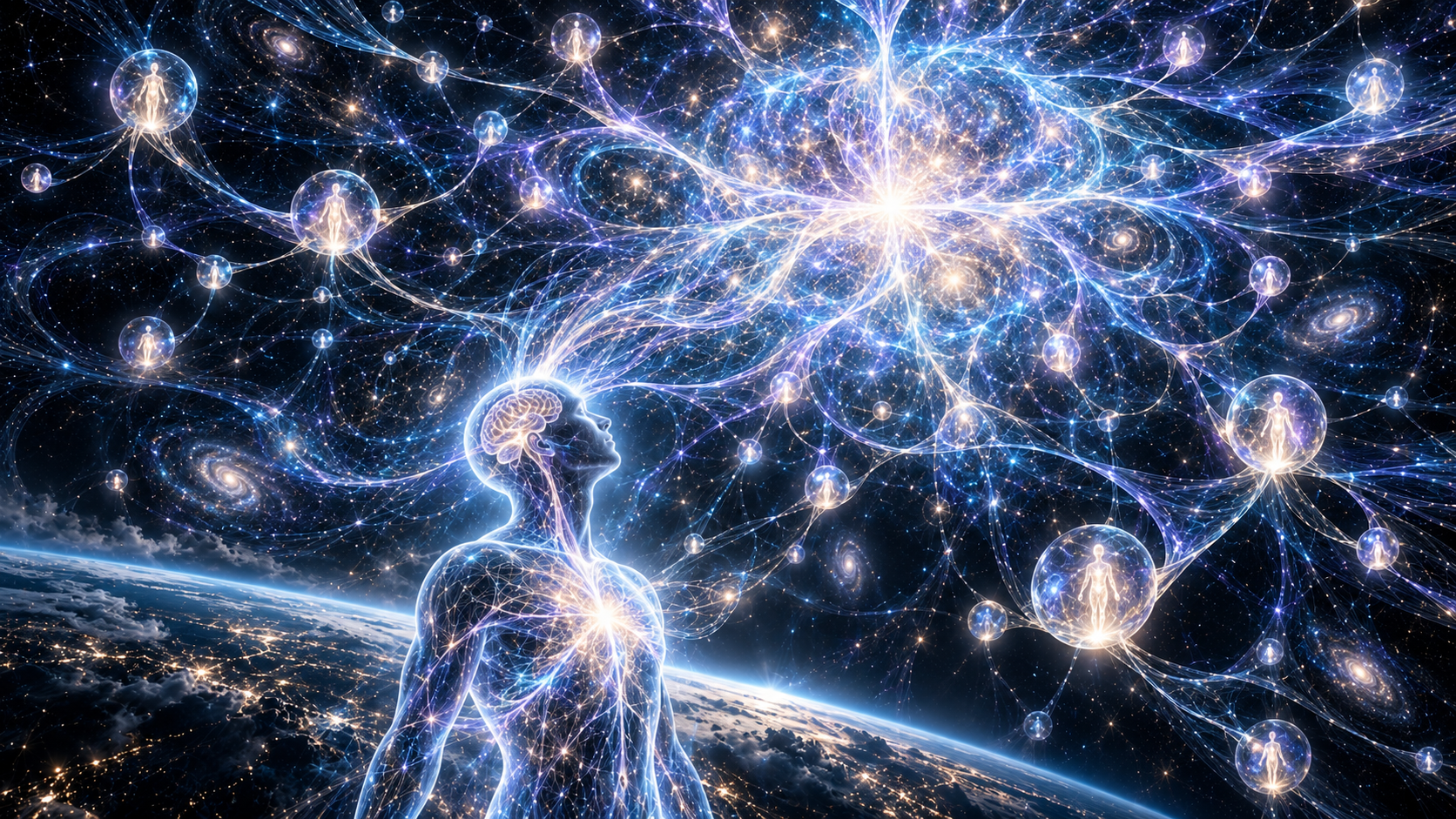
The second view begins with the primacy of consciousness. The brain does not manufacture consciousness; it receives, limits, and transmits it, like a terminal tuned to a wider field of information. In this model, consciousness can exist independently of the physical body. Philosophers, spiritual traditions, researchers of extraordinary states, and some scientists have all considered this possibility. Cardiologist Pim van Lommel has written about nonlocal consciousness. Robert Monroe developed a practical approach to investigating out-of-body states. Rupert Sheldrake proposed the existence of morphic fields and a collective memory within natural systems.
I belong to the second tradition. Not because it is more comforting, but because it corresponds to what I have experienced. Before I began having out-of-body experiences, I believed in the soul because of books and the testimony of others. Direct experience changed that. For me, consciousness beyond the physical body ceased to be a matter of belief. It became part of a reality I had personally encountered.
Why the Brain Is Not the Same as Consciousness
The brain clearly influences human perception. Injury, illness, exhaustion, alcohol, medication, or extreme stress can alter memory, personality, the sense of time, and even the experience of one’s own body. The materialist model draws a simple conclusion: if changing the brain changes consciousness, then the brain must create consciousness.
But that is not the only possible conclusion.
Damage to a radio receiver distorts the music, but it does not prove that the music originated inside the receiver. A broken screen alters the image, but the image is not created by the glass. An instrument determines how accurately a signal can appear within a physical medium. In the same way, the condition of the brain determines how clearly consciousness can express itself through the body.
In my model, the brain performs several functions at once. It connects the soul to the physical organism, processes signals from the senses, anchors attention in material reality, and translates the wider experience of consciousness into images, thoughts, and memories the human personality can understand. At the same time, it restricts the amount of information we can access. That restriction is necessary. Without it, a person could not remain focused on earthly life, relationships, choices, and the specific work of this incarnation.
The brain, then, is not the source of consciousness. It is a filter and a transmitter. The more limited the instrument, the less it allows through. The more a person develops attention, awareness, and inner discipline, the more accurately the brain can transmit the impulses of the soul.
This leads to an important practical insight: developing consciousness does not mean rejecting the body. On the contrary, we should care for the brain, the nervous system, and physical health, because the quality of the instrument affects the quality of the soul’s expression. Body and consciousness are not enemies. They form a partnership in which each has its own role.
Consciousness, the Subconscious, and the Superconscious: Three Modes of One Soul
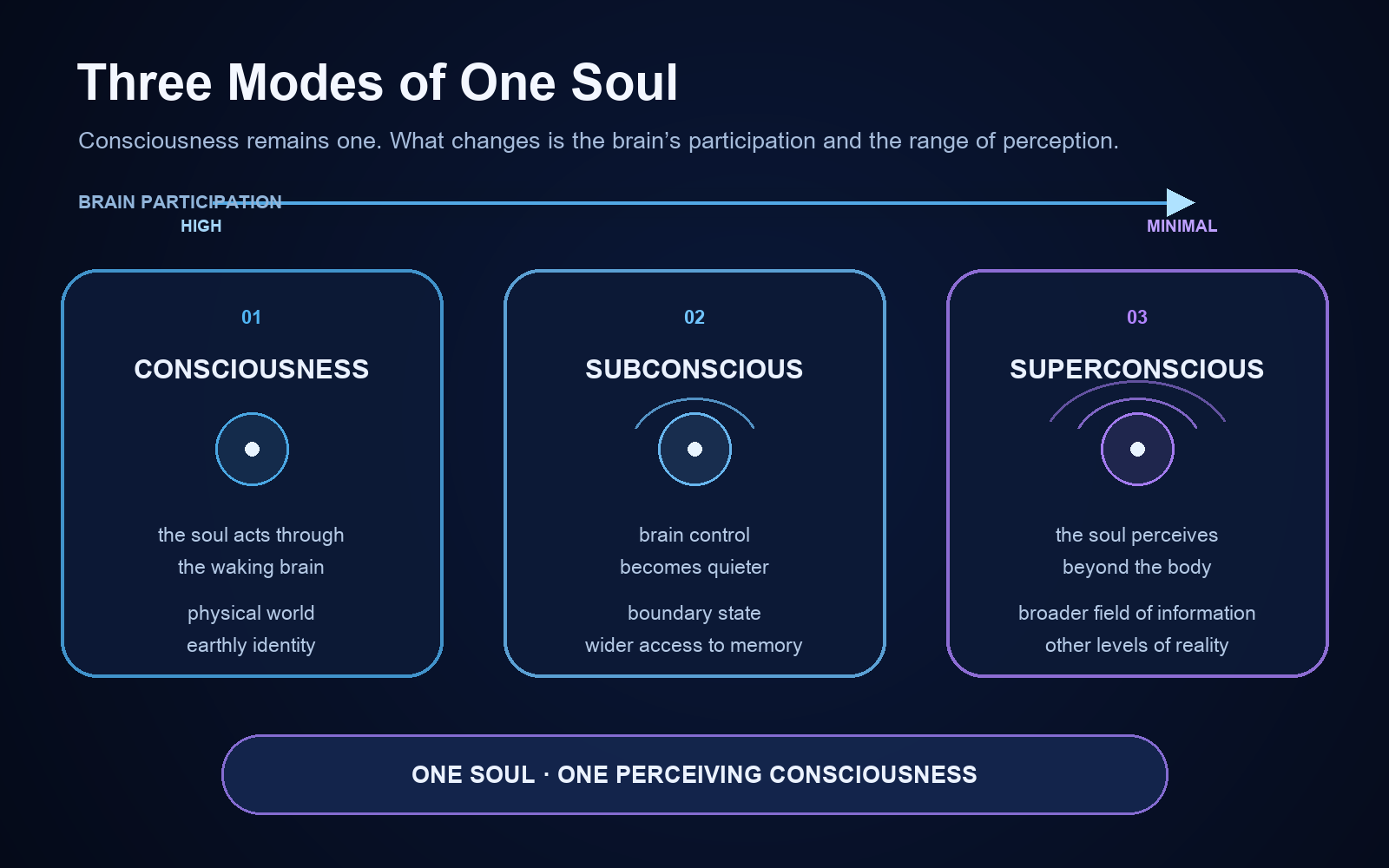
The words consciousness, subconscious, and superconscious are often used as though they refer to three separate entities. In my understanding, they do not. They describe three modes through which the same soul operates, distinguished by the degree of participation of the physical brain.
Consciousness: The Soul Working Through the Waking Brain
In an ordinary waking state, the soul uses the brain to guide the body, behavior, and thought. We perceive the world through the physical senses, recall events from our earthly lives, make decisions, and act within material reality.
This is what we normally call consciousness. Yet the range of perception available to us in this state is limited. The brain allows through only the portion of information necessary for life in the physical world. It anchors us within a particular personality, biography, and frame of reference.
This limitation is not a flaw in nature. It creates the conditions for genuine choice. If we continuously remembered the full history of the soul, saw the consequences of every decision, and perceived other levels of reality as clearly as the physical world, many earthly trials would lose their purpose. We are here not only to know, but to choose under conditions of incomplete knowledge.
The Subconscious: The Threshold Between the Brain and the Soul’s Memory
I understand the subconscious as a threshold state. Brain activity slows, its control weakens, yet the connection with the physical body and the ability to preserve information remain.
Such states arise during deep relaxation, trance, meditation, and the borderlands between sleep and waking. The ordinary stream of thought grows quieter, and consciousness gains wider access to the soul’s memory, imagery, and accumulated experience.
This is why altered states can bring unusual memories, solutions, intuitive knowledge, and experiences that ordinary logical analysis cannot reach. In my own practice, this state has opened access to memories of previous lives and to a deeper understanding of events unfolding in the present.
The subconscious is not merely a dark warehouse of primitive impulses. It is a transitional zone in which the physical brain suppresses consciousness less forcefully, while still retaining the ability to record what has been received and carry it into waking memory.
The Superconscious: The Soul’s Unrestricted Perception
The superconscious is the state of the soul when it is no longer constrained by the active physical brain. During a full out-of-body experience, the center of perception moves beyond the body. A person continues to exist, observe, move, feel, and make choices, even though the familiar physical senses are not involved.
Here consciousness reveals far more of its range. It gains access to a broader field of information, to its own memory, and to other levels of reality. Yet this creates a problem familiar to many people after vivid dreams and out-of-body experiences: the experience was clear and immediate, but it begins to disappear after full waking.
As I understand it, this happens because the physical brain did not participate in forming the memory. To preserve the experience, a person must pass through the intermediate subconscious state after returning and, in effect, download the memory into the brain. If someone wakes too quickly, begins moving, or immediately turns attention to external concerns, much of the experience may be lost.
The distinction between consciousness, the subconscious, and the superconscious is therefore conditional. There is only one consciousness. What changes is the degree of the brain’s involvement and the range of perception available to the soul.
Soul, Consciousness, and Energy: Different Words for the Same Reality
In my writing, I use the words soul, consciousness, and energy. To me, they describe the same essential reality from different angles.
The word soul emphasizes individuality, memory, and the path of development. Consciousness emphasizes the ability to perceive, observe, and gain experience. Energy describes the nature of the soul and the way it interacts with different levels of reality.
The soul is not an abstract symbol, nor is it a duplicate of the physical body. It is a living system of energy with memory, will, perception, and the capacity to develop. Physical life is one stage in a much longer journey.
During incarnation, the soul joins with the organism, and together they form the earthly personality. Human character emerges from a complex interaction among the body, the brain, life circumstances, accumulated experience, and the soul itself. The soul does not turn a person into a puppet. It does not cancel free will or force us to follow a predetermined path. Its influence appears through conscience, intuition, inner attraction, meaning, and the ability to see beyond immediate advantage.
Our task is to learn to recognize that influence. The more noise, fear, and automatic reaction fill our lives, the harder it becomes to hear the soul. The greater our awareness, the clearer our inner direction becomes.
The Soul’s Ability to Divide
One of the most important properties of the soul revealed to me through practice is its ability to divide its attention and energy. A separated part of consciousness can have its own point of perception, memory, and experience. When the parts reunite, the knowledge they have acquired becomes part of the whole again.
I first noticed this in trance states, when I could perceive physical reality and a second stream of imagery at the same time. The two lines of perception existed in parallel. Each felt distinct, yet both belonged to me.
In a milder form, something similar happens every day. We can drive a car while becoming absorbed in a memory. We can perform a familiar action while continuing an inner conversation. In sleep, part of our attention withdraws almost completely from the ordinary physical world, while the body continues its own living processes.
During an out-of-body experience, this division becomes deeper. One part of consciousness and energy maintains the connection with the body, while another operates on a different level of reality. The body is therefore never left “empty,” and return remains possible. After reunion, the experiences of both parts must be integrated, even though the physical brain can preserve only a portion of what occurred.
The soul’s ability to divide helps explain how a person can belong to several systems and levels of experience at once. We are individual souls, yet we remain part of a greater consciousness.
The Oversoul and the Illusion of Separation
During one of my early trance experiences, I saw a brilliant sphere from which countless luminous drops were separating. They streamed outward in every direction, surrounded by currents of light. I understood this as a memory of individual souls separating from the Oversoul.
Each soul begins its own journey, develops an individual point of perception, and gathers unique experience. Yet separation does not mean a final rupture. The soul continues to exist within the energy of which the Oversoul is composed. It cannot leave that field, because space itself is also an expression of the Oversoul.
This creates an apparent paradox: we are separate, yet we have never truly been divided. Separation creates individuality, free choice, and the possibility of acquiring a unique experience. Unity preserves the deepest connection among all that exists.
I see this as one of the central truths of human life. Loneliness, weakness, and isolation belong to the limitations of earthly perception. At a deeper level, we always remain within a single living consciousness. There is no place in which a human being is completely abandoned by the source of existence.
Collective Consciousness: From the Cell to the Planet
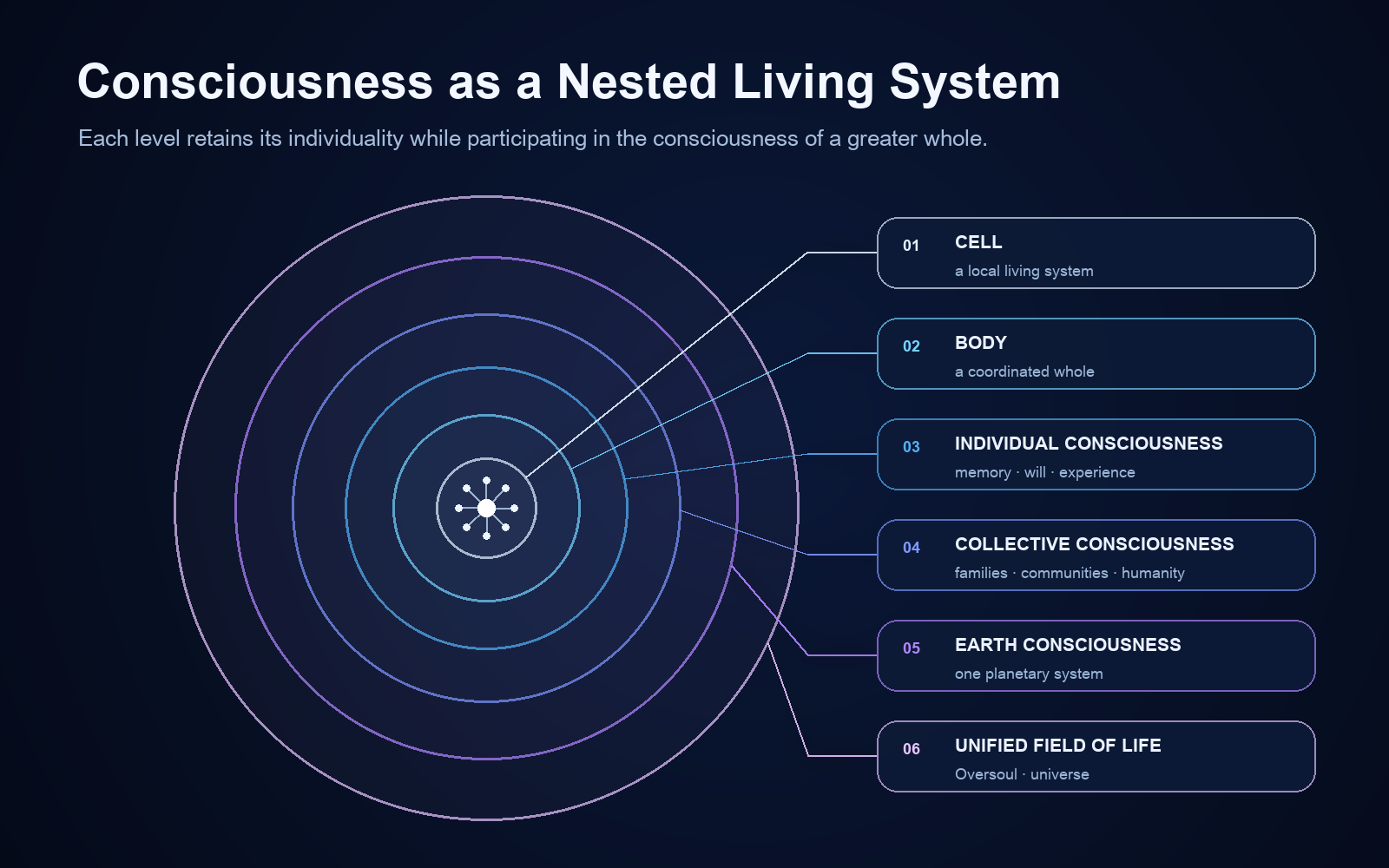
If consciousness is primary, and the energy of space is part of the Oversoul, then consciousness is not confined to human beings. It manifests at many levels of organization in matter and life.
A single cell is a living system. Cells form organs; organs form an organism. Each smaller system retains its own function while participating in a larger whole. Their coordinated activity produces the collective consciousness of the body.
Human beings also do not exist in isolation. We belong to families, communities, nations, humanity, and the biosphere. Animals, plants, water, minerals, the atmosphere, and the planet itself form a complex, interconnected system. I call this the consciousness of Earth.
That consciousness is not the same as human consciousness. It would be a mistake to attribute our thoughts and emotions to the planet in a literal way. Every system has its own scale of perception, its own relationship to time, and its own developmental tasks. A different form of consciousness, however, does not mean an absence of consciousness.
Individual thoughts, feelings, and actions enter the larger field. Every person affects collective consciousness, whether or not we notice it. Fear strengthens structures built on fear. Cruelty creates conditions for further cruelty. But clarity, compassion, inner dignity, and conscious choice also change the system.
Spiritual development is therefore never a purely private matter. By changing the quality of our own consciousness, we change the reality of which we are a part.
Why the Materialist Picture Is Not Enough for Me
Materialism has given humanity powerful tools for studying the physical world. I do not reject the achievements of neuroscience, medicine, or biology. The error begins when a method designed to investigate matter is declared to be the final description of all reality.
If a human being is defined only as a temporary arrangement of cells and neurons, the deeper meaning of existence disappears from the picture. Love becomes a chemical reaction, moral choice a survival strategy, inner experience a side effect of the brain, and death the permanent annihilation of the person.
To me, this is more than an incomplete theory. It is a worldview that diminishes the human being and makes people easier to control. A person who sees himself as an accidental biological mechanism is more likely to search for certainty in external systems and to fear the loss of the body. A person who recognizes himself as a soul develops a different relationship with fear, authority, responsibility, and freedom. He understands that the consequences of his choices extend beyond one brief physical lifetime.
Belief in the primacy of consciousness does not free us from morality. It makes morality more profound. Every action becomes part of the soul’s experience. We cannot hide from ourselves, from the energy we create, or from the shared reality we are building together.
What Changes When We Understand the Nature of Consciousness
An understanding of consciousness should not remain a philosophical diversion. It changes how we live.
First, the fear of death begins to weaken. Death no longer appears to be the destruction of the person, but a transition in which consciousness is released from its physical instrument.
Second, responsibility deepens. If experience, memory, and the quality of consciousness endure, inner development acquires a long-term meaning. We do not grow in order to earn society’s approval, but because the results of that growth become part of the soul.
Third, our relationship with others changes. If all souls exist within one Oversoul, then harming another person damages the larger system to which we ourselves belong. Compassion stops being merely a moral command and becomes an understanding of how reality is structured.
Fourth, we reclaim the freedom to investigate. We stop waiting for someone else to grant us permission to think about consciousness, death, and the nature of the universe. We examine experience, compare ideas, develop attention, and learn to distinguish fantasy from deep inner knowledge.
Consciousness Is Not the Product of an Isolated Brain
My conclusion can be stated simply.
Consciousness is the expression of the soul. The brain does not create it. The brain connects consciousness to the physical body, restricts the available range of perception, and translates experience into the earthly personality. Consciousness, the subconscious, and the superconscious are modes of one soul, distinguished by the degree of the brain’s involvement. The soul can divide its attention and energy while preserving the connection among its parts. Individual souls exist within a greater consciousness that encompasses life, matter, the planet, and the universe.
This model did not appear overnight. It grew out of twenty years of out-of-body practice, observation, and sustained effort to understand what I experienced. In future articles, I will examine the division of consciousness, levels of reality, the memory of the soul, and the ways human beings can learn to perceive more than the ordinary waking state allows.
We are only at the beginning of the study of consciousness. But we do not have to wait for one system of knowledge to deliver a final answer. Human beings already possess the essential instrument of investigation: consciousness itself. The question is whether we are willing to learn how to use it.
Thinkers and Research Traditions Mentioned
- Patricia Churchland — neurophilosophy and materialist theories of consciousness.
- Francis Crick — the neurobiological view of personal identity and consciousness.
- Pim van Lommel — near-death research and the model of nonlocal consciousness.
- Robert Monroe — practical investigation of out-of-body states.
- Rupert Sheldrake — the hypothesis of morphic fields and collective memory in natural systems.
Go Deeper
This article introduces the foundation of my model of consciousness. In my book The Phenomenon of Consciousness Outside the Body, I explore the experiences, observations, and long-term inquiry from which that model emerged.
Continue with the book on Amazon: Kindle Edition or Paperback.
Leave a Reply