
Affirmations are often presented as a simple way to get what we want. People are told to repeat every day that they are wealthy, successful, healthy, or happy, with the promise that reality will eventually begin to match those words.
The promise is attractive because it sounds easy. It allows us to expect a significant result without profound inner change, sustained effort, or concrete action. Say the right phrase, believe it, and life is supposed to rearrange itself.
I believe this understanding distorts the real meaning of affirmations. Words can influence us. Intention can influence the direction of our lives. Consciousness possesses creative power. But between a spoken phrase and a change in physical reality lies an entire process: attention, inner state, decisions, actions, time, and responsibility.
An affirmation can become part of that process. It cannot replace it.
What Is an Affirmation?
An affirmation is a brief positive statement that a person repeats regularly in order to establish a particular inner orientation. In psychology, it is commonly treated as a form of self-suggestion that can help create a desired mindset and support a chosen direction of behavior.
There is practical value in this. Whatever repeatedly receives our attention gradually occupies a more important place in our stream of thought. A repeated idea becomes familiar. The brain begins to retrieve it more easily, connect events with it, and notice things that previously passed outside our awareness.
But a phrase is not an action. It creates an inner direction from which action can emerge.
If someone repeats an affirmation mechanically and then spends the rest of the day living in the opposite state, making the same decisions, and following the same habits, the words remain only words. They gain no continuation in reality.
Why Affirmations Have Become Surrounded by So Much Exploitation
Human beings naturally look for the shortest road to what they want. We want to gain more while spending less time, effort, and risk. Promises of instant wealth, rapid success, and effortless fulfillment appeal directly to this weakness.
Financial pyramids are marketed in the same way. So are many “secret methods” that supposedly allow money, love, and opportunity to appear as long as a person thinks correctly.
Spiritual ideas are especially easy to exploit. People are told that consciousness affects reality, and then a convenient conclusion is added: if they imagine the result long enough, the physical world is obligated to provide it without any further effort.
The first part of that claim is true according to my understanding: consciousness does participate in shaping our lives. The mistake begins when everything else is removed from the process.
An affirmation will not create money inside a closed drawer. You can spend a week convincing yourself that one hundred dollars is lying there, but it will not appear when you open the drawer. Physical reality does not respond to every thought with an immediate material result.
This does not mean that consciousness is powerless. It means that its influence operates differently in our world.
What Actually Happens Through Repetition
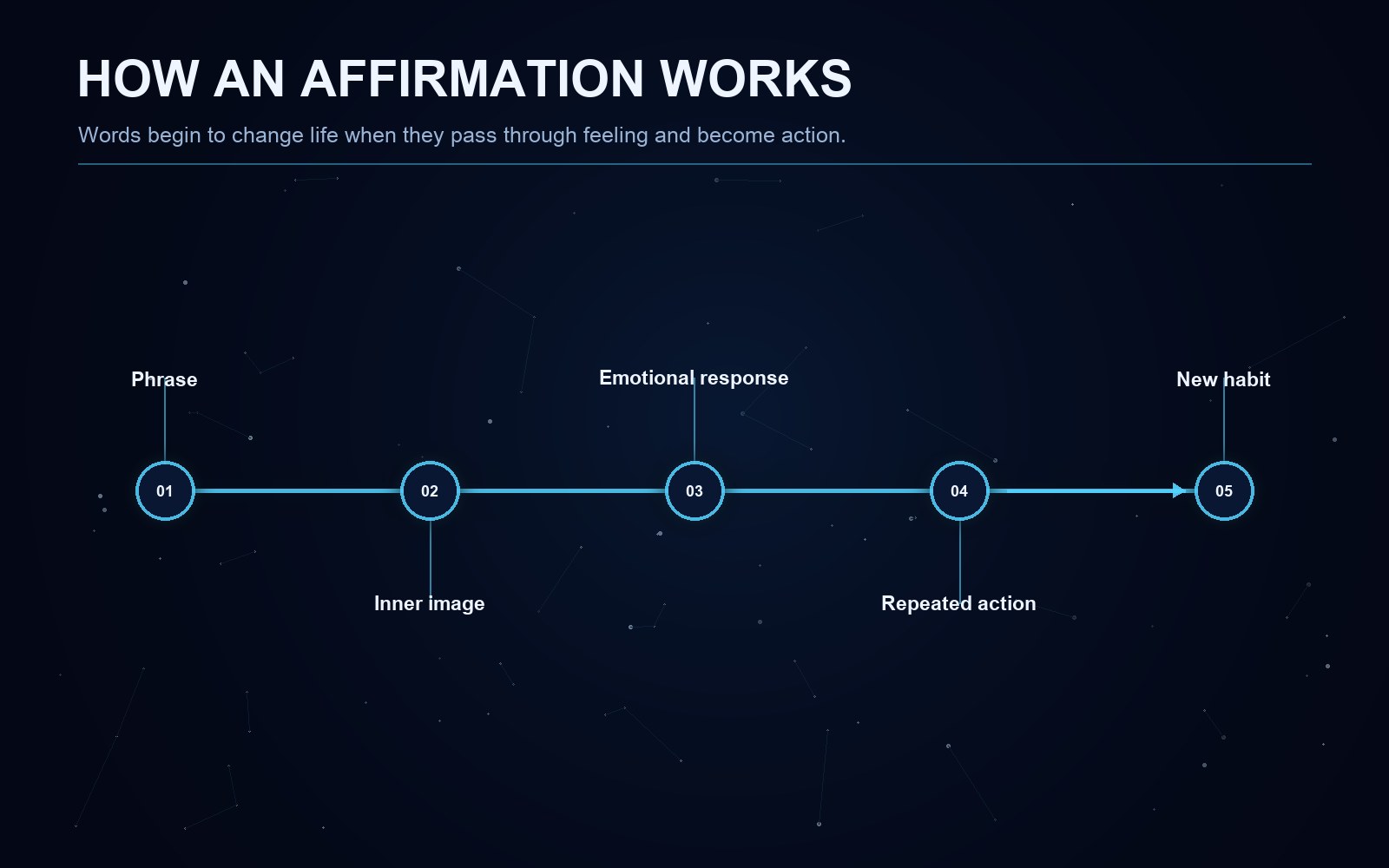
Every repeated thought creates a stable mental route. The brain returns more easily to familiar content, while attention begins selecting things in the surrounding world that are connected with it.
When someone lives for years with the conviction that nothing can be changed, that person rejects many possibilities before exploring them. They may overlook a useful offer, avoid starting a conversation, refuse to try a new path, or stop after the first setback. The inner belief becomes visible through decisions and behavior.
When the inner orientation changes, the same circumstances begin to look different. The person notices other options, allows for the possibility of success, and acts with greater confidence. The chain of events gradually changes because their participation in it changes.
This is not magic. It is the interaction between an inner direction and real life.
It is important here to distinguish consciousness, the brain, and the stream of thought. The brain reinforces familiar pathways, processes information, and offers again what a person has repeated many times. The stream of thought reflects memory, fear, habits, and incoming information. Consciousness can observe this process, choose the direction of attention, and decline to follow every thought automatically.
An affirmation can serve as an instrument of that choice. It reminds us where we have decided to go. But the phrase does not make the journey. The person does.
Consciousness as a Creative Force
My understanding is based not only on reflection but also on many years of investigating consciousness and exploring out-of-body experience.
I perceive consciousness as part of the Source. It carries the ability to influence energy, give it direction, create forms, and dissolve them. This ability manifests at different levels of reality with different degrees of speed and power.
A person participates continuously in creating the direction of life, even without realizing it. Attention, beliefs, emotional reactions, and actions shape the path being followed. We can create order or intensify chaos, support our development or destroy our own possibilities.
One of the important tasks of human life is therefore to learn how to direct this power. This does not mean suppressing thoughts and emotions. It means understanding where they come from, choosing a direction consciously, and seeing the consequences of that choice.
An affirmation has meaning within this context. It is not a spell for controlling the world. It is one way to tell ourselves which direction we have chosen and which inner position we intend to strengthen.
Why Physical Reality Changes Slowly
Our world is made from a very dense form of energy. Everything here possesses stability: bodies, objects, social systems, the consequences of previous decisions, and circumstances that have already taken shape.
This reality can be compared to hard modeling clay. It can be reshaped, but the process requires time and continuous pressure. At other times, it resembles stone from which a person gradually carves a form. A single strike does not produce a sculpture, but many directed strikes change the material.
Life changes in a similar way. Intention establishes the image of a future form. Attention helps us maintain the direction. Decisions and actions gradually change existing circumstances.
The delay between thought and result is often treated as proof that inner intention has no meaning. I see a different purpose in this delay. It protects us from the immediate manifestation of every fear, accidental desire, and contradictory impulse.
Imagine that every thought instantly became a physical event. Most people have not yet learned to hold their attention or manage their stream of thought. Fears, grievances, fantasies, and opposing desires would all begin taking form around us at the same time. The world would quickly descend into chaos.
The density of physical reality creates a necessary pause. Within that pause, we learn to understand our intentions and confirm them through consistency.
What I Have Observed in Out-of-Body Experience
During out-of-body states, the surrounding space responds to thought much more quickly. An image, expectation, or fear can alter the perceived environment almost immediately. Think of a place, and the direction of movement can change. Imagine an object, and it may appear. Lose control of attention, and the space begins reflecting the resulting inner chaos.
At first, this responsiveness feels like unlimited freedom. Very quickly, however, it becomes clear how unprepared a person is for it. The stream of thought is unstable. One intention replaces another. Desire collides with fear, while an image that has been created dissolves under the influence of doubt.
This experience helped me look at the physical world differently. Here, a thought does not turn into form instantly. We have time to stop, change a decision, recognize a mistake, and learn how to maintain a direction.
The slow manifestation of results should therefore not be viewed as a flaw in our world. It is part of our education.
Earthly Life as a Place of Learning
We are learning to use creative power under conditions in which every change requires a sustained intention. Wanting something once is not enough. We must return to the chosen direction, act, and accept the consequences of our decisions.
Responsibility develops through this process. We begin to understand that life is not created by one thought or one event. It is shaped by countless repeated choices.
An affirmation can help maintain a chosen direction, especially when old habits pull us back toward familiar fears and limitations. Its purpose is not to persuade the universe to grant a request. It helps us remember what we have decided to develop within ourselves.
The physical world then responds to that direction through a chain of real circumstances. Opportunities, encounters, ideas, and challenges appear. We must still make use of them. An opportunity does not automatically become a result.
What Affirmations Can Actually Change
Affirmations can strengthen an inner direction. They help return attention to a goal when the mind drifts back into familiar doubts. Over time, they can weaken an assumption that has been treated as an unquestionable truth for years.
Regular repetition can support confidence before an important action, remind us of a decision, and help us avoid abandoning it when difficulty appears. We begin noticing our own reactions more clearly and recognizing the situations in which an old program is trying to regain control.
An affirmation, however, does not replace:
- knowledge and learning;
- real action;
- discipline;
- the ability to make decisions;
- the willingness to correct mistakes;
- the time required for a result.
Someone who wants to improve their financial situation must examine their abilities, work, spending, and opportunities. Someone who wants to build a relationship must learn to listen, speak honestly, and take responsibility for their own behavior. Someone pursuing inner development needs more than a beautiful phrase; that path requires daily work with attention and action.
Words become powerful when they begin changing the way a person participates in life.
Why an Affirmation Sometimes Fails
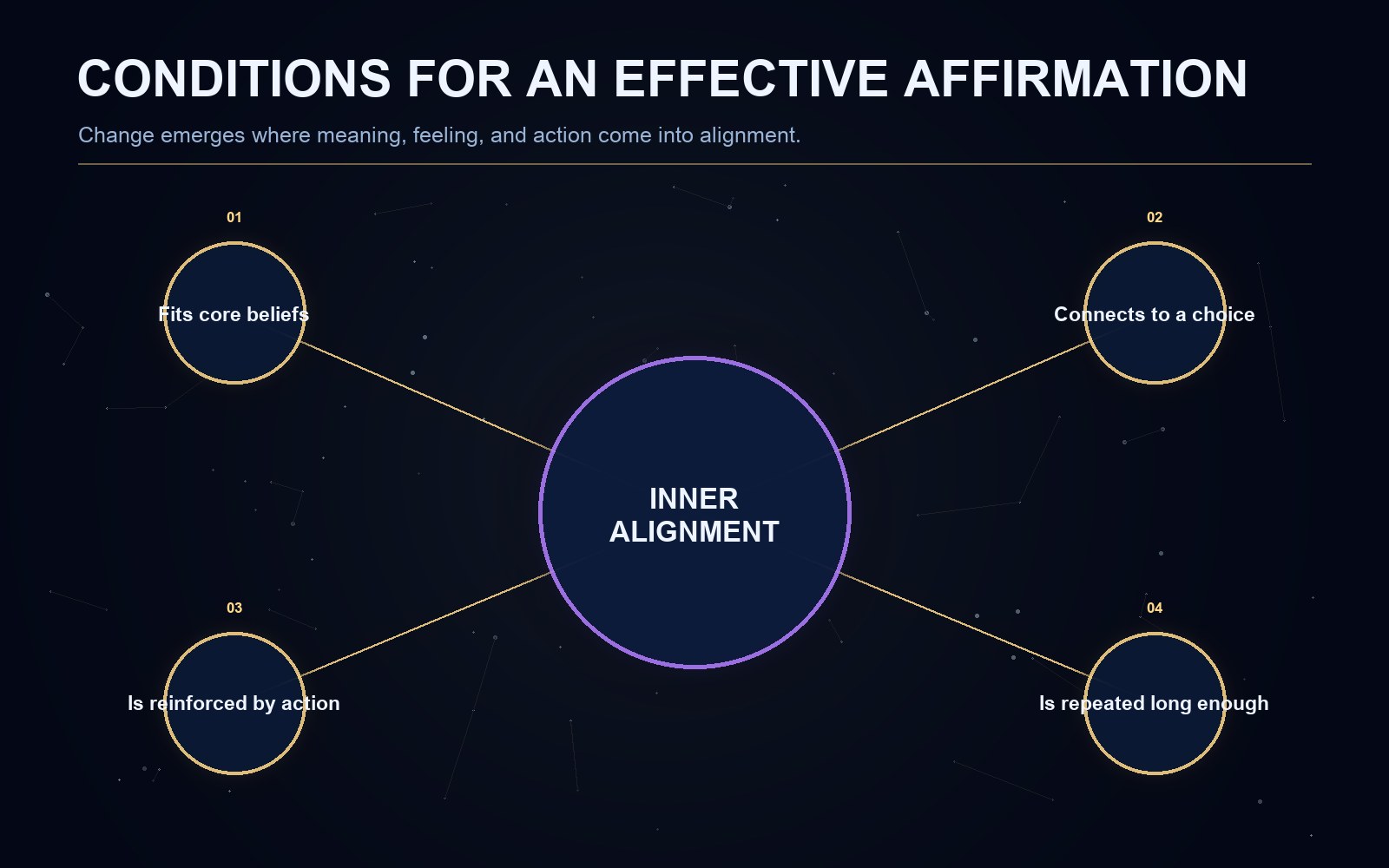
The first reason is mechanical repetition. A person says the words without connecting them to an inner decision. The phrase becomes background noise and quickly loses its meaning.
The second reason is contradictory action. A person can declare a new direction indefinitely while continuing to reinforce the old habit every day. Reality receives the action rather than the declaration.
The third reason is a borrowed goal. Sometimes people try to convince themselves to want something because society considers it correct or prestigious, even though the desire is not truly theirs. Resistance appears because the words do not match the actual direction of the soul.
The fourth reason is impatience. A person repeats a statement for several days, sees no immediate result, and decides that the method is useless. Yet stable inner programs were formed over years. Changing them also requires time.
The fifth reason is using an affirmation to avoid solving a problem. A positive statement should not make us close our eyes to debt, illness, conflict, or our own mistakes. A conscious intention brings us into contact with reality rather than leading us away from it.
Turning an Affirmation Into a Practice
The first step is to identify the real intention. This is not an external symbol of success but a change that a person is genuinely prepared to support in daily life.
That intention is then expressed through a brief affirmative statement. It should be repeated consciously rather than automatically, bringing attention back to the chosen direction.
The next step is to connect the words with an inner state. Instead of imagining the miraculous arrival of a result, we should imagine ourselves living and acting in accordance with the decision. How does our behavior change? Which habits no longer belong to that person? What action confirms the intention today?
Then an action is required. It may be small, but it must be real. Action is what connects an inner decision with the physical world.
The practice must continue long enough for the new direction to stop being an occasional thought and become part of life. During this process, it is important to observe resistance. Resistance reveals the fears and old beliefs that still hold us in place.
This is how an affirmation changes from a repeated phrase into an instrument of conscious transformation.
Responsibility for the Direction of Thought
The ability to influence our lives is not only an opportunity. It is also a responsibility. Creative power can support development, or it can reinforce destructive programs.
When someone repeatedly returns to hatred, fear, or the desire to harm, that person strengthens the corresponding inner route. Even when the thought does not immediately appear as an external event, it changes their state, perception, and subsequent decisions.
Directing attention therefore has spiritual meaning. We learn to see a thought before it becomes an action. We choose what receives our energy and what we turn our lives into.
An affirmation can assist with that choice. But the important element is not a collection of correct words. It is the consciousness that makes the decision and the human being who embodies it through action.
Words Alone Do Not Create a New Life
Affirmations work because they can change a person’s inner direction, not because the world is obligated to obey a spoken command.
A repeated thought holds attention. Attention influences decisions. Decisions become actions. Actions repeated over time change circumstances and gradually create a different life.
Consciousness gives this process its direction, but dense physical reality requires time. There is no injustice in this. Time allows us to learn how to use our inner power responsibly.
We should not expect words to do the work for us. Their purpose is to remind us which work we have chosen.
When intention joins with attention, discipline, and action, an affirmation stops being the promise of a miracle. It becomes part of genuine creation.
In my book The Phenomenon of Consciousness Beyond the Body, I explore the nature of consciousness, subtle reality, and our responsibility for directing attention and inner power in greater depth.
Leave a Reply