
An intrusive thought rarely comes only once. It returns to the same conversation, replays an old grievance, forces us to relive a loss, or imagines a disaster that has not happened. We understand that the repetition will tell us nothing new, yet we cannot stop the inner dialogue.
Reliving the past cannot change it. Constant anxiety cannot make the future safe. Still, the brain keeps sending the same thoughts around in circles, while the body responds each time as if the event were happening now.
As a result, we become exhausted not only by the original problem but also by its thousands of mental repetitions.
I have spent many years exploring the nature of consciousness and practical ways of directing the flow of thought. In my experience, simply ordering ourselves, “Don’t think about it,” is useless. A thought cannot be displaced by emptiness for long. We can interrupt it, but the attention we free must then be directed somewhere else.
Working with intrusive thoughts therefore involves three connected actions:
- Interrupt the automatic inner dialogue.
- Hold your attention on a chosen object.
- Replace the old mental route with new content.
This is not self-deception or an escape from reality. It is the recovery of our right to decide what we allow to remain in our stream of thought.
Thought and Attention Are Not the Same Thing
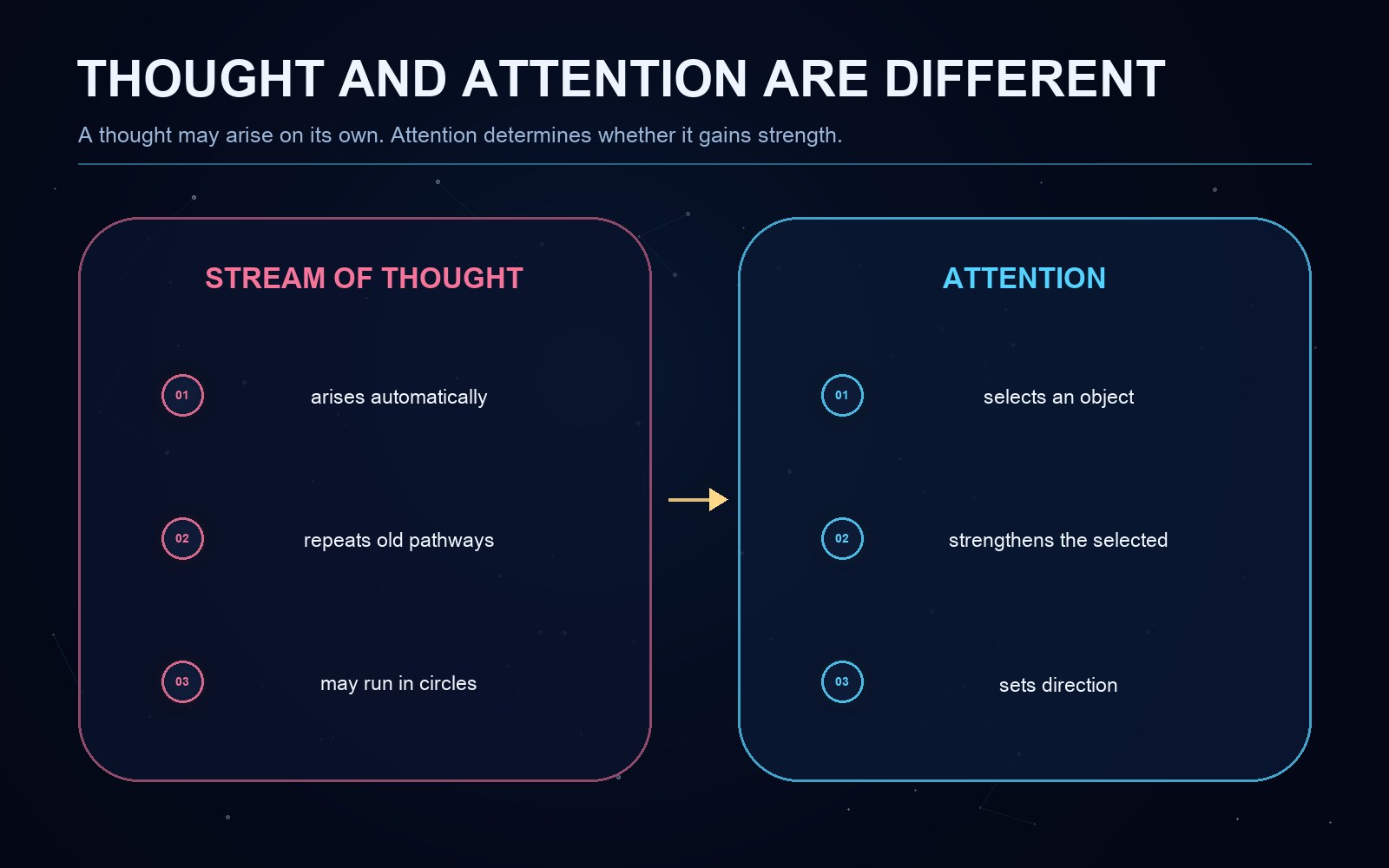
We do not choose every thought that enters the mind. Memory, habits, fear, conversations, the news we watch, the condition of the body, and the events of the day all influence what appears. Sometimes a single phrase, smell, or photograph is enough for the brain to retrieve an old episode instantly.
But the appearance of a thought does not mean that we must follow it.
The first reaction may be automatic. What happens next depends on attention. If we reconstruct every detail of an old grievance, invent a new response to someone from the past, and prove our case in an imaginary argument, we reinforce that mental chain. It grows stronger and becomes easier to activate the next time.
An intrusive thought draws its power not only from the event that once occurred. It is also sustained by our repeated participation.
That is why attention becomes the primary instrument. It resembles a beam of light: out of the enormous number of signals within and around us, it selects one and makes it part of our present experience. Whatever holds our attention for a long time begins to shape our emotional state, our decisions, and our relationship with life.
Managing our thoughts does not mean gaining absolute control of the mind or never remembering anything unpleasant again. It means recognizing sooner when the stream of thought has entered a familiar loop and learning not to keep traveling along it.
Why Ordinary Distraction Provides Only Temporary Relief
People instinctively feel the need to switch their attention. Some turn on a show. Others bury themselves in work, scroll endlessly through their phones, or stay busy until they are completely exhausted.
For a while, this can help. Attention receives a powerful external object, and the inner dialogue becomes quieter. But as soon as the movie ends, the work stops, and the surroundings become silent, the old thought returns.
The reason is simple: the person has occupied their attention without learning to direct it. The entertainment did the work for them.
I do not consider distraction useless. Sometimes we need to give the nervous system a break. Lasting change, however, begins when switching and holding attention become skills of our own. Like muscles, these skills can be trained.
The First Skill: Concentration Interrupts the Inner Dialogue
Concentration is the ability to choose one object voluntarily and return attention to it whenever the mind begins to wander.
The simplest exercise is to focus on your breathing.
Sit or lie down comfortably, close your eyes, and make your breath the sole object of attention for several minutes. There is no need to alter its rhythm. Notice the inhale and exhale, the movement of the chest, the passage of air, and the brief pause between cycles.
A different thought will appear within seconds. This does not mean that the exercise has failed. The moment you notice that your attention has wandered and bring it back to the breath is the exercise itself.
Some people find it easier to focus on sound: rain, rustling leaves, birdsong, or calm music without words. Others prefer a candle flame or a simple stationary object. The object itself is not important. What matters is that it allows you to gather scattered attention in one place, again and again.
For the duration of the exercise, everything else becomes secondary. A thought appears; you notice it, decline to develop it, and return to the chosen object.
There is no need to fight the thought, criticize yourself, or force the mind into absolute emptiness. Fighting a thought still keeps attention fixed on the very thing from which we want to be free. Our task is quieter: to stop feeding the automatic stream.
Ten to fifteen minutes a day is enough to begin building this skill. Gradually, the gap between the arrival of an unwanted thought and our recognition of it becomes shorter. We begin to notice not only the thought itself but also the moment when it tries to capture all of our attention.
That is the point at which choice returns.
Emptiness Does Not Remain Empty
Concentration can interrupt the inner dialogue, but interruption alone is not enough. After several minutes, we end the exercise and return to ordinary life. If attention has no new direction, the old stream will occupy the space we have cleared.
This is one of the central principles of working with thought: removing the old content is easier than preserving an empty space.
We therefore need to know in advance where we will direct our thinking after we interrupt it. Otherwise, the brain returns to the most familiar and emotionally charged material.
This is where the second skill becomes necessary: the ability to maintain a chosen stream.
The Second Skill: Mental Reconstruction Holds a New Direction
In the video on which this article is based, I call this stage visualization. I am not referring to fantasy or to imagining an ideal future. This is an exercise in accurately reconstructing a real experience.
For three to five minutes, walk through a room, go outside, or follow a short path. Do not move automatically. Notice the color of the walls, the shape of objects, the light, the texture of surfaces, the temperature of the air, the smells, and the sounds. You might open a door, touch its handle, turn on the water, look at a tree, or listen to the street.
Then sit down, close your eyes, and reconstruct those few minutes in sequence. Recall the route, your movements, the colors, sounds, sensations, and the order in which they appeared. Try not to jump to unrelated subjects or add imagined details.
This exercise develops several abilities at once:
- maintaining a chosen direction of thought;
- noticing more detail in the present moment;
- using memory more accurately;
- distinguishing observation from imagined additions;
- returning attention when it wanders.
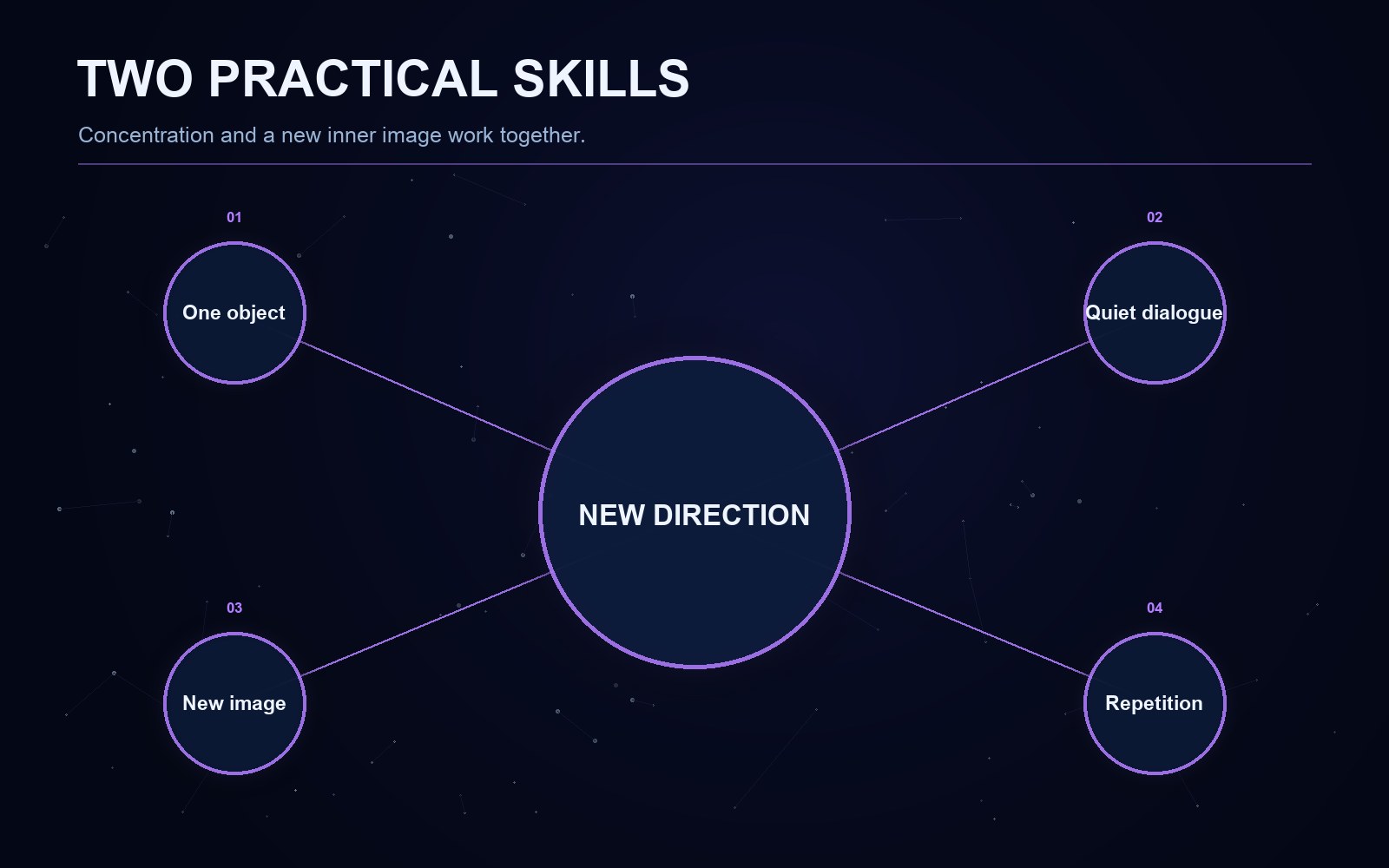
Concentration helps us interrupt the old stream. Mental reconstruction teaches us to hold our thoughts in a new channel. The two skills reinforce each other.
What Should Replace the Intrusive Thought?
The replacement should not be random. If we respond to an anxious thought by simply trying to think of something pleasant, the new image may be too weak. It is better to prepare several meaningful directions toward which attention can move.
If a memory of someone you lost keeps returning, you do not have to relive the moment of loss every time. You can deliberately reconstruct an episode in which you were together, heard that person’s voice, laughed, or felt close. This does not deny grief. It refuses to reduce the person’s entire story to its final tragedy.
If the mind keeps repeating a problem at work or at home, replace the question “Why is everything so terrible?” with “What specific action can I take next?” A problem becomes a task only when an action appears.
If your anxiety concerns someone you love who is far away, separate known facts from an imagined catastrophe. What do you actually know right now? Does the person need real help? Can you call, arrange a check-in, or do something useful? If action is possible, take it. If you have already done everything available to you, repeatedly creating frightening scenarios protects no one.
Useful replacements might include:
- a calm memory that restores a sense of stability;
- a practical plan for solving a problem;
- a creative idea;
- something you are studying;
- an image of the next useful action;
- gratitude for something good that exists now.
The new thought should not be an empty slogan. It must have meaning for you and contain enough substance to hold your attention.
Our Stream of Thought Reflects What We Feed the Brain
We cannot fill the mind with fear, conflict, and other people’s aggression for hours and then expect it to offer us only calm and lucid thoughts when the surroundings become quiet.
News, movies, short videos, conversations, and our social environment all become material for the inner dialogue. The brain continues processing this information even after we turn to something else. If much of what enters is built around danger, outrage, and conflict, that emotional background gradually begins to feel like the natural condition of the world.
This does not mean closing our eyes to difficult events or surrounding ourselves with artificial positivity. My point is different: the flow of information should be our choice rather than an uncontrolled invasion.
We can spend less time in news feeds. We can replace some entertainment noise with a book, a serious investigation, meaningful work, or a conversation that leaves us with greater clarity. We can become more careful not only about what we eat but also about the information we feed the brain and use to construct our stream of thought.
Change comes gradually. The mind gains more meaningful material to draw upon after the intrusive stream has been interrupted.
A Daily Practice
I recommend a simple cycle that takes about fifteen minutes.
1. Five to Ten Minutes of Concentration
Choose the breath, a sound, or a visual object. Whenever you notice another thought, return your attention calmly. Do not measure success by the number of thoughts that appeared. Measure it by the number of times you recognized what had happened and returned deliberately.
2. Three Minutes of Attentive Perception
Follow a short route and collect as many real sensations as possible: colors, shapes, sounds, smells, physical contact, and movement.
3. Three to Five Minutes of Reconstruction
Close your eyes and reproduce the experience in the correct sequence. If attention wanders, return to the last detail you remember accurately.
4. Prepare Three Directions for Replacement
Write down one supportive memory, one problem you want to approach constructively, and one useful action for the near future. When the intrusive stream appears during the day, you will not have to invent its replacement while already under pressure.
With experience, the entire process becomes faster. I now need only a few seconds to recognize an unwanted thought, interrupt its development, and redirect my attention. That speed is not a special gift. It is the result of repeated practice.
Not Every Difficult Thought Is an Enemy
Managing attention should not become a ban on every unpleasant feeling. Sometimes a thought returns because there is an unresolved problem, unprocessed grief, or a decision we keep postponing.
In that situation, we need to do more than switch our attention. We need to understand the signal. What requires action? Do we need to speak with someone, establish a boundary, admit a mistake, seek support, or allow ourselves to grieve?
Awareness does not mean replacing every painful feeling with a pleasant picture. It allows us to distinguish a useful signal from a repetition that no longer solves anything.
There are also times when individual exercises are not enough. If thoughts consistently prevent sleep or work, cause panic, involve harming yourself or someone else, or feel uncontrollable, help from a qualified professional is necessary. Seeking that help is also an act of responsibility for your inner state.
The Spiritual Meaning of Directing Attention
A human being is not identical to every thought that appears in the mind. If we can see a thought, then there is someone observing it. For me, that observer is consciousness connected with the deeper nature of the soul.
Automatic thoughts are formed by memory, the body, upbringing, and the surrounding environment. Conscious attention allows us to avoid dissolving into them completely. It creates enough inner distance to ask: Do I want to continue this thought? Does it correspond to who I am and who I am trying to become? What kind of action will it produce?
This is the spiritual value of the practice. We are doing more than making life more comfortable and reducing unnecessary distress. We are learning to distinguish ourselves from a stream of automatic programs and restoring consciousness to an active role.
Freedom does not begin with the ability to do whatever we want. It begins with the ability to choose what receives our attention and which thoughts we turn into actions.
We Do Not Have to Repeat the Same Pain
Intrusive thoughts can create the impression that an unstoppable mechanism is operating within us. But this mechanism responds to training. The more often we notice the automatic stream, interrupt it, and deliberately choose a new direction, the weaker the old habit becomes.
We do not need to wait for instant silence. It is enough to reclaim a few minutes of direction each day. At first, attention does not remain steady for long. Gradually, the inner dialogue stops feeling continuous and inevitable. A space opens between thought and reaction.
Within that space, we become participants in our own lives again.
In my book The Phenomenon of Consciousness Beyond the Body, I explore the nature of consciousness, the development of attention, and the inner work of the human being in greater depth.
Leave a Reply