
Sometimes a person suddenly realizes that several months have passed while they were barely present in their own life. They woke up, carried out familiar responsibilities, reacted to the same irritations, worried about the same problems, and returned each evening to the same familiar thoughts. Many things happened on the outside, yet almost nothing changed within.
This is how autopilot works.
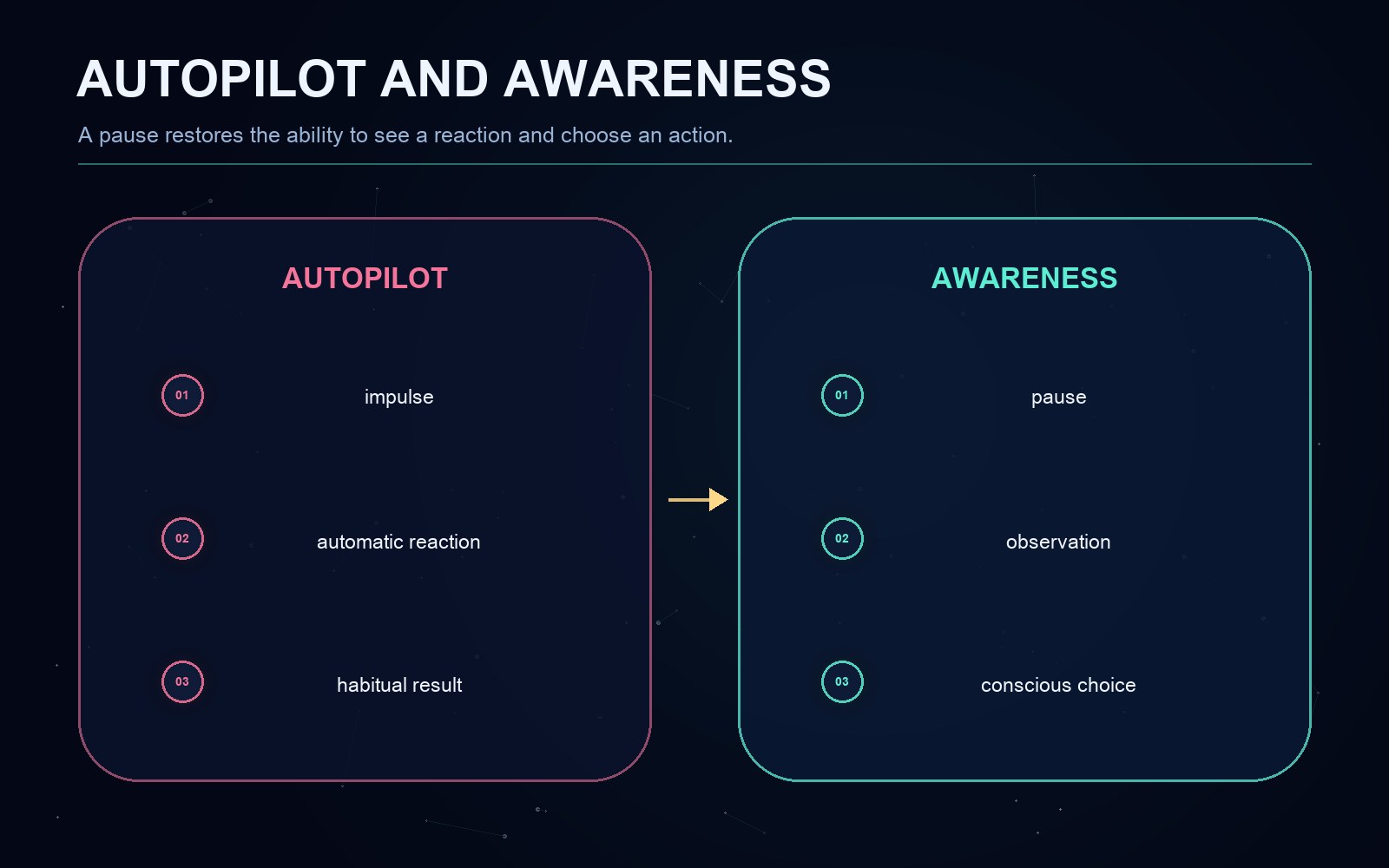
We continue moving, working, communicating, and making decisions, but much of our behavior is controlled by automatic reactions. We respond not to the situation itself but to our habits, fears, upbringing, social expectations, and old inner programs. We believe we are choosing, even though many of our decisions were prepared long before we began consciously thinking about them.
Awareness begins when this automatic pattern becomes visible.
For me, awareness is not a fashionable psychological exercise, the ability to observe one’s breathing for a few minutes, or an appealing spiritual image. It is the capacity to understand what is happening within and around us, recognize the forces influencing our decisions, and consciously choose the direction of our lives.
Yet its meaning goes further. Genuine awareness requires us to confront deeper questions: Who am I? Where did I come from? Why am I in this reality? Where am I going when physical life ends?
Without these questions, we may learn to experience the present moment more attentively while still failing to understand the larger journey to which that moment belongs.
The Two Dimensions of Awareness
In psychology, awareness is usually associated with being present here and now: noticing our thoughts, feelings, physical sensations, and immediate circumstances without automatically reacting to them. This is an important definition. Once we can see our reaction, we gain the possibility of choosing whether to follow it.
Consider an ordinary conflict. Someone says something hurtful, and irritation immediately rises within us. On autopilot, we respond with aggression, become defensive, or try to cause the other person the same pain.
Awareness creates a small space between the event and our response. Within that space, we can see our hurt, understand where it came from, and choose an answer that does not deepen the conflict.
The spiritual meaning of awareness, however, is much broader.
From this perspective, it is not enough to notice what is happening to me today. I must understand myself as a soul passing through a particular stage of development. The physical personality is part of our existence, but it is not our entire nature. It has a name, a biography, a profession, a character, and a social role. The soul existed before this personality appeared and will continue its journey after the body dies.
Spiritual awareness therefore includes an understanding of our place within a much longer continuum of existence. We begin asking: What experience am I receiving through this life? What qualities am I developing? Why do certain situations keep repeating? Which decisions bring me closer to my spiritual nature, and which ones return me to fear and automatic behavior?
Psychological awareness gives us presence. Spiritual awareness gives us direction. Together, they allow us not only to see the present moment but also to understand its meaning.
Autopilot Makes Life Feel Shorter
Time moves slowly in childhood. Almost every day brings new impressions, knowledge, and discoveries. As we grow older, life often seems to accelerate. Weeks and months blur together, and each year passes faster than the one before it.
Age is not the only reason. The more actions we perform automatically, the fewer experiences consciousness truly inhabits. Repetitive days leave almost no inner trace. The brain relies on established patterns, conserves energy, and stops recording familiar reality in detail.
Automatic behavior is necessary. Without it, we would have to relearn every movement and spend our attention on thousands of minor actions. The problem begins when autopilot takes over not only everyday routines but also our relationships, beliefs, moral choices, and the direction of our entire lives.
We automatically adopt the views of our families, societies, religious environments, or political cultures. We automatically choose a career because it is expected. We automatically remain in destructive relationships because we fear change. We automatically submit to authority because we were taught that obedience is a virtue.
As a result, a person may live according to someone else’s script and discover only near the end that they rarely asked what their own soul truly wanted.
Awareness Is Never a Permanent Achievement
Awareness is not a title we earn once and keep forever. We cannot complete a course, declare ourselves awakened, and consider the inner work finished.
It is more like a moving scale. In one part of life, a person may be attentive and mature; in another, they may remain completely controlled by automatic reactions. Someone may understand politics while remaining blind to their own fear. They may know a great deal about spirituality while still depending on approval. They may condemn social manipulation while manipulating the people closest to them.
This is why I do not measure awareness by the number of books someone has read, the length of their meditation practice, or their command of spiritual language. Awareness reveals itself in how a person makes decisions, responds to the consequences of their actions, and reacts when reality contradicts their beliefs.
An aware person can admit a mistake. They do not treat a change of mind as defeat. When new knowledge reveals that their former picture was incomplete, they expand it. Their purpose is not to protect their self-image but to move closer to truth.
Conscience as a Connection with a Greater Part of Ourselves
I consider conscience one of the clearest inner signs of awareness.
Conscience is influenced by upbringing, culture, and social norms. Different societies and historical periods have defined acceptable behavior in different ways. Yet conscience cannot be reduced entirely to external rules. Sometimes a person recognizes that an action is wrong even when society justifies it, the law permits it, and everyone around them approves.
I connect this deeper moral orientation with the experience of the soul and the influence of the Higher Self. The greater part of the soul sees consequences from a wider perspective than the human personality. It perceives not only the immediate benefit of an action but also what that action is turning us into.
Conscience is different from fear of punishment. If I refrain from doing harm only because I fear the law or other people’s judgment, I am still being controlled from the outside. Conscience acts even when no one will ever know what I have done. It arises from an inner understanding: I do not want to create this kind of reality or become a person capable of this choice.
The Higher Self does not dictate detailed instructions or take away our freedom. Its influence feels like a clear recognition of direction. We can ignore it, invent an excuse, and choose the more convenient path. But the more often we betray this inner understanding, the less clearly we hear it.
Awareness clears the channel. We learn to distinguish conscience from guilt, inner clarity from fear, and the knowledge of the soul from the desire to look good in the eyes of others.
Education Begins When We Learn to Think
Awareness is closely connected with education, but I am not referring to a diploma.
Formal education may provide a profession and a body of knowledge, but it does not guarantee the ability to understand what is happening. A person can hold several degrees and repeat other people’s opinions without examining them. Another person may have no prestigious credentials yet continue learning, compare evidence, and see the world with far greater depth.
To make independent decisions, we need to understand the world in which we live. History helps us recognize recurring mechanisms of power. Economics reveals the interests behind decisions. Knowledge of the law allows us to defend our rights. Psychology helps us recognize manipulation through fear, shame, and the need to belong to the majority.
An uninformed person is easy to control. Give them a simple enemy, a ready-made explanation, and an emotional slogan, and they may stop asking questions. The less they know, the more easily they mistake confidence for truth and volume for evidence.
An aware person does not have to be an expert in everything. But they understand the limits of their knowledge, know how to ask questions, and do not surrender their right to think to whoever speaks most convincingly.
Society Shapes the Limits of Our Awareness
No one develops in a vacuum. Culture, tradition, law, the information environment, political institutions, and the behavior of the people around us all influence who we become.
A society can support awareness. It can teach citizens to think, respect one another’s rights, examine the decisions of those in power, and face difficult questions without fear. In such a society, law restricts arbitrary power, education develops independence, and people understand that they are responsible not only for their private lives but also for the shared world around them.
A society can also do the opposite. A government built on fear and unconditional obedience has no interest in aware citizens. An aware citizen asks questions. They notice when their rights are violated, demand explanations, compare words with actions, and refuse to treat authority as proof of truth.
It is harder to make such a person support something that violates their conscience. They are less easily controlled through propaganda, guilt, or the image of an external enemy. This is why systems seeking total control often weaken real education, encourage dependence on ready-made answers, and portray independent thinking as dangerous.
The level of awareness in a society is visible not only in its public declarations. It appears in ordinary details: how people behave on the road, whether they follow rules, whether they respect the vulnerable, where they leave their trash, how they treat shared spaces and nature, and whether they consider it acceptable to benefit from something everyone shares while leaving the cost to others.
For me, behavior on the road is an especially revealing measure. Behind the wheel, a person’s attitude toward rules, responsibility, and other people becomes visible very quickly. When a driver believes that personal convenience matters more than everyone else’s safety, that attitude says more than polished statements about morality.
Awareness always becomes visible in what people do when they believe no one is watching.
Spirituality Is Not Religious Submission
We need to distinguish spirituality from religious automatic behavior.
Faith can support a person, remind them of moral responsibility, and open a path toward inner work. But it stops being spiritual when it demands that people abandon their questions and surrender their conscience to an external authority.
A person may attend religious services regularly, perform every ritual, and repeat all the approved words while remaining unaware. If they act only because they were told to, fear doubt, and condemn everyone who sees the world differently, their behavior is being governed not by the soul but by fear of leaving the system.
Living spirituality does not fear investigation. It does not demand that we defend God from questions. It makes a person freer, more honest, and more responsible. Fanaticism makes a person dependent on ready-made answers, divides the world into insiders and outsiders, and allows cruelty to be justified by a higher purpose.
The number of religious symbols in a society therefore tells us nothing by itself about spiritual maturity. What matters is whether faith develops conscience and love or is used as an instrument of control and submission.
Responsibility Is the Clearest External Sign
Awareness cannot be separated from responsibility.
Every serious decision creates consequences beyond our own lives. Choosing a partner, becoming a parent, and deciding how we relate to health, money, work, and nature all affect other people and help shape the future.
The decision to become a parent, for example, should not be reduced to tradition, pressure from relatives, or the need to resemble an idealized family. A child needs safety, attention, love, education, and room to develop. The number of children in a family proves nothing by itself. The real question is whether the parents understand the scale of their responsibility and can create the conditions each child needs for a full life.
The same principle applies everywhere. An aware person does not make promises they have no intention of keeping. They do not force others to carry the consequences of their decisions. They do not demand freedom only for themselves while denying it to everyone else. They understand that freedom without responsibility quickly becomes the privilege of the strong.
What Awareness Gives Us
The greatest benefit of awareness is that it returns control of our lives to us.
We begin to understand why we are in a particular relationship, why we do a certain kind of work, why we live where we do, and why we make one decision instead of another. We recognize when we are acting from love and when we are acting from fear of losing approval, money status, or familiar security.
This does not mean that we gain total control over external circumstances. The physical world, society, and other people will always limit our options. Yet even within those limits, there remains a space for choice. We can choose our attitude, our direction, our way of acting, and who we become in response to what happens.
An aware person can defend their rights because they understand them. They can refuse to participate in a lie even when that lie is convenient for the majority. They can change professions, end a destructive relationship, move somewhere new, begin learning, or admit that they have spent years moving in the wrong direction.
From a spiritual perspective, awareness turns earthly life into an active process of development. We stop merely accumulating events and begin to understand the experience they offer us, the qualities they reveal, and the person we are becoming through our own decisions. The more aware we become, the less control our automatic programs have over us and the more fully the soul can express itself through our actions.
Awakening Has a Price
Awareness does not always make life more comfortable.
As long as we do not see the contradictions around us, it is easier to preserve the familiar order. Awakening forces us to confront deception, both social and personal. Empty relationships, meaningless work, dependence on approval, and decisions made from fear become impossible to ignore.
These discoveries can be painful. Sometimes we have to change what we spent years building. Sometimes our social circle becomes smaller because the old closeness depended on an unspoken agreement never to ask important questions. Sometimes we feel alone because we can no longer participate sincerely in conversations or actions we consider destructive.
Returning to sleep, however, does not solve the problem. What has been seen cannot be entirely forgotten. Inner freedom requires the courage to live according to what we understand.
Awareness does not guarantee that every decision will be correct. It gives us something more important: the ability to recognize an error, learn from it, and change direction without defending the past simply because we have already invested so much in it.
How to Develop Awareness
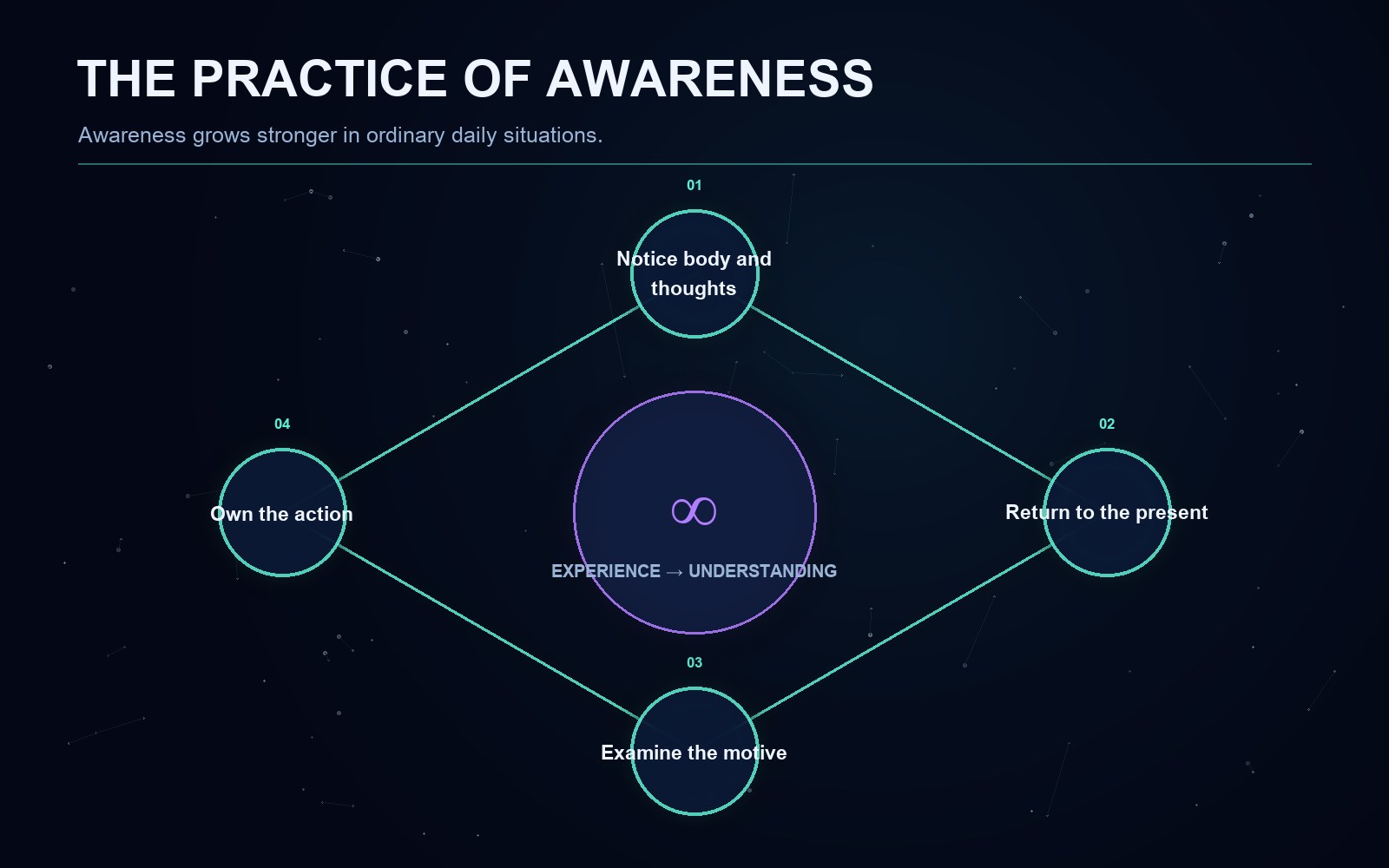
Awareness is an ongoing process, not a single discovery. I see five main directions for this work.
1. Strengthen the Connection with the Higher Self
This requires inner silence. While the mind constantly comments on everything that happens, it is difficult to distinguish the influence of the deeper soul from fear and desire. Meditation, quiet observation, and an honest inner question help clear the channel of perception.
An answer does not always arrive in words. Sometimes it comes as a complete understanding that we translate into thought only afterward. The goal is not to demand an immediate sign but to learn to recognize quiet clarity.
2. Keep Working on Yourself
Awareness requires us to see not only the failures of society but also our own weaknesses. It is easy to blame the government, our environment, or our circumstances. It is much harder to recognize our envy, fear, dependence on recognition, or desire to control other people.
Working on ourselves does not mean hating ourselves. It means seeing our present condition honestly and steadily developing character, moral strength, and the ability to take responsibility for our actions.
3. Never Stop Learning
We can devote part of every day to learning something new. The purpose is not to accumulate random information but to expand our picture of reality. Read positions you disagree with. Check sources. Study the history of ideas. Compare different explanations.
The more a person understands, the harder it becomes to control them through primitive fear.
4. Care for the Physical Body
The condition of the body directly affects attention, emotional stability, and the ability to think clearly. Chronic exhaustion, inactivity, lack of sleep, and addiction narrow consciousness until immediate problems occupy the entire field of perception.
Spiritual development does not require us to neglect the body. It is the instrument of this incarnation, and caring for it is part of the soul’s responsibility for the life it has been given.
5. Turn Understanding into Action
We can spend years reading about awareness without changing anything. The real work begins when understanding influences a decision.
If I see that a relationship is built on fear, what do I do with that knowledge? If I recognize that I am being manipulated, do I continue to obey? If I notice my own injustice, can I admit it and repair the harm?
Awareness that never changes behavior remains an intellectual game.
The Central Task Is to Awaken While We Are Alive
I consider awareness one of the central purposes of earthly incarnation.
The soul enters the physical world not simply to pass through a series of events. It receives an opportunity to become aware of itself within a dense reality where its spiritual nature is not directly visible and where fear, instinct, and social programming exert enormous power.
To awaken under these conditions is to remember that we are more than a biography and a body. It is to see our automatic patterns, restore our connection with the soul, learn to guide our attention, and make decisions consistent with our inner understanding.
Until we become aware, the same lessons may repeat themselves again and again. The setting, relationships, and circumstances change, but the inner pattern remains the same. Awareness allows us to break that cycle and rise to the next stage of development.
This work is difficult. It requires knowledge, honesty, discipline, and courage. Yet there is no other path to inner freedom.
Awareness begins the moment we stop asking who will control our lives and accept that responsibility ourselves.
In my book The Phenomenon of Consciousness Beyond the Body, I explore the nature of the soul, the Higher Self, the purpose of earthly incarnation, and the development of consciousness in greater depth.
Leave a Reply