Category: Uncategorized

  • Personal Experience Is Not Proof—But It Cannot Be Ignored

    Personal Experience Is Not Proof—But It Cannot Be Ignored

    “That is only personal experience” is often used as though it ends the discussion. A person reports an out-of-body experience, a meeting with a deceased loved one, or information received in an unusual state—and is told that a subjective observation means nothing.

    That is a mistake.

    Personal experience is not conclusive proof for another person. It is, however, a real fact in the life of the person who had it and the starting material for any investigation of consciousness.

    For the person who lived it, experience can become knowledge

    If you have never seen the ocean, another person’s story will not prove its existence completely. Yet someone who stood on the shore is not required to call the ocean a hypothesis merely because no measuring instrument was present.

    I approach my experience of consciousness beyond the body in the same way. My conviction did not arise from one dramatic night or a desire to believe. It grew from hundreds of observations, repeated patterns, meetings, and experiments over twenty years.

    For me, the independent existence of consciousness is not an abstract philosophy. I also understand that my internal degree of certainty cannot be transferred automatically to a reader.

    An artistic visualization of the article's central idea

    Why an account does not become proof for everyone

    Another person cannot enter my experience directly. He receives a memory translated into words and filtered through interpretation.

    The account may be affected by:

    • errors of memory;
    • expectations and beliefs;
    • mental constructions;
    • the desire to give the event meaning;
    • imprecise language;
    • selecting only successful episodes;
    • deliberate exaggeration.

    An author’s honesty matters, but honesty alone does not solve the problem of verification.

    Consciousness research inevitably uses subjective data

    Pain, love, fear, meaning, and the sense of “I” cannot be observed directly from the outside. A scientist records brain activity, behavior, and physiological responses, but learns the content of the experience from the person’s report.

    If we remove subjective experience entirely, we lose the subject of consciousness research itself. Only external correlations remain.

    The answer is not to discard personal accounts, but to collect them according to clear rules: record conditions, compare characteristics, search for repetition, and isolate verifiable elements.
    A diagram of the article's key concepts

    A body of experience is stronger than one story

    One account may be an error. Thousands of independent accounts with a repeating structure demand an explanation.

    This does not prove that every person visited the same objective region. Shared features may arise from the brain, culture, or similar transitional states. But dismissing the material as “fantasy” is not an adequate explanation.

    We should compare:

    • how experiences begin;
    • degree of awareness;
    • stability of the environment;
    • bodily sensations during transition;
    • the influence of thought;
    • forms of consciousness encountered;
    • verifiable information;
    • changes in personality afterward.

    An investigative model grows out of repeating patterns.

    Transformation does not prove a worldview, but it reveals the power of the phenomenon

    After a powerful out-of-body or near-death experience, a person may lose the fear of death, change values, and relate to life differently.

    A profound change in personality does not prove the literal accuracy of everything perceived. A dream, book, or psychological crisis can also change a person. But a stable transformative effect shows that the phenomenon cannot be dismissed as insignificant noise in the brain.

    Even an investigator who disputes the explanation should study the consequences.

    Two extremes obstruct understanding

    The first extreme declares every unusual experience an absolute truth. Personal interpretation then becomes dogma.

    The second treats subjectivity as a synonym for meaninglessness. Science then closes itself to material it cannot yet measure directly.

    I choose a third path: respect the experience and test the conclusions.

    A person has the right to speak confidently about what he experienced. He also has a responsibility to separate observation from explanation. An investigator has the right to question the interpretation, but not to humiliate the witness or declare the phenomenon impossible in advance.

    Institutional science also has limits

    Research priorities are shaped by more than scientific curiosity. Funding, reputation, career risk, and organizational interests all influence them. Consciousness beyond the body has long remained outside the boundaries of scientific respectability, so it receives fewer resources and fewer well-designed experiments.

    That does not make scientific method unnecessary. On the contrary, we especially need high-quality research. But a lack of funding and data must not be mistaken for evidence that a phenomenon does not exist.

    Science develops when someone dares to investigate what an earlier worldview considered impossible.

    Personal experience as the beginning of a path

    A subjective experience performs several essential functions.

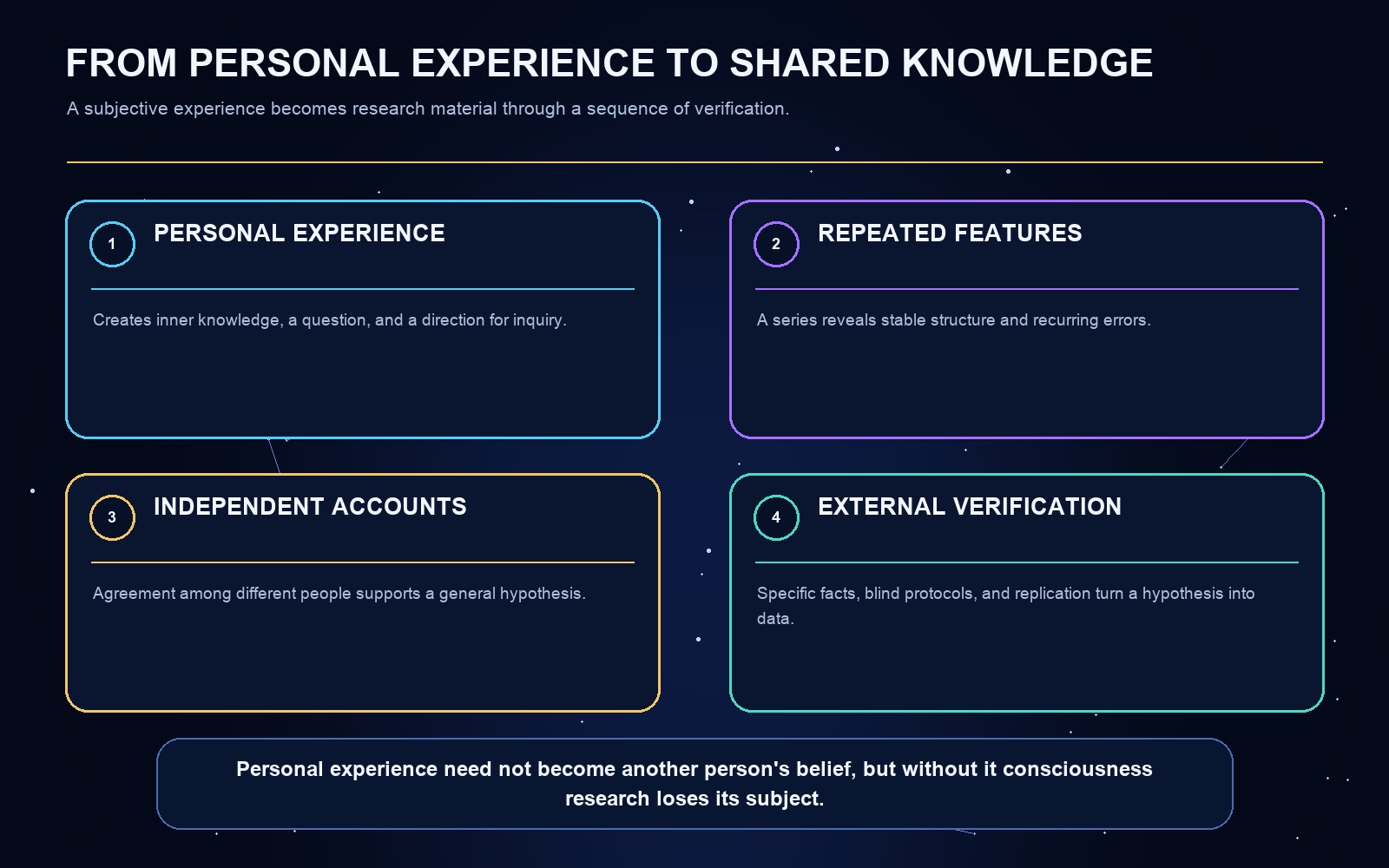
    It creates a question. It reveals a possible direction. It helps formulate a hypothesis. It provides characteristics for comparison. It suggests a new experiment.

    The next step is then required: recording, repetition, comparison with other people, and a search for external verification.

    Personal experience thus becomes more than a private story. It becomes research material.

    Hope also deserves honesty

    People approach the subject of consciousness for more than curiosity. They fear death, grieve loved ones, and search for meaning in their lives.

    I want to give them hope, but I do not believe hope should be built on beautiful promises. Strong hope grows from honest testimony: this is what I experienced, this is what I observed repeatedly, this is what I was able to verify, and these questions remain open.

    My personal experience does not have to become your belief. Its purpose is to show that the familiar materialist picture may be incomplete and that consciousness deserves a far more courageous investigation.

    Do not believe me automatically. But do not reject a possibility merely because a modern instrument cannot yet detect it. Investigate, compare, and preserve your right to arrive at your own knowledge.


    You can read more about my twenty-year personal investigation of consciousness in my book The Phenomenon of Consciousness Beyond the Body.

    Continue with the book on Amazon: Kindle Edition or Paperback.

  • What Experiments Could Test Out-of-Body Experience?

    What Experiments Could Test Out-of-Body Experience?

    Most debates about out-of-body experience end with an exchange of convictions. A practitioner says, “I know because I experienced it.” A skeptic replies, “It is the brain.” Both repeat their starting positions without producing new data.

    We need experiments designed around the actual characteristics of the out-of-body state. If a method ignores the instability of separation, the mental layer, and memory transfer, its failure tells us little about the nature of consciousness.

    The following are several directions that I consider promising.

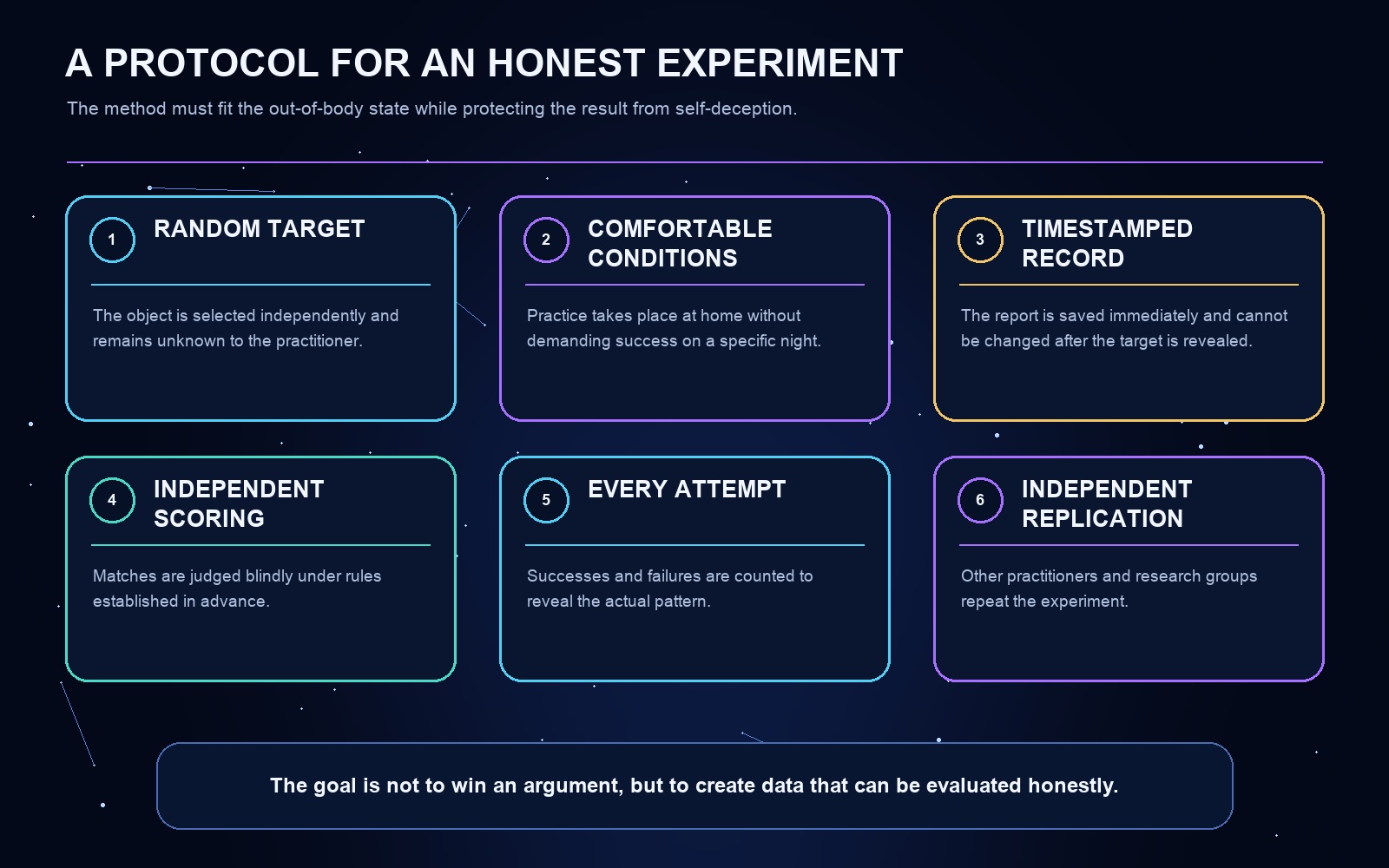
    1. A concealed visual target at home

    The practitioner works in familiar surroundings without a rigid deadline. Another participant randomly selects one image from a large set and places it at an agreed location or displays it on a separate locked screen.

    After the experience, the practitioner records everything before contacting the organizer. An independent judge then compares the report with several possible images.

    The method offers comfortable conditions and does not require separation on command. Targets must be changed after every attempt, and every result must be counted.

    2. A remote person performing an action

    At a randomly selected time, an assistant performs one of several clearly different actions: assembling an object, drawing a large symbol, moving through the room, or interacting with a brightly colored item.

    The practitioner attempts to visit the location and describe the action. The report receives a timestamp, and evaluation occurs only after the series is complete.

    Ordinary communication between participants must be excluded, and the possible actions defined in advance.

    An artistic visualization of the article's central idea

    3. A change in a familiar space

    In a room the practitioner knows well, another person changes one major element by moving an object, adding something new, or covering part of the space.

    The task is not to reconstruct the room from memory, but to detect the change. This experiment can help distinguish physical information, an older energetic trace, and a mental reconstruction from memory.

    A series may be especially valuable in showing how long it takes for a physical change to become perceptible on another level.

    4. Two independent practitioners

    Two people receive the same target but do not communicate before submitting their reports. They attempt to visit a location or meet in an agreed region.

    The comparison should focus not on generic words such as “light” and “energy,” but on rare, specific details: the sequence of events, an unusual object, the appearance of the environment, and the other participant’s actions.

    Agreement between two accounts is not final proof, but repeated independent agreement creates serious material for study.

    5. Information unknown to everyone involved

    The strongest test uses a correct answer that neither the practitioner nor the person interacting with him knows before the experience is complete.

    A computer or independent organizer may select the target randomly. The answer is unlocked only after the report has been protected from later editing.

    This removes accidental cueing and the experimenter’s desire to see success.

    6. Repeated observation of one target

    Instead of continually changing targets, a practitioner can investigate one location many times. Stable elements, changes, and verifiable details are recorded in advance.

    This method helps us study not only hits, but the structure of errors. Certain objects may be perceived as energetic traces while others are consistently replaced by mental images.

    For building a model, these patterns may be as important as one accurate result.

    A diagram of the article's key concepts

    What every protocol should include

    A good experiment requires several conditions.

    • The target is selected randomly.
    • The practitioner does not know the correct answer.
    • The report is recorded before the target is revealed.
    • The original record is preserved without revision.
    • Criteria for a match are established in advance.
    • Every attempt, including failures, is counted.
    • Results are judged by an independent person.
    • The series is large enough to compare with chance.
    • The practitioner’s condition, method of separation, and quality of memory are recorded separately.

    Without these rules, even an impressive correspondence remains a story that cannot be evaluated.

    Why a laboratory is not always better than a bedroom

    A traditional experiment places a person under observation, attaches sensors, and requires a task at a scheduled time. This is useful for recording the activity of the body and brain, but it creates poor conditions for controlled separation itself.

    An unfamiliar room, wires, video monitoring, and performance pressure interfere with relaxation. A more reasonable approach is to separate physiological measurement from the informational test. Some experiments can take place at home using precise digital timestamps, random target selection, and protected reports.

    What would count as persuasive evidence

    One success would not prove that consciousness exists outside the body. We need a series of results exceeding chance, repeated by different practitioners and independent groups.

    A negative result from one method would not disprove the entire phenomenon. It would show that a particular task or set of conditions did not provide access to verifiable information.

    Science advances through gradual improvement in methods, not one dramatic final experiment.

    From argument to investigation

    I do not propose that every unusual result be declared proof of the soul. I propose conditions under which the hypothesis of perception outside the body has a fair opportunity to appear.

    Practitioners must stop counting every similarity as success. Skeptics must stop using methods that ignore the nature of the state being investigated.

    When both sides agree to test rather than to win, real investigation can begin.


    You can read more about the challenges of laboratory verification and obtaining information outside the body in my book The Phenomenon of Consciousness Beyond the Body.

    Continue with the book on Amazon: Kindle Edition or Paperback.

  • Can We Obtain Objective Information During an Out-of-Body Experience?

    Can We Obtain Objective Information During an Out-of-Body Experience?

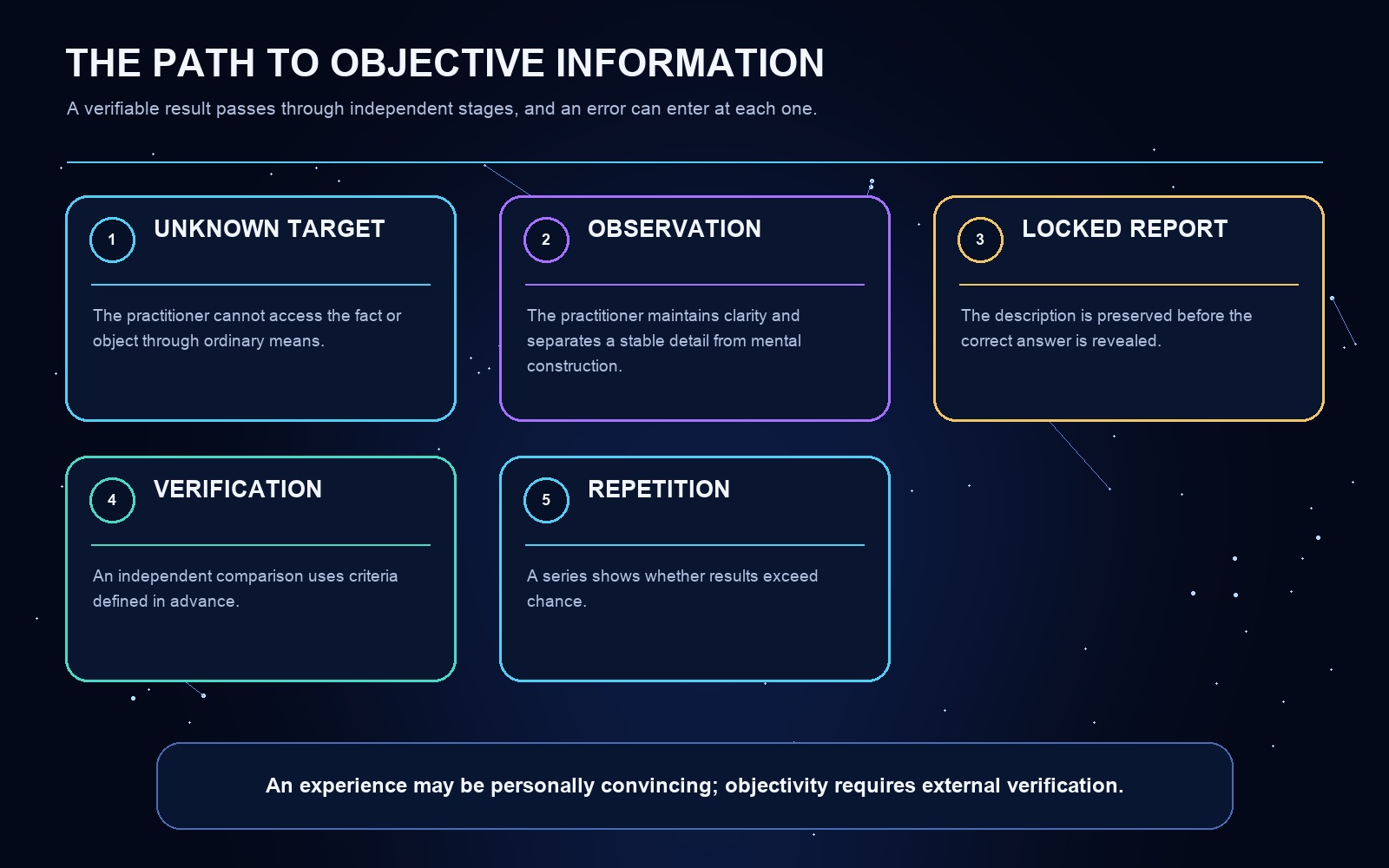
    If consciousness can truly perceive the world outside the physical body, it should sometimes obtain information that the person did not know beforehand. This is one of the central questions of the entire practice.

    My answer is yes: such information is possible. I have encountered unexpected details, meetings, and knowledge that were confirmed later. Yet obtaining an objective result is far more difficult than having a vivid separation from the body.

    Most experiences pass through the mental layer, expectations, and limitations of memory. Verifiable information therefore requires special conditions and rigorous honesty.

    What “objective information” means

    I do not use the term for information that sounds wise or produces strong emotion. I mean a specific fact that:

    • was not known to the practitioner before the experience;
    • existed independently of his wishes;
    • was recorded before verification;
    • can be confirmed by another person or a physical source;
    • is described precisely enough to prevent free interpretation.

    “I sensed an important energy” cannot be checked. A description of an unfamiliar object selected at random and hidden from the practitioner can be compared with the target.

    An artistic visualization of the article's central idea

    Why the familiar number experiment is so difficult

    A common proposal is to place a random number on top of a cabinet and ask the practitioner to read it outside the body. The idea appears simple, but it contains several separate tasks.

    First, the person must produce a controlled separation during the required period. Then consciousness must remain near the physical body rather than move elsewhere. The practitioner must avoid the mental layer, remember the purpose, find the object, perceive the symbols accurately, remember them, and transfer that memory to the brain upon returning.

    An error at any stage destroys the result. This does not prove that perception outside the body is impossible. It shows that the method must account for the nature of the state.

    Main sources of error

    Instability of separation. Even an experienced practitioner cannot always separate on schedule.

    Arrival at the wrong target. After separation, consciousness may appear in another location or on another level.

    Mental substitution. The expectation of a number generates its own symbols.

    Change of interest. Without the ordinary influence of the physical brain, a task that seemed important beforehand may suddenly seem insignificant and be forgotten.

    The behavior of text. Letters and numbers in a nonphysical state often change when viewed a second time.

    Memory loss on return. An accurate perception may fail to become established in the brain’s memory.

    Chance correspondence. The vaguer the description, the easier it is to find a similar fact.

    A diagram of the article's key concepts

    Which tasks work better

    The method should adapt to the nature of the experience instead of demanding that consciousness behave like a physical camera.

    The practitioner should work at home in familiar, calm surroundings. The experiment should not require success on a particular night. The target should be simple and emotionally neutral. Its selection must be concealed, and the report must be recorded before the answer is revealed.

    Instead of one number, use a set of substantially different images or objects. The assessment can then compare shape, color, function, and composition rather than depend on literal reading.

    A series of attempts matters more than one success or failure.

    Information from encountered beings

    Verifiable information may come from another consciousness rather than from observing an object.

    The standards should be even stricter in this case. Separate the being’s words from personal interpretation, record the exact message, and verify the fact independently.

    If a message cannot be checked, it may still be valuable as personal guidance, but it does not become objective knowledge for other people.

    How to handle a partial match

    A result is rarely photographic. A practitioner may describe the overall image correctly while missing some details. It is essential not to select agreements after the correct target is already known.

    Criteria should be defined before evaluation: Which properties count as a match? How many alternatives are available? Who will compare the descriptions? Ideally, an independent judge who does not know the target performs the comparison.

    The result then depends less on the participant’s enthusiasm.

    Why a negative result is also useful

    Failure reveals the limits of a method. The practitioner may have entered a mental layer, chosen an unsuitable target, lost the memory, or used a kind of information that is difficult to perceive.

    If every attempt is recorded honestly, not only the successes, a map of conditions gradually emerges: when accuracy improves, which errors recur, and which kind of task works best.

    Investigation begins when a person stops hiding unsuccessful results.

    The possibility is real, but the standard must change

    Objective information during an out-of-body experience is possible. It cannot be demonstrated by the persuasiveness of a story alone. A specific target, a record made in advance, independent verification, and repeated trials are necessary.

    I am convinced of the reality of consciousness beyond the body because of the totality of twenty years of experience. If we want to take the next step and communicate that knowledge to society, however, experiences are not enough. We need methods that distinguish an external fact from the power of our own mind.


    You can read more about the obstacles to objective verification and the special features of perception beyond the body in my book The Phenomenon of Consciousness Beyond the Body.

    Continue with the book on Amazon: Kindle Edition or Paperback.
  • Can Observation Be Completely Separated from Expectation?

    Can Observation Be Completely Separated from Expectation?

    An investigator wants to see reality as it is. Yet before an experience begins, he already has a purpose, knowledge, fears, and an idea of the possible result.

    Can that influence be eliminated entirely? I do not think so. As long as perception passes through the earthly personality and the brain, the observer remains part of the observation.

    This does not make objectivity impossible. We can reduce the influence of expectation, notice when it intervenes, and build a method of verification in which personal desire does not determine the result.

    Expectation begins before the experience

    If someone decides in advance that he will meet a guide, he has already formed an image of the meeting. If he wants to prove that out-of-body experience is real, he will notice agreements more readily. If he is certain that everything is fantasy, he may dismiss even unexpected, verifiable information.

    Bias works in both directions. Belief and denial are equally capable of obstructing observation.

    Honesty therefore begins not with the claim “I have no expectations,” but with listing them.

    An artistic visualization of the article's central idea

    Intention and expectation are different

    Without intention, practice becomes chaotic. An investigator needs a purpose: visit a place, meet a person, examine an object, or obtain information.

    Expectation paints the result in advance: the place should look a certain way, the person should say particular words, or a particular object should be behind the door.

    Intention provides direction. Expectation replaces observation with a ready-made picture.

    We can know clearly what we want to examine without deciding in advance what we must see.

    Why “do not think about it” is not enough

    The brain does not turn off on command. Trying not to think of a red ball keeps attention fixed on the red ball. Fear and expectation work the same way during an out-of-body experience.

    It is more effective to recognize the thought than to fight it: “I expect to see this. Therefore, this image by itself will not count as evidence.”

    Once named, an expectation loses some of its hidden power.

    A protocol before the experience

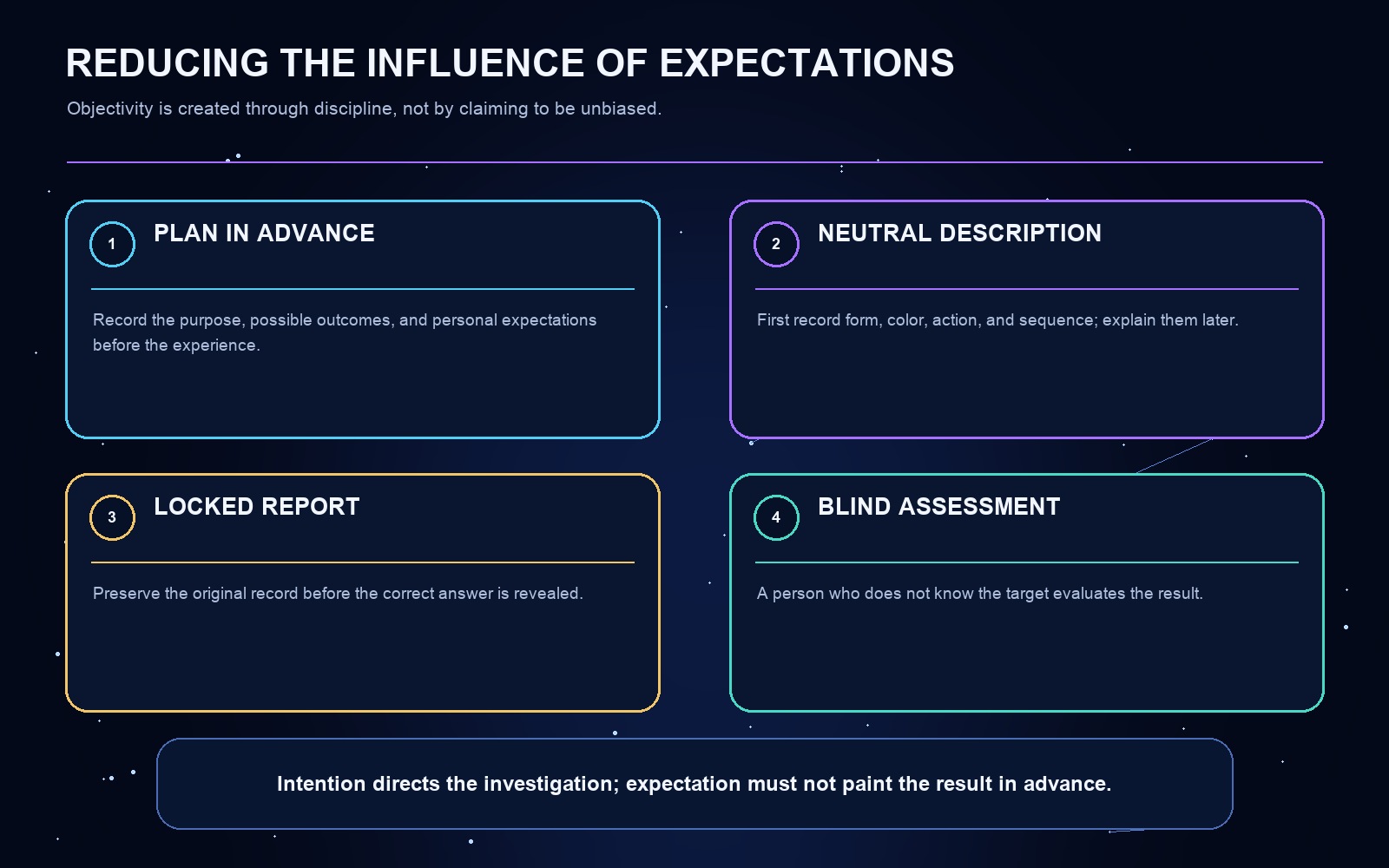
    To reduce distortion, record the plan in advance.

    1. What exactly am I going to observe?
    2. Which results do I consider possible?
    3. Which result do I especially want—or fear?
    4. What can be checked in physical reality?
    5. Which signs would indicate that the environment has become mental?

    A written plan prevents us from quietly changing the original purpose later to match the outcome.

    A diagram of the article's key concepts

    Description before explanation

    After returning, first record direct characteristics: color, form, location, sequence of actions, words, and sensations.

    Add the explanation separately.

    For example:

    • observation: “A tall, dark figure stood near the entrance”;
    • emotion: “I was afraid”;
    • interpretation: “It seemed to be a guard”;
    • conclusion: “The figure may have been limiting access.”

    If the only record is “A guard would not let me enter,” four different layers have been compressed into one claim.

    Surprise as an important characteristic

    Independent reality can resist our script. I therefore pay close attention to details that I did not expect, did not understand during the experience, and was able to verify later.

    Surprise alone is not proof. The subconscious contains an enormous amount of information and can produce unexpected combinations. A detail becomes significant when it accurately corresponds to an external fact that was unavailable beforehand.

    Repetition is stronger than one coincidence

    One correct result may be chance. A series of observations following the same protocol is much more valuable.

    If a practitioner visits an unknown target ten times and records every report before receiving feedback, we can evaluate the stability of the matches rather than the beauty of the story.

    Repetition also reveals personal filters: which images appear regardless of the target, which errors recur, and where clarity tends to be lost.

    An independent person reduces self-deception

    Ideally, another participant selects the target and a person who does not know the correct answer evaluates the report. This is a blind assessment.

    It does not make the experiment perfect, but it removes some cues and some of the desire to make the result fit. That matters especially in consciousness research, where most information reaches us through a subjective report.

    Objectivity is not the absence of personality

    The observer can never be removed completely. Even a physical scientist chooses the instrument, conditions, question, and method of interpreting data.

    Objectivity arises from discipline rather than emptiness: a transparent method, repetition, independent evaluation, and a willingness to accept an inconvenient result.

    Out-of-body research adds the need to work with one’s own emotional and mental state.

    I am not trying to prove that I never make mistakes. I am trying to understand where an error could have entered. That approach does not weaken the investigation. It makes it stronger.

    We cannot separate observation from expectation completely. We can separate honest investigation from the desire to confirm a belief at any cost.


    You can read more about clear perception, mental constructions, and the discipline of observation in my book The Phenomenon of Consciousness Beyond the Body.

    Continue with the book on Amazon: Kindle Edition or Paperback.
  • Emotions and Beliefs as Filters of Perception

    Emotions and Beliefs as Filters of Perception

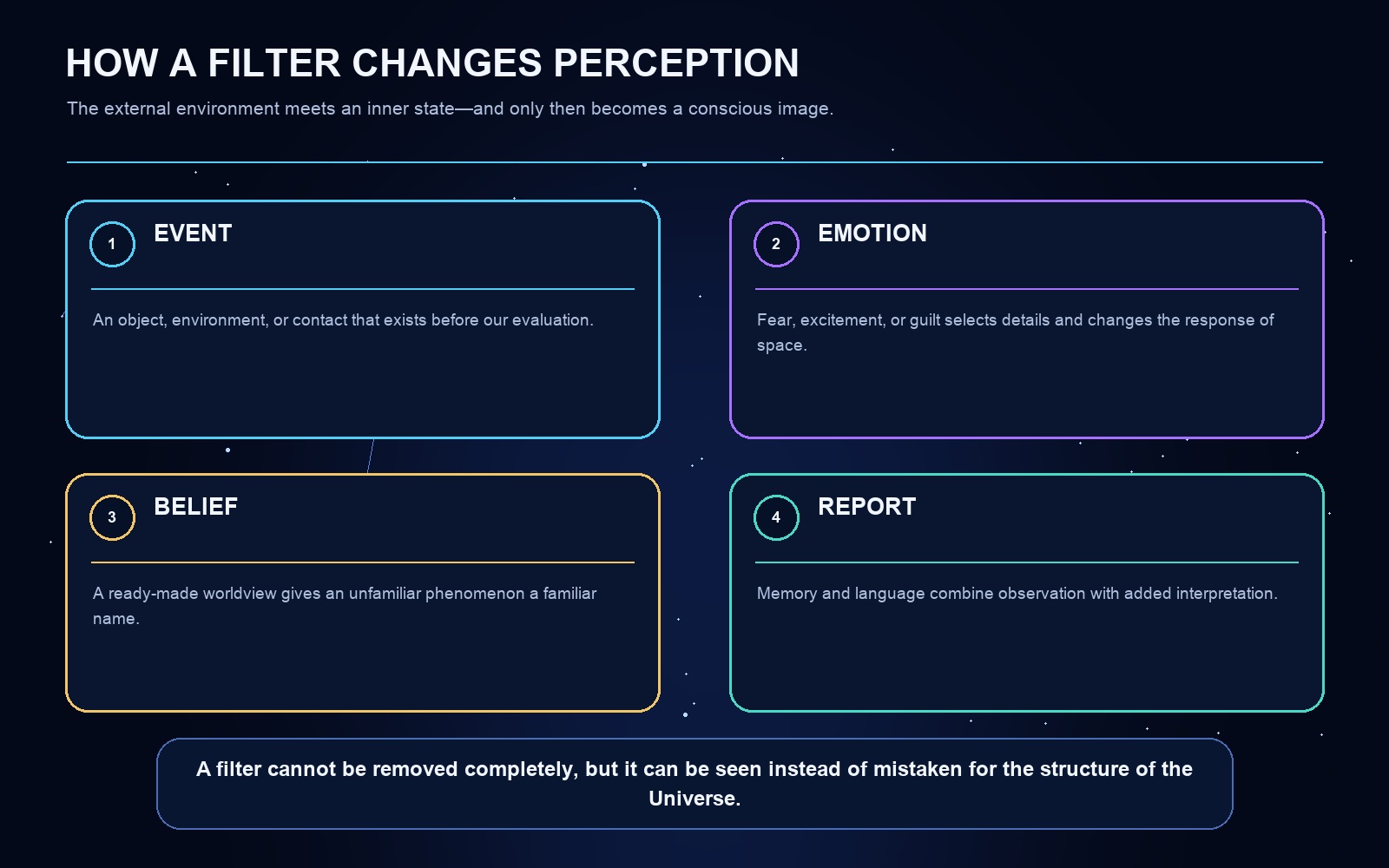
    We are accustomed to believing that we see the world as it is. In reality, even our perception of physical reality is filtered through memory, attention, upbringing, and emotional state. During an out-of-body experience, the influence of those filters becomes much stronger.

    Thought becomes form more quickly. Fear gives an undefined image threatening features. Expectation creates the anticipated setting. Religious belief gives a familiar name to an unfamiliar being.

    This does not mean that nothing exists outside us. It means that an interpreter always stands between reality and our understanding: the earthly personality and the active stream of thought.

    Emotion changes more than our evaluation

    In physical life, fear directs attention toward threats, while infatuation highlights another person’s virtues. The object may remain unchanged, but attention selects certain features.

    On the second energy level, emotion also affects the environment itself. Intense fear may create a form that appears to be an independent being. Joy makes movement freer. Doubt weakens intention. Anger holds attention on conflict and prolongs the scene.

    The emotional response therefore becomes part of the observed event.

    An artistic visualization of the article's central idea

    Belief supplies an answer before the question is studied

    If a person is convinced that out-of-body space is filled with demons, every unclear form will be interpreted as a threat. If he believes he will meet only luminous teachers, he may fail to notice manipulation behind a beautiful appearance.

    Belief acts like a caption placed under an unidentified photograph. The observer has not yet examined the object, but already knows what to call it.

    Beliefs connected with religion, death, guilt, and personal exceptionalism are especially powerful. They do more than explain an experience afterward; at times they construct the experience while it is taking place.

    What I mean by clarity of consciousness

    When I speak of a clear consciousness, I do not mean moral perfection. I mean the absence of strong expectations, predetermined explanations, and emotional noise that impose a ready-made form on the environment.

    Clarity of observation is the ability to enter an experience without demanding to see what one already believes.

    We cannot free ourselves completely from the past. We can notice our expectations and keep them from quietly becoming “facts.”

    The mental layer reveals the power of filters

    In the mental layer, inner content becomes almost visible. A thought creates a room, an expectation summons a character, and fear builds an obstacle.

    This makes mental experience valuable. It shows a person his inner programs without their usual disguise. Yet such an experience cannot automatically serve as a map of external reality.

    If an image created by fear tells a person that the Universe is dangerous, what he has learned first is something about his fear.

    A diagram of the article's key concepts

    Distinguishing perception from emotional construction

    I pay attention to the moment of change.

    • What was before me prior to the strong emotion?
    • How did the space change after fear or expectation appeared?
    • Does the object disappear when I become calm?
    • Does it retain its properties regardless of my attitude?
    • Does the encounter provide unexpected information?
    • Can I repeat the observation in a different state?

    It is also useful to compare several experiences. If the same object assumes the form of the current fear every time, the filter is more likely changing than the object.

    Positive expectations also distort

    People worry more about negative thoughts, but pleasant expectations can be just as powerful a construction.

    The desire to meet the Higher Self, a famous teacher, or a deceased relative may create a figure who says exactly what the person wants to hear. Love and hope do not guarantee objectivity.

    This does not mean such meetings are impossible. It means the value of a meeting is determined not by emotional intensity, but by the independence of the contact, the quality of information, and the possibility of verification.

    A filter cannot be eliminated, but it can be made visible

    Our earthly personality always participates in perception. We translate the unknown into familiar language, select important details, and connect them with accumulated experience.

    The goal is not to become an empty consciousness without memory or character. The goal is to understand our own contribution.

    Before practice, name your expectations. After returning, record the event before explanation begins. Later, note the emotions, beliefs, and possible alternative interpretations separately.

    In this way, the filter becomes visible.

    Emotional maturity increases accuracy

    Emotional control does not mean suppression. Fear must be noticed rather than denied. Excitement must also be recognized before an experience is declared a revelation.

    The more calmly a person can observe, the less the environment reflects his immediate reaction. He gains the opportunity to encounter a reality that is not obligated to be pleasant, frightening, or consistent with his worldview.

    That is why emotional work matters not only for quality of life. It is part of preparation for research.

    We cannot remove ourselves completely from observation. We can stop mistaking our own shadow for the structure of the Universe.


    You can read more about the mental layer, clarity of consciousness, and the influence of expectations in my book The Phenomenon of Consciousness Beyond the Body.

    Continue with the book on Amazon: Kindle Edition or Paperback.

  • Energy Protection: A Necessary Measure or a Reflection of Fear?

    Energy Protection: A Necessary Measure or a Reflection of Fear?

    Some practitioners recommend protection before every out-of-body experience. Others insist that all protection is created by fear and merely attracts danger.

    Both positions are too absolute.

    Energy protection can be a useful tool. But when someone builds it in a state of panic and constantly expects an attack, it becomes part of his mental prison.

    What I mean by energy protection

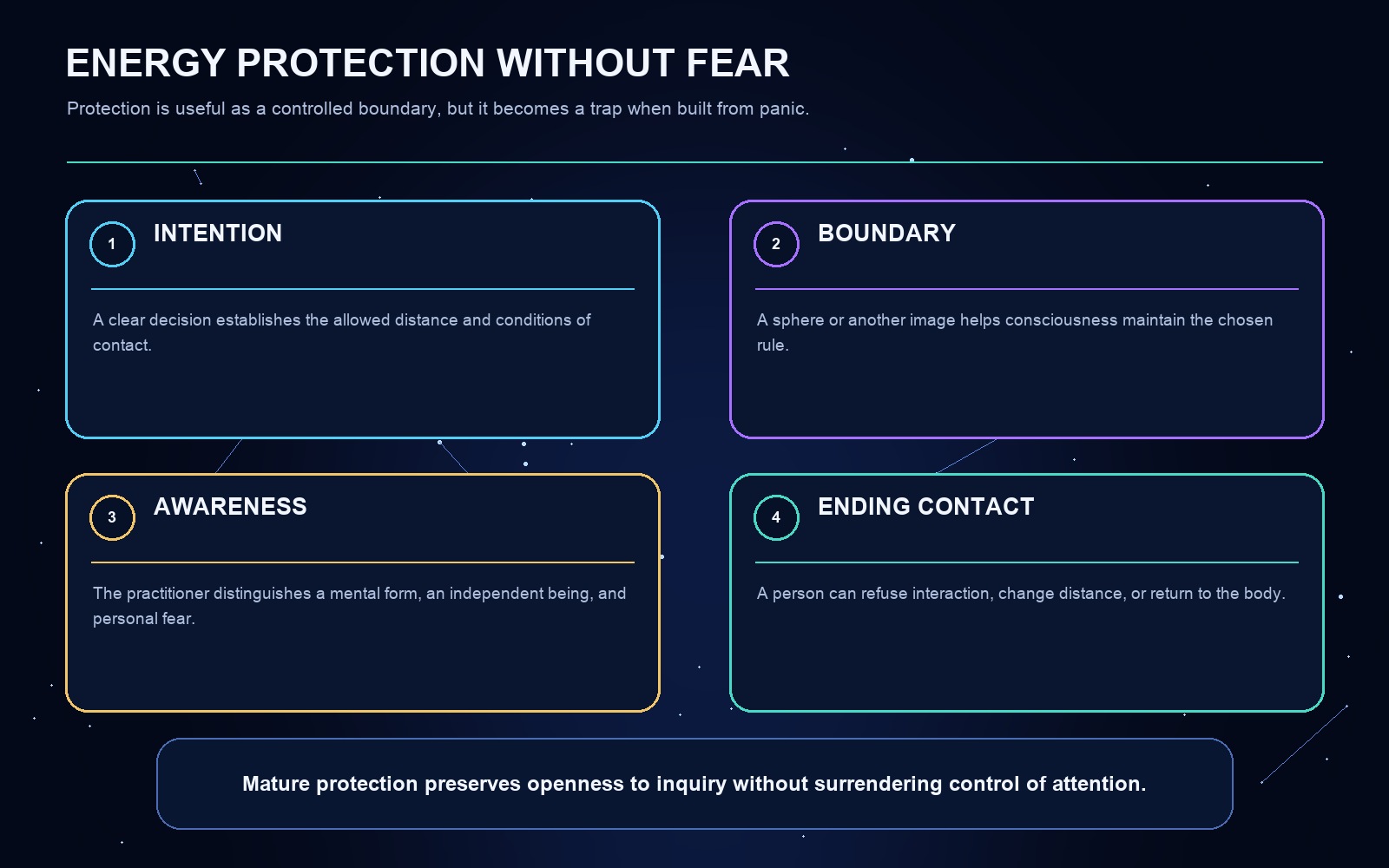
    In nonphysical space, intention can affect energy much more quickly than it does in the physical world. A person may establish a boundary, limit access, conceal his presence, or end an unwanted interaction.

    A protective sphere is one image through which that intention can be focused. Its power does not come from an imaginary material, but from a clear decision of consciousness: “This space belongs to me. Contact is possible only with my consent.”

    The form helps concentrate the will. It is not a magical object in itself.

    An artistic visualization of the article's central idea

    When protection is genuinely useful

    Protection makes sense when:

    • a person encounters an aggressive or intrusive form of consciousness;
    • he needs to stop pressure or an attempt to read information;
    • intense fear prevents clear perception;
    • a practitioner enters unfamiliar space;
    • concentration must be maintained despite distracting imagery;
    • a person has not yet learned to control distance and return confidently.

    In these situations, protection provides both a boundary and inner support.

    When protection becomes the problem

    If someone spends hours building a multilayered fortress before every practice, his consciousness is already filled with the expectation of danger.

    On the second energy level, expectation quickly takes form. Fear can create a frightening figure, a sensation of attack, or resistance in the environment. The practitioner then mistakes his own construction for proof of danger and strengthens the protection. A closed loop develops.

    Protection built from clarity increases freedom. Protection built from panic reinforces fear.

    A diagram of the article's key concepts

    The primary protection is awareness

    The most vulnerable practitioner is not the one without a luminous sphere. It is the person who does not know where he is, believes every image, and loses control under the influence of emotion.

    Awareness makes it possible to:

    • recognize a mental construction;
    • avoid mistaking a being’s appearance for proof of its nature;
    • refuse contact;
    • change distance;
    • ask for help;
    • return to the body;
    • refuse instructions received in an unusual state.

    No visual image can replace these skills.

    Calm is stronger than struggle

    Fear leads a person to expect attack and respond with aggression. Yet struggle often holds attention on the unwanted form and continues to feed it.

    It is frequently more effective to end contact calmly, stop giving it the energy of attention, or move in another direction. If the image is a mental construction, it will weaken quickly. If an independent being is present, a clear boundary communicates that interaction is not permitted.

    Strength does not always appear as attack. Sometimes it appears as complete inner nonparticipation.

    Protecting information and protecting against harm

    These are different tasks.

    Shielding oneself from an unpleasant contact is one thing. Concealing information, a presence, or an object under investigation is another. In my book, I describe observations of multilayered systems designed specifically to restrict access to information.

    This suggests that protection in nonphysical space is not merely superstition. It may function as a technology for managing attention, access, and interaction.

    The more complex the claim, however, the more repeated observation it requires. Seeing one fortress does not prove the existence of a sophisticated security system.

    How to identify the source of your protection

    Before practice, ask yourself:

    • Am I creating a boundary calmly, or trying to suppress panic?
    • Do I understand a specific risk, or fear everything unknown?
    • Does this protection allow me to act more freely?
    • Can I practice without it without feeling that disaster is inevitable?
    • Am I creating the image of an enemy myself?
    • Can I end contact in other ways?

    The answers reveal whether protection is a tool or a ritual of dependence.

    A controlled boundary, not a fortress

    I do not believe energy protection should be rejected entirely. Intention and visualization can create stable forms, and the skill may be useful in a specific situation.

    But to live in expectation of constant attack is to carry fear into every investigation. In most cases, a clear purpose, calm, an understanding of the environment, and a confident right to end interaction are enough.

    Mature protection does not separate a person from the Universe. It allows him to remain open to investigation without giving anyone power over his attention and decisions.


    You can read more about the protective sphere, the properties of intention, and interactions with beings on the second level in my book The Phenomenon of Consciousness Beyond the Body.

    Continue with the book on Amazon: Kindle Edition or Paperback.
  • Out-of-Body Safety: Real Risks and Common Myths

    Out-of-Body Safety: Real Risks and Common Myths

    Out-of-body experience is surrounded by fear. People worry that they may not return, lose their connection with the body, allow another entity to enter it, or accidentally find themselves in a dangerous world.

    In twenty years of practice, I have found no reason to consider conscious separation deadly. Consciousness naturally separates partially from the body during sleep. Its connection with the organism remains intact, and a strong emotion, an external sound, or the body’s need to awaken usually brings an immediate return.

    That does not mean the practice should be treated carelessly. Real risks exist. They are simply different from the popular horror stories.

    Myth: you may be unable to return

    Returning to the body does not require finding a route back. Consciousness retains its natural connection with the organism. In my experience, the intention to return is enough—and sometimes the body ends the practice sooner than I would like.

    The fear of being “trapped forever” usually comes from religious stories, movies, and a lack of personal experience. It can create a frightening mental scene, but it does not sever the connection with a living body.

    Myth: someone else can take your body

    The physical body is not an empty house with an unlocked door. Its biology, memory, and energy structure are connected to a particular consciousness.

    I have encountered different forms of consciousness and observed attempts at contact, pressure, or the reading of information. That does not mean an outside being can simply replace a person in his body during ordinary practice.

    Myth: every separation attracts dangerous entities

    The second energy level contains different beings, just as the physical world does. Most encounters are neutral or benevolent. Many frightening forms are also created by the practitioner’s own fear.

    This is not a reason to label every threat imaginary. Independent beings exist, and not every interaction is useful. But the expectation of attack reduces perceptual accuracy and strengthens mental constructions.

    The best foundation for safety is clarity, calm, and the ability to end contact.

    An artistic visualization of the article's central idea

    A real risk: physical health

    Some preparatory methods affect breathing, sleep, the nervous system, and arousal. A person with health concerns should discuss a particular strain or technique with a physician.

    Do not use extreme sleep deprivation, dangerous breathing exercises, psychoactive substances, or physical exhaustion to force an unusual state. Such methods may produce an experience while reducing clarity and increasing risk to the body.

    Out-of-body experience is valuable because of awareness. A method that damages health and control defeats the purpose of the practice.

    A real risk: fear and loss of balance

    A first separation can feel so realistic that it causes shock. Vibrations, noise, temporary inability to move the physical body, and unfamiliar perception can be frightening when a practitioner does not understand what is happening.

    Preparation reduces this risk. A person should know what sensations may occur and remember that the experience can be ended.

    If practice produces persistent anxiety, disrupts sleep, or creates fear of ordinary life, take a break. Investigating consciousness should not become a struggle against oneself.

    A real risk: escape from physical life

    Unusual worlds can be vivid and compelling. A person may begin living for the next separation and lose interest in work, relationships, and the body.

    That is not development; it is dependence on an experience. Out-of-body practice reveals its value when it makes physical life more meaningful and the practitioner more responsible. When it becomes a way to avoid real problems, it leads away from its purpose.

    A real risk: gullibility after a powerful experience

    A dramatic encounter may convince someone that he has received absolute knowledge. He begins following instructions from an unknown being, making important decisions from symbols, or seeing himself as chosen.

    No experience cancels critical thinking. Information must be tested, and decisions about health, money, and relationships should be made in a clear physical state.

    A diagram of the article's key concepts

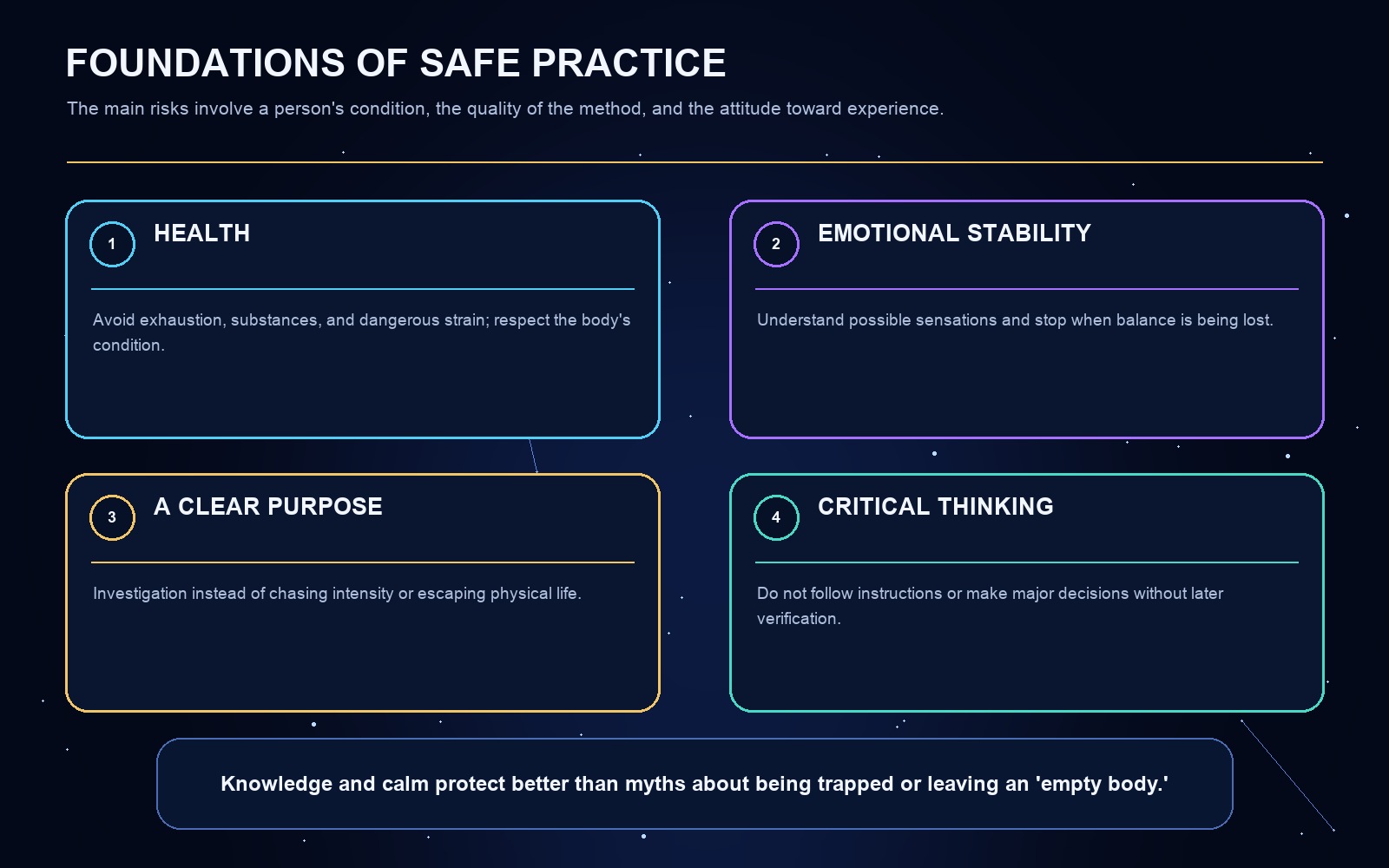
    Foundations of a safe approach

    Safety begins before separation.

    • Practice from a stable physical and emotional condition.
    • Do not use substances or dangerous methods of altering consciousness.
    • Understand the possible stages and sensations.
    • Choose a clear purpose instead of chasing intensity at any cost.
    • Do not enter contact from fear or the desire to prove courage.
    • End the experience if control is slipping.
    • After returning, restore attention to the body and ordinary reality.
    • Record the experience and analyze it later, without emotional haste.

    Safety does not require constant fear

    I consider the nearest nonphysical level generally safer than the physical world. Thought and intention have greater power there, while return to the body remains a natural way to end the experience.

    Safety, however, does not come from denying every risk. It comes from knowledge, preparation, and inner stability.

    There is no need to build a cult of danger around the practice. There is also no reason to turn it into irresponsible entertainment. We are investigating a reality we do not yet fully understand. Respect for it is a sign of maturity, not fear.


    You can read more about preparation, possible encounters, and the principles of safe practice in my book The Phenomenon of Consciousness Beyond the Body.

    Continue with the book on Amazon: Kindle Edition or Paperback.

  • What We Actually See During an Out-of-Body Experience

    What We Actually See During an Out-of-Body Experience

    After a first conscious separation, people often expect to see an exact copy of their room. Instead, unfamiliar furniture may stand beside the bed, a doorway may be in the wrong place, or an entirely different city may appear outside the window.

    The question is natural: If consciousness truly separated from the body, why does the environment differ from the physical one?

    Because outside the body we do not always observe the same layer of reality, and we are not using physical sight.

    We do not perceive with the eyes

    The physical eyes remain closed with the body. Perception is produced by consciousness itself. It receives information about the surrounding space and translates it into a visual form familiar to the personality and the brain.

    Intention can intensify this perception. A person may change focus, perceive space in greater depth, draw a distant object closer, or become aware of several directions at once. Sometimes vision does not appear immediately, even though position, movement, and presence are already clear.

    The picture perceived outside the body is therefore not a photograph transmitted by the eyes. It is information translated into a form the person can understand.

    An artistic visualization of the article's central idea

    Three sources of what we see

    In my observations, the image may contain three principal components.

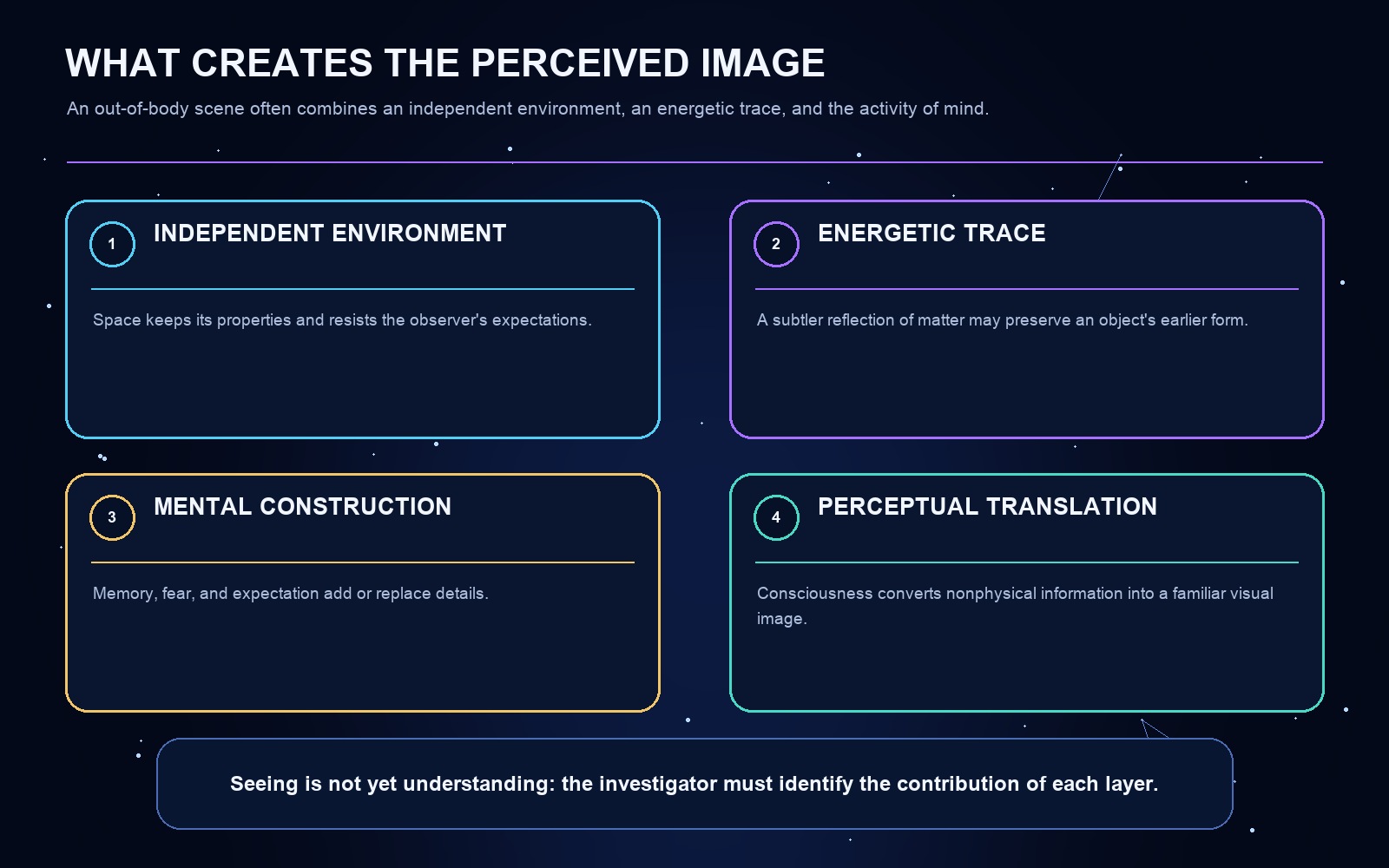
    A real nonphysical environment. Consciousness perceives a space that exists independently of its wishes: an energetic reflection of the physical world or an autonomous region on another level.

    The energetic trace of physical matter. Objects in our world produce a subtler reflection. That reflection may preserve an earlier form after the physical object has been changed or destroyed. A room may therefore contain old wallpaper, previous furniture, or an object that is no longer physically present.

    A mental construction. The brain and mind add expectations, fears, memories, and familiar images. This construction may partially cover the actual environment or replace it completely.

    Most often, a practitioner sees a mixture of all three layers.

    Why your own room may look different

    The energy level closest to us reflects physical reality without copying it mechanically. The energetic echo of matter follows its own laws and responds to consciousness much faster than a physical object does.

    The reflection also does not update immediately. If furniture was moved or new wallpaper installed, the earlier image may persist for a while. Conversely, a practitioner’s thought may add an object that never existed physically.

    A discrepancy does not prove that the whole experience was a dream. A familiar-looking room does not prove that the observation was objective either. We must examine how the space behaves.

    How the mind completes reality

    When information is incomplete, the brain fills the gaps with familiar imagery. It does the same in physical life, but we rarely notice it. In the mental layer, its influence becomes much stronger.

    If a person expects a mirror, one may appear. If he fears a dark figure, an unclear shape may become a threat. If he believes he must meet a deceased relative, the mind may create a convincing image of that person.

    This produces a central error: the observer mistakes the precision of the experience for the independence of its source.

    A diagram of the article's key concepts

    Signs of an independent environment

    I look for ways reality resists my expectations.

    • The space remains stable when I redirect my attention.
    • Not every intention takes effect immediately.
    • Objects have consistent properties.
    • Encountered beings demonstrate their own will.
    • Details appear that I did not expect and could not have planned.
    • Information is sometimes confirmed after I return.

    Mental space is more fluid. Thought rapidly becomes form, scenes change easily, and events follow the practitioner’s emotional state.

    Why people see different versions of the same place

    Two practitioners may visit the same location and describe it differently. The quality of separation, degree of awareness, available range of perception, and mental filters all affect what each person sees.

    One may perceive mainly a physical reflection. Another may see an older energetic trace. A third may add personal constructions. This is less like two witnesses arguing when one must be lying, and more like observing a complex object through different filters.

    That explanation must not be used to excuse every contradiction. The fewer the shared and verifiable details, the more cautious the conclusion should be.

    What we see when we encounter beings

    The consciousness of another being may also create a form. It may present itself as it understands itself, or in a way that the observer can more easily comprehend.

    A human appearance therefore does not necessarily imply human origin, and an unusual appearance does not prove extraterrestrial origin. We must look beyond form: at independent behavior, quality of communication, energetic imprint, and content of the information.

    In nonphysical reality, appearance is much more closely connected to thought and self-perception.

    Seeing is not yet understanding

    Out-of-body vision offers extraordinary possibilities, but it also creates new opportunities for self-deception. A person may see a symbol clearly and mistake it for a literal object. He may encounter an energetic trace and believe he is observing the physical past. He may create a form through fear and declare it an independent being.

    After returning, I ask more than “What did I see?” I also ask:

    • On which level was consciousness operating?
    • How dependent was the environment on thought?
    • What remained stable?
    • Which details were unexpected?
    • Can anything be verified?
    • Did the environment change after a strong emotion?

    Vision outside the body is an instrument of consciousness. Like any instrument, it requires training and calibration.

    We do not simply see “the other world.” We see the meeting of an external environment, energetic traces, and our own mind. The investigator’s task is to learn to distinguish the contribution of each.


    You can read more about energetic reflection, the mental layer, and perception without physical senses in my book The Phenomenon of Consciousness Beyond the Body.

    Continue with the book on Amazon: Kindle Edition or Paperback.

  • Lucid Dream, Out-of-Body Experience, or Hallucination: How to Tell the Difference

    Lucid Dream, Out-of-Body Experience, or Hallucination: How to Tell the Difference

    The vividness of an experience does not reveal its nature. A dream can be realistic. A hallucination can be convincing. An out-of-body experience may begin in a room that looks exactly like the physical one, then shift almost imperceptibly into a space created by the mind.

    The first question, therefore, should not be, “Was it real?” We must first determine what state the person was in, how aware he remained, and which parts of the experience depended on his thoughts.

    Over years of practice, I have learned to distinguish several states. Transitions occur between them, but each has stable characteristics.

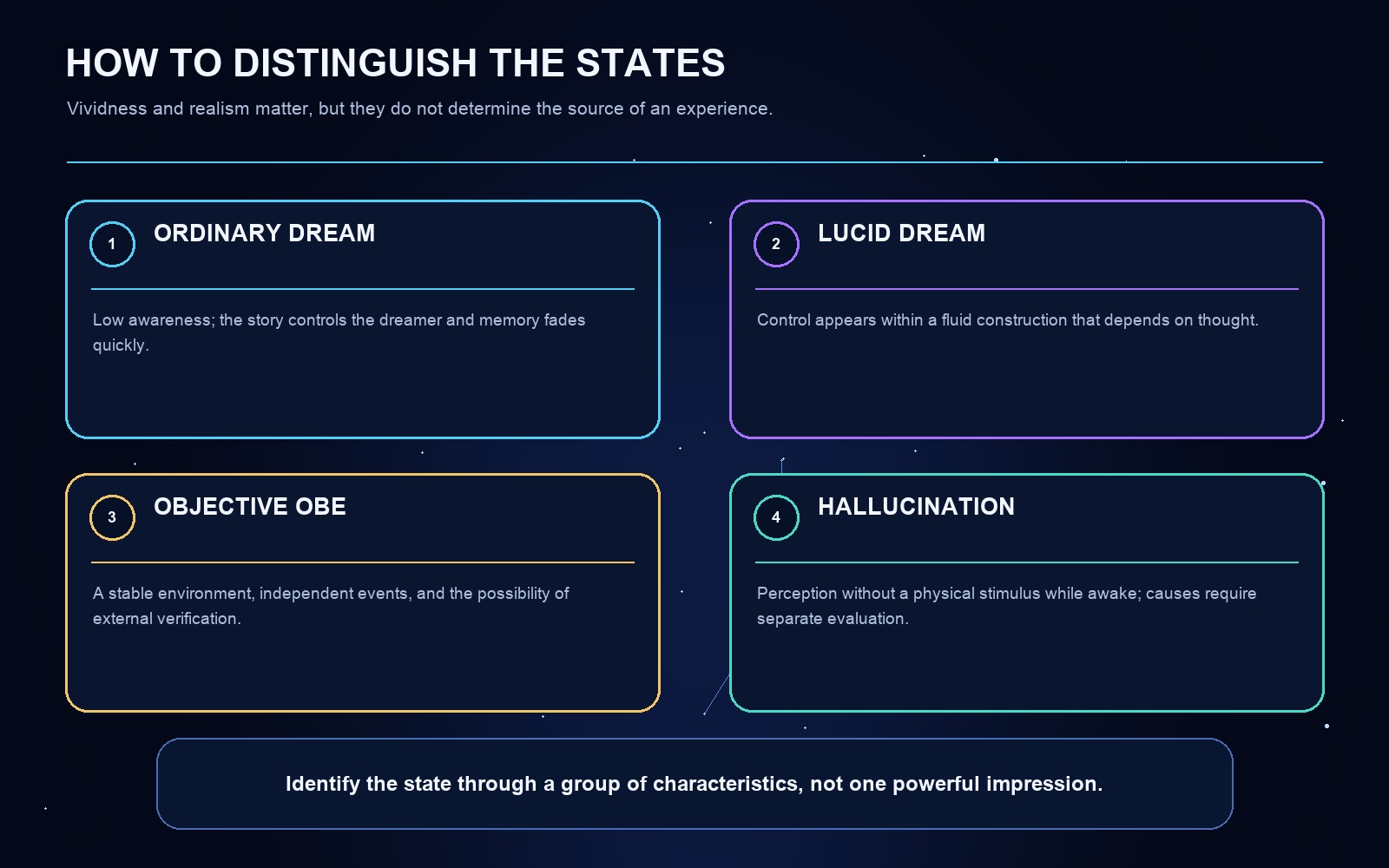
    Ordinary dreaming: the story controls the dreamer

    In an ordinary dream, a person has little control over what happens. He accepts illogical events as normal, moves rapidly between storylines, and rarely asks where he is.

    The brain processes impressions, emotions, fears, and information from the day. The resulting imagery may be coherent or chaotic. Awareness is weak, and memory fades quickly after waking.

    The central characteristic of an ordinary dream is that the person is inside a story without realizing that it is a story.

    Lucid dreaming: clarity appears within a construction

    In a lucid dream, the dreamer knows that he is asleep. He may choose an action, change the story, fly, create an object, or move to another location. Awareness alone, however, does not turn the surrounding space into an external reality.

    If the environment instantly obeys expectation, characters repeat the dreamer’s own thoughts, and the scene changes without stable causes, the experience is most likely a mental construction.

    Such a space can be beautiful, useful, and even transformative. But the dreamer’s own mind plays the leading role in creating it.

    An artistic visualization of the article's central idea

    An out-of-body experience in the mental layer

    This state is more complex. Separation from the body may occur consciously, the sensations may be extraordinarily realistic, and the person may retain a high degree of control. He can walk through the room, see the body, pass through walls, and follow a plan.

    Yet the surrounding space may still be mental. Fear, religious imagery, daily impressions, and expectations create the setting and events. The experience is out-of-body in its mode of perception, but it does not provide an objective picture of an external world.

    That is why I do not equate conscious separation from the body with reliable information.

    An objective out-of-body experience

    In what I call a clear or objective experience, the environment shows greater independence from the observer.

    It has several characteristics:

    • the surroundings remain stable;
    • objects do not appear merely because the person thinks of them;
    • unexpected details arise that were not planned;
    • other beings act independently;
    • information can sometimes be verified after returning;
    • attempts to alter the environment through thought do not always succeed;
    • the person retains a clear memory of the purpose and sequence of events.

    This kind of experience is much less common than a mental one. Even for an experienced practitioner, most experiences contain some contribution from personal constructions.

    What “hallucination” means in this comparison

    The word hallucination is often used as a universal explanation for anything unusual. That is too crude.

    A hallucination is generally defined as perception without a corresponding physical stimulus, occurring while awake or when the organism is impaired. It may be associated with fever, drugs, sleep deprivation, or neurological and psychiatric conditions.

    An out-of-body experience also occurs without ordinary sensory input, but it has a different internal structure: a transitional state, a sense of separation, preserved awareness, and the capacity for sequential action outside the physical body.

    One label cannot settle the nature of an experience. At the same time, unusual images or voices that appear during normal waking life, interfere with daily functioning, cause fear, or urge dangerous actions require professional medical evaluation. A spiritual explanation must never replace responsible health care.

    A diagram of the article's key concepts

    Tests within the experience

    To identify the state, I consider a group of characteristics rather than one dramatic effect.

    Memory. Do I remember who I am, where my body is, and the purpose I chose?

    Logic. Does the sequence of events remain coherent?

    Stability. Does the room change when I look away or expect something different?

    Independence of encountered beings. Do they provide unexpected information, or merely reflect my thoughts?

    Agency. Can I pause, choose a direction, and return?

    Verification. Is there a specific detail that can be compared with physical reality?

    No single sign is absolute proof. Together, however, they allow a much more accurate assessment of the experience.

    Why the states become mixed

    Consciousness can move between layers of perception. An ordinary dream becomes lucid. A lucid dream leads to separation from the body. An objective observation becomes a mental scene under the influence of strong emotion.

    For this reason, an entire experience should not be assigned one label from beginning to end. It is more useful to examine it episode by episode: Where did the environment remain stable? When did fantasy enter? What changed after fear or expectation appeared?

    Realism is not the same as objectivity

    This is the essential conclusion. A feeling of complete reality tells us how powerful an experience was, but it does not tell us who created the space.

    I do not dismiss dreams or mental experiences. They reveal the activity of the mind, help us investigate fear, and demonstrate the creative power of consciousness. But if we want to study the structure of reality, we must learn to distinguish an internal construction from an environment that exists independently of us.

    Awareness is more than the ability to wake up inside a dream. It is the ability not to deceive ourselves after we wake.


    You can read more about dreams, the mental layer, and levels of out-of-body perception in my book The Phenomenon of Consciousness Beyond the Body.

    Continue with the book on Amazon: Kindle Edition or Paperback.
  • How to Describe an Experience for Which Human Language Has No Words

    How to Describe an Experience for Which Human Language Has No Words

    One of the hardest tasks for an investigator of consciousness begins after returning to the body. The experience was clear, rich, and whole, yet trying to describe it reduces a multidimensional event to a sequence of inadequate human words.

    We tend to assume that if someone cannot explain something precisely, he did not fully understand what he saw. Out-of-body experience is different. Sometimes consciousness understands more than the brain can express.

    Language was built for physical life

    Human language grew from bodily experience and the material world. We have words for objects, distance, direction, time, and action. We say “above,” “far away,” “first,” “later,” and “inside.”

    Beyond familiar physical perception, however, space may have no ordinary distance, events may be perceived simultaneously, and information may arrive not in sentences but as a complete meaning.

    When I say that I entered another world, I do not necessarily mean that I traveled there along a physical route. When I describe light, it may not have been optical light. When I speak of a voice, I may be describing an understanding that appeared in consciousness without sound.

    Words are necessary, but they inevitably simplify.

    Meaning may arrive whole

    In nonphysical communication, I have repeatedly received not phrases, but an imprint of meaning. In a single instant I could receive an amount of information that would take several minutes to explain.

    It is difficult to call this telepathic “speech,” because words are not always present. One consciousness seems to transmit a structure of understanding to another: an image, a relationship, an emotional quality, and knowledge of connections and context.

    After returning, the brain begins dividing this whole into familiar concepts. Distortion often appears at that stage. We choose the closest available words, even though they convey only part of the original meaning.

    An artistic visualization of the article's central idea

    Where observation ends and translation begins

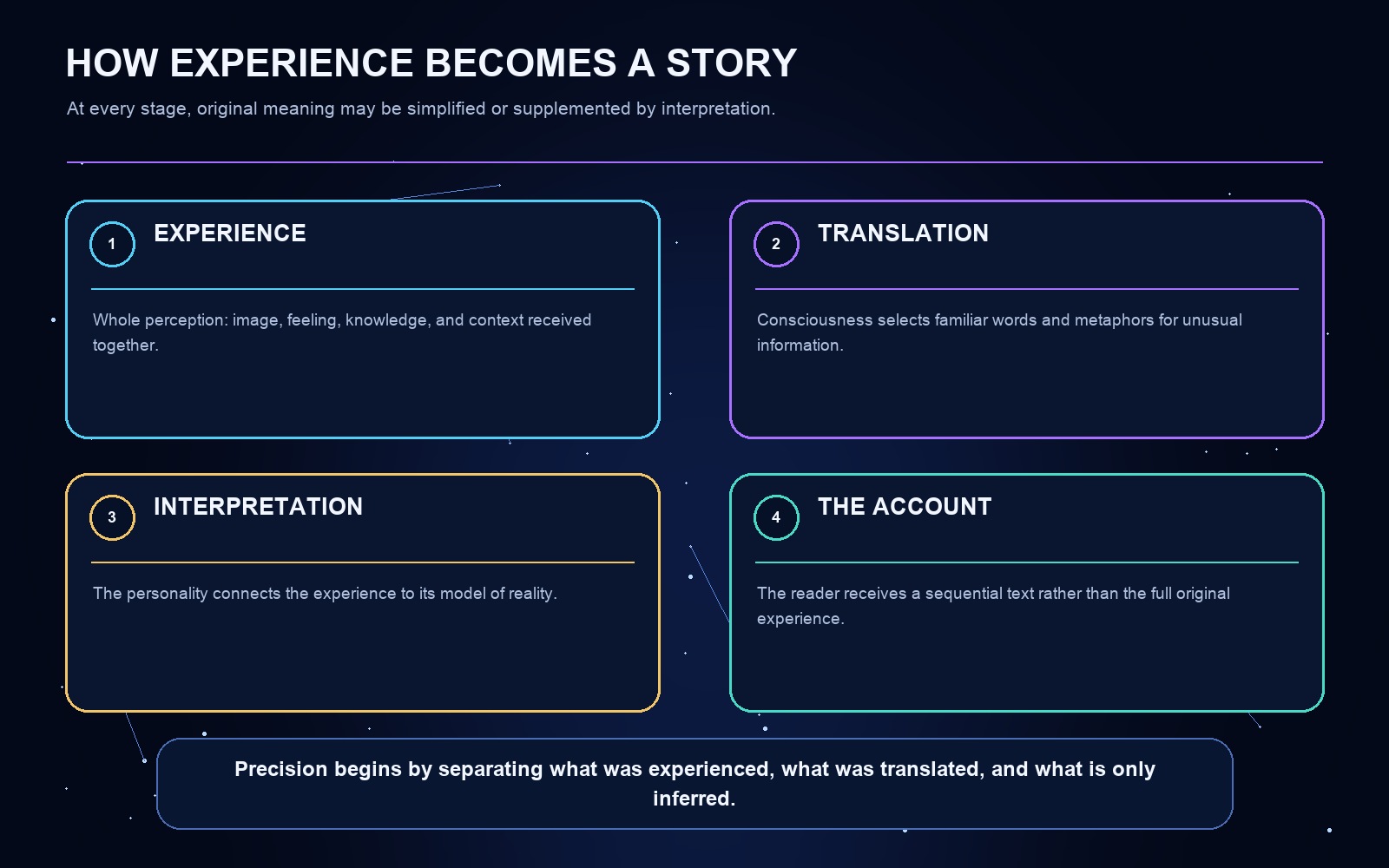
    To remain honest, we need to distinguish three layers in the account.

    Direct perception. What was seen, heard, felt, or understood during the experience itself.

    Translation. The human words and metaphors selected after returning.

    Explanation. The way an investigator connects the event to a model of reality.

    For example, “I saw a being made of light” is already a translation. There may have been neither physical light nor a body as we understand those terms. The observer is reporting that the perception most closely resembled a luminous form.

    Without that distinction, readers may take a metaphor literally.

    Metaphor is a tool, not a photograph of reality

    I often compare the world of the soul to enormous soap bubbles, energy levels to frequency ranges, and the connection between consciousness and the body to signal transmission. These comparisons help reveal structure, but they are not exact pictures of how reality is built.

    A good metaphor clarifies a relationship. A bad metaphor quietly becomes a dogma.

    It helps to say directly: “This is not a literal picture. It is the closest comparison I could find.”

    Do not decorate the gaps

    Memory of an unusual experience can fade quickly. Sometimes the central event remains clear while the details disappear. At that point, the temptation arises to complete the story so that it feels coherent.

    An investigator must resist that temptation. It is better to leave a gap than to fill it with a beautiful invention. Saying “I do not remember that” increases confidence in the rest of the account.

    Record the experience immediately after returning, and note separately:

    • what remains completely clear;
    • what survives only as a feeling;
    • what was reconstructed later;
    • which conclusions appeared only during analysis.

    The account then remains research material rather than a literary reconstruction.

    A diagram of the article's key concepts

    Why similar experiences receive different names

    Two people may encounter similar phenomena and describe them differently. One says “angel,” another “guide,” and a third “energy being.” Culture, religion, vocabulary, and expectation all influence the language.

    This does not mean that every account is equally accurate, or that a single object must lie behind all of them. We should compare characteristics rather than labels: How did contact occur? What information was received? Could anything be verified? How did the being behave? What changed after the meeting?

    Words divide experience into schools. Repeated characteristics help us see a shared structure.

    How to write precisely about the unusual

    I follow several principles.

    1. Use plain language. Do not hide confusion behind complex terminology.
    2. Separate perception from conclusion. “I saw” and “It was” are different claims.
    3. Offer more than one comparison. If one metaphor distorts, another may restore dimension.
    4. State the limits of memory. Do not present a reconstructed detail as exact observation.
    5. Preserve context. A person’s condition, purpose, expectations, and method of transition all influence perception.
    6. Do not turn private terminology into universal law. A label is a working tool.

    Precision is more than finding the right word

    It may be impossible to transfer a nonphysical experience fully into language. We can still be precise in another way: by stating honestly what was experienced, what was understood, what is only inferred, and where words fail.

    Language cannot contain the whole reality of consciousness. Disciplined description can nevertheless preserve its trace and give other people a map clear enough for their own investigation.

    My task as a writer is not to create an atmosphere of mystery. It is to bring the reader as close to the experience as language permits—and, where human words end, to leave room for future understanding.


    You can read more about wordless communication and the difficulty of describing nonphysical worlds in my book The Phenomenon of Consciousness Beyond the Body.

    Continue with the book on Amazon: Kindle Edition or Paperback.