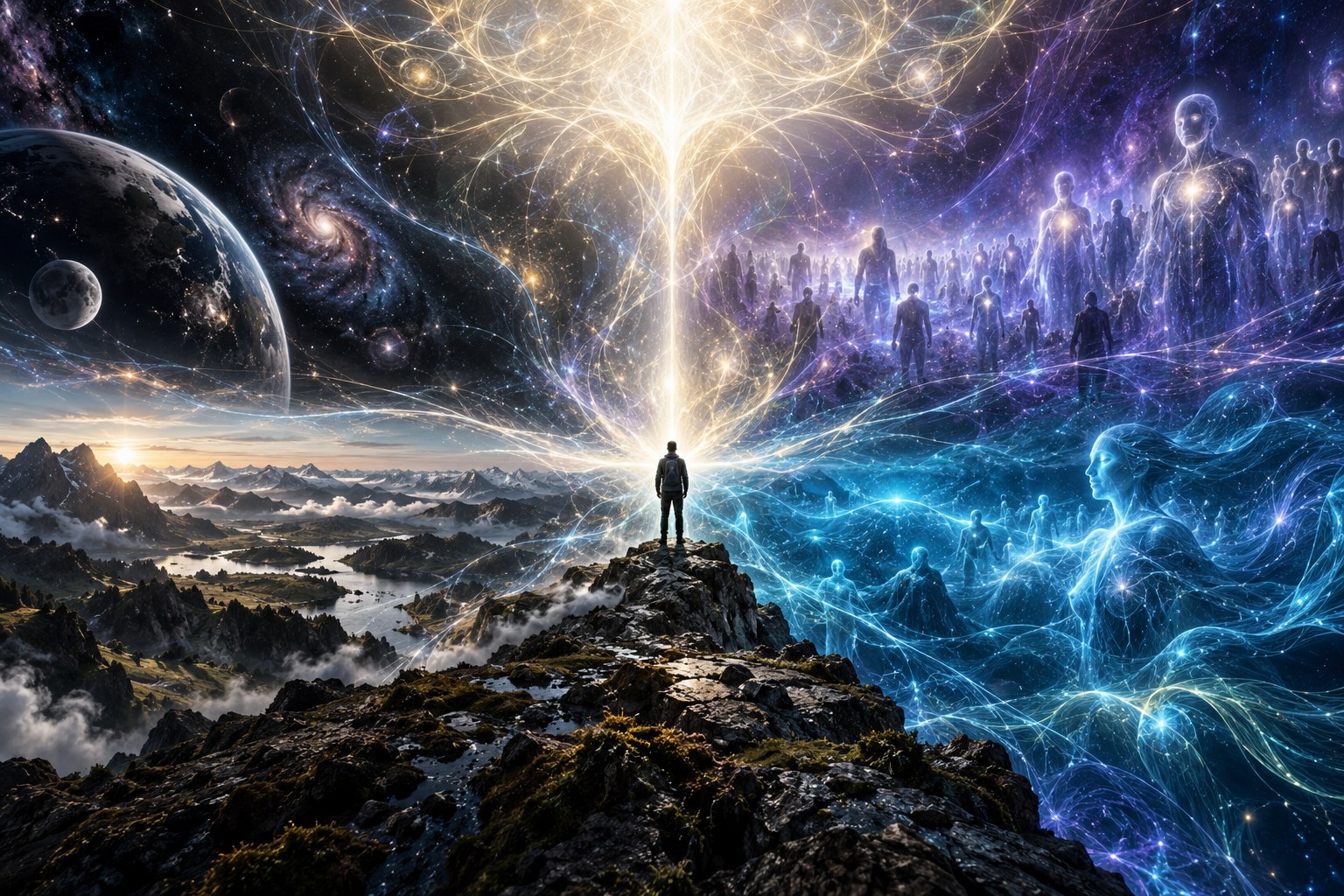
We are accustomed to treating the physical world as the whole of reality. Whatever can be seen, measured, or detected by instruments is accepted as real. Everything else is usually dismissed as belief, fantasy, or a product of the human brain.
But what if our senses perceive only the part of reality that the physical body was designed to experience?
The human eye can see only a narrow range of the electromagnetic spectrum. The ear detects only a small portion of existing sound frequencies. We do not doubt the existence of radio waves simply because we cannot hear them without a receiver. We understand that our inability to perceive something directly does not mean it is absent.
I am convinced that the same principle applies to reality itself. The physical world exists, but it is not the only world. It is one of several levels that occupy the same space, interact with one another, and differ in their energetic density, laws of perception, and possibilities available to consciousness.
Over twenty years of out-of-body exploration, I gradually developed my own map of these levels. It did not arrive as a finished revelation, nor did I borrow it from a religion or esoteric tradition. It emerged through repeated experience. I observed, compared, returned to the same states, noticed recurring differences, and tried to understand the underlying patterns.
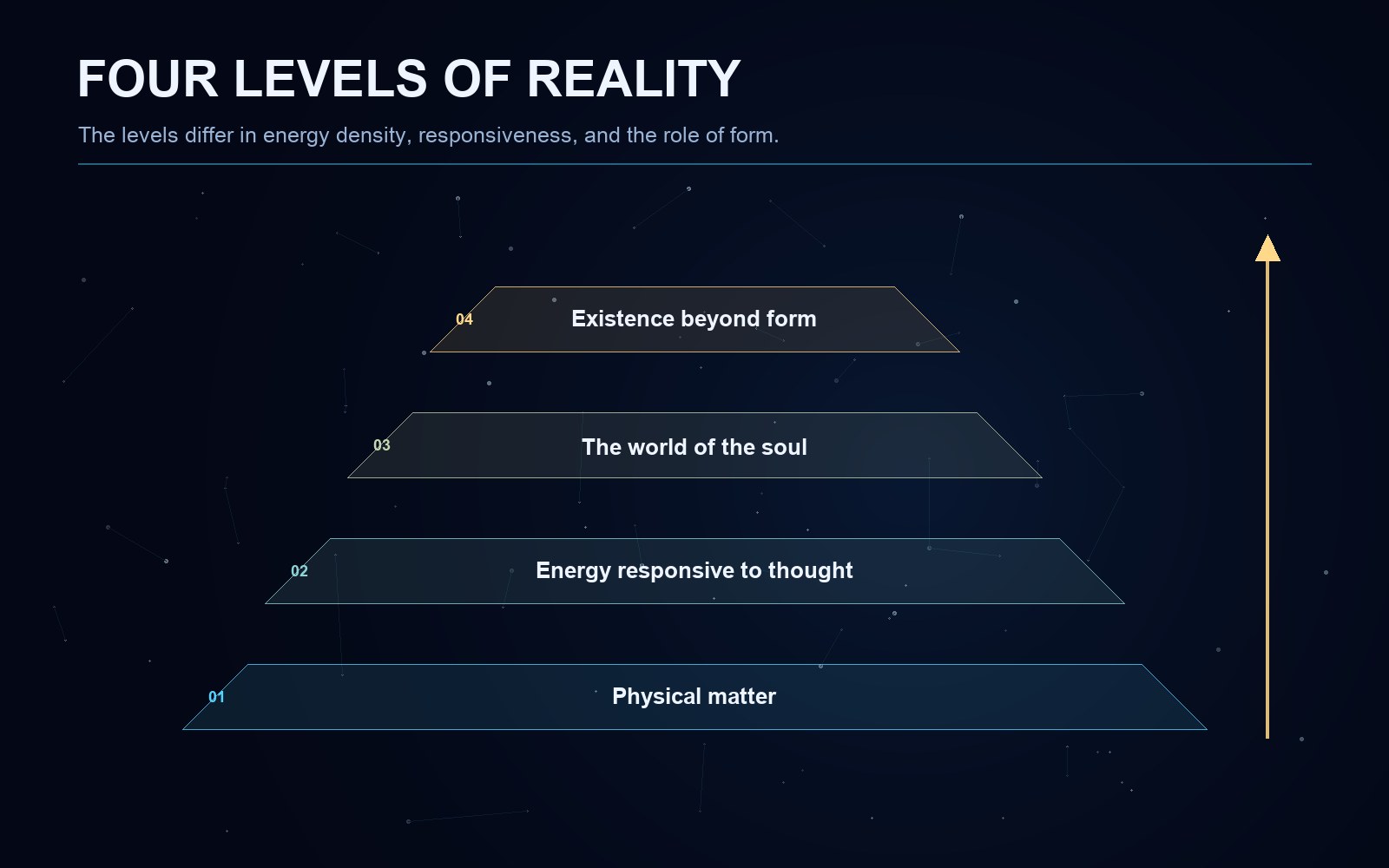
This map contains four primary levels of reality. I do not consider the fourth level the final boundary of existence. Other states may lie beyond it, but I do not yet know enough about them. These four levels, however, explain much of what happens during out-of-body experiences, between incarnations, and after the death of the physical body.
Reality Extends Beyond Physical Perception
Our bodies are made for life in a dense material world. They allow us to navigate space, interact with objects, experience pain and pleasure, recognize danger, and make decisions. At the same time, the body limits the range of what we can perceive.
A person may look around a room and feel certain that they see everything in it. In fact, they see only its physical dimension. Other levels may be present in the very same space while remaining invisible to ordinary sight.
Radio frequencies offer a useful comparison. Signals from dozens of radio stations, television broadcasts, cell networks, and wireless devices can pass through one room at the same time. They do not collide with or displace one another. A device receives a particular signal only when it is tuned to the corresponding frequency.
This is only an analogy, but it illustrates the central principle: moving between levels of reality does not necessarily mean traveling to a distant place. What changes is the state of consciousness and the energetic frequency with which it can interact. The space remains the same, while the reality being perceived changes.
During an out-of-body experience, a person does more than leave the physical body. Consciousness is no longer restricted by the body’s senses and can perceive a broader range of existence.
Matter Is Energy in a Dense Form
My model begins with the understanding that matter and energy are not opposites. Matter is energy in a very dense and stable state.
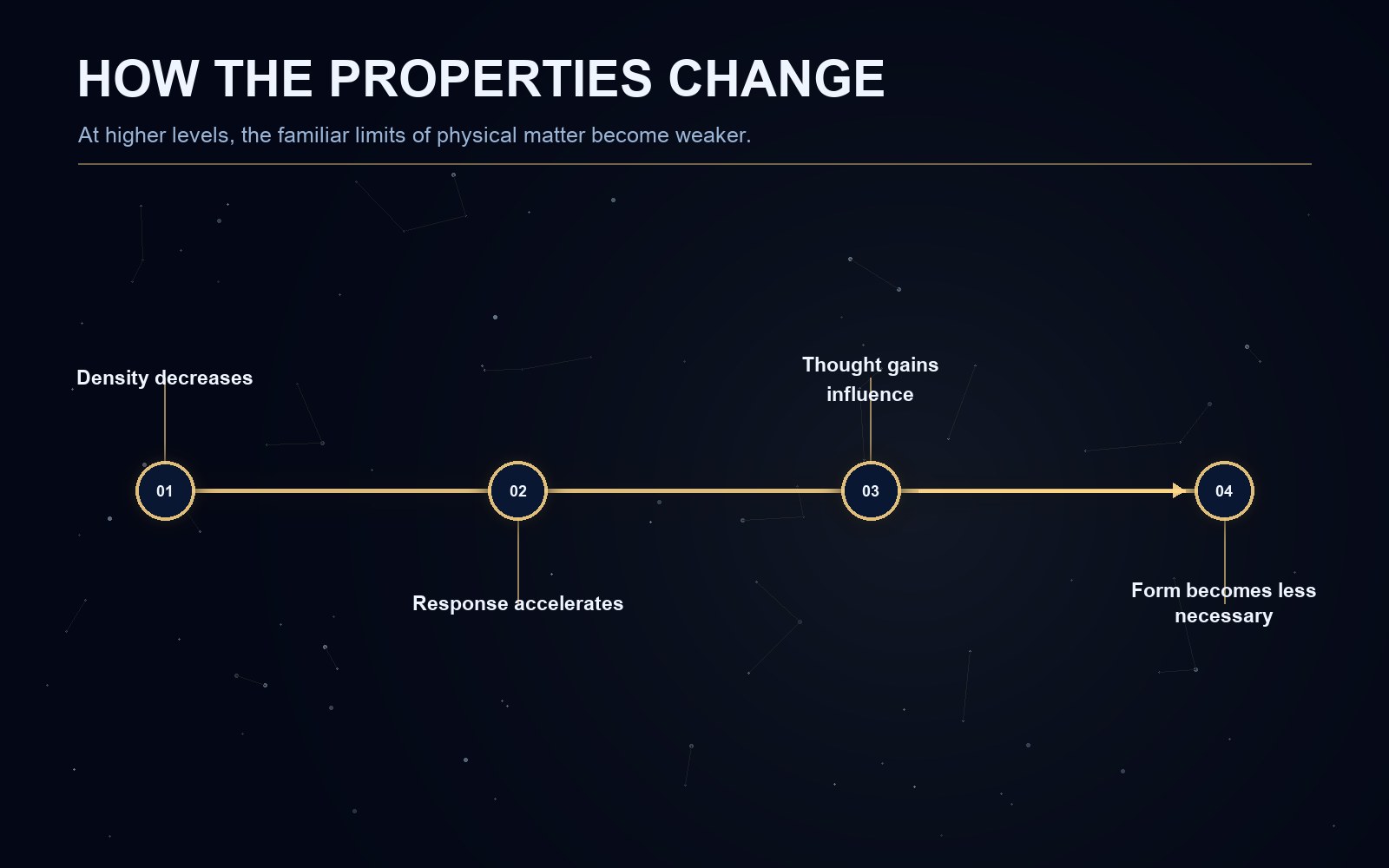
The denser the level, the more slowly change occurs and the less immediate the power of thought becomes. The subtler the energetic environment, the more quickly it responds to consciousness.
In the physical world, imagining a house does not cause one to appear. A design must be created, materials acquired, and time and labor invested. On less dense levels, an image held in consciousness can alter the surrounding environment almost immediately. Thought becomes more than an internal process. It becomes an active creative force.
The levels therefore differ in more than appearance. Each operates according to its own rules. Our perception of distance and time changes, as do our means of movement, the stability of our surroundings, and the degree to which thought can affect them.
The First Level: Physical Reality
The first level is our material world. It is the densest reality I have explored.
This is where space and time behave as we know them. Objects hold their form. The body has weight and limitations. Every action requires energy, and its consequences cannot be erased by a simple wish.
That stability is precisely what gives physical life its importance.
In a less dense reality, a person may alter an image, redirect attention, or leave an unpleasant situation. Here, we must live with the consequences of our choices. Spoken words cannot be taken back. Broken trust cannot be restored instantly. The body requires care. Creating anything demands consistency, work, and patience.
The physical world is a realm of genuine choice. Here our inner qualities become actions. Love must appear not only as a feeling, but as something we do. Compassion requires involvement. Courage emerges in the presence of real fear. Responsibility arises where decisions have consequences.
The first level should therefore never be considered “lower” in the sense of being bad or unnecessary. The density of matter creates unique conditions for growth. Life on Earth is difficult precisely because it matters.
We do not come here merely to escape into a spiritual world as quickly as possible. We come to gain experience that cannot be acquired outside physical incarnation.
The Second Level: A Reality That Responds to Thought
The second level is often called the astral realm. It is a less dense energetic reality in which consciousness has far greater freedom.
At this level, a person can move without a physical body, pass through walls, fly, and cross enormous distances. The familiar limitations of matter weaken. Yet this freedom brings a new kind of responsibility: the environment begins to respond to thoughts, expectations, and emotions.
When a person is calm and able to hold their attention steady, perception remains clear. When fear takes control, an emerging image can quickly assume form and appear to be an independent reality. Learning to guide the stream of thought is therefore one of the central requirements for consciously exploring the second level.
In my model, the second level contains several distinct regions.
The first is an energetic reflection of the physical universe. A person may see a familiar room, house, street, the Earth, and the surrounding cosmos. This reflection does not always match the physical original exactly. Objects that no longer exist in the material world may still appear there, while recent physical changes may be absent. It is not a photographic copy, but an energetic layer of reality.
The second region contains independent worlds that are not copies of our universe. They have their own conditions, forms of life, and environments in which souls may undergo other kinds of experience.
The third is the mental region. It is created by human thoughts, fears, beliefs, and fantasies. This part of the second level is especially important because it can produce experiences that are extraordinarily vivid and, at the same time, deeply contradictory.
Mental Reality: When Thought Becomes an Environment
Human thought does not simply vanish. Repeated images and powerful emotions create energetic structures. When millions of people sustain the same fears, hopes, and religious ideas over generations, these structures join together and form stable regions within mental reality.
A person who enters such a region may see exactly what they have been conditioned to believe. One may encounter a familiar religious figure. Another may enter a world shaped by fear. Someone else may see a landscape resembling a dream or fantasy. The experience can feel entirely convincing because the surrounding environment truly does respond to consciousness.
This may explain why accounts of out-of-body experiences and postmortem reality often contradict one another. People are not necessarily lying. They may be describing their experiences honestly while visiting different regions or interacting with material generated by their own stream of thought.
The ability to leave the body does not make anyone all-knowing. Beyond the body, we must still learn to observe, verify, and distinguish a stable reality from a structure created by thought.
The mental region deserves a detailed discussion of its own. No serious exploration of out-of-body experience is possible without understanding its nature.
The Third Level: The Soul’s Home
The third level differs fundamentally from the energetic reflection of our world. It is not a copy of the physical universe, and familiar concepts of distance and time begin to lose their meaning.
I understand this as the level to which the soul returns between physical incarnations. It is our true home, not in a geographical sense, but in the deepest sense of who we are.
During earthly life, a person experiences the self as a separate personality. Memory is limited to the current incarnation, attention is centered on the body, and the soul’s previous experience remains hidden. When physical life ends, these restrictions gradually fall away. The soul regains a fuller understanding of itself, reunites with closely connected souls, reflects on the life just completed, and prepares for further development.
Stable realities created by large groups of souls can exist on the third level. They are not comparable to brief, chaotic mental images. They possess internal structure and endure through the coordinated participation of many consciousnesses.
A soul can assume a familiar appearance so that others can perceive it. An encounter does not require a physical body, but consciousness may use an image that everyone involved can understand. Form becomes a means of communication rather than a biological necessity.
Time does not move here as it does on Earth. We are accustomed to sequence: the past is over, the present is unfolding, and the future has not yet arrived. On the third level, perception becomes broader. Events and relationships can be understood as a whole rather than divided into separate moments.
Remaining in this state during out-of-body exploration is considerably more difficult. It requires steady attention and the ability to avoid automatically returning to the familiar habits of earthly perception.
The Fourth Level: Existence Beyond Form
The fourth level is the most difficult to describe in human language. Our language evolved to describe objects, actions, distances, and time. Here, familiar forms almost completely disappear.
This is a reality of pure energy. There is no body in the familiar sense, no room, landscape, or separate source of light. Perception becomes whole: you see, know, and understand at once. Information is not communicated through individual words. It is present immediately as complete knowledge.
At this level, the sense of isolation that accompanies physical embodiment disappears. Consciousness does not lose its identity, but experiences a far deeper connection with the reality around it.
I associate the fourth level with highly developed souls that no longer need earthly incarnation. Their development continues, but under conditions I cannot yet explore completely or describe in full detail.
I do not consider the fourth level an ultimate summit. Reality does not have to end where my ability to perceive it ends. Other levels probably exist, but I will not construct a detailed account of them without sufficient experience.
For me, an honest boundary of knowledge matters more than an elegant but artificial system.
The Levels Are Not a Measure of Human Worth
The words “first,” “second,” “third,” and “fourth” are simply a way to describe the model. They do not mean that a person who has experienced a higher level is better than anyone else.
Spiritual development is not measured by the number of extraordinary experiences a person has had. Someone may leave the body many times and remain selfish, cruel, or irresponsible. Another person may never have a conscious out-of-body experience and still live with love, dignity, and a profound understanding of others.
This map is not meant to establish a new hierarchy. Its purpose is to clarify the conditions in which consciousness exists and develops.
Each level serves a purpose. Physical reality provides the experience of embodied choice. The second level teaches the direction of attention and thought. The third restores the soul’s wholeness and broader memory. The fourth opens existence beyond familiar form.
How This Map Changes Our Understanding of Death
If the physical body is considered the source of consciousness, death appears to be the final destruction of the person. But if the body is an instrument through which consciousness interacts with the first level, then the body’s death ends one mode of interaction. It does not erase the human being.
After death, consciousness does not fall into absolute nothingness. It stops perceiving the physical world through the body and continues on another level. At first, a person may retain their familiar sense of identity and connection to earthly life. Then memory expands, perception changes, and the soul returns to a more complete understanding of itself.
This does not diminish grief or eliminate the pain of separation. We truly do lose the physical presence of someone we love. But we do not lose that person forever.
Understanding the layered nature of reality restores hope. Death becomes a transition between forms of existence rather than disappearance.
Why This Map Matters While We Are Alive
It may seem that levels of reality matter only to people interested in out-of-body experience or life after death. In fact, this map changes how we understand the life we are living now.
If a human being is a consciousness that continues to develop beyond a single incarnation, then every decision carries deeper meaning. We do not take money, titles, or social standing with us. What remains is what we have become: our capacity to love, understand, choose, move through fear, and accept responsibility for our actions.
Physical life is no longer a random interval between birth and extinction. It becomes an important stage in a much larger journey.
This map also teaches responsibility for the stream of thought. In the material world, thought often seems private and inconsequential. On subtler levels, its creative force becomes immediate. Learning to observe the activity of the brain, resist automatic fear, and consciously direct attention prepares us for existence beyond the body.
Finally, the map teaches us not to mistake every extraordinary image for ultimate truth. The intensity of an experience does not guarantee that our interpretation is accurate. A serious explorer must remain clear, compare experiences, and learn to distinguish among levels of reality.
This Is a Map for Exploration, Not a Dogma
I am confident in the reality of my experience and in the central patterns I have observed over twenty years. But I do not claim that my map describes the whole of existence.
A map is never the territory itself. It helps us find our way, but it cannot replace direct knowledge.
My understanding will continue to grow as my exploration continues. If future experience reveals details I cannot see today, I will expand the model. A willingness to learn does not mean doubting the path already traveled. It means remaining honest as a researcher.
I am not asking the reader for blind belief. I am offering another way of seeing reality—one that can be examined, compared with personal experience, questioned, and used as a foundation for further exploration.
We Are More Than Our Bodies
We are not bodies that accidentally learned to become conscious. We are consciousness temporarily experiencing life through a physical body.
The first level gives us dense matter, limitations, and consequences. The second reveals the power of thought and the diversity of energetic worlds. The third restores the soul’s memory and the sense of returning home. The fourth leads toward existence beyond familiar form.
All these levels are parts of one reality. They are not divided by impenetrable walls. We are already connected to them, even while physical life limits our awareness to the material world.
We did not come here by accident. Our lives are not brief flashes between two stretches of eternal nothingness. This is one stage of a far greater journey—difficult, valuable, and filled with meaning.
Death does not close that path. It changes the level on which the journey continues.
In the articles that follow, I will explore each level in detail, examine the mental region, explain the transition between states, and discuss how we can distinguish a stable reality from an environment created by human thought.
You can read more about my experiences and research in my book, The Phenomenon of Consciousness Beyond the Body.
English editions:
Leave a Reply