
Much of our fear of death comes from the belief that when the body stops, the person disappears. As if our entire life—our love, memory, and accumulated experience—could turn into nothing in a single moment.
My experience tells me otherwise.
After twenty years of out-of-body practice, I have come to understand that death does not destroy a person. It completes one stage of existence and begins another. We do not disappear. We are released from the body, gradually recover our memory, and remember who we are beyond a single earthly life.
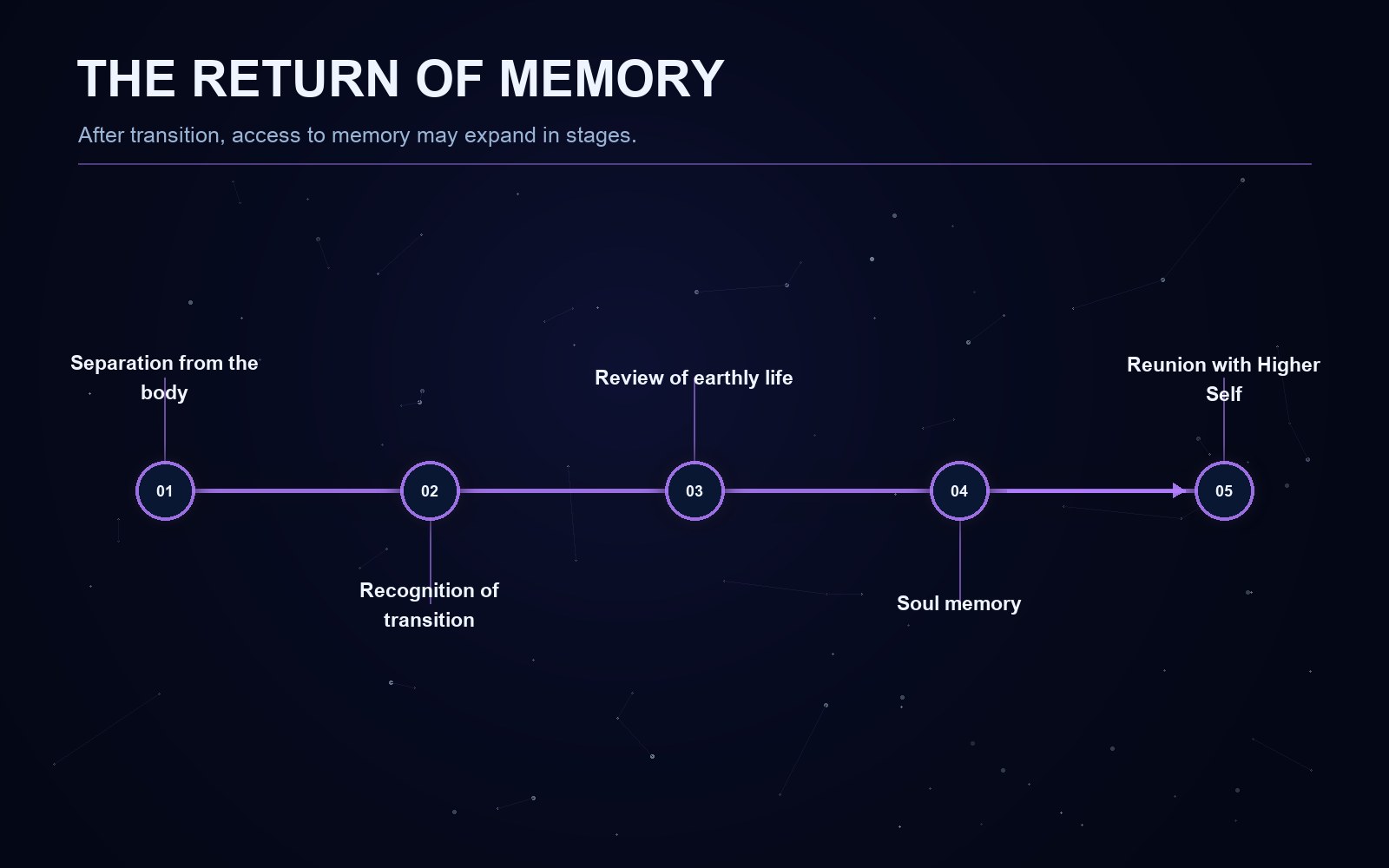
But memory does not return all at once. Between the final moment of physical life and the full recovery of self-awareness, the soul passes through several stages. Each one has its own purpose.
Why We Enter Life Without Our Memory
Before we can understand what a person remembers after death, we must understand why we forget in the first place.
Before incarnation, the soul knows far more than the embodied personality. It knows where it came from, sees the purpose of the coming life, recognizes the souls connected with it, and becomes familiar with the major events of the path ahead. But when it enters earthly life, it willingly closes that memory.
Forgetting is neither a punishment nor a mistake. It is a necessary condition of authentic experience.
If we remembered the world of the soul from birth—its freedom, the way we felt there, and those to whom we were connected—earthly life might feel like a narrow prison. We would know that we existed before birth and would continue after death. We would remember the entire scenario, anticipate every major trial, and know where pain awaited us and where the way out could be found.
Our decisions would no longer be real. We would not truly live the life before us; we would simply follow instructions we already knew.
Incarnation has a different purpose. We must face circumstances directly and make our decisions from inside the life we are living: without hints, without a prepared answer, and without turning to the final page to see how everything ends.
That is why the rules are hidden and the memory is closed.
Why We Do Not Remember Past Lives
People sometimes assume that memories of previous incarnations would make them wiser and prevent them from repeating old mistakes. But knowledge would not return alone. It would bring an enormous emotional burden with it.
Across many lives, every soul has lost loved ones and endured betrayal, violence, illness, and war. It has also made mistakes, caused pain, and made choices it later regretted. The complete memory of all of this could place more weight on the human mind than it could bear.
Imagine remembering the death of every child, parent, spouse, brother, or sister you had lost in other lives. Imagine remembering every person you failed to save, every harmful act you committed, and every weakness you once surrendered to. Imagine recognizing in someone you know today the person who once betrayed or killed you. What would become of your present choices? Would a new life simply become an extension of old grief, guilt, and revenge?
We are given the opportunity to begin a new path without that pressure. The stories of former lives are concealed, but the qualities developed through them remain: the soul’s tendencies, its strength, its weaknesses, and its capacity to love, feel compassion, and choose. The experience remains within us even when we no longer remember the circumstances in which it was acquired.
We do not arrive empty. We arrive without biographical memory, but we carry the result of everything we have lived before.
Death Begins with Separation from the Body
The first stage of death is the separation of the soul from the physical body.
This separation is not experienced in exactly the same way by everyone. A person who has been ill for a long time or has prepared inwardly for death will often recognize the transition more quickly. After a sudden death, the soul may not immediately understand that the body is no longer alive. A person may continue to perceive the surroundings, see the people nearby, and try to speak to them without understanding why no one responds.
In other cases, the soul understands what has happened but refuses to accept it. This can be especially difficult after the sudden death of a young person whose life was filled with plans, desires, and strong bonds with loved ones.
Several years ago, I was told about a young man who died in a hospital during the pandemic. After his death, unusual events began occurring in the hospital rooms: objects fell or moved, and a distinct presence could be felt. A physician who had been near him during his final days believed that he had not understood or accepted his death. She began reading my book aloud, explaining what had happened to his body, that the life of the soul continued, and where he needed to go next. A few days later, the disturbances stopped completely.
For me, this story shows why an understanding of death can matter even while we are alive. Knowledge does not erase the pain of separation, but it can help a soul avoid becoming trapped in fear and confusion.
Accepting the Fact of Death
After separation comes the next stage: acceptance.
For someone convinced that nothing exists beyond death, the continuation of his or her own awareness can be overwhelming. The person discovers that perception and thought continue even though the body no longer functions. An entire worldview collapses in an instant.
For many people, however, death feels like release. Physical pain disappears. The weight of an old or sick body is gone. People who return after a near-death experience often say they did not want to come back. They experienced separation as freedom and as a return to a more natural state of being.
The soul’s experience matters greatly at this stage. A soul that understands the nature of death accepts the transition more quickly. A confused soul is met and assisted by kindred souls, who offer support and explain what comes next.
No one is left alone.
The Memory of This Life Returns First
Once death is accepted, memory begins to return—but it returns gradually.
The person first remembers the life that has just ended. Events, emotions, and decisions that were forgotten or only partly understood during incarnation become available again. The person sees the life as a whole and recognizes connections between events that once seemed accidental.
This may explain the familiar account of an entire life passing before someone’s eyes during a near-death experience. It is more than a series of images. The person regains a complete perception of the life that was lived.
Out-of-body experiences that did not remain in ordinary waking memory are also recovered. The person begins to see the life from beyond the perspective of the earthly personality, although the soul’s full memory has not yet returned. At this stage, the individual still feels like the person who lived on Earth. Loved ones, unfinished relationships, and events in the physical world still matter deeply.
Saying Goodbye to Loved Ones
The next stage is farewell.
After separation, the soul remains close to the earthly world for a period of time. It visits loved ones and tries to communicate that it still exists and that it is all right. People in the depths of grief may be unable to perceive these attempts, but the soul still wants to comfort those it loves.
In my experience, this period usually lasts up to ten days. This is not a rigid deadline or an identical rule for every soul. The length of the transition depends on the soul, the circumstances of death, the strength of earthly attachments, and the soul’s readiness to move forward.
Love does not disappear after death. Gradually, however, the soul understands that its earthly stage is complete. It releases the former personality and begins the journey home.
Returning to the World of Souls
The return does not happen in a single instant. It is a gradual transition into a more complete state of being.
The soul first meets a teacher or guide. Together they examine the life that has just ended: the decisions that were made, what was understood, where the person showed strength, and where fear, anger, or habitual patterns took control.
This is not a trial, and no sentence is imposed. The soul is not punished. What takes place is an honest understanding of experience.
On Earth, we often evaluate a life through outward results: success, wealth, recognition, victories, and defeats. After the return, the inner motives behind our actions become visible, along with the ways those actions changed the quality of the soul. A choice unnoticed by everyone else may matter more than a celebrated achievement. What looked like failure on Earth may sometimes bring the soul more growth than an easy victory.
The soul sees where another choice was possible. It also understands why it made the choice it did. The entire chain of circumstances, emotions, and consequences becomes clear.
Restoring Inner Harmony
Earthly life leaves an imprint on our energy. Pain, fear, difficult relationships, and inner conflict create imbalance. After returning, the soul goes through a period of restoration.
Some experience this stage as a special place of healing. Others describe a connection with light or with a powerful source of energy. The images may differ, but the purpose is the same: the soul’s energy is restored to harmony.
That energy is not exhausted or destroyed. Energy never disappears; it changes form and quality. Everything we lived becomes part of the soul, but pain no longer controls it as it controlled the embodied person.
Reuniting with the Higher Self
The most complete restoration of memory occurs later, when the incarnated part of the soul reunites with the Higher Self.
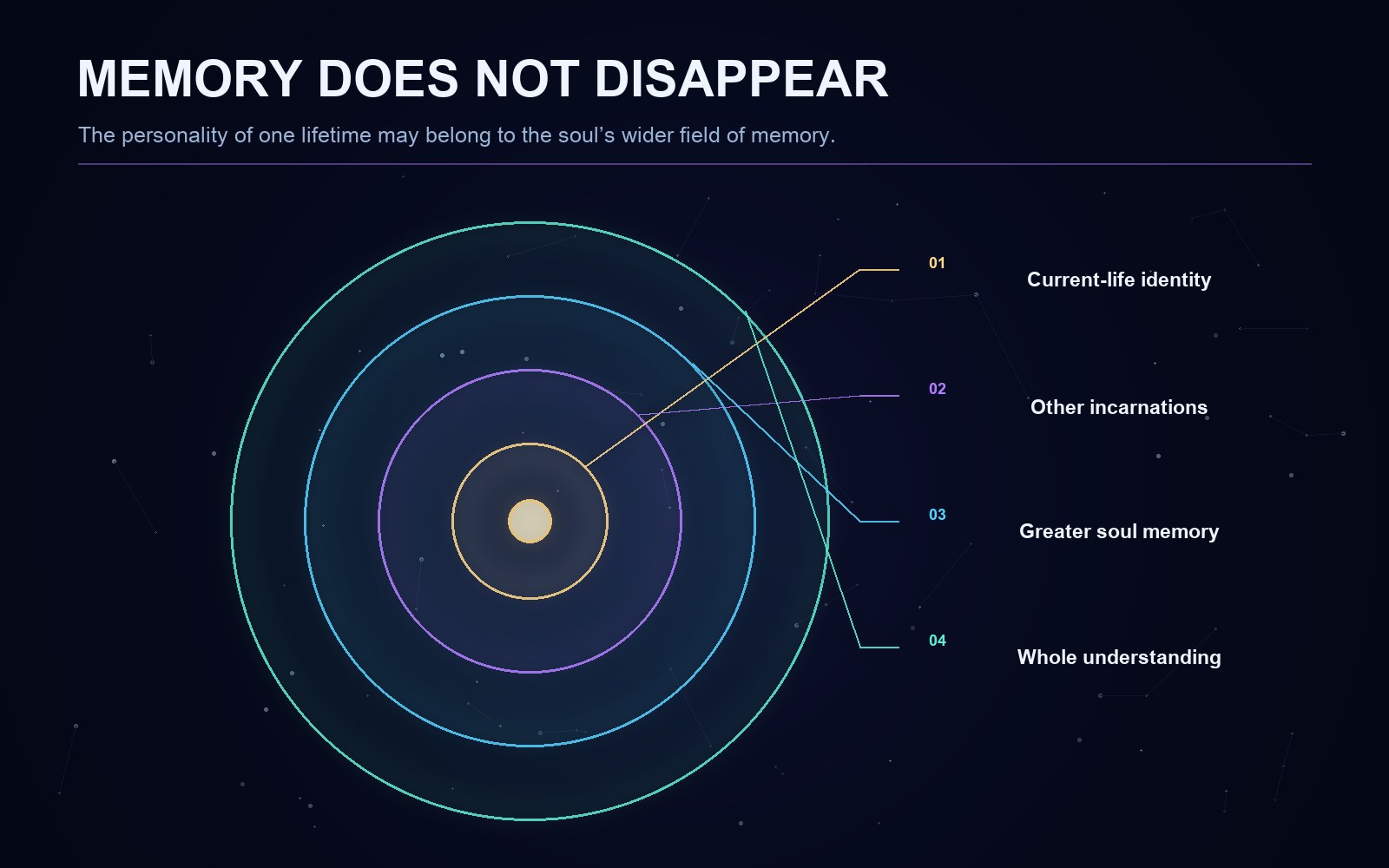
Only part of our greater being enters an earthly life. The larger part remains in the world of souls, retaining a much wider consciousness and its connection with all accumulated experience. While living in the body, a person experiences the self as a separate personality. After death, that personality is not erased. It returns to its own wholeness.
At the moment of reunion, memory of other incarnations returns, along with the preparation for the earthly life, its purposes, and its place within the soul’s much longer journey. Experiences that once appeared unjust or meaningless can now be seen within a larger picture.
We remember more than events. We remember the principles behind incarnation itself. We understand why we agreed to forget, why we met particular people, what we came to transform within ourselves, and what experience we gained.
This is the true meaning of returning home. It is not merely movement to another place. It is the restoration of our own wholeness.
Why Those Who Have Died Do Not Fix Our Lives
People often ask: if deceased relatives continue to exist, why do they not help us more openly? Why do they not warn us of danger, tell us which choice to make, or remove our problems?
After full memory is restored, the soul understands the reason.
We came here to make our own decisions. If a departed soul continually intervened, removed every difficulty, and directed every step, it would deprive us of the experience for which we incarnated. That would not be help. It would diminish the meaning of our path.
The souls who love us do not become indifferent. The connection remains, but they see our lives from a wider perspective. They understand that certain trials cannot be completed on behalf of another person. Support is possible, but the decision must arise within us.
One day, we too will return, recover our memory, and understand this just as clearly.
Life Continues in Another Form
After restoration, the soul returns to its kindred group—to those with whom it has shared many incarnations. There is no earthly sense of urgency there. No one forces the soul to choose another life immediately. It reflects, communicates, learns, and remains in that state for as long as it needs.
A new incarnation begins when the soul recognizes that it is ready for another experience. It sees the qualities it wants to reveal, chooses the conditions, and enters earthly life again.
This is how development continues: not as punishment and not as an endless repetition of the same mistake, but as the gradual unfolding of the soul through experience, love, choice, and transformation.
No One Disappears
Death remains painful for those who continue living. The loss of physical presence is real. We miss the voice, the touch, the familiar conversations, and the ability to see someone we love beside us.
But the person does not become nothing.
The soul separates from the body, accepts the transition, remembers the life that was lived, says goodbye to loved ones, returns to the world of souls, restores its inner harmony, and reunites with its greater being.
We fear death because we view it from the perspective of the body. For the soul, it is not the end. It is the return of memory and the journey home.
Death as the destruction of the person does not exist. There is transition. And one day, each of us will remember why we came, whom we loved, what we learned, and who we have always been.
For a deeper account of my experience and research, see my book The Phenomenon of Consciousness Beyond the Body.
English editions:
Leave a Reply