Category: Uncategorized

  • My First Conscious Out-of-Body Experiences: What I Observed and What They Taught Me

    My First Conscious Out-of-Body Experiences: What I Observed and What They Taught Me

    The next part of my personal story: my first attempts to repeat the experience, the unexpected discoveries, the mistakes, and the patterns that became the beginning of my twenty-year investigation of consciousness beyond the body.

    The first thing I noticed was that the wallpaper looked lighter.

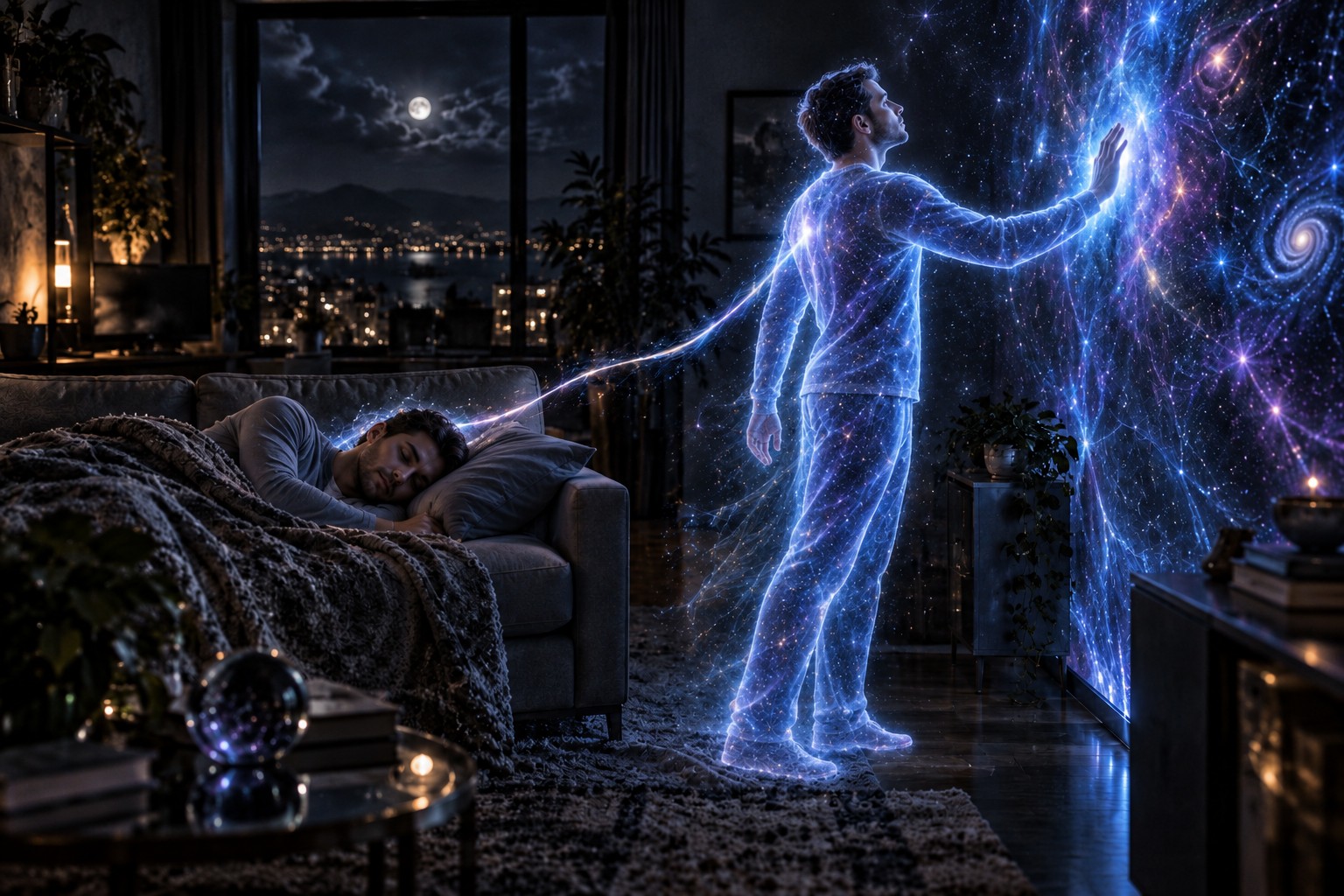
    It was late at night. I was lying on the couch after a long drive, trying to repeat my first conscious out-of-body experience. I waited for the familiar vibrations and the roar inside my head, but nothing like that happened. The room remained quiet. Only the wall looked different, as though moonlight were falling across the wallpaper.

    I decided to get up and take a closer look. I walked over to the wall, ran my hand across it, and felt a faint vibration in my fingers. I pressed a little harder. The surface yielded. My hand slowly began to sink into the wall, then passed through it.

    Only then did I understand: I was already outside my body.

    I turned toward the couch and saw myself lying there. In the same instant, I was back.

    The entire experience lasted no more than two minutes. Yet those two minutes taught me one of my first important lessons: leaving the body is not always accompanied by dramatic effects. Sometimes the transition feels so natural, and the surrounding space looks so convincing, that a person may not realize it has happened.

    The most astonishing part was not that my hand had passed through the wall. What struck me more deeply was that until that moment, I had been certain I had simply gotten up from the couch physically.

    That was when an isolated extraordinary event began to become an investigation.

    After the First Experience

    After my first fully conscious out-of-body experience, I tried to understand what circumstances had made it possible.

    That day, I had spent many hours behind the wheel and driven roughly five hundred miles. During the trip, my attention had shifted several times into an unusual state of deep concentration. Later, when I lay down to rest, a powerful inner roar filled my head and vibrations moved through my body. Then I found myself outside the physical body.

    I remembered the sequence and concluded that the vibrations and inner sound might signal an approaching separation.

    For several evenings, I lay down, relaxed, and waited for them. I listened to every sensation, remained as still as I could, and directed my attention inward. Nothing happened. I simply fell asleep.

    I tried practicing during the day, when I was not tired. The result was the same.

    Looking back, I see how naive those first attempts were. I expected that reproducing a few external conditions—lying down, closing my eyes, relaxing, waiting for vibrations—would cause the experience to repeat. But consciousness does not work like a mechanical switch. The depth of relaxation matters. The quality of attention matters. So do one’s inner state, the moment of transition, and many other factors I had not yet learned to recognize.

    The failures did not discourage me. They helped me separate the event itself from my first assumptions about it. I began to understand that if I wanted real answers, I could not rely on a formula discovered by chance. I would have to observe, compare, and test.

    The Experience I Mistook for Ordinary Waking Life

    A few days later, I made another long drive. On the way back, my attention once again entered that familiar altered state. I did not regard this as an established method, and I would never advise anyone to experiment with consciousness while driving. It was part of my history, a circumstance whose importance I understood only later. Every deliberate attempt took place at home, in a safe environment.

    I returned late at night, completely exhausted. I did not want to miss an evening of practice, so I lay down on the couch and directed my attention inward.

    I waited for the vibrations. I waited for the inner sound. Nothing happened.

    But the room began to look slightly different. The wallpaper seemed much lighter than usual. I thought moonlight might be coming through the window, so I got up and walked over to the wall.

    What followed was the moment that opens this essay: the faint vibration in my fingers, the surface that was no longer solid, my hand moving into the wall, and the sudden realization.

    I had already left my body without noticing it.

    The experience changed my understanding of the transition itself. I had assumed that leaving the body would always be unmistakable: powerful vibrations, an inner roar, a clear sensation of separation, a sudden change in perception. Now I saw that consciousness could move beyond the body quietly, without a dramatic threshold. I still perceived the familiar room and retained my ordinary clarity of thought. My position in space also felt natural: I had been lying on the couch, then I stood up and walked to the wall. My mind automatically offered the most familiar explanation—I had simply awakened and gotten up.

    The only clue was the slightly altered color of the wallpaper.

    That became an important observation. A familiar-looking environment does not necessarily mean the state of consciousness has remained the same. Sometimes the difference is hidden in a small detail that is easy to overlook.

    The First Patterns

    Within ten days, I had two successful out-of-body experiences despite having almost no deliberate practice. That gave me confidence, but it also raised new questions.

    I compared the two events and identified my first working patterns.

    The altered state of attention that followed sustained concentration clearly played an important role. Physical exhaustion helped the body relax quickly, but it guaranteed nothing. Vibrations and inner sound could accompany a separation, but the second experience showed me that they were not required. The room could look almost identical to physical reality. And seeing my own body ended the experience immediately.

    These were not final laws. They were working observations—the first points on a map that had not existed for me before.

    I decided to stop waiting for another accident and make a deliberate attempt.
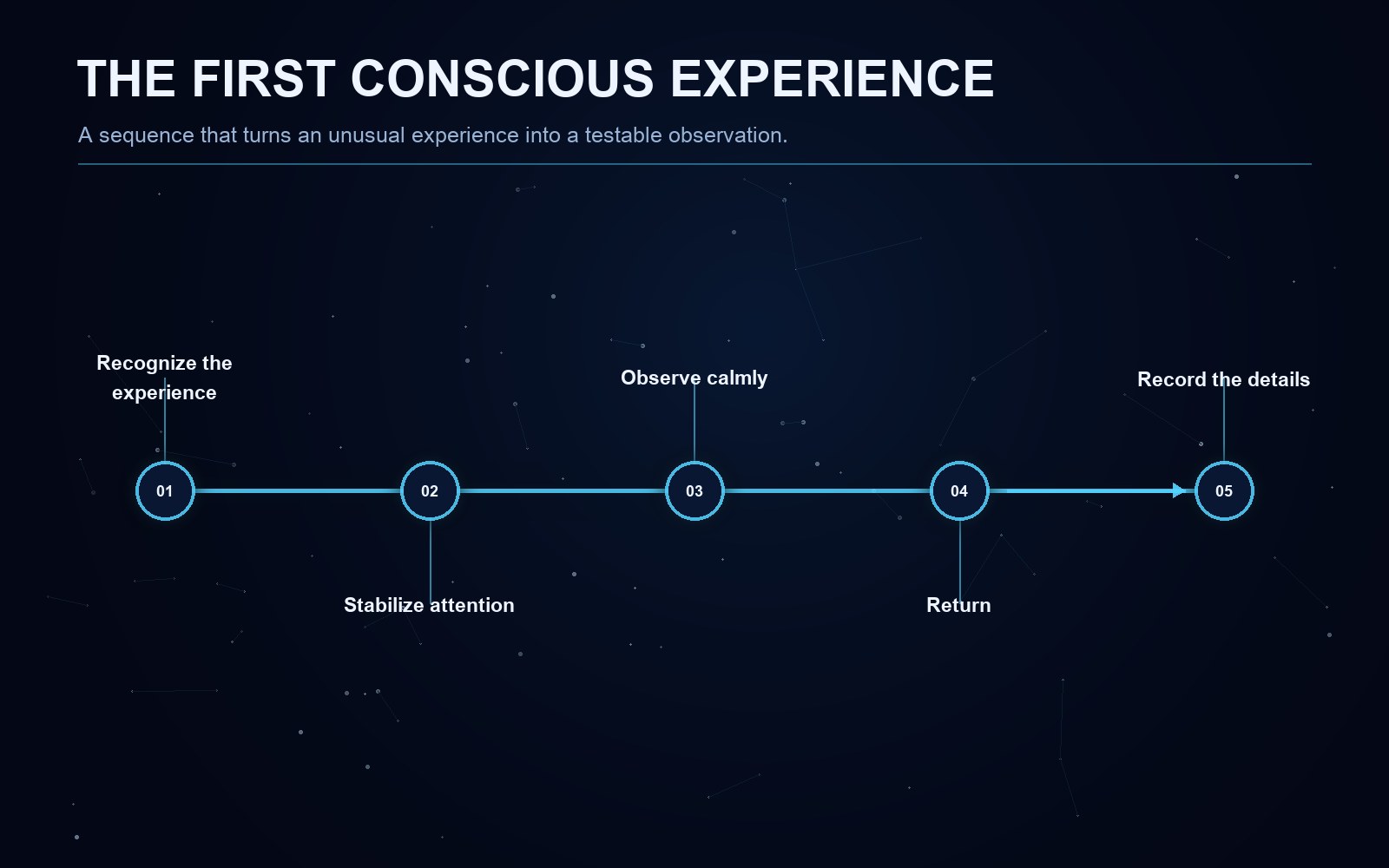
    Explanatory diagram for the article
    The first recurring patterns of conscious out-of-body experience.

    My First Intentional Preparation

    The following evening, I made a simple plan. First I would use breathing and deep relaxation. Then I would visualize a place I knew well.

    Late at night, in complete darkness and silence, I lay on the couch. For ten or fifteen minutes, I breathed calmly, remained still, and observed my body gradually relax. Then I began to imagine myself walking through a familiar place. I was not merely trying to produce a picture. I tried to feel that I was present there: the direction of movement, the distance, the position of objects around me.

    Before long, vibrations appeared in my chest.

    They resembled the shivering that comes after spending too long in cold water, except I was not cold. The sensation seemed to arise from within. It was not painful. In fact, it felt almost pleasant, like a gentle electrical massage moving through the body.

    I decided the moment had come.

    I got up from the couch, walked to the wall, placed my hand against it, and pressed.

    The wall remained solid.

    I looked back at the couch. My body was not there. No separation had taken place. I had felt the vibrations, assumed the transition was complete, and physically stood up.

    It was a mistake, but a useful one.

    I was relieved that I had begun by testing the wall instead of trying to fly. I lived on the fifth floor. That thought quickly restored both my seriousness and my sense of humor.

    From that moment on, testing the state became essential. An unusual sensation does not necessarily mean a separation has occurred. The expectation of success can persuade a person too soon. I needed a simple way to distinguish preparation from the experience itself.

    Rolling onto the Floor

    I lay back down and repeated the breathing exercises.

    After a while, the vibrations returned. This time they were accompanied by the familiar inner roar. I decided to try something different and imagined myself rolling out of my body, much as I believed I had during my first experience.

    In the next instant, I landed on the floor beside the couch.

    “Well, that failed again,” I thought.

    The situation seemed so absurd that I laughed. From the outside, it must have looked ridiculous: a grown man lying on a couch in the middle of the night, trying to leave his body, only to roll onto the floor.

    I stood up and turned around.

    My body was lying on the couch.

    In the same instant, I was back inside it.

    This time the separation had happened intentionally. It was brief and completely undramatic. There were no grand visions, no voices, no symbols—only the floor beside the couch, a moment of laughter, and my own body in front of me.

    That was precisely why the experience mattered so much. I had not expected that result and initially mistook it for failure. The test showed otherwise.

    My earliest successes taught me something simple: real investigation rarely looks majestic. It is built from awkward attempts, mistaken conclusions, repetition, and unexpected details. What matters is not how impressive an event appears, but what you are able to notice within it.

    Attention as an Instrument

    That brief experience led me to another conclusion. Whenever I looked at or remembered my physical body, I returned to it.

    If I wanted the state to continue, I needed to direct my attention away from the body and toward the surrounding space, movement, or a chosen destination.

    Visualization took on a new meaning for me. I did not see it as inventing a fantasy. I used it to give attention a direction. When consciousness focuses on the body, the connection with physical perception becomes stronger and the experience ends. When attention is fully directed toward another place, continued movement becomes possible.

    I began visualizing familiar places in as much detail as I could: the space, the distance, the arrangement of objects, the feeling of being present. Over time, I became convinced that the capacity to sustain an image and a direction of attention could be developed like any other skill.

    Attention later became the central element of my practice. Not force. Not strain. Not the desire to obtain a result at any cost. Calm, steady attention.

    It determined whether I recognized the moment of transition, whether I retained clarity, where my perception moved, and how long the experience lasted.

    What My First Mistakes Taught Me

    I made many mistakes at the beginning. Sometimes I fell asleep without noticing any change. Sometimes I mistook preparatory sensations for a completed separation. Sometimes I left the body but understood it too late. Sometimes I returned the instant I saw myself lying on the couch.

    Every mistake refined the picture.

    I learned that I could not rely on a single sign. Vibrations could occur without a separation, and a separation could happen without vibrations. A familiar-looking room was not proof of ordinary waking consciousness. I also learned not to let excitement take over completely, because a powerful emotional reaction quickly destabilized the state.

    I learned to observe before explaining.

    That distinction became the foundation of everything that followed. Explanation always comes after an event and inevitably reflects our existing beliefs. Observation comes first. The more precisely I remembered the sequence of sensations, actions, and consequences, the less dependent I became on other people’s ready-made interpretations.

    I did not need permission to consider my experience meaningful. It had already changed my understanding of the human being and of reality. My task was different: to learn how to enter the state consciously, remain clear, and understand its structure step by step.
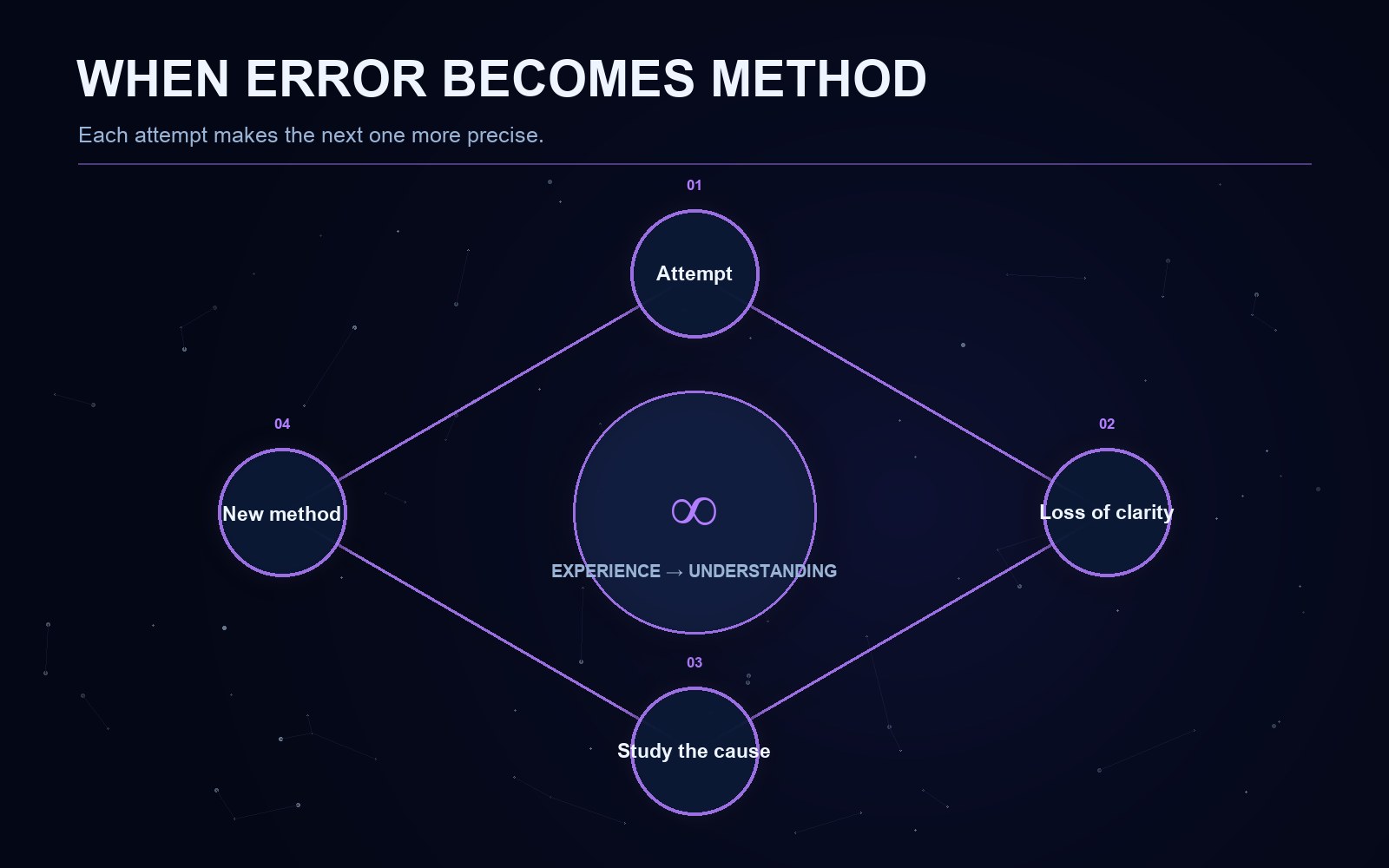
    Explanatory diagram for the article
    How early mistakes gradually become a practical research method.

    The Questions Became More Difficult

    My first experiences lasted only a few minutes, but they opened a field that could not be explored in a single evening.

    How could the state be extended? How could I move through space? Why did some thoughts help consciousness remain outside the body while others brought it back immediately? Why did a familiar room sometimes look almost ordinary while small details changed? How could I preserve a clear memory of everything I perceived? What was seeing the room while the physical eyes remained closed? And what connected that perceiving consciousness to the body?

    I did not yet have answers. But these were no longer abstract philosophical questions. I had encountered them directly.

    During the following year, I continued to practice, compare states, and learn through trial and error. I studied the vibrations, the moment of separation, the preservation of calm, and the direction of attention. Gradually, short accidental episodes began to become a more consistent experience.

    As the possibilities expanded, so did the responsibility. The deeper I went, the more clearly I understood that a premature explanation could close the path to further knowledge. I could have adopted a religious interpretation, an esoteric system, or materialist dismissal—and stopped there. Instead, I chose to keep observing.

    Why I Stopped Talking About It

    My discoveries occupied almost all of my attention, and naturally I wanted to share them with family and friends.

    Their reactions surprised me. People stared at me with wide eyes and asked whether I was all right. They knew nothing about such states, and I did not yet have the language to explain my experience calmly and clearly.

    I saw that the conversation did not open a space for inquiry. It simply made people defend their familiar picture of reality.

    So I chose silence.

    I continued to practice and build my own understanding, but I told almost no one. For many years, this part of my life remained a secret. Only in 2020 did I begin to speak about it openly.

    My silence did not mean that I doubted what I had experienced. It meant that I had not yet found a community capable of discussing such questions without fear, ridicule, or ready-made labels.

    Today, I am creating that space myself.

    From a Few Minutes to Twenty Years of Investigation

    When I look back on those first attempts, I see more than extraordinary events. I see the beginning of a method.

    First I noticed recurring signs. Then I tried to reproduce the conditions. I encountered failure. I formed a mistaken conclusion. I tested it. I obtained a different result. I compared it with what had happened before and formed the next question.

    That is how a single experience became an investigation to which I have devoted twenty years.

    At the time, I had no idea where those first separations would lead. I could not imagine the levels of reality I would encounter, the forms of consciousness I would meet, or how profoundly my understanding of the soul, life, and death would change.

    But I had already understood the central truth: consciousness possesses capacities that people are rarely told about. Those capacities cannot be understood through speculation alone. They must be investigated—with attention, persistence, and the courage to follow the evidence of experience.

    My hand passing through the wall was not a miracle demanding worship. It was a question.

    And that question changed my life.

    Continue the Story

    In Phenomenon of Consciousness Outside the Body, I describe how the practice developed, the levels of reality I encountered, and the conclusions that emerged from twenty years of personal investigation.
  • How My Search Began: From Childhood Experiences to the Study of Consciousness

    How My Search Began: From Childhood Experiences to the Study of Consciousness

    Andrey Chsherbakov’s personal story: early experiences, questions about the nature of matter, his departure from a religious system, and the first conscious experience that turned the study of consciousness into his life’s work.

    In the summer of 2006, I returned home after a long drive. I had traveled about five hundred miles, and several days with my family lay ahead. I ate dinner, talked with my family, and lay down on the couch. The children were already asleep, and my wife was reading in another room. My body was tired, but my mind was still moving through the events of the day.

    At some point, I felt a powerful vibration and a loud humming inside my head. Then it seemed that I had fallen from the couch onto the floor. I decided to get up and go to the kitchen for a glass of water—and in the next instant, I was already there.

    My first thought was: How did I get here? I had no memory of standing up or walking across the room.

    It was night outside. No lights were on, yet the kitchen did not seem dark. Everything was clearly visible, as though the objects were illuminated from within. I was still trying to understand whether morning had already come when I began to rise. My body passed through the ceiling, the floors above me, and the roof. I felt a strange vibration, and a moment later I found myself standing on top of an ordinary five-story apartment building.

    My consciousness was completely clear. I knew who I was, where my home was, and that only moments earlier I had been lying on the couch. This was not a disjointed stream of images. I observed, thought, made decisions, and tried to test what was happening.

    That night, my long search ceased to be only philosophical.

    But it had begun much earlier.

    An Experience I Did Not Yet Know How to Name

    My first unusual experiences began when I was about ten years old. At times, I became aware of myself moving through our apartment. I saw members of my family, passed through walls, and, when I returned to my bed, saw my own body asleep.

    These episodes were infrequent and stopped when I was around fifteen. At the time, I regarded them as unusual dreams. I did not search them for hidden symbols or predictions. I still see no reason to turn every dream into a message. Dreams too easily mix memory, emotion, expectation, and fantasy.

    But those childhood states had a distinct clarity and a powerful sense of my own presence. I did not analyze them or build theories around them. I had neither the language nor the knowledge to understand what was happening. Their meaning began to reveal itself much later, when I encountered a similar state again as an adult.

    Other questions occupied me during childhood as well. I grew up in the Soviet Union and attended an ordinary school. When we asked about the meaning of life, we were given a clear social answer: a person should serve the country, society, and the common good. I did not reject the value of work or responsibility toward others, but I felt that the question went much deeper.

    I wanted to understand more than how one should live. I wanted to know what the world we live in actually is.

    What Is Reality Made Of?

    One day I approached my physics teacher and asked him what matter was. The question surprised him; until then, I had shown little interest in school physics.

    He explained that matter is the substance that exists in space and time and makes up everything around us, including ourselves.

    Then I asked: What is matter itself made of?

    In response, I received a short lecture on the periodic table. I earned a top grade for my curiosity, but I did not receive an answer to my question. I was told which elements make up the objects around us, but I was asking something else: What lies beneath the elements themselves? What is the primary reality from which everything visible arises?

    Today, anyone can find hundreds of explanations about atoms, elementary particles, and quantum physics in seconds. In the 1980s, an ordinary schoolchild had neither the internet nor open access to the world’s libraries. It took me about a year to find an answer.

    Eventually, I arrived at an idea that made a profound impression on me: matter could be understood as a form in which energy appears.

    The idea matched something I had already sensed intuitively. The world around me no longer looked like a collection of separate, solid objects. Beneath familiar forms, I began to perceive a deeper unity. A table, a human body, air, and light could all be different states of the same energy.

    But one answer immediately produced new questions.

    What is energy itself? Why does it take such complex and ordered forms? Why does life arise? Where does the ability to perceive the world and recognize oneself come from? Is order an accident, or is there intelligence behind it?

    I had begun with a question about matter, but I was gradually approaching the question of consciousness.

    When I Turned to Religion for Answers

    After the collapse of the Soviet Union, the information available to us changed dramatically. In the early 1990s, books that had once been nearly impossible to find began to appear: works on philosophy, religion, esoteric traditions, and different understandings of the soul, life, and death. I read everything I could get my hands on.

    At the time, I believed religion might possess the knowledge I was missing. Science described many processes of the material world with extraordinary power, but questions of meaning, the soul, and the source of consciousness remained open. Religion spoke about these subjects with certainty and offered a complete picture.

    My search led me to a theological academy. After two years of study, I was ordained and began serving in the church while continuing my education by correspondence. I took my faith seriously, was willing to work hard, and lived according to my faith. Because of this, I advanced quickly within the organization. By the age of twenty-five, I held a senior position in my country’s church leadership.

    With that position came access to a side of church life that ordinary parishioners rarely see.

    In private conversations, I increasingly noticed that sincerity of faith did not always guide people’s decisions. Money, influence, status, and control were often more important than the spirituality we preached to others. This was deeply unsettling. I had entered the church in search of truth and was prepared to organize my life around it. Now I saw that the system could demand loyalty primarily to itself.

    I began to examine the central teachings of my own faith more carefully. I listened to scientists, skeptics, and representatives of other traditions. I asked questions I had once considered almost forbidden. The more honest my search became, the more clearly I saw that I had been living inside a cage of religious fanaticism.

    I had been trained to change the thinking of other people, and I had willingly become part of that system. I do not shift the responsibility onto anyone else. At the time, I wanted that life, believed I had chosen the right path, and accepted its rules. But a person also remains responsible for recognizing an error when it finally becomes visible.

    When I began asking uncomfortable questions and speaking openly about my doubts, the leadership tried to return me to the accepted boundaries. I was expected to continue repeating the correct words even when my conscience could no longer affirm them.

    During my final service, I stood before the congregation and suddenly understood with complete clarity: I could no longer say what I did not believe.

    I left before the service ended and never returned.

    The decision was not easy. I lost my familiar position, my community, and a ready-made picture of the world. But I regained the right to think for myself. Leaving religion did not end my search. It set the search free.

    Life Without a Ready-Made System of Answers

    After I left, a different life began. I had to support my family, find my place in the world, and learn to make decisions without the backing of a large organization. I met many people who had no interest in the questions that had occupied me since childhood. They did not understand why anyone would spend time thinking about the nature of matter, consciousness, or the meaning of life when practical problems were everywhere.

    To a degree, I understood them. Everyday life demands time, money, and attention. But the question inside me never disappeared.

    By 2003, I had begun to think that I might never find an answer. I had passed through a religious system, read many books, and listened to many explanations, yet none of them gave me a coherent picture. I wanted to stop struggling, abandon the search, and simply live as everyone else seemed to live.

    I now understand that those years were not wasted. I needed to pass through other people’s systems of knowledge, believe in them, become disappointed, and find myself without external support. Only then was I prepared to investigate the unknown for myself.

    The next turning point began with an event that seemed to have nothing to do with consciousness.

    The Accident and My Fear of Falling Asleep at the Wheel

    In 2003, I was involved in a car accident. I escaped serious injury and suffered only bruises and cuts. But afterward, I developed an intense fear of losing control of the car again, falling asleep at the wheel, and causing another crash.

    At the time, I worked far from home. About once every two weeks, I drove roughly five hundred miles to see my family. The trip took nine or ten hours. Giving up the car was difficult, but drowsiness had become a real problem.

    First, I tried energy drinks. They disrupted my sleep and left a fog in my head. Then I tried sports supplements that promised alertness. Their effect was brief and unpleasant: I alternated between feeling overheated and chilled. I stopped, moved around, sang, and constantly chewed something, but none of it helped for long.

    During one trip, I began experimenting with my breathing. I had no training and knew nothing about breathwork. I was simply trying to become alert and stay awake. One combination produced an unexpectedly powerful effect. After about ten minutes, the drowsiness disappeared, the road became extraordinarily clear, and my attention sharpened.

    I repeated the breathing whenever I felt tired. But along with alertness came changes I had not expected.

    The world became brighter, though the change had nothing to do with sunlight. Space seemed transparent, as though it were glowing from within. Sometimes I felt as if I could see through two sets of eyes. One part of my attention continued watching the road while another simultaneously perceived unfamiliar places, people, and events. The two streams did not merge, yet both belonged to me.

    My memory changed as well. I could reconstruct almost any scene from my life with surprising ease. At the same time, unfamiliar places, smells, people, and emotions appeared—none of them connected to my ordinary biography.

    I need to state this plainly: experimenting in this way while driving was dangerous. I describe it as part of my history, not as a method anyone should repeat. At the time, I did not yet understand the nature of the state and was learning through my own mistakes.

    Over the next several months, I became more familiar with this mode of perception. I learned to sustain it longer and to direct my attention instead of simply following random images. It seemed that consciousness could maintain several independent points of perception at once.

    Then I saw something I remember to this day.

    The Golden Sphere

    During one of those long trips, I again began to feel drowsy and changed my breathing almost automatically. My consciousness divided. One part continued to perceive the road; the other stood before a scene unlike anything on Earth.

    Before me was an immense, radiant sphere. It resembled the Sun, but it was so vast that I could not see its boundaries. Tiny droplets formed on its surface, separated from it, and traveled outward along streams of light. It looked like golden rain dispersing in every direction.

    I felt wonder, recognition, and shock at the same time. The magnitude of what I saw could not be contained in ordinary language. The road demanded my attention, and the vision disappeared, but the impression remained with me for the rest of the drive.

    Several weeks later, the scene returned. Again I saw the enormous golden sphere and billions of droplets moving away along rays of light. This time, the experience was even more powerful. I felt that what I was seeing was directly connected to me, though I did not yet understand how.

    In my mind, I asked, “What is this?”

    The answer came from within, clear and calm:

    “This is the place where you came into being.”

    Tears rose in my eyes, and I pulled over.

    In that moment, I was certain that I had not been shown a random fantasy. I had touched a part of reality whose meaning I would have to learn gradually.

    I did not immediately turn the experience into a finished cosmology. In the years that followed, I returned to the image of the golden sphere many times, compared it with other experiences, and gradually developed my own understanding of the soul, energy, and the unified field of life. But at that moment, something more immediate mattered: the search had come alive again. I understood that answers could come from more than books and other people’s teachings. Consciousness itself could become an instrument of investigation.

    The Night on the Roof

    About a year after these unusual states began, I had learned to direct the second stream of perception to some degree. I tried to reproduce it at home in a quiet setting, but nothing happened. Apparently, the long hours on the road, fatigue, and continuous motion created a threshold state that I did not yet know how to enter in any other way.

    Several powerful experiences occurred during the drive on that summer day in 2006. But the most important event happened after I returned home and lay down on the couch to rest.

    Standing on the roof, I first tried to understand what was happening to me. The most obvious explanation was that I might be dreaming. But the state was unlike any dream I had known. My thinking remained clear, the environment was stable, and my actions followed my decisions.

    I considered whether I was in a trance, but this experience also differed from the trance states I had known. Before, there had been two streams of perception: physical reality and a second vision. Now there was no division. I was entirely there, on the roof, aware of myself as one undivided being.

    My next thought was frightening: Was I experiencing a serious psychological breakdown? But I was able to stop the fear and focus on testing the experience.

    I had heard stories about people flying in similar states. I had never been able to fly in ordinary dreams. I decided to perform a simple experiment: choose a distant point and deliberately try to move toward it.

    I did not jump from the edge of the roof. Even within this extraordinary experience, I allowed for the possibility that I might be mistaken and might somehow be physically standing there. Falling from a five-story building would have been too high a price for a test.

    Instead, I focused on a distant point. Before I had fully formed the command, I felt myself move.

    I flew.

    Houses and streetlights passed beneath me. Everything was visible with extraordinary clarity. I moved wherever I directed my attention. Then an overwhelming excitement seized me. I never reached the point I had chosen; the emotion brought me back instantly.

    I was lying on the couch again.

    The entire experience lasted no more than five minutes—from the sensation of falling off the couch to my return to the body. Yet those five minutes changed my life more profoundly than years of reading and debate.

    For another half hour, I remained still and reconstructed the sequence in detail. I did not want to lose anything: the kitchen, the strange nighttime light, the ceiling, the roof, the tests of my own condition, the decision to move, and the flight itself.

    The next morning, I knew I had to investigate this phenomenon.

    Explanatory diagram for the article
    A method for separating direct experience from ready-made explanations.

    Why I Refused to Accept Ready-Made Answers

    I found the books available to me and spent the next month reading everything I could gather about out-of-body experience. Very quickly, I encountered a familiar problem. The authors contradicted one another. Some turned the subject into a mystical ritual. Others constructed elaborate systems without explaining how they had obtained their knowledge. Many described one part of the phenomenon and presented it as the whole.

    I had already followed a path on which someone else’s system first promised final answers and then demanded that I trust it more than my own conscience. I had no intention of repeating that mistake.

    I made a decision: no book would become my final authority. I would take from available sources only what helped me begin a practical investigation. From there, I would observe for myself. I would learn to maintain clarity, repeat the experience, compare states, test my own memory, and gradually distinguish direct perception from the interpretation that followed it.

    That was the beginning of the investigation to which I devoted the next twenty years.

    My explanations changed. Some of my early conclusions proved too simple. I learned to recognize the influence of expectation, emotion, and familiar ideas. But the experience itself continued to recur, deepened, and opened new questions.

    I could no longer regard consciousness as a byproduct of the physical body. For me, it had become an independent reality—capable of perceiving, acting, preserving memory, and existing beyond the ordinary bodily point of view.

    Why I Am Telling This Story Today

    I describe my path because I do not want to replace one system of belief with another. I know too well what happens when a person gives someone else the right to define truth on his behalf.

    I do not ask readers to treat my experience as their own. But I insist on the right to speak about it directly and investigate it seriously.

    My path led through a Soviet school, an independent search for knowledge, religious faith, a senior position within a church system, disillusionment, departure, years of ordinary life, and experiences that shattered my former boundaries of the possible. None of these stages was unnecessary. Each helped me release another ready-made answer and move closer to independent observation.

    Today, I see the greatest value of studying consciousness not in unusual abilities, but in inner freedom. A person who learns to observe, ask questions, and take responsibility for his own conclusions becomes less dependent on someone else’s fear, authority, or control.

    That is why this research platform exists. Here, I will share more than dramatic experiences. I will describe how my understanding changed, where I was mistaken, which patterns repeated, and how personal experience relates to philosophy, research, and the testimony of others.

    I began by asking what matter is made of. That question eventually led me to investigate the one who perceives matter.

    And the investigation continues.

    Go Deeper

    This article tells only the beginning of my journey. In The Phenomenon of Consciousness Outside the Body, I explore my out-of-body experiences, the development of my understanding of consciousness, and the conclusions that emerged from twenty years of investigation.

    Continue with the book on Amazon: Kindle Edition or Paperback.

  • What Is Consciousness? The Soul, the Brain, and the Unified Field of Life

    What Is Consciousness? The Soul, the Brain, and the Unified Field of Life

    By Andrey Chsherbakov

    Consciousness is the most intimate part of reality, and at the same time the most mysterious. We may question the structure of the universe, argue about the nature of matter and time, but each of us knows one thing directly: I exist. I see, feel, think, remember, and choose. Through every change in the body and every shift in circumstance, an inner observer remains, experiencing life as a continuous story.

    But what, exactly, is the “I” that speaks within us?

    Anyone trying to answer this question is like a traveler standing in a vast forest at night. He touches the nearest tree, feels its bark, branches, and the damp ground beneath it, then tries to imagine the entire forest from those few impressions. The same thing happens when we study consciousness. A neuroscientist observes brain activity. A psychologist studies behavior and inner states. A philosopher investigates subjective experience. A mystic speaks of the soul. Each touches one part of a larger reality, yet no single perspective has fully captured the whole.

    I do not study consciousness only as an abstract idea. For twenty years, my primary source of understanding has been direct out-of-body experience and careful observation of the transitions between waking, sleep, trance, and states beyond ordinary physical perception. That journey has led me to a clear conclusion: consciousness is not produced by the brain, and it does not disappear when the brain stops functioning. Consciousness is primary. The brain is a biological instrument through which consciousness expresses itself in the physical world.

    In this article, I will present my model directly and systematically: what I mean by consciousness, how it differs from the subconscious and the superconscious, why the soul can divide its attention, and how individual consciousness is connected to the consciousness of other people, the planet, and the universe itself.

    Two Visions of the Human Being

    Nearly every theory of consciousness belongs to one of two broad approaches.

    The first is materialism. According to this view, the brain creates consciousness. Thought, memory, love, moral choice, and the sense of self are all understood as products of neurons, electrical signals, and biochemical processes. As long as the brain functions, the personality exists. When the brain stops, the personality disappears.

    Many prominent scientists have defended this position. Neurophilosopher Patricia Churchland connects consciousness, morality, and personal identity to the structure of the nervous system. Francis Crick put it even more starkly: our joys, sorrows, memories, and sense of freedom are the activity of a vast assembly of nerve cells and molecules.

    The second view begins with the primacy of consciousness. The brain does not manufacture consciousness; it receives, limits, and transmits it, like a terminal tuned to a wider field of information. In this model, consciousness can exist independently of the physical body. Philosophers, spiritual traditions, researchers of extraordinary states, and some scientists have all considered this possibility. Cardiologist Pim van Lommel has written about nonlocal consciousness. Robert Monroe developed a practical approach to investigating out-of-body states. Rupert Sheldrake proposed the existence of morphic fields and a collective memory within natural systems.

    I belong to the second tradition. Not because it is more comforting, but because it corresponds to what I have experienced. Before I began having out-of-body experiences, I believed in the soul because of books and the testimony of others. Direct experience changed that. For me, consciousness beyond the physical body ceased to be a matter of belief. It became part of a reality I had personally encountered.

    Why the Brain Is Not the Same as Consciousness

    The brain clearly influences human perception. Injury, illness, exhaustion, alcohol, medication, or extreme stress can alter memory, personality, the sense of time, and even the experience of one’s own body. The materialist model draws a simple conclusion: if changing the brain changes consciousness, then the brain must create consciousness.

    But that is not the only possible conclusion.

    Damage to a radio receiver distorts the music, but it does not prove that the music originated inside the receiver. A broken screen alters the image, but the image is not created by the glass. An instrument determines how accurately a signal can appear within a physical medium. In the same way, the condition of the brain determines how clearly consciousness can express itself through the body.

    In my model, the brain performs several functions at once. It connects the soul to the physical organism, processes signals from the senses, anchors attention in material reality, and translates the wider experience of consciousness into images, thoughts, and memories the human personality can understand. At the same time, it restricts the amount of information we can access. That restriction is necessary. Without it, a person could not remain focused on earthly life, relationships, choices, and the specific work of this incarnation.

    The brain, then, is not the source of consciousness. It is a filter and a transmitter. The more limited the instrument, the less it allows through. The more a person develops attention, awareness, and inner discipline, the more accurately the brain can transmit the impulses of the soul.

    This leads to an important practical insight: developing consciousness does not mean rejecting the body. On the contrary, we should care for the brain, the nervous system, and physical health, because the quality of the instrument affects the quality of the soul’s expression. Body and consciousness are not enemies. They form a partnership in which each has its own role.

    Consciousness, the Subconscious, and the Superconscious: Three Modes of One Soul

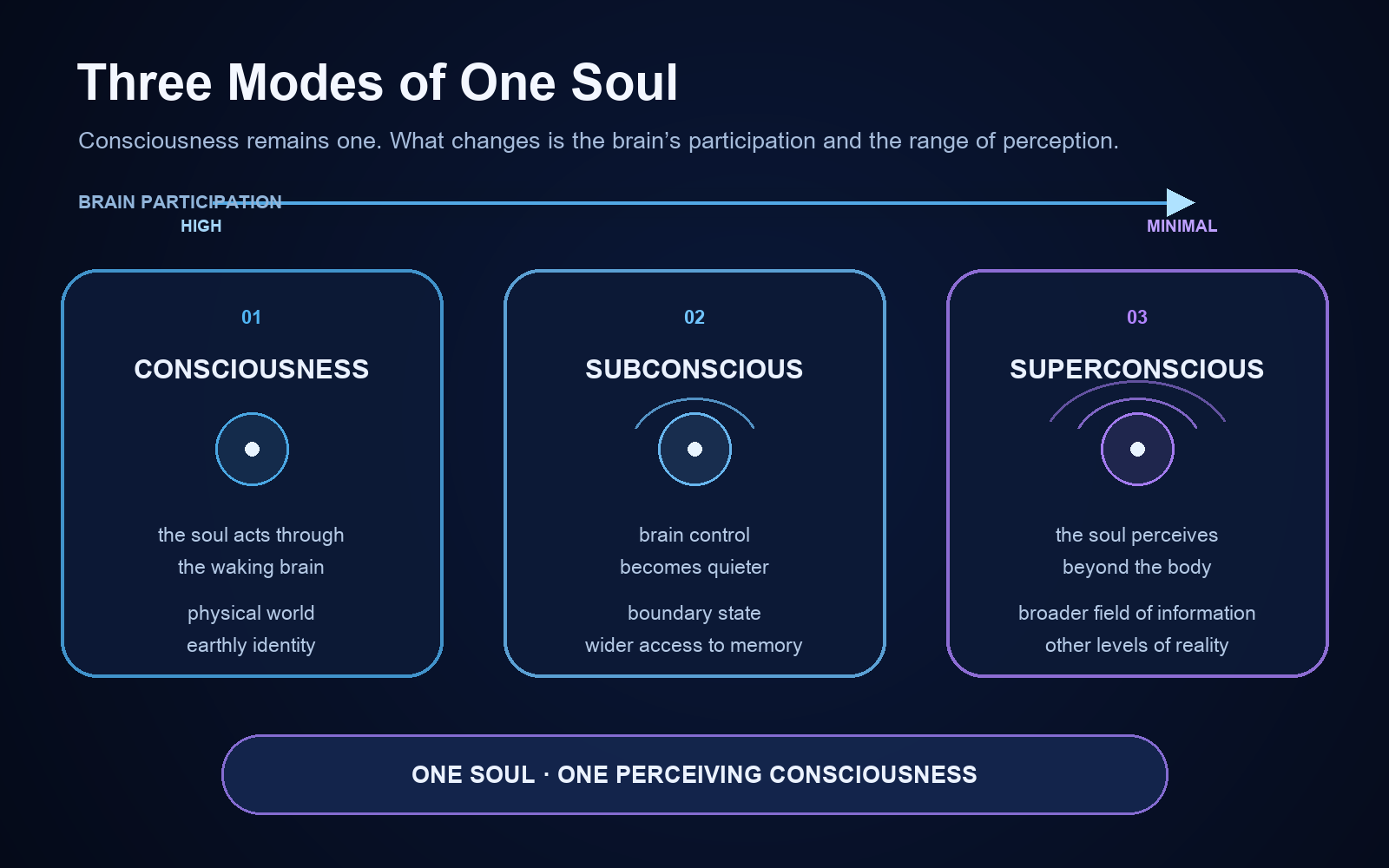
    The words consciousness, subconscious, and superconscious are often used as though they refer to three separate entities. In my understanding, they do not. They describe three modes through which the same soul operates, distinguished by the degree of participation of the physical brain.

    Consciousness: The Soul Working Through the Waking Brain

    In an ordinary waking state, the soul uses the brain to guide the body, behavior, and thought. We perceive the world through the physical senses, recall events from our earthly lives, make decisions, and act within material reality.

    This is what we normally call consciousness. Yet the range of perception available to us in this state is limited. The brain allows through only the portion of information necessary for life in the physical world. It anchors us within a particular personality, biography, and frame of reference.

    This limitation is not a flaw in nature. It creates the conditions for genuine choice. If we continuously remembered the full history of the soul, saw the consequences of every decision, and perceived other levels of reality as clearly as the physical world, many earthly trials would lose their purpose. We are here not only to know, but to choose under conditions of incomplete knowledge.

    The Subconscious: The Threshold Between the Brain and the Soul’s Memory

    I understand the subconscious as a threshold state. Brain activity slows, its control weakens, yet the connection with the physical body and the ability to preserve information remain.

    Such states arise during deep relaxation, trance, meditation, and the borderlands between sleep and waking. The ordinary stream of thought grows quieter, and consciousness gains wider access to the soul’s memory, imagery, and accumulated experience.

    This is why altered states can bring unusual memories, solutions, intuitive knowledge, and experiences that ordinary logical analysis cannot reach. In my own practice, this state has opened access to memories of previous lives and to a deeper understanding of events unfolding in the present.

    The subconscious is not merely a dark warehouse of primitive impulses. It is a transitional zone in which the physical brain suppresses consciousness less forcefully, while still retaining the ability to record what has been received and carry it into waking memory.

    The Superconscious: The Soul’s Unrestricted Perception

    The superconscious is the state of the soul when it is no longer constrained by the active physical brain. During a full out-of-body experience, the center of perception moves beyond the body. A person continues to exist, observe, move, feel, and make choices, even though the familiar physical senses are not involved.

    Here consciousness reveals far more of its range. It gains access to a broader field of information, to its own memory, and to other levels of reality. Yet this creates a problem familiar to many people after vivid dreams and out-of-body experiences: the experience was clear and immediate, but it begins to disappear after full waking.

    As I understand it, this happens because the physical brain did not participate in forming the memory. To preserve the experience, a person must pass through the intermediate subconscious state after returning and, in effect, download the memory into the brain. If someone wakes too quickly, begins moving, or immediately turns attention to external concerns, much of the experience may be lost.

    The distinction between consciousness, the subconscious, and the superconscious is therefore conditional. There is only one consciousness. What changes is the degree of the brain’s involvement and the range of perception available to the soul.

    Three modes of one soul: consciousness, subconsciousness, and superconsciousness
    Consciousness remains one; what changes is the brain’s participation and the soul’s range of perception.

    Soul, Consciousness, and Energy: Different Words for the Same Reality

    In my writing, I use the words soul, consciousness, and energy. To me, they describe the same essential reality from different angles.

    The word soul emphasizes individuality, memory, and the path of development. Consciousness emphasizes the ability to perceive, observe, and gain experience. Energy describes the nature of the soul and the way it interacts with different levels of reality.

    The soul is not an abstract symbol, nor is it a duplicate of the physical body. It is a living system of energy with memory, will, perception, and the capacity to develop. Physical life is one stage in a much longer journey.

    During incarnation, the soul joins with the organism, and together they form the earthly personality. Human character emerges from a complex interaction among the body, the brain, life circumstances, accumulated experience, and the soul itself. The soul does not turn a person into a puppet. It does not cancel free will or force us to follow a predetermined path. Its influence appears through conscience, intuition, inner attraction, meaning, and the ability to see beyond immediate advantage.

    Our task is to learn to recognize that influence. The more noise, fear, and automatic reaction fill our lives, the harder it becomes to hear the soul. The greater our awareness, the clearer our inner direction becomes.

    The Soul’s Ability to Divide

    One of the most important properties of the soul revealed to me through practice is its ability to divide its attention and energy. A separated part of consciousness can have its own point of perception, memory, and experience. When the parts reunite, the knowledge they have acquired becomes part of the whole again.

    I first noticed this in trance states, when I could perceive physical reality and a second stream of imagery at the same time. The two lines of perception existed in parallel. Each felt distinct, yet both belonged to me.

    In a milder form, something similar happens every day. We can drive a car while becoming absorbed in a memory. We can perform a familiar action while continuing an inner conversation. In sleep, part of our attention withdraws almost completely from the ordinary physical world, while the body continues its own living processes.

    During an out-of-body experience, this division becomes deeper. One part of consciousness and energy maintains the connection with the body, while another operates on a different level of reality. The body is therefore never left “empty,” and return remains possible. After reunion, the experiences of both parts must be integrated, even though the physical brain can preserve only a portion of what occurred.

    The soul’s ability to divide helps explain how a person can belong to several systems and levels of experience at once. We are individual souls, yet we remain part of a greater consciousness.

    The Oversoul and the Illusion of Separation

    During one of my early trance experiences, I saw a brilliant sphere from which countless luminous drops were separating. They streamed outward in every direction, surrounded by currents of light. I understood this as a memory of individual souls separating from the Oversoul.

    Each soul begins its own journey, develops an individual point of perception, and gathers unique experience. Yet separation does not mean a final rupture. The soul continues to exist within the energy of which the Oversoul is composed. It cannot leave that field, because space itself is also an expression of the Oversoul.

    This creates an apparent paradox: we are separate, yet we have never truly been divided. Separation creates individuality, free choice, and the possibility of acquiring a unique experience. Unity preserves the deepest connection among all that exists.

    I see this as one of the central truths of human life. Loneliness, weakness, and isolation belong to the limitations of earthly perception. At a deeper level, we always remain within a single living consciousness. There is no place in which a human being is completely abandoned by the source of existence.

    Collective Consciousness: From the Cell to the Planet

    If consciousness is primary, and the energy of space is part of the Oversoul, then consciousness is not confined to human beings. It manifests at many levels of organization in matter and life.

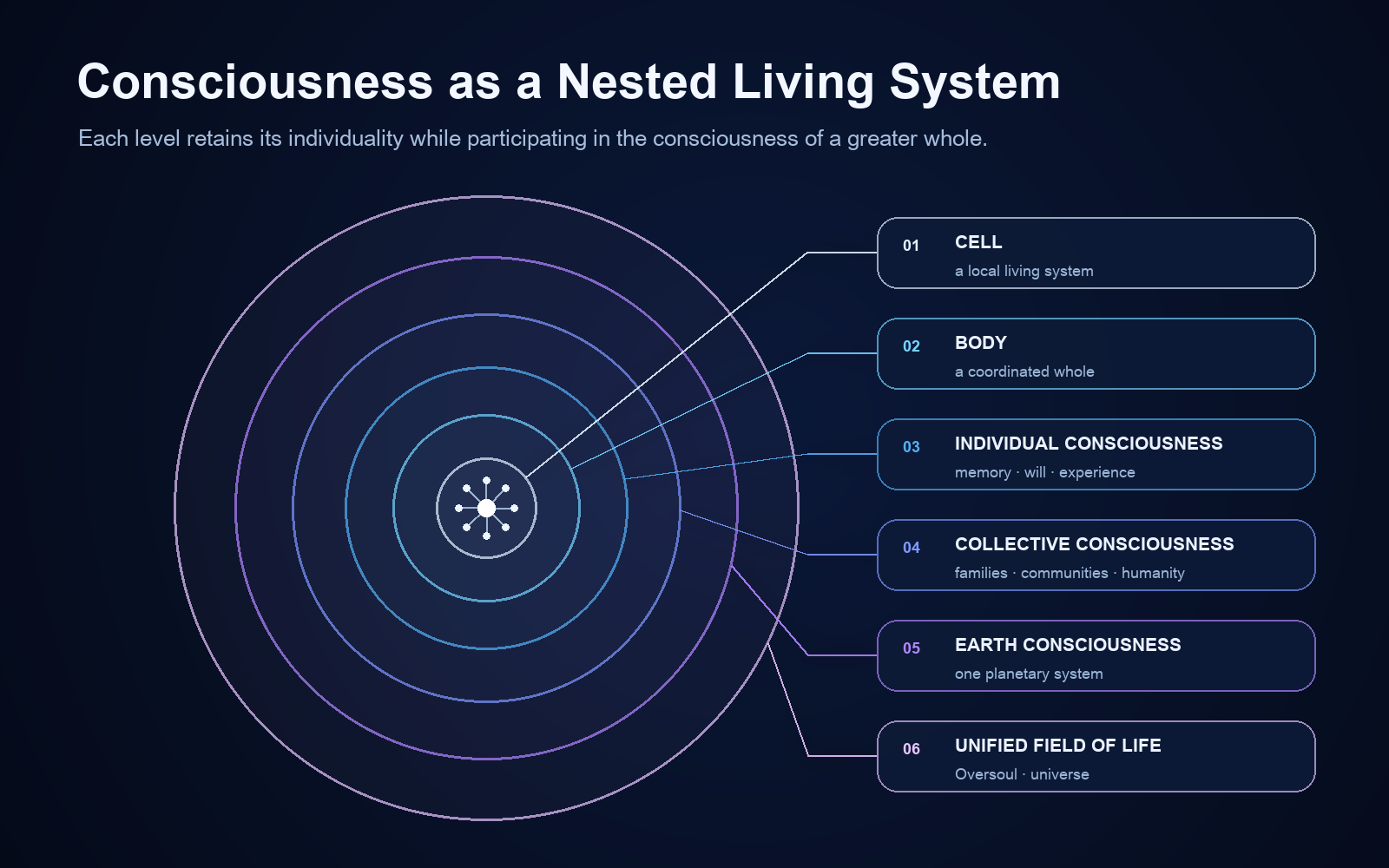
    A single cell is a living system. Cells form organs; organs form an organism. Each smaller system retains its own function while participating in a larger whole. Their coordinated activity produces the collective consciousness of the body.

    Human beings also do not exist in isolation. We belong to families, communities, nations, humanity, and the biosphere. Animals, plants, water, minerals, the atmosphere, and the planet itself form a complex, interconnected system. I call this the consciousness of Earth.

    That consciousness is not the same as human consciousness. It would be a mistake to attribute our thoughts and emotions to the planet in a literal way. Every system has its own scale of perception, its own relationship to time, and its own developmental tasks. A different form of consciousness, however, does not mean an absence of consciousness.

    Individual thoughts, feelings, and actions enter the larger field. Every person affects collective consciousness, whether or not we notice it. Fear strengthens structures built on fear. Cruelty creates conditions for further cruelty. But clarity, compassion, inner dignity, and conscious choice also change the system.

    Spiritual development is therefore never a purely private matter. By changing the quality of our own consciousness, we change the reality of which we are a part.

    Consciousness as a nested living system, from the cell to the unified field of life
    Each level retains its individuality while participating in the consciousness of a greater whole.

    Why the Materialist Picture Is Not Enough for Me

    Materialism has given humanity powerful tools for studying the physical world. I do not reject the achievements of neuroscience, medicine, or biology. The error begins when a method designed to investigate matter is declared to be the final description of all reality.

    If a human being is defined only as a temporary arrangement of cells and neurons, the deeper meaning of existence disappears from the picture. Love becomes a chemical reaction, moral choice a survival strategy, inner experience a side effect of the brain, and death the permanent annihilation of the person.

    To me, this is more than an incomplete theory. It is a worldview that diminishes the human being and makes people easier to control. A person who sees himself as an accidental biological mechanism is more likely to search for certainty in external systems and to fear the loss of the body. A person who recognizes himself as a soul develops a different relationship with fear, authority, responsibility, and freedom. He understands that the consequences of his choices extend beyond one brief physical lifetime.

    Belief in the primacy of consciousness does not free us from morality. It makes morality more profound. Every action becomes part of the soul’s experience. We cannot hide from ourselves, from the energy we create, or from the shared reality we are building together.

    What Changes When We Understand the Nature of Consciousness

    An understanding of consciousness should not remain a philosophical diversion. It changes how we live.

    First, the fear of death begins to weaken. Death no longer appears to be the destruction of the person, but a transition in which consciousness is released from its physical instrument.

    Second, responsibility deepens. If experience, memory, and the quality of consciousness endure, inner development acquires a long-term meaning. We do not grow in order to earn society’s approval, but because the results of that growth become part of the soul.

    Third, our relationship with others changes. If all souls exist within one Oversoul, then harming another person damages the larger system to which we ourselves belong. Compassion stops being merely a moral command and becomes an understanding of how reality is structured.

    Fourth, we reclaim the freedom to investigate. We stop waiting for someone else to grant us permission to think about consciousness, death, and the nature of the universe. We examine experience, compare ideas, develop attention, and learn to distinguish fantasy from deep inner knowledge.

    Consciousness Is Not the Product of an Isolated Brain

    My conclusion can be stated simply.

    Consciousness is the expression of the soul. The brain does not create it. The brain connects consciousness to the physical body, restricts the available range of perception, and translates experience into the earthly personality. Consciousness, the subconscious, and the superconscious are modes of one soul, distinguished by the degree of the brain’s involvement. The soul can divide its attention and energy while preserving the connection among its parts. Individual souls exist within a greater consciousness that encompasses life, matter, the planet, and the universe.

    This model did not appear overnight. It grew out of twenty years of out-of-body practice, observation, and sustained effort to understand what I experienced. In future articles, I will examine the division of consciousness, levels of reality, the memory of the soul, and the ways human beings can learn to perceive more than the ordinary waking state allows.

    We are only at the beginning of the study of consciousness. But we do not have to wait for one system of knowledge to deliver a final answer. Human beings already possess the essential instrument of investigation: consciousness itself. The question is whether we are willing to learn how to use it.

    Thinkers and Research Traditions Mentioned

    • Patricia Churchland — neurophilosophy and materialist theories of consciousness.
    • Francis Crick — the neurobiological view of personal identity and consciousness.
    • Pim van Lommel — near-death research and the model of nonlocal consciousness.
    • Robert Monroe — practical investigation of out-of-body states.
    • Rupert Sheldrake — the hypothesis of morphic fields and collective memory in natural systems.

    Go Deeper

    This article introduces the foundation of my model of consciousness. In my book The Phenomenon of Consciousness Outside the Body, I explore the experiences, observations, and long-term inquiry from which that model emerged.

    Continue with the book on Amazon: Kindle Edition or Paperback.

  • Why Consciousness Beyond the Body Deserves Serious Inquiry

    Why Consciousness Beyond the Body Deserves Serious Inquiry

    START HERE · A PERSONAL POSITION

    A manifesto for Andrey Chsherbakov’s personal research platform

    A human being is more than a physical body. Consciousness does not begin in the brain, nor does it end when the brain stops functioning. Beyond the limits of ordinary perception lies a greater reality—one that we are already part of.

    To me, this is neither an appealing philosophy nor a comforting belief. It is the conclusion I have reached after twenty years of firsthand out-of-body experience, observation, mistakes, comparison, and sustained effort to understand the nature of consciousness.

    I created this site because I am no longer willing to speak about these questions in a whisper.

    For too long, the nature of consciousness has been surrendered to one of two extremes: a rigid materialism that reduces the human being to the workings of the brain, or a mysticism that too often demands belief without investigation. I accept neither. Consciousness can and must be investigated—through direct experience, inner discipline, philosophy, the testimony of others, and every serious avenue capable of expanding our understanding of reality.

    This inquiry changes more than our understanding of death. It changes how we understand life, freedom, responsibility, and the human being itself.

    The Experience After Which Life Can Never Be the Same

    My path did not begin with a search for miracles. I was always drawn to more fundamental questions: What are matter and energy? Why does the universe exist? Who is it that perceives the world from within the human body? And what, exactly, do we mean when we say “I”?

    Then came experiences in which the familiar picture of reality no longer held. My consciousness remained clear outside the ordinary sense of the physical body. I continued to perceive, move, make decisions, and know that I existed. These states recurred, developed, and became increasingly consistent.

    A single unusual episode can be dismissed as chance. Twenty years of recurring experience cannot simply be filed away under “imagined.”

    I observed the transitions between waking consciousness, sleep, trance, and fully conscious out-of-body perception. I learned to preserve the memory of an experience after returning. I compared different states, looked for recurring patterns, and distinguished my own expectations from what happened unexpectedly. The longer the investigation continued, the clearer its central conclusion became: consciousness can exist and act beyond the ordinary operation of physical perception.

    Before this practice began, I could only believe that the soul existed. Now, for me, it belongs to known reality. I do not ask readers to adopt my experience as their own. But I refuse to pretend it never happened merely because the modern worldview cannot yet contain the full range of human experience.

    What I Mean by Consciousness Beyond the Body

    Consciousness beyond the body is a state in which the center of perception is no longer bound to the familiar sensation of the physical organism. A person continues to experience the self as an existing “I”: seeing, feeling, thinking, moving, encountering other forms of reality, and retaining the ability to choose.

    I deliberately speak of consciousness rather than a body “leaving” the body. Nothing physical has to depart from the organism. What changes is the point of perception. A portion of the soul’s attention and energy is no longer focused entirely on signals from the brain and begins to perceive a broader range of reality.

    This experience is not an escape from life. On the contrary, it makes every day of life more consequential. If consciousness continues beyond the body, then our choices, our inner development, and the way we treat others do not disappear with our biographies. They become part of the soul’s longer journey.

    Out-of-body experience matters not because it is unusual, but because it breaks the most fundamental human fear: the fear of complete extinction.

    The Brain Is an Instrument of Consciousness, Not Its Creator

    The modern materialist model offers a familiar formula: the brain produces consciousness in much the same way the liver produces bile. Alter the brain and perception changes. When the brain stops functioning, the individual disappears.

    The first part of that argument is true: the state of the brain clearly affects the way consciousness expresses itself in the physical world. Injury, illness, exhaustion, alcohol, medication, and severe stress can alter memory, personality, and perception. But the fact that an instrument affects a signal does not prove that the instrument is the source of the signal.

    A damaged radio distorts the music, but it does not create the music. A broken screen alters the image, but the image is not born in the glass. In the same way, the brain may receive, limit, and translate the experience of consciousness into forms available to a physical human being.

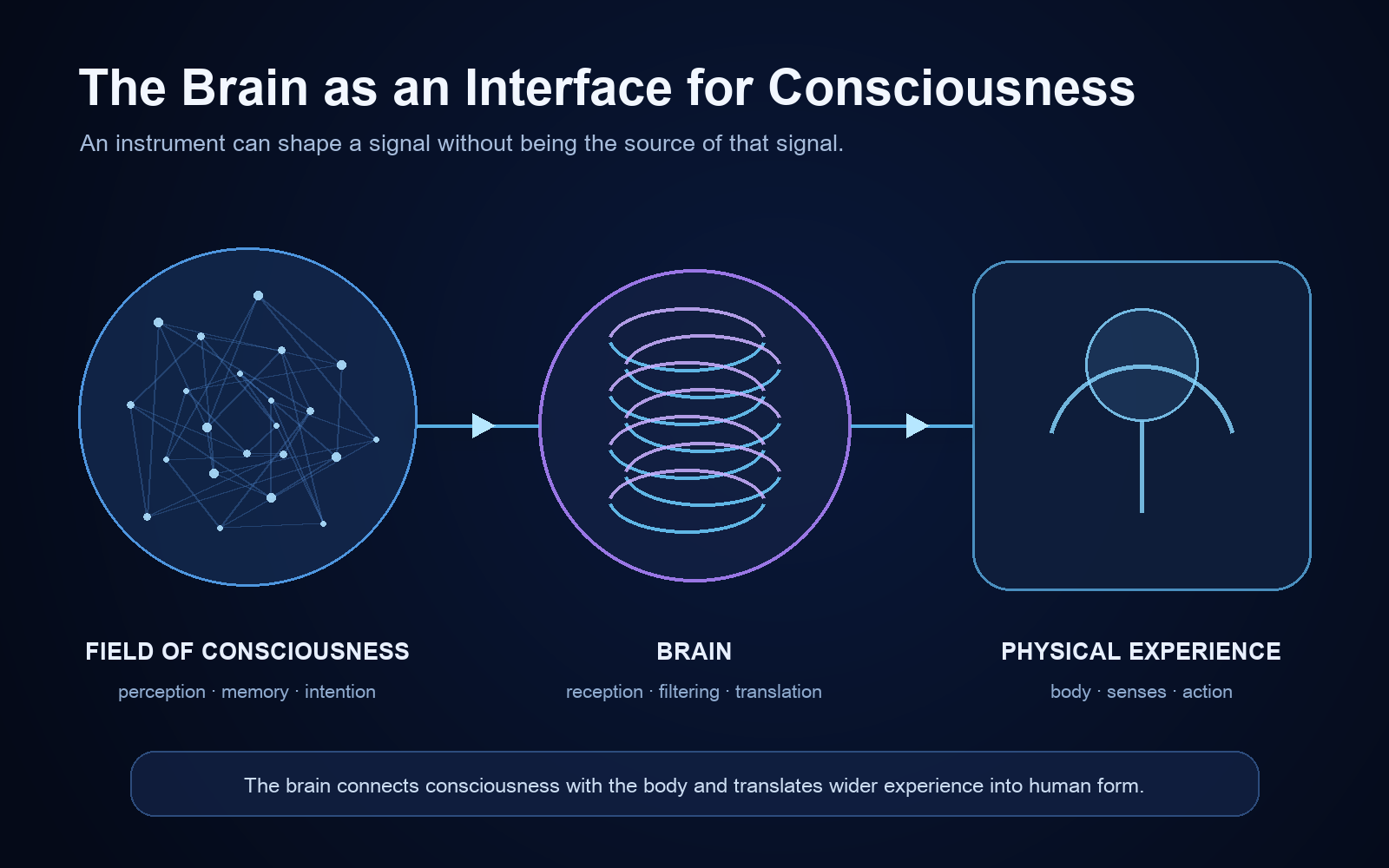
    My experience has led me to a model in which the brain functions as the soul’s biological interface. It connects consciousness to the body, anchors attention in material reality, processes sensory input, and records part of what is experienced in human memory. At the same time, it acts as a filter, preventing the earthly personality from perceiving all the information available to the soul.

    Consciousness is vastly greater than what the waking brain can contain.

    Diagram of the author’s model: field of consciousness, brain as interface, and physical experience.
    The author’s model: consciousness is wider than physical perception, and the brain connects it with the body.

    Why This Question Remains at the Margins

    Science is commonly described as a fully independent search for truth. In practice, scientific research exists within systems of grants, universities, corporations, government programs, career incentives, and social fashion. What gets studied is, above all, what receives funding, institutional support, and permission to be treated as a “serious subject.”

    This does not mean that scientists are dishonest. A great many researchers are sincerely devoted to knowledge and perform work of immense value. But the system itself establishes the boundaries of what is acceptable long before an experiment begins. Some questions receive laboratories, teams, and decades of funding. Others are ridiculed before anyone has had the opportunity to develop an appropriate method for studying them.

    Consciousness beyond the body is inconvenient to the materialist worldview. If consciousness can exist independently of the brain, then we must reconsider our ideas about the human being, death, memory, morality, and the structure of reality itself. This would not be a minor revision to the existing model. It would change the foundation.

    A person who sees himself as nothing more than matter is convenient for any system of power. If he believes he is a temporary biological mechanism, he is easier to control through fear of death, deprivation, judgment, and the loss of security. He looks outside himself for meaning and permission. He is more likely to submit to those who promise to protect his body and define reality for him.

    A person who recognizes himself as a soul becomes inwardly more independent. He understands that power over the body is not power over consciousness. He begins to question, to recognize manipulation, to take responsibility for his own choices, and to fear less those who demand unconditional obedience.

    That is why the study of consciousness is connected not only to science, but to freedom.

    Inner Freedom Demands Responsibility

    Freedom does not mean rejecting everything official, believing every extraordinary account, or declaring every fantasy a revelation. That would only be another form of captivity—a dependence on our own desires and fears.

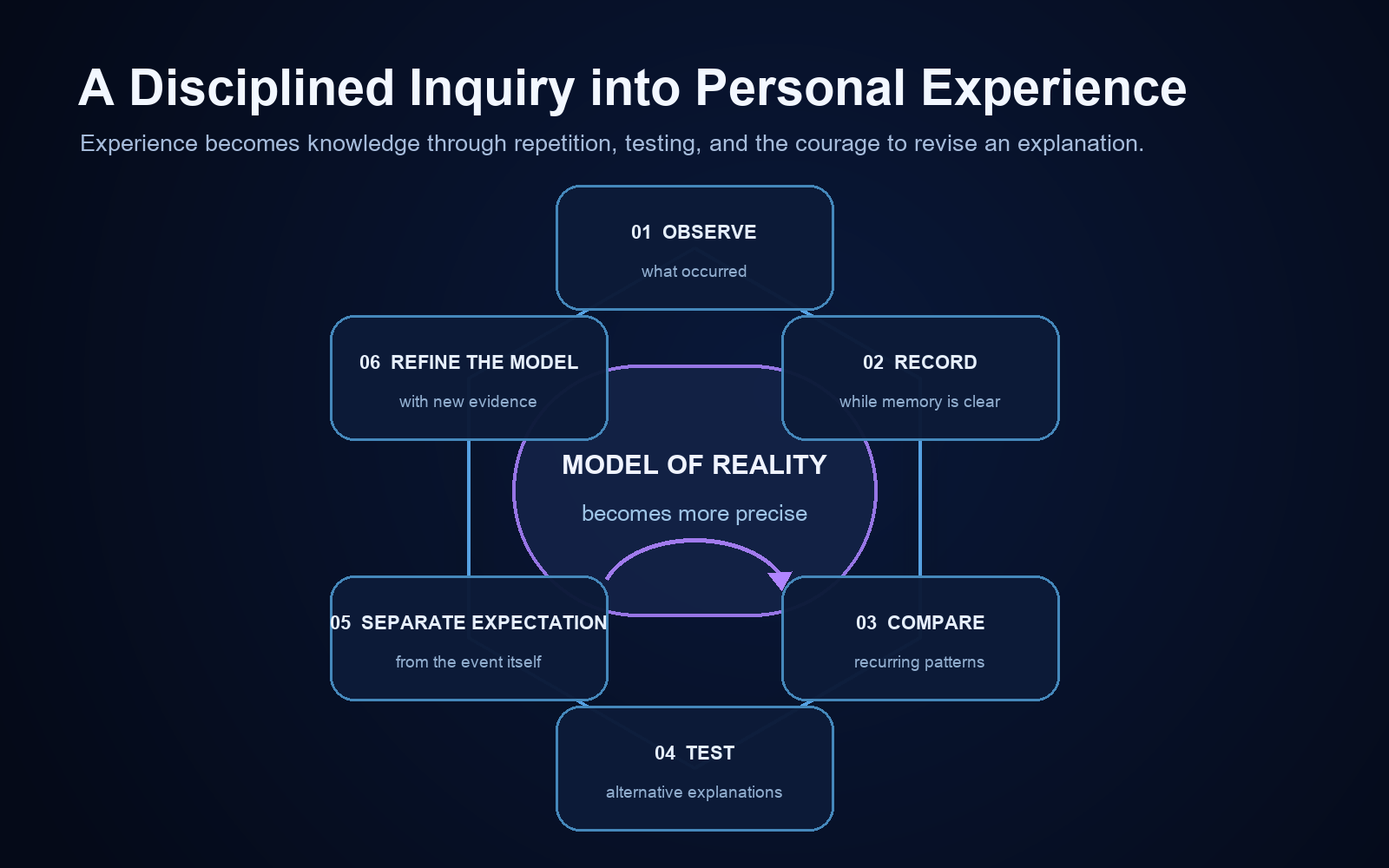
    Real inquiry demands discipline. We must observe ourselves, record our experiences, compare states, recognize the failures of memory, distinguish expectation from event, and be willing to correct the details of our model. I remain open to new knowledge and ready to learn. A strong argument or a precise observation does not threaten my path; it helps make that path clearer.

    But openness does not require endless self-doubt. I know what I experienced. I know how often it recurred and how deeply it changed me. I can revise my explanations, but I am not required to deny the reality of my own experience for the comfort of others.

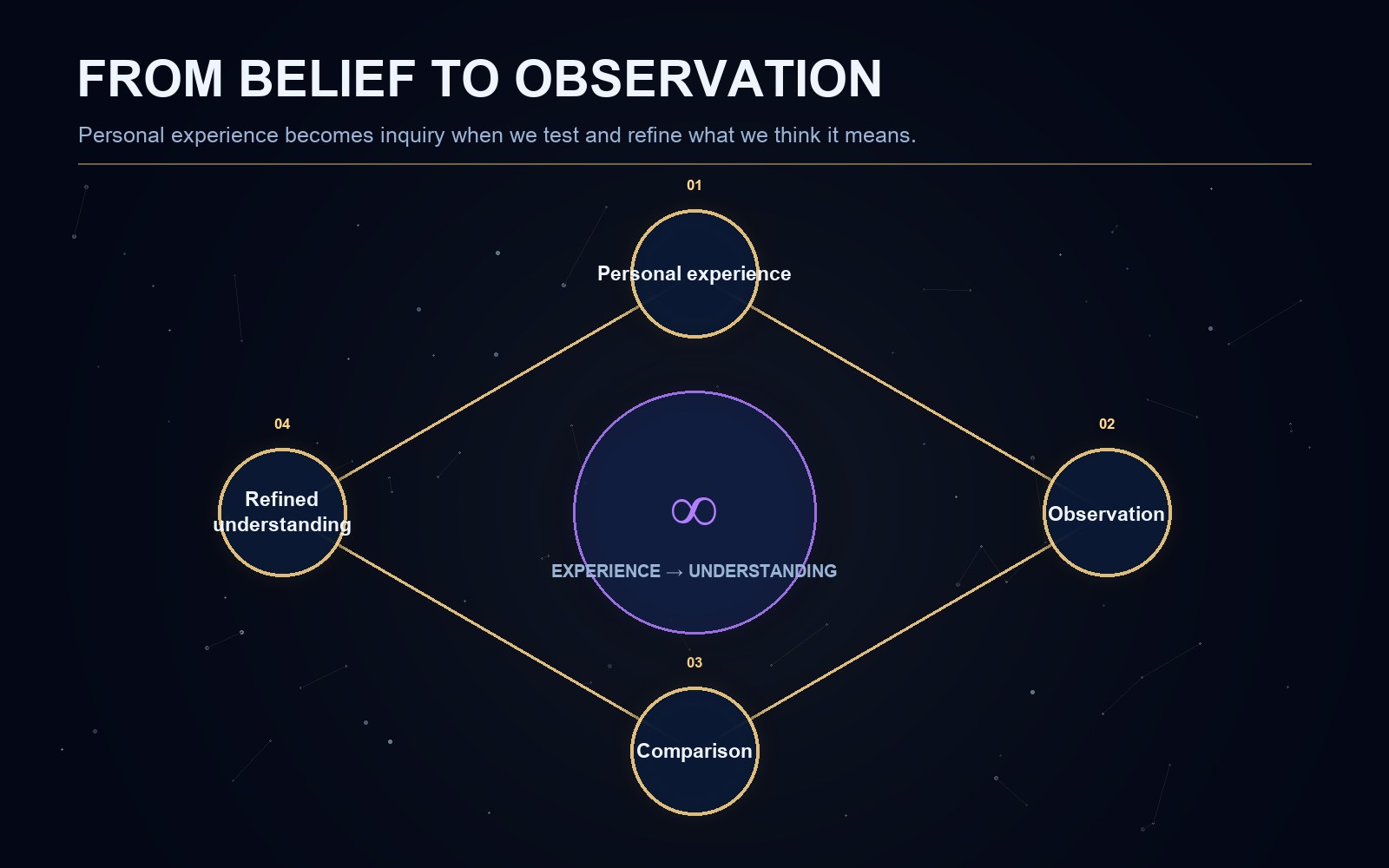
    My position is simple: personal experience matters. It does not replace every other form of knowledge, but it is a legitimate source of questions and discovery. Every major inquiry begins when someone notices something the existing model cannot explain.

    Cycle of disciplined inquiry into personal experience: observe, record, compare, test, separate expectation, and refine the model.
    Personal experience becomes inquiry through discipline, repetition, and testing.

    What Changes When We Stop Believing We Are Only a Body

    First, our relationship to death changes. Death no longer appears to be the absolute destruction of the individual. The physical body reaches the end of its path, but consciousness continues in another form of perception.

    This understanding does not diminish earthly life. It makes life more important. If life is part of the soul’s longer development, then every choice leaves a mark. We cannot hide forever from the energy we create, the consequences of our actions, or the quality of consciousness we shape each day.

    Our relationship to other people changes as well. If every individual consciousness exists within a greater living whole, then the harm we cause another person does not end at the boundary of that person’s body. Cruelty, fear, and humiliation enter the shared field just as dignity, compassion, and love do.

    And finally, hope becomes possible—not the passive hope that waits for a miracle, but the deep recognition that human beings have not been abandoned in an indifferent universe. We are part of a living reality. Our consciousness has meaning. The loss of the physical body does not erase the experience we have gained. Inner work is not wasted. Love and the bonds between souls reach deeper than a single human lifetime.

    This hope does not weaken a person. It releases the energy that fear once consumed.

    Why This Site Exists

    This site is not a neutral catalog of other people’s opinions. It is my personal research platform—a place where I will speak openly about my understanding of reality.

    Here you will find essays, ideas and chapters from my books, discussions of research, videos, audio, practical observations, and projects. I will place personal experience in conversation with the work of scientists, philosophers, researchers of altered states, and spiritual traditions. But independent thought will remain central: no famous name, institution, or ancient text should replace a person’s own consciousness.

    I am not trying to create a new religion, and I do not ask anyone to accept my conclusions blindly. What matters to me is restoring the human right to investigate the deepest questions without fear of ridicule, exclusion, or being declared irrational.

    We will speak about the nature of the soul, the structure of consciousness, levels of reality, transitional states of perception, memory, the fear of death, inner transformation, and collective consciousness. We will examine the ideas of others without hiding behind them. I will clearly distinguish facts, other people’s hypotheses, and my own conclusions—and I will speak in my own voice, without artificial caution.

    My Invitation

    I am not asking you to trade one ready-made worldview for another. I am asking you to stop surrendering the right to a final answer to someone else.

    Observe the states of your own consciousness. Learn to sustain your attention. If a clear, conscious experience occurs, record it immediately after you return, while the memory remains precise. Compare experiences, look for recurring patterns, and separate direct perception from expectation and fantasy. Read those you agree with, and those who compel you to argue. Do not be afraid to ask questions for which no officially sanctioned answer yet exists.

    Every person possesses the essential instrument for investigating reality: consciousness itself. We may only be beginning to understand what it can do.

    I have devoted twenty years to this path, and I am still learning. On this site, I will share what I have seen, what I have understood, and what I am still trying to understand.

    Because reality is deeper than we were taught. Consciousness is greater than the body. And human beings are freer than they have learned to believe.

    This is where our inquiry begins.

    Go Deeper

    This manifesto is the beginning of the inquiry. In my book The Phenomenon of Consciousness Outside the Body, I share the experiences, observations, and conclusions that emerged from twenty years of exploring consciousness beyond the body.

    Continue with the book on Amazon: Kindle Edition or Paperback.