
After someone close to us dies, we are left with questions that cannot be answered through an ordinary phone call, letter, or meeting: Can they hear me now? Do they know I still love them? Do they see my pain? Can they remain close to me?
For me, this is not an abstract philosophical question. Over twenty years of out-of-body investigation, I have repeatedly encountered a reality in which the death of the physical body does not mean the disappearance of the person. The form of existence changes. The way perception works changes. Familiar communication through voice, hearing, and the body comes to an end. But the soul, its memory, and its connection with loved ones are not destroyed.
Those who have died can still perceive us. But they do not hear us in the same way they did during physical life. On other levels of reality, thought, feeling, and intention can be communicated directly.
To understand this connection, we need to consider what happens to a person after death, why the relationship changes over time, and why we so rarely receive an answer that leaves no room for doubt.
Death Ends the Work of the Body, Not the Life of Consciousness
We are accustomed to recognizing a person through the body. We see a face, hear a voice, and feel a touch. When the body dies, it can therefore seem that the person has disappeared as well. Our physical senses can no longer find the one we love, and the brain reaches a natural conclusion: they are gone.
But the body was a means of interacting with the physical world. It was not the source of the soul itself.
After death, a person continues to be aware of who they are. At first, they remain in many ways the same personality: they remember their name, character, loved ones, and the life that has just ended. Later, perception expands. A deeper memory of the soul returns, and the earthly personality reconnects with a larger part of itself. This happens gradually.
The early stages of this transition are especially important when we are trying to understand the bond between the living and those who have died. The soul does not necessarily vanish immediately into some inaccessible realm. For a time, it may remain close to the physical world, processing what has happened, observing loved ones, and saying goodbye.
This may help explain why people in many different cultures independently report sensing the presence of someone who has recently died. That does not mean every such impression is necessarily a genuine contact. The human mind can produce vivid images, especially during grief. But it would be equally mistaken to dismiss every experience as fantasy simply because our current worldview cannot yet explain it.
My Encounter With a Neighbor Who Had Died
One of my clearest experiences occurred during an out-of-body state.
I left my body and rose through the ceiling and the roof of my building. A man was sitting nearby. At first, I assumed he was another out-of-body traveler. He looked young, calm, and fully aware of what was happening.
We began to talk. He was surprised that I had passed through the roof, and I jokingly asked whether he still used the stairs. At one point, he told me that he had initially taken me for someone who had died. Only then did I understand: he was the one who had died.
I asked what had happened to him and why he was there. He replied that he was actually very old, although he now appeared young. He had lived a long life, he was tired, and he knew that he would soon return home, where his family was waiting for him. For the moment, however, he wanted to say goodbye to his body. His funeral would take place soon.
I offered to deliver a message to his relatives who remained in the physical world. He declined. He was peaceful, did not feel abandoned, and clearly understood that he had others with whom he could communicate. I continued my exploration.
A few days later, I learned that my neighbor across the landing had died—an elderly man whom I had occasionally seen stepping onto his balcony.

This encounter became important evidence for me that the soul does not necessarily leave the vicinity of earthly life immediately after death. For a time, a person may remain nearby, retain the familiar personality, observe what is happening, and prepare to return home.
But that person is already perceiving reality in a different way.

What Does It Mean to Say They Can “Hear” Us?
When we ask whether those who have died can hear us, we instinctively imagine a person standing somewhere and listening to our words. But physical hearing belongs to the body. After death, the way information is transmitted changes.
Words can still be used in an out-of-body state, especially when the people involved are accustomed to human speech. Yet meaning can also be communicated without language. At times, you do not hear a sentence one word at a time. You understand the whole thought at once, together with the feeling, intention, and context that would require a long explanation in an ordinary conversation.
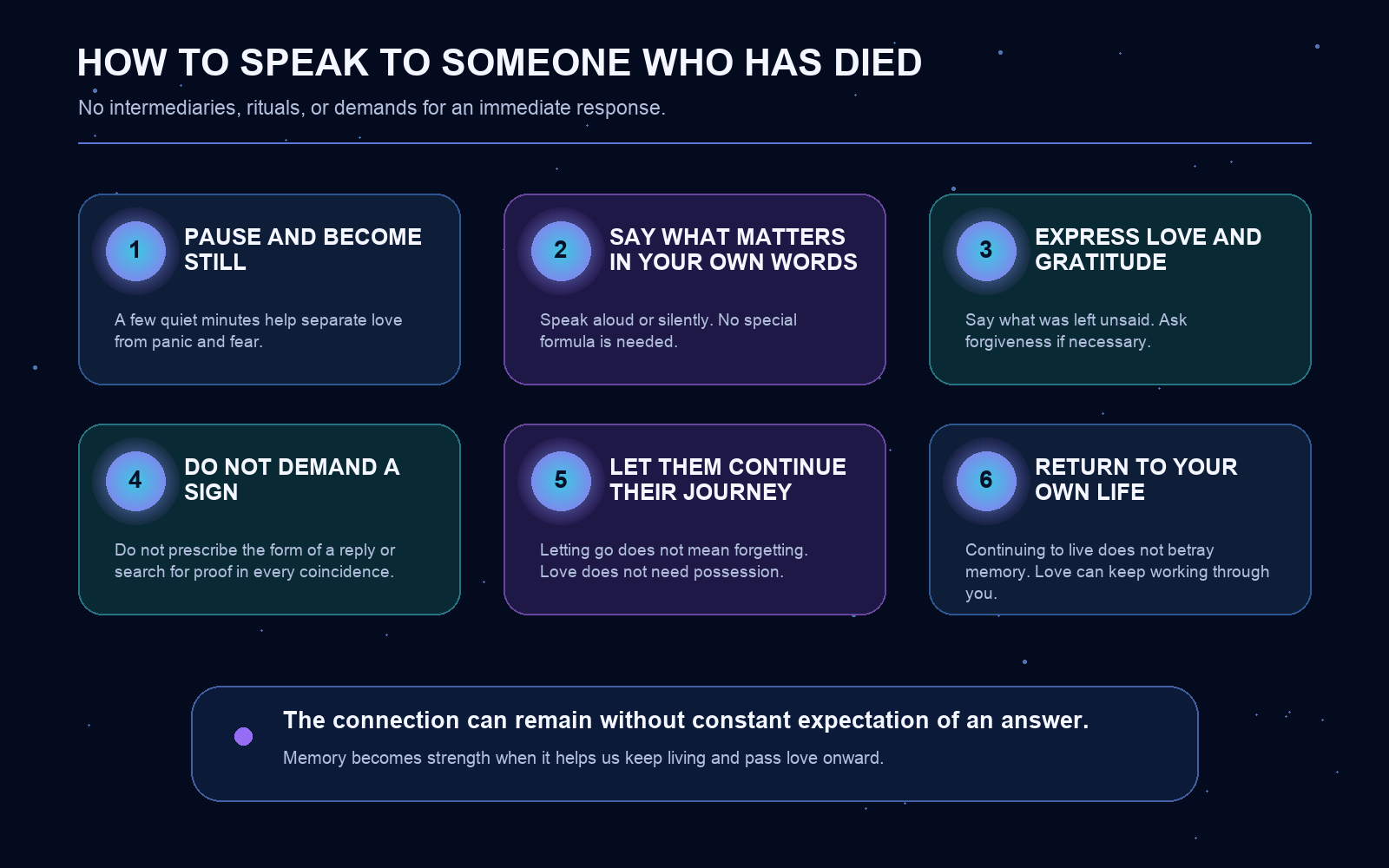
For that reason, a sincere inner message may matter more than a carefully composed statement. No special prayers, magical formulas, or intermediaries are required in order to express love, gratitude, or a request for forgiveness. You can speak to someone who has died in your own words—aloud or silently.
I cannot promise that every message will be perceived immediately. The soul continues its own journey and is not required to remain constantly beside an earthly family. But a sincere inner message does not become meaningless simply because we have no physical way to verify its receipt.
The connection between souls is not governed by distance in the same way the body is.
Why Some People Remain Near the Physical World for a Time
After death, a person may not immediately understand what has happened. This may be especially likely after a sudden death, a powerful attachment to the body, or a lifelong conviction that nothing exists beyond physical life.
Others understand the transition quickly. They see their own body, perceive their loved ones, and recognize that the earthly stage has ended. Often, the soul remains nearby not because it is unable to leave, but because it wants to say goodbye and support the people it loves.
The living, meanwhile, are experiencing shock, pain, and confusion. The person who has died may try to communicate that they still exist and that they are all right. But someone immersed in acute grief is rarely able to perceive anything beyond the force of that pain.
This is not the grieving person’s fault. The loss of physical presence is real. No knowledge about the continuation of life can replace a familiar voice, a touch, or the ability to see someone we love beside us. Grief cannot be erased by beautiful words. It has to be lived through.
It is still important to understand that a departed soul is not left alone. The person is met, guided, and helped to recover a fuller understanding of who they are. Even if someone dies confused, frightened, or unprepared for the transition, they are not abandoned in emptiness.
Why We Rarely Receive an Unmistakable Answer
If those who have died can perceive us, why do they not answer in a way that removes every doubt?
The main obstacle may not be on their side, but on ours. The physical brain is designed to process signals from the material world. It receives light, sound, pressure, temperature, and other physical influences. Information that arrives outside the familiar senses must pass through a very narrow channel, and it quickly becomes mixed with memory, expectation, and imagination.
We also tend to demand a particular form of response. We ask a loved one to turn on a light, move an object, send a specific sign, or appear in a dream. Then we begin watching every coincidence. In that state, it is easy to mistake what we want to see for what is actually there.
A real connection does not have to stage a performance in order to prove that it exists.
There is another reason. Those who have died are not meant to direct every part of our lives. We came into this world to make decisions, make mistakes, learn, and become more aware. If a loved one warned us about every danger and dictated every next step after death, that person would deprive us of much of our own experience.
Love is not always expressed through intervention. Sometimes love means remaining connected while allowing another person to walk their own path.
The absence of an obvious sign does not mean that someone has disappeared, forgotten us, or stopped loving us.
Can Our Grief Hold a Soul Back?
People who have lost someone close sometimes become afraid of their own emotions: Are my tears preventing them from moving on? Am I holding them here? Am I causing them pain?
Love itself does not trap anyone. Natural grief is not a prison for the soul either. We cannot lose someone we love and feel no pain.
But there is a difference between love and a desperate demand that the person continue to live only through our earthly life. When someone refuses for years to accept what has happened, constantly calls the dead person back, demands signs, and turns that memory into the only meaning of life, a heavy emotional attachment is being continually reinforced.
A recently departed soul may perceive this pain and try to comfort the person who remains. But there comes a time when that soul needs to continue its own journey and return to the world of the soul. The living person must also continue their earthly life.
Letting go does not mean forgetting. It is not betrayal, and it is not the end of love. Letting go means accepting that the form of the relationship has changed. We can no longer hold the person through a body, a voice, and a shared daily life, but we can preserve gratitude, respect, and an inner connection.
I love you. Thank you for the life we shared. I will remember you. You may continue your journey, and I will continue mine.

Should We Try to Summon the Dead?
I do not believe that communicating with someone who has died requires séances, elaborate rituals, or people who promise guaranteed contact in exchange for money.
The desire to obtain an answer at any cost makes a person vulnerable. Intense longing can lead us to see confirmation where none exists, and dishonest people can exploit that need. In addition, the energetic level nearest to ours contains more than our own relatives. It may include thought-forms, people who have recently died, beings with different intentions, and reflections of our own expectations.
Receiving unusual information does not by itself prove that it came from the person the source claims to be.
For this reason, I am cautious about any contact that demands worship, money, submission, fear, or unconditional belief. A genuine connection with someone who loves you should not weaken your will, inflate a sense of being specially chosen, or require you to abandon sound judgment.
You do not need an intermediary to speak to someone you love. Speak calmly and honestly. Say what you did not have time to say. Express gratitude. Ask forgiveness if necessary. Then return to your own life.
Do not turn love into an endless wait for an answer.
How to Think About Possible Signs
At times, a person suddenly senses a familiar presence, receives a very clear inner knowing, or encounters a coincidence with deep personal meaning. I am not suggesting that such experiences should be dismissed. But we should not declare every event a message from beyond either.
It is better to ask a few questions:
- Did the experience arise naturally, without intense expectation?
- Did it leave clarity and calm rather than fear and dependence?
- Am I forcing a coincidence to confirm something I desperately want to believe?
- Does the presumed source demand unquestioning obedience?
- Does the experience help me live with greater awareness and responsibility?
Genuine contact does not cancel the ability to think. Spiritual experience and critical perception are not enemies. The more important an experience is, the more calmly and honestly it should be examined.
Ordinary dreams should not automatically be turned into messages either. During sleep, the brain freely combines memories, fears, desires, and fantasies. A vivid dream may be personally meaningful, but that alone does not prove that a real meeting occurred. For me, what matters is not only the emotional power of an image, but the quality of awareness, the consistency of the experience, and the possibility of at least partial verification.
Why Those Who Have Died Do Not Fix Our Lives for Us
Continuing to exist after death does not instantly turn a person into an all-knowing guide. Someone who has recently died still perceives themselves through the life that has just ended. They also need time to understand what has happened and recover a fuller memory of the soul.
Even later, when understanding expands, our loved ones do not begin to manage us. They recognize that our lives have their own meaning. Some decisions cannot be made for us. Some qualities cannot be delivered as ready-made advice; they can only be developed through our own choices.
We often ask, “If you can hear me, tell me what I should do.” But the love of someone who has died should not replace our own awareness and responsibility.
Support may appear in subtler ways: an unexpected inner steadiness, a sense that we are not alone, or a reminder of the good that person taught us. Yet we still determine the direction of our lives.
How to Preserve the Connection and Continue Living
Memory becomes destructive when we use it only to return again and again to the moment of loss. But it can become a source of strength when it helps us continue the best of what the relationship created.
We can speak to someone who has died without demanding a reply. We can keep photographs and meaningful objects without turning the home into a place of permanent waiting. We can continue shared work, pass along the kindness we received, support the family, and live in a way that allows love to take form through our actions.
New joy does not erase memory. New love does not cancel the love that came before it. The desire to keep living is not a betrayal of the dead.
If someone we love can truly perceive us, it is difficult to imagine that they would want the rest of our life to become a monument to pain. It is far more natural to believe that they want us to grow, recover our inner strength, and become capable of joy again.
We preserve the connection not by refusing to live without someone, but by allowing their love to keep working in the world through us.
Love Does Not End With the Body
Those who have died do not cease to exist. They become inaccessible to ordinary physical perception, pass through a transitional stage, and return to a fuller state of the soul. For a time, they may remain close to the earthly world. Later, the connection changes form, but it is not destroyed.
We can speak to them. We can express gratitude, ask forgiveness, and tell them that we love them. But we do not need to hold them beside us, demand proof, or build our lives around the expectation of signs.
Love is not measured by the number of supernatural events we experience. It is revealed through what another person changed within us, what they taught us, and what continues to live through our decisions.
Death separates bodies, but it does not destroy the experience we have gathered or the connection between souls. One day, each of us will complete the earthly stage, recover our memory, and meet again those we believed we had lost.
Until then, our task is to live: to remember those who have died with gratitude, to continue our own path, and to transform the love we received from them into something we can give to others.
For a deeper account of my experiences, encounters, and investigation of other levels of reality, continue with my book, The Phenomenon of Consciousness Beyond the Body.
Leave a Reply