Category: Uncategorized

  • How Out-of-Body Experience Changes Our Relationship with Money and Well-Being

    How Out-of-Body Experience Changes Our Relationship with Money and Well-Being

    Out-of-body experience is not a way to get rich quickly. I do not believe promises that leaving the body and receiving secret information will make financial problems disappear.

    The practice can, however, change a person's relationship with money. That relationship affects decisions, career, risk, the ability to accept payment, and the way resources are managed.

    The fear of scarcity becomes visible

    Many financial decisions come not from calculation, but from fear. A person stays in a hated job, refuses to name a fair price, buys status symbols, or avoids every investment.

    This behavior may seem rational until the person learns to observe his own thoughts from a distance.

    The practice of awareness and the experience of existing beyond the familiar personality reveal how many decisions arise from a survival program. Once fear is seen, it can no longer govern an entire life invisibly.

    The worship of accumulation fades

    Experiencing oneself beyond the physical body changes the meaning of ownership. A person understands clearly that neither a house, a bank account, nor a position belongs to the soul.

    Property does not become unnecessary. It simply stops serving as proof of existence and a measure of human worth.

    Money returns to its proper function: a tool for life rather than a substitute for inner support.

    Artistic visualization of the article's central idea

    Well-being becomes larger than income

    A high income accompanied by constant fear, no free time, and damaged relationships cannot be called complete well-being.

    After a powerful unusual experience, people often reconsider their definition of success. Freedom, health, meaningful work, relationships, and the opportunity to develop become important.

    For some, this leads to a new profession or the decision to give up part of an income. For others, it means finally allowing themselves to earn more because they no longer confuse poverty with spiritual virtue.

    Clarity improves earthly decisions

    Out-of-body practice develops concentration, the ability to hold a purpose, and awareness of emotional impulses. These qualities are useful in work and financial planning.

    A person makes fewer decisions in panic, sees consequences more clearly, and can work on a project longer without an immediate reward.

    This is not the magical attraction of money. It is a change in the quality of decisions.

    Intuition does not replace verification

    An inner feeling sometimes points toward a direction. A financial decision must still take account of facts: contract terms, risk, numbers, and the possibility of loss.

    We should never invest our last resources because a symbol appeared in a dream or meditation produced a feeling of success. A mental image can easily reflect the person's own desire.

    The more serious the consequences, the more important it is to combine intuition with ordinary verification.
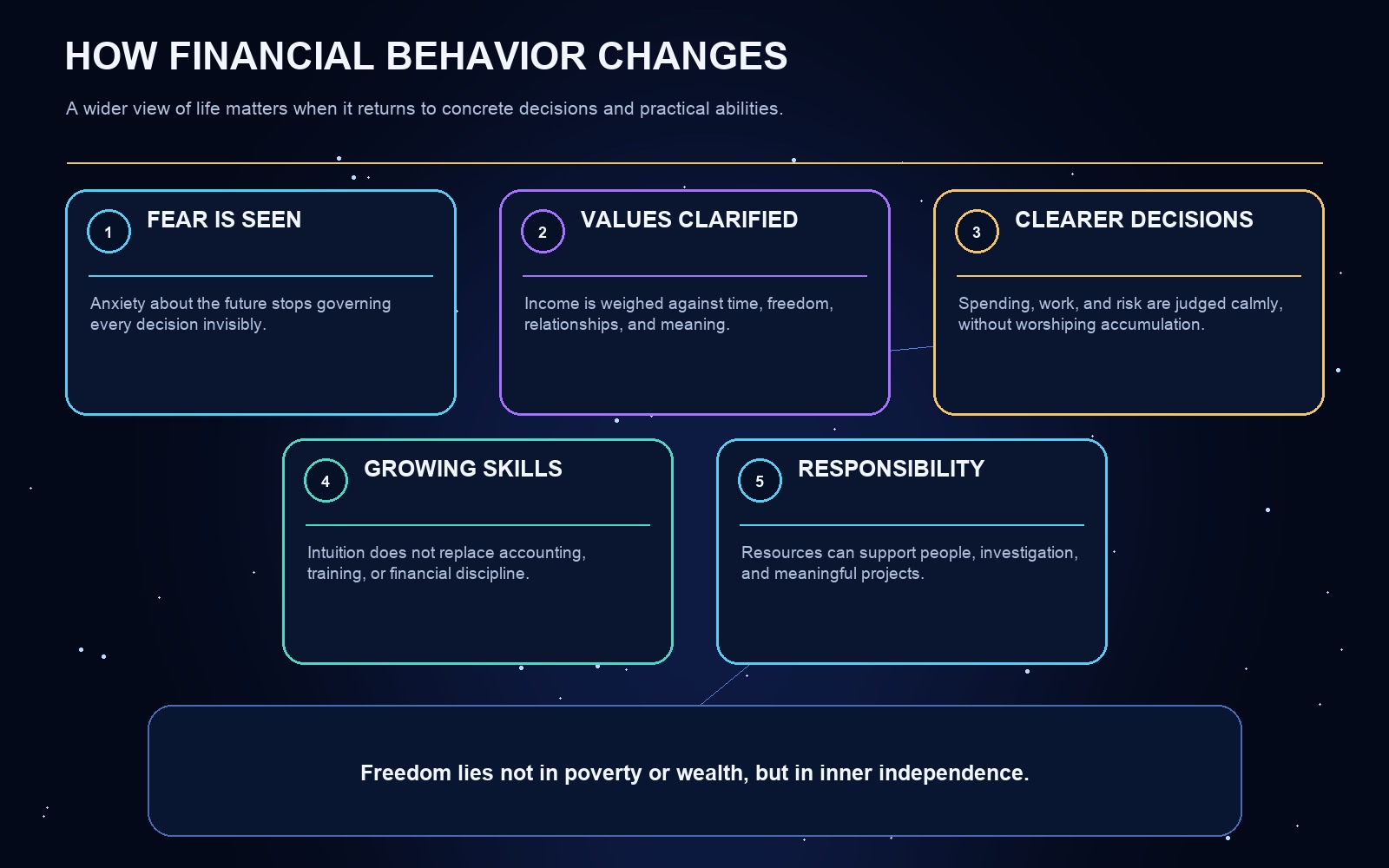
    Diagram of the article's central concepts

    Money reveals our real beliefs

    A person may speak about freedom and still be afraid to name a price for his work. He may condemn the wealthy while dreaming of power. He may call money “low energy” while thinking of nothing else.

    Financial life reveals contradictions more honestly than many spiritual conversations. Here, beliefs become choices and choices become consequences.

    Our relationship with money is therefore part of awareness.

    Practice does not replace professional skills

    Creating stability requires knowledge, work, discipline, and an understanding of the physical world. Spiritual experience does not replace a profession, accounting, negotiation, or a financial plan.

    It can help a person understand why he works and what kind of life he wants. But that understanding must be embodied here through specific action.

    Resources create responsibility

    Money expands possibilities, and responsibility for consequences grows with them.

    A resource can be used to control, display status, or exploit others. It can also support a family, create honest projects, fund research, and help people in difficulty.

    Prosperity reveals not a person's spiritual rank, but his relationship with freedom and power.

    After an expanded view comes earthly work

    An out-of-body experience can change priorities, but it does not create a profession or build a financial system for us. After a powerful realization, we still need to learn, calculate expenses, keep promises, create something useful, and accept limitations.

    The difference lies in motivation. A person no longer does this from a desperate need to prove his worth, but to create stability, freedom of action, and the ability to support meaningful projects. Material well-being then stops being an object of worship and becomes the infrastructure of a meaningful life.

    Neither poverty nor wealth, but inner independence

    My experience did not teach me to despise the physical world. It showed me that this world is temporary and, at the same time, deeply valuable.

    We live in a reality where money is necessary. Awareness does not demand that we reject it. It asks us to see its proper place, stop confusing the means with the purpose, and refuse to let financial fear govern an entire life.

    In The Phenomenon of Consciousness Beyond the Body, I describe how a wider picture of reality changes the earthly personality and its choices.


  • Intuition, Money, and the Spiritual Trap of Success

    Intuition, Money, and the Spiritual Trap of Success

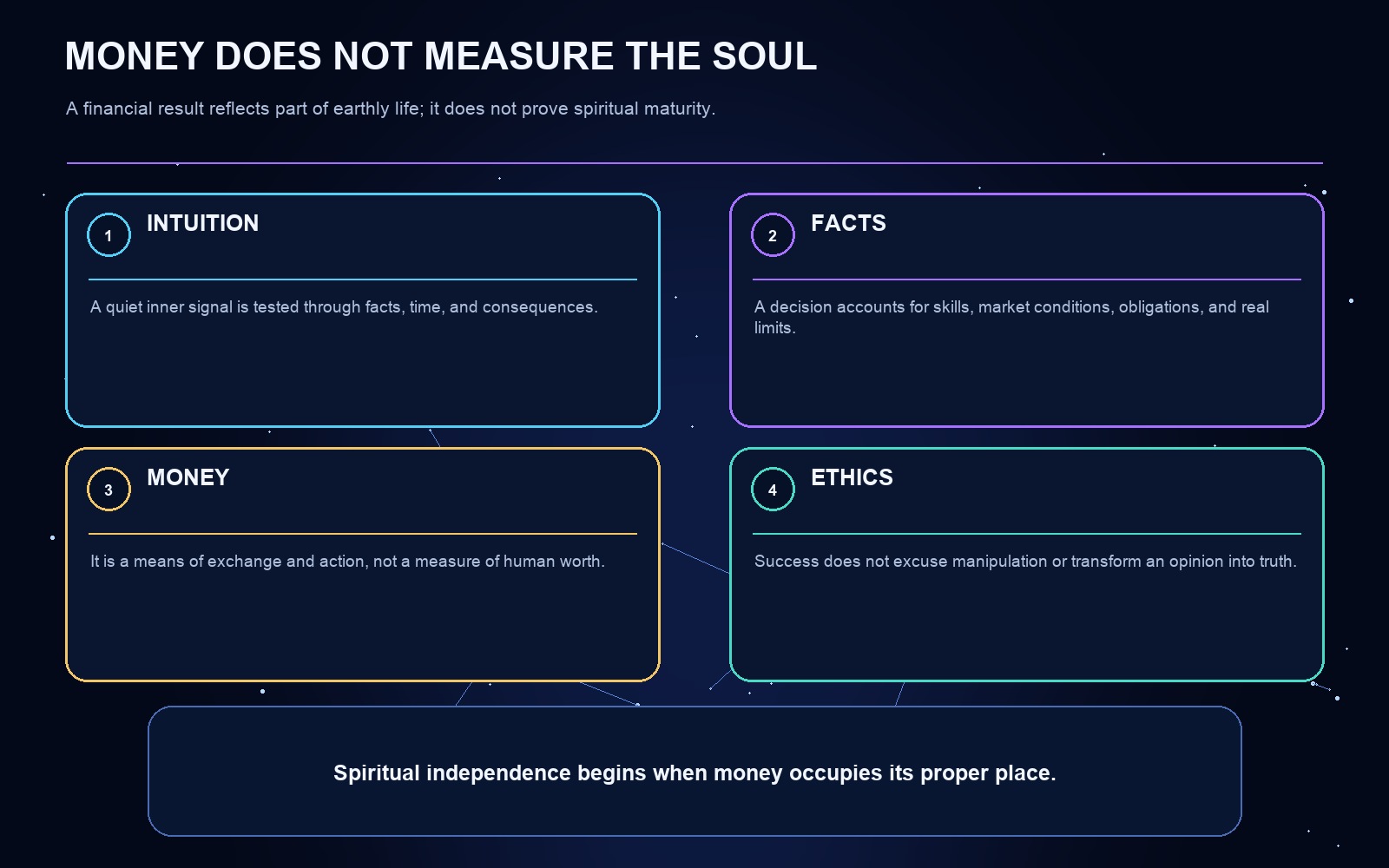
    In modern esoteric culture, material success is often presented as proof of a “high vibration.” If a person is wealthy, we are told, he must be thinking correctly, listening to intuition, and living in harmony with the Universe. If he is poor, he supposedly created the scarcity through his own false beliefs.

    I consider this picture primitive and cruel. Money matters in physical life, but it is not a measure of the soul's maturity.

    What we call intuition

    An intuitive decision may arise from different sources. Sometimes the brain processes accumulated experience rapidly and produces a result without a long chain of reasoning. Sometimes a person senses emotional danger. Sometimes clear inner knowledge arrives through a stable connection with the soul.

    The source cannot be identified automatically from a feeling alone.

    Intuition becomes more reliable when it is compared with outcomes. Which signals recur? Which decisions actually proved accurate? Where did the inner voice express fear or a powerful desire?

    Money is a tool of the physical world

    Money allows people to exchange labor, time, and resources. It provides housing, education, health care, mobility, and the ability to support projects.

    Money itself is neither spiritual nor unspiritual. Its meaning comes from how it is acquired, how it is used, and how much power we surrender to it.

    Denying material needs is as unreasonable as making wealth the highest goal.

    Artistic visualization of the article's central idea

    Why success does not prove someone is right

    A person may build a fortune through discipline, talent, connections, inheritance, luck, or an ability to manipulate others. A financial result says nothing automatically about honesty or understanding of reality.

    A spiritual teacher with an expensive home does not become wiser because of the property's value. Popularity does not prove that a teaching is true. A large audience shows only that someone knows how to attract attention.

    Once success is declared proof of special status, a system quickly develops around the leader in which every question is dismissed as evidence of “low vibration.”

    The danger of saying “you created your own poverty”

    Thoughts and beliefs do affect decisions. Fear can hold a person back from opportunities. A belief in helplessness can prevent action.

    Financial life also depends on health, family, education, country, the economic system, discrimination, chance events, and many other conditions. Blaming a person for “vibrating incorrectly” means refusing to see reality.

    Awareness requires us to consider internal and external causes together.

    How money becomes a spiritual trap

    The trap does not begin when someone earns a good income. It begins when income becomes proof of personal exceptionalism.

    The person stops listening to criticism, surrounds himself with dependent followers, and excuses every action as serving a “higher purpose.” The desire to help quietly turns into the desire to control.

    Promises of guaranteed wealth through a ritual, a thought, or the purchase of access to “secret knowledge” are especially dangerous. When the method fails, responsibility is shifted to the client: you did not believe enough, you doubted, your energy was wrong.

    Diagram of the article's central concepts

    A healthy relationship with success

    Material well-being can give a person time for investigation, creativity, and helping others. It does not conflict with spiritual development.

    Several points of reference should remain clear:

    • success does not place one person above another;
    • income does not replace conscience;
    • intuition should be tested by the consequences of decisions;
    • promises of easy money deserve particular skepticism;
    • spiritual work does not eliminate the need for financial literacy.

    The real value of inner knowledge

    A connection with the soul does not necessarily reveal the winning investment. More often, it helps us recognize what kind of work is truly ours, where we are betraying ourselves, and what price we refuse to pay for external success.

    Intuition may warn us about the wrong partner or support a courageous decision. Its purpose, however, is broader than enrichment. It guides the development of the personality.

    Intuition does not cancel earthly responsibility

    An inner signal may suggest a direction, but a contract, investment, or career change has physical consequences. I therefore compare intuition with numbers, terms, other people's experience, and my own willingness to accept the outcome. When an idea forbids questions and demands that we risk everything immediately, it resembles emotional pressure more than clear inner knowledge.

    Mature spirituality does not promise a privilege that lets us bypass the laws of the physical world. It helps us act more calmly, honestly, and precisely within them. Responsibility for money remains part of responsibility for life.

    Freedom begins when money occupies its proper place

    I am not calling for a rejection of prosperity. I am calling for an end to worshiping it and shaming those who struggle.

    Money should occupy an important but limited place. It helps us build a physical life, but it does not determine human worth or measure the level of consciousness.

    Maturity is revealed in whether a person can possess a resource without allowing that resource to possess him.

    I examine this subject through personal experience and a wider understanding of the soul in The Phenomenon of Consciousness Beyond the Body.

  • Awareness in Children: What We Preserve at the Beginning of Life and What We Later Lose

    Awareness in Children: What We Preserve at the Beginning of Life and What We Later Lose

    Children often ask questions that adults stopped noticing long ago. Who am I? Where was I before I was born? Why do people die? Why can I fly in a dream? They have not yet learned to divide reality into approved and forbidden subjects.

    I believe that early in life, the connection between personality and soul is expressed more freely. That does not mean every childhood fantasy should be declared a past-life memory or an out-of-body experience.

    The child has not yet built a rigid filter

    Over many years, an adult brain learns to select only the information that fits an accepted picture of the world. Anything unusual quickly receives a familiar explanation or is discarded.

    In a child, this filter is still forming. Children more easily notice inner images, subtle emotional changes, and states between sleep and waking. Sometimes they speak about events or people they could not, in the adults' view, possibly remember.

    Such accounts deserve attention, but not a predetermined conclusion.

    Imagination is not the enemy of awareness

    A child's imagination actively creates worlds, characters, and stories. This is a normal ability of the brain, not proof of spiritual contact.

    Adults tend to make one of two mistakes. Some immediately ridicule the child and teach him not to trust his own perception. Others turn every story into a sensation and impose their own explanation.

    Both responses deprive the child of the opportunity to understand the experience independently.

    Artistic visualization of the article's central idea

    Awareness does not begin with mysticism

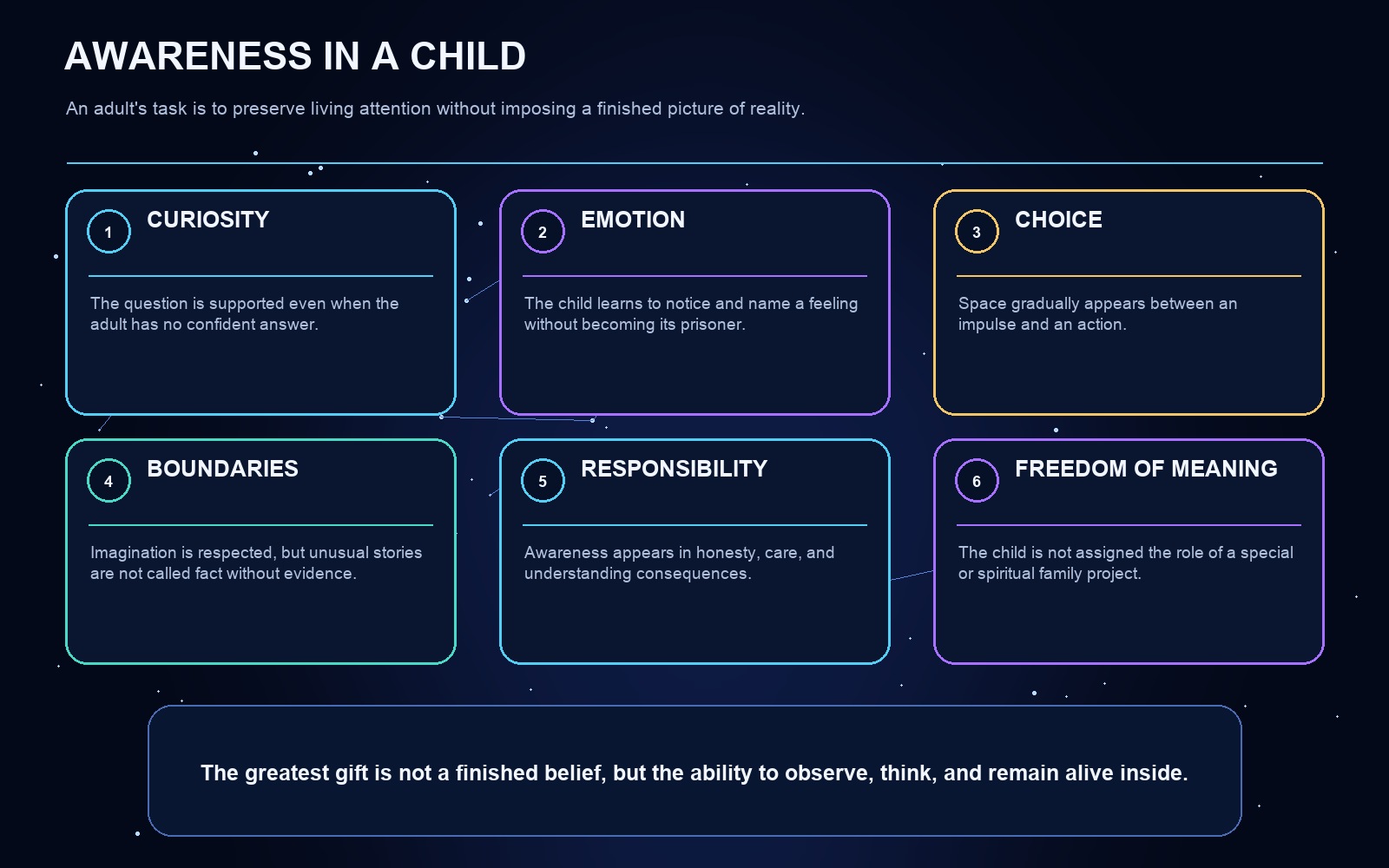
    For a child, awareness begins with the ability to notice:

    • what he is feeling right now;
    • why a particular thought arose;
    • how an action affects another person;
    • where his personal boundary lies;
    • when fear, resentment, or group pressure is directing him.

    These abilities matter more than conversations about energy levels. They create an inner foundation that will later help the child investigate difficult questions independently.

    The responsibility of parents

    Awareness cannot be measured by beautiful words. It is expressed in the ability to think about consequences.

    Bringing a child into the world means accepting responsibility for safety, education, emotional development, and the opportunity to become an independent person. It is not enough to demand obedience. We must explain reasons, respect questions, and lead through our own actions.

    A child quickly notices the contradiction between an adult's words and actual behavior.

    Do not turn a child into a spiritual project

    Some parents want to see an “old soul,” a medium, or a future spiritual leader in their child. Such expectations are dangerous. The child begins to perform a role that brings attention and gradually loses the ability to distinguish personal experience from the adults' wishes.

    Children should not be pushed to practice leaving the body, contact unknown beings, or prove unusual abilities. Their nervous systems and personalities are still developing.

    The central task is to provide safety, freedom to ask questions, and the right not to fulfill someone else's expectations.

    Diagram of the article's central concepts

    How to discuss unusual experiences

    If a child describes a strange dream, encounter, or memory, first listen without supplying an explanation. Open questions are helpful: “What did you see?” “How did you feel?” “What happened next?”

    Questions such as “Was it an angel?” or “Did you see a past life?” should be avoided. The answer is already embedded in them, and that can change the story.

    The child's exact words can be recorded and revisited later. Specific information can sometimes be checked. When it cannot, the account remains part of the child's inner experience and still deserves respect.

    What children gradually lose

    As people grow, they learn to meet expectations. They suppress curiosity, fear looking foolish, and replace living questions with ready-made opinions.

    What is lost is not necessarily a mystical ability. More often, it is honesty of perception: the ability to say “I don't know,” notice a feeling, and recognize an obvious contradiction.

    Conscious parenting should help preserve that honesty.

    Awareness is visible in behavior

    A child's unusual stories may be interesting, but I do not consider them the principal sign of development. Awareness appears in simpler ways: Can the child notice a feeling, hear another person, admit a mistake, and choose an action that avoids unnecessary harm?

    If adults admire only mystical stories, the child quickly learns what kind of account makes him special. Living investigation then turns into a role. It is far more important to support honesty: a child should be able to describe an experience without fear of ridicule while learning to distinguish fantasy, dream, memory, and an event in the external world.

    What adults can learn from children

    A child's view reminds us that reality does not have to fit within our system of concepts. A child may observe for a long time what an adult passes without noticing.

    Mature awareness combines a child's openness with an adult's responsibility. It neither accepts everything on faith nor closes the door in advance.

    I want children to grow not into obedient carriers of other people's beliefs, but into independent human beings capable of feeling, thinking, testing, and making their own choices.

    In The Phenomenon of Consciousness Beyond the Body, I explain how the earthly personality forms and why its connection with the soul's wider consciousness may weaken as a person grows.

  • Sleepwalking and Sleep Paralysis from an Out-of-Body Perspective

    Sleepwalking and Sleep Paralysis from an Out-of-Body Perspective

    Sleepwalking and sleep paralysis are often surrounded by mystical stories. One person cannot move, senses a presence, or sees a figure in the room. Another gets up at night, walks through the house, and remembers nothing in the morning.

    I find these phenomena important as threshold states involving sleep, the brain, and the activity of consciousness. A spiritual explanation, however, must never replace a medical one.

    Sleep paralysis: consciousness is awake while the body still sleeps

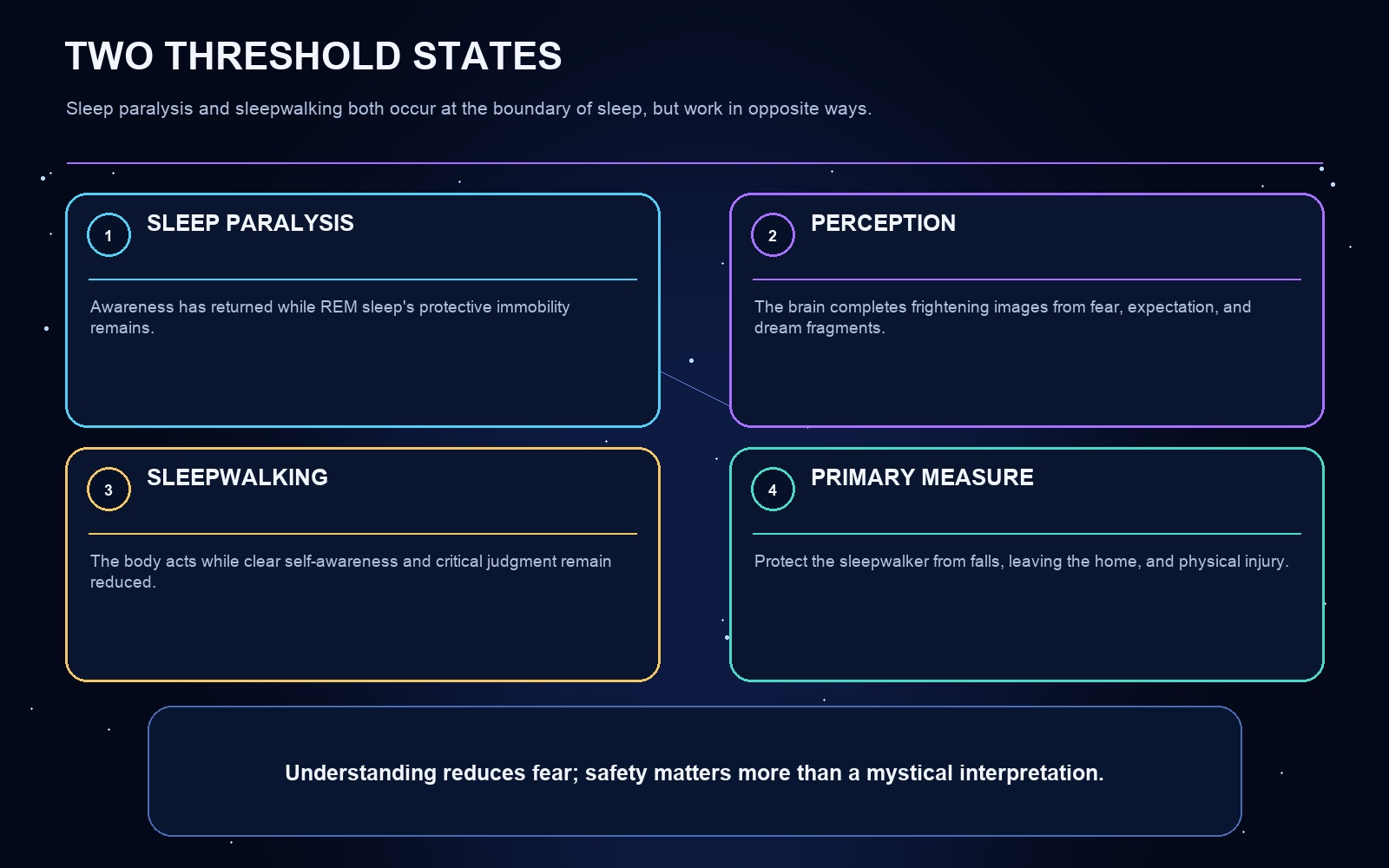
    During sleep, the organism naturally restricts muscle activity so that a person does not physically act out dream movements. Sometimes awakening is not synchronized: the person is already aware, but the body remains in sleep mode for several seconds or minutes.

    Medicine describes sleep paralysis as a transitional state during falling asleep or waking. It is usually brief and is not considered dangerous by itself.

    From the perspective of my experience, this moment is also close to the state in which consciousness can separate from the physical body. Sleep paralysis therefore often includes vibrations, sounds, a sense of presence, or an unusual perception of space.

    These two descriptions do not have to contradict each other. One describes the condition of the organism; the other considers the possibilities of consciousness within the transition.

    Where frightening figures come from

    A person wakes, cannot move, and immediately feels fear. The brain tries to explain the immobility as an external threat. At the boundary of sleep, mental images have not yet disappeared, so anxiety takes a form: a shadow, a being, pressure on the chest, or footsteps in the room.

    I do not claim that every perception in this state is imaginary. But the starting point should be the most likely explanation: a transitional condition in which fear and dream imagery overlap the actual room.

    Understanding the mechanism usually makes the experience less frightening.

    Artistic visualization of the article's central idea

    Why sleep paralysis can become a gateway to an OBE

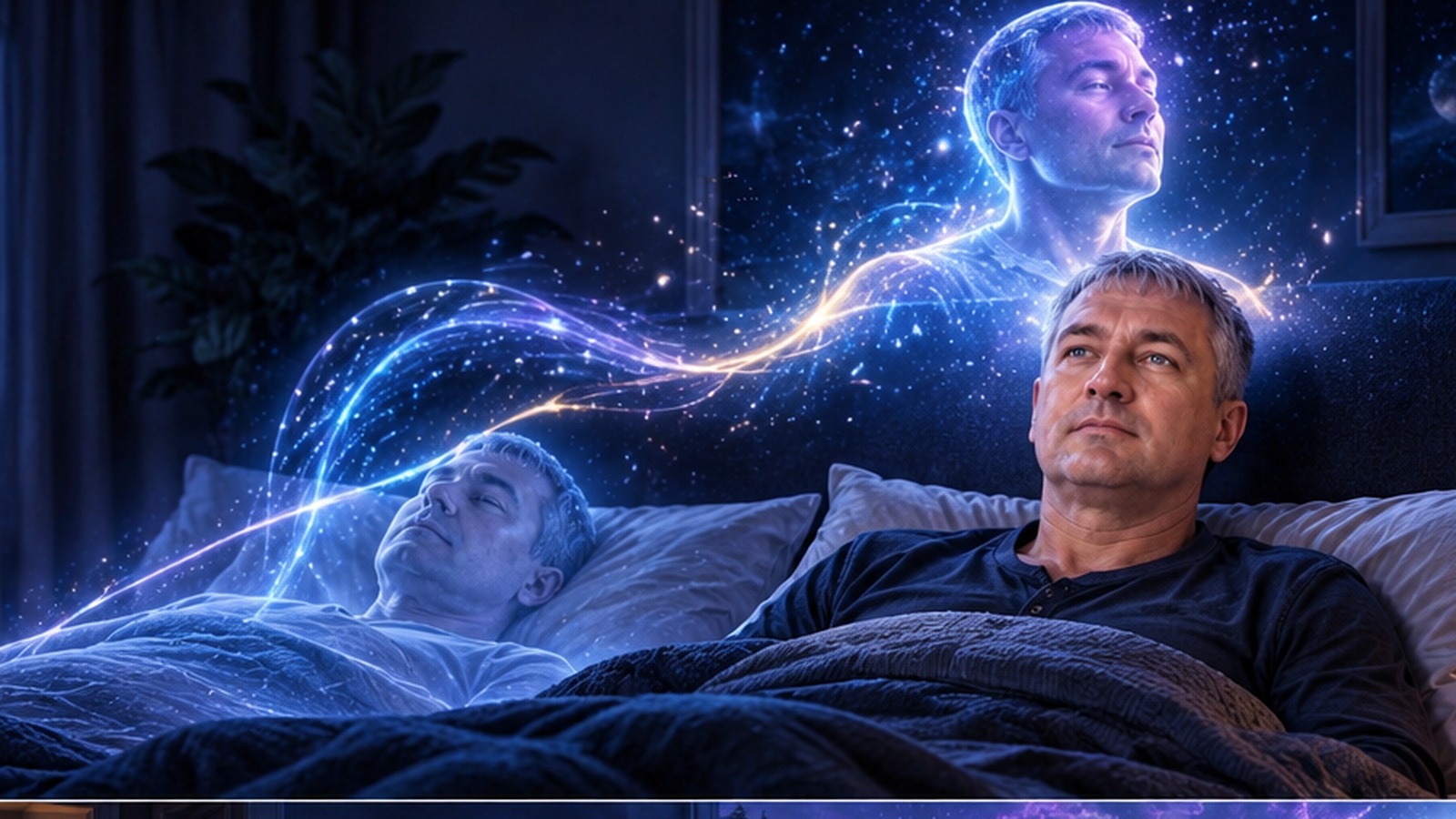
    In this state, the physical body is deeply relaxed while awareness is preserved. Many practitioners deliberately seek exactly this combination.

    The central task is neither to fight nor to force the body to move. The first step is to reduce panic and restore calm attention. Without that, a person will keep generating more frightening images around himself.

    I do not consider sleep paralysis a requirement or a necessary stage of practice. It is simply one of the transitional states that some people experience naturally.

    Sleepwalking works differently

    During sleepwalking, the physical body can move while the ordinary waking personality is not fully in control. A person may sit up, walk, perform familiar actions, and respond only weakly to the surroundings. Memories are usually absent in the morning.

    The medical explanation describes a partial awakening from deep sleep: the motor systems are active while the brain has not yet reached full wakefulness.

    In my view, a dream scenario may overlap physical perception at that moment. The person moves through the actual home but responds to an inner scene the brain continues to create.

    Sleepwalking is not a conscious exit from the body

    During a full out-of-body experience, the physical body remains lying down while consciousness acts beyond it. During sleepwalking, the body moves through physical space. This distinction matters.

    There is no reason to explain somnambulism by saying that “the soul has lost the body” or that an outside being is controlling the person. Such ideas intensify fear and distract from practical safety.

    Diagram of the article's central concepts

    Safety is more important than interpretation

    A sleepwalker can fall, leave the house, or encounter a dangerous object. Windows and doors should be secured, pathways cleared, and access to stairs and sharp objects limited.

    If episodes recur, create a risk of injury, include interrupted breathing, severe daytime sleepiness, or other unusual symptoms, a doctor or sleep specialist should be consulted.

    Frequent sleep paralysis is also worth discussing with a physician when it produces persistent anxiety, fear of falling asleep, or chronic exhaustion.

    Understanding instead of fear

    Threshold states seem mystical because a person receives signals from sleep and waking at the same time. Without an understanding of what is happening, the mind fills the gap with the most frightening explanation.

    My approach is neither to deny nonphysical reality nor to declare every nighttime event a spiritual encounter. We must determine as precisely as possible what was happening with the body, brain, memory, and consciousness.

    The more clearly we understand the mechanism, the less room remains for panic and the more room opens for conscious investigation.

    In The Phenomenon of Consciousness Beyond the Body, I examine sleep, awareness, and the separation of consciousness from the physical body as related but distinct processes.

  • Why Some Experiences Leave Us Rested and Others Exhausted

    Why Some Experiences Leave Us Rested and Others Exhausted

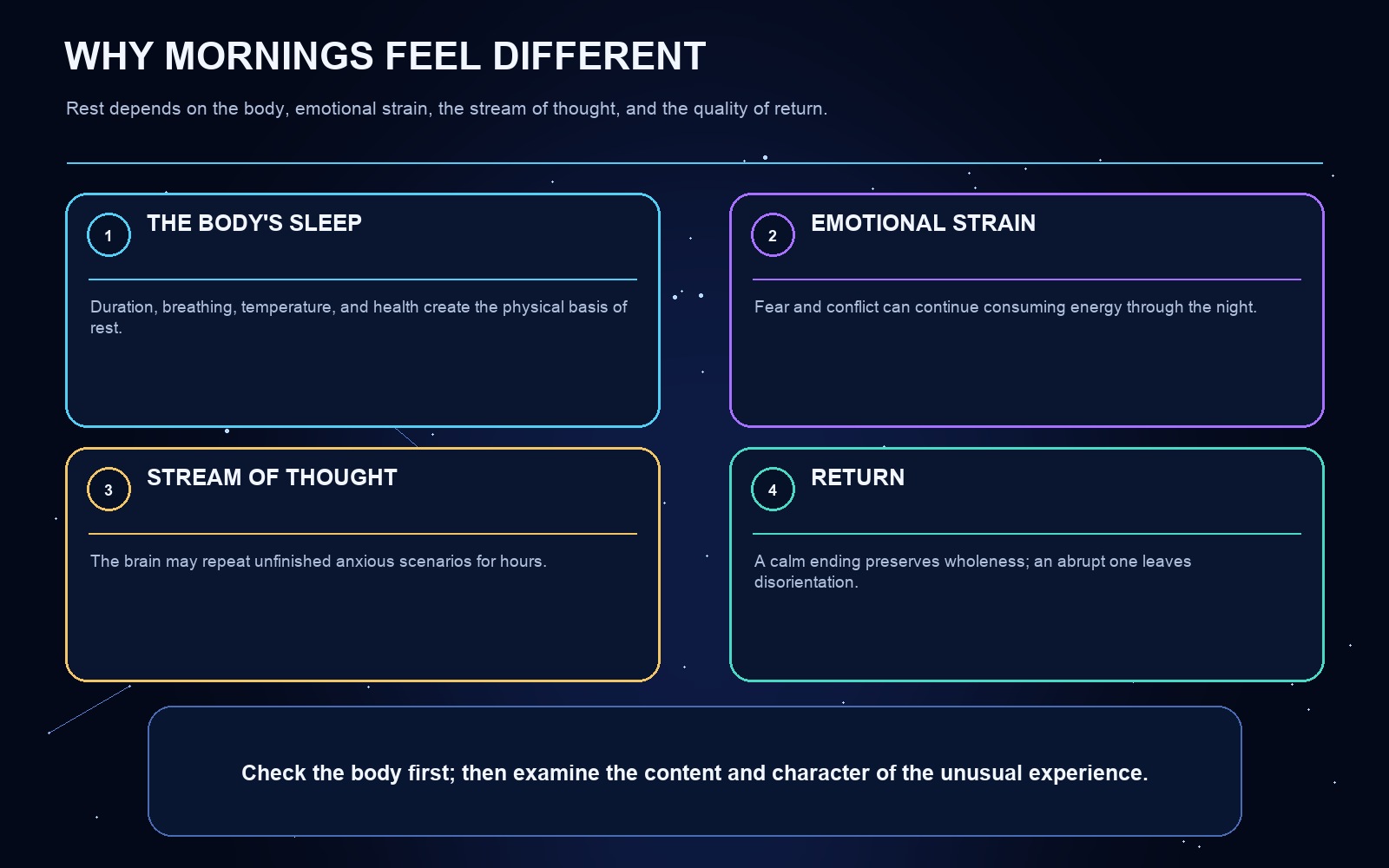
    Sometimes, after a vivid dream or out-of-body experience, a person opens his eyes with remarkable clarity. The body feels rested, the thoughts are calm, and there is more energy than the day before. At other times, the experience seems brief, yet the morning begins with heaviness and fatigue.

    I have observed both states. They show that the quality of a night's rest depends on more than the number of hours spent in bed.

    The body and consciousness rest differently

    The physical organism needs sleep. During the night, brain activity changes, the body's systems recover, and accumulated information is processed.

    Consciousness, as I understand it, does not switch off. It continues to exist and act even when the earthly personality retains no memory of what occurred.

    In the morning, therefore, we receive the result of two processes at once: the condition of the physical body and the degree of harmony in the experience of consciousness.

    A peaceful experience can restore energy

    When the transition occurs naturally, without fear or inner struggle, consciousness does not spend its energy resisting. Time in a clear and harmonious realm can leave a person with profound calm after returning.

    The feeling can be especially strong after contact with kindred souls or an experience on a higher level of reality. A person may not remember every detail, yet awaken with a sense of support, meaning, and inner coherence.

    This kind of rest cannot be measured by sleep duration alone. Sometimes a few hours restore more than a long night filled with anxious scenarios.

    Artistic visualization of the article's central idea

    Fear creates a burden

    If a person becomes frightened by vibrations, sleep paralysis, or the fact of separation itself, the experience becomes a struggle. The brain and nervous system respond to fear as though the danger were physical.

    Even when there was no external threat, the emotional tension remains real. After returning, a headache, racing heart, or sense of exhaustion may continue.

    In such cases, the fatigue is usually explained not by the idea that “someone took my energy,” but by the fact that the person spent the night in a state of tension.

    The mental stream can run all night

    During sleep, the brain can endlessly repeat the day's conflicts, fears, and unfinished conversations. Mental scenarios form around the sleeping person and capture attention.

    Consciousness appears to be moving, but it reaches nowhere. In the morning, it can feel as though we spent the entire night solving problems.

    The more powerful the anxious stream of thought, the less inner quiet remains for recovery.

    Sustained awareness also requires effort

    A highly lucid out-of-body experience demands concentration. We must hold a purpose, maintain the state, and prevent the brain from quickly translating what is happening into an ordinary dream.

    If the experience is long or emotionally intense, it may leave fatigue similar to what follows demanding intellectual work. This is not necessarily a sign of danger. Sometimes consciousness has done substantial work and the brain has had to receive and process an unfamiliar volume of information.

    Diagram of the article's central concepts

    An abrupt return disrupts the feeling of rest

    Returning to the body may be gentle or sudden—triggered by a sound, fear, physical discomfort, or an unexpected movement.

    After an abrupt transition, disorientation is common. The heart and breathing need time to settle, and memory needs time to reconstruct the sequence of events. If a person jumps up and immediately turns to the day's tasks, the experience may feel like a form of nighttime stress.

    Check ordinary causes first

    Not every morning of fatigue is connected to a nonphysical experience. Insufficient sleep, sleep apnea, alcohol, medication, pain, stress, and many health conditions can interfere with the body's recovery.

    It is a mistake to explain everything in terms of energy. If someone routinely wakes exhausted, has severe daytime sleepiness, experiences choking, pain, or other symptoms, physical health and sleep quality should be evaluated.

    Conscious investigation does not replace care for the body.

    Understanding your own case

    It helps to compare several signs:

    • how long the person actually slept;
    • the emotional state before sleep;
    • whether fear persisted during the experience;
    • whether the experience was clear or made up of chaotic scenarios;
    • whether the return was calm;
    • whether fatigue occurs regardless of unusual experiences.

    One episode rarely gives a precise answer. A repeating pattern tells us much more.

    Rest is the restoration of wholeness

    For me, good sleep is more than the body's stillness. It is the alignment of physical recovery, emotional condition, and the activity of consciousness.

    When someone lives in constant anxiety, even ordinary sleep may not restore strength. When the person learns to quiet the mental stream and stop fighting natural transitions, nighttime experiences become more harmonious.

    In The Phenomenon of Consciousness Beyond the Body, I discuss the role of energy, memory, and maintaining the state in greater depth.

  • Can We Find a Person or Place Beyond the Body—and How Can We Test the Result?

    Can We Find a Person or Place Beyond the Body—and How Can We Test the Result?

    On the second energy level, distance does not operate as it does in the physical world. We do not always have to travel mile after mile in sequence. Intention and a clear image of the destination can immediately change the area in which consciousness finds itself.

    This creates an extraordinary possibility: searching for a particular place or person. It is also where a desired image can most easily be mistaken for a genuine result.

    Intention sets the direction

    During an out-of-body experience, thought acts like a coordinate. If I hold a familiar place clearly in mind, the transition can happen almost instantly. I do not fly across the physical distance; I find myself in another region of perception.

    Destinations connected with stable memories and strong recognition work best. This is why I often found myself automatically in the yard where I grew up. That place is deeply established in my memory.

    Familiarity also creates a problem: the brain is capable of completing the expected scene on its own.

    Finding an image is easier than finding the physical object

    If a person imagines a friend's house, he will almost certainly see some kind of house. That does not prove that he reached the actual reflection of the intended location.

    He may have arrived at:

    • an energetic reflection of the physical space;
    • an altered version of the familiar place;
    • a mental construction created by memory;
    • an independent realm that only resembles the destination.

    The question “Did I get there?” cannot be settled by confidence alone.

    Artistic visualization of the article's central idea

    Finding a person is harder than finding an address

    A person is not a fixed point. The physical body may be in one place, attention in another, and consciousness during sleep in a mental environment of its own.

    On the second energy level, we may encounter a reflection of the sleeping person, a thought-form, or an independent aspect of consciousness. These forms do not always behave in the same way. A person may answer us there and remember nothing after waking.

    The fact of a meeting does not tell us which aspect of the person we contacted.

    An emotional bond helps and interferes

    A strong bond makes it easier to hold the destination. The image of someone close arises quickly and carries many details.

    At the same time, hope, fear, and longing increase the risk of creating the desired meeting. The more important the result, the stricter the test must be.

    An emotionally convincing contact cannot be called objective merely because it brought relief.

    What an honest test looks like

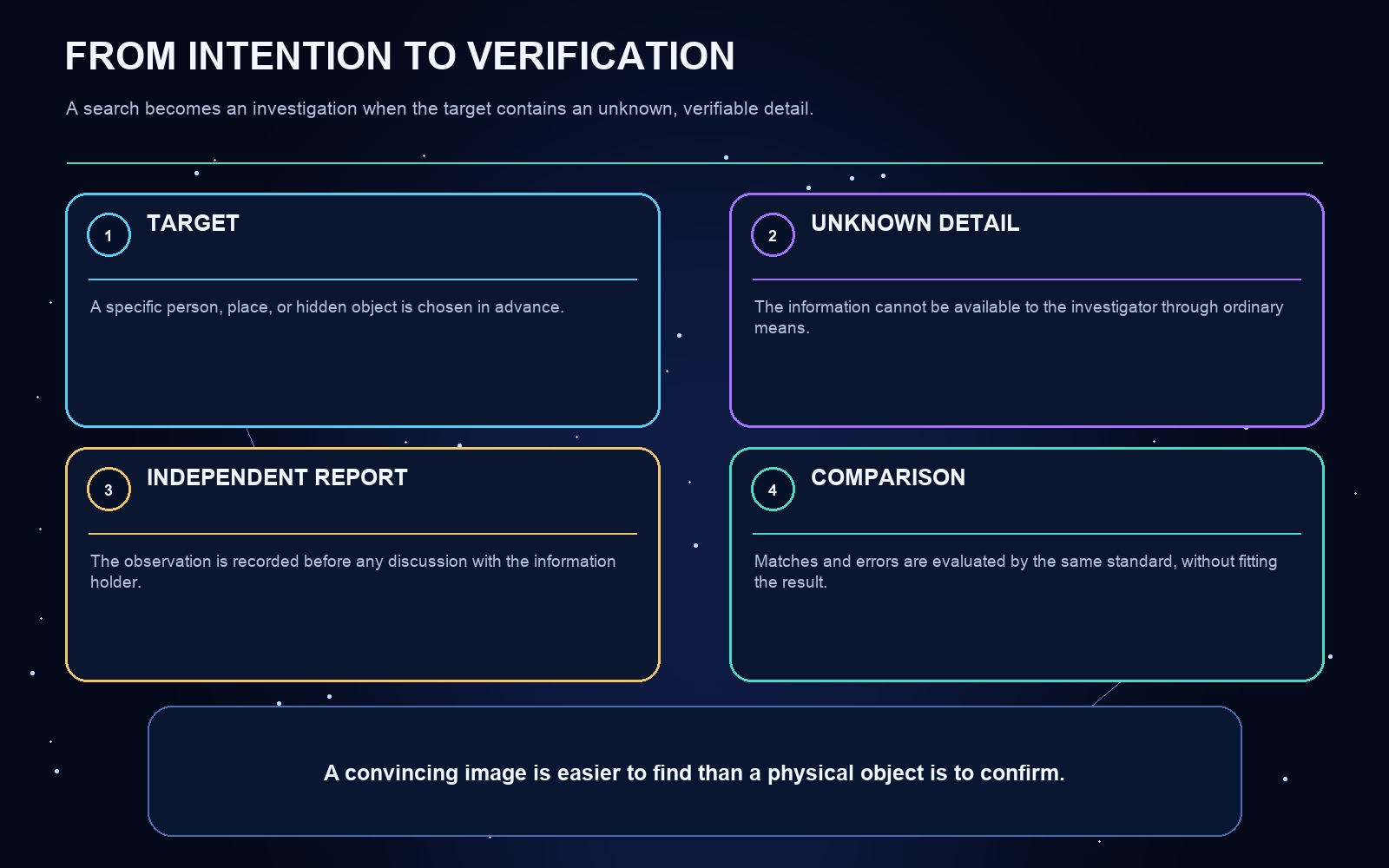
    The best method is to prepare information the practitioner does not know. For example, an independent person selects an unusual object or image and places it at the agreed location only after the participant has already received the assignment.

    After the experience, the practitioner records everything observed before receiving any hints. Only then is the target revealed and compared with the report.

    General similarities such as “something pale” or “a round object” are not enough. Specific and unexpected details matter. One success is interesting; a series of results under the same conditions is far more valuable.

    Diagram of the article's central concepts

    An error also provides information

    If the practitioner describes another room or sees an object that is not there, that does not always mean the entire experience was meaningless. Perhaps he reached an energetic reflection of an earlier state of the place. Perhaps a mental construction replaced the target. Perhaps the transition simply failed.

    But explanations must never become a way to declare every outcome a success. An error must remain an error until evidence supports another conclusion.

    That is how an investigation develops.

    The ethical boundary

    The ability to search for a person does not give us the right to invade that person's privacy. An intention to observe someone without consent still crosses a boundary, even if the action takes place outside the physical body.

    I consider experiments acceptable when participation is voluntary, the task is agreed in advance, and the purpose is clear. Curiosity does not cancel respect.

    A series matters more than one match

    One precise result can be a major personal event, but it is not enough for research. The conditions should be defined beforehand: who chooses the target, what qualifies as a match, how many attempts will be made, and when the correct answer will be revealed. These rules cannot be changed after the outcome is known.

    A repeatable series reveals not only successes, but the pattern of errors. Perhaps accuracy declines under strong emotion, familiar places are found more often, or shapes transfer more reliably than numbers. This material helps us understand the mechanism. An honest protocol does not destroy mystery; it makes the possibility open to study.

    The possibility exists; evidence requires discipline

    My experience shows that consciousness can move with direction and find familiar regions. I have also seen how easily expectation changes the result.

    I therefore do not choose between belief and denial. I choose verification. An unusual ability becomes knowledge only when we can separate real information from memory, coincidence, and mental creativity.

    In The Phenomenon of Consciousness Beyond the Body, I describe methods of movement, encounters, and the distinctive properties of the second energy level.

  • Emotion, Taste, Smell, Vision, and Pain Beyond the Body: Why Sensations Differ

    Emotion, Taste, Smell, Vision, and Pain Beyond the Body: Why Sensations Differ

    One of the first questions people ask about out-of-body experience is this: if the physical eyes are closed, what do we see with? If the body is lying in bed, what allows us to feel touch, movement, scent, or pain?

    My experience shows that perception does not disappear after separation from the body. It changes. Sometimes sensations are weaker than physical ones, sometimes far more vivid, and sometimes a particular channel can be intensified or almost completely turned off by intention.

    We do not perceive through physical organs

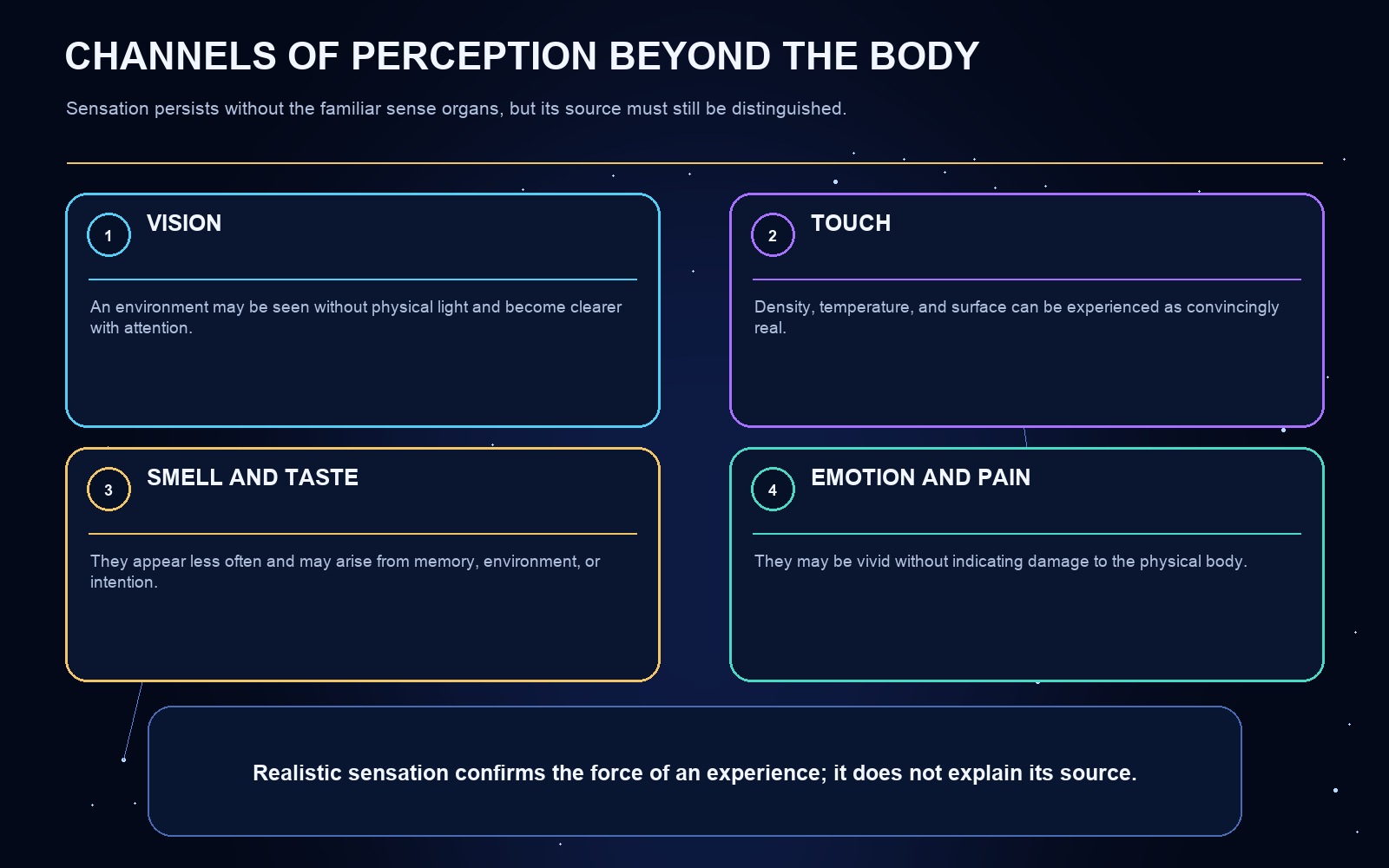
    During an out-of-body experience, consciousness does not receive an image through the retina and optic nerve. Nevertheless, a person sees space, form, color, and movement.

    The same is true of hearing and touch. I have heard speech, felt the surfaces of objects, and perceived movement while my physical body remained still.

    This suggests that the sense organs do not create the experience itself. They transmit signals from the physical environment to the brain. Beyond the body, consciousness receives information in another way and translates it into familiar sensory forms.

    Vision can function without light

    In some experiences, I could see where there was no physical illumination. The space did not appear black. Objects were distinguishable as though lit from within, without a familiar source of light.

    At times, the field of view became wider than normal. In other experiences, the image was unstable and required concentration. This is further evidence that out-of-body vision is not simply a copy of how the eyes work.

    The quality of perception depends on the level of reality, the degree of awareness, and how actively the brain intervenes in translating the information.

    Artistic visualization of the article's central idea

    Touch confirms the density of the environment

    On the second energy level, walls, furniture, and the ground can feel solid. I could touch a surface and feel its texture and resistance. Yet the same barrier could stop being impassable when I changed my intention.

    This is an unusual combination. The environment has properties of its own, but consciousness interacts with it far more directly than in physical reality.

    Its density therefore cannot be understood as an exact copy of earthly matter.

    Smell and taste appear less often

    Smell is possible during an out-of-body experience, but in my practice it appeared less often than vision and motion. Taste is also not a constant part of the experience.

    I associate this with the direction of attention. Vision dominates physical life, and the brain automatically translates most information into a visual scene. Smell and taste become active when they matter to the event or when consciousness deliberately attends to them.

    Why emotion becomes stronger

    Outside the body, emotion may be experienced as energy in its own right. Joy, love, anxiety, or fear does not merely color a thought; it fills the entire field of perception.

    On higher levels, the feeling of closeness and recognition can be so powerful that ordinary language cannot convey it. On the second level, by contrast, fear can rapidly form a frightening image.

    This is why emotional stability matters more than outward bravery. We must notice a feeling without allowing it to construct an entire reality around us at once.

    Diagram of the article's central concepts

    What pain outside the body means

    Pain is possible without physical injury, but it is different in nature.

    Sometimes the brain translates a strong energetic influence into a familiar signal. Sometimes pain arises from expectation or fear. At other times, consciousness perceives the state of another being and experiences it as its own.

    After returning, the physical body may be completely healthy even though the pain felt convincing during the experience. The sensation should not automatically be treated as proof that a nonphysical “body” has been injured.

    At the same time, a physical symptom after waking should never be ignored. The condition of the organism must be checked first.

    Sensations can be strengthened or weakened

    Intention affects perception in an out-of-body state. If the scene is dim, concentrating on clarity may make it brighter. If an unpleasant sensation takes over attention, changing the purpose of the experience may reduce it.

    This does not always happen immediately. The degree of control depends on awareness. Still, the relationship reveals how closely perception is tied to the direction of consciousness.

    Realism does not explain the source

    A sensation can be extraordinarily vivid and still belong to a mental construction. Conversely, an independent environment may seem unclear at first.

    I therefore do not judge an experience only by its intensity. I look for the stability of the environment, unexpected details, repetition, and the possibility of later verification.

    “It felt completely real” is an important statement, but the investigation begins with the next question: What produced that sensation?

    In The Phenomenon of Consciousness Beyond the Body, I describe perception on different energy levels and specific episodes from my practice in greater depth.

  • Why Substances Cannot Replace the Conscious Investigation of Consciousness

    Why Substances Cannot Replace the Conscious Investigation of Consciousness

    Human beings have always searched for ways to move beyond ordinary perception. Different cultures have used plants, alcohol, and psychoactive substances for this purpose. Today these substances are sometimes presented as a shortcut to spiritual experience.

    I do not deny that a person under the influence of a substance may enter an unusual state. But altered perception and the conscious investigation of reality are not the same thing.

    An open door is not a guided journey

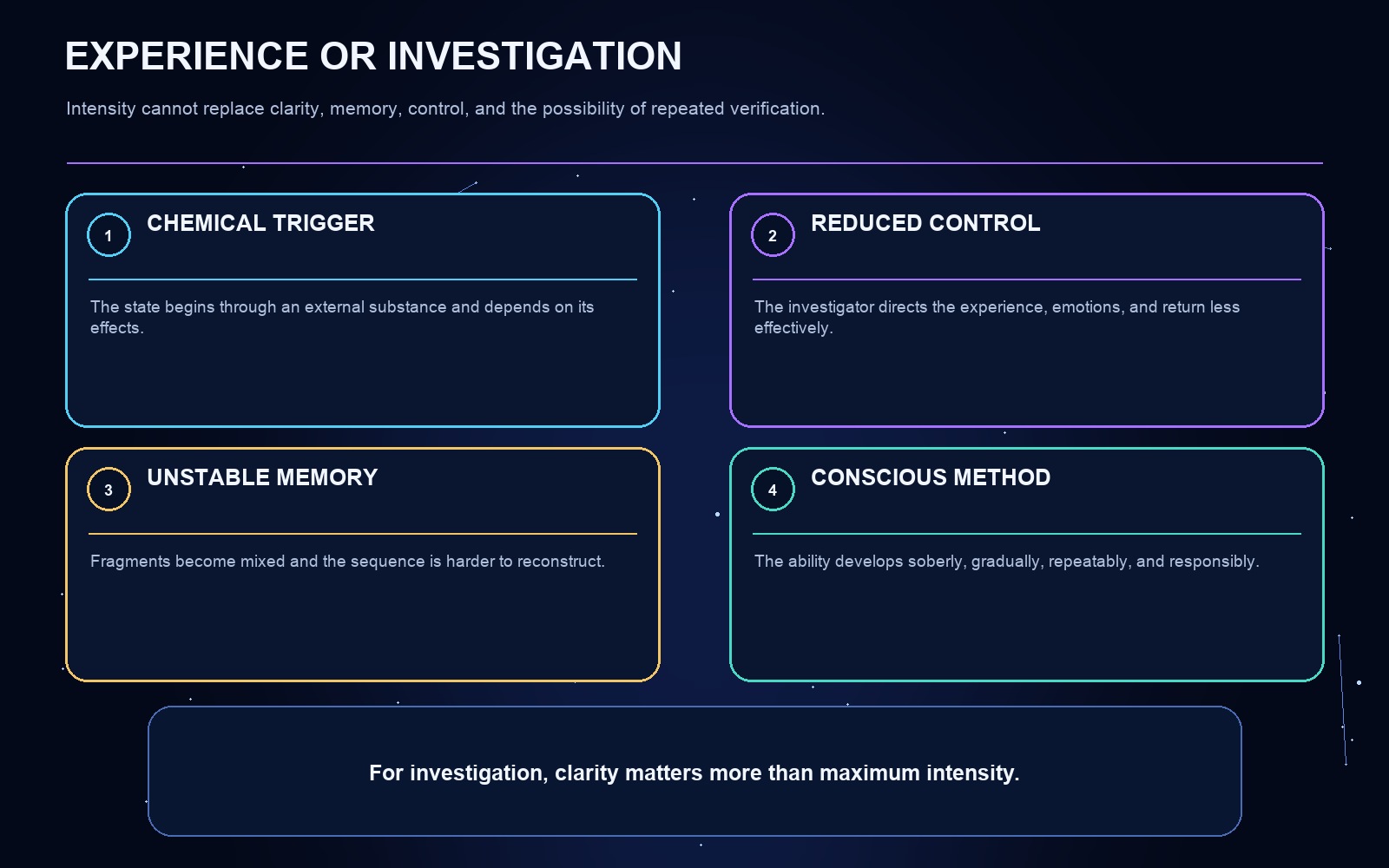
    A substance may weaken the brain's familiar operations, change how signals are filtered, and open access to images, emotions, or nonphysical perception. Most often, however, the person does not control the moment of transition, the direction of movement, or the end of the experience.

    He becomes a passenger in a process already set in motion by a chemical influence. The intensity may be enormous while the ability to examine what is happening is minimal.

    Conscious practice is built differently. The investigator learns to enter an altered state through intention, preserve memory, hold a purpose, and return to an ordinary state without chemical dependence.

    The central problem is diminished control

    A high-quality out-of-body experience requires clarity, emotional stability, and control of attention. Alcohol and psychoactive substances disrupt precisely these functions.

    A person may feel that he has received final knowledge. Yet at that moment, it is especially difficult to separate an independent environment from a mental construction, or an observation from an intensified emotion.

    A powerful feeling of truth is not, by itself, a test. The brain can give absolute conviction to an image it generated internally.

    Artistic visualization of the article's central idea

    Memory becomes unreliable

    Even an ordinary out-of-body experience can be difficult to transfer fully into the brain's memory. Details fade quickly after returning unless the person deliberately reconstructs the sequence of events.

    Under the influence of a substance, the task becomes harder. Memory may break into fragments, and later interpretation fills the gaps. After several days, the person may remember not the experience itself, but the story he has built around it.

    That is a serious problem for any investigation.

    A chemical state should not be confused with development

    An unusual experience can show a person that familiar reality is not all that exists. But one experience does not automatically change character, habits, or level of awareness.

    Someone may see magnificent worlds and remain dependent on fear. Someone may experience unity with the Universe and continue to treat loved ones irresponsibly. Development begins after the vision, in the daily work a person does with himself.

    A substance can produce an event. It cannot do the inner work for us.

    Dependence on an external key

    When access to an unusual state is tied to a substance, a person begins to believe that the door is closed without it. He seeks to repeat the intensity, increases the dose, or lives in anticipation of the next session.

    The investigation of consciousness then becomes dependence on a way of altering the brain. The person does not develop command of attention because the chemical key performs the work each time.

    I consider a path more valuable when the ability becomes part of the person himself.

    Diagram of the article's central concepts

    The physical organism participates in the experience

    We investigate nonphysical states while remaining connected to a living body. The condition of the nervous system, heart, breathing, and brain matters. Substances place a physiological burden on the body and may interact unpredictably with anxiety, illness, and medication.

    These risks should not be romanticized with spiritual language. If a method damages health or takes away control, its cost is too high.

    What a conscious path looks like

    Conscious practice is built on sobriety, gradual development, and the ability to repeat an experience without an external chemical influence. A person learns to:

    • hold a clear intention;
    • notice the transition between states;
    • direct attention;
    • distinguish emotion from observation;
    • restore memory after returning;
    • test the information received.

    These abilities remain with the person and influence ordinary life.

    Integration matters more than intensity

    After an unusual state, a person may want to preserve the feeling of expansion at any cost. But the value of an experience is not measured by the strength of the impression. It becomes visible in whether the person is more attentive to loved ones, more honest in decisions, and freer from automatic reactions. If another external influence is required simply to feel meaning again, the experience has not been integrated into life.

    Sober practice gives us time to examine what happened, compare it with earlier observations, and see its consequences. Between experiences there is ordinary life, where everything received is tested. That interval turns a powerful event into understanding, and understanding into a stable human quality.

    I choose clarity

    I do not condemn people for their search, and I do not deny the significance of their experiences. For myself and for my work as an investigator, however, I choose a path without substances.

    It is not enough for me simply to see something unusual. I need to understand where I am, why I perceive it in this particular way, whether I can change direction, and what remains valid when tested.

    Freedom of consciousness is expressed not in the loss of control, but in the ability to expand perception while remaining aware.

    I discuss the effects of alcohol and psychoactive substances on out-of-body practice in The Phenomenon of Consciousness Beyond the Body.

  • Knowledge and Responsibility: The Price of Unusual Experience

    Knowledge and Responsibility: The Price of Unusual Experience

    People seek unusual knowledge because they see freedom, power, and answers to life's deepest questions in it. Few of them consider in advance what that knowledge may cost.

    I am not talking about money. I mean the inner responsibility that begins when the familiar picture of reality has been broken and we can no longer pretend that nothing happened.

    Information does not always bring relief

    An out-of-body experience can free a person from the fear of total extinction after death. It can bring hope and a sense of meaning. It can also shake a person deeply.

    Imagine meeting a loved one who has died, seeing your own body from the outside, or entering a realm whose laws contradict everything you were taught. After returning, you still have to get up in the morning, speak with your family, go to work, and make ordinary decisions.

    Consciousness must make room for two worlds without losing its connection to either one. That requires maturity.

    Knowledge changes what we can demand of ourselves

    Before we understand something, we can explain our behavior through habit, upbringing, or circumstance. Once we have seen how much thought, emotion, and intention affect our state, those old excuses lose their force.

    If I understand that fear and expectation distort perception, I must account for them in my conclusions. If I know that a human being does not end with physical death, I must look differently at life, violence, and responsibility. If I speak to other people about nonphysical reality, I am responsible for recognizing when an observation has been replaced by fantasy.

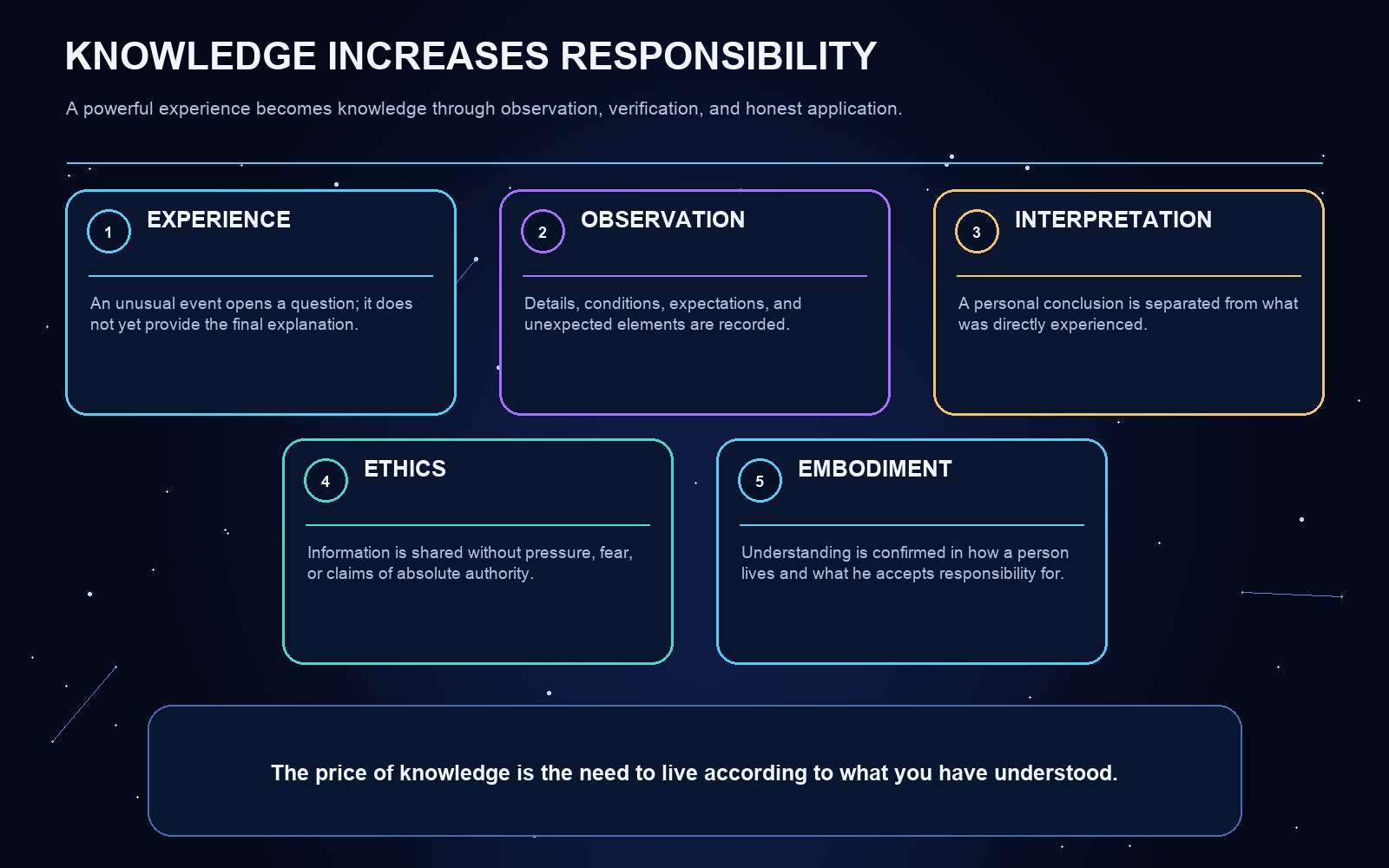
    Real knowledge increases responsibility, not superiority.

    Artistic visualization of the article's central idea

    A powerful experience does not make someone a teacher

    One of the most dangerous traps begins after a vivid experience. A person decides that he has received a special status, the final truth, or the right to direct others.

    But the intensity of an event is not the same as depth of understanding. We may see a genuine fragment of another domain of reality and explain it incorrectly. We may meet an independent consciousness and misjudge its intentions. We may receive useful information and then add our own expectations to it.

    After a powerful experience, the responsible response is not to declare oneself chosen. It is to examine oneself more carefully.

    Responsibility toward the listener

    When we speak about the unusual, our words may affect people who are living through fear, grief, or a serious crisis. We cannot perform certainty simply to gain attention.

    I have the right to speak firmly about what I have repeatedly experienced and observed. I also have a duty to distinguish among:

    • a direct observation;
    • my conclusion based on that observation;
    • information received from another being;
    • a hypothesis that cannot yet be tested.

    This distinction does not weaken an author's position. It makes it honest.

    Some knowledge should not be shared immediately

    During an out-of-body experience, a person may receive private information about someone else. Even if it appears accurate, that does not give us the right to intrude on another person's life.

    Unrequested information can frighten, wound, or create dependence on the person who claims to know. Sometimes the responsible choice is silence. Sometimes we should wait until the person asks. Sometimes the information must be checked before we decide whether it has any practical value.

    The ethics of investigation begins where the ability to affect another person begins.

    Diagram of the article's central concepts

    The price of knowledge is the loss of comforting illusions

    After twenty years of practice, I cannot view a human being as merely a biological organism. I cannot regard death as consciousness simply switching off. I cannot hand full responsibility for my life to religion, government, science, or a spiritual teacher.

    That brings freedom, but many convenient excuses disappear with it.

    The wider our picture of reality becomes, the harder it is to live on autopilot. We must examine our motives, care about the quality of information, and admit our mistakes. We must preserve inner independence even in the presence of authority.

    How to remain balanced

    Unusual experience should be integrated into life gradually. It helps to keep a familiar rhythm, care for the body, meet one's obligations, and speak with people who can listen without ridicule or fanaticism.

    Not every experience needs to become an immediate revolution in worldview. First, it should be considered. What repeats? How does it compare with earlier experiences? What can be verified?

    If knowledge makes someone more anxious, arrogant, or dependent on new revelations, that person has not yet learned how to use it. If it brings calm, independence, and responsibility, it has become part of maturity.

    Knowledge must serve life

    I do not believe we should close ourselves off from difficult information. Consciousness develops through the investigation of the unknown. But a wider range of possibilities must be accompanied by a wider sense of responsibility.

    The price of unusual experience is the need to live according to what we have understood: not to preach our own infallibility, but to become more honest; not to withdraw from the world, but to act in it more consciously; not to collect impressions, but to turn knowledge into the quality of our own life.

    I explore this path and its consequences in The Phenomenon of Consciousness Beyond the Body.

  • The Practical Value of Out-of-Body Experience in Everyday Life

    The Practical Value of Out-of-Body Experience in Everyday Life

    Out-of-body experience is often portrayed as an escape from everyday life: a person leaves the body, flies, visits unusual places, and returns with vivid memories. If that is where it ends, the practice really does become a form of entertainment.

    For me, its meaning lies elsewhere. The true value of out-of-body experience becomes visible after we return—in how we think, make decisions, treat other people, and live an ordinary day.

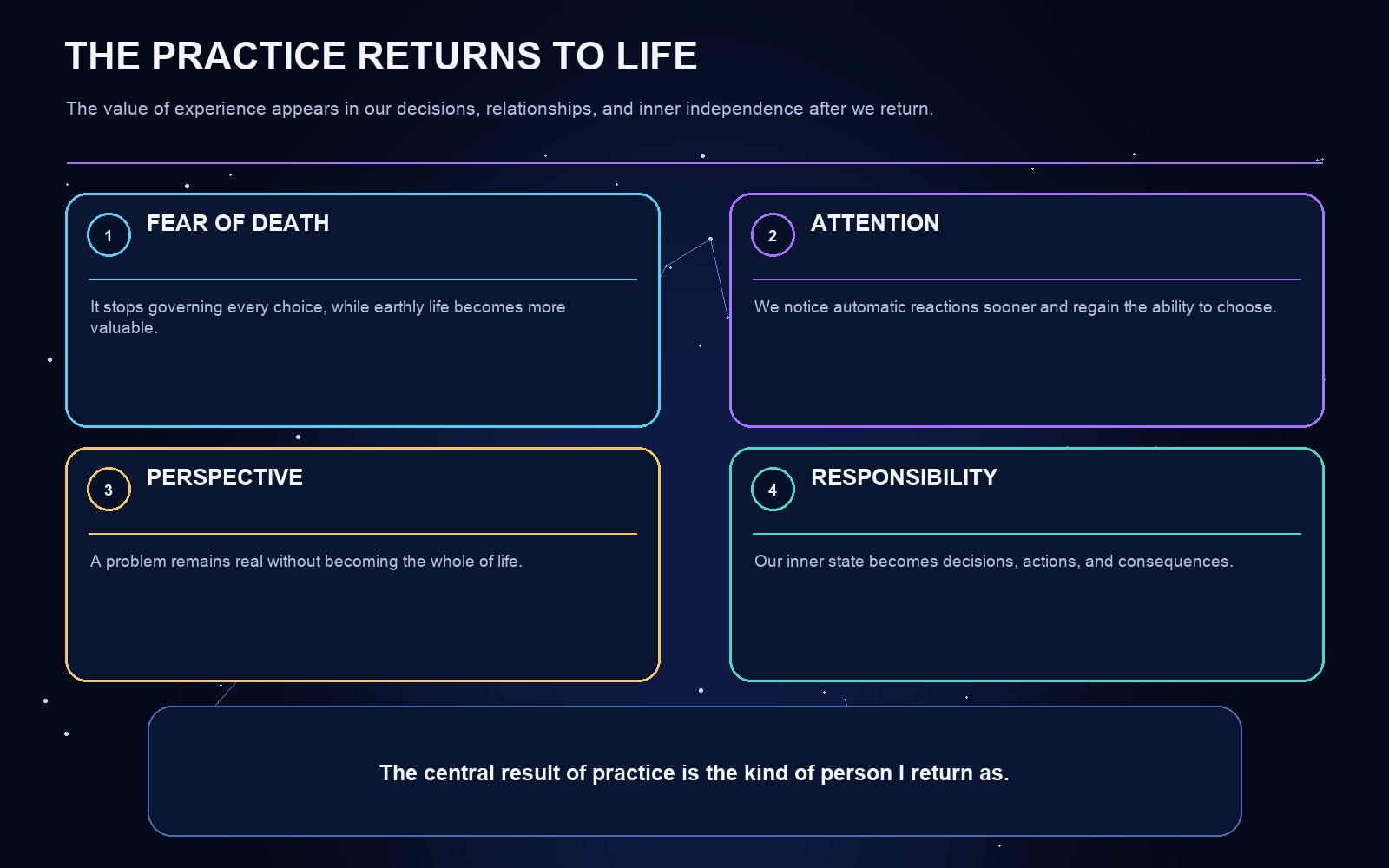
    The fear of death stops governing life

    The first major change that comes with conscious experience outside the body is the understanding that a human being is more than a physical organism. I did not reach this conclusion through a book or a religious sermon. I have experienced separation from the body many times while retaining my memory, my sense of self, and my ability to act.

    This did not make me reckless. On the contrary, physical life became more valuable to me. When death no longer appears to be the complete destruction of the person, we cling less desperately to external things and see more clearly what we are actually spending our years on.

    Awareness carries over into physical life

    Remaining clear outside the body requires control of attention, emotion, and the stream of thought. Gradually, those same abilities begin to work during the day.

    We notice an automatic reaction sooner. We have time to stop before fear, irritation, or habit makes the decision for us. We begin to distinguish our own desire from a program imposed by family, society, advertising, or authority.

    That is practical awareness: not an attractive spiritual state, but the ability to be present in one's own life and choose how to act.

    Artistic visualization of the article's central idea

    Our relationship with problems changes

    An out-of-body experience will not pay the bills or resolve a family conflict for us. It can, however, change the scale on which we see a problem.

    What looked like the end of the world yesterday becomes a difficult but temporary episode. We do not stop feeling pain, but we stop mistaking it for the whole of reality. We see this life as part of the soul's longer journey and gain the inner space needed to find a solution.

    That change in perspective does not replace action. It releases energy that was previously consumed by panic.

    We become responsible for our inner state

    On the second energy level, thought and emotion affect the perceived environment much faster than they do in the physical world. Fear can generate a frightening image. Expectation can alter the surroundings. Calm intention helps us hold a direction.

    After observing this many times, it becomes difficult to keep treating the stream of thought as harmless background noise. A thought does not always create a physical event directly, but it shapes attention, decisions, and actions—and actions create a life.

    Work on oneself therefore stops being an abstract spiritual subject. It becomes a matter of personal responsibility.

    Relationships become more honest

    In ordinary life, we often defend an image of ourselves rather than the truth. We want to appear right, strong, spiritual, or successful. Unusual experience quickly reveals the limits of that game. Beyond our familiar social role, consciousness remains—with its fears, intentions, and actual level of maturity.

    This knowledge helps us pretend less, especially to ourselves. When a person becomes more honest with himself, his relationships also change. He needs other people to validate his worth less often and becomes better able to see the living person behind the role.

    Diagram of the article's central concepts

    An investigator's way of thinking develops

    A sound practice teaches us not only to experience, but also to observe. What did I see? What did I feel? What did I know in advance? What was unexpected? What can I verify after returning?

    That approach is useful far beyond out-of-body experience. It helps separate fact from interpretation, notice our expectations, and resist treating the first explanation as the final truth.

    This is why I call myself an investigator. I am certain that my experiences are real, and I continue to refine my understanding of how they work.

    The practice should not diminish earthly life

    There is a danger in becoming so absorbed in unusual states that physical life begins to look like an inferior and uninteresting stage. I believe that is a mistake.

    We did not incarnate here to spend all our time dreaming of another world. Physical reality gives us resistance, consequences, relationships, and the need to act. Here our inner qualities become real decisions. That is precisely why earthly experience has such value for the soul.

    If a practice separates a person from family, work, and responsibility, it is being used incorrectly. If it makes that person calmer, freer, more attentive, and more honest, it is fulfilling its purpose.

    The most important result is visible after the experience

    The number of unusual experiences tells us nothing by itself about a person's development. Someone can leave the body hundreds of times and remain governed by fear, pride, and habit. Another person may have only a few powerful experiences and completely reconsider how to live.

    The central question is simple: What kind of person do I return as?

    For me, out-of-body experience became both a way to investigate reality and a tool for inner growth. It gave me hope, reduced my fear of death, and made me more responsible for every day of my life. That is its greatest practical value.

    I describe my path and observations in greater depth in The Phenomenon of Consciousness Beyond the Body.