Why thought becomes visible beyond the physical body, how personal and collective thought-forms arise, and why learning to direct our attention becomes a matter of personal responsibility.

In the previous article, I described the energetic reflection of the physical world. This is why, at the beginning of a conscious out-of-body experience, we often see a familiar room, house, street, or city. Physical matter leaves an energetic echo in the region of the second level closest to us.
But that is only one part of the second energy level.
Alongside this energetic reflection lies a vast mental realm. Its objects, beings, scenes, and entire environments arise not from physical matter, but from thoughts, memories, beliefs, desires, expectations, and fears.
Here, thought ceases to be invisible noise inside the head. It takes on form.
What “Mental” Means
The word mental is often used as though it refers to something vague or esoteric. In my understanding, it has a very specific meaning.
Mental means created by the mind—by our intellectual capacity to form thoughts, images, expectations, and inner scenarios.
At the same time, we must distinguish consciousness from the thinking process. Consciousness is living, perceiving energy. It can observe, direct attention, make decisions, and act. The brain and mind process information, create associations, replay memories, and initiate habitual thoughts.
An intrusive thought is not created by consciousness itself. The brain and the habitual stream of thought keep driving it in circles. Consciousness can notice this process, stop feeding it with attention, and choose a different direction.
This, to me, is the foundation of inner freedom.
How Thought Becomes Form
In physical reality, we do not see a thought-form being created. A thought appears and disappears without leaving a visible trace. It seems to have no weight, volume, or force.
On the second energy level, everything happens much faster. The surrounding energy is responsive and highly sensitive to a mental impulse.
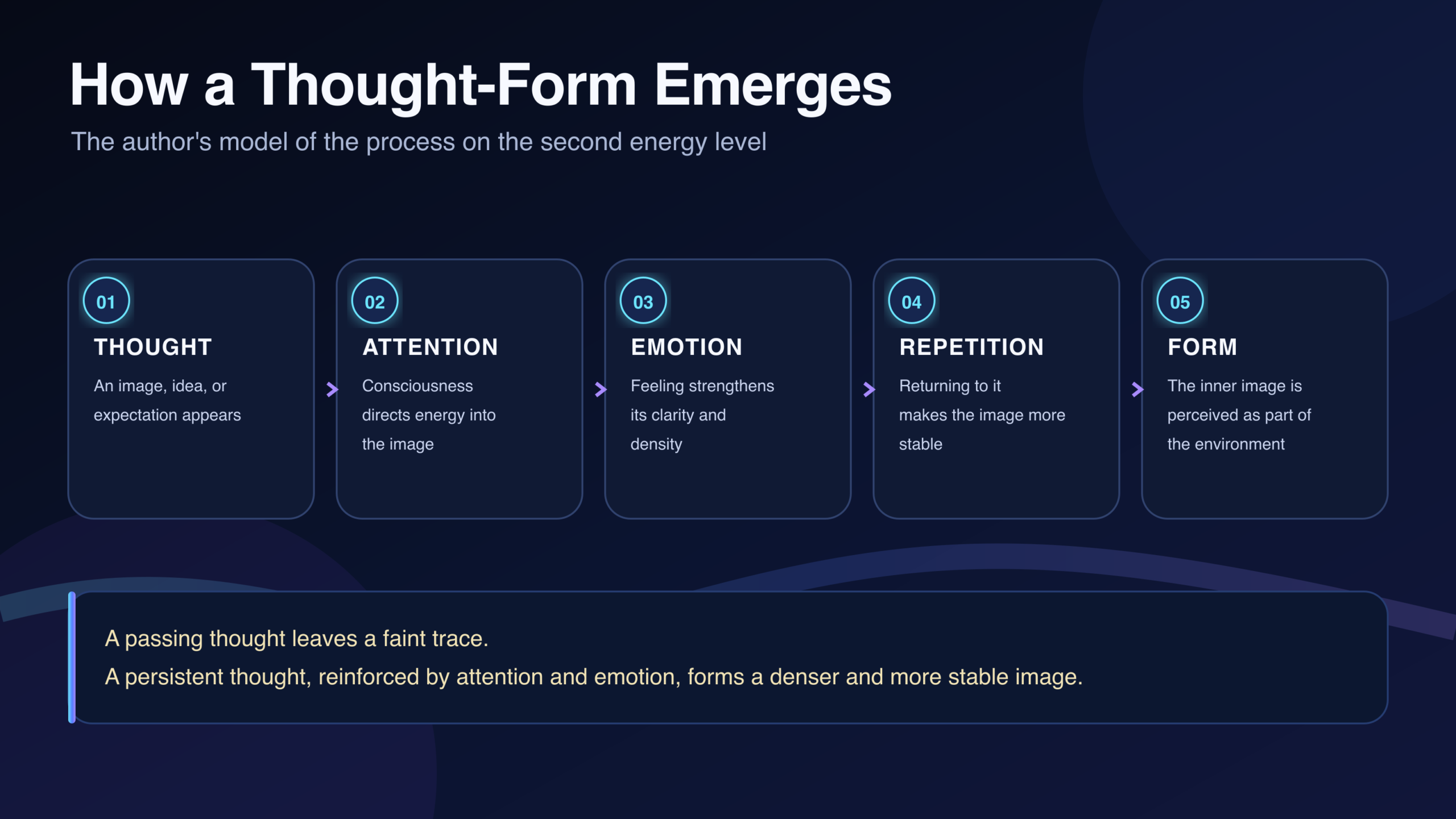
First, a thought or image appears. Attention fills it with energy. Emotion intensifies it. Repetition makes the form more stable. At a certain point, an inner image begins to exist as an external object.
A passing thought usually creates a weak and short-lived form. A thought that is repeated continuously and reinforced by strong emotion can create a dense and stable image.
This is why fear acts with such power. It captures attention, produces strong emotion, and compels the brain to replay the same scenario again and again. On the second level, that scenario rapidly becomes the reality surrounding the observer.
Personal Thought-Forms
A personal thought-form is created by one individual. It may arise from a memory, desire, trauma, religious image, habitual pattern, or expectation of what is “supposed” to happen.
During an out-of-body experience, a person may see someone familiar who is not actually present in that place. They may find themselves in a childhood home surrounded by objects that disappeared long ago. They may encounter a frightening being that grew out of their own fear.
This happens especially often when a person has already absorbed other people’s stories. They have been told that dangerous entities are certain to be waiting beyond the body. They leave the body expecting an attack. Expectation creates an image. The image triggers another wave of fear. Fear makes the thought-form denser.
The person then treats this chain of events as proof that the danger was objectively real, even though their own attention is sustaining it.
A thought-form can appear alive. It may move, speak, answer questions, and react to the observer. But its behavior is governed by the scenario embedded within it. The image of a dangerous being will behave like a dangerous being. The image of a helper may perform the role of a helper. Detail and persuasiveness do not make such an image an independent living being.
Realistic Does Not Necessarily Mean Objective
The human brain is accustomed to judging reality by the density and detail of perception. If we can see, hear, and touch something, we almost automatically assume that it exists independently of us.
That rule does not work on the second level.
A thought-form can have color, volume, sound, scent, and density. It can be touched. A person can move within it. It can present an entire unfolding story. The observer may be absolutely convinced that they have entered an objective reality.
But the intensity of an experience does not explain the origin of what is being perceived.
An explorer must look for other signs. Does the object remain when we stop thinking about it? Can we return to it on another occasion? Does it immediately obey our intention? Does it possess a history and characteristics we did not already know? Does it provide new information that can be verified?
None of these questions offers an absolute guarantee. What matters is their combined weight, the repeatability of the experience, and our willingness to revise our conclusions.
Collective Thought-Forms
If one person can create a thought-form, what happens when thousands or millions of people feed the same image for decades?
A collective thought-form emerges.
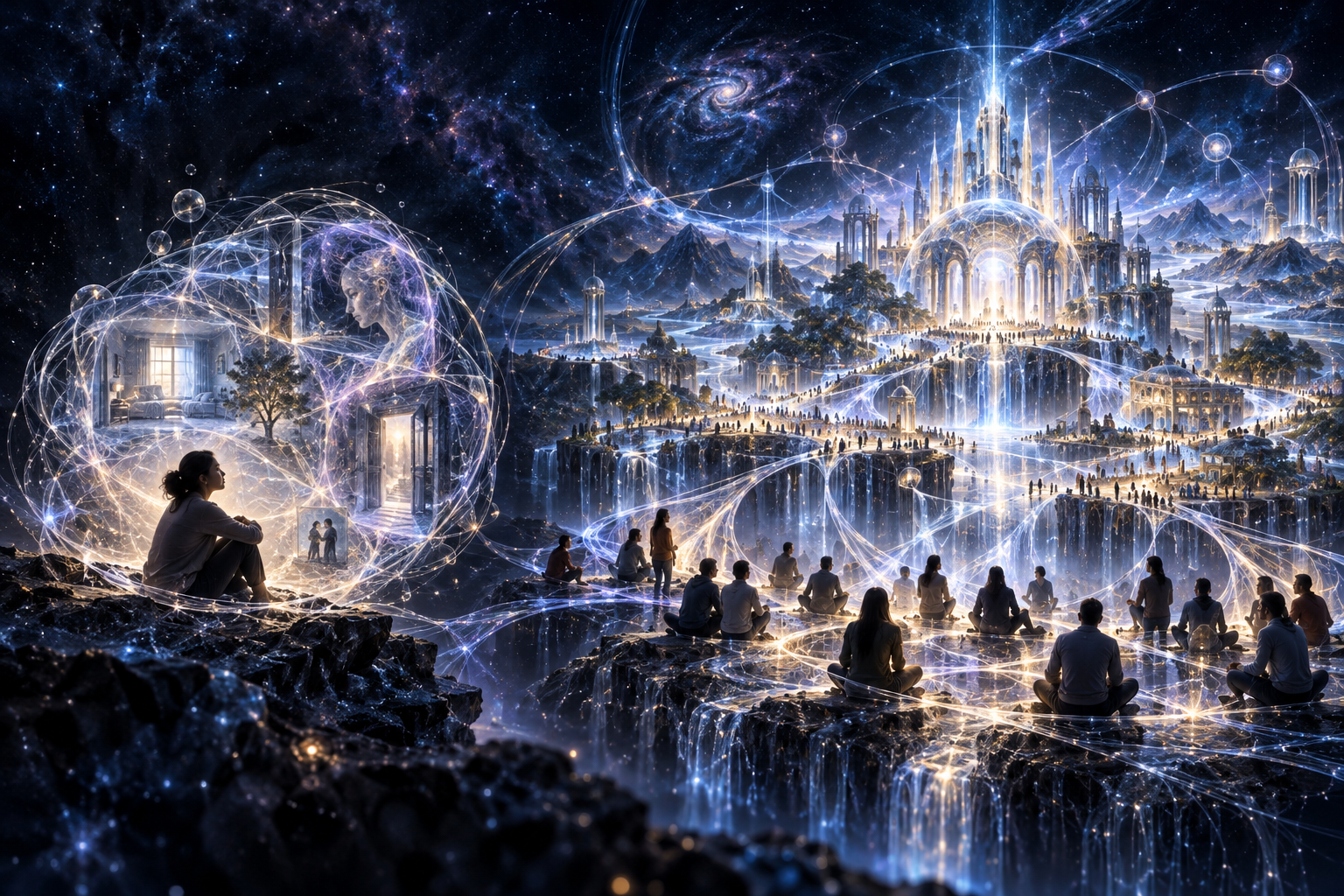
Shared belief, emotion, ritual, repeated imagery, and continuous attention fill it with an enormous amount of energy. It can become far more stable and complex than a personal image. Buildings, landscapes, symbols, characters, and entire scenarios may appear within it.
Such forms can include religious visions of the afterlife, cultural archetypes, mythological beings, images of saints and demons, and places associated with collective fear, tragedy, or hope.
This helps explain why people from different cultures may encounter different images during out-of-body or near-death experiences. The differences do not necessarily mean that one person is telling the truth while everyone else is mistaken. People may enter different collective constructions that correspond to their beliefs, expectations, and inner attunement.
Yet a collective thought-form does not become an independent world simply because it is vast and stable. Its continued existence still depends on the attention and energy invested in it. Independent worlds have their own development, history, inhabitants, and laws. They do not disappear when someone’s beliefs change.
Thought-Forms Around Sleeping People
During my out-of-body research, I have observed shifting scenes around sleeping people that resembled three-dimensional holographic images. Faces, places, emotions, memories, and unfinished thoughts from the day were woven together within them.
I do not consider such scenes to be literal recordings of dreams. Dreaming is a complex activity involving the brain, memory, and the stream of thought. On the second level, I see an energetic expression of some of these processes.
The brightest forms tend to arise around intense emotions, anxiety, and recurring thoughts. A sleeping person’s thought stream does not stop. The brain continues to process experience, while the surrounding energy responds to the images it generates.
This is not a reason to begin interpreting every dream endlessly. It is far more important to recognize how the brain and the stream of thought continually create and repeat inner scenarios.
Information Clouds Around a Person
I have observed similar phenomena around people who are awake but deeply absorbed in television, a phone, or another stream of information.
A kind of cloud may form around the viewer, filled with their reactions, associations, memories, and emotions. The image extends beyond the screen and continues in a space being created by the mind.
This observation has a direct bearing on everyday life.
The information we consume does not vanish without a trace. It becomes material for the stream of thought. The brain continues processing what it has seen, replaying what it has heard, and using it to construct new scenarios.
If a person fills themselves every day with aggression, fear, scandal, and images of catastrophe, they give the mind material from which it will build their inner environment. The same principle applies to ideas that bring strength, clarity, and hope.
Attention is not merely a passive reaction to the outside world. It is a means of transferring energy.
Religious and Esoteric Expectations
Other people’s descriptions can exert an especially powerful influence on out-of-body experience. Once a person has been told what the spiritual world is “supposed” to look like, the brain has a ready-made library of images.
A Christian may encounter familiar Christian imagery. A person from another tradition may see the symbols of their own culture. Someone immersed in esoteric teachings and already convinced of the presence of particular entities may experience exactly those entities.
After returning, each person may sincerely say, “I saw it myself.” And they will be telling the truth. They really did see, hear, and feel what happened.
But a personally experienced reality does not guarantee that all of its forms existed independently of the observer. This is why an explorer must learn to set prior experience aside, suspend ready-made explanations, and enter a new experience without a script already written.
Someone else’s map may help us take the first step. It must not replace our own investigation.
Fear as a Factory of Images
Fear is not the only emotion capable of creating thought-forms, but it does so with exceptional speed.
Fear narrows attention. The brain stops noticing anything unrelated to danger and begins repeating a frightening scenario. Attention directs energy into it. The second level gives that scenario a visible form. The visible form then intensifies the fear.
A closed loop is created.
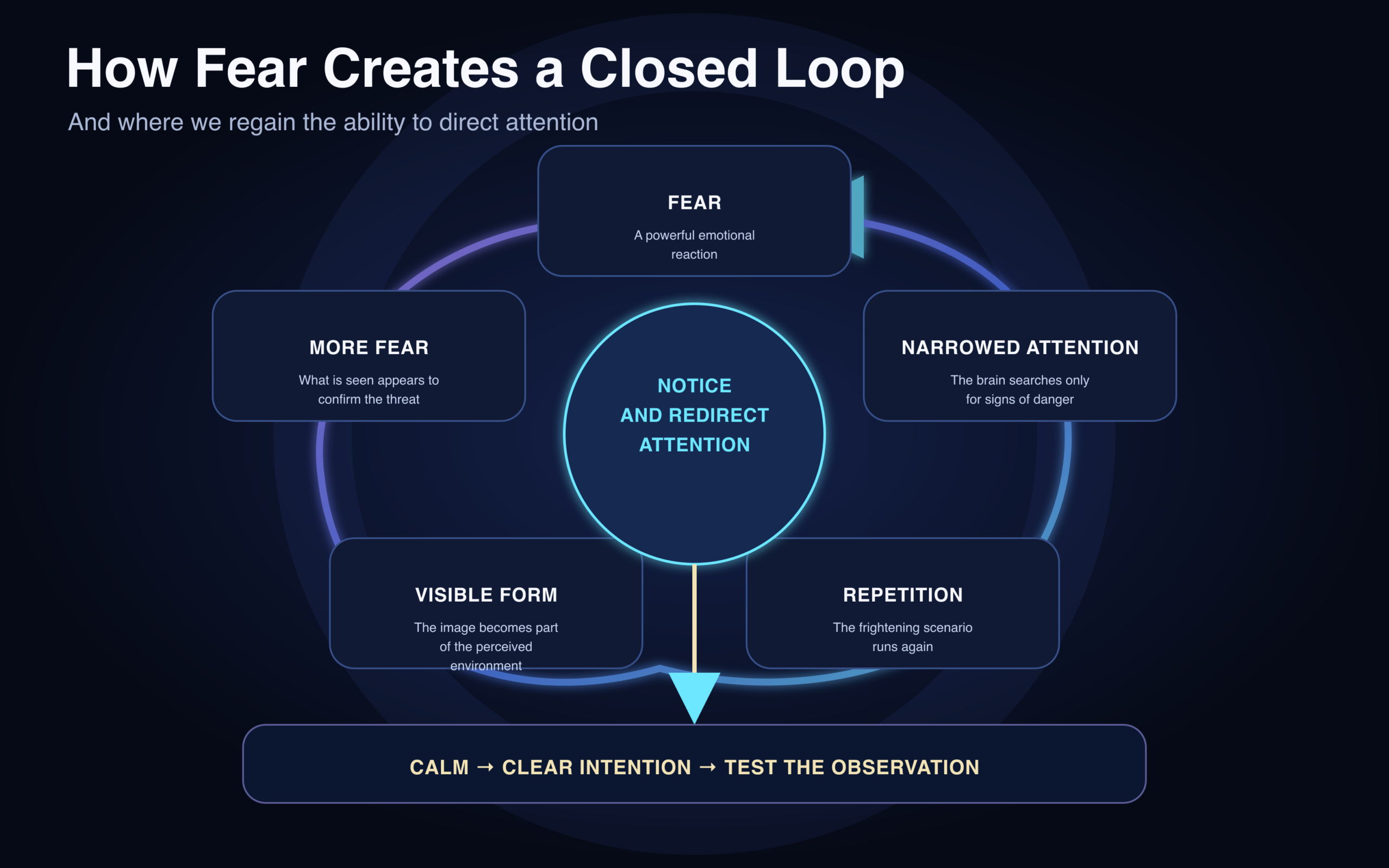
The way out does not begin with trying to destroy the image. It begins with reclaiming control of attention. Once a person understands that the image is being fed by their reaction, they can stop sustaining the process. Calmness, clear intention, and a deliberate shift of attention deprive the thought-form of its energetic fuel.
This does not mean that every frightening image is necessarily created by the observer. The second level is inhabited by many kinds of beings and contains independent worlds. But before assigning independent will and an external origin to every disturbing image, an explorer must determine whether they themselves are sustaining it.
How to Direct the Stream of Thought
Controlling thought does not mean violently forcing all inner speech to stop. The harder we try to forbid the brain from thinking about something, the more often it tends to return to the same thought.
The task is different:
- notice the thought as it arises;
- do not confuse it with your own will;
- do not continue developing it through inner dialogue;
- remain calm;
- return to a clear intention;
- consciously redirect attention.
It is essential to distinguish a thought from a decision. The brain can offer hundreds of scenarios. Consciousness does not have to follow every one of them.
We do not always choose the first thought that appears. But we can choose whether to feed it, repeat it, and allow it to shape the direction of our lives.
Responsibility for Attention
On the second energy level, responsibility for the stream of thought becomes visible. What seemed insignificant within us reveals itself as a force capable of changing the surrounding environment.
A passing thought does not define a person. Responsibility begins with what we do next. Do we give the thought our attention? Do we repeat it? Do we make it part of our view of reality? Do we pass it on to other people?
Every time we direct attention, we choose which thought-form to strengthen.
In physical life, this process unfolds over time. A thought does not become a wall or a being before our eyes. Yet a continuous stream of thought shapes our perception. Perception influences decisions. Decisions become actions. Actions build our lives.
The second energy level simply reveals this connection much faster.
We Do Not Have to Live Inside Automatic Thoughts
A thought is not harmless noise inside the head. It is an energetic impulse capable of taking form, influencing perception, and changing the space around us.
On the second energy level, we see this almost immediately. In physical life, the result appears more slowly, but the principle remains the same: attention feeds whatever it is directed toward.
If the brain keeps driving thoughts in circles, that does not mean we must follow them endlessly. We can recognize the process, reclaim our attention, and stop feeding what we do not want to strengthen.
Directing attention does not make a person unfeeling, nor does it require denying real problems. It restores our right to decide what we will give our energy to.
This is one of the central meanings of awareness: refusing to let an automatic stream of thought determine who we will become and what kind of reality we will sustain.
I explore the second energy level, thought-forms, fear, and my out-of-body observations in greater depth in my book, The Phenomenon of Consciousness Beyond the Body.
The book is available on Amazon as a Kindle edition and in paperback.
With respect, Andrey Chsherbakov.
Leave a Reply