
When familiar explanations stop providing answers, an enormous landscape of ideas opens before us. Energy, chakras, past lives, astral worlds, teachers, channeling, karma, vibrations, other civilizations—esotericism offers an explanation for almost every unusual phenomenon.
The problem is that an explanation is not the same as knowledge.
Esoteric traditions contain valuable observations gathered by generations of practitioners. Alongside them, however, are fantasies, contradictory systems, commercial promises, and beliefs that cannot be tested. If we accept everything, we do not expand our understanding of reality. We simply replace one closed system with another.
Complicated words do not make an idea profound
I deliberately try to speak about consciousness in simple, contemporary language. Complex terminology often creates an impression of depth where there is no clear content.
If an author cannot explain what he actually observed but constantly uses words such as “quantum,” “high-vibrational,” “multidimensional,” or “energy-information,” that proves nothing. Every term needs a clear meaning.
I use the phrase “energy level” because it identifies a specific part of my model of reality. I explain what I mean by it and which characteristics allow me to distinguish one level from another. Without a definition, the phrase becomes decoration.
The first rule of an investigator is simple: if you do not understand what a statement means, do not rush to declare it profound.
A system that explains everything explains nothing
A dangerous feature of many esoteric teachings is that every outcome supposedly confirms them.
If a prediction comes true, the teacher possesses special knowledge. If it fails, the energy timeline changed. If a method helps, it works. If it does not, the student lacked faith, had low vibrations, or was not ready.
Such a system cannot be tested because it is protected in advance from every objection. That is no longer investigation; it is faith in one’s own infallibility.
A useful working model must allow the possibility of error. I can speak confidently about something I have observed repeatedly while leaving room to refine the mechanism. Reality is under no obligation to conform to my terminology.

Personal experience can also mislead us
An unusual experience can feel more vivid than physical life. The force of an impression, however, does not guarantee that our explanation of it is accurate.
During an out-of-body experience, a person may enter a mental layer—a space shaped by the mind, memory, fear, and expectation. A religious person may see figures from his tradition. Someone devoted to cosmic teachings may see representatives of other civilizations. A person expecting an attack may create a frightening form himself.
The experience may be real. The interpretation may be wrong.
I therefore separate three levels:
- The event: what happened and what I directly perceived.
- The interpretation: how I explained what I perceived.
- The conclusion: the general rule I attempted to draw from it.
The farther we move from the event, the greater the chance that belief has been mixed into the experience.
Signs of a spiritual trap
Be cautious when a teaching or teacher:
- claims to be the sole source of truth;
- asks you to give up independent verification;
- treats doubt as spiritual weakness;
- continually promises a rapid ascent to a “new level”;
- uses fear, guilt, or the idea of being chosen;
- charges ever more money for the next secret;
- separates followers from loved ones and other sources of information;
- promises to solve every physical, psychological, or practical problem with one universal method;
- makes people dependent on a continuing stream of messages and instructions.
A real teacher increases a student’s independence. A manipulator increases dependence.
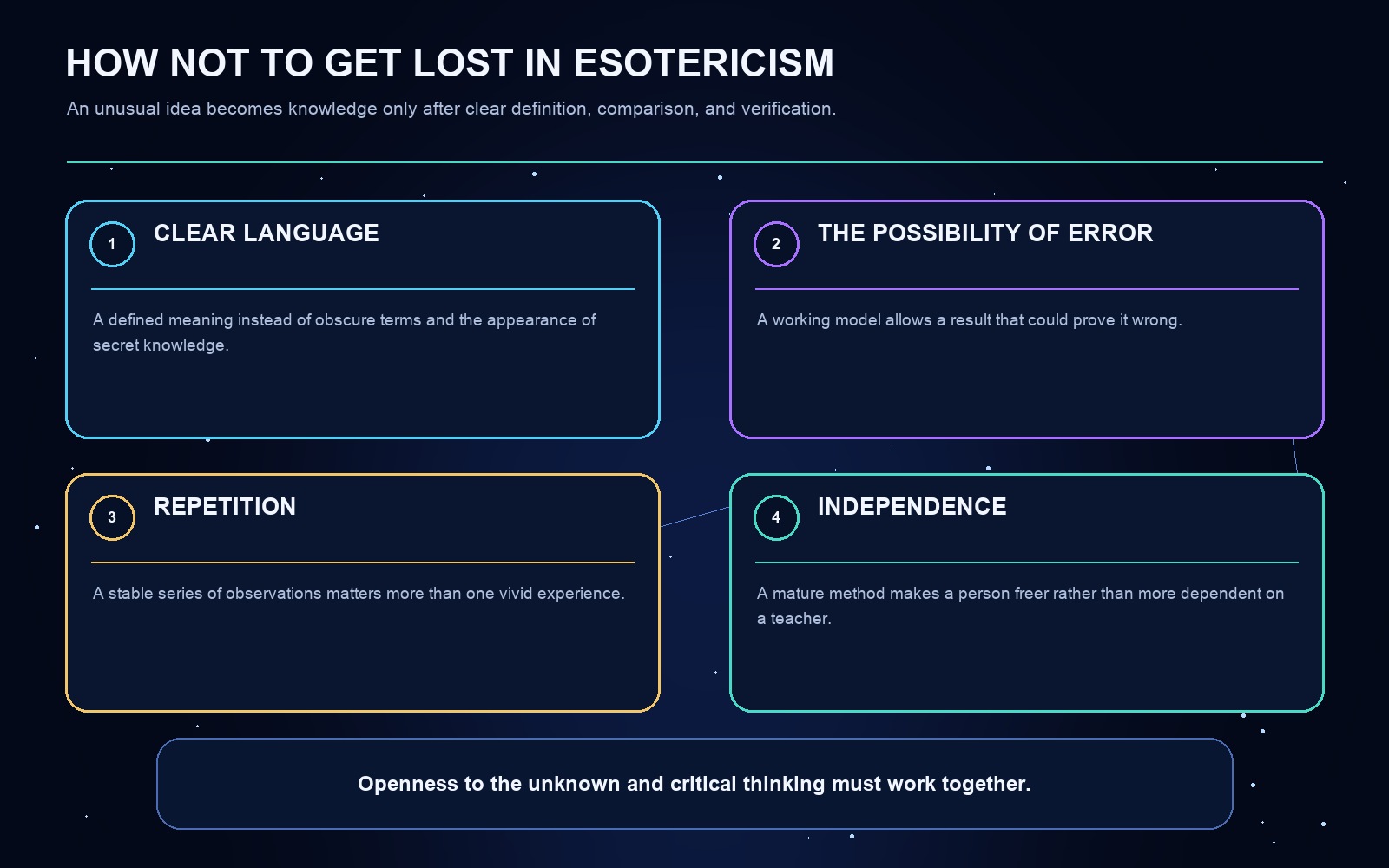
How to evaluate unusual information
I use several simple principles.
Compare sources. Agreement among independent observations does not prove a claim, but it deserves attention.
Look for repetition. One vivid episode may be chance or a mental construction. A series of similar observations provides firmer ground.
Separate the experience from the promise. A person may honestly describe an experience and still misunderstand it. Sincerity is not accuracy.
Examine the consequences. Knowledge should increase clarity, responsibility, and the ability to live. If a teaching makes a person anxious, arrogant, and helpless without a teacher, that is a serious warning.
Do not abandon common sense. Spiritual growth does not require us to stop checking health information, financial decisions, contracts, or the facts of physical life.
Skepticism must not become blindness
Critical thinking is essential, but it too can become a dogma. If a person declares everything he has not experienced impossible, he is no longer investigating reality. He is defending a materialist worldview.
My approach is neither to believe everything unusual nor to deny it. I propose investigation: gain experience, compare it with other observations, repeat, correct mistakes, and do not be afraid to say, “I do not know yet.”
At the same time, do not be afraid to say, “I have observed this many times and I am certain of the fact, even though the mechanism still needs to be studied.”
The main point of reference is not a school or a teacher
Esotericism becomes dangerous when a person searches within it for a new external authority. He continues living by someone else’s explanations; he has merely exchanged sacred books for courses and prophets for popular guides.
An investigator follows a different path. Books, teachers, and methods are tools, but none of them receives his right to see, think, and decide.
Unusual reality exists independently of our schools and labels. To keep from getting lost in it, we need clear awareness, disciplined observation, and honesty with ourselves—not mysterious language.
You can read more about the difference between observation, mental construction, and objective experience in my book The Phenomenon of Consciousness Beyond the Body.
Continue with the book on Amazon: Kindle Edition or Paperback.
Leave a Reply