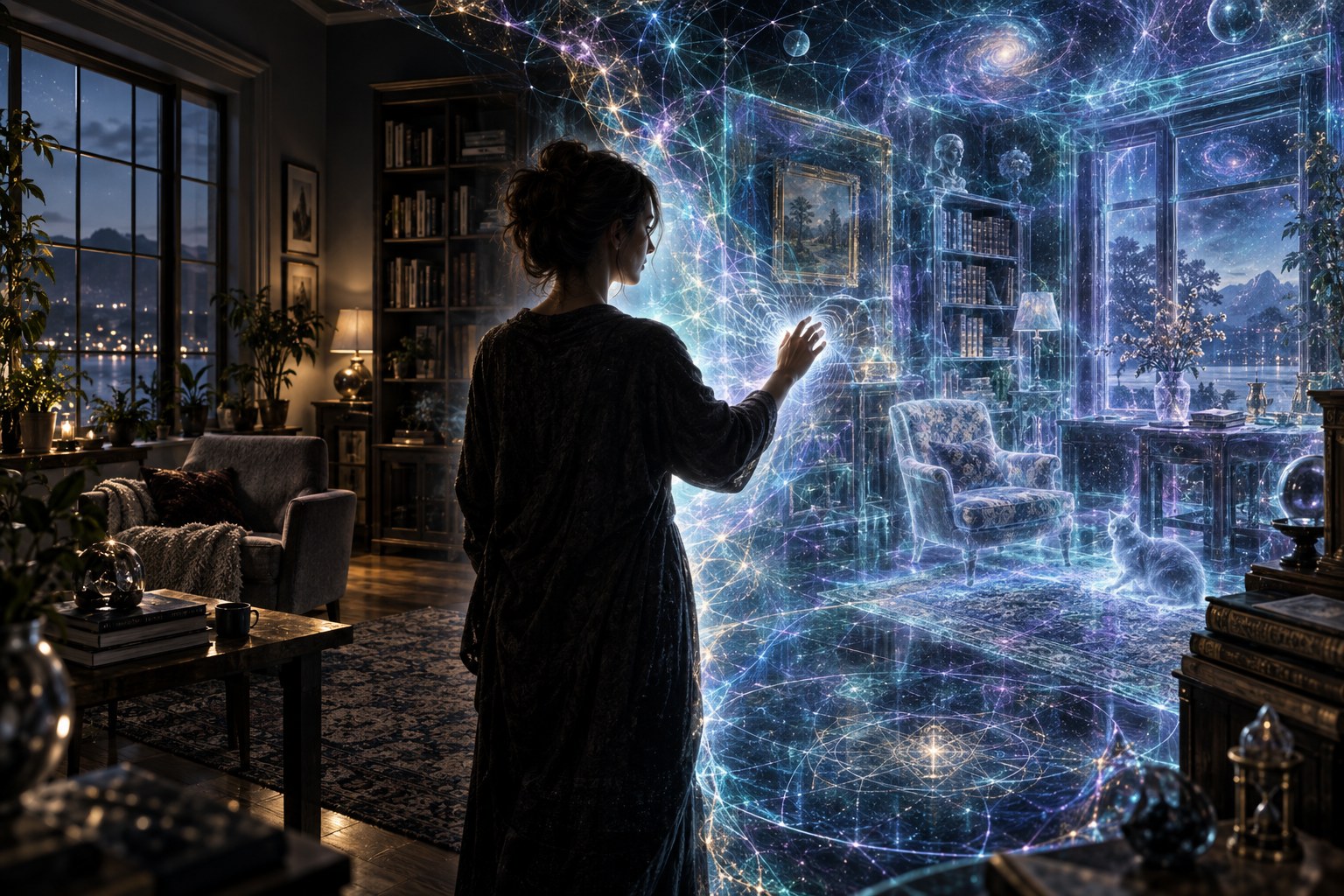
What exists in the nearest region of the second energy level, why familiar objects retain their form, where the discrepancies come from, and how our thoughts begin to alter the space around us.
The second energy level is an extraordinary realm. It opens remarkable possibilities to anyone who reaches it consciously. Based on more than twenty years of personal practice and my familiarity with the experiences of other practitioners, I estimate that roughly 95 percent of conscious out-of-body experiences take place in this region closest to our reality.
Yet proximity does not make it simple or easy to understand. On the contrary, it may be the most mysterious level I have encountered. It resembles our world while continually violating our assumptions about it. You may see your own room, step onto a familiar street, and recognize the houses around you. Yet the walls may be a different color, an object removed long ago may stand in its former place, and a perfectly solid door may cease to be an obstacle the moment you decide to pass through it.
That is why I continue to investigate the second energy level. I return to the same questions, repeat observations, and compare results. The more I learn, the more clearly I see the scale of this reality—and the more new mysteries it presents.
A Familiar Room That Is No Longer Quite Familiar
At the beginning of a conscious separation, people often find themselves beside their sleeping bodies. They see the bed, walls, doors, windows, and furniture. Everything looks so familiar that, for the first few seconds, they may not even realize the separation has already occurred.
The floor feels solid. The wall seems dense. You instinctively reach for the door in the usual way. We continue to behave as we have throughout physical life because we do not yet know another way to interact with the surrounding world.
Then the differences begin to appear. The wallpaper may be lighter or display an older pattern. A favorite chair may look different. An object that has been gone for years may reappear, while something recently purchased and placed in plain sight may be missing. The furniture may have shifted. At times the entire setting is recognizable yet carries a difficult-to-explain impression: this is the same room, but it exists in another state.
Such discrepancies can easily be taken as proof that the entire experience is imaginary. When I began practicing, I too needed to understand why a space that felt completely real did not match the physical world in every detail.
The answer did not come at once. It emerged after many separations and repeated observations: on the second energy level, we do not see the physical world itself. We see its energetic reflection.
What I Mean by an Energetic Echo
How does the reflection of our reality arise on the second level? My honest answer is that I do not know.
I do not know the final mechanism, and I cannot claim to know which law underlies this phenomenon. I can describe what I have observed, compare recurring features, and offer a model that accounts for those observations. I call this model the energetic echo.
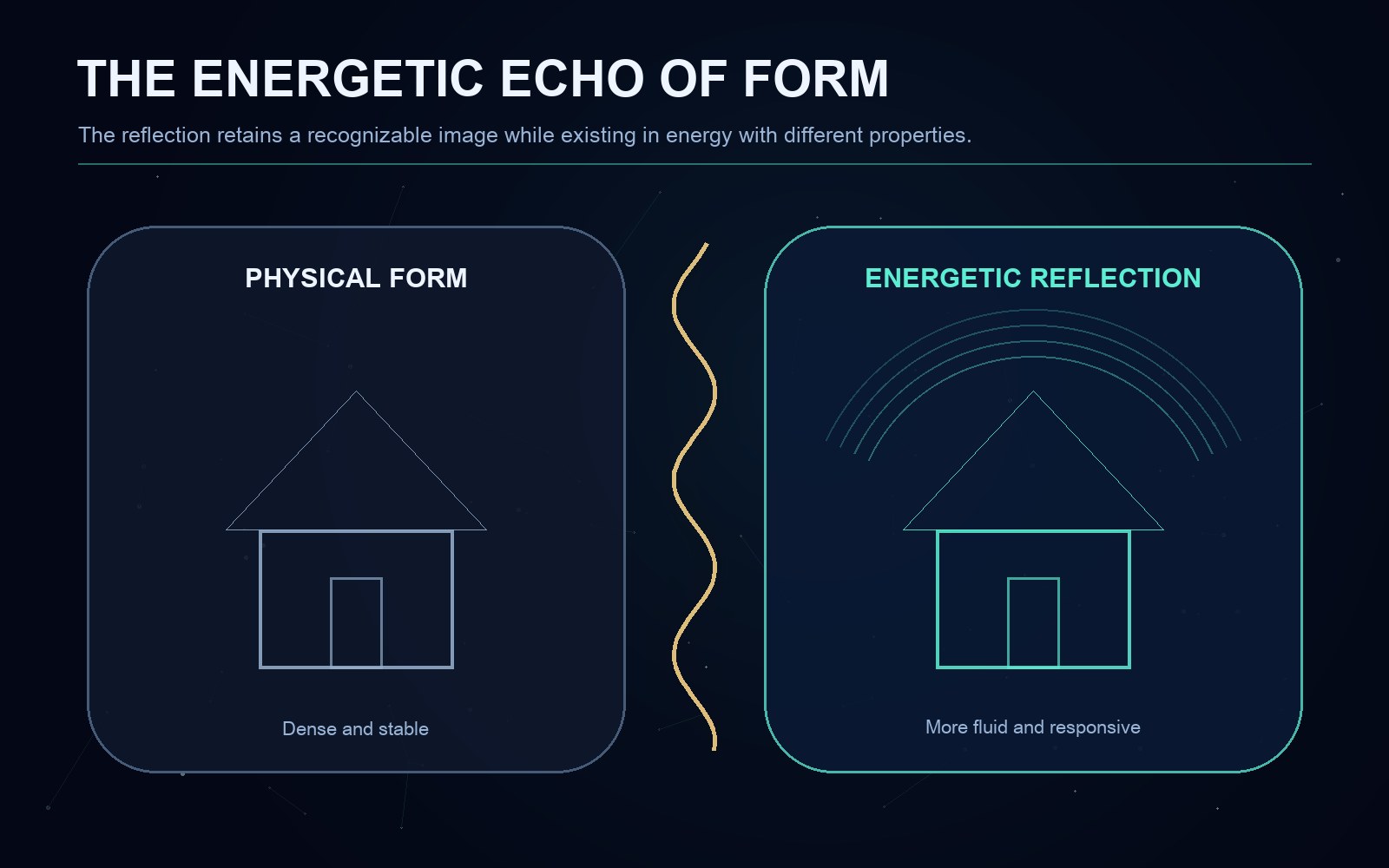
My hypothesis is that matter and energy on the physical level have the capacity to produce a subtler energetic reflection. It preserves the original object’s outward form, position, and certain properties, but exists as a different quality of energy.
Think of an ordinary echo. A sound originates in one place, reflects from a surface, and continues as a repetition of the original signal. The energetic echo I am describing is far more complex. It reflects more than a single sound or movement; it reproduces the form of objects, natural environments, and immense regions of the physical universe.
I believe the energy of this reflection has a subtler and faster pattern of vibration. The emerging echo may enter into resonance with the energy of the original object. The quality of its vibration then changes, and the reflection manifests in an adjacent region of reality. It becomes invisible and intangible to our physical senses while continuing to exist in the form of its source energy.
This is a working hypothesis, not a mechanism I consider conclusively established. My purpose is not to give the unknown an attractive name, but to find an explanation for a consistent phenomenon I have encountered again and again.
My observations lead me to another conclusion: the reflection moves upward, from the denser physical level to a subtler one, rather than the other way around. The nearest region of the second level is therefore secondary to physical reality. It is connected to our world, reproduces its forms, and responds to changes occurring here, but the response is not always immediate or perfectly exact.
Why the Reflection Is Not an Exact Copy
If the second level reflects the physical world, why can the color of a wall or the shape of a chair be different?
Because this is not a mechanical duplicate, a photograph, or a live video feed. The reflection is connected both to the physical object and to the perception of the beings who interact with it.
An object used every day by many people usually has a more stable reflection. Its form is continuously reinforced by attention, habit, and repeated interaction. A personal possession that receives little attention may appear differently. Minor details that people rarely notice change even more easily.
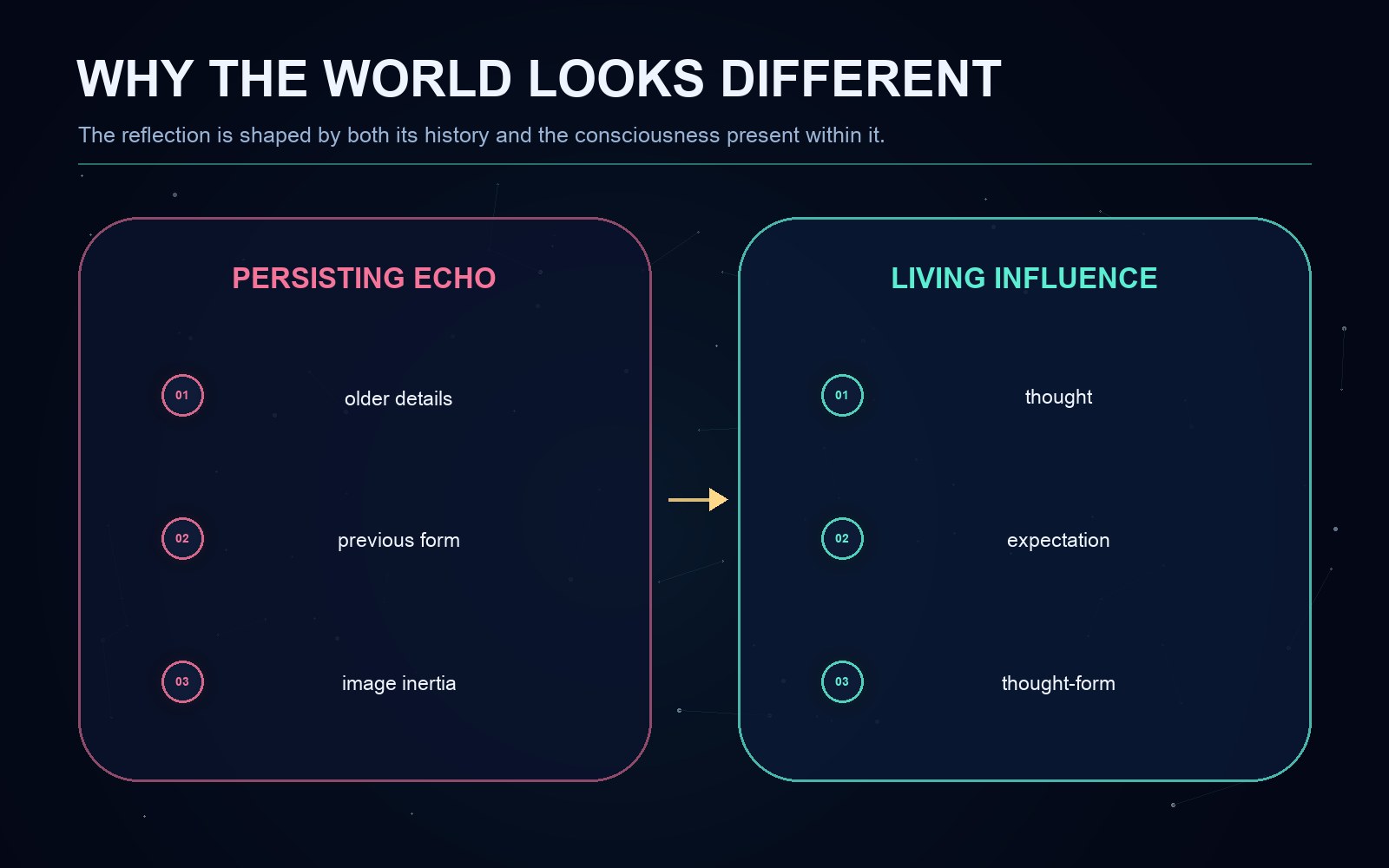
Intense attention can also distort the reflection. When a place or object carries powerful emotions, expectations, and memories, its energetic reflection begins to overlap with thought-forms. It can then be difficult to determine which features belong to the relatively stable reflection of a physical object and which have been created by the observer’s mind or by the collective attention of other people.
The reflection has another mysterious quality: it can lag behind.
Imagine that you have replaced the wallpaper in a room. The physical wall now looks entirely different, yet during an out-of-body experience you may still see the old pattern. If a tree has burned down or been cut down, its energetic reflection may continue to exist for a time. The physical object is gone, but its former shape remains in the neighboring region of reality and fades only gradually.
I do not yet know what determines how long such a trace remains. The age of the object, the energy invested in its existence, the attention it received, people’s emotional connection to it, and the manner of its destruction may all play a role. I continue to investigate this feature. But the recurrence of such observations suggests that changes in the physical world are not transmitted to its energetic reflection as instantly as data refreshes on a computer screen. The process has its own inertia.
Why Familiar Laws Seem to Apply at First
When people enter the second energy level, they do not usually begin by flying or sinking through the floor. By default, the environment behaves much like the physical world.
We feel gravity. Matter seems solid. Walls appear impenetrable. We walk around a table, open a door, and take the stairs, even though none of this is necessary anymore.
The reason lies not only in the properties of the reflection but also within us. An entire physical lifetime has taught us that the floor supports the body, a wall stops movement, and leaving a room requires using the door. These assumptions are so deeply embedded in our perception that they continue to operate even after we separate from the body.
On the second level, however, a familiar limitation exists only as long as we continue to support it.
Once a person clearly understands where they are, they can change how they interact with the environment. They can pass through a wall, rise into the air, descend underwater without breathing, or travel into space. There is no need to break the wall or overcome gravity. They need only stop treating these conditions as mandatory limits on movement.
This reveals the defining difference of the second energy level: its environment responds to thought and intention far more quickly.
Thought Becomes a Law of the Environment
In the physical world, a long chain of actions usually stands between desire and result. Imagining a house is not enough to build one. Materials, knowledge, labor, and time are required. Dense matter accepts a new form slowly.
On the second energy level, the distance between a thought and its manifestation becomes dramatically shorter. At times it disappears almost completely.
Expect an obstacle, and it becomes impassable. Decide with certainty to move through a wall, and its density ceases to matter. Recall a familiar place and hold it as your intention, and you may be able to move there. Fear can produce a frightening image, while strong expectation can transform the surrounding scene.
I understand this through the nature of consciousness itself. To me, consciousness is not a product of the physical brain. It is an independent energy, a particle of the Source, the Superconsciousness, or God—the name is a matter of personal choice. A creative power exists within our nature. In the physical world it manifests slowly because dense matter resists change. On the second level, energy is more responsive, and the influence of thought becomes rapid and unmistakable.
We are therefore continually constructing part of the reality we perceive there, whether deliberately or unconsciously.
This is both an immense possibility and a serious challenge. A person with a clear intention can direct movement, sharpen perception, and carry out investigations. A person who cannot regulate the flow of thought can quickly become trapped in chaos created by expectations, fears, and habitual images.
Fear changes the environment. The altered environment intensifies the fear. A closed loop develops and usually ends with an immediate return to the body.
This is why I speak so often about clarity of perception, inner calm, and setting previous experience aside. An explorer must learn, at least temporarily, to release religious imagery, other people’s stories, and personal expectations. Otherwise, the first thing they see will be what they already believed.
What a Person Looks Like Without the Physical Body
During an out-of-body experience, the physical body remains on the first energy level. Consciousness—a living energy capable of perceiving and acting independently—enters the second.
Why, then, do people continue to see hands, legs, and a familiar human form?
Because that is how they perceive themselves. The human form is the foundation of our earthly self-identity. We are accustomed to seeing through eyes, touching with hands, and moving with legs. Consciousness therefore reproduces this image even when the physical body is no longer participating in the experience.
This form does not have to match the body exactly. It can change with our sense of self. People often perceive themselves as younger, healthier, and more harmonious. Illness, age-related changes, and physical limitations may disappear because they belong to the body, not to the nature of consciousness itself.
With sufficient control, a person can alter this appearance far more radically or stop maintaining a familiar form altogether. Most practitioners, however, retain a human appearance because it is familiar, practical, and requires no additional intention.
The same principle applies to the senses. On the second level, there are no physical eyes or ears in the ordinary sense, yet a person continues to see and hear. They may perceive touch, temperature, scent, or movement. Perception can be intensified, softened, and directed. The limitations of a physical organ give way to the capacities of consciousness itself, although learning to control them takes time.
Where the Reflection Meets the Thought-Form
To understand what occurs on the second energy level, we must distinguish the energetic reflection of the physical world from mental formations.
By mental, I mean created by the mind—by our capacity to form thoughts, images, expectations, and inner scenarios. A mental form may be personal or collective. It can arise from one person’s memory or be sustained by the belief and attention of a vast number of people.
The energetic reflection has relative stability. A house remains a house, a street retains its direction, and objects occupy recognizable places. A thought-form is more fluid. It changes with a person’s attention, fear, or desire.
In actual experience, however, these phenomena often overlap. You may be standing in the reflection of your own room while seeing an object created by memory. You may step onto a familiar street and then, without noticing the transition, enter a space shaped by expectation. No visible line marks the boundary, and no voice announces that the surrounding scene has just changed its origin.
For this reason, vividness and realism prove nothing by themselves. A thought-form can be detailed, convincing, and completely tangible. What matters to investigation is stability, repeatability, and the environment’s ability to preserve its properties independently of the observer’s immediate wishes.
Why Books and Screens Cannot Be Read as They Are in the Physical World
The fluid nature of information is especially apparent in books, televisions, phones, and computers. The outward form of an object may remain recognizable while its contents change easily.
I have repeatedly tried to read books during out-of-body experiences. The result differed every time. The text might vanish, change into different words, or become images that had never appeared in the book.
During one experiment, I opened a copy of my own book. I knew its contents perfectly because I had written it. Yet instead of the familiar text, I saw a map. No such map existed in the physical copy. It showed the route of a journey I intended to make during that experience. I used the information that appeared and set out to carry out my plan.
That experience revealed an important distinction: the energetic reflection of a book and the information within it are not the same thing. The book’s form may be connected to a physical object, while its contents at that moment are supplied by the observer’s intention, memory, or mental request.
Something similar happens with television. During my practice, I have repeatedly encountered people watching programs. A kind of cloud formed around each viewer, filled with that person’s perception of what was being seen. Images moved beyond the screen and became an entire performance around the individual. The viewer was not merely sitting in front of a television but inhabiting a space made from personal reactions, associations, and thoughts.
I have observed a similar effect around sleeping people. Their stream of thought created moving scenes around them, resembling holographic images. This already belongs to the realm of thought-forms, yet it can enter the reflection of the physical world and alter the space around a person.
How to Investigate a Reality That Responds to the Investigator
The central difficulty is that the observer is not separate from what is observed. The observer’s thoughts can influence the result.
One impressive experience is therefore not enough. I return to familiar places, compare details, and look for recurring properties. I examine what remains stable and what changes with my attention. At times I deliberately create an expectation and then observe whether the environment conforms to it. After returning, I record what I saw and compare it with earlier experiences.
I separate direct observation from interpretation. If I see old wallpaper in the reflection of a room, the old wallpaper is the observation. My explanation for why its energetic trace remained is an interpretation. It may prove correct, partially correct, or in need of revision.
Admitting that I do not yet know the exact mechanism does not diminish the result. It allows the investigation to continue without forcing new observations into a predetermined answer.
I am certain that the energetic reflection exists because I have repeatedly encountered its characteristic properties. I continue, however, to seek an explanation for how a physical object produces its trace, why some reflections update quickly while others remain after the original object is gone, and how the object’s energy, human attention, and thought-forms interact.
Why This Reflection Exists
I do not regard the nearest region of the second energy level as an accidental by-product of physical matter.
I am convinced that it forms part of a much larger architecture of life. It was created through the wisdom of the Superconsciousness, the Oversoul, or God to support the development of beings living on the first energy level. This extends beyond Earth and humanity. Our universe is immense, and physical life is not limited to the forms familiar to us.
The energetic reflection allows us to investigate the first level from a perspective unavailable to the physical body. Here, we can study the organization of life and the properties of space, communicate, gather information, cross immense distances almost instantly, and move closer to understanding the laws of the universe.
Its purpose, however, is not limited to extraordinary travel. The second level reveals the power of a person’s inner state. Here, mental disorder cannot remain hidden behind outward discipline for long. Fear takes form. Expectation becomes an obstacle. Clear intention opens a path.
In the physical world, the consequences of inner chaos emerge slowly, and a person may spend years without recognizing their connection to their own thinking. On the second level, that relationship becomes almost immediate. A controlled out-of-body experience can therefore become a school of awareness and responsibility.
We learn more than how to use unusual abilities. We learn how to govern ourselves.
Reality Is Far More Alive Than It Appears
A familiar room on the second energy level becomes the first indication that reality extends far beyond the physical world. Walls and objects retain their outlines but cease to be final and unchangeable. Matter reveals an energetic trace. Space responds to thought. The human form becomes an expression of self-perception rather than a limitation imposed by the body.
I do not know every law governing this reflection. That is precisely why I continue the investigation. But I know that what stands before us is neither meaningless scenery nor a collection of random images. It is a complex realm of life, connected to our universe and possessing its own patterns, possibilities, and mysteries.
Humanity is accustomed to exploring the world by building increasingly sophisticated instruments. Yet there is another direction of inquiry in which consciousness itself becomes the primary instrument. By learning to use it, we may not only see the space beyond the body differently but also gain a deeper understanding of the nature of our own lives.
The energetic reflection of the physical world is only the first region of the second energy level. Beside it lies the realm of thought-forms, created by the mind, imagination, fear, belief, and humanity’s collective attention. That will be the subject of the next article in this series.
I explore the second energy level, out-of-body investigation, and my personal observations in greater depth in my book, The Phenomenon of Consciousness Beyond the Body.
With respect, Andrey Chsherbakov.
Leave a Reply