
We are accustomed to believing that we see the world as it is. In reality, even our perception of physical reality is filtered through memory, attention, upbringing, and emotional state. During an out-of-body experience, the influence of those filters becomes much stronger.
Thought becomes form more quickly. Fear gives an undefined image threatening features. Expectation creates the anticipated setting. Religious belief gives a familiar name to an unfamiliar being.
This does not mean that nothing exists outside us. It means that an interpreter always stands between reality and our understanding: the earthly personality and the active stream of thought.
Emotion changes more than our evaluation
In physical life, fear directs attention toward threats, while infatuation highlights another person’s virtues. The object may remain unchanged, but attention selects certain features.
On the second energy level, emotion also affects the environment itself. Intense fear may create a form that appears to be an independent being. Joy makes movement freer. Doubt weakens intention. Anger holds attention on conflict and prolongs the scene.
The emotional response therefore becomes part of the observed event.

Belief supplies an answer before the question is studied
If a person is convinced that out-of-body space is filled with demons, every unclear form will be interpreted as a threat. If he believes he will meet only luminous teachers, he may fail to notice manipulation behind a beautiful appearance.
Belief acts like a caption placed under an unidentified photograph. The observer has not yet examined the object, but already knows what to call it.
Beliefs connected with religion, death, guilt, and personal exceptionalism are especially powerful. They do more than explain an experience afterward; at times they construct the experience while it is taking place.
What I mean by clarity of consciousness
When I speak of a clear consciousness, I do not mean moral perfection. I mean the absence of strong expectations, predetermined explanations, and emotional noise that impose a ready-made form on the environment.
Clarity of observation is the ability to enter an experience without demanding to see what one already believes.
We cannot free ourselves completely from the past. We can notice our expectations and keep them from quietly becoming “facts.”
The mental layer reveals the power of filters
In the mental layer, inner content becomes almost visible. A thought creates a room, an expectation summons a character, and fear builds an obstacle.
This makes mental experience valuable. It shows a person his inner programs without their usual disguise. Yet such an experience cannot automatically serve as a map of external reality.
If an image created by fear tells a person that the Universe is dangerous, what he has learned first is something about his fear.
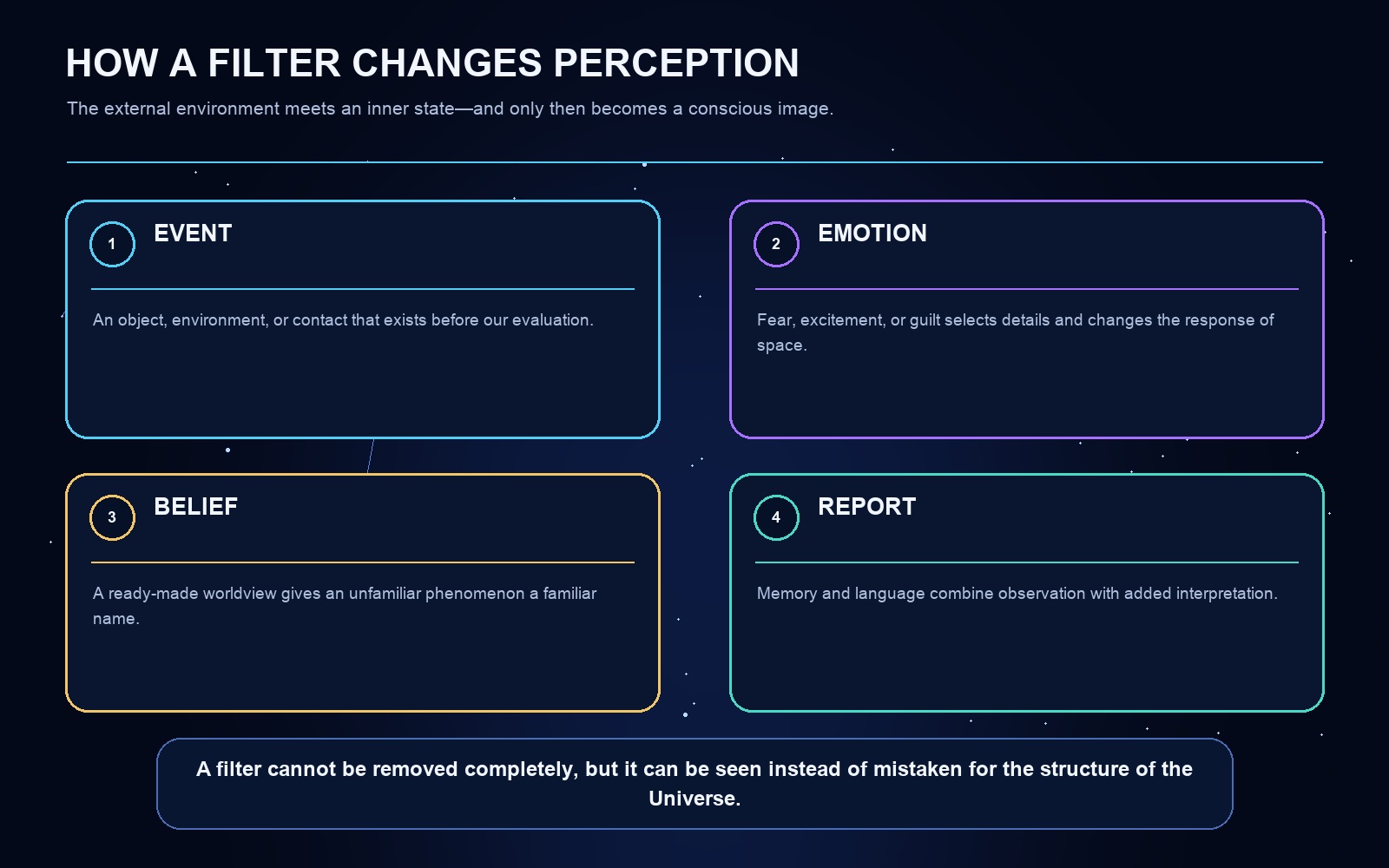
Distinguishing perception from emotional construction
I pay attention to the moment of change.
- What was before me prior to the strong emotion?
- How did the space change after fear or expectation appeared?
- Does the object disappear when I become calm?
- Does it retain its properties regardless of my attitude?
- Does the encounter provide unexpected information?
- Can I repeat the observation in a different state?
It is also useful to compare several experiences. If the same object assumes the form of the current fear every time, the filter is more likely changing than the object.
Positive expectations also distort
People worry more about negative thoughts, but pleasant expectations can be just as powerful a construction.
The desire to meet the Higher Self, a famous teacher, or a deceased relative may create a figure who says exactly what the person wants to hear. Love and hope do not guarantee objectivity.
This does not mean such meetings are impossible. It means the value of a meeting is determined not by emotional intensity, but by the independence of the contact, the quality of information, and the possibility of verification.
A filter cannot be eliminated, but it can be made visible
Our earthly personality always participates in perception. We translate the unknown into familiar language, select important details, and connect them with accumulated experience.
The goal is not to become an empty consciousness without memory or character. The goal is to understand our own contribution.
Before practice, name your expectations. After returning, record the event before explanation begins. Later, note the emotions, beliefs, and possible alternative interpretations separately.
In this way, the filter becomes visible.
Emotional maturity increases accuracy
Emotional control does not mean suppression. Fear must be noticed rather than denied. Excitement must also be recognized before an experience is declared a revelation.
The more calmly a person can observe, the less the environment reflects his immediate reaction. He gains the opportunity to encounter a reality that is not obligated to be pleasant, frightening, or consistent with his worldview.
That is why emotional work matters not only for quality of life. It is part of preparation for research.
We cannot remove ourselves completely from observation. We can stop mistaking our own shadow for the structure of the Universe.
You can read more about the mental layer, clarity of consciousness, and the influence of expectations in my book The Phenomenon of Consciousness Beyond the Body.
Continue with the book on Amazon: Kindle Edition or Paperback.
Leave a Reply