
Most debates about out-of-body experience end with an exchange of convictions. A practitioner says, “I know because I experienced it.” A skeptic replies, “It is the brain.” Both repeat their starting positions without producing new data.
We need experiments designed around the actual characteristics of the out-of-body state. If a method ignores the instability of separation, the mental layer, and memory transfer, its failure tells us little about the nature of consciousness.
The following are several directions that I consider promising.
1. A concealed visual target at home
The practitioner works in familiar surroundings without a rigid deadline. Another participant randomly selects one image from a large set and places it at an agreed location or displays it on a separate locked screen.
After the experience, the practitioner records everything before contacting the organizer. An independent judge then compares the report with several possible images.
The method offers comfortable conditions and does not require separation on command. Targets must be changed after every attempt, and every result must be counted.
2. A remote person performing an action
At a randomly selected time, an assistant performs one of several clearly different actions: assembling an object, drawing a large symbol, moving through the room, or interacting with a brightly colored item.
The practitioner attempts to visit the location and describe the action. The report receives a timestamp, and evaluation occurs only after the series is complete.
Ordinary communication between participants must be excluded, and the possible actions defined in advance.

3. A change in a familiar space
In a room the practitioner knows well, another person changes one major element by moving an object, adding something new, or covering part of the space.
The task is not to reconstruct the room from memory, but to detect the change. This experiment can help distinguish physical information, an older energetic trace, and a mental reconstruction from memory.
A series may be especially valuable in showing how long it takes for a physical change to become perceptible on another level.
4. Two independent practitioners
Two people receive the same target but do not communicate before submitting their reports. They attempt to visit a location or meet in an agreed region.
The comparison should focus not on generic words such as “light” and “energy,” but on rare, specific details: the sequence of events, an unusual object, the appearance of the environment, and the other participant’s actions.
Agreement between two accounts is not final proof, but repeated independent agreement creates serious material for study.
5. Information unknown to everyone involved
The strongest test uses a correct answer that neither the practitioner nor the person interacting with him knows before the experience is complete.
A computer or independent organizer may select the target randomly. The answer is unlocked only after the report has been protected from later editing.
This removes accidental cueing and the experimenter’s desire to see success.
6. Repeated observation of one target
Instead of continually changing targets, a practitioner can investigate one location many times. Stable elements, changes, and verifiable details are recorded in advance.
This method helps us study not only hits, but the structure of errors. Certain objects may be perceived as energetic traces while others are consistently replaced by mental images.
For building a model, these patterns may be as important as one accurate result.
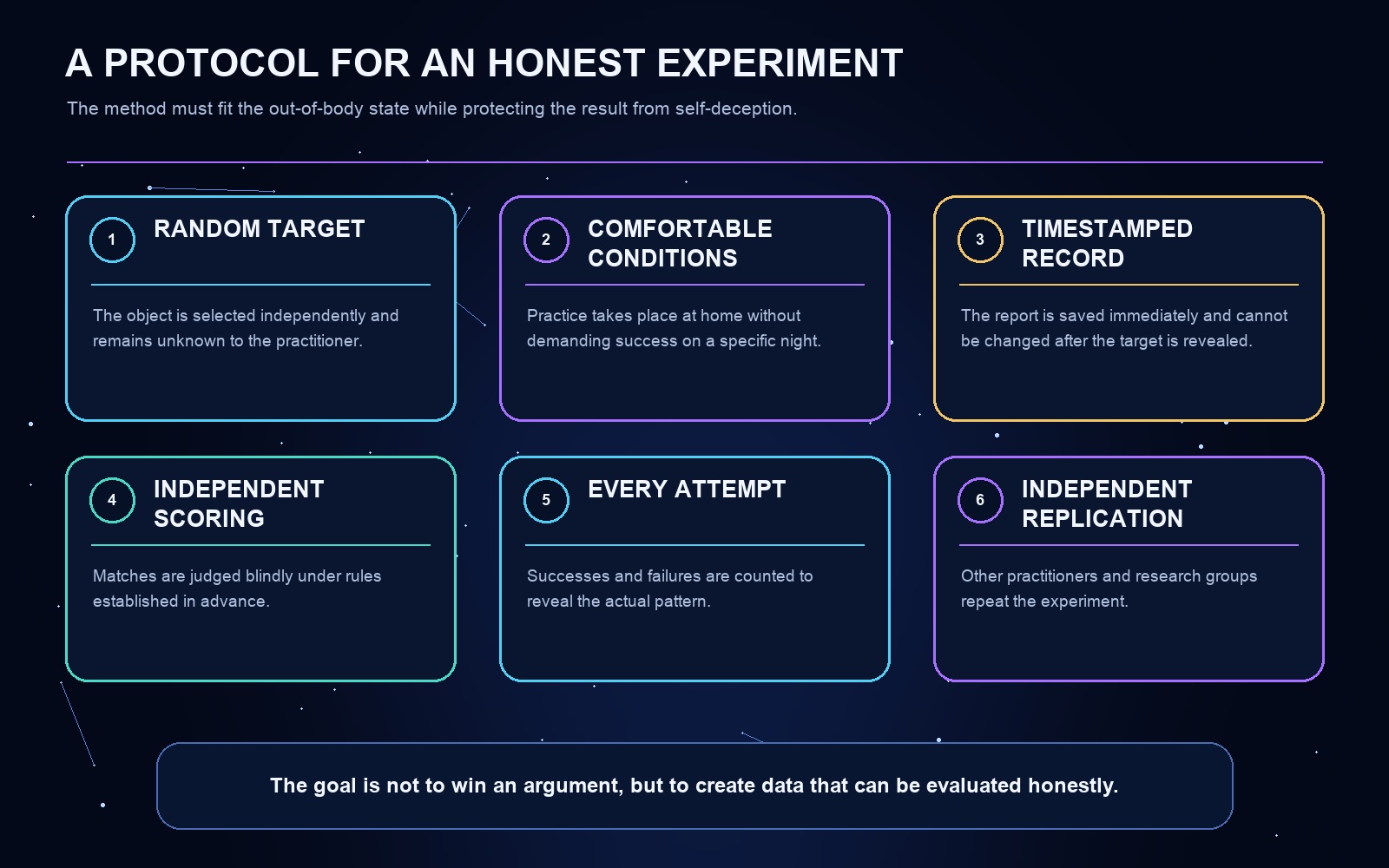
What every protocol should include
A good experiment requires several conditions.
- The target is selected randomly.
- The practitioner does not know the correct answer.
- The report is recorded before the target is revealed.
- The original record is preserved without revision.
- Criteria for a match are established in advance.
- Every attempt, including failures, is counted.
- Results are judged by an independent person.
- The series is large enough to compare with chance.
- The practitioner’s condition, method of separation, and quality of memory are recorded separately.
Without these rules, even an impressive correspondence remains a story that cannot be evaluated.
Why a laboratory is not always better than a bedroom
A traditional experiment places a person under observation, attaches sensors, and requires a task at a scheduled time. This is useful for recording the activity of the body and brain, but it creates poor conditions for controlled separation itself.
An unfamiliar room, wires, video monitoring, and performance pressure interfere with relaxation. A more reasonable approach is to separate physiological measurement from the informational test. Some experiments can take place at home using precise digital timestamps, random target selection, and protected reports.
What would count as persuasive evidence
One success would not prove that consciousness exists outside the body. We need a series of results exceeding chance, repeated by different practitioners and independent groups.
A negative result from one method would not disprove the entire phenomenon. It would show that a particular task or set of conditions did not provide access to verifiable information.
Science advances through gradual improvement in methods, not one dramatic final experiment.
From argument to investigation
I do not propose that every unusual result be declared proof of the soul. I propose conditions under which the hypothesis of perception outside the body has a fair opportunity to appear.
Practitioners must stop counting every similarity as success. Skeptics must stop using methods that ignore the nature of the state being investigated.
When both sides agree to test rather than to win, real investigation can begin.
You can read more about the challenges of laboratory verification and obtaining information outside the body in my book The Phenomenon of Consciousness Beyond the Body.
Continue with the book on Amazon: Kindle Edition or Paperback.
Leave a Reply