
One of the hardest tasks for an investigator of consciousness begins after returning to the body. The experience was clear, rich, and whole, yet trying to describe it reduces a multidimensional event to a sequence of inadequate human words.
We tend to assume that if someone cannot explain something precisely, he did not fully understand what he saw. Out-of-body experience is different. Sometimes consciousness understands more than the brain can express.
Language was built for physical life
Human language grew from bodily experience and the material world. We have words for objects, distance, direction, time, and action. We say “above,” “far away,” “first,” “later,” and “inside.”
Beyond familiar physical perception, however, space may have no ordinary distance, events may be perceived simultaneously, and information may arrive not in sentences but as a complete meaning.
When I say that I entered another world, I do not necessarily mean that I traveled there along a physical route. When I describe light, it may not have been optical light. When I speak of a voice, I may be describing an understanding that appeared in consciousness without sound.
Words are necessary, but they inevitably simplify.
Meaning may arrive whole
In nonphysical communication, I have repeatedly received not phrases, but an imprint of meaning. In a single instant I could receive an amount of information that would take several minutes to explain.
It is difficult to call this telepathic “speech,” because words are not always present. One consciousness seems to transmit a structure of understanding to another: an image, a relationship, an emotional quality, and knowledge of connections and context.
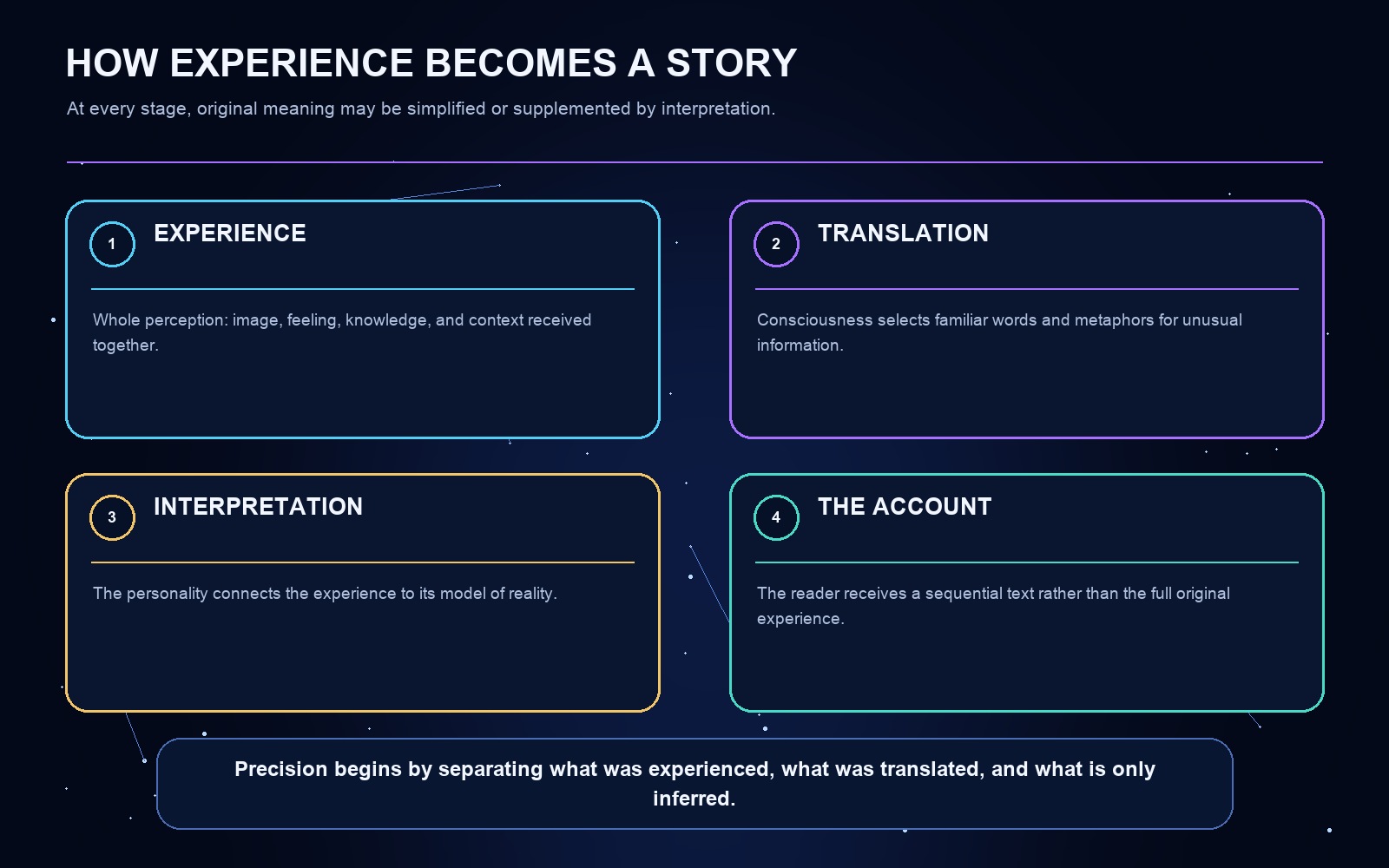
After returning, the brain begins dividing this whole into familiar concepts. Distortion often appears at that stage. We choose the closest available words, even though they convey only part of the original meaning.

Where observation ends and translation begins
To remain honest, we need to distinguish three layers in the account.
Direct perception. What was seen, heard, felt, or understood during the experience itself.
Translation. The human words and metaphors selected after returning.
Explanation. The way an investigator connects the event to a model of reality.
For example, “I saw a being made of light” is already a translation. There may have been neither physical light nor a body as we understand those terms. The observer is reporting that the perception most closely resembled a luminous form.
Without that distinction, readers may take a metaphor literally.
Metaphor is a tool, not a photograph of reality
I often compare the world of the soul to enormous soap bubbles, energy levels to frequency ranges, and the connection between consciousness and the body to signal transmission. These comparisons help reveal structure, but they are not exact pictures of how reality is built.
A good metaphor clarifies a relationship. A bad metaphor quietly becomes a dogma.
It helps to say directly: “This is not a literal picture. It is the closest comparison I could find.”
Do not decorate the gaps
Memory of an unusual experience can fade quickly. Sometimes the central event remains clear while the details disappear. At that point, the temptation arises to complete the story so that it feels coherent.
An investigator must resist that temptation. It is better to leave a gap than to fill it with a beautiful invention. Saying “I do not remember that” increases confidence in the rest of the account.
Record the experience immediately after returning, and note separately:
- what remains completely clear;
- what survives only as a feeling;
- what was reconstructed later;
- which conclusions appeared only during analysis.
The account then remains research material rather than a literary reconstruction.
Why similar experiences receive different names
Two people may encounter similar phenomena and describe them differently. One says “angel,” another “guide,” and a third “energy being.” Culture, religion, vocabulary, and expectation all influence the language.
This does not mean that every account is equally accurate, or that a single object must lie behind all of them. We should compare characteristics rather than labels: How did contact occur? What information was received? Could anything be verified? How did the being behave? What changed after the meeting?
Words divide experience into schools. Repeated characteristics help us see a shared structure.
How to write precisely about the unusual
I follow several principles.
- Use plain language. Do not hide confusion behind complex terminology.
- Separate perception from conclusion. “I saw” and “It was” are different claims.
- Offer more than one comparison. If one metaphor distorts, another may restore dimension.
- State the limits of memory. Do not present a reconstructed detail as exact observation.
- Preserve context. A person’s condition, purpose, expectations, and method of transition all influence perception.
- Do not turn private terminology into universal law. A label is a working tool.
Precision is more than finding the right word
It may be impossible to transfer a nonphysical experience fully into language. We can still be precise in another way: by stating honestly what was experienced, what was understood, what is only inferred, and where words fail.
Language cannot contain the whole reality of consciousness. Disciplined description can nevertheless preserve its trace and give other people a map clear enough for their own investigation.
My task as a writer is not to create an atmosphere of mystery. It is to bring the reader as close to the experience as language permits—and, where human words end, to leave room for future understanding.
You can read more about wordless communication and the difficulty of describing nonphysical worlds in my book The Phenomenon of Consciousness Beyond the Body.
Continue with the book on Amazon: Kindle Edition or Paperback.
Leave a Reply