
The vividness of an experience does not reveal its nature. A dream can be realistic. A hallucination can be convincing. An out-of-body experience may begin in a room that looks exactly like the physical one, then shift almost imperceptibly into a space created by the mind.
The first question, therefore, should not be, “Was it real?” We must first determine what state the person was in, how aware he remained, and which parts of the experience depended on his thoughts.
Over years of practice, I have learned to distinguish several states. Transitions occur between them, but each has stable characteristics.
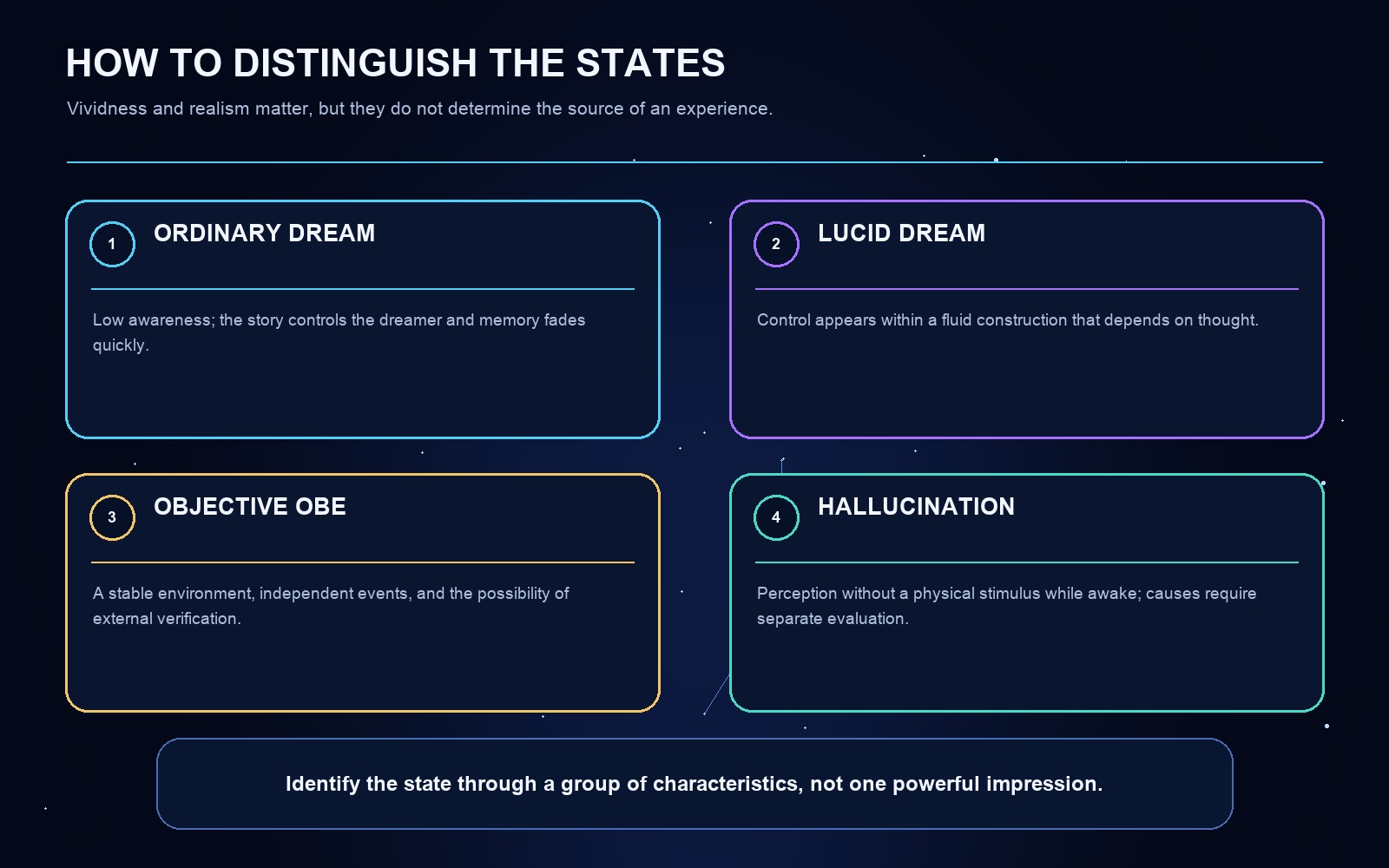
Ordinary dreaming: the story controls the dreamer
In an ordinary dream, a person has little control over what happens. He accepts illogical events as normal, moves rapidly between storylines, and rarely asks where he is.
The brain processes impressions, emotions, fears, and information from the day. The resulting imagery may be coherent or chaotic. Awareness is weak, and memory fades quickly after waking.
The central characteristic of an ordinary dream is that the person is inside a story without realizing that it is a story.
Lucid dreaming: clarity appears within a construction
In a lucid dream, the dreamer knows that he is asleep. He may choose an action, change the story, fly, create an object, or move to another location. Awareness alone, however, does not turn the surrounding space into an external reality.
If the environment instantly obeys expectation, characters repeat the dreamer’s own thoughts, and the scene changes without stable causes, the experience is most likely a mental construction.
Such a space can be beautiful, useful, and even transformative. But the dreamer’s own mind plays the leading role in creating it.

An out-of-body experience in the mental layer
This state is more complex. Separation from the body may occur consciously, the sensations may be extraordinarily realistic, and the person may retain a high degree of control. He can walk through the room, see the body, pass through walls, and follow a plan.
Yet the surrounding space may still be mental. Fear, religious imagery, daily impressions, and expectations create the setting and events. The experience is out-of-body in its mode of perception, but it does not provide an objective picture of an external world.
That is why I do not equate conscious separation from the body with reliable information.
An objective out-of-body experience
In what I call a clear or objective experience, the environment shows greater independence from the observer.
It has several characteristics:
- the surroundings remain stable;
- objects do not appear merely because the person thinks of them;
- unexpected details arise that were not planned;
- other beings act independently;
- information can sometimes be verified after returning;
- attempts to alter the environment through thought do not always succeed;
- the person retains a clear memory of the purpose and sequence of events.
This kind of experience is much less common than a mental one. Even for an experienced practitioner, most experiences contain some contribution from personal constructions.
What “hallucination” means in this comparison
The word hallucination is often used as a universal explanation for anything unusual. That is too crude.
A hallucination is generally defined as perception without a corresponding physical stimulus, occurring while awake or when the organism is impaired. It may be associated with fever, drugs, sleep deprivation, or neurological and psychiatric conditions.
An out-of-body experience also occurs without ordinary sensory input, but it has a different internal structure: a transitional state, a sense of separation, preserved awareness, and the capacity for sequential action outside the physical body.
One label cannot settle the nature of an experience. At the same time, unusual images or voices that appear during normal waking life, interfere with daily functioning, cause fear, or urge dangerous actions require professional medical evaluation. A spiritual explanation must never replace responsible health care.
Tests within the experience
To identify the state, I consider a group of characteristics rather than one dramatic effect.
Memory. Do I remember who I am, where my body is, and the purpose I chose?
Logic. Does the sequence of events remain coherent?
Stability. Does the room change when I look away or expect something different?
Independence of encountered beings. Do they provide unexpected information, or merely reflect my thoughts?
Agency. Can I pause, choose a direction, and return?
Verification. Is there a specific detail that can be compared with physical reality?
No single sign is absolute proof. Together, however, they allow a much more accurate assessment of the experience.
Why the states become mixed
Consciousness can move between layers of perception. An ordinary dream becomes lucid. A lucid dream leads to separation from the body. An objective observation becomes a mental scene under the influence of strong emotion.
For this reason, an entire experience should not be assigned one label from beginning to end. It is more useful to examine it episode by episode: Where did the environment remain stable? When did fantasy enter? What changed after fear or expectation appeared?
Realism is not the same as objectivity
This is the essential conclusion. A feeling of complete reality tells us how powerful an experience was, but it does not tell us who created the space.
I do not dismiss dreams or mental experiences. They reveal the activity of the mind, help us investigate fear, and demonstrate the creative power of consciousness. But if we want to study the structure of reality, we must learn to distinguish an internal construction from an environment that exists independently of us.
Awareness is more than the ability to wake up inside a dream. It is the ability not to deceive ourselves after we wake.
You can read more about dreams, the mental layer, and levels of out-of-body perception in my book The Phenomenon of Consciousness Beyond the Body.
Continue with the book on Amazon: Kindle Edition or Paperback.
Leave a Reply