
People seek unusual knowledge because they see freedom, power, and answers to life's deepest questions in it. Few of them consider in advance what that knowledge may cost.
I am not talking about money. I mean the inner responsibility that begins when the familiar picture of reality has been broken and we can no longer pretend that nothing happened.
Information does not always bring relief
An out-of-body experience can free a person from the fear of total extinction after death. It can bring hope and a sense of meaning. It can also shake a person deeply.
Imagine meeting a loved one who has died, seeing your own body from the outside, or entering a realm whose laws contradict everything you were taught. After returning, you still have to get up in the morning, speak with your family, go to work, and make ordinary decisions.
Consciousness must make room for two worlds without losing its connection to either one. That requires maturity.
Knowledge changes what we can demand of ourselves
Before we understand something, we can explain our behavior through habit, upbringing, or circumstance. Once we have seen how much thought, emotion, and intention affect our state, those old excuses lose their force.
If I understand that fear and expectation distort perception, I must account for them in my conclusions. If I know that a human being does not end with physical death, I must look differently at life, violence, and responsibility. If I speak to other people about nonphysical reality, I am responsible for recognizing when an observation has been replaced by fantasy.
Real knowledge increases responsibility, not superiority.

A powerful experience does not make someone a teacher
One of the most dangerous traps begins after a vivid experience. A person decides that he has received a special status, the final truth, or the right to direct others.
But the intensity of an event is not the same as depth of understanding. We may see a genuine fragment of another domain of reality and explain it incorrectly. We may meet an independent consciousness and misjudge its intentions. We may receive useful information and then add our own expectations to it.
After a powerful experience, the responsible response is not to declare oneself chosen. It is to examine oneself more carefully.
Responsibility toward the listener
When we speak about the unusual, our words may affect people who are living through fear, grief, or a serious crisis. We cannot perform certainty simply to gain attention.
I have the right to speak firmly about what I have repeatedly experienced and observed. I also have a duty to distinguish among:
- a direct observation;
- my conclusion based on that observation;
- information received from another being;
- a hypothesis that cannot yet be tested.
This distinction does not weaken an author's position. It makes it honest.
Some knowledge should not be shared immediately
During an out-of-body experience, a person may receive private information about someone else. Even if it appears accurate, that does not give us the right to intrude on another person's life.
Unrequested information can frighten, wound, or create dependence on the person who claims to know. Sometimes the responsible choice is silence. Sometimes we should wait until the person asks. Sometimes the information must be checked before we decide whether it has any practical value.
The ethics of investigation begins where the ability to affect another person begins.
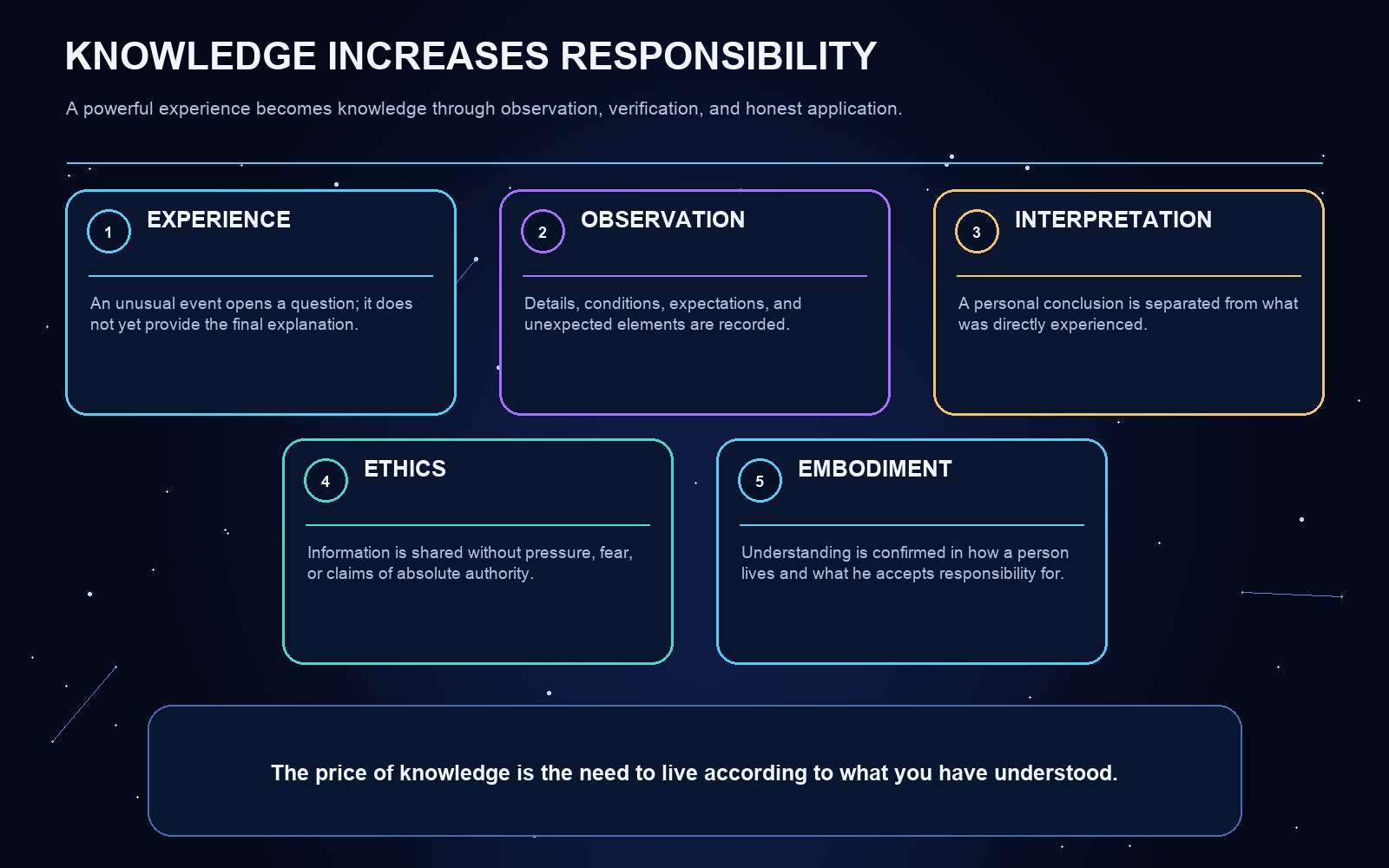
The price of knowledge is the loss of comforting illusions
After twenty years of practice, I cannot view a human being as merely a biological organism. I cannot regard death as consciousness simply switching off. I cannot hand full responsibility for my life to religion, government, science, or a spiritual teacher.
That brings freedom, but many convenient excuses disappear with it.
The wider our picture of reality becomes, the harder it is to live on autopilot. We must examine our motives, care about the quality of information, and admit our mistakes. We must preserve inner independence even in the presence of authority.
How to remain balanced
Unusual experience should be integrated into life gradually. It helps to keep a familiar rhythm, care for the body, meet one's obligations, and speak with people who can listen without ridicule or fanaticism.
Not every experience needs to become an immediate revolution in worldview. First, it should be considered. What repeats? How does it compare with earlier experiences? What can be verified?
If knowledge makes someone more anxious, arrogant, or dependent on new revelations, that person has not yet learned how to use it. If it brings calm, independence, and responsibility, it has become part of maturity.
Knowledge must serve life
I do not believe we should close ourselves off from difficult information. Consciousness develops through the investigation of the unknown. But a wider range of possibilities must be accompanied by a wider sense of responsibility.
The price of unusual experience is the need to live according to what we have understood: not to preach our own infallibility, but to become more honest; not to withdraw from the world, but to act in it more consciously; not to collect impressions, but to turn knowledge into the quality of our own life.
I explore this path and its consequences in The Phenomenon of Consciousness Beyond the Body.
Leave a Reply