
Sometimes, after a vivid dream or out-of-body experience, a person opens his eyes with remarkable clarity. The body feels rested, the thoughts are calm, and there is more energy than the day before. At other times, the experience seems brief, yet the morning begins with heaviness and fatigue.
I have observed both states. They show that the quality of a night's rest depends on more than the number of hours spent in bed.
The body and consciousness rest differently
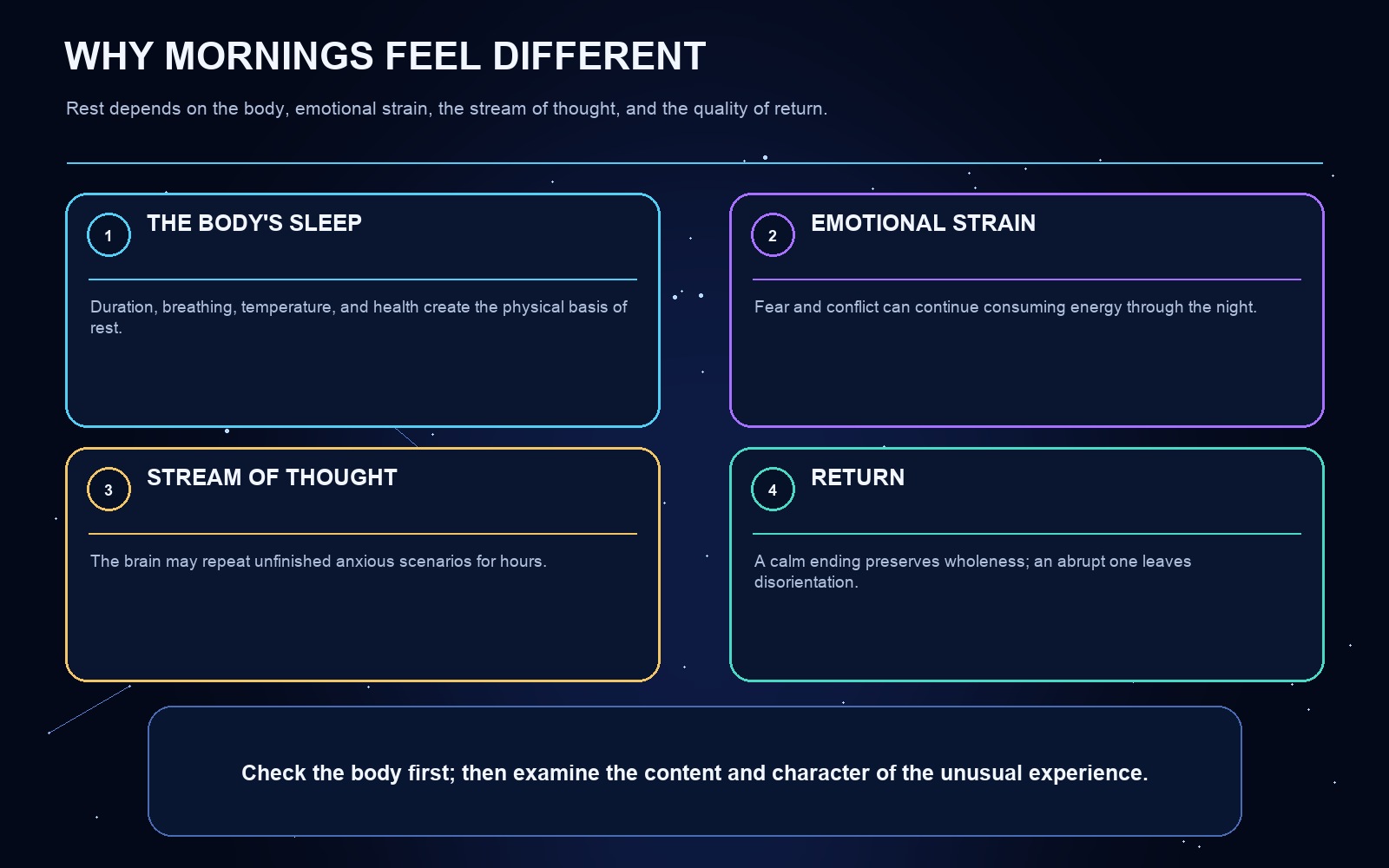
The physical organism needs sleep. During the night, brain activity changes, the body's systems recover, and accumulated information is processed.
Consciousness, as I understand it, does not switch off. It continues to exist and act even when the earthly personality retains no memory of what occurred.
In the morning, therefore, we receive the result of two processes at once: the condition of the physical body and the degree of harmony in the experience of consciousness.
A peaceful experience can restore energy
When the transition occurs naturally, without fear or inner struggle, consciousness does not spend its energy resisting. Time in a clear and harmonious realm can leave a person with profound calm after returning.
The feeling can be especially strong after contact with kindred souls or an experience on a higher level of reality. A person may not remember every detail, yet awaken with a sense of support, meaning, and inner coherence.
This kind of rest cannot be measured by sleep duration alone. Sometimes a few hours restore more than a long night filled with anxious scenarios.

Fear creates a burden
If a person becomes frightened by vibrations, sleep paralysis, or the fact of separation itself, the experience becomes a struggle. The brain and nervous system respond to fear as though the danger were physical.
Even when there was no external threat, the emotional tension remains real. After returning, a headache, racing heart, or sense of exhaustion may continue.
In such cases, the fatigue is usually explained not by the idea that “someone took my energy,” but by the fact that the person spent the night in a state of tension.
The mental stream can run all night
During sleep, the brain can endlessly repeat the day's conflicts, fears, and unfinished conversations. Mental scenarios form around the sleeping person and capture attention.
Consciousness appears to be moving, but it reaches nowhere. In the morning, it can feel as though we spent the entire night solving problems.
The more powerful the anxious stream of thought, the less inner quiet remains for recovery.
Sustained awareness also requires effort
A highly lucid out-of-body experience demands concentration. We must hold a purpose, maintain the state, and prevent the brain from quickly translating what is happening into an ordinary dream.
If the experience is long or emotionally intense, it may leave fatigue similar to what follows demanding intellectual work. This is not necessarily a sign of danger. Sometimes consciousness has done substantial work and the brain has had to receive and process an unfamiliar volume of information.
An abrupt return disrupts the feeling of rest
Returning to the body may be gentle or sudden—triggered by a sound, fear, physical discomfort, or an unexpected movement.
After an abrupt transition, disorientation is common. The heart and breathing need time to settle, and memory needs time to reconstruct the sequence of events. If a person jumps up and immediately turns to the day's tasks, the experience may feel like a form of nighttime stress.
Check ordinary causes first
Not every morning of fatigue is connected to a nonphysical experience. Insufficient sleep, sleep apnea, alcohol, medication, pain, stress, and many health conditions can interfere with the body's recovery.
It is a mistake to explain everything in terms of energy. If someone routinely wakes exhausted, has severe daytime sleepiness, experiences choking, pain, or other symptoms, physical health and sleep quality should be evaluated.
Conscious investigation does not replace care for the body.
Understanding your own case
It helps to compare several signs:
- how long the person actually slept;
- the emotional state before sleep;
- whether fear persisted during the experience;
- whether the experience was clear or made up of chaotic scenarios;
- whether the return was calm;
- whether fatigue occurs regardless of unusual experiences.
One episode rarely gives a precise answer. A repeating pattern tells us much more.
Rest is the restoration of wholeness
For me, good sleep is more than the body's stillness. It is the alignment of physical recovery, emotional condition, and the activity of consciousness.
When someone lives in constant anxiety, even ordinary sleep may not restore strength. When the person learns to quiet the mental stream and stop fighting natural transitions, nighttime experiences become more harmonious.
In The Phenomenon of Consciousness Beyond the Body, I discuss the role of energy, memory, and maintaining the state in greater depth.
Leave a Reply