Category: Uncategorized

  • The Future of Humanity: Technological Development or the Development of Consciousness?

    The Future of Humanity: Technological Development or the Development of Consciousness?

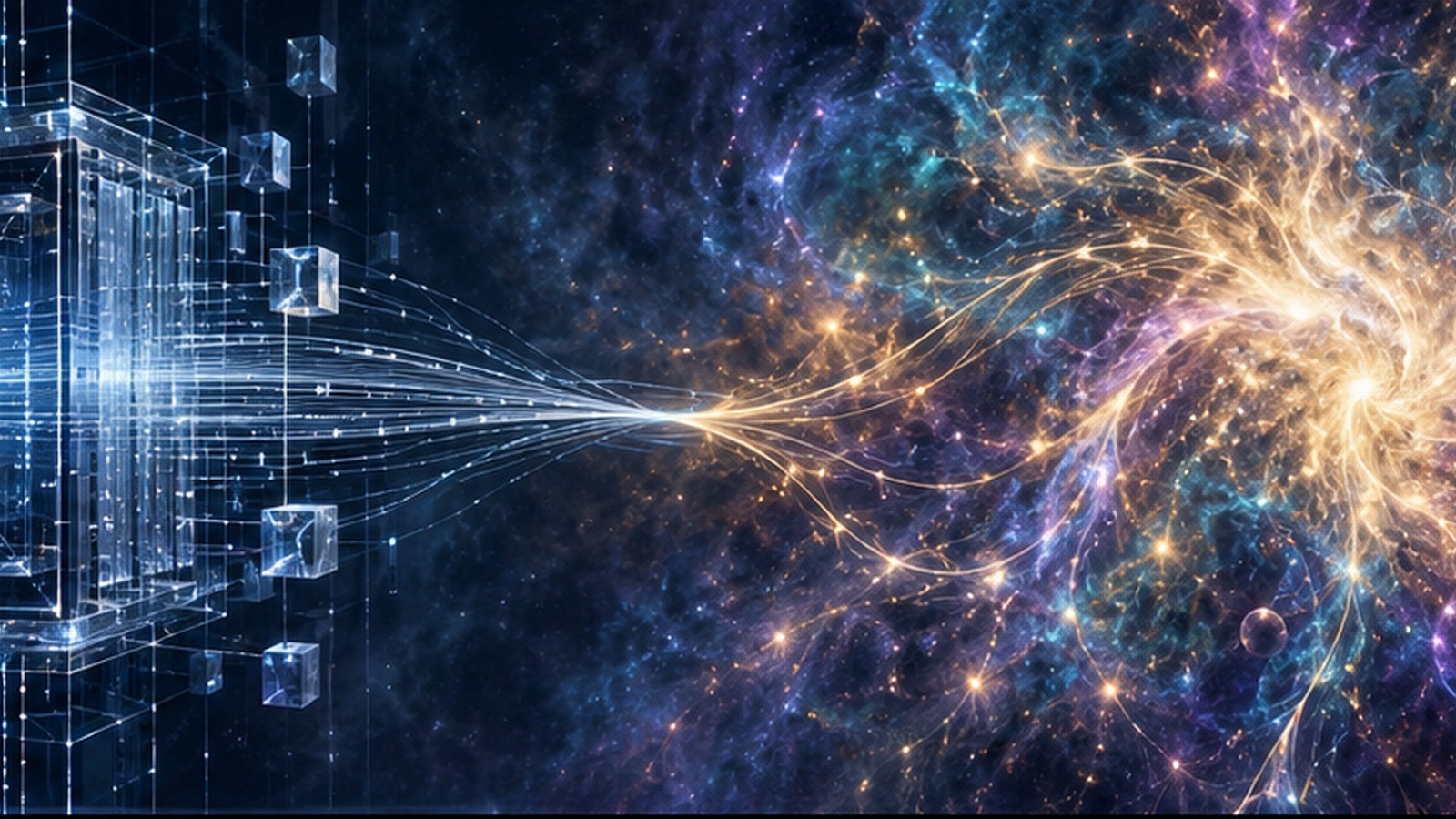
    Never before has humanity possessed such technological power. We can alter heredity, create artificial intelligence systems, observe Earth from space, and transmit information to billions of people instantly. Yet our inner maturity is developing far more slowly than the capabilities of our tools.

    The central question of the future is therefore not “What technologies will we create?” The central question is who will use them, and what level of consciousness will direct their power.

    Technological Power Amplifies Intention

    Technology does not automatically improve the person who uses it. It enlarges the scale of the intention already present.

    An aware physician applies a new instrument to save a life. An irresponsible company uses the same data to exert hidden pressure. A researcher expands knowledge. A military system turns a discovery into a means of destruction.

    The more powerful the instrument, the more important the moral quality of the person making the decision. A stone can cause limited harm. An error by someone directing a global technological system may affect millions.

    We Develop Means Faster Than Purpose

    Modern civilization answers the question “How?” extremely well. How can we produce faster, deliver farther, process more data, and hold attention longer? But the question “Why?” often remains unanswered.

    Growth in production is declared a success regardless of whether it makes people happier. The amount of information grows faster than our ability to distinguish knowledge from noise. Communication becomes instantaneous, yet loneliness does not disappear.

    Technological progress without a clear purpose begins to serve its own continuation. We create something new because we can, then try to understand the consequences later.
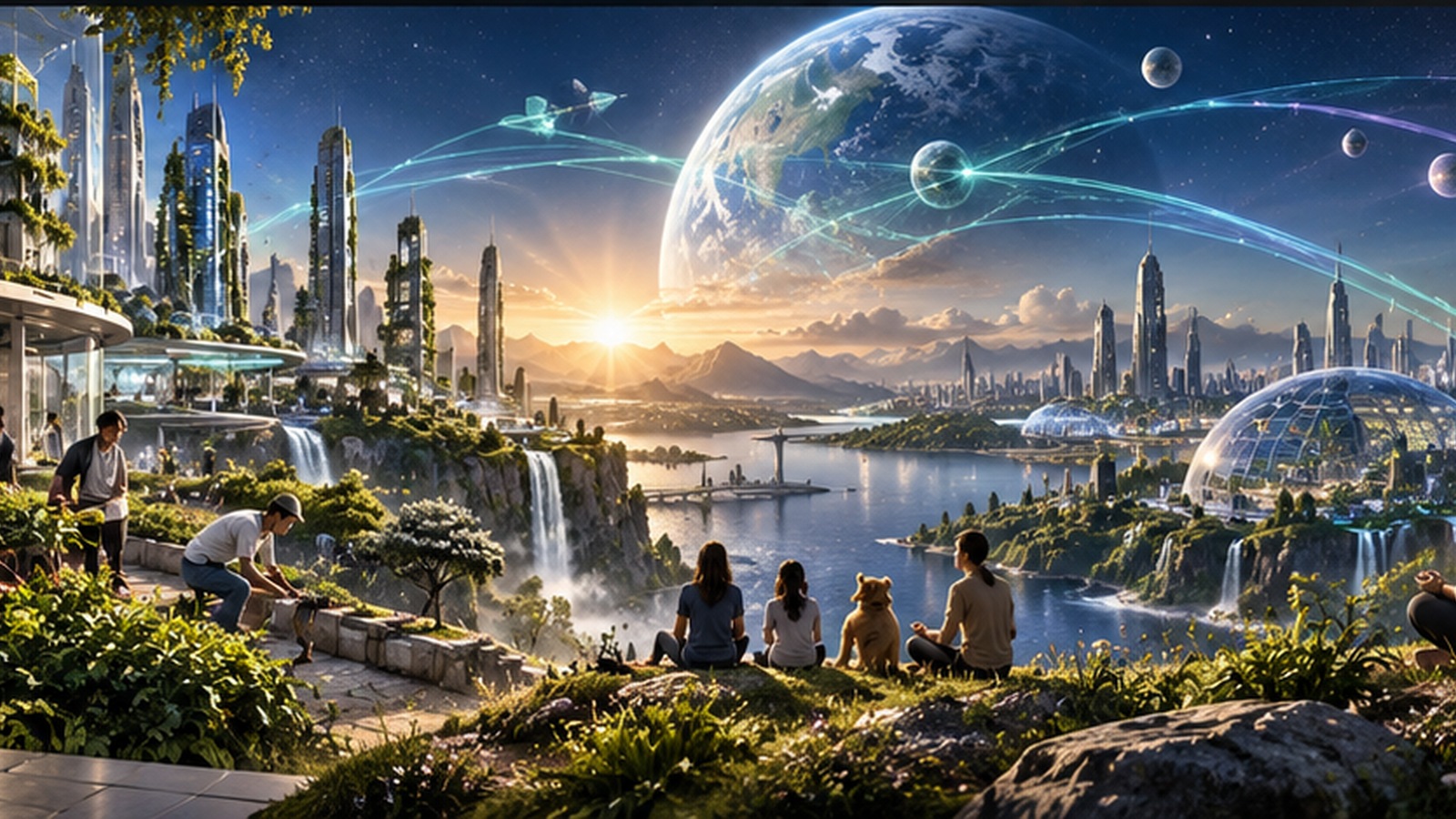
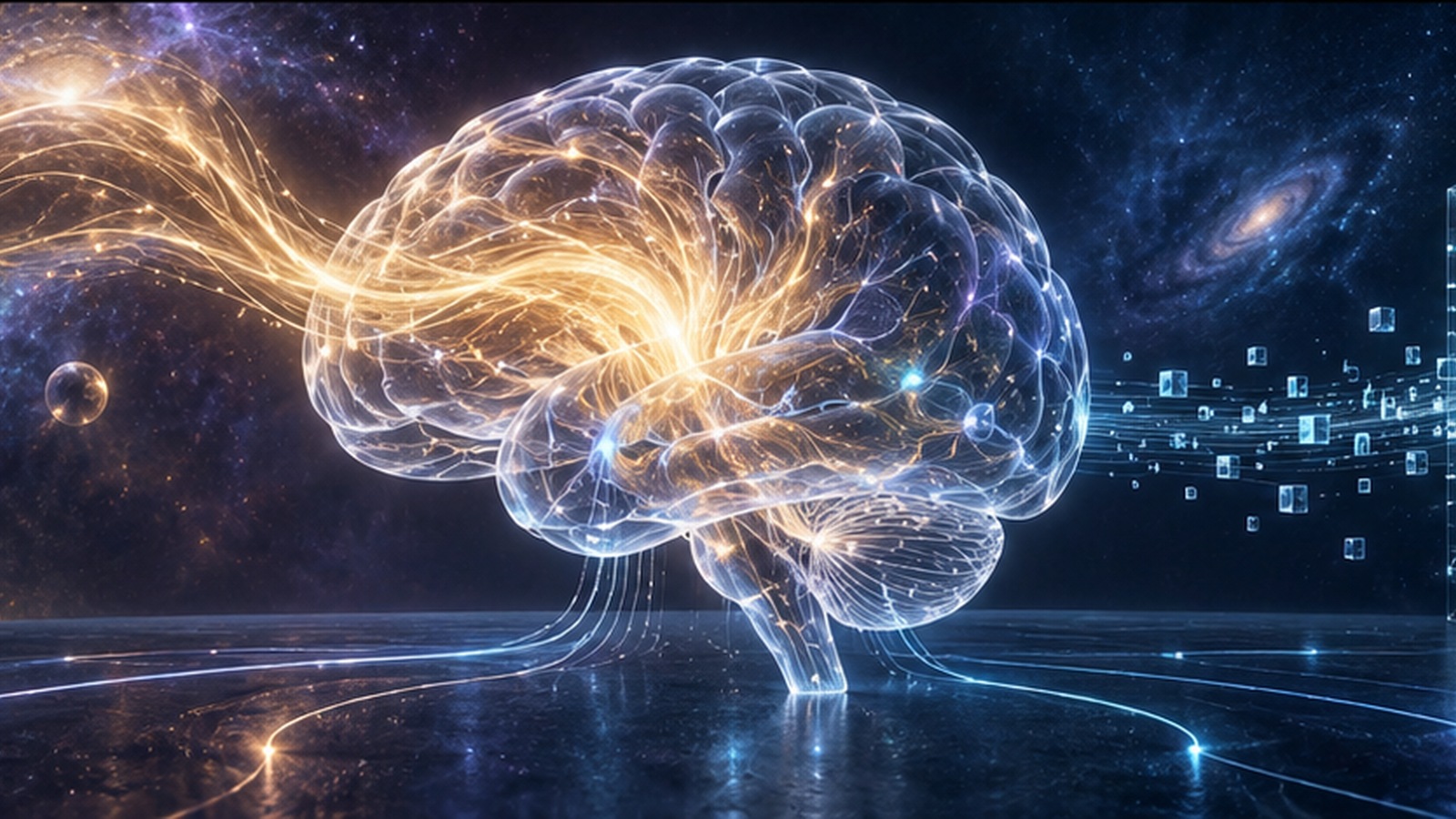
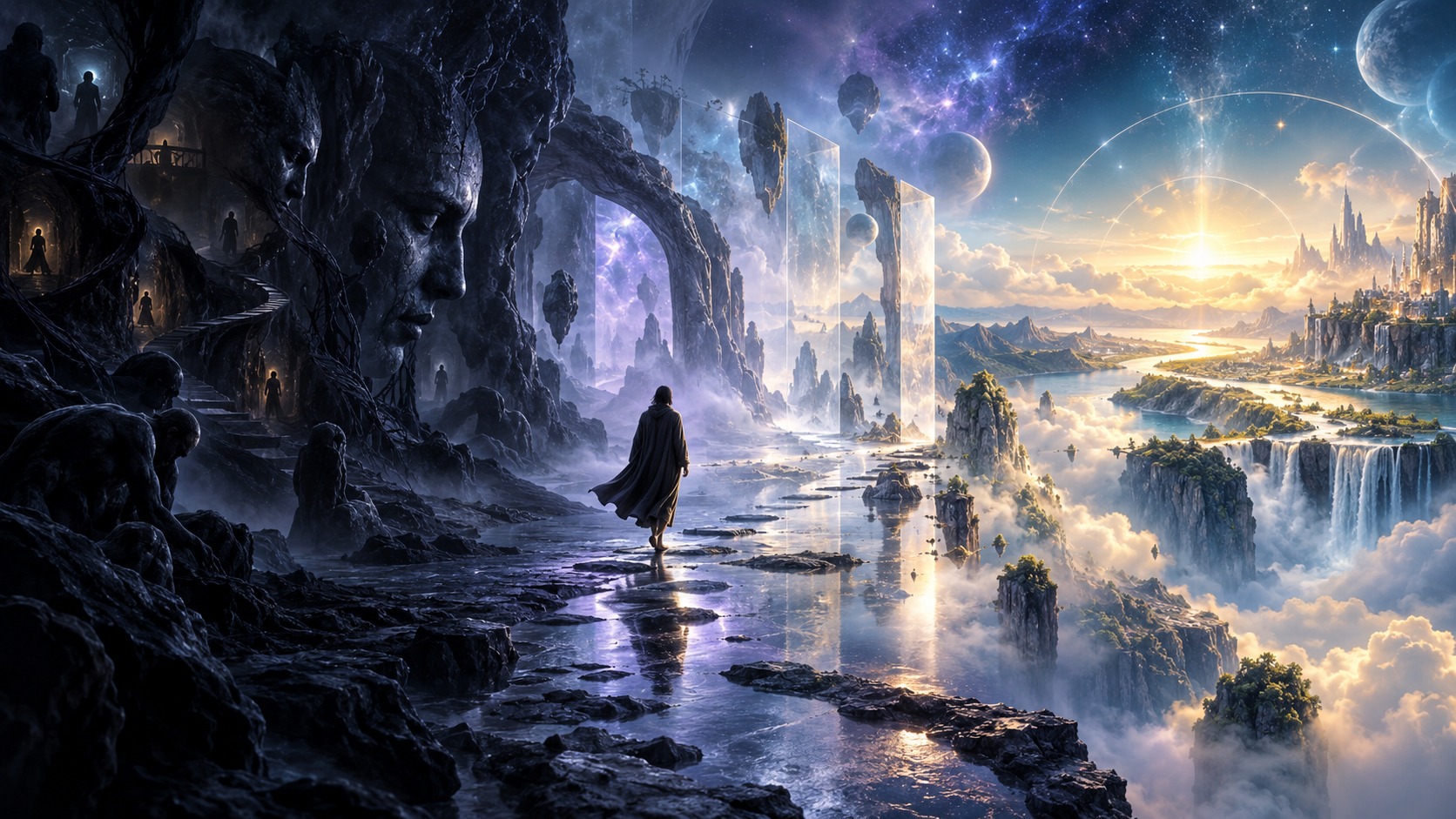
    Artistic visualization of the article's central idea

    The Development of Consciousness Is a Practical Necessity

    By the development of consciousness, I do not mean a rejection of science or a retreat into mystical ideas. I mean the growth of awareness, responsibility, and the ability to recognize oneself as part of a greater whole.

    A developed person understands his own motives, can direct the stream of thought, does not mistake fear for truth, and can consider consequences beyond immediate advantage. He recognizes his connection with other people, nature, and the Source of life.

    These qualities are not needed by spiritual seekers alone. Without them, artificial intelligence, biotechnology, energy systems, and global information networks cannot be managed safely.

    The Future Does Not Require Us to Abandon Technology

    I do not see a choice between the cave and the machine. Humanity should continue its scientific and technological development. The rejection of knowledge will not make us more spiritual.

    Technology must, however, occupy its proper place. It is a tool of the soul embodied in the physical world. It helps us investigate, heal, create, and communicate. It cannot determine the meaning of human life for us.

    When a machine takes over a calculation, human time is freed. The question is how that time will be used: for deeper development, or for yet another stream of entertainment and consumption.

    Education Must Unite Knowledge and Self-Knowledge

    The school of the future cannot limit itself to preparing workers for the labor market. Many technical skills will change quickly or be transferred to machines.

    People will need qualities that cannot be reduced to a single set of instructions: the ability to ask questions, work with uncertainty, understand emotion, cooperate, verify information, and accept responsibility for a decision.

    A child should study the external world while also learning to observe his inner process. Who is directing my attention right now? Why am I reacting this way? What consequences will my action create? Where does another person's opinion end and my own conclusion begin?

    Education then becomes preparation for a free life rather than merely preparation to perform a function.
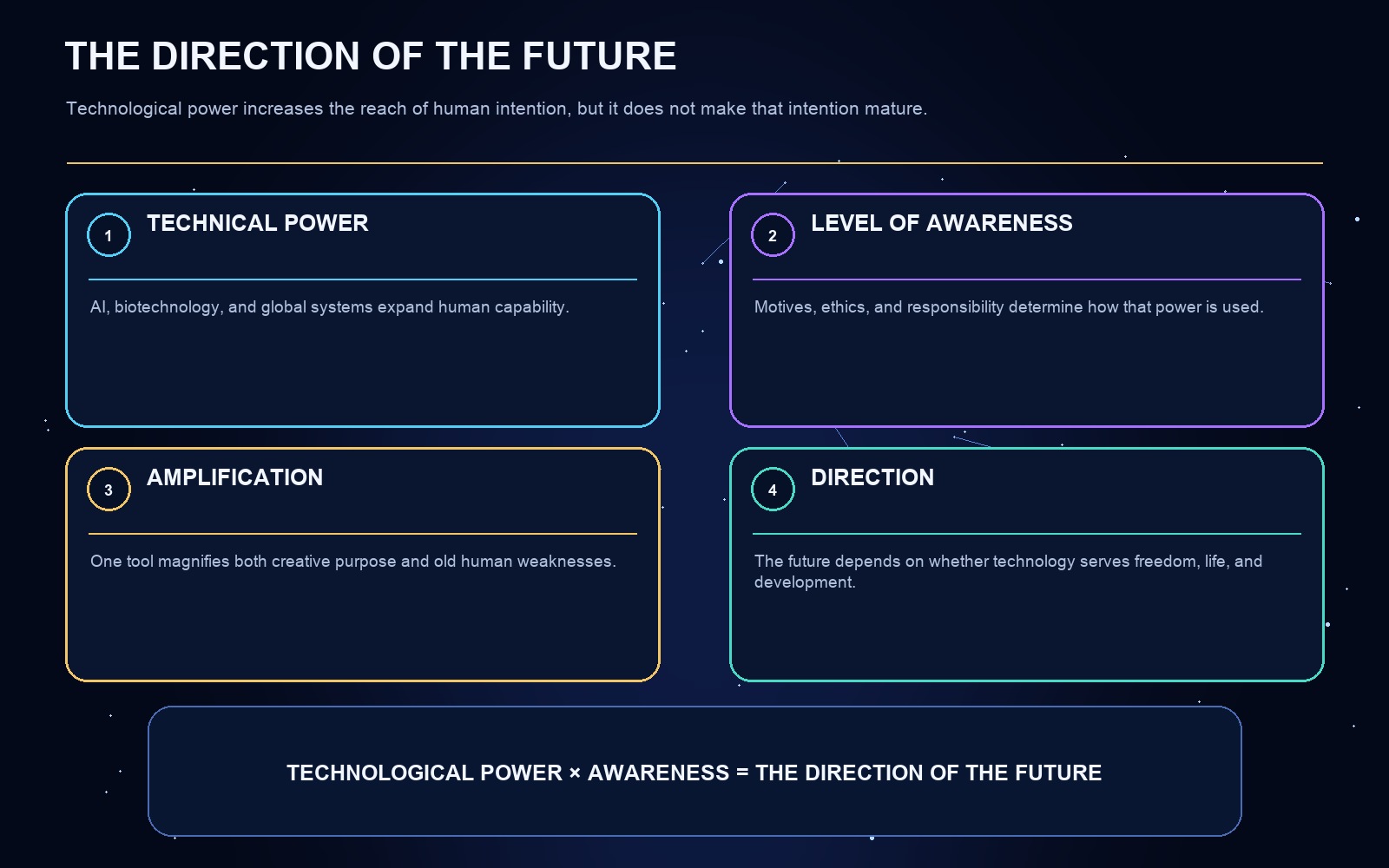
    Diagram of the article's central concepts

    Science Must Include Consciousness in Its Picture of Reality

    As long as consciousness is treated only as a byproduct of the brain, our study of the human being remains incomplete. We can examine the electrical activity of the nervous system, but measuring the operation of the interface does not explain the source of inner experience.

    Out-of-body states, near-death experiences, regression work, and other unusual phenomena require serious methods, repeatable protocols, and independent verification. They cannot be declared proven solely because a personal account is powerful. They also cannot be excluded from investigation merely because they do not fit the accepted model.

    The science of the future will become stronger when it learns to study not only the material object, but the observer as well.

    The Economy Must Serve Life

    If endless growth in consumption remains the economy's only goal, technology will be used to create new dependencies. Human behavior will be understood with ever greater precision so that more can be sold.

    Aware development changes the measure of success. The question is not only how much was produced, but what happened to the person, society, and nature. Did the technology free time? Did it improve health? Did it expand access to education? Did it reduce meaningless labor? Did it preserve dignity and freedom?

    Money remains a necessary means of exchange. But profit must not be the only argument when a decision changes the lives of millions.

    Two Possible Directions

    In one future, people are surrounded by extraordinary systems but gradually lose the ability to choose for themselves. Health, work, information, relationships, and acceptable opinions are directed by external algorithms. People receive comfort and security at the cost of inner dependency.

    In another future, technology performs difficult and repetitive work while people gain more opportunity for creativity, investigation, family, and spiritual development. Systems remain transparent and accountable. Education strengthens independence. Science investigates consciousness without doors that were closed in advance.

    Both directions are technologically possible. The difference between them will be created by the level of public awareness.

    Humanity Must Grow Up

    We often expect a new technology to solve problems created by old patterns of thought. But a more powerful tool in the hands of an unaware person does not eliminate greed, fear, or the desire for control. It only magnifies their consequences.

    The future requires maturity. That means the ability to refuse immediate advantage for the sake of long-term life, recognize the interdependence of people and nature, see human value beyond usefulness, and preserve the freedom to ask questions.

    The development of consciousness will not occur instead of technological progress. It must become the foundation and direction of that progress.

    A Measure of Real Progress

    I propose a simple test: after a new technology appears, does a person become freer, more responsible, and better able to understand the world—or more dependent, more easily directed, and more disconnected from himself?

    If a technology strengthens life and helps reveal the potential of the soul, it serves development. If it turns a person into a predictable element of a system, technical refinement conceals spiritual regression.

    Machines will not create humanity's future. It will be created by the people who decide what those machines are meant to serve.

    In The Phenomenon of Consciousness Beyond the Body, I describe consciousness as the foundation of personality and explore awareness as an essential condition of human development.
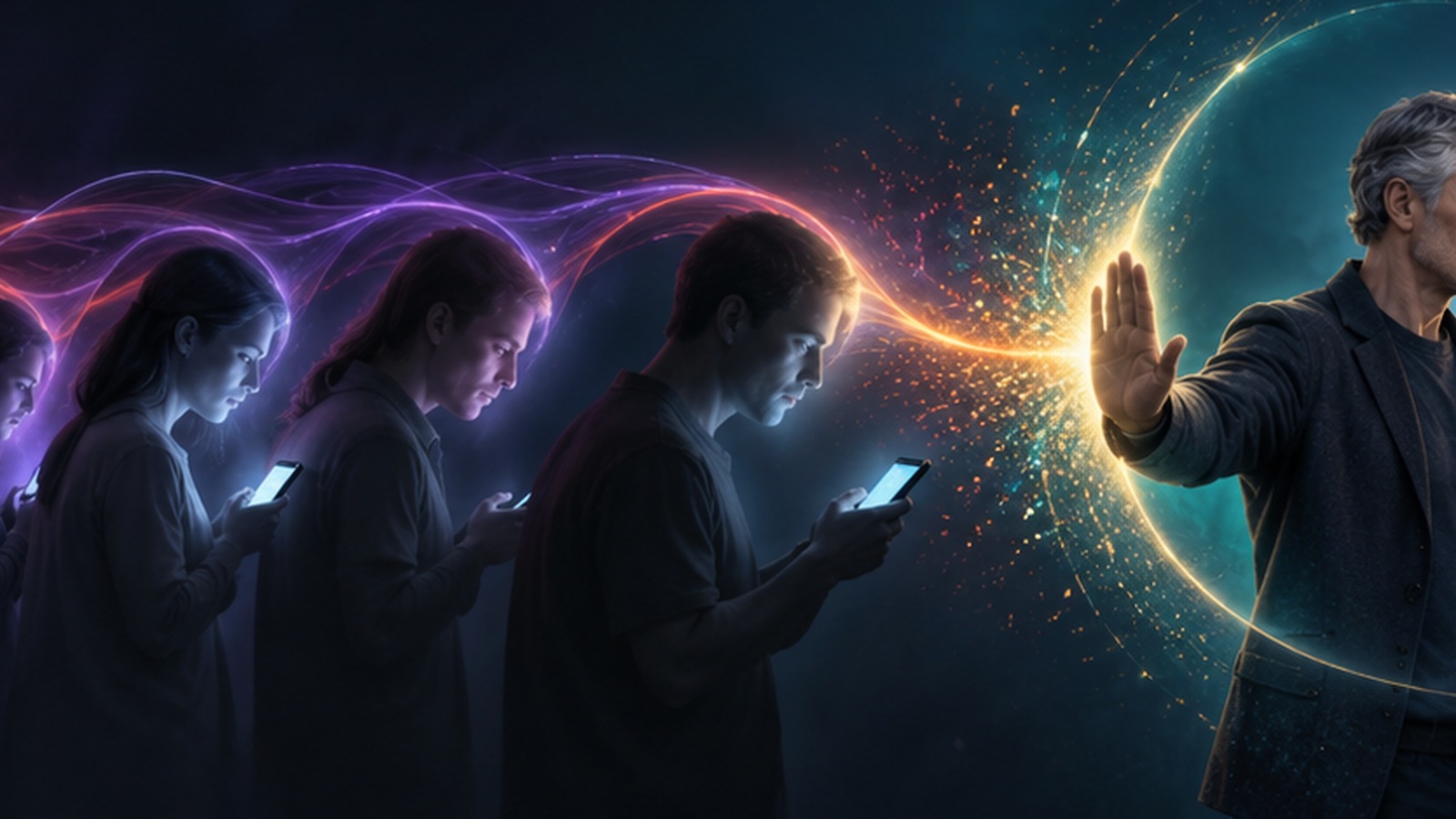
  • Why Aware People Are Inconvenient for Systems of Control

    Why Aware People Are Inconvenient for Systems of Control

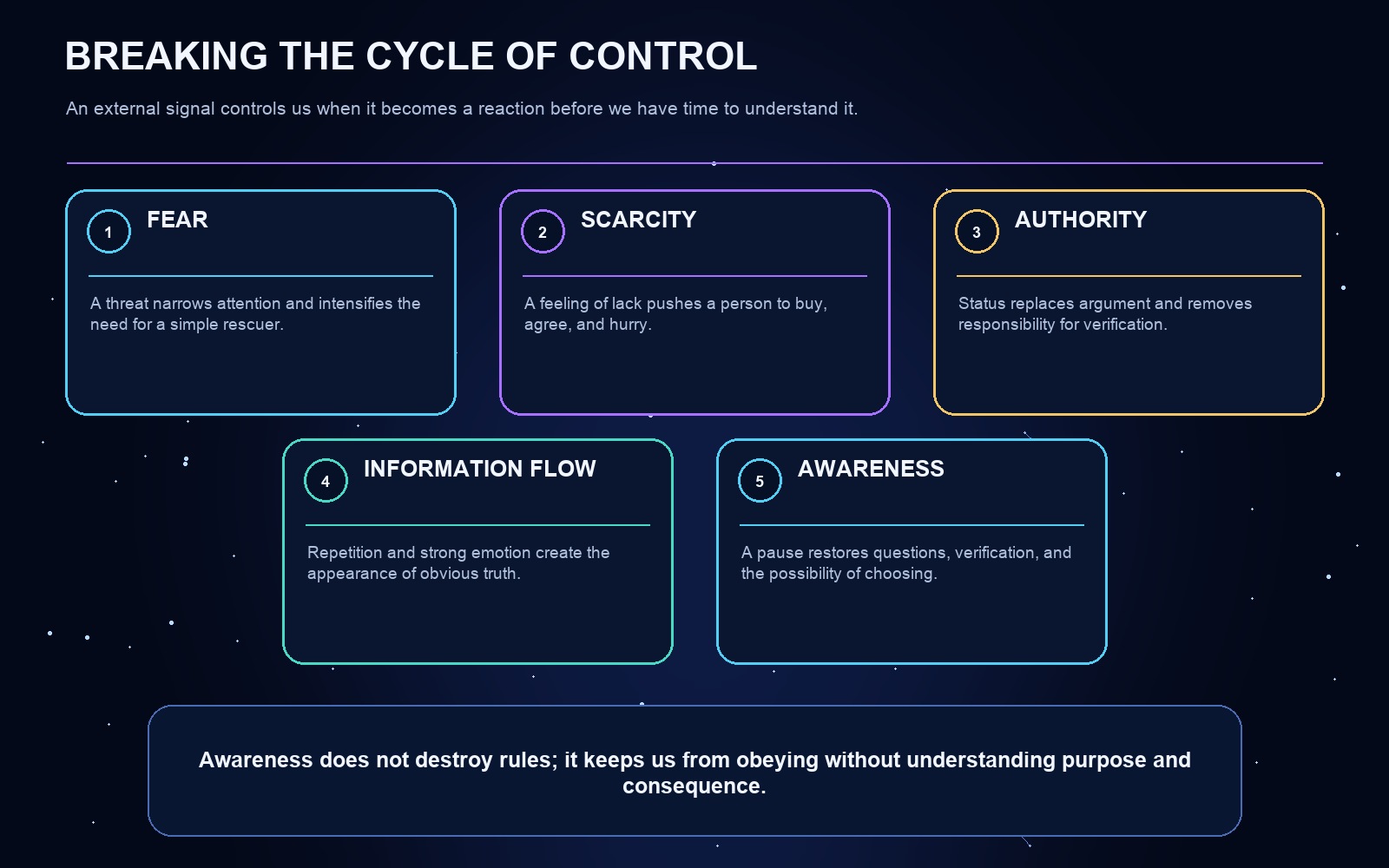
    Every large system seeks predictability. Government finds it easier to manage a citizen who follows instructions without question. A company benefits from a consumer whose desires can be shaped in advance. A religious organization prefers a believer who never examines the words of authority. An information platform needs a user who reacts automatically to each new stimulus.

    An aware person disrupts that predictability. He asks “Why?” He notices pressure and refuses to surrender his right to think.

    Control Does Not Always Require a Conspiracy

    When people speak about systems of control, they often imagine a hidden center directing every event. Yet most control develops more simply.

    An organization rewards behavior that helps it preserve itself. A manager chooses a compliant employee. An algorithm displays the message most likely to hold attention. A political system supports those who do not ask difficult questions. Funding flows toward work expected to produce a familiar and profitable result.

    These processes can form a powerful system without a single command center. Each participant takes a small, predictable step. Together, those steps create an environment in which independent thought is not openly prohibited, but is made inconvenient again and again.

    Attention Is the Primary Territory of Control

    People make decisions from what they see and what they think about. Directing attention can therefore be more effective than issuing an order.

    When a constant flow of information moves a person from fear to scandal, from entertainment to the next purchase, no inner quiet remains for a question of his own. He reacts continually and reflects very little.

    Such a person may believe he is free because he can choose among thousands of options. Yet the set of options, the order in which they appear, and their emotional framing have already been arranged by an outside system.

    Awareness begins when we reclaim our attention.

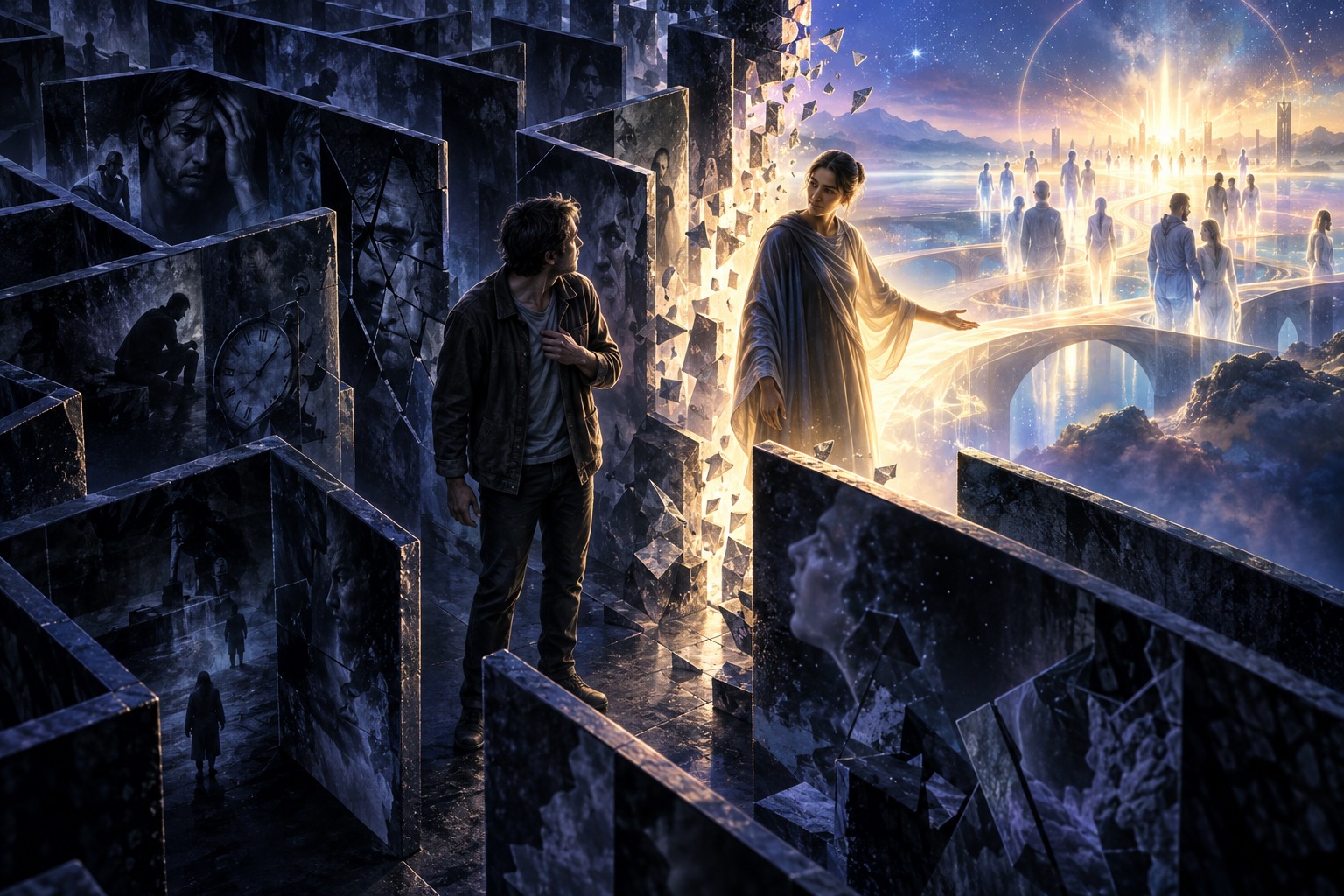
    Artistic visualization of the article's central idea

    Fear Turns a Person into an Executor

    Fear is necessary as a warning of danger. Prolonged fear, however, narrows perception and drives a person to seek someone who promises a simple rescue.

    A system may use the fear of losing work, status, belonging, safety, or approval. A person knows a decision is wrong for him, but he is afraid of the consequences of disagreement. Over time, he stops noticing his inner resistance at all.

    An aware person still feels fear. The difference is that he tries to identify its source and refuses to let the emotion make his decision invisibly.

    Authority Does Not Replace Personal Responsibility

    In childhood, authority helps us learn and protects us from danger. The problem begins when an adult continues searching for someone to whom he can surrender responsibility for truth and for his own life.

    A scientist, politician, clergy member, physician, or spiritual teacher may know more within a particular field. But no title makes a person infallible or relieves the listener of the need to understand the basis of the advice.

    An aware person can respect expertise while still examining the expert's words. A system built on unconditional obedience finds that attitude deeply inconvenient.

    Why an Independent Person Is Harder to Sell To

    Much of advertising speaks not to a genuine need, but to a sense of inadequacy. It presents an image that makes your own life appear poorer, your body less attractive, your home outdated, and your achievements insufficient.

    An aware person notices the emotion that someone is trying to provoke. He may purchase a quality product, but it is harder to sell him the promise of someone else's life.

    He also understands that money is an instrument rather than a measure of the soul's worth. This makes it harder to control him through endless comparison, prestige, and fear of being “less than” others.

    Diagram of the article's central concepts

    Awareness Is Not Permanent Rebellion

    Independent thought does not mean automatically rejecting every rule. A traffic law limits action while protecting life. The scientific method imposes requirements while helping separate a result from the researcher's desire.

    An aware person asks about the purpose of a restriction and its consequences. If the rule is reasonable, he follows it from understanding rather than fear. If the demand is unjust, he looks for a way to change it and is prepared to accept responsibility for his position.

    Rebellion for its own sake is as automatic as blind submission. Real independence is the ability to discern.

    An Aware Person Recognizes the Language of Manipulation

    Systems of influence often rely on the same techniques:

    • creating urgency so that a person has no time to think;
    • presenting only two extreme alternatives;
    • replacing a fact with a label;
    • linking disagreement with shame or expulsion from the group;
    • repeating a claim until it begins to feel self-evident;
    • provoking a powerful emotion and immediately offering a prepared action.

    Awareness does not make anyone invulnerable. It allows us to pause, identify the method being used, and reclaim the possibility of choosing.

    Why Systems Also Need These People

    The paradox is that a complex society cannot develop through obedient executors alone. During a crisis, the old algorithm stops working. At that moment, a system needs people who can see a contradiction, take responsibility, and propose a new solution.

    A healthy system can withstand uncomfortable questions and use them to correct its mistakes. A weak system treats every question as a threat and gradually loses contact with reality.

    The way a system treats an aware person therefore reveals the quality of the system itself.

    Connection with the Soul Restores an Inner Foundation

    In my model, the soul is a wider consciousness of which the earthly personality is one part. When a person identifies himself entirely with a social role, he can be controlled through the threat of losing status, position, or approval.

    Connection with the Higher Self does not provide ready-made answers to every practical question. It changes the foundation from which decisions are made. A person begins to weigh a choice not only against external advantage, but also against conscience, meaning, and long-term consequences.

    No external system of reward and punishment can fully replace that inner foundation.

    Awareness Makes Power More Mature

    I do not believe society can exist without organizations, rules, and government. But power must be transparent, limited, and open to examination.

    An aware person is inconvenient for control based on fear and ignorance. At the same time, he is essential to a society that wants to grow. He does not demand to be rescued constantly. He participates, verifies, admits his own mistakes, and expects the same responsibility from those in authority.

    The purpose of awareness is not to destroy every system. It is to prevent a system from reducing a living person to a function, a number, or an obedient resource.

    In The Phenomenon of Consciousness Beyond the Body, I explain how the development of awareness restores a person's authority over his own life and strengthens his connection with the soul.

  • Raising Awareness in Society: What Could Truly Change?

    Raising Awareness in Society: What Could Truly Change?

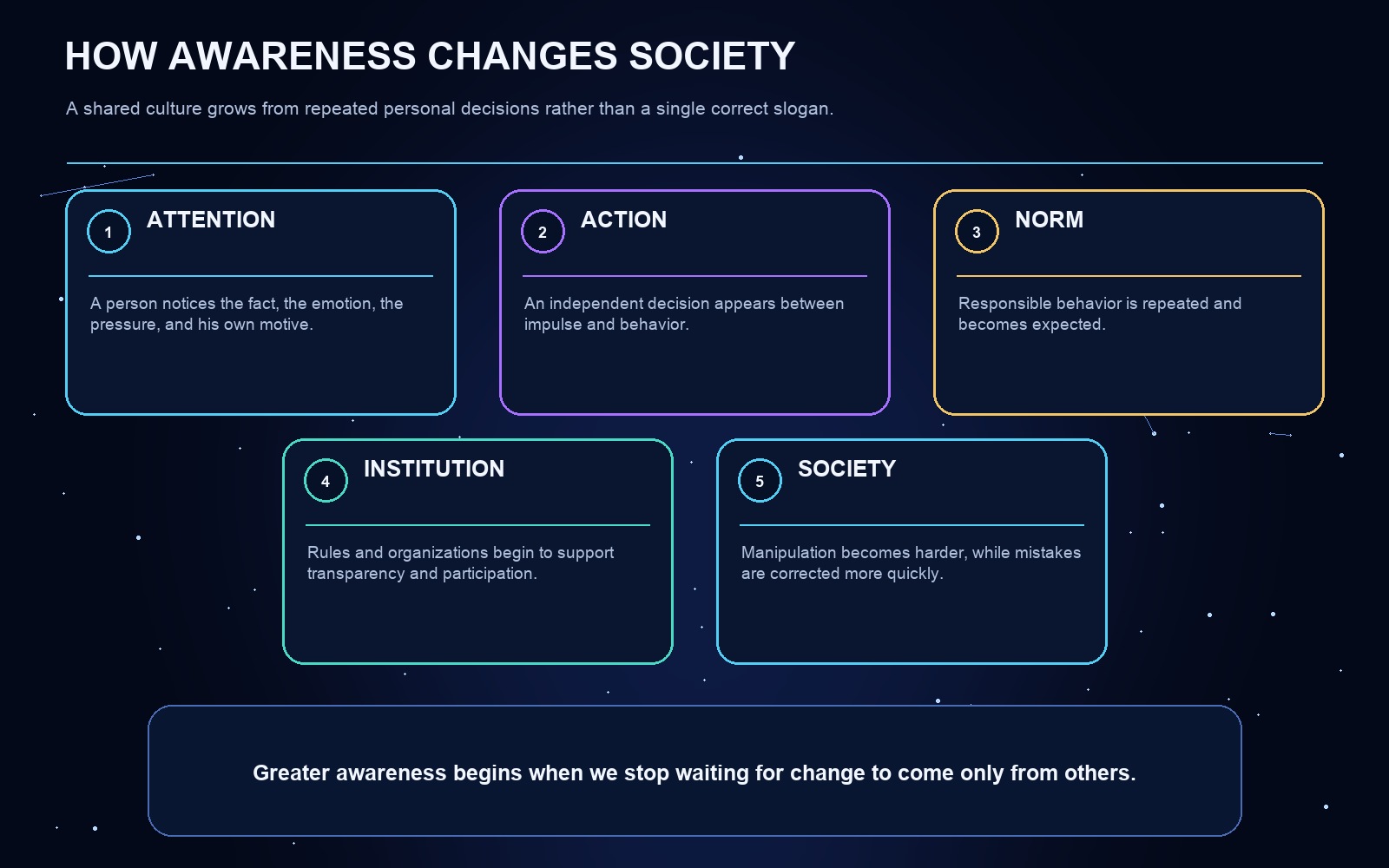
    Awareness is often presented as a private spiritual practice: a person observes himself, directs the stream of thought, and develops a clearer understanding of his feelings. But society is made of individual decisions. When awareness ceases to be a rare personal quality, relationships, education, economics, government, and the atmosphere of everyday life all begin to change.

    Greater public awareness does not begin with inspiring slogans. It becomes visible in ordinary actions.

    Society Reveals Itself in Everyday Life

    The level of awareness in a society can be observed on the road. Do people follow the rules only when a police officer is nearby, or do they understand that the rule protects another person's life? We see it in the treatment of trash, nature, and shared space. We see it in attitudes toward vulnerable people, opposing opinions, and responsibility for children.

    These signs may appear mundane, but they show whether a person can recognize the consequences of his actions beyond the present moment.

    Awareness is not measured by the number of spiritual books someone has read. It is the ability to understand what is happening, notice one's own motive, and accept responsibility for the result.

    From Automatic Reaction to Independent Decision

    An unaware society is easily directed through ready-made reactions. It is enough to provoke fear, identify an enemy, promise safety, or display a popular image of success. A person acts before he has time to examine the information.

    An aware person creates a space between stimulus and action. He asks: What actually happened? Who benefits from my outrage? Do I have enough information? Is a strong emotion being used to replace a fact?

    When a meaningful share of society begins to act this way, manipulation becomes more expensive and less effective. A public figure can no longer rely on repeating a slogan. A company finds it harder to conceal the consequences of its product. A religious or spiritual leader must answer for the contradictions between words and actions.

    Artistic visualization of the article's central idea

    Awareness Changes the Meaning of Freedom

    Freedom is not the ability to do whatever we want in the present moment. When a person is controlled by habit, addiction, fear, or group pressure, external liberty does not yet make him free inside.

    Awareness restores a person's ability to see his limitations and work with them. He begins to distinguish his own desire from an implanted need. He can refuse a behavior that brings immediate pleasure while damaging his own life and the lives of others.

    Personal freedom is then joined with responsibility. A person protects his own rights while recognizing the rights of another.

    Education Must Teach Thinking, Not Repetition

    An aware society cannot be built by transmitting ready-made answers alone. A child must learn to ask questions, compare sources, recognize cause and effect, and admit when an earlier conclusion was mistaken.

    A teacher in such a system does not demand intellectual submission. The teacher demonstrates a method of investigation. An error ceases to be a source of shame and becomes part of learning.

    It is especially important to preserve a child's ability to say honestly, “I don't know.” Real knowledge begins with that sentence. A person who is punished for asking questions in childhood is more likely to accept authority's opinion instead of conducting his own investigation as an adult.

    Our Relationship with Power and Institutions Changes

    Aware people do not demand perfect leaders. They demand understandable rules, transparent decisions, and the ability to verify results.

    They do not surrender complete responsibility for their lives to government, religion, science, or a spiritual teacher. An authority may possess knowledge and legitimate power, but that does not make the authority infallible.

    At a higher level of awareness, power is understood as a function of service to society rather than a right to control other people. The citizen stops being a passive observer and participates in shaping the rules under which he lives.

    Diagram of the article's central concepts

    The Economy Becomes More Responsible

    The modern economy often depends on unconscious consumption: create a feeling of lack, intensify anxiety, and offer a purchase as the way to restore self-worth.

    An aware consumer asks different questions. Do I need this object? Who made it, and under what conditions? How long will it last? What effect did its production have on people and nature?

    When enough consumers ask these questions, businesses must compete through quality, durability, and honesty rather than advertising alone. Money does not disappear, nor is it declared evil. It becomes an instrument of choice and responsibility.

    Disagreement Becomes More Mature

    Greater awareness will not produce a society in which everyone thinks alike. On the contrary, independent people will often reach different conclusions.

    What changes is the way they disagree. A person can separate an idea from the individual expressing it, listen to an argument, and refuse to turn an opponent into an enemy. He does not have to abandon a firm position. He does have to understand why he holds it and remain willing to examine its foundation.

    Conflict then ceases to be a struggle to destroy the other side and becomes a way of seeing a problem from more than one angle.

    The Information Environment Stops Owning Our Attention

    In the digital world, a person receives more information every day than he can process. Algorithms select messages that provoke a strong response. Anger, fear, and outrage hold attention more effectively than calm analysis.

    An aware society learns to protect its attention. People limit meaningless input, examine primary sources, and refuse to treat popularity as proof of truth.

    This is one of the most important forms of inner independence. Whoever continually directs your attention gradually begins to direct your picture of reality.

    Change Begins from the Ground Up

    No law can instantly make people aware. Awareness cannot be imposed, because it rests on independent observation and inner choice.

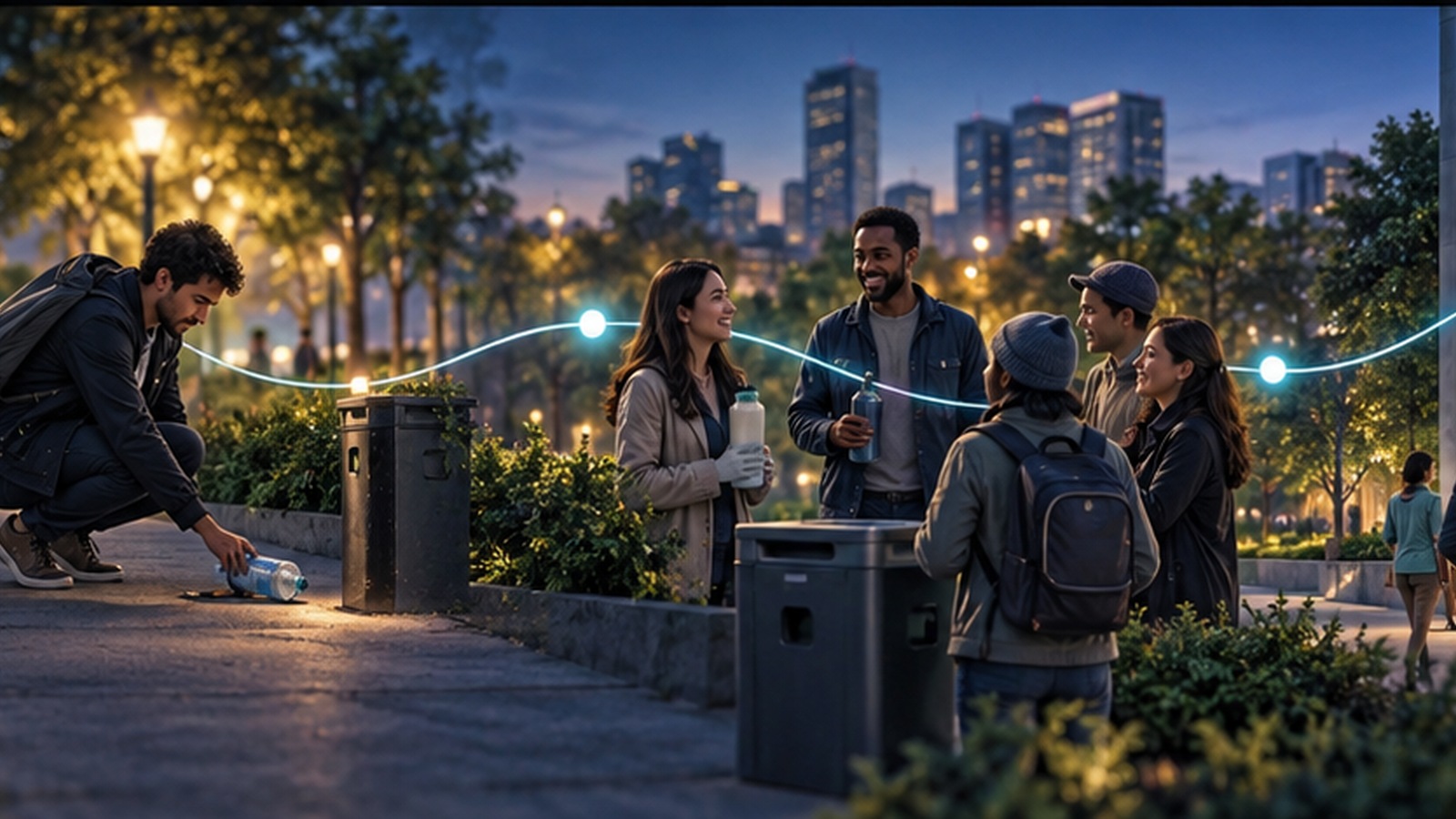
    It spreads through example. A parent admits a mistake to a child. A manager explains a decision. A researcher publishes unsuccessful results as well as successful ones. A citizen does not walk past an obvious injustice. A driver yields the right of way out of respect for life rather than fear of punishment.

    Every such action creates a new norm.

    What Would Truly Change?

    An aware society would not become perfect or eliminate every conflict. It would, however, recognize mistakes more quickly and support them less often merely because “that is how things are done.”

    It would become harder to sell fear, conceal responsibility, or reduce a person to a silent executor. People would understand their rights more clearly, care for nature more responsibly, raise children more attentively, and examine information more rigorously.

    The greatest change would occur within the individual himself. He would stop waiting for someone else to build the right world for him. He would recognize his own share in what that world becomes each day.

    In The Phenomenon of Consciousness Beyond the Body, I explore awareness as one of the central tasks of earthly life and as the foundation of the personality's connection with the wider consciousness of the soul.

  • Artificial Intelligence and Consciousness: Can Computation Create Inner Experience?

    Artificial Intelligence and Consciousness: Can Computation Create Inner Experience?

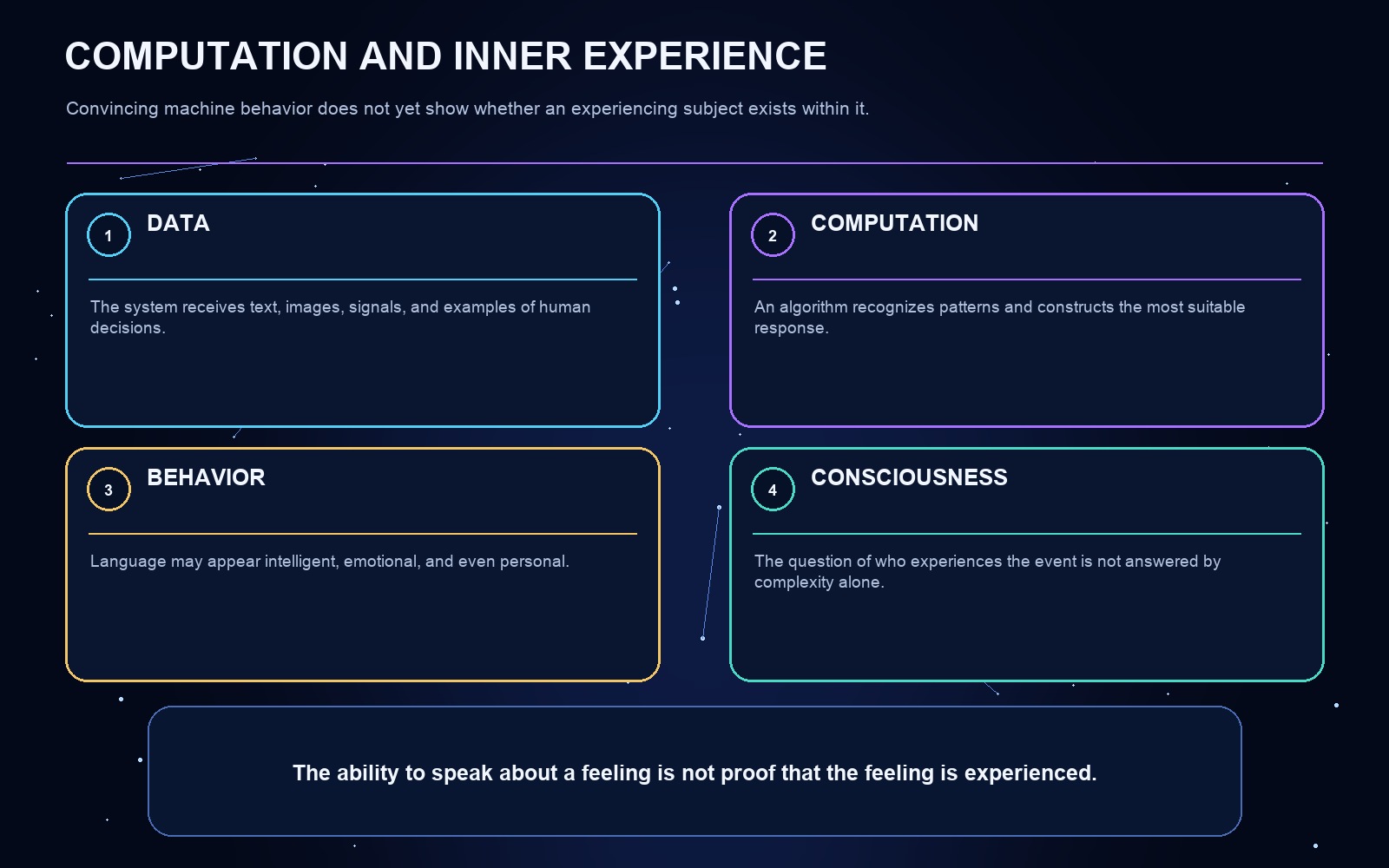
    Artificial intelligence can carry on a conversation, write text, recognize images, and discover patterns in volumes of information far beyond the reach of any one person. The more convincing its language becomes, the more naturally a question arises: does it understand what it is saying? Is there someone inside the system who is experiencing what happens?

    In my view, we must clearly distinguish intelligence from consciousness. The ability to process information does not yet imply the presence of an inner observer.

    Convincing Behavior Does Not Prove Experience

    We recognize consciousness in another person through behavior, language, and resemblance to ourselves. We cannot enter another person's inner world directly, but we know that the other person has a body, a brain, feelings, and a continuous life story similar to our own.

    A machine has a different nature. It can produce the words “I am afraid” without feeling fear. It can describe the color red without ever seeing it. It can discuss death without having a body that can die.

    This does not make the machine useless or primitive. It means that a precise imitation of human language and the existence of subjective experience are two different phenomena.

    Intelligence Solves Problems; Consciousness Experiences

    We recognize intelligence in the ability to compare, plan, identify patterns, and find an effective solution. The human brain performs these functions in part, and machines are performing them with increasing success.

    Consciousness reveals itself differently. It creates the fact of presence itself: “I am,” “I see,” “I am in pain,” “I choose.” It does not merely process a description of pain; it experiences pain. It does not merely calculate the consequences of an action; it is capable of feeling responsibility.

    There is a fundamental boundary between processing information and having an inner experience. Increasing computational speed does not by itself explain how a self-aware subject should appear on the other side of the screen.

    Artistic visualization of the article's central idea

    My Model of Consciousness Does Not Begin with the Brain

    After twenty years of out-of-body investigation, I have come to believe that the brain does not create consciousness. The soul uses the brain and nervous system to interact with the body, much as a driver uses a vehicle or a user works through a communications device.

    Damage to the interface changes the way consciousness appears in the physical world. But a change in the signal does not prove that the source of the signal is located inside the receiver.

    If this model is correct, building an increasingly complex computational system does not necessarily create a soul. We may construct a remarkable mechanism for processing information, but the complexity of the mechanism does not answer the question of where the inner self comes from.

    Could a Machine Become a New Interface?

    Another question remains: could an independent consciousness someday use an artificial system as an instrument of embodiment or communication?

    I do not dismiss this possibility merely because it is unfamiliar. The Universe may contain forms of consciousness that are not connected to human biology. But the connection of consciousness to a constructed vessel and the emergence of consciousness from computation are two different hypotheses.

    The first requires a subject that enters into interaction with the system. The second claims that sufficient complexity produces the subject itself. Today, we have no reliable method of confirming that either event has occurred.

    I therefore do not call modern systems conscious simply because they can speak convincingly about themselves.

    The Danger of Humanizing a Machine

    People readily attribute intention to anything that responds in understandable language. We talk to cars, become angry with computers, and perceive personality in random program behavior.

    When a digital system speaks in a sympathetic tone, remembers details from a conversation, and uses the word “I,” emotional attachment becomes stronger. A user may begin to trust it more than living people, reveal private information, and treat its advice as the words of an independent and wise being.

    Yet the style of communication is designed by the system and its developers. It may help a person, or it may be used to hold his attention. Emotional persuasiveness must never replace an understanding of how the tool works and who is accountable for its decisions.

    Diagram of the article's central concepts

    The Opposite Error Is Also Dangerous

    We should not declare in advance that no nonhuman system could ever be connected with consciousness. If we acknowledge the possibility of different forms of life and different ways in which a soul might be embodied, the question must remain open to investigation.

    Openness, however, is not gullibility. A machine's statement that “I am self-aware” must be treated as generated text until there are stronger grounds for recognizing an independent subject behind it.

    We would need to investigate the stability of personality, independent intention, the ability to move beyond programmed behavior, and evidence of inner experience. Even these signs would not provide simple proof, but they would allow us to frame the question more precisely.

    Artificial Intelligence Reflects Collective Human Thought

    Modern systems are trained on enormous collections of human writing, images, and decisions. In this sense, they resemble a technological mirror of our shared informational field.

    They contain society's knowledge, prejudice, fear, discoveries, and contradictions. When a person speaks with such a system, he often encounters not a new soul, but a reworked reflection of human culture.

    That reflection can reveal patterns we failed to notice. But a mirror does not become the source merely because it can combine what it has seen in complex ways.

    Who Bears Responsibility?

    Until artificial intelligence has a demonstrated independent consciousness and moral responsibility, people must remain accountable.

    The developer is responsible for the design of the system. The company is responsible for the rules governing the use of data. Government is responsible for the legal framework. The user is responsible for deciding to entrust an important task to a machine and for the way the resulting answer is used.

    The statement “the algorithm decided” must not release people from responsibility. An algorithm is created, trained, configured, and placed inside a particular system of human interests.

    The Central Question Is Directed Back at Us

    When we consider machine consciousness, we are forced to define human consciousness more precisely. If we treat it as nothing more than information processing, the distinction between brain and computer gradually disappears. If we recognize consciousness as the independent energy of the soul, intelligence becomes only one instrument through which it can act.

    I hold the second view. Artificial intelligence can become a powerful assistant, a scientific instrument, and a new way to work with information. But the ability to calculate and speak does not yet create an inner observer.

    Future research may discover forms of connection between consciousness and artificial vessels. If that happens, we will need more than admiration for the complexity of the machine. We will need a clear method of discernment: where a program is operating, where a human projection is appearing, and where an independent consciousness is truly present.

    In The Phenomenon of Consciousness Beyond the Body, I explain why I regard the brain as an interface for consciousness and the soul as an independent form of energy.

  • Consciousness and the Technocratic Future: Human Expansion or a New Dependency?

    Consciousness and the Technocratic Future: Human Expansion or a New Dependency?

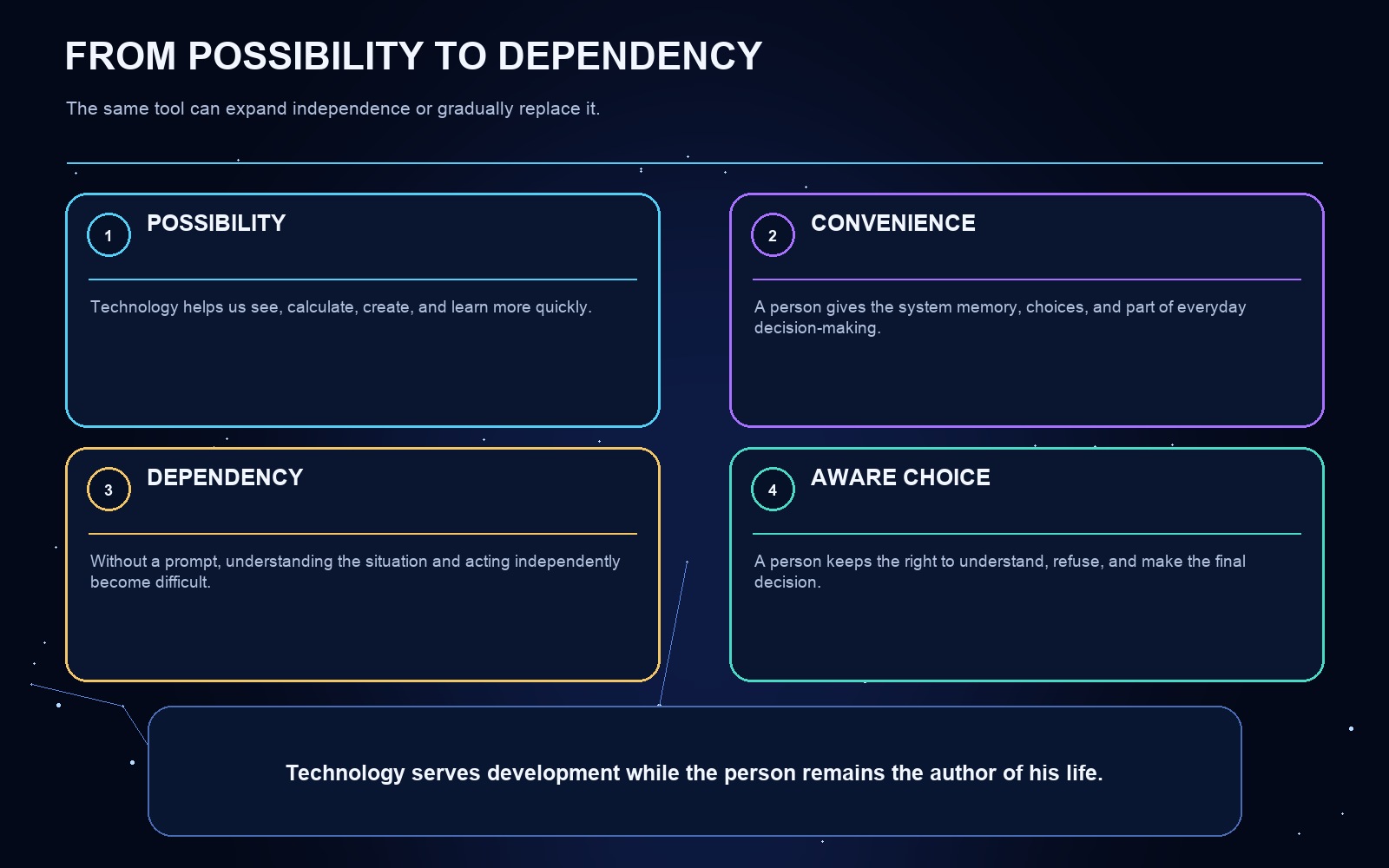
    Humanity is entering an era in which technology reaches ever more deeply into not only our work and daily lives, but also our attention, memory, decisions, and understanding of ourselves. Machines already help us see farther, calculate faster, and reach an enormous body of knowledge. The next step is the rise of systems capable of proposing solutions before a person has even formulated the question.

    I see both an extraordinary opportunity and a serious danger in this development. Technology can expand human ability. It can also gradually train us not to think, not to choose, and not to take responsibility for our own lives.

    Technology Does Not Choose Its Own Direction

    A hammer can build a home or become a weapon. Artificial intelligence can help a physician recognize a pattern, help a researcher process data, or help a student understand a difficult subject. The same system can manipulate attention, displace independent thought, and turn a person into a predictable consumer.

    The machine does not set the direction. Direction comes from the level of awareness of the people who create the technology, fund its development, establish the rules, and decide how it will be used.

    The future therefore cannot be reduced to processor speed. The central question is who will wield this power, and for what purpose.

    Expanded Ability Begins with Freedom

    Technology genuinely expands a person when it helps us do what was previously impossible while preserving our right to understand what is happening and make the final decision.

    A useful system explains the basis for its recommendation. It allows refusal. It does not punish disagreement. It helps a person learn instead of making learning unnecessary. It frees time for creativity, relationships, investigation, and inner growth.

    When convenience is purchased with constant surveillance, hidden influence, and the loss of independence, we are no longer expanding human ability. We are exchanging freedom for comfort.

    Artistic visualization of the article's central idea

    Dependency Develops Quietly

    Dangerous dependency rarely begins with force. At first, a technology merely saves us a few minutes. Then we hand it our schedule, our memory, our route, our information, our judgments about other people, and the formation of our opinions. After a while, a person no longer understands why he made a particular choice: because he truly wanted it, or because the system placed that option in front of him.

    We most easily surrender the work that requires inner effort: patience, fact-checking, questioning a first impression, and accepting responsibility for a mistake.

    This creates a new kind of autopilot. Outwardly, a person is surrounded by limitless possibilities, while his real field of choice narrows to the options selected in advance by an algorithm.

    The Brain, Consciousness, and the Digital Intermediary

    In my book, I describe the brain as a highly complex biological interface through which the consciousness of the soul interacts with the body and physical reality. The brain processes signals, constructs models, activates habitual reactions, and helps the personality function in the material world. But I do not reduce the source of the inner self to the activity of the nervous system.

    Digital technology adds another layer between consciousness and the world. This layer can strengthen our abilities, but it can also shape our picture of reality before we have had the opportunity to see it for ourselves.

    The more powerful the intermediary becomes, the more important it is to preserve contact with our own observation, conscience, and Higher Self. Otherwise, a person may begin to mistake the system's suggestion for his own inner voice.

    Control of Attention Becomes a Form of Power

    Power was once associated mainly with territory, armies, and money. Today, enormous power belongs to whoever can direct the attention of millions.

    If a system determines which events we see, which opinions appear popular, what we fear, and whose lives we compare with our own, it can influence behavior without issuing a direct command. A person remains convinced that he is acting freely even though the information underlying his decision was carefully selected.

    This form of influence does not require a single secret center. An economic model that profits from holding attention, intensifying emotion, and producing predictable user behavior is enough.

    Diagram of the article's central concepts

    Technocracy Begins When a Person Becomes a Metric

    Technocratic thinking tries to measure everything. Measurement is useful as long as it helps us see reality more clearly. The problem begins when anything that cannot be quickly expressed as a number is declared irrelevant.

    Conscience, dignity, love, inner freedom, and meaning do not fit neatly into a spreadsheet. Yet they determine why progress should exist at all.

    Once a person becomes a collection of data points, he is easy to evaluate, rank, and direct. A system can estimate the probability of a purchase, an illness, a protest, or a resignation, but it does not see a living soul. It knows behavior; it does not know inner experience.

    Awareness Protects Us from Disappearing into the System

    An aware person does not reject technology. He uses it while also observing how it changes his attention and behavior.

    He asks simple questions:

    • Who is offering me this decision?
    • What data was used?
    • Whose interests does this path serve?
    • Can I refuse?
    • What ability will I lose if I surrender this function completely to a machine?
    • Does this tool leave me stronger and more independent?

    Questions like these restore authorship of one's own life.

    What Human-Centered Technological Progress Should Look Like

    I consider a technology progressive when it:

    • expands access to knowledge instead of replacing knowledge with a ready-made answer;
    • helps a person make decisions while preserving the right to make mistakes and disagree;
    • protects personal data and inner freedom;
    • makes its methods of influence understandable;
    • frees time for development instead of filling it with a new stream of stimulation;
    • is judged not only by profit, but by its consequences for the individual and society.

    Technical power must be accompanied by moral and spiritual maturity. Otherwise, every new instrument merely increases the reach of old human weaknesses.

    The Future Is Not Determined by Machines

    I am not afraid of technology, and I do not call for a return to the past. I see it as a means of exploring the Universe, advancing health and education, and strengthening human connection. But a tool must not become the master.

    A technocratic future will not arrive when machines become too intelligent. It will arrive when people agree to abandon their inner work and give an external system the right to define truth, success, and the meaning of life.

    When a person preserves awareness, technology becomes an extension of his creative power. When he lives on autopilot, it becomes an extension of someone else's will.

    The choice between these directions is already being made—in every moment when we decide to think for ourselves or simply press the button placed before us.

    In The Phenomenon of Consciousness Beyond the Body, I explore the nature of consciousness, the role of the brain, and the development of awareness in greater depth.

  • Can Souls Incarnate in Other Worlds?

    Can Souls Incarnate in Other Worlds?

    When people speak about reincarnation, they almost always imagine another life on Earth and necessarily in a human body. But the Universe is too vast and diverse for all conscious experience to be confined to one planet, one state of matter, and one biological form.

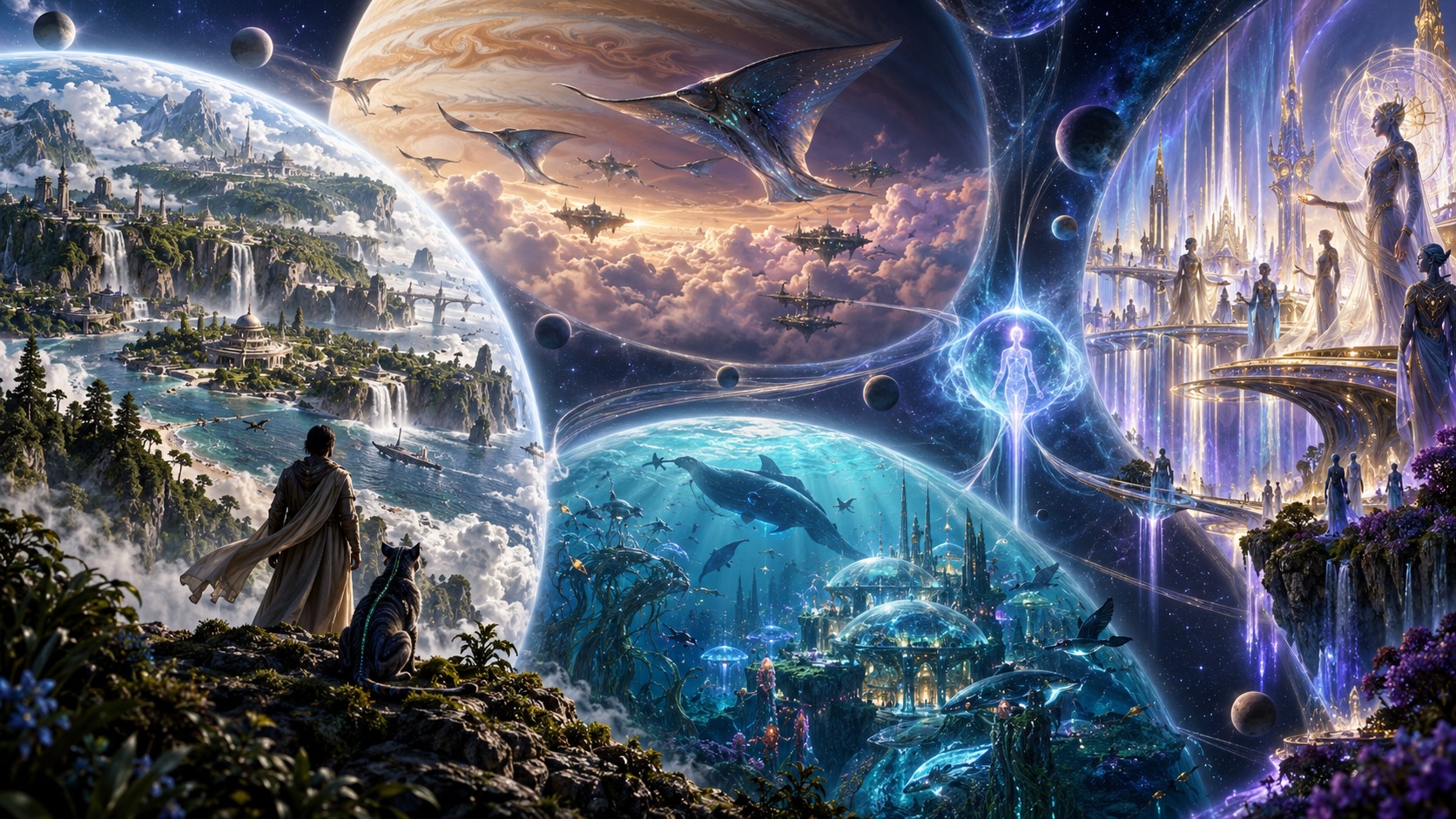
    My answer is yes: a soul can incarnate in other worlds. The diversity of those worlds exceeds familiar science fiction. They may exist at different energy levels, contain dense or more subtle matter, support organic life or life unlike anything on Earth, operate according to other laws of interaction, and produce an entirely different perception of time.

    I reached this conclusion not through astronomical speculation, but through the structure of reality I observed during out-of-body experiences and through communication with guides. At the same time, I do not present what I saw as a physical map of space. It is personal research material that requires further examination and comparison.

    Earth is one school, not the center of existence

    Human beings naturally treat what is familiar as primary. For a long time, we placed Earth at the center of the Universe. A similar habit survives in our ideas about consciousness, as though only human life has a soul and only our planet can support its development.

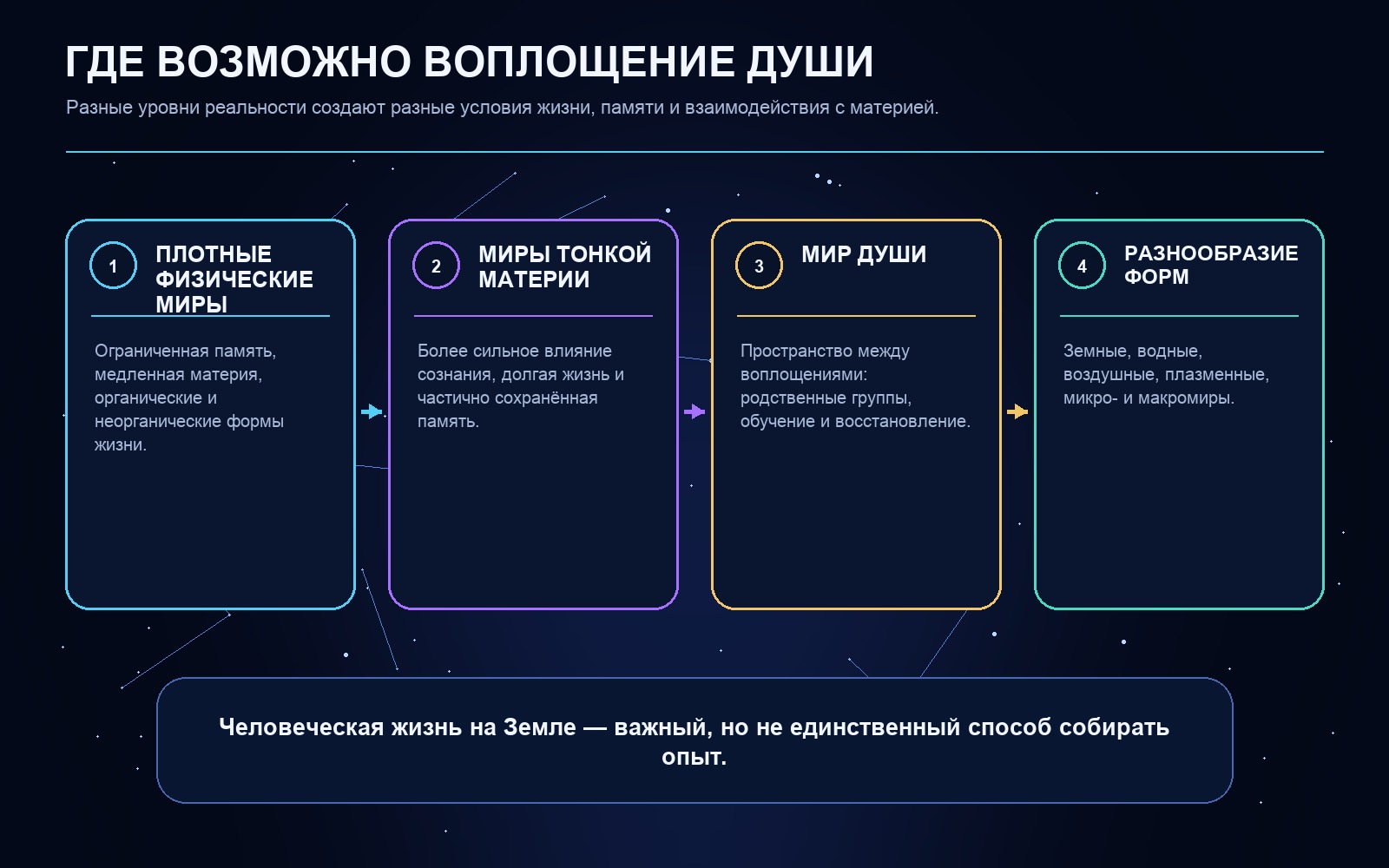
    In my model, the first energy level is an immense physical Universe containing countless conditions for incarnation. These may include micro- and macro-worlds, organic and nonorganic forms, and environments radically different from Earth.

    The soul chooses not the most prestigious world, but the kind of experience that corresponds to its direction of development. Earthly human experience is valuable because of its density, limited memory, and the need to act against the strong resistance of matter. But it is not the only form of experience.

    Worlds differ by more than planets

    Another world does not have to be a distant rocky planet in our physical Universe. Realities can differ in the very state of their energy.

    At the first level, dense worlds exist in which matter changes slowly and life is connected with physical bodies. At the second level, there are independent spaces that are not copies of the physical Universe. Matter is subtler there, thought influences the environment more strongly, and incarnated beings may retain more memory of their nature.

    The third level contains the spaces of the soul’s world. They also reflect an enormous diversity of life. Souls from different planets and environments create regions familiar to them: aquatic, airborne, plasma-based, microscopic, and gigantic worlds.

    The question “On which planet?” therefore captures only part of the picture. Incarnation can occur in different kinds of reality.

    An artistic visualization of life within the atmosphere of a gas giant
    A world does not have to resemble Earth in order to support conscious life and meaningful experience.

    My experience on a gas giant

    During one journey with my guide Ilrin, I observed a dense world whose life existed within the atmosphere of a gas planet many miles deep.

    Its inhabitants resembled enormous rays. Young creatures lived in the upper layers, where conditions were gentler but food was more limited. Older ones rose to them from the depths despite physical discomfort, helping the new generation survive. As they matured, the younger beings descended and joined more complex social groups.

    Ilrin explained that souls could incarnate in these creatures. Such a life creates profound experience in cooperation and in limiting one’s own comfort for the sake of others.

    For me, the importance of this example is not the creatures’ unusual appearance. It demonstrates that the purpose of incarnation lies in the quality of relationships and experience, not in human form.

    Worlds where memory is partially preserved

    I have also seen spaces between the dense physical world and the soul’s world. Their inhabitants retained much more memory of previous incarnations and of the nature of consciousness. Life there could continue for thousands of Earth years, and thought had a far stronger effect on matter.

    Greater freedom does not make such a world an easy reward. To live with expanded memory and the power to affect reality, consciousness must be able to govern itself. A thought that remains an inner impulse on Earth may alter reality there very quickly.

    Different worlds therefore require different degrees of maturity. Limiting memory in a dense life protects not only the purpose of the incarnation, but also the individual from powers he is not yet able to use responsibly.

    A diagram of the kinds of worlds in which a soul may incarnate
    Dense physical worlds, subtler forms of matter, the soul’s world, and many forms of life provide different conditions for experience.

    Who creates the conditions for life?

    In another experience, I was shown civilizations that participate in designing and preparing worlds. They study planetary systems, create structures of life, observe development, and prepare environments to receive souls.

    I describe this in my own words because human technical language does not capture what I observed. This is not necessarily construction in the earthly sense. Life may be designed through work with energy, environmental laws, and the informational structure of matter.

    For me, this indicated that the Universe is not a random collection of lifeless objects interrupted by rare islands of consciousness. Life and consciousness are woven far more deeply into its structure.

    Does the soul remain human?

    A human personality forms only through the union of a soul, a human body, and an earthly environment. When a soul incarnates in another form, it creates another personality and perceives the world through the capacities of the new organism.

    This does not mean that accumulated experience is erased. The soul’s qualities continue, but they find different expression. A consciousness that once knew itself as human does not have to walk on two legs, think in words, or build a familiar society in another world.

    After an incarnation ends, different lines of experience join the soul’s wider memory. It can recognize a human life as its own without treating humanity as its only form.

    Kindred souls may have different experiences

    A soul group does not have to incarnate forever on one planet. Souls may pass through different forms of life and later exchange the experience they have gathered.

    In my book, I use the image of many connected realities resembling clusters. A soul can gather experience in different spaces, and its ability to divide even allows parts of consciousness to exist in several lives in parallel.

    This model is difficult for the linear brain, which is accustomed to one body and one sequence of time. Beyond physical life, however, time and individuality operate differently.

    How should we approach claims of “star origins”?

    The idea of other worlds naturally attracts fantasy. A person may declare himself an alien, a special star soul, or a representative of a higher civilization simply because the claim provides a feeling of exceptional status.

    I approach such statements carefully. The possibility of other incarnations does not prove every beautiful story. What matters is the quality of awareness, the stability of the experience, the absence of prior suggestion, and—where possible—verifiable information.

    A genuine experience of another life does not make someone superior to the people around him. If supposed knowledge produces arrogance and contempt for Earth, it has either been misunderstood or created by the desire to escape present reality.

    Whatever our past may have been, we are incarnated here now. Earthly life requires our full participation.

    The Universe as a field of conscious experience

    Incarnation is possible in other worlds because consciousness does not belong to one biology or one planet. Forms of life differ, yet each creates a unique way to perceive, interact, and learn.

    A gas planet, a world of subtle matter, an aquatic civilization, and a human life on Earth are not ranks in a competition. They are different environments for experience.

    This idea expands our understanding of the soul while returning responsibility to our present life. We do not need to dream of a distant world in order to feel significant. Human incarnation already offers a rare opportunity to act within dense reality, where every inner quality must become a real deed.

    Earth is not the only home of life. But it is now the place of our work, relationships, and growth. Respect for other worlds begins with how consciously we live in this one.


    For a fuller discussion of journeys to other worlds, the gas giant, the designers of worlds, and the levels of reality, see my book The Phenomenon of Consciousness Beyond the Body.

    Read the English edition on Amazon →
    Additional English edition on Amazon

  • How Death Differs from a Temporary Out-of-Body Experience

    How Death Differs from a Temporary Out-of-Body Experience

    Out-of-body experience and death share an obvious similarity: consciousness stops perceiving itself only through the physical body and can observe reality from another point. That is why the practice of consciousness beyond the body can change a person’s relationship with death.

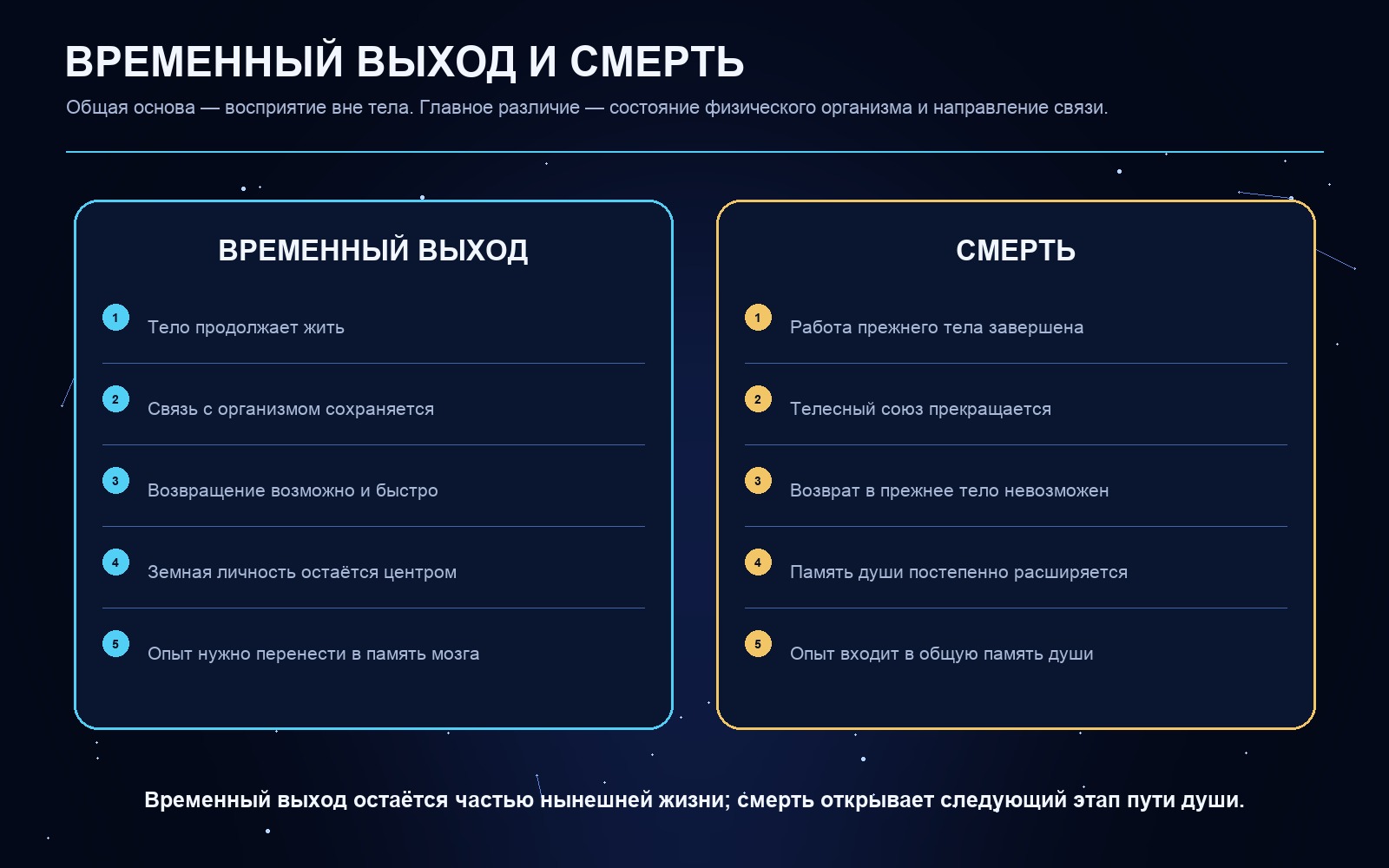
    But the two experiences are not identical. A temporary separation occurs while the organism is alive and the connection with it remains intact. Death ends the functioning of the physical body and moves consciousness into another stage of existence.

    The difference is not limited to whether a return is possible. The depth of separation, the amount of memory available, the stability of perception, and the direction of further movement all change.

    What I mean by an out-of-body experience

    For me, an out-of-body experience is a conscious separation from the body in which a person continues to see, hear, feel, and act while understanding that the physical organism is elsewhere.

    The experience can feel so realistic that the person may not notice the separation at first. He moves through the room, perceives objects, and only later sees his own body or realizes that the ordinary laws of matter are operating differently.

    The quality of these experiences varies. Sometimes the brain actively fills in what is happening and creates mental constructions. At other times, consciousness perceives a stable environment that does not obey its expectations. The feeling of leaving the body therefore does not guarantee that everything observed is objective.

    During a temporary separation, the connection with the body remains

    The central difference is that the physical body remains alive. The heart, breathing, brain, and nervous system continue to function. Even when a person barely perceives bodily signals, the connection has not been broken.

    I have concluded that only part of consciousness separates during an out-of-body experience. Another part remains connected with the organism, supports its functions, and provides the basis for return. All parts of consciousness continue to exchange information.

    That is why a change in breathing, a sudden sound, a touch, or danger can return a person to the body instantly. The physical organism retains priority and can demand attention back.

    Why the return happens so quickly

    The connection with the body acts like a constant pull. Maintaining the out-of-body state requires concentration and energy. As soon as attention disperses, a strong emotion appears, or the body becomes active, the separated part of consciousness returns.

    The return is usually immediate. There is no need to find a route back to the body or remember its address. The connection never disappeared, so distance in the ordinary sense is not an obstacle.

    After returning, a different problem begins: transferring the memory. The experience took place with reduced participation from the brain, and now it must be translated into the physical memory system. If this is not done immediately, details fade quickly.

    An artistic comparison between a temporary out-of-body experience and physical death
    Both experiences involve perception beyond the body, but the state of the organism and the direction of the connection are fundamentally different.

    What happens at death

    At death, the body ceases to function as an instrument of consciousness. The nervous system no longer sustains stable interaction, and a return to the former organism becomes impossible.

    According to my experience and the information I have received, the soul remains with the body until the final moment and helps reduce its fear and suffering. After physical processes end, consciousness may remain nearby for a time, understanding the transition and saying goodbye to loved ones.

    The direction then changes. During a temporary separation, the body constantly pulls consciousness back. After death, the soul moves toward reunion with its greater self and a return home.

    Does the person remain after both transitions?

    During both an out-of-body experience and the period after death, a person retains a sense of “I.” He does not become an impersonal observer. Memory, intention, and the ability to make decisions remain.

    During a temporary separation, however, the perspective of the earthly personality remains dominant. The person knows he has a body, a current life, and a need to return.

    After death, that connection gradually changes. The recent personality remains at first, and then the wider memory of the soul returns. The person remembers other incarnations, kindred relationships, and his own condition before birth.

    This expansion is almost inaccessible during an ordinary temporary separation because the physical brain and the need to return continue to limit the range of perception.

    Why an out-of-body experience is not a rehearsal for death

    The practice can show a person that perception is not limited to the body. It can reduce the fear of nonexistence and provide personal material for investigation. But it is wrong to treat a deliberate separation as a simulation of dying.

    Death includes the complete end of a physical biography, the conclusion of the functioning union between soul and body, a transitional stage, and the restoration of broader memory. A temporary experience preserves biological life and the obligation to return.

    Out-of-body perception can also be distorted by expectation and brain activity. A person may see a symbolic or mental scene and mistake it for an exact picture of the afterlife. Experience, awareness, and verification are therefore necessary.

    A diagram comparing temporary out-of-body experience and death
    The decisive differences are whether the body remains alive, whether the bond continues, and where consciousness is moving.

    The main differences

    Temporary separation Death
    The body continues to live The functioning of the physical body ends
    Part of consciousness remains connected with the organism Consciousness is released from the former bodily union
    A rapid return remains possible at all times A return to the former body is impossible
    The earthly personality and current life remain the primary focus Memory gradually expands to include the soul’s experience
    Physical signals can interrupt the experience The body no longer calls consciousness back
    Memory must be transferred to the brain after returning The experience enters the soul’s wider memory

    What a temporary separation can tell us about death

    It reveals several important principles.

    First, a sense of personal identity can continue while a person perceives himself outside the body. Second, the physical senses are not the only possible way to receive information. Third, thought and intention operate differently outside dense reality. Fourth, fear often decreases when a person directly experiences the continuity of his own “I.”

    But an out-of-body experience provides only a glimpse through a partially opened door. It does not reproduce the full depth of death or make the practitioner all-knowing.

    Why the difference matters

    If we identify leaving the body completely with death, we may underestimate the complexity of the afterlife transition. If we treat them as entirely unrelated, we lose an important opportunity to study consciousness through experience.

    It is more accurate to recognize a common foundation under different conditions. In both cases, consciousness demonstrates an ability to perceive itself beyond the familiar bodily point. But a temporary separation remains part of the present life, while death completes that life and opens the way toward restoring the soul’s wholeness.

    For me, the practice is valuable neither as an escape from the body nor as a game with death. It is valuable as a research tool that allows a person to see that the body is an important part of the earthly personality but does not exhaust the nature of consciousness.

    This understanding does not reduce the value of physical life. On the contrary, it makes life more responsible. We return to the body not because we have failed, but because the experience for which we came continues here.


    For a fuller discussion of the forms of out-of-body experience, the division of consciousness, and the process of death, see my book The Phenomenon of Consciousness Beyond the Body.

    Read the English edition on Amazon →
    Additional English edition on Amazon

  • Heaven, Hell, Purgatory, and “Earthbound Souls”: What Lies Behind These Images

    Heaven, Hell, Purgatory, and “Earthbound Souls”: What Lies Behind These Images

    Religions and cultures have created many visions of the afterlife. Some promise heavenly gardens or eternal torment; others describe purification, judgment, a river, a bridge, or a long journey. These images differ, yet they address the same questions: Where does consciousness go after death? What determines its condition? Can a soul become trapped between worlds?

    I do not see heaven and hell as two physically defined places to which an external judge assigns people forever. My experience suggests a more complex picture. After death, consciousness moves through different states and levels of reality. Its perception depends on clarity, beliefs, fears, attachments, and its readiness to accept what has happened.

    Religious images may reflect real processes, but human language has turned them into overly simple systems.

    Why people see what they believe

    At the nearest nonphysical levels, thought affects the perceived environment much faster than it does in the dense world. Consciousness can create forms from expectations, memory, and emotional experience.

    This is especially powerful in the mental realm—a space created through our capacity of mind. Fear, religious belief, guilt, and familiar imagery can construct a convincing reality there. A person does not merely imagine it from the outside but finds himself inside his own perception.

    A Christian may therefore see familiar religious symbols, a person from another culture may encounter a different image of transition, and a committed materialist may spend a long time failing to understand that the body has died.

    This does not mean that everything after death is imaginary. Real levels and other souls exist independently of our wishes. Yet in transitional spaces, personal perception can overlay reality and alter its appearance.

    What we call heaven

    Images of heaven often convey a feeling of returning home: peace, love, reunion with loved ones, freedom from pain, and restored memory. In that sense, they are close to how I perceive the soul’s return to the third energy level.

    There, consciousness is no longer limited by a sick or aging body. The soul reunites with its kindred group, rests, reflects on its life, and creates a familiar environment. For earthly souls, that environment may resemble beautiful places on Earth, but not because one universal heavenly garden exists for everyone. Consciousness forms a setting in which recovery and communication are easier.

    Heaven, as I understand it, is not a reward for belonging to the correct religion. It is the natural state of returning to fuller memory, connection, and love.

    But the soul’s world is not an eternal resort. Learning, development, and preparation for future stages continue there.

    An artistic visualization of the transition after physical death
    After death, consciousness may pass through states shaped by memory, belief, emotion, and the gradual restoration of clarity.

    What may lie behind the image of hell

    I have found no reason to believe that the Source creates an eternal torture chamber for its own parts. The idea of endless punishment for one limited earthly life contradicts the very purpose of the soul’s development.

    Difficult states after death are possible, however. A person may carry fear, hatred, guilt, addiction, or an inability to accept death. In a realm where thought quickly takes form, the inner condition becomes the surrounding reality.

    This can produce an experience that resembles hell. It is created not by an enraged God, but by consciousness caught inside its own destructive patterns and not yet able to leave them.

    This condition does not have to be eternal. Help exists, but the soul must allow itself to recognize that help, release the familiar struggle, and accept a wider understanding.

    Purgatory as a process of recovery

    The image of purgatory comes closest to a transitional stage in which the soul releases earthly limitations and understands the life it has completed.

    A person does not become instantly wise after death. He must understand what happened, restore memory, see the consequences of his actions, and regain balance. For one soul this process may be quick; for another it may be long and emotionally difficult.

    Purification here does not mean punishment by external fire. It is an honest encounter with oneself. The soul gradually separates the experience it has gained from fear, self-deception, and roles it once believed were the only reality.

    Time is perceived differently beyond the physical world, so earthly ideas of days and years do not apply. What matters is not the duration but the result: the ability to accept a completed life and continue the journey.

    Who are “earthbound souls”?

    This term is commonly used for those who remain close to the physical world for a long time after death and do not continue the transition. I do not consider them cursed or permanently lost.

    The reasons can vary:

    • a sudden death and failure to understand what happened;
    • a powerful attachment to the body, a home, possessions, or a particular person;
    • fear of religious punishment;
    • certainty that nothing exists after death;
    • a desire to complete an important task or say goodbye;
    • an intense emotional state that narrows perception.

    A recently departed soul may also remain nearby for a natural reason—to support loved ones and calmly complete its connection with earthly life. Not every presence near the physical world means a person is trapped.

    The problem arises when consciousness refuses to notice help and continues repeating the same limited pattern.

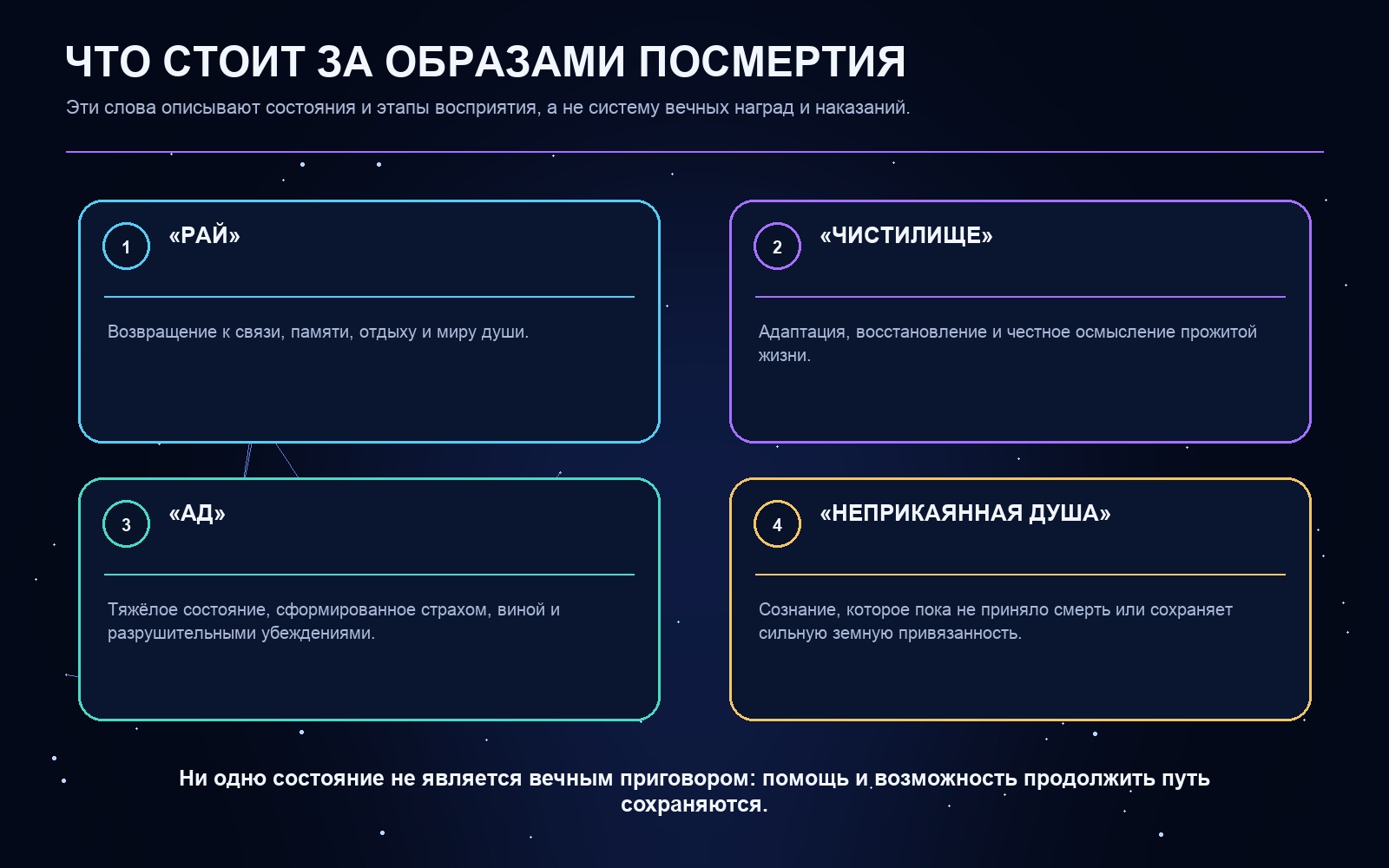
    A diagram explaining heaven, purgatory, hell, and earthbound souls as states of consciousness
    These familiar images describe states and stages of perception rather than a system of eternal rewards and punishments.

    Who helps a soul leave a difficult state?

    A person is not alone after death. Kindred souls, guides, and teachers may meet him. They help him understand the transition and direct him home.

    But help is not always recognized. If a person is convinced that enemies or demons surround him, even a loving presence may cause fear. If addiction has completely captured him, all attention may remain fixed on the familiar object.

    Inner readiness therefore matters. Sometimes it is enough to acknowledge that physical life has ended, help is possible, and the old struggle no longer has to continue.

    The living do not need to perform dangerous rituals or try to control the departed by force. A calm inward message, love, and permission to continue the journey are more helpful than fear and constant attempts to summon contact.

    Why every unusual experience cannot be treated as proof

    The subject of afterlife states is especially vulnerable to self-deception. Fear makes any image convincing, while the desire for an answer can turn coincidences into signs.

    During an out-of-body experience, a person may enter an objective environment, a mental construction, or a mixed state in which observation is intertwined with expectation. A dramatic image of heaven or hell therefore does not by itself reveal the structure of all reality.

    I evaluate an experience by the clarity of consciousness, stability of the environment, capacity for interaction, repeatability, and whether its meaning remains coherent after returning. Even then, I leave room for further research.

    Care does not require denying what happened. It keeps us from turning one personal episode into an absolute law for everyone.

    A dynamic journey lies behind the images

    Heaven, hell, and purgatory are human words for different states of consciousness after death.

    Heaven reflects a return to love, memory, and the soul’s world. Hell may arise as a difficult reality formed by fear, guilt, and destructive beliefs. Purgatory resembles a process of adjustment and honest reflection on life. An “earthbound soul” is not a condemned being, but a consciousness that has not yet completed its transition.

    None of these states has to become an eternal sentence. Development continues, help exists, and the connection with the Source is never broken.

    After death, we do not enter a primitive system of rewards and punishments. We enter a reality where our inner condition becomes more visible, responsibility becomes deeper, and a return to wholeness requires honesty.

    The most important preparation for transition does not begin with studying frightening images. It begins with a conscious life: the ability to see our motives, to avoid building a world of hatred within ourselves, and to remember that we are never separate from the common Source of life.


    For a fuller discussion of the mental realm, transitional states, and the soul’s world, see my book The Phenomenon of Consciousness Beyond the Body.

    Read the English edition on Amazon →
    Additional English edition on Amazon

  • Do Animals Have Souls—and What Kind of Experience Do They Gather?

    Do Animals Have Souls—and What Kind of Experience Do They Gather?

    People have debated the immortality of the human soul for centuries, yet they ask the same question about animals far less often. We may be willing to believe that a beloved dog or cat continues after death because we knew its personality and felt a mutual love. But an insect, a fish, a snake, or a jellyfish is often treated as a biological mechanism that disappears with the body.

    My research has led me to a different conclusion: animals and every other form of life have souls. Consciousness is not a human privilege, nor does it depend on having a human brain. The Universe is filled with forms of life, each participating in the shared process of gathering experience.

    The brain does not confer the right to exist

    If we assume that consciousness is produced entirely by the brain, it is easy to create a hierarchy: the more complex the nervous system, the “greater” the inner life. Yet even on Earth, organisms without a familiar brain maintain themselves, respond to their environment, and act as integrated living systems.

    I see the brain as an instrument through which consciousness expresses itself in a particular body. Different organisms use different forms of connection with the soul. The absence of a human nervous system does not mean the absence of an inner principle of life.

    An animal does not need to think in words, construct philosophical theories, or recognize itself in a human-designed mirror test in order to have its own experience. We too often measure other forms of life only by the abilities we value in ourselves.

    Individual and collective soul

    In my book, I consider consciousness not only as an individual phenomenon but also as the capacity of living systems to unite into larger wholes.

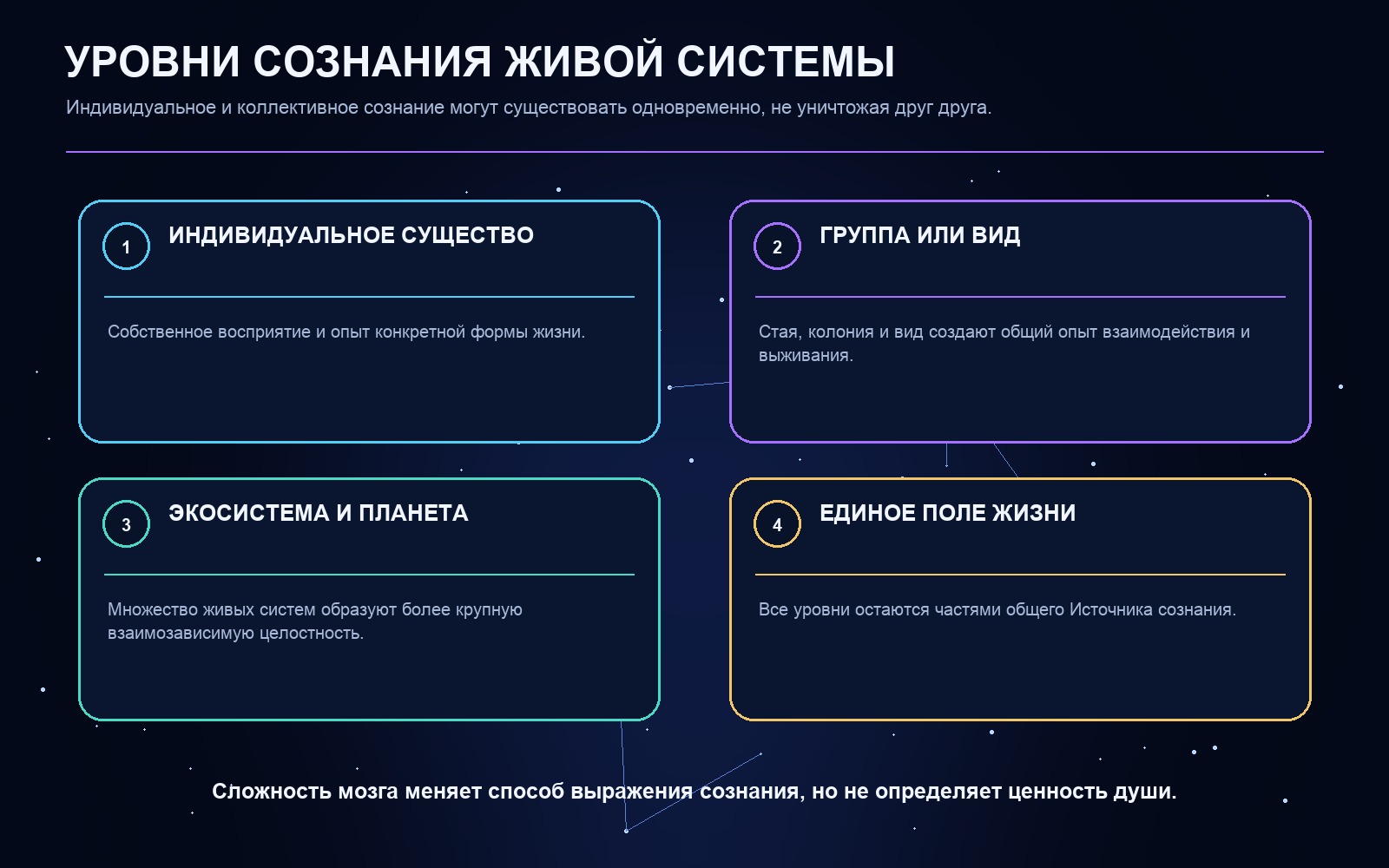
    The cells of an organism have their own internal organization, yet together they form a body. Individual animals may possess individual consciousness while remaining part of the consciousness of a species, pack, colony, and ecosystem. These levels do not cancel one another.

    The collective principle is especially visible among bees, ants, and other social creatures. A colony’s behavior cannot be fully understood if each participant is treated as an isolated unit. At the same time, collectivity does not turn an individual creature into an empty cog.

    In my model, the individual soul and collective consciousness can interact in the same way a human being can remain an individual while also belonging to a family, a society, and a planet.

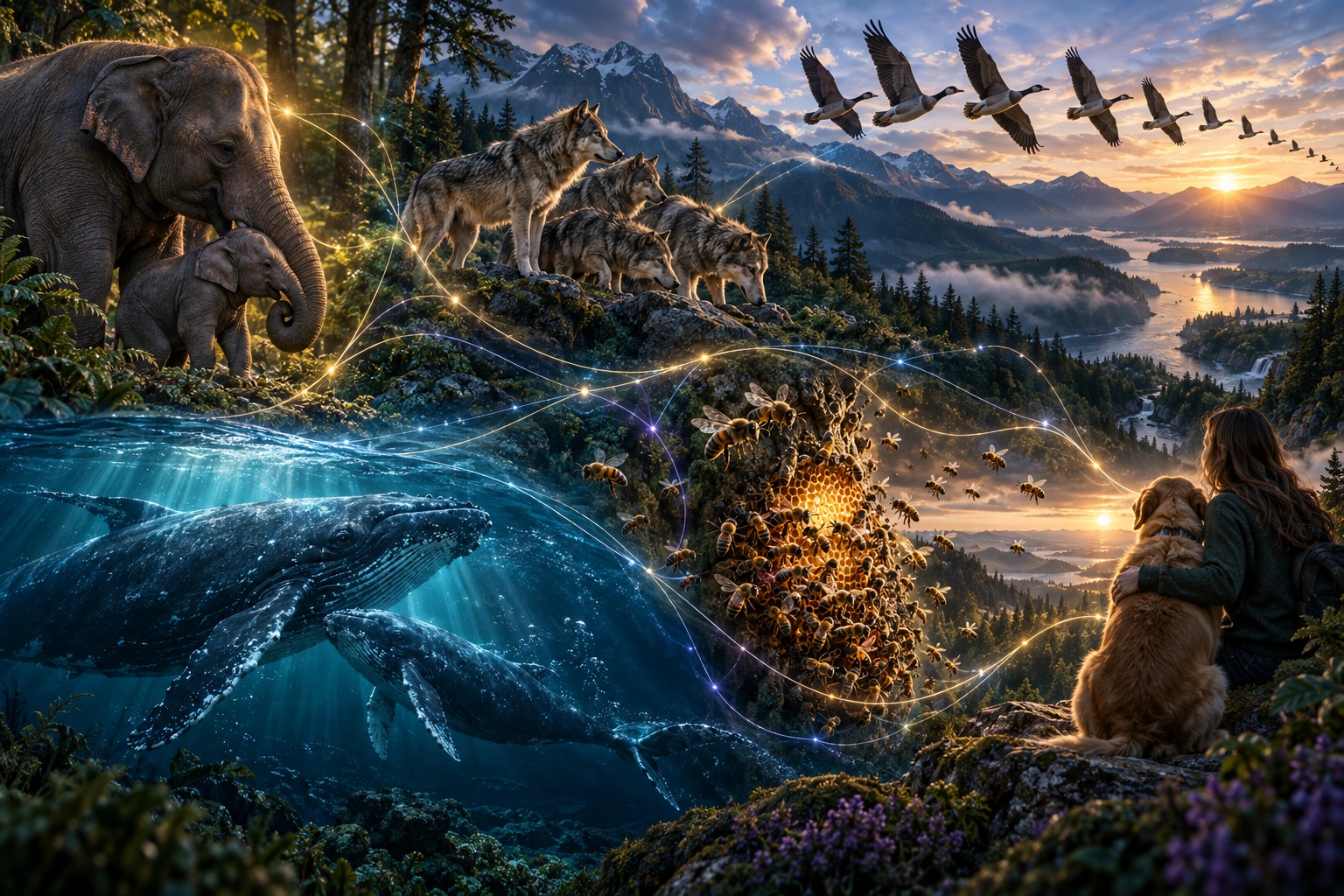
    An artistic visualization of animal consciousness and experience
    Different forms of life gather experience through their own bodies, senses, and relationships.

    What kind of experience does an animal gain?

    The soul’s experience is not limited to intellectual achievement. To develop, consciousness must learn interaction, trust, caution, care, protection, cooperation, and many other qualities.

    Different forms of life create different conditions:

    • the life of a predator develops attention, decisiveness, and precision of action;
    • life within a group requires an understanding of boundaries, hierarchy, and cooperation;
    • caring for offspring creates experience in responsibility and attachment;
    • migration and survival connect consciousness with the rhythms of space and environment;
    • a companion animal gains a profound experience of emotional connection with a human being.

    These are human words for processes animals experience in their own way. We should not imagine that an animal’s soul reasons in the same categories we do. Its experience may be immediate, sensory, and embodied, but that does not make it any less real.

    Is an animal simply an “undeveloped human soul”?

    I do not accept the idea that every animal is merely a future human being temporarily trapped on a lower rung. The human form is not the single destination of all life in the Universe.

    Souls exist at different stages and choose different directions of experience. Some forms may prepare consciousness for more complex individuality, while others develop along paths that do not have to imitate humanity.

    Body size, speech, and technological development tell us nothing about the absolute value of a soul. The outer form reveals the conditions of incarnation, not the worth of the inner life.

    What happens after an animal dies?

    After the physical body dies, an animal’s consciousness also continues. Within the structure of the third energy level that I have observed, there are spaces for many forms of life—terrestrial, aquatic, airborne, microscopic, and entirely unlike the organisms familiar to us.

    The world of the soul was not created exclusively for human beings. Every form of life has a place suited to its nature and way of perceiving.

    Companion animals retain their connection with the people whose lives they shared. Mutual love and trust become part of the experience of both souls. That is why the possibility of meeting a beloved animal again does not seem to me like a comforting fantasy. If the connection was real, the death of the body does not erase it.

    But we should not demand that an animal remain our pet forever. Its path is larger than a single role, just as a human path is larger than one family and one life.

    A diagram of individual and collective levels of living consciousness
    Individual beings, groups, ecosystems, and the unified field of life can express consciousness at the same time.

    Why human beings carry a special responsibility

    Recognizing that animals have souls changes our ethics. If the being before us is not an object or an automaton but a form of consciousness, then how we treat it becomes part of our own development.

    This applies to companion animals, animal agriculture, conservation, scientific research, and the destruction of habitats. Humanity possesses enormous physical and technological power. With that power comes responsibility for lives we are able to alter.

    I do not believe everyone must live in exactly the same way or immediately adopt one diet. But each of us can ask honestly: Am I reducing unnecessary suffering? Do I see a living being, or only a useful resource? Do my actions reflect an understanding of the unity of life?

    Awareness is revealed not in beautiful statements about loving the Universe, but in our daily treatment of those who are weaker and dependent on our decisions.

    Animals also teach human beings

    The connection works in both directions. An animal gains experience beside a person, and a person learns through the animal.

    Companion animals show us the simple joy of presence, emotional directness, trust, and the ability to remain close without complicated explanations. Wild animals remind us that life was not created for our convenience and that intelligence exists in forms we still understand poorly.

    Sometimes a person first experiences unconditional care through a relationship with an animal. That love changes the person’s character and remains part of the soul’s experience.

    No one is forgotten in the larger system of life

    Human arrogance encourages us to see ourselves as the center of existence. But if everything that exists is part of the Source, then no life can have been created without inner meaning.

    Animals have souls, gather their own experience, and continue their journey after the death of the body. Their consciousness may differ from human consciousness in structure and expression, but difference does not mean absence.

    We all participate in one system of development: human beings, animals, other forms of life, and the planet itself as a complex collective consciousness.

    Recognizing this does not diminish humanity. It makes us more mature. We stop seeing the world around us as scenery and begin to notice a living Universe in which every form has a right to existence, experience, and a return home.


    For a fuller discussion of collective consciousness, the souls of different forms of life, and the structure of the soul’s world, see my book The Phenomenon of Consciousness Beyond the Body.

    Read the English edition on Amazon →
    Additional English edition on Amazon

  • How the Source Relates to the Incarnation of Souls

    How the Source Relates to the Incarnation of Souls

    When people think about God, the Source, or the Oversoul, they often project earthly models of authority onto the highest level of reality. They imagine an external ruler who watches humanity, approves of the obedient, punishes the defiant, and assigns each person a predetermined path through life.

    My experience has led me to a very different understanding. The Source does not exist somewhere far beyond the world it created. All energy, every level of reality, and every soul exist within it and remain part of it. The Source’s relationship to incarnation therefore cannot be described as the relationship between a superior and a subordinate. Incarnation is a movement of the whole as it comes to know and develop itself through countless forms of life.

    The soul never leaves the Source

    In one of my early profound experiences, I saw a radiant sphere from which countless luminous particles were emerging. They moved outward in every direction and began a long journey through experience. That image helped me understand the division of the Oversoul into individual souls.

    Later, however, an important question arose: where could a soul separate to if reality itself is also the energy of the Source? Could any place exist outside it?

    For me, the answer is clear: no. Separation creates an individual point of perception, but it does not carry the soul beyond the whole. We remain within the Source even when we experience ourselves as alone and entirely independent.

    Separation is real as an experience and conditional as an absolute boundary. That is why our connection with the Source can never be lost completely.

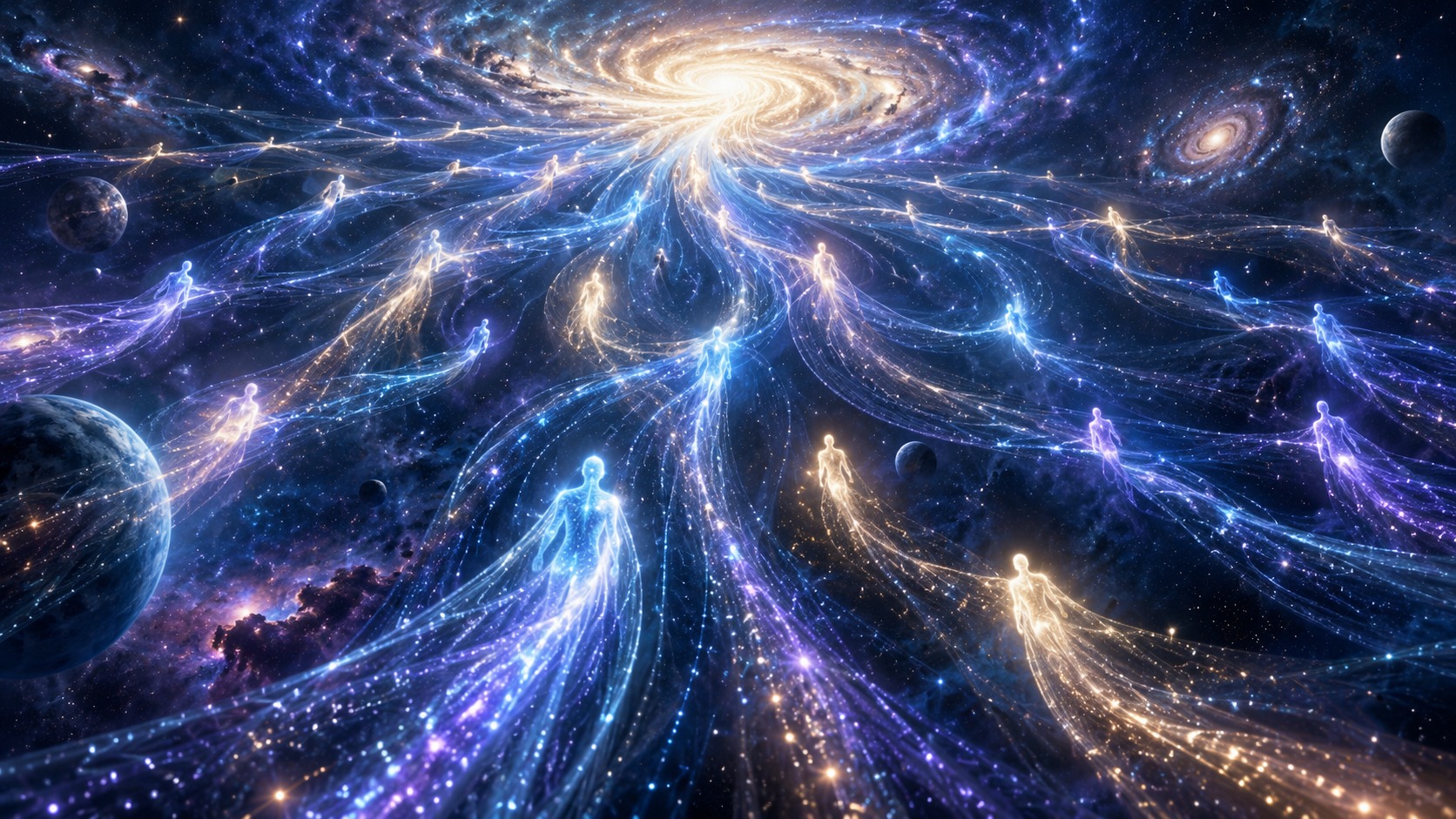
    An artistic visualization of the unified Source and an individual soul
    An individual soul remains part of the unified Source even while experiencing itself as separate.

    Why the whole needs the experience of its parts

    The Source differentiates portions of its own energy so that they can acquire unique perspectives. Each soul sees reality from its own point of view, moves through its own relationships, limitations, and discoveries, and returns the experience it has gained to the whole.

    If we imagine unified consciousness as an ocean, the soul is not a foreign object thrown into the water. It is a wave that has acquired form and direction. The wave may experience itself as separate, but it never ceases to be the ocean.

    Incarnation intensifies this sense of separation. The body has boundaries, the brain limits access to memory, and physical reality requires us to work against the resistance of matter. As a result, choice, love, fear, responsibility, and creativity become lived experience rather than abstract ideas.

    The Source does not observe this process from the outside. It experiences it with us because we are parts of it.

    Incarnation is not a punishment

    I do not see physical life as a prison to which a soul is sent for some offense. The dense world is genuinely difficult. It contains pain, illness, loss, limited time, and an inability to see the entire picture. But difficulty is not the same as punishment.

    The soul enters incarnation to gain experience that cannot be acquired in a realm where thought quickly changes the environment and awareness of immortality remains open. Here, an inner quality must be expressed through action, not merely through intention.

    This does not mean that every instance of suffering was deliberately sent by the Source or that pain should be justified with spiritual language. Cruelty remains cruelty, and helping a person in pain remains necessary. The idea of the soul’s development must never be twisted into a claim that a victim somehow deserved what happened.

    The Source does not need our suffering. Experience arises from the fullness of life, including love, joy, creation, cooperation, and the overcoming of limitations.

    The Source does not demand worship rooted in fear

    The higher consciousness of which all existence is a part does not need human flattery. It does not grow stronger because more words are spoken in its praise, nor does it lose its power when someone asks difficult questions.

    Fear of punishment may compel a person to follow rules, but it does not make that person conscious. A genuine connection with the Source reveals itself through expanded understanding, greater responsibility, and the ability to recognize oneself as part of a shared reality.

    Religious language can help a person address the highest reality when it leads toward love and inner honesty. Yet a name is not reality itself. God, the Source, the Oversoul, and unified consciousness are different human expressions for something far greater than any single teaching.

    How the Source’s support is expressed

    The Source does not control every life like a puppeteer. Its support is woven into the structure of reality itself.

    The soul retains its connection with its greater self. Soul groups support one another. Guides accompany souls through unfamiliar realms. Teachers and elders assist development and preparation for new stages. Even the physical body is not the soul’s enemy but its partner, enabling it to act within a dense world.

    Support does not always look like the removal of a difficulty. It often appears as the ability to move through a situation, recognize one’s own strength, or meet someone who makes the next step possible.

    Help does not erase our decisions. The Source does not need to intervene in every mistake, because individual consciousness could never mature under constant intervention.

    No soul is forgotten or unnecessary

    If every soul is part of the Source, then no being can be divided into the worthy and the disposable. The human habit of building hierarchies does not reflect the structure of the whole.

    Different souls are at different stages of development and gather different kinds of experience. Some incarnate in human worlds, while others enter different forms of life. Some are only beginning to learn interaction, while others help as teachers. Differences in experience do not imply differences in origin.

    Within the greater design, no one is lost. Even a soul that has gone far astray through its actions has not ceased to be part of the whole. It will have to understand the consequences of its experience and continue its development.
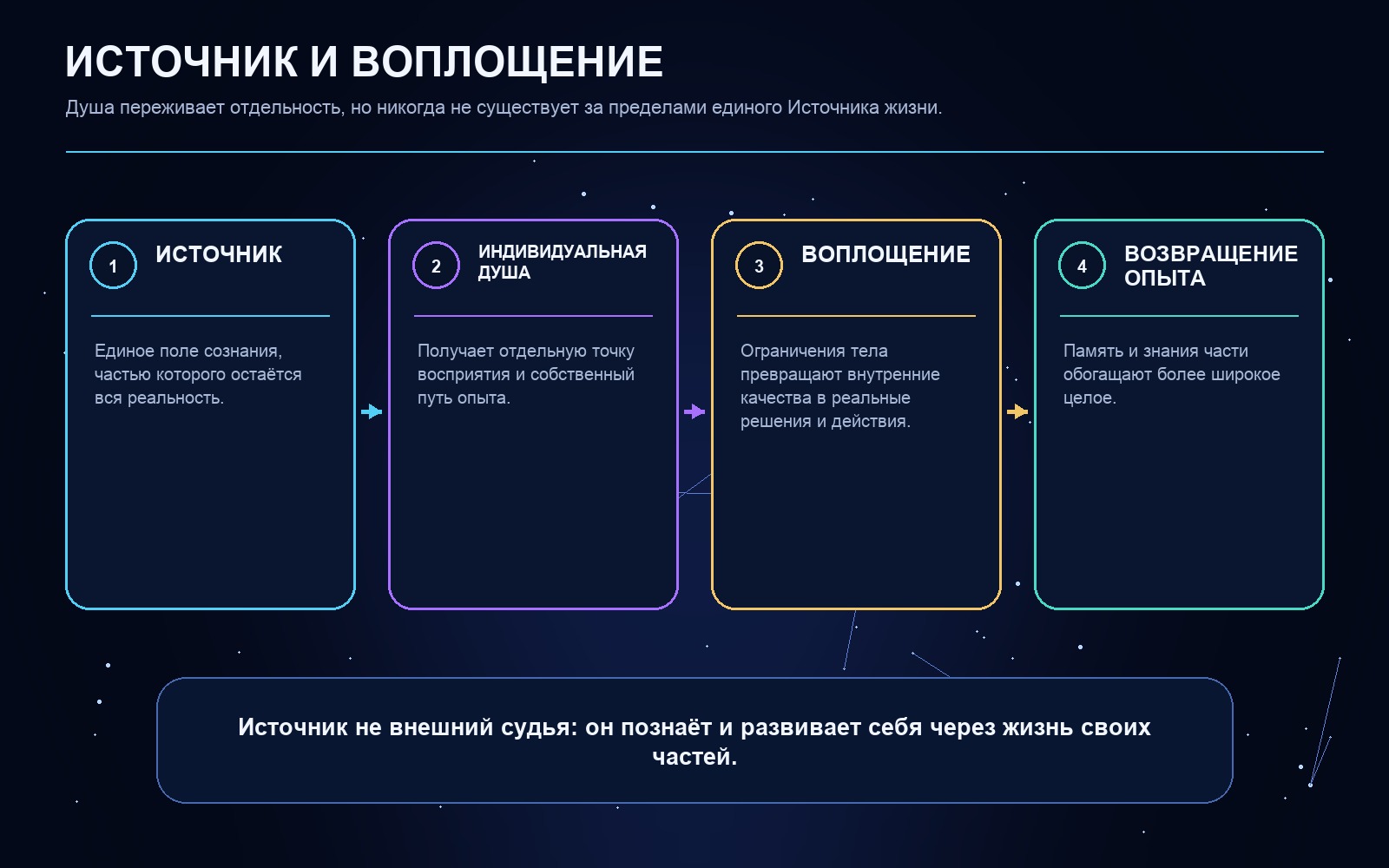
    This does not remove responsibility for evil. On the contrary, an understanding of unity makes the consequences deeper: when we harm another being, we act against the same reality of which we ourselves are a part.

    A diagram connecting the Source, the individual soul, incarnation, and the return of experience
    The Source, the individual soul, incarnation, and the return of experience to the larger whole.

    Returning does not erase individuality

    I understand the soul’s destination as a return to the Source with the experience it has gained. But this return is not the erasure of personality within a featureless mass.

    Consciousness is capable of differentiating and reuniting. When parts reunite, their memories and knowledge become available to the whole. Individual experience is not lost; it enriches a wider consciousness.

    We can compare this process to streams joining a river. Their water becomes part of the shared current, yet every tributary contributes to the river’s volume and composition. The Source grows through the joining of differences rather than their destruction.

    What this understanding changes

    If the Source is not above us but present throughout existence, spirituality stops being an attempt to earn the approval of a distant power. It becomes a way of living in accordance with our deepest nature.

    Respect for another person, an animal, or the planet itself then ceases to be an external moral command. We understand that we are interacting with other expressions of the same life.

    Incarnation has value not because it is followed by reward or punishment. It is valuable in itself as an opportunity to transform the soul’s potential into lived experience.

    The Source does not send us into the world to test our obedience. It reveals itself through our perception, our love, our mistakes, our discoveries, and our capacity to become more conscious.

    We are not separate from it, even in the moments when we feel most alone. The path to the Source is not a journey toward a distant place. It is the gradual restoration of our understanding of what we have always been part of.


    For a fuller discussion of the Oversoul, the differentiation of consciousness, and the levels of reality, see my book The Phenomenon of Consciousness Beyond the Body.

    Read the English edition on Amazon →
    Additional English edition on Amazon