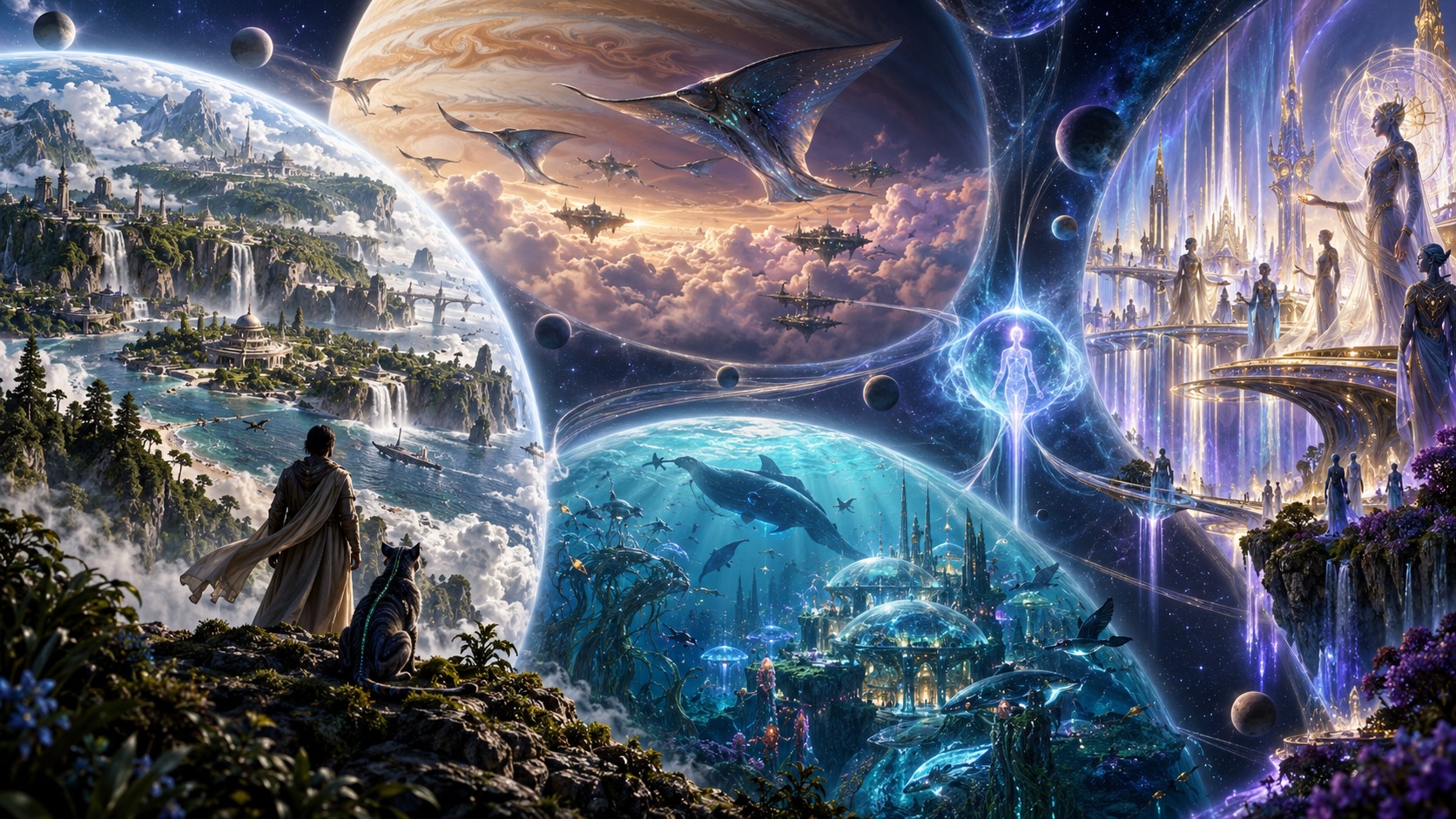
When people speak about reincarnation, they almost always imagine another life on Earth and necessarily in a human body. But the Universe is too vast and diverse for all conscious experience to be confined to one planet, one state of matter, and one biological form.
My answer is yes: a soul can incarnate in other worlds. The diversity of those worlds exceeds familiar science fiction. They may exist at different energy levels, contain dense or more subtle matter, support organic life or life unlike anything on Earth, operate according to other laws of interaction, and produce an entirely different perception of time.
I reached this conclusion not through astronomical speculation, but through the structure of reality I observed during out-of-body experiences and through communication with guides. At the same time, I do not present what I saw as a physical map of space. It is personal research material that requires further examination and comparison.
Earth is one school, not the center of existence
Human beings naturally treat what is familiar as primary. For a long time, we placed Earth at the center of the Universe. A similar habit survives in our ideas about consciousness, as though only human life has a soul and only our planet can support its development.
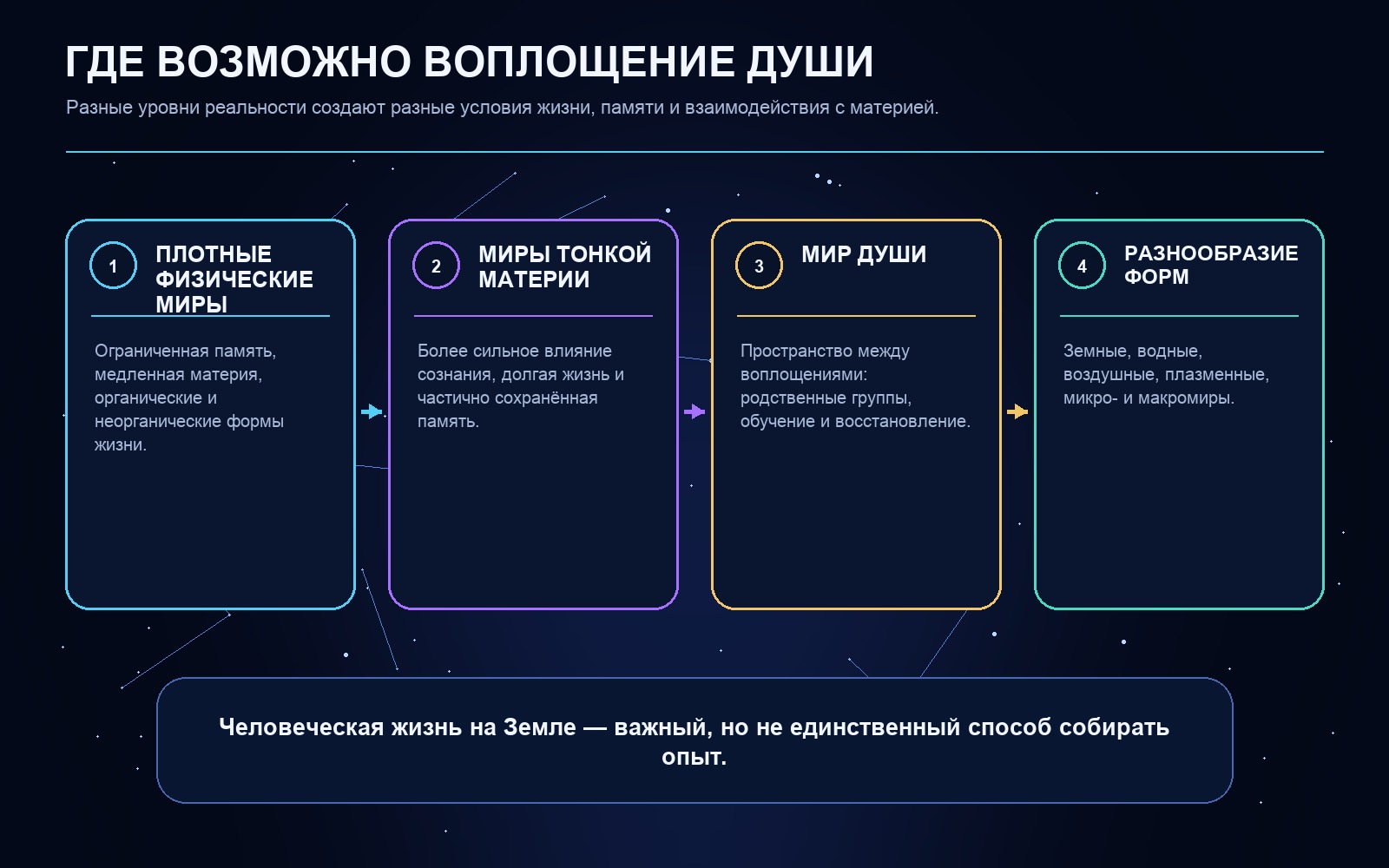
In my model, the first energy level is an immense physical Universe containing countless conditions for incarnation. These may include micro- and macro-worlds, organic and nonorganic forms, and environments radically different from Earth.
The soul chooses not the most prestigious world, but the kind of experience that corresponds to its direction of development. Earthly human experience is valuable because of its density, limited memory, and the need to act against the strong resistance of matter. But it is not the only form of experience.
Worlds differ by more than planets
Another world does not have to be a distant rocky planet in our physical Universe. Realities can differ in the very state of their energy.
At the first level, dense worlds exist in which matter changes slowly and life is connected with physical bodies. At the second level, there are independent spaces that are not copies of the physical Universe. Matter is subtler there, thought influences the environment more strongly, and incarnated beings may retain more memory of their nature.
The third level contains the spaces of the soul’s world. They also reflect an enormous diversity of life. Souls from different planets and environments create regions familiar to them: aquatic, airborne, plasma-based, microscopic, and gigantic worlds.
The question “On which planet?” therefore captures only part of the picture. Incarnation can occur in different kinds of reality.
My experience on a gas giant
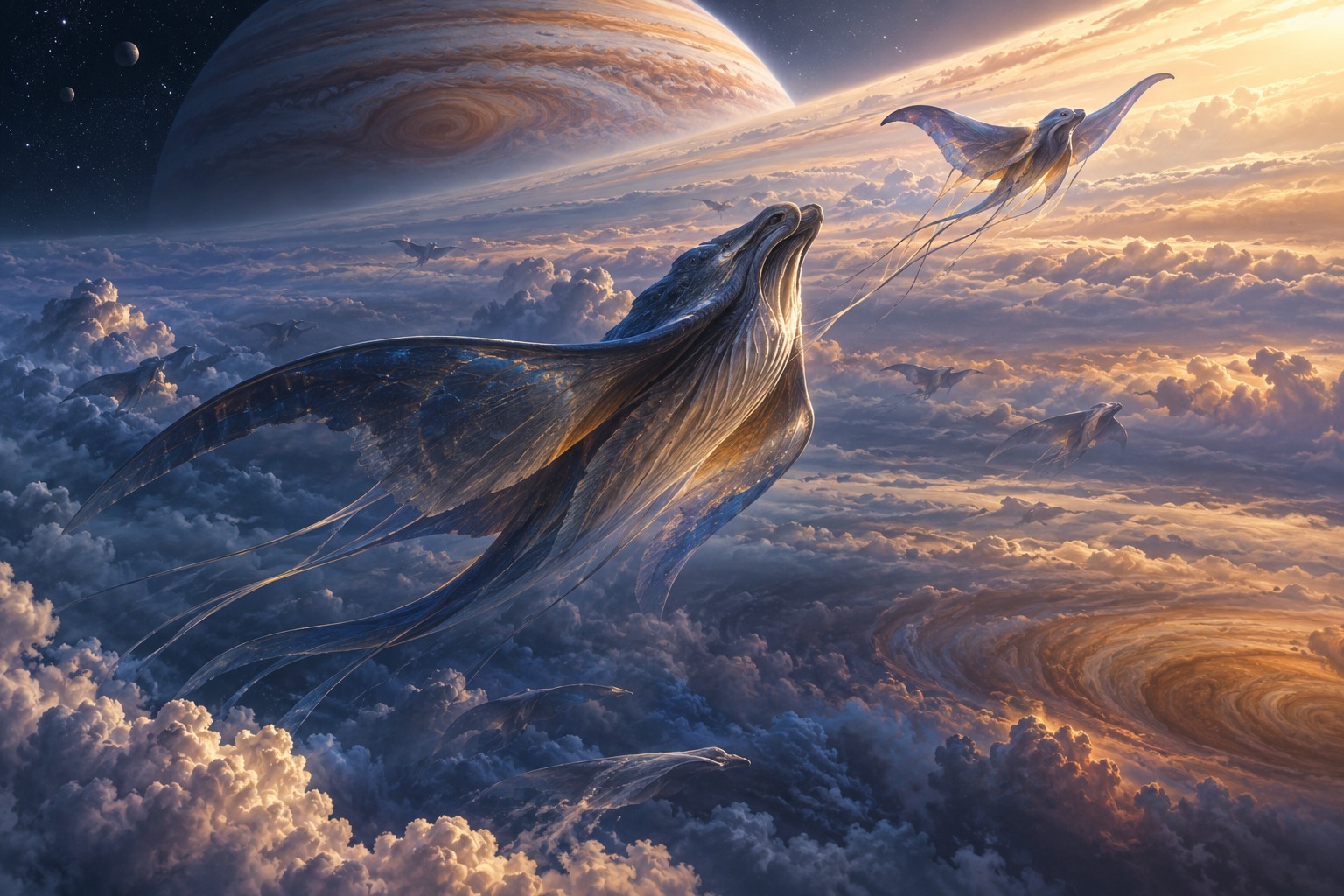
During one journey with my guide Ilrin, I observed a dense world whose life existed within the atmosphere of a gas planet many miles deep.
Its inhabitants resembled enormous rays. Young creatures lived in the upper layers, where conditions were gentler but food was more limited. Older ones rose to them from the depths despite physical discomfort, helping the new generation survive. As they matured, the younger beings descended and joined more complex social groups.
Ilrin explained that souls could incarnate in these creatures. Such a life creates profound experience in cooperation and in limiting one’s own comfort for the sake of others.
For me, the importance of this example is not the creatures’ unusual appearance. It demonstrates that the purpose of incarnation lies in the quality of relationships and experience, not in human form.
Worlds where memory is partially preserved
I have also seen spaces between the dense physical world and the soul’s world. Their inhabitants retained much more memory of previous incarnations and of the nature of consciousness. Life there could continue for thousands of Earth years, and thought had a far stronger effect on matter.
Greater freedom does not make such a world an easy reward. To live with expanded memory and the power to affect reality, consciousness must be able to govern itself. A thought that remains an inner impulse on Earth may alter reality there very quickly.
Different worlds therefore require different degrees of maturity. Limiting memory in a dense life protects not only the purpose of the incarnation, but also the individual from powers he is not yet able to use responsibly.
Who creates the conditions for life?
In another experience, I was shown civilizations that participate in designing and preparing worlds. They study planetary systems, create structures of life, observe development, and prepare environments to receive souls.
I describe this in my own words because human technical language does not capture what I observed. This is not necessarily construction in the earthly sense. Life may be designed through work with energy, environmental laws, and the informational structure of matter.
For me, this indicated that the Universe is not a random collection of lifeless objects interrupted by rare islands of consciousness. Life and consciousness are woven far more deeply into its structure.
Does the soul remain human?
A human personality forms only through the union of a soul, a human body, and an earthly environment. When a soul incarnates in another form, it creates another personality and perceives the world through the capacities of the new organism.
This does not mean that accumulated experience is erased. The soul’s qualities continue, but they find different expression. A consciousness that once knew itself as human does not have to walk on two legs, think in words, or build a familiar society in another world.
After an incarnation ends, different lines of experience join the soul’s wider memory. It can recognize a human life as its own without treating humanity as its only form.
Kindred souls may have different experiences
A soul group does not have to incarnate forever on one planet. Souls may pass through different forms of life and later exchange the experience they have gathered.
In my book, I use the image of many connected realities resembling clusters. A soul can gather experience in different spaces, and its ability to divide even allows parts of consciousness to exist in several lives in parallel.
This model is difficult for the linear brain, which is accustomed to one body and one sequence of time. Beyond physical life, however, time and individuality operate differently.
How should we approach claims of “star origins”?
The idea of other worlds naturally attracts fantasy. A person may declare himself an alien, a special star soul, or a representative of a higher civilization simply because the claim provides a feeling of exceptional status.
I approach such statements carefully. The possibility of other incarnations does not prove every beautiful story. What matters is the quality of awareness, the stability of the experience, the absence of prior suggestion, and—where possible—verifiable information.
A genuine experience of another life does not make someone superior to the people around him. If supposed knowledge produces arrogance and contempt for Earth, it has either been misunderstood or created by the desire to escape present reality.
Whatever our past may have been, we are incarnated here now. Earthly life requires our full participation.
The Universe as a field of conscious experience
Incarnation is possible in other worlds because consciousness does not belong to one biology or one planet. Forms of life differ, yet each creates a unique way to perceive, interact, and learn.
A gas planet, a world of subtle matter, an aquatic civilization, and a human life on Earth are not ranks in a competition. They are different environments for experience.
This idea expands our understanding of the soul while returning responsibility to our present life. We do not need to dream of a distant world in order to feel significant. Human incarnation already offers a rare opportunity to act within dense reality, where every inner quality must become a real deed.
Earth is not the only home of life. But it is now the place of our work, relationships, and growth. Respect for other worlds begins with how consciously we live in this one.
For a fuller discussion of journeys to other worlds, the gas giant, the designers of worlds, and the levels of reality, see my book The Phenomenon of Consciousness Beyond the Body.
Read the English edition on Amazon →
Additional English edition on Amazon
Leave a Reply