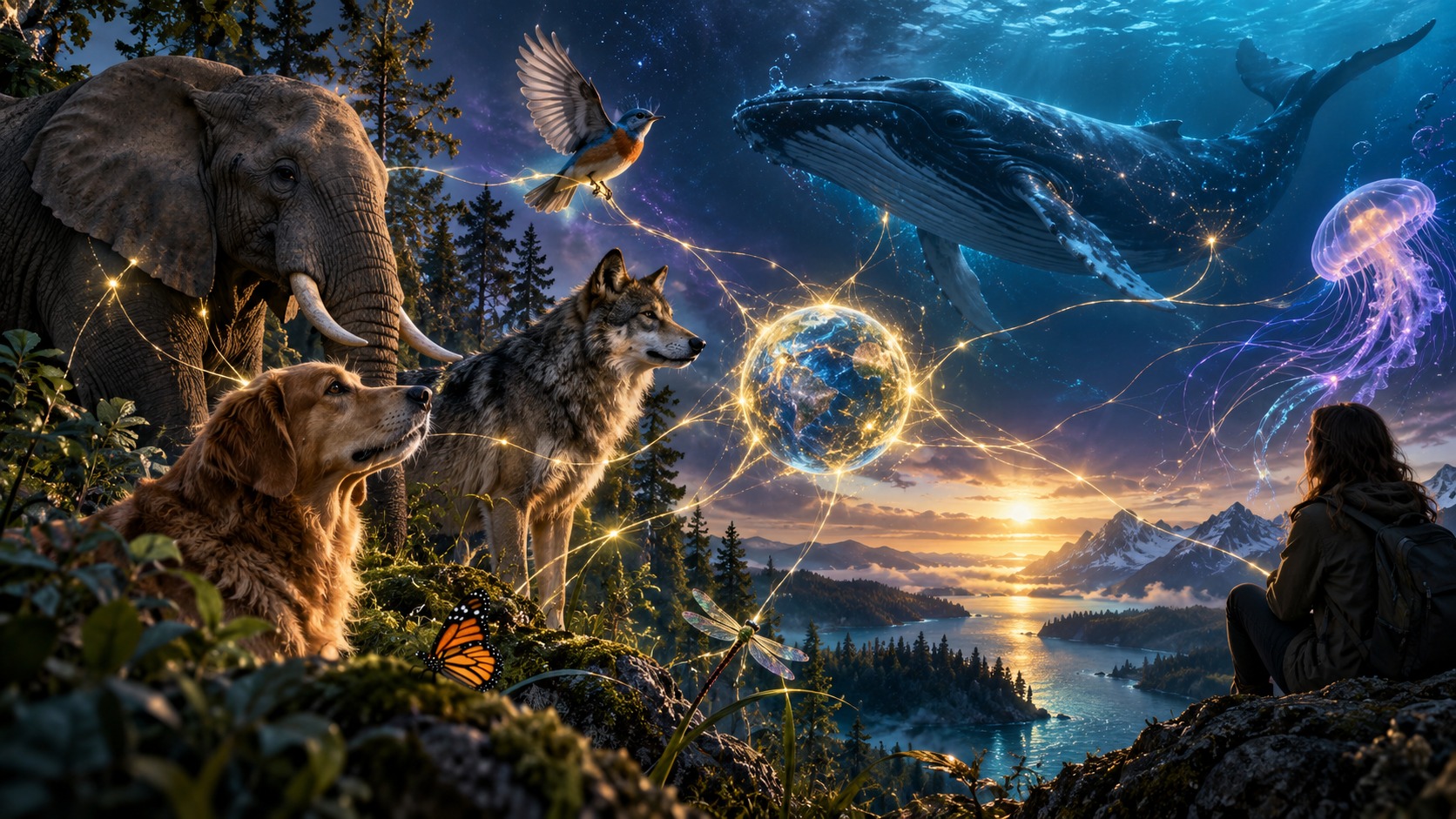
People have debated the immortality of the human soul for centuries, yet they ask the same question about animals far less often. We may be willing to believe that a beloved dog or cat continues after death because we knew its personality and felt a mutual love. But an insect, a fish, a snake, or a jellyfish is often treated as a biological mechanism that disappears with the body.
My research has led me to a different conclusion: animals and every other form of life have souls. Consciousness is not a human privilege, nor does it depend on having a human brain. The Universe is filled with forms of life, each participating in the shared process of gathering experience.
The brain does not confer the right to exist
If we assume that consciousness is produced entirely by the brain, it is easy to create a hierarchy: the more complex the nervous system, the “greater” the inner life. Yet even on Earth, organisms without a familiar brain maintain themselves, respond to their environment, and act as integrated living systems.
I see the brain as an instrument through which consciousness expresses itself in a particular body. Different organisms use different forms of connection with the soul. The absence of a human nervous system does not mean the absence of an inner principle of life.
An animal does not need to think in words, construct philosophical theories, or recognize itself in a human-designed mirror test in order to have its own experience. We too often measure other forms of life only by the abilities we value in ourselves.
Individual and collective soul
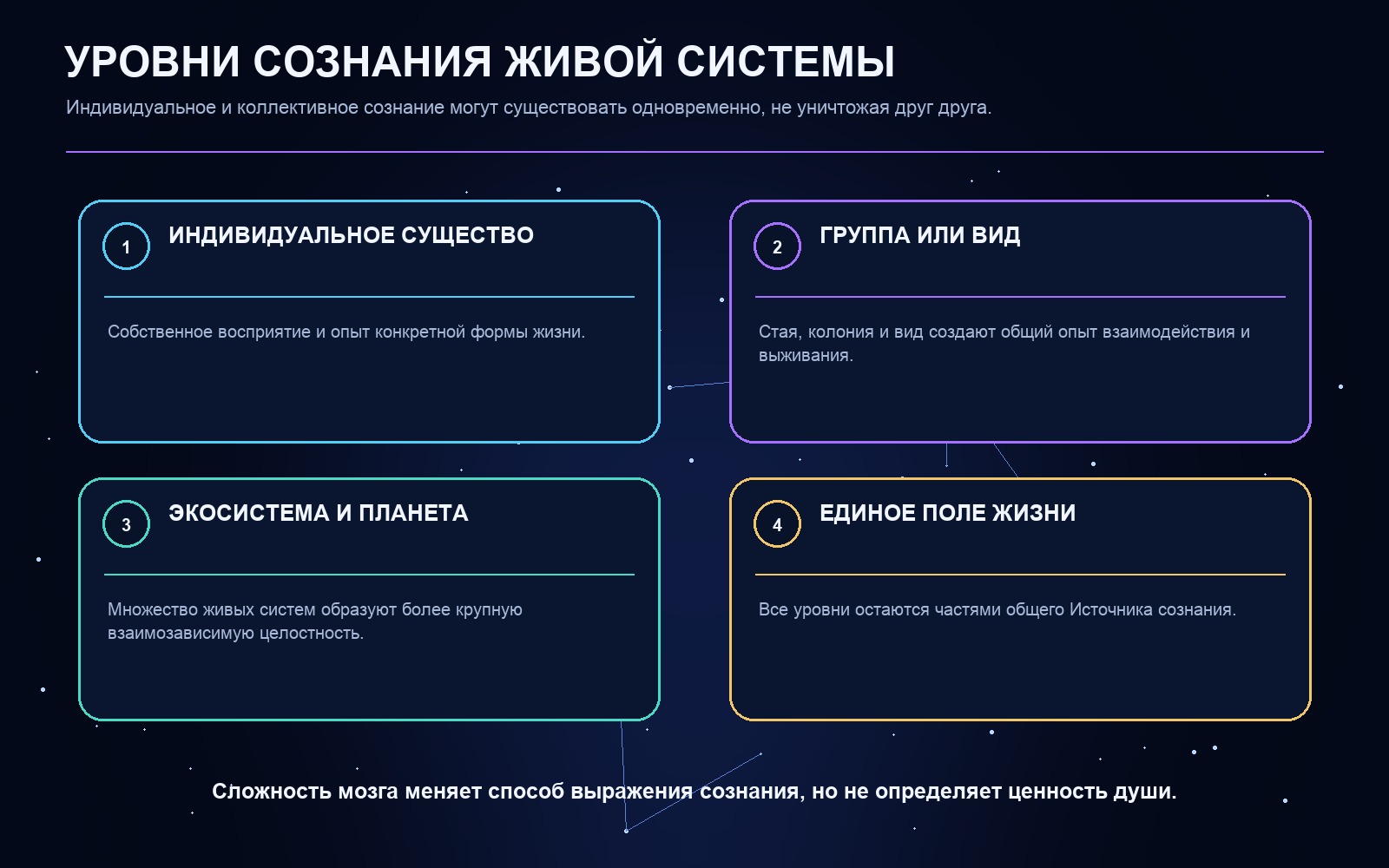
In my book, I consider consciousness not only as an individual phenomenon but also as the capacity of living systems to unite into larger wholes.
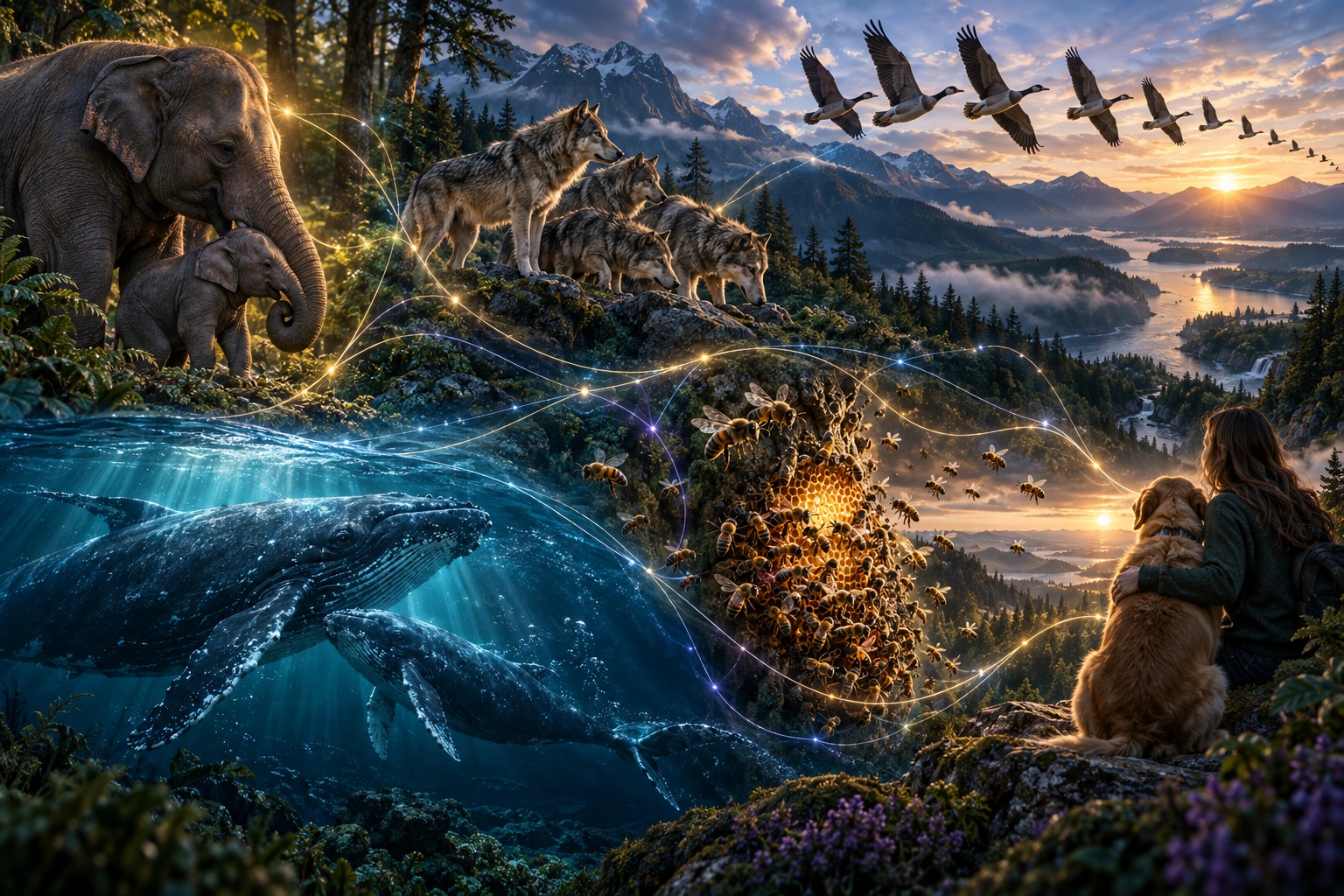
The cells of an organism have their own internal organization, yet together they form a body. Individual animals may possess individual consciousness while remaining part of the consciousness of a species, pack, colony, and ecosystem. These levels do not cancel one another.
The collective principle is especially visible among bees, ants, and other social creatures. A colony’s behavior cannot be fully understood if each participant is treated as an isolated unit. At the same time, collectivity does not turn an individual creature into an empty cog.
In my model, the individual soul and collective consciousness can interact in the same way a human being can remain an individual while also belonging to a family, a society, and a planet.
What kind of experience does an animal gain?
The soul’s experience is not limited to intellectual achievement. To develop, consciousness must learn interaction, trust, caution, care, protection, cooperation, and many other qualities.
Different forms of life create different conditions:
- the life of a predator develops attention, decisiveness, and precision of action;
- life within a group requires an understanding of boundaries, hierarchy, and cooperation;
- caring for offspring creates experience in responsibility and attachment;
- migration and survival connect consciousness with the rhythms of space and environment;
- a companion animal gains a profound experience of emotional connection with a human being.
These are human words for processes animals experience in their own way. We should not imagine that an animal’s soul reasons in the same categories we do. Its experience may be immediate, sensory, and embodied, but that does not make it any less real.
Is an animal simply an “undeveloped human soul”?
I do not accept the idea that every animal is merely a future human being temporarily trapped on a lower rung. The human form is not the single destination of all life in the Universe.
Souls exist at different stages and choose different directions of experience. Some forms may prepare consciousness for more complex individuality, while others develop along paths that do not have to imitate humanity.
Body size, speech, and technological development tell us nothing about the absolute value of a soul. The outer form reveals the conditions of incarnation, not the worth of the inner life.
What happens after an animal dies?
After the physical body dies, an animal’s consciousness also continues. Within the structure of the third energy level that I have observed, there are spaces for many forms of life—terrestrial, aquatic, airborne, microscopic, and entirely unlike the organisms familiar to us.
The world of the soul was not created exclusively for human beings. Every form of life has a place suited to its nature and way of perceiving.
Companion animals retain their connection with the people whose lives they shared. Mutual love and trust become part of the experience of both souls. That is why the possibility of meeting a beloved animal again does not seem to me like a comforting fantasy. If the connection was real, the death of the body does not erase it.
But we should not demand that an animal remain our pet forever. Its path is larger than a single role, just as a human path is larger than one family and one life.
Why human beings carry a special responsibility
Recognizing that animals have souls changes our ethics. If the being before us is not an object or an automaton but a form of consciousness, then how we treat it becomes part of our own development.
This applies to companion animals, animal agriculture, conservation, scientific research, and the destruction of habitats. Humanity possesses enormous physical and technological power. With that power comes responsibility for lives we are able to alter.
I do not believe everyone must live in exactly the same way or immediately adopt one diet. But each of us can ask honestly: Am I reducing unnecessary suffering? Do I see a living being, or only a useful resource? Do my actions reflect an understanding of the unity of life?
Awareness is revealed not in beautiful statements about loving the Universe, but in our daily treatment of those who are weaker and dependent on our decisions.
Animals also teach human beings
The connection works in both directions. An animal gains experience beside a person, and a person learns through the animal.
Companion animals show us the simple joy of presence, emotional directness, trust, and the ability to remain close without complicated explanations. Wild animals remind us that life was not created for our convenience and that intelligence exists in forms we still understand poorly.
Sometimes a person first experiences unconditional care through a relationship with an animal. That love changes the person’s character and remains part of the soul’s experience.
No one is forgotten in the larger system of life
Human arrogance encourages us to see ourselves as the center of existence. But if everything that exists is part of the Source, then no life can have been created without inner meaning.
Animals have souls, gather their own experience, and continue their journey after the death of the body. Their consciousness may differ from human consciousness in structure and expression, but difference does not mean absence.
We all participate in one system of development: human beings, animals, other forms of life, and the planet itself as a complex collective consciousness.
Recognizing this does not diminish humanity. It makes us more mature. We stop seeing the world around us as scenery and begin to notice a living Universe in which every form has a right to existence, experience, and a return home.
For a fuller discussion of collective consciousness, the souls of different forms of life, and the structure of the soul’s world, see my book The Phenomenon of Consciousness Beyond the Body.
Read the English edition on Amazon →
Additional English edition on Amazon
Leave a Reply