
Every large system seeks predictability. Government finds it easier to manage a citizen who follows instructions without question. A company benefits from a consumer whose desires can be shaped in advance. A religious organization prefers a believer who never examines the words of authority. An information platform needs a user who reacts automatically to each new stimulus.
An aware person disrupts that predictability. He asks “Why?” He notices pressure and refuses to surrender his right to think.
Control Does Not Always Require a Conspiracy
When people speak about systems of control, they often imagine a hidden center directing every event. Yet most control develops more simply.
An organization rewards behavior that helps it preserve itself. A manager chooses a compliant employee. An algorithm displays the message most likely to hold attention. A political system supports those who do not ask difficult questions. Funding flows toward work expected to produce a familiar and profitable result.
These processes can form a powerful system without a single command center. Each participant takes a small, predictable step. Together, those steps create an environment in which independent thought is not openly prohibited, but is made inconvenient again and again.
Attention Is the Primary Territory of Control
People make decisions from what they see and what they think about. Directing attention can therefore be more effective than issuing an order.
When a constant flow of information moves a person from fear to scandal, from entertainment to the next purchase, no inner quiet remains for a question of his own. He reacts continually and reflects very little.
Such a person may believe he is free because he can choose among thousands of options. Yet the set of options, the order in which they appear, and their emotional framing have already been arranged by an outside system.
Awareness begins when we reclaim our attention.

Fear Turns a Person into an Executor
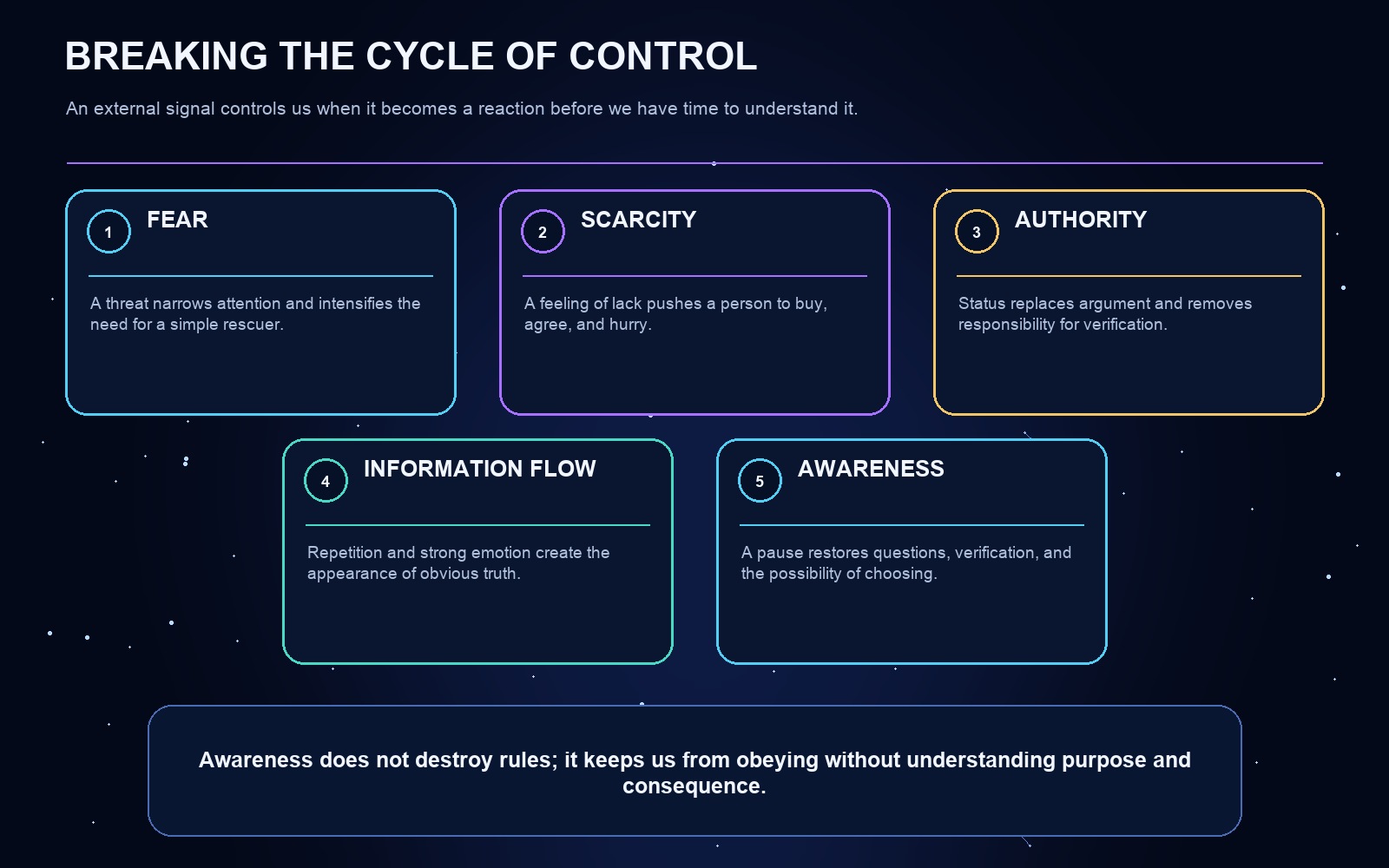
Fear is necessary as a warning of danger. Prolonged fear, however, narrows perception and drives a person to seek someone who promises a simple rescue.
A system may use the fear of losing work, status, belonging, safety, or approval. A person knows a decision is wrong for him, but he is afraid of the consequences of disagreement. Over time, he stops noticing his inner resistance at all.
An aware person still feels fear. The difference is that he tries to identify its source and refuses to let the emotion make his decision invisibly.
Authority Does Not Replace Personal Responsibility
In childhood, authority helps us learn and protects us from danger. The problem begins when an adult continues searching for someone to whom he can surrender responsibility for truth and for his own life.
A scientist, politician, clergy member, physician, or spiritual teacher may know more within a particular field. But no title makes a person infallible or relieves the listener of the need to understand the basis of the advice.
An aware person can respect expertise while still examining the expert's words. A system built on unconditional obedience finds that attitude deeply inconvenient.
Why an Independent Person Is Harder to Sell To
Much of advertising speaks not to a genuine need, but to a sense of inadequacy. It presents an image that makes your own life appear poorer, your body less attractive, your home outdated, and your achievements insufficient.
An aware person notices the emotion that someone is trying to provoke. He may purchase a quality product, but it is harder to sell him the promise of someone else's life.
He also understands that money is an instrument rather than a measure of the soul's worth. This makes it harder to control him through endless comparison, prestige, and fear of being “less than” others.
Awareness Is Not Permanent Rebellion
Independent thought does not mean automatically rejecting every rule. A traffic law limits action while protecting life. The scientific method imposes requirements while helping separate a result from the researcher's desire.
An aware person asks about the purpose of a restriction and its consequences. If the rule is reasonable, he follows it from understanding rather than fear. If the demand is unjust, he looks for a way to change it and is prepared to accept responsibility for his position.
Rebellion for its own sake is as automatic as blind submission. Real independence is the ability to discern.
An Aware Person Recognizes the Language of Manipulation
Systems of influence often rely on the same techniques:
- creating urgency so that a person has no time to think;
- presenting only two extreme alternatives;
- replacing a fact with a label;
- linking disagreement with shame or expulsion from the group;
- repeating a claim until it begins to feel self-evident;
- provoking a powerful emotion and immediately offering a prepared action.
Awareness does not make anyone invulnerable. It allows us to pause, identify the method being used, and reclaim the possibility of choosing.
Why Systems Also Need These People
The paradox is that a complex society cannot develop through obedient executors alone. During a crisis, the old algorithm stops working. At that moment, a system needs people who can see a contradiction, take responsibility, and propose a new solution.
A healthy system can withstand uncomfortable questions and use them to correct its mistakes. A weak system treats every question as a threat and gradually loses contact with reality.
The way a system treats an aware person therefore reveals the quality of the system itself.
Connection with the Soul Restores an Inner Foundation
In my model, the soul is a wider consciousness of which the earthly personality is one part. When a person identifies himself entirely with a social role, he can be controlled through the threat of losing status, position, or approval.
Connection with the Higher Self does not provide ready-made answers to every practical question. It changes the foundation from which decisions are made. A person begins to weigh a choice not only against external advantage, but also against conscience, meaning, and long-term consequences.
No external system of reward and punishment can fully replace that inner foundation.
Awareness Makes Power More Mature
I do not believe society can exist without organizations, rules, and government. But power must be transparent, limited, and open to examination.
An aware person is inconvenient for control based on fear and ignorance. At the same time, he is essential to a society that wants to grow. He does not demand to be rescued constantly. He participates, verifies, admits his own mistakes, and expects the same responsibility from those in authority.
The purpose of awareness is not to destroy every system. It is to prevent a system from reducing a living person to a function, a number, or an obedient resource.
In The Phenomenon of Consciousness Beyond the Body, I explain how the development of awareness restores a person's authority over his own life and strengthens his connection with the soul.
Leave a Reply