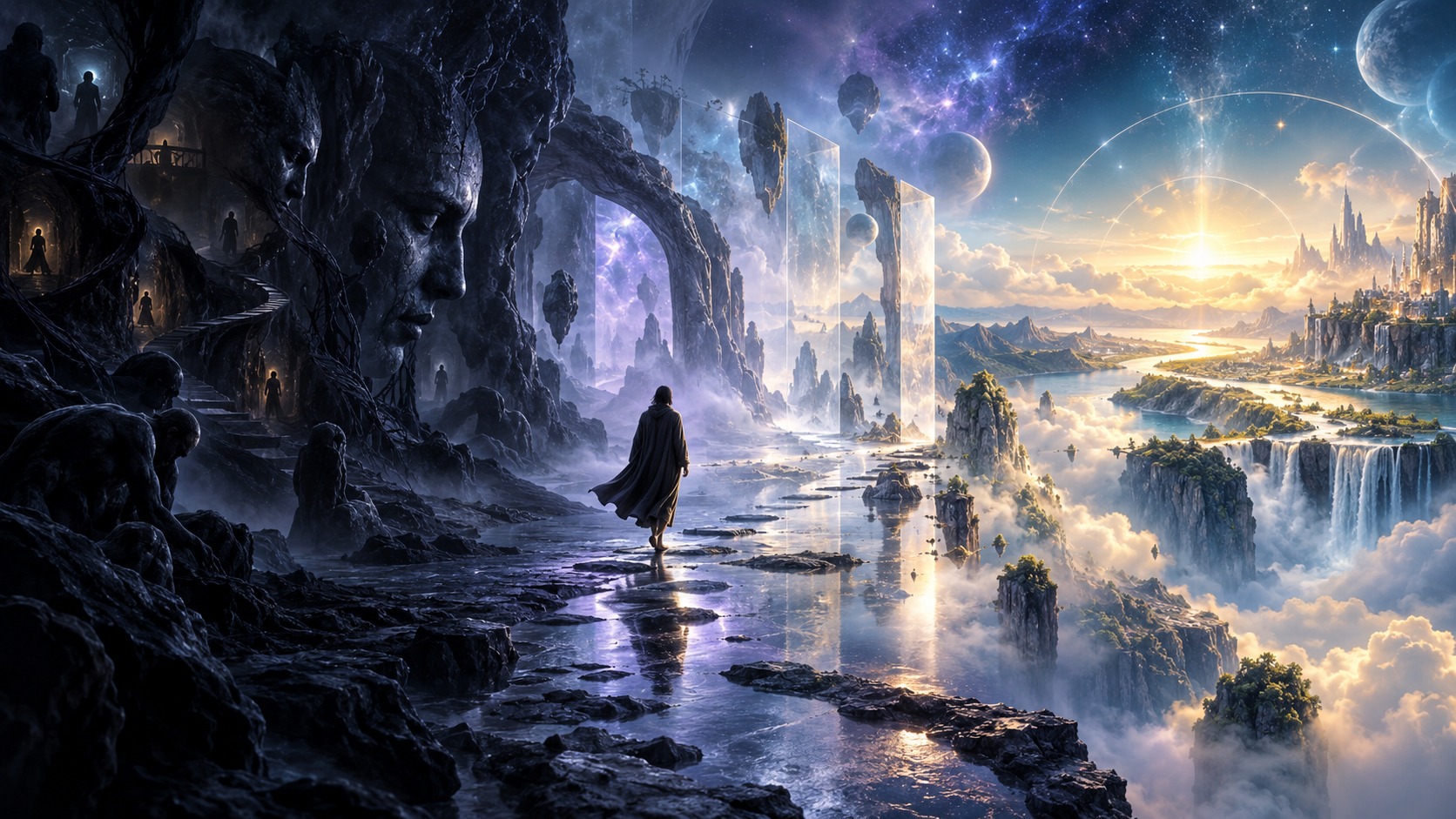
Religions and cultures have created many visions of the afterlife. Some promise heavenly gardens or eternal torment; others describe purification, judgment, a river, a bridge, or a long journey. These images differ, yet they address the same questions: Where does consciousness go after death? What determines its condition? Can a soul become trapped between worlds?
I do not see heaven and hell as two physically defined places to which an external judge assigns people forever. My experience suggests a more complex picture. After death, consciousness moves through different states and levels of reality. Its perception depends on clarity, beliefs, fears, attachments, and its readiness to accept what has happened.
Religious images may reflect real processes, but human language has turned them into overly simple systems.
Why people see what they believe
At the nearest nonphysical levels, thought affects the perceived environment much faster than it does in the dense world. Consciousness can create forms from expectations, memory, and emotional experience.
This is especially powerful in the mental realm—a space created through our capacity of mind. Fear, religious belief, guilt, and familiar imagery can construct a convincing reality there. A person does not merely imagine it from the outside but finds himself inside his own perception.
A Christian may therefore see familiar religious symbols, a person from another culture may encounter a different image of transition, and a committed materialist may spend a long time failing to understand that the body has died.
This does not mean that everything after death is imaginary. Real levels and other souls exist independently of our wishes. Yet in transitional spaces, personal perception can overlay reality and alter its appearance.
What we call heaven
Images of heaven often convey a feeling of returning home: peace, love, reunion with loved ones, freedom from pain, and restored memory. In that sense, they are close to how I perceive the soul’s return to the third energy level.
There, consciousness is no longer limited by a sick or aging body. The soul reunites with its kindred group, rests, reflects on its life, and creates a familiar environment. For earthly souls, that environment may resemble beautiful places on Earth, but not because one universal heavenly garden exists for everyone. Consciousness forms a setting in which recovery and communication are easier.
Heaven, as I understand it, is not a reward for belonging to the correct religion. It is the natural state of returning to fuller memory, connection, and love.
But the soul’s world is not an eternal resort. Learning, development, and preparation for future stages continue there.
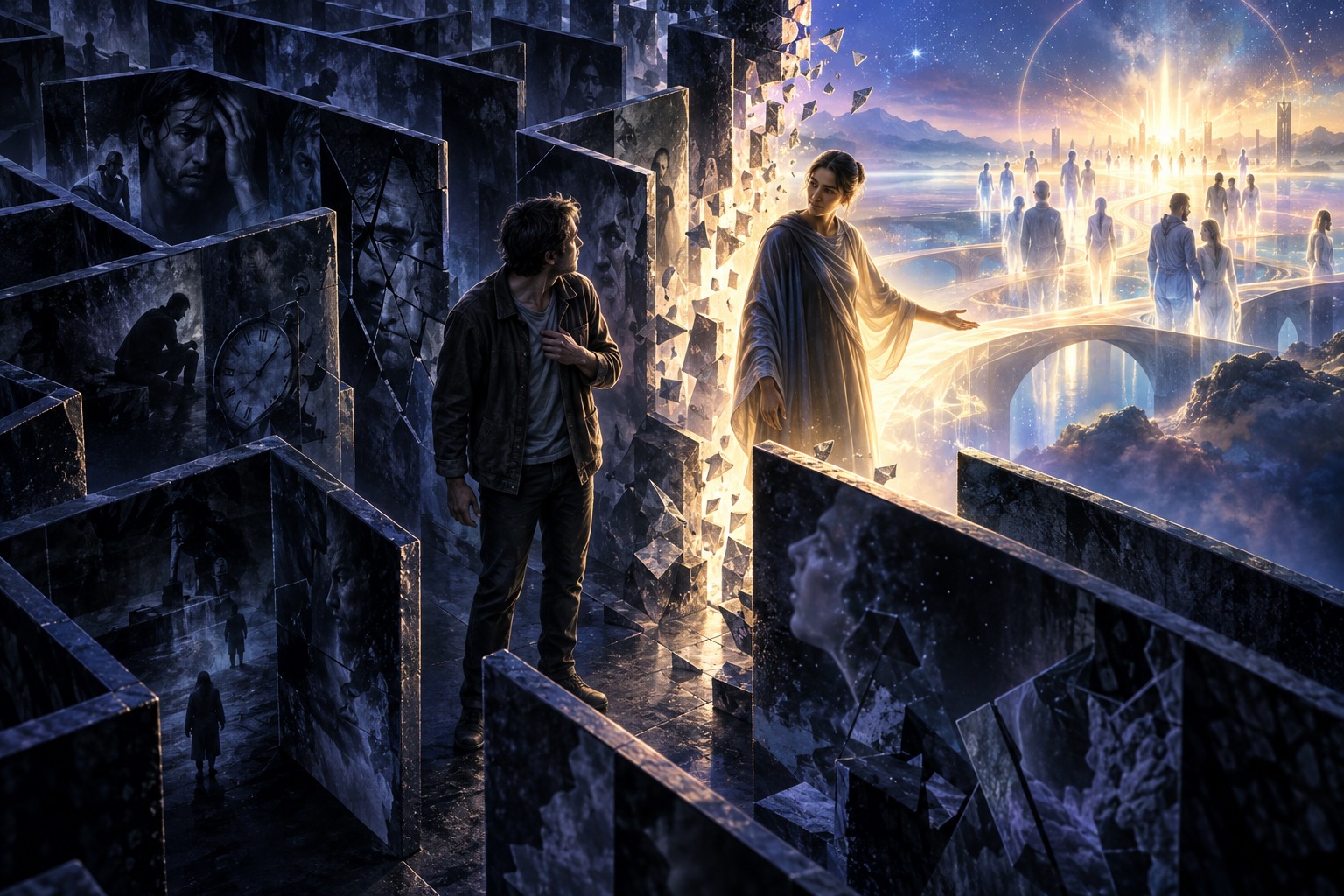
What may lie behind the image of hell
I have found no reason to believe that the Source creates an eternal torture chamber for its own parts. The idea of endless punishment for one limited earthly life contradicts the very purpose of the soul’s development.
Difficult states after death are possible, however. A person may carry fear, hatred, guilt, addiction, or an inability to accept death. In a realm where thought quickly takes form, the inner condition becomes the surrounding reality.
This can produce an experience that resembles hell. It is created not by an enraged God, but by consciousness caught inside its own destructive patterns and not yet able to leave them.
This condition does not have to be eternal. Help exists, but the soul must allow itself to recognize that help, release the familiar struggle, and accept a wider understanding.
Purgatory as a process of recovery
The image of purgatory comes closest to a transitional stage in which the soul releases earthly limitations and understands the life it has completed.
A person does not become instantly wise after death. He must understand what happened, restore memory, see the consequences of his actions, and regain balance. For one soul this process may be quick; for another it may be long and emotionally difficult.
Purification here does not mean punishment by external fire. It is an honest encounter with oneself. The soul gradually separates the experience it has gained from fear, self-deception, and roles it once believed were the only reality.
Time is perceived differently beyond the physical world, so earthly ideas of days and years do not apply. What matters is not the duration but the result: the ability to accept a completed life and continue the journey.
Who are “earthbound souls”?
This term is commonly used for those who remain close to the physical world for a long time after death and do not continue the transition. I do not consider them cursed or permanently lost.
The reasons can vary:
- a sudden death and failure to understand what happened;
- a powerful attachment to the body, a home, possessions, or a particular person;
- fear of religious punishment;
- certainty that nothing exists after death;
- a desire to complete an important task or say goodbye;
- an intense emotional state that narrows perception.
A recently departed soul may also remain nearby for a natural reason—to support loved ones and calmly complete its connection with earthly life. Not every presence near the physical world means a person is trapped.
The problem arises when consciousness refuses to notice help and continues repeating the same limited pattern.
Who helps a soul leave a difficult state?
A person is not alone after death. Kindred souls, guides, and teachers may meet him. They help him understand the transition and direct him home.
But help is not always recognized. If a person is convinced that enemies or demons surround him, even a loving presence may cause fear. If addiction has completely captured him, all attention may remain fixed on the familiar object.
Inner readiness therefore matters. Sometimes it is enough to acknowledge that physical life has ended, help is possible, and the old struggle no longer has to continue.
The living do not need to perform dangerous rituals or try to control the departed by force. A calm inward message, love, and permission to continue the journey are more helpful than fear and constant attempts to summon contact.
Why every unusual experience cannot be treated as proof
The subject of afterlife states is especially vulnerable to self-deception. Fear makes any image convincing, while the desire for an answer can turn coincidences into signs.
During an out-of-body experience, a person may enter an objective environment, a mental construction, or a mixed state in which observation is intertwined with expectation. A dramatic image of heaven or hell therefore does not by itself reveal the structure of all reality.
I evaluate an experience by the clarity of consciousness, stability of the environment, capacity for interaction, repeatability, and whether its meaning remains coherent after returning. Even then, I leave room for further research.
Care does not require denying what happened. It keeps us from turning one personal episode into an absolute law for everyone.
A dynamic journey lies behind the images
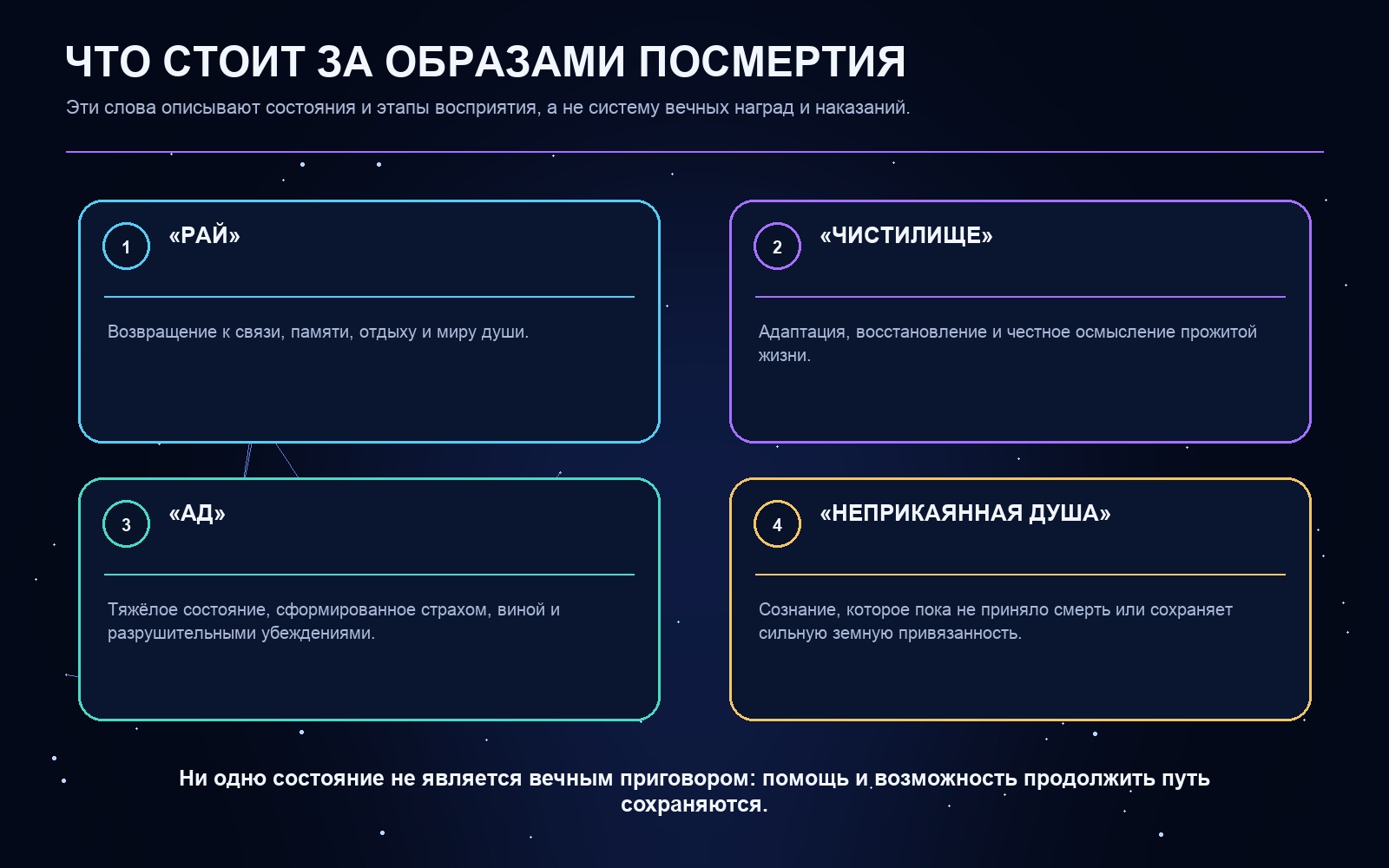
Heaven, hell, and purgatory are human words for different states of consciousness after death.
Heaven reflects a return to love, memory, and the soul’s world. Hell may arise as a difficult reality formed by fear, guilt, and destructive beliefs. Purgatory resembles a process of adjustment and honest reflection on life. An “earthbound soul” is not a condemned being, but a consciousness that has not yet completed its transition.
None of these states has to become an eternal sentence. Development continues, help exists, and the connection with the Source is never broken.
After death, we do not enter a primitive system of rewards and punishments. We enter a reality where our inner condition becomes more visible, responsibility becomes deeper, and a return to wholeness requires honesty.
The most important preparation for transition does not begin with studying frightening images. It begins with a conscious life: the ability to see our motives, to avoid building a world of hatred within ourselves, and to remember that we are never separate from the common Source of life.
For a fuller discussion of the mental realm, transitional states, and the soul’s world, see my book The Phenomenon of Consciousness Beyond the Body.
Read the English edition on Amazon →
Additional English edition on Amazon
Leave a Reply