
Awareness is often presented as a private spiritual practice: a person observes himself, directs the stream of thought, and develops a clearer understanding of his feelings. But society is made of individual decisions. When awareness ceases to be a rare personal quality, relationships, education, economics, government, and the atmosphere of everyday life all begin to change.
Greater public awareness does not begin with inspiring slogans. It becomes visible in ordinary actions.
Society Reveals Itself in Everyday Life
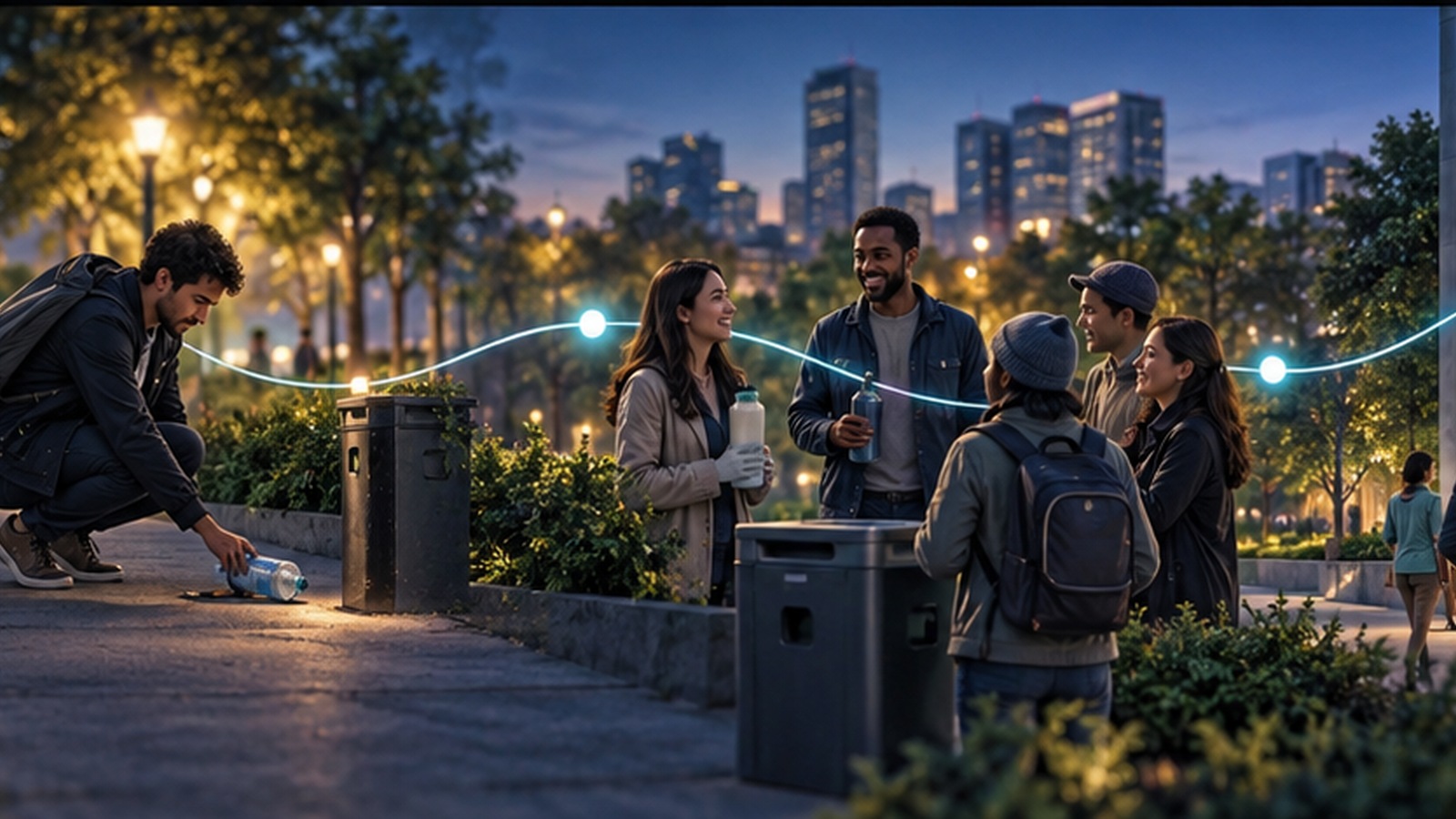
The level of awareness in a society can be observed on the road. Do people follow the rules only when a police officer is nearby, or do they understand that the rule protects another person's life? We see it in the treatment of trash, nature, and shared space. We see it in attitudes toward vulnerable people, opposing opinions, and responsibility for children.
These signs may appear mundane, but they show whether a person can recognize the consequences of his actions beyond the present moment.
Awareness is not measured by the number of spiritual books someone has read. It is the ability to understand what is happening, notice one's own motive, and accept responsibility for the result.
From Automatic Reaction to Independent Decision
An unaware society is easily directed through ready-made reactions. It is enough to provoke fear, identify an enemy, promise safety, or display a popular image of success. A person acts before he has time to examine the information.
An aware person creates a space between stimulus and action. He asks: What actually happened? Who benefits from my outrage? Do I have enough information? Is a strong emotion being used to replace a fact?
When a meaningful share of society begins to act this way, manipulation becomes more expensive and less effective. A public figure can no longer rely on repeating a slogan. A company finds it harder to conceal the consequences of its product. A religious or spiritual leader must answer for the contradictions between words and actions.
Awareness Changes the Meaning of Freedom
Freedom is not the ability to do whatever we want in the present moment. When a person is controlled by habit, addiction, fear, or group pressure, external liberty does not yet make him free inside.
Awareness restores a person's ability to see his limitations and work with them. He begins to distinguish his own desire from an implanted need. He can refuse a behavior that brings immediate pleasure while damaging his own life and the lives of others.
Personal freedom is then joined with responsibility. A person protects his own rights while recognizing the rights of another.
Education Must Teach Thinking, Not Repetition
An aware society cannot be built by transmitting ready-made answers alone. A child must learn to ask questions, compare sources, recognize cause and effect, and admit when an earlier conclusion was mistaken.
A teacher in such a system does not demand intellectual submission. The teacher demonstrates a method of investigation. An error ceases to be a source of shame and becomes part of learning.
It is especially important to preserve a child's ability to say honestly, “I don't know.” Real knowledge begins with that sentence. A person who is punished for asking questions in childhood is more likely to accept authority's opinion instead of conducting his own investigation as an adult.
Our Relationship with Power and Institutions Changes
Aware people do not demand perfect leaders. They demand understandable rules, transparent decisions, and the ability to verify results.
They do not surrender complete responsibility for their lives to government, religion, science, or a spiritual teacher. An authority may possess knowledge and legitimate power, but that does not make the authority infallible.
At a higher level of awareness, power is understood as a function of service to society rather than a right to control other people. The citizen stops being a passive observer and participates in shaping the rules under which he lives.
The Economy Becomes More Responsible
The modern economy often depends on unconscious consumption: create a feeling of lack, intensify anxiety, and offer a purchase as the way to restore self-worth.
An aware consumer asks different questions. Do I need this object? Who made it, and under what conditions? How long will it last? What effect did its production have on people and nature?
When enough consumers ask these questions, businesses must compete through quality, durability, and honesty rather than advertising alone. Money does not disappear, nor is it declared evil. It becomes an instrument of choice and responsibility.
Disagreement Becomes More Mature
Greater awareness will not produce a society in which everyone thinks alike. On the contrary, independent people will often reach different conclusions.
What changes is the way they disagree. A person can separate an idea from the individual expressing it, listen to an argument, and refuse to turn an opponent into an enemy. He does not have to abandon a firm position. He does have to understand why he holds it and remain willing to examine its foundation.
Conflict then ceases to be a struggle to destroy the other side and becomes a way of seeing a problem from more than one angle.
The Information Environment Stops Owning Our Attention
In the digital world, a person receives more information every day than he can process. Algorithms select messages that provoke a strong response. Anger, fear, and outrage hold attention more effectively than calm analysis.
An aware society learns to protect its attention. People limit meaningless input, examine primary sources, and refuse to treat popularity as proof of truth.
This is one of the most important forms of inner independence. Whoever continually directs your attention gradually begins to direct your picture of reality.
Change Begins from the Ground Up
No law can instantly make people aware. Awareness cannot be imposed, because it rests on independent observation and inner choice.
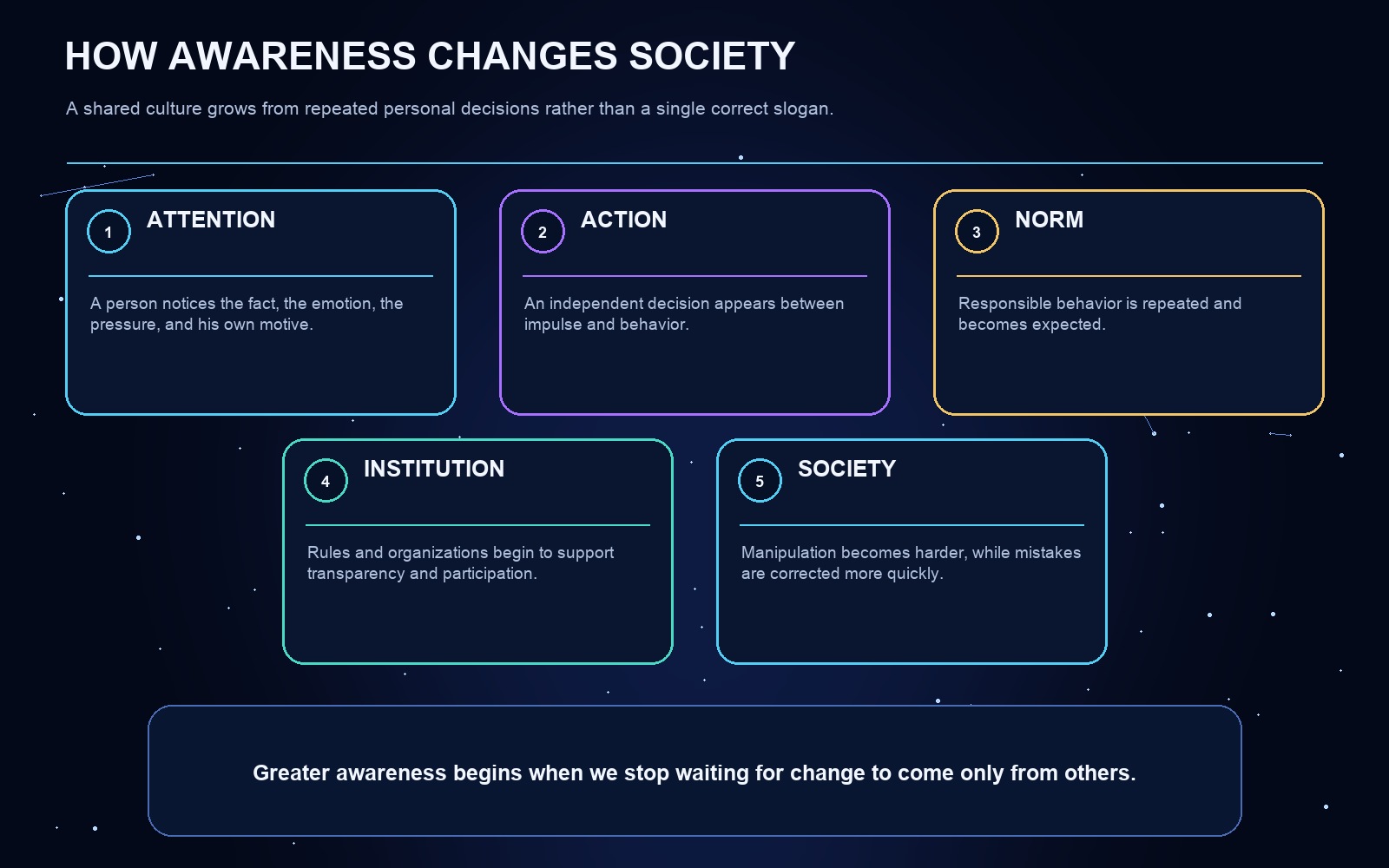
It spreads through example. A parent admits a mistake to a child. A manager explains a decision. A researcher publishes unsuccessful results as well as successful ones. A citizen does not walk past an obvious injustice. A driver yields the right of way out of respect for life rather than fear of punishment.
Every such action creates a new norm.
What Would Truly Change?
An aware society would not become perfect or eliminate every conflict. It would, however, recognize mistakes more quickly and support them less often merely because “that is how things are done.”
It would become harder to sell fear, conceal responsibility, or reduce a person to a silent executor. People would understand their rights more clearly, care for nature more responsibly, raise children more attentively, and examine information more rigorously.
The greatest change would occur within the individual himself. He would stop waiting for someone else to build the right world for him. He would recognize his own share in what that world becomes each day.
In The Phenomenon of Consciousness Beyond the Body, I explore awareness as one of the central tasks of earthly life and as the foundation of the personality's connection with the wider consciousness of the soul.
Leave a Reply