
Can a regression practitioner help another person have a genuine out-of-body experience? Several years ago, that question became the foundation of a large practical project. More than twenty regression practitioners and over fifty participants took part. The practitioners used different methods, conducted individual sessions, exchanged observations, and gradually identified conditions under which guided separation of consciousness from the body may become possible.
Oleg Saifuddinov was only one member of this work. His statistics are valuable, but they represent a separate series of sessions rather than the project as a whole. The larger picture was much broader: successful and unsuccessful attempts, full exits, partial separation, vibrations, immediate arrival in another environment without the usual sensation of leaving, delayed results, and early attempts to verify the information participants perceived.
The project did not provide a final answer about the nature of consciousness. It did something else: it demonstrated that combining out-of-body practice with regression is a workable field of investigation capable of producing results with different practitioners and different participants.
Why the Project Was Created
To enter an out-of-body state consciously, a person needs to relax the physical body deeply, preserve clarity, and pass through the transitional state without losing awareness. Many independent attempts end at precisely this threshold. The person falls asleep, becomes frightened by unfamiliar sensations, returns attention to the body, or begins analyzing the experience too actively.
A regression practitioner already knows how to guide someone into deep relaxation, help the person sustain attention, and move calmly through unusual states. This led to the idea of combining the experience of OBE practitioners with the tools of regression. The purpose was not to suggest a ready-made image. It was to help a participant reach the point of separation and then provide space for independent experience.

A Project Larger Than One Method or One Practitioner
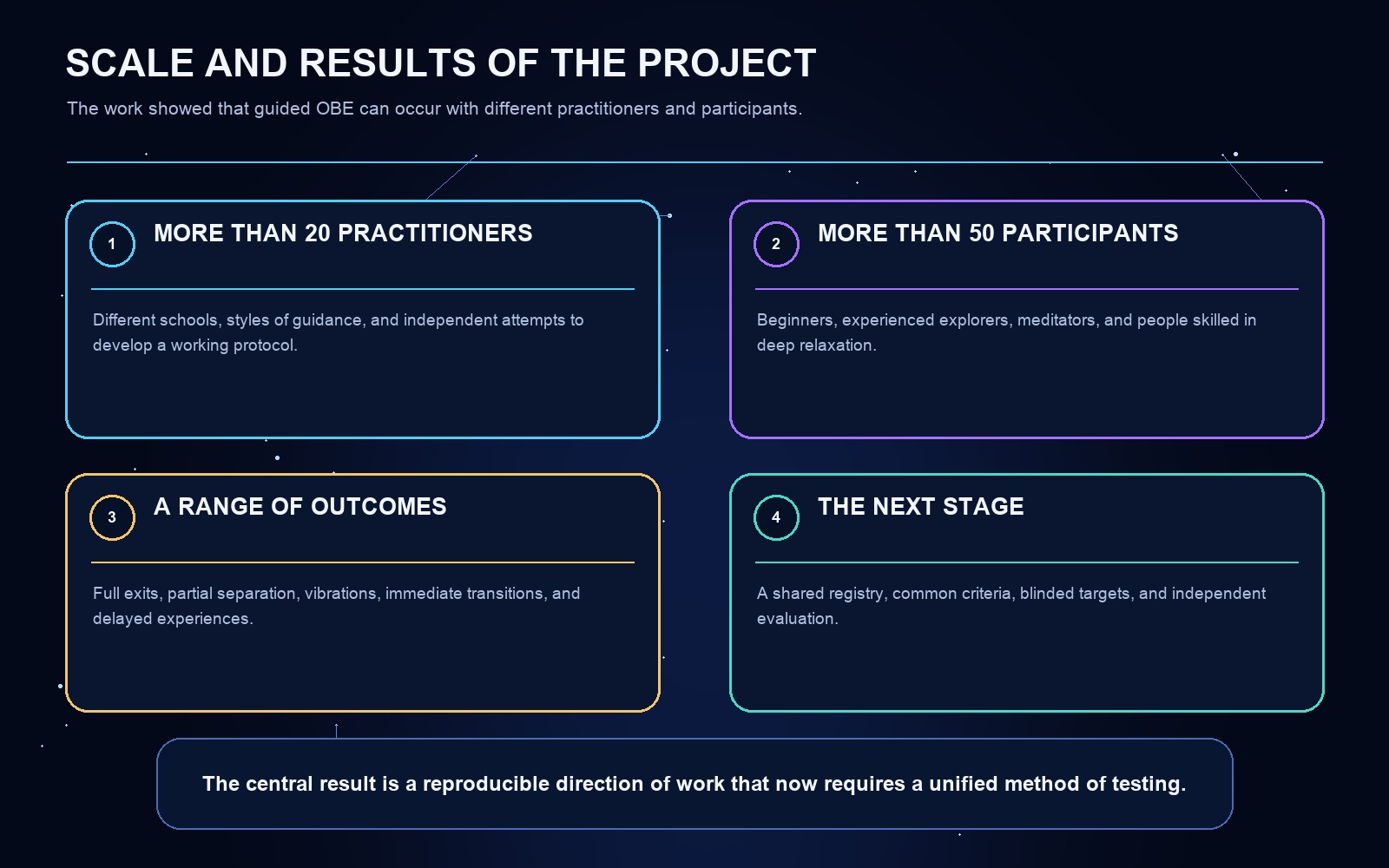
More than twenty regression practitioners joined the working group, and over fifty participants went through sessions. The practitioners represented different schools and levels of experience. The participants varied as well: some had already experienced OBE, some encountered transitional states for the first time, and others had never left the body but practiced meditation and knew how to relax deeply.
This diversity made a single statistical summary more difficult, but it gave the project an important strength. The results were not tied to one voice, one script, or one personality. Positive cases appeared with different practitioners. Unsuccessful attempts were valuable as well because they revealed the conditions that interfere with transition and the elements of preparation that needed to change.
It gradually became clear that an ordinary regression script cannot simply be given a new objective. In regression, the practitioner often continues to lead through questions. In an out-of-body experience, too much guidance after transition may interfere. The practitioner’s task is to prepare the participant, help the person cross the threshold, and then step back at the right moment so that independent action can begin.
The Range of Results
The experience cannot be reduced to two outcomes—“left the body” or “did not leave.” The reports revealed a spectrum of states:
- full separation with clear perception;
- partial separation involving the hands, legs, or upper part of the energy body;
- vibrations, tingling, and changes in the perceived size or position of the body;
- sudden arrival in another environment without a noticeable separation process;
- an exit that occurred later, after the session or early the next morning;
- an independent repeat experience after the participant first crossed the threshold with a practitioner;
- images and information that were later compared with external facts.
This is a significant observation. Strong classical vibrations do not occur in every case. Sometimes a person does not feel the act of leaving at all and simply discovers that awareness is present in another reality. If a dramatic physical sensation is treated as the only valid result, meaningful cases will be lost.
Natalia Talyzina’s Series: Fifteen Sessions and Three Full Exits
Regression practitioner Natalia Talyzina conducted fifteen experimental sessions. She classified three as successful full exits. She emphasized that fifteen cases were not enough for final conclusions, but the results were strong enough to justify continuing the investigation.
Natalia’s central conclusion concerned participant preparation. Her most successful participants had no prior OBE, but they did have experience with meditation and other practices. They knew how to relax the body, quiet the stream of thought, and sustain attention. Before a session, they learned about the nature of OBE, read my book, and studied material on transitional states.
Natalia first guided the participant and then stopped speaking completely for ten to twenty minutes. This period of silence allowed independent action. The practice revealed an important principle: the practitioner’s voice may be necessary up to a certain boundary, but beyond that boundary it can distract the participant from the new environment.
One participant, a twenty-five-year-old man, felt neither strong vibrations nor a clearly defined separation. He experienced only mild tingling and then simply found himself in another reality. This became one indication that transition does not have to follow a single script.
Early Attempts to Verify Perception
In one session, the same participant first perceived himself inside a dark liquid and then understood the environment as a person’s lungs. He associated what he saw with the father of a friend. The following day, he learned that doctors suspected cancer. Seventeen days later, the man died of lung cancer.
This case cannot be treated as controlled proof. The participant had taken the man to a doctor the day before and could have unconsciously noticed signs of a serious condition. The correspondence was nevertheless strong enough to document and to show why future investigations must exclude possible ordinary sources of information in advance.
In another task, the participant was asked to visit a large memorial park in another state that he had never physically visited. During the experience, he described a parking area, an unusual structure, and a tall statue that he believed represented Benjamin Franklin. Later, online maps and photographs revealed a similar area containing parking, a structure, and a large statue of Thomas Jefferson.
This was not yet a clean blinded experiment because the participant had been shown photographs and video of the park before the session. The case cannot therefore serve as final confirmation of distant perception. It did, however, clarify how verification should develop: the target must be selected in advance; neither the participant nor the practitioner should receive visual information about it; the description must be recorded before the target is revealed; and an independent evaluator should judge the match.
What Alexey Kuleshov’s Experience Added
Alexey Kuleshov’s report was valuable because he openly analyzed an unsuccessful attempt. His participant came to the exercise after a long session, was tired, knew very little about OBE, and was not adequately prepared. Vibrations appeared, but full separation did not occur.
The negative result revealed several critical mistakes. A participant must understand the purpose of the session and recognize the signs of a transitional state. The work is better conducted when the person is rested and able to sustain attention. The practitioner and participant should agree in advance on a signal indicating that separation or return has begun. Time distortion must also be considered: a few minutes may seem to pass internally while a much longer period passes externally.
Alexey’s experience further confirmed that a single script will not suit everyone. One participant continues to hear the practitioner; another stops perceiving the voice. One needs support all the way to the threshold; another needs a long period of silence. A future protocol should therefore be standardized in its definitions and documentation while remaining flexible in the guidance itself.
Oleg Saifuddinov’s Separate Series
Psychologist and regression practitioner Oleg Saifuddinov later continued the work and reported statistics from his own series of thirty-nine sessions:
- nine resulted in full out-of-body experiences;
- twenty-six produced vibrations or partial separation;
- four produced no noticeable result.
The average rate of full exits in this series was approximately 23 percent. Seven of the nine participants had previous experience, while two had their first full exit. In some cases, the result occurred after the guided session—later that day or early the next morning.
The change after introducing a preliminary questionnaire was especially notable. Among the first twenty-two sessions conducted without detailed screening, the full-exit rate was about 13 percent. In the next group of better-prepared participants, it approached 40 percent. These figures should not be generalized to the entire project, but they support the conclusion reached by other practitioners: preparation has a major effect on the outcome.
The Project’s Main Patterns
When the reports are compared, several shared patterns become visible.
Preparation matters more than a particular school of regression. Success appeared more often among people who understood the objective, knew how to relax, could quiet the thought stream, and could sustain attention.
The practitioner cannot leave the body for the participant. The practitioner helps the person cross the most difficult part, reduces fear, and maintains direction. Separation and subsequent action remain the participant’s responsibility.
External guidance should decrease after transition. Continuous questions and instructions can return attention to the physical body or replace direct perception with a mental narrative.
The absence of powerful vibrations does not mean that no OBE occurred. Some participants found themselves in another environment almost immediately.
Unsuccessful sessions are part of the result. They revealed the influence of fatigue, insufficient preparation, internal dialogue, fear, and poorly timed guidance.
A verification task should be established in advance. Without one, even a vivid experience remains personal. The project took early steps toward external verification, but the next stage should be considerably more rigorous.
What the Project Actually Demonstrated
More than twenty regression practitioners and over fifty participants constitute more than one person’s story. The project demonstrated that guided out-of-body experience is possible with different practitioners using different methods. It identified recurring transitional signs and conditions associated with a higher likelihood of success. It also showed that a person without previous OBE can have a first experience with appropriate preparation.
The project was not yet a single controlled scientific experiment. Not every practitioner used the same script. Definitions of full separation could differ. There was no unified registry in which every attempt was documented in the same format. Verification tasks were not always blinded, and most of the material consists of personal reports.
This does not erase the results. It shows how the accumulated experience can be taken to the next level.
What the Next Stage Should Include
The next stage should preserve the living, practical character of the project while adding shared research rules:
- Register every session, including unsuccessful attempts.
- Use standardized questionnaires before and after the experience.
- Separate beginners from participants with previous OBE experience.
- Record levels of outcome: relaxation, transitional sensations, vibrations, partial separation, full separation, retained memory, and completion of the assigned task.
- Select blinded targets unknown to both participant and practitioner.
- Record every description before revealing the target.
- Use independent evaluators to compare the reports with the targets.
- Track delayed experiences and later independent exits.
- Publish positive, partial, and negative results.
This structure would allow us to ask not only whether a guided exit is possible, but which conditions actually improve the probability, which techniques can be reproduced by different practitioners, and what information a person may obtain beyond the familiar channels of perception.
A Project That Should Continue
The project’s main result is not one number or one successful case. It created a practical research environment in which more than twenty professionals searched for a way to help people cross the boundary of physical perception consciously. Over fifty participants contributed material for comparison. The work produced full exits, partial results, methodological discoveries, and early verification attempts.
We did not finish this investigation. We only began to see its true scale.
It is now clear that regression can become a bridge to out-of-body experience. The bridge must be strengthened by consolidating the reports, establishing a shared protocol, conducting blinded tests, and inviting more independent researchers.
I am convinced that consciousness possesses far greater capacities than we have been taught to expect. The “Out-of-Body Experience and Regression” project did not give us a final answer. It gave a researcher something more valuable: a direction, real results, and a reason to continue.
For more about the nature of out-of-body experience and methods for investigating consciousness, see my book *The Phenomenon of Consciousness Beyond the Body*.
Leave a Reply