
We are accustomed to imagining science as a free search for truth. A scientist asks a bold question, conducts an experiment, and reports the result to society. In reality, funding stands between the question and the experiment.
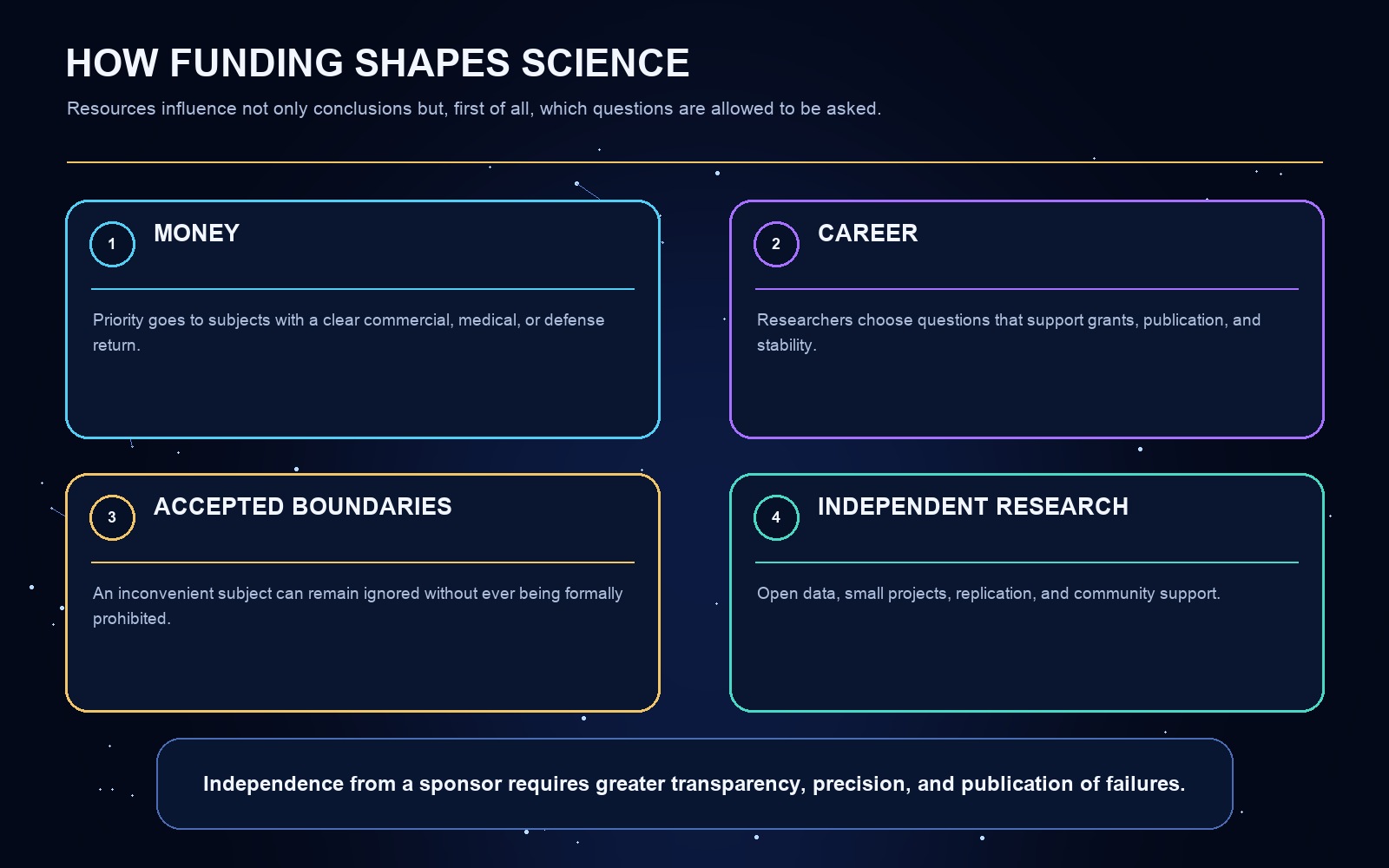
Research requires equipment, facilities, staff, time, access to data, and the ability to publish. As a result, we do not investigate everything that matters. We investigate, first of all, what someone is willing to fund.
The person who pays does not always dictate the conclusion. But the music is chosen earlier, when institutions decide which subjects will be allowed onto the stage.
Money Determines the Map of Questions
The greatest resources go to fields with a recognizable return: new drugs, defense technologies, computing systems, and commercial products. That is understandable. Society needs practical results.
Human importance and financial attractiveness are not the same. Research into the independent existence of consciousness could transform our understanding of life, death, and responsibility. It does not promise a quick patent or an obvious market.
It is therefore easier to secure a grant for measuring a familiar brain process than for testing whether perception can operate outside the body.

Funding Exerts Influence Before an Experiment Begins
Dependence is not limited to direct pressure from a sponsor. Researchers learn in advance which questions will appear “serious,” which vocabulary will pass a review panel, and which result will support the next application.
This produces self-censorship. A scientist may sincerely care about an unusual phenomenon but choose a safer subject because a laboratory must be maintained and a career must be built.
The public then sees few publications on consciousness beyond the body and concludes that there is nothing to study. In reality, the absence of research often reflects the absence of resources and institutional permission.
Power Prefers a Predictable Person
The study of consciousness is not limited to philosophy. When people stop viewing themselves as accidental biological machines, their relationship with life changes. They are less easily controlled by fear of death, more attentive to the consequences of their actions, and more willing to question established authorities.
An aware person can think independently and refuses to obey merely because an order was given. Such a person is less convenient for any system of power.
I am not claiming that a single center exists to prohibit consciousness research. Control works in a more complex way. Governments, corporations, universities, and foundations support fields aligned with their goals. Research capable of radically changing how human beings understand themselves is pushed to the margins without any formal ban.
Reputation Is Also a Form of Currency
Even with modest independent funding, a researcher needs journals, conferences, and colleagues. If a subject has already been labeled unacceptable, work may fail peer review regardless of its quality.
A convenient circle appears: the field is called unscientific because rigorous studies are scarce, while rigorous studies are not funded or published because the field is considered unscientific.
Only real projects with open methods and accessible data can break that circle.
Independence Does Not Mean Abandoning Rigor
Criticism of academic science sometimes leads to the opposite extreme. A person decides that personal conviction is enough and that verification is evidence of closed-mindedness. Free inquiry is then replaced by another belief system.
If a project is funded by viewers, a private foundation, or the participants themselves, its transparency should be even stronger:
- a question defined in advance;
- clear criteria for a result;
- documentation of unsuccessful attempts;
- access to de-identified source data;
- separation of observation from explanation;
- independent analysis;
- open disclosure of conflicts of interest.
Freedom from institutional pressure is not freedom from honesty.
A New Model for Research
I see an opportunity to build consciousness research from the ground up. Experienced practitioners, regression professionals, psychologists, physiologists, and data analysts can create small collaborative projects. A community can support a specific experiment when people understand its purpose and receive a transparent report on expenses.
Results should be published openly, including negative findings. Several independent groups can repeat the same protocol. This approach will not replace a major laboratory, but it can build a body of evidence and show which questions deserve larger resources.
International collaboration is especially important. When people from different cultures obtain similar results using the same criteria, the influence of a shared cultural narrative becomes smaller.
Boundaries Should Protect People, Not a Worldview
Research ethics are essential. A participant must never be placed in danger, misled about risk, deprived of confidentiality, or exploited while vulnerable. Those boundaries protect the human being.
Refusing to ask a question merely because a possible answer contradicts a materialist worldview is not ethics. It is protection of the model.
Science must retain the right to investigate and the possibility of being wrong. Practitioners must also be prepared for an experiment not to confirm their expectations. Only then can the encounter be honest.
Investigating the Whole of Reality
I value the scientific method, but I do not regard the present scientific system as neutral. It is influenced by money, power, reputation, and the boundaries of the accepted worldview.
That is not a reason to reject science. It is a reason to make science more independent.
Society funds countless methods for making people more productive, controllable, and predictable. It is time to invest in understanding what a human being actually is.
If consciousness is not confined to the body, that discovery will matter more than another device. That is precisely why the question deserves more intellectual courage, not less.
For more about my observations, verification methods, and model of consciousness, see my book *The Phenomenon of Consciousness Beyond the Body*.
Leave a Reply