
Researchers of consciousness often work within a single method. An out-of-body practitioner observes nonphysical environments. A regression practitioner helps a person access memory and imagery in an altered state. A specialist in instrumental transcommunication searches for meaningful signals in audio and video recordings.
Each field develops its own evidence, vocabulary, and disagreements. Yet if all three methods touch the same reality, they need to be brought together—not by blending the results into a beautiful story, but by using each method to test the others.
Three Different Windows
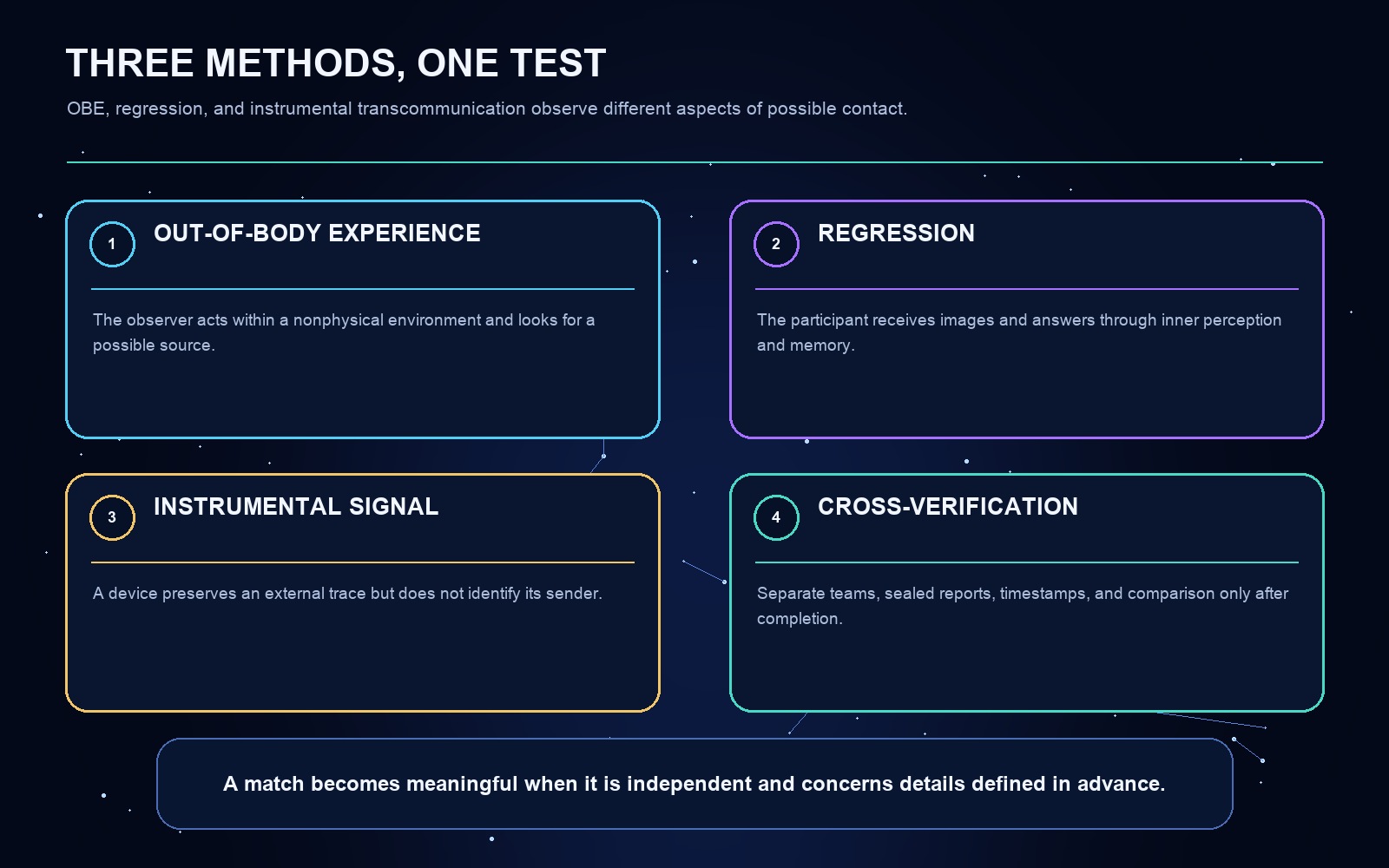
Out-of-body experience provides the perspective of a participant-observer. A person experiences separation from the body, moves, searches for an object or being, and can change the direction of the investigation.
Regression opens access through inner perception. A person remains connected with the body but receives images, emotions, and knowledge that may relate to other incarnations or nonphysical realms.
Instrumental transcommunication uses a technical medium. The researcher records sound, images, or another signal in which a possible message is later identified.
Each window has an advantage. Each also has its own distortions.
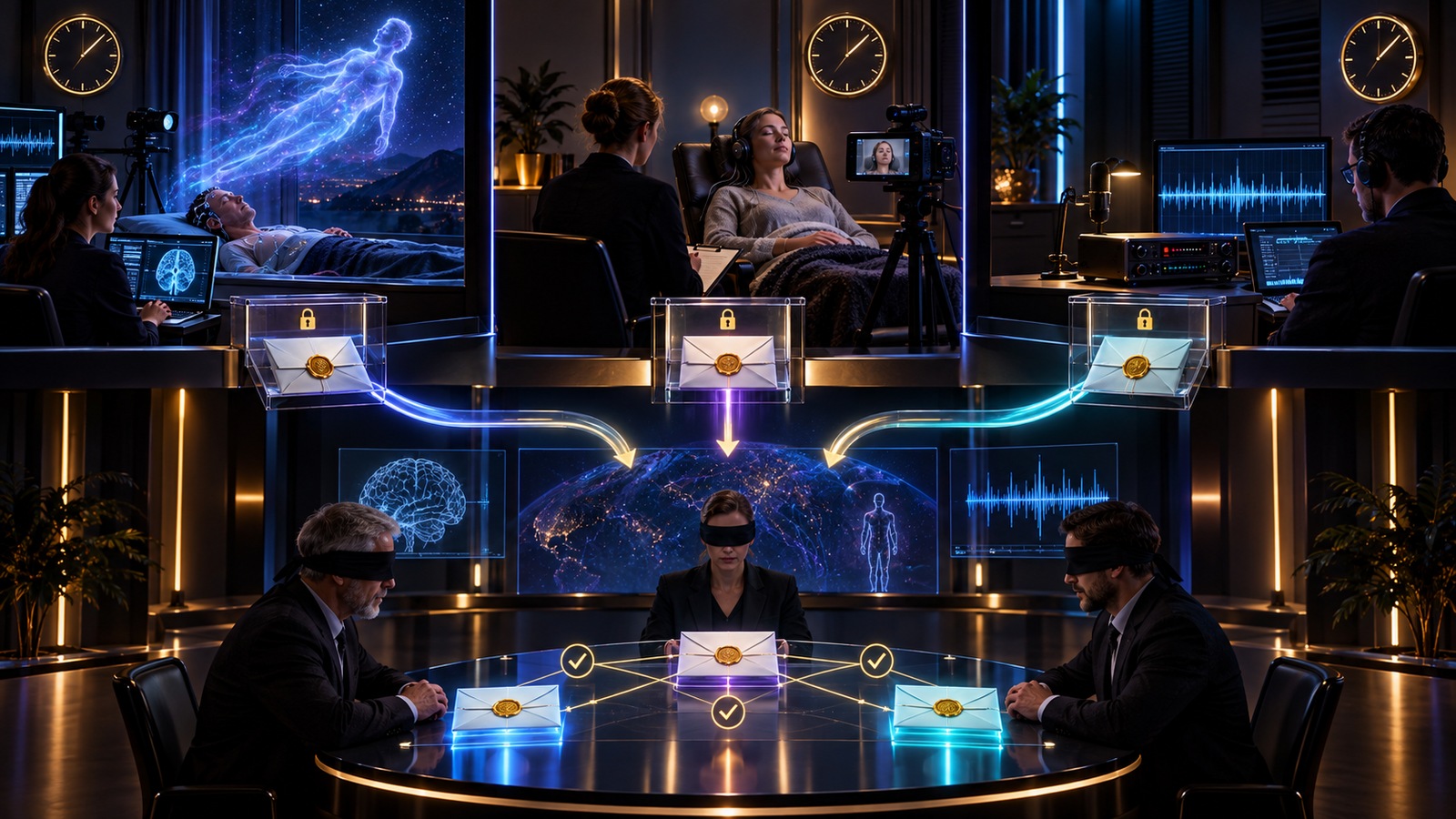
The Central Mystery of Instrumental Contact
Even when a clear phrase can be heard in a recording, one question remains: Who said it?
The source might be a deceased person, another independent consciousness, a guide, a thought-form, the researcher’s expectation, or random noise to which the brain has assigned familiar meaning. A technical recording makes the signal external, but it does not establish the identity of the sender.
I do not have a complete explanation for the mechanism of instrumental transcommunication. Out-of-body experience can, however, add another point of observation. A practitioner can attempt to see what is occurring in the nonphysical environment during a session, who approaches the participants, and how the signal is formed.
That does not guarantee an answer. Illusions and mental constructions also arise in an out-of-body state. One practitioner’s observation must therefore be compared with other data.
What Regression Can Add
Regression allows participants to ask questions about the nature of the contact and receive a connected description of the process. It is accessible to a larger number of people and can help collect several independent accounts of the same event.
The regression practitioner must not suggest the expected answer. If a participant is told in advance that a particular deceased person is present, the mind can easily create the corresponding image.
A clean experiment requires that the participant know neither the content of the recording, the proposed identity of the communicator, nor the results obtained by other participants.
Why a Simple Match Is Not Enough
Suppose researchers hear a name on an audio recording. An OBE practitioner reports seeing someone with that name, and a regression participant describes a similar figure. The agreement seems persuasive, but information exchange, a shared cultural image, and influence from the organizer must first be excluded.
The result is stronger when each report is created separately and time-stamped. Comparison takes place only after every stage has ended. Agreement is evaluated by predetermined details rather than a general impression.
A Possible Combined Protocol
I envision the following research design:
- An independent coordinator selects a person, event, or item of verifiable information and keeps it concealed.
- The instrumental transcommunication team conducts several sessions and preserves the original recordings without providing preliminary interpretations to the other groups.
- At an agreed time, OBE practitioners investigate the location or source without knowing the expected answer.
- Regression participants work with a neutral question and receive no information about the OBE reports or recordings.
- Every account is recorded before group discussion.
- Independent evaluators compare specific features: names, appearance, events, object locations, recurring phrases, and facts unknown to the participants.
- Agreements, contradictions, and null results are all published.
Such a project would not immediately settle the question of life after death. It could show whether different methods can independently obtain related information.
Attempting to Affect Matter
During my own out-of-body experiences, I have tried to move physical objects and extinguish a candle. In nonphysical perception, the action could appear successful. After I returned, however, the object had not moved and the candle was still burning.
This illustrates how difficult it is to transfer action directly between levels. An instrumental signal is therefore especially interesting. If information truly appears in a physical device, we need to understand the mechanism of that transition.
Perhaps the process does not involve mechanical force but an influence on probability, noise, the operator’s perception, or an electronic device. These remain hypotheses and should be separated and tested individually.
A Larger Picture Emerges at the Intersection
No method has a monopoly on truth. OBE offers immediacy but depends on the practitioner’s level of awareness. Regression can produce a large amount of material but is vulnerable to suggestion. Instrumental transcommunication creates a record but leaves the source of the signal uncertain.
The weakness of one method can be partly offset by another. A technical recording tests whether an external event occurred. OBE can help investigate a possible source. Regression allows additional questions and comparison of recurring structures.
Combining methods requires maturity. Participants must be willing to receive different answers and resist forcing them into one narrative. The value of the research lies not in an attractive agreement but in an honest picture.
I am convinced that different practices touch different parts of one greater reality. If we stop defending the names of our schools and begin testing observations together, we may understand the mechanism of contact, the nature of memory, and the structure of consciousness much more deeply.
For more on energy levels, contact, and the investigation of consciousness, see my book *The Phenomenon of Consciousness Beyond the Body*.
Leave a Reply