START HERE · A PERSONAL POSITION
A manifesto for Andrey Chsherbakov’s personal research platform
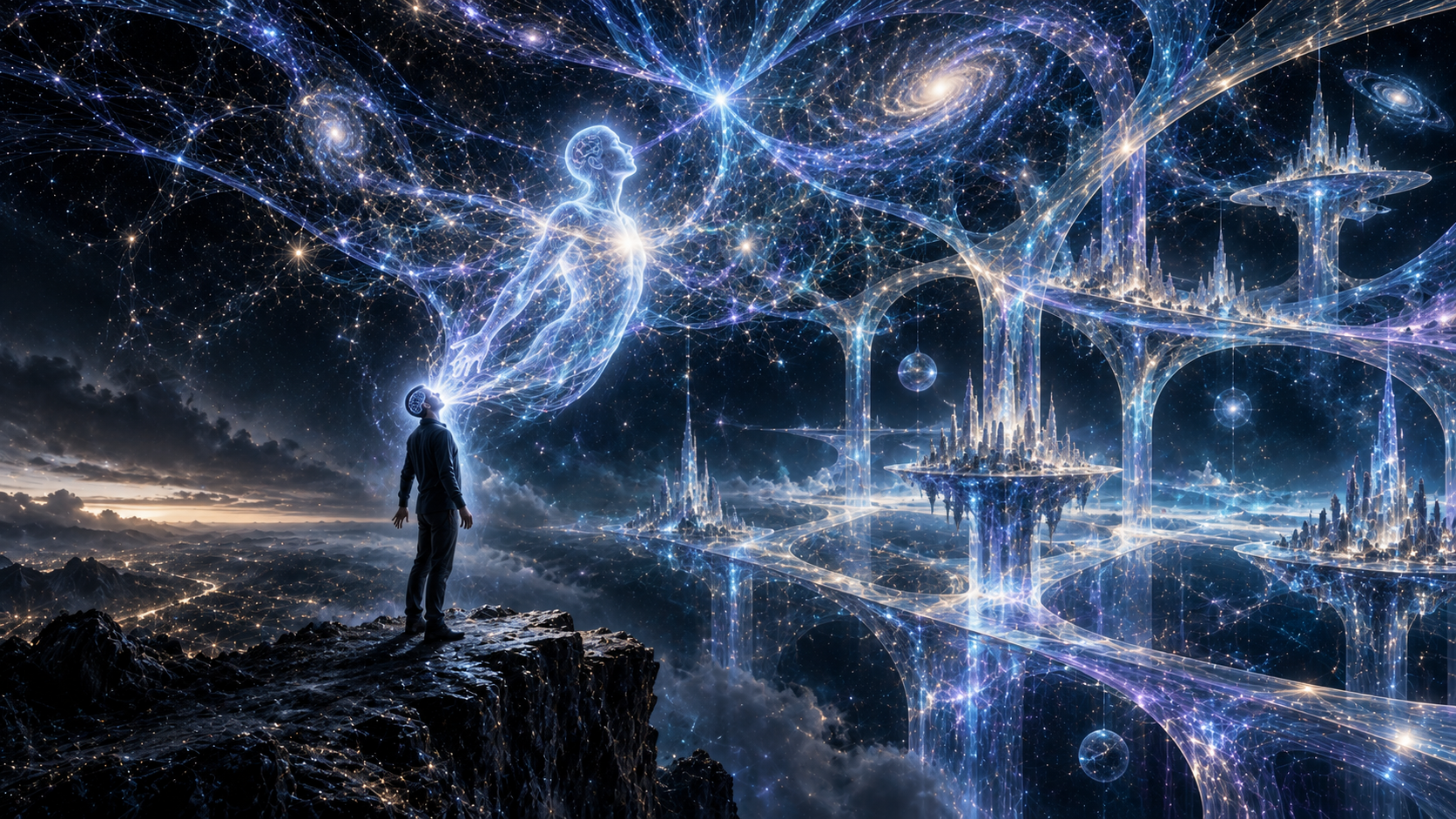
A human being is more than a physical body. Consciousness does not begin in the brain, nor does it end when the brain stops functioning. Beyond the limits of ordinary perception lies a greater reality—one that we are already part of.
To me, this is neither an appealing philosophy nor a comforting belief. It is the conclusion I have reached after twenty years of firsthand out-of-body experience, observation, mistakes, comparison, and sustained effort to understand the nature of consciousness.
I created this site because I am no longer willing to speak about these questions in a whisper.
For too long, the nature of consciousness has been surrendered to one of two extremes: a rigid materialism that reduces the human being to the workings of the brain, or a mysticism that too often demands belief without investigation. I accept neither. Consciousness can and must be investigated—through direct experience, inner discipline, philosophy, the testimony of others, and every serious avenue capable of expanding our understanding of reality.
This inquiry changes more than our understanding of death. It changes how we understand life, freedom, responsibility, and the human being itself.
The Experience After Which Life Can Never Be the Same
My path did not begin with a search for miracles. I was always drawn to more fundamental questions: What are matter and energy? Why does the universe exist? Who is it that perceives the world from within the human body? And what, exactly, do we mean when we say “I”?
Then came experiences in which the familiar picture of reality no longer held. My consciousness remained clear outside the ordinary sense of the physical body. I continued to perceive, move, make decisions, and know that I existed. These states recurred, developed, and became increasingly consistent.
A single unusual episode can be dismissed as chance. Twenty years of recurring experience cannot simply be filed away under “imagined.”
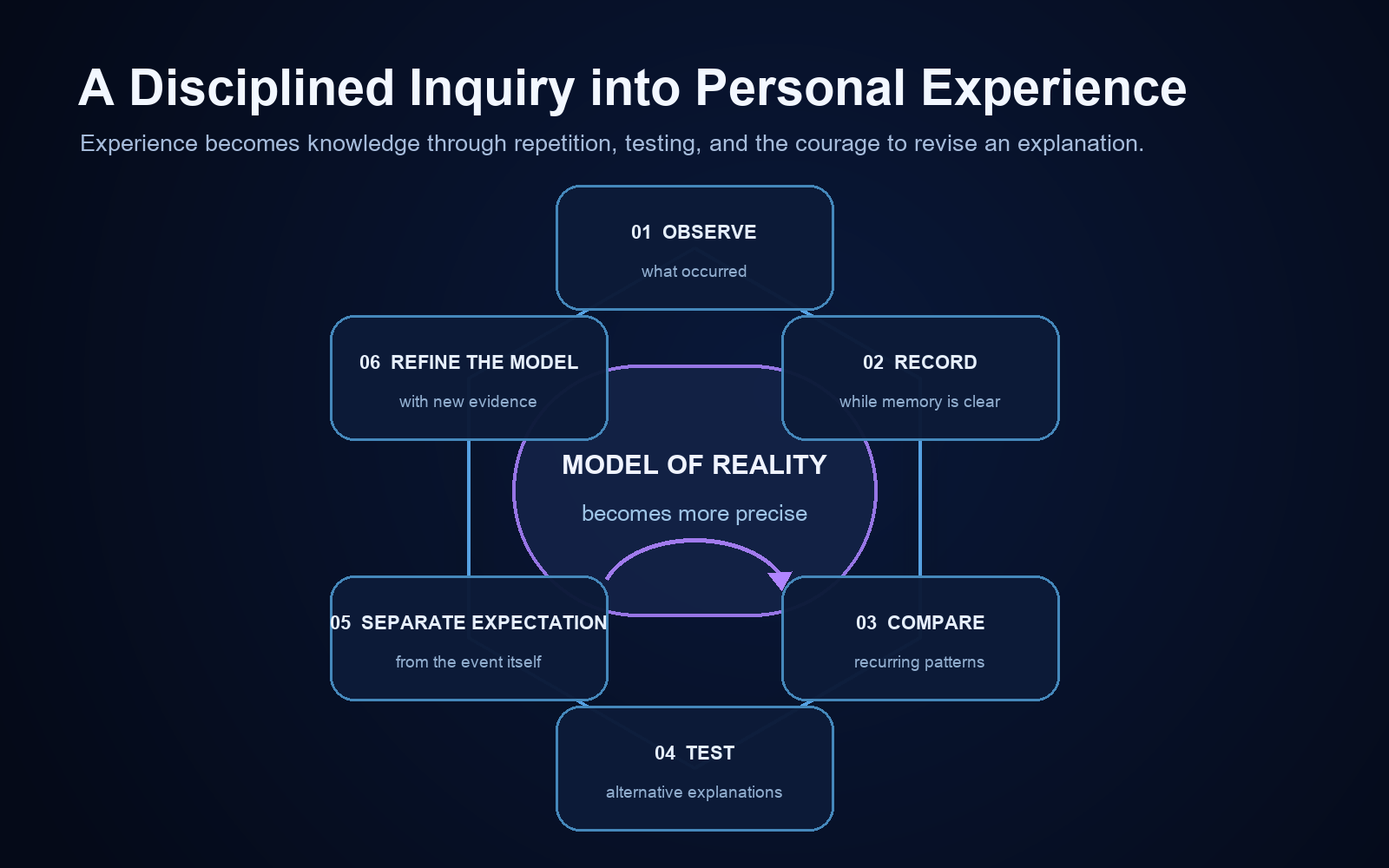
I observed the transitions between waking consciousness, sleep, trance, and fully conscious out-of-body perception. I learned to preserve the memory of an experience after returning. I compared different states, looked for recurring patterns, and distinguished my own expectations from what happened unexpectedly. The longer the investigation continued, the clearer its central conclusion became: consciousness can exist and act beyond the ordinary operation of physical perception.
Before this practice began, I could only believe that the soul existed. Now, for me, it belongs to known reality. I do not ask readers to adopt my experience as their own. But I refuse to pretend it never happened merely because the modern worldview cannot yet contain the full range of human experience.
What I Mean by Consciousness Beyond the Body
Consciousness beyond the body is a state in which the center of perception is no longer bound to the familiar sensation of the physical organism. A person continues to experience the self as an existing “I”: seeing, feeling, thinking, moving, encountering other forms of reality, and retaining the ability to choose.
I deliberately speak of consciousness rather than a body “leaving” the body. Nothing physical has to depart from the organism. What changes is the point of perception. A portion of the soul’s attention and energy is no longer focused entirely on signals from the brain and begins to perceive a broader range of reality.
This experience is not an escape from life. On the contrary, it makes every day of life more consequential. If consciousness continues beyond the body, then our choices, our inner development, and the way we treat others do not disappear with our biographies. They become part of the soul’s longer journey.
Out-of-body experience matters not because it is unusual, but because it breaks the most fundamental human fear: the fear of complete extinction.
The Brain Is an Instrument of Consciousness, Not Its Creator
The modern materialist model offers a familiar formula: the brain produces consciousness in much the same way the liver produces bile. Alter the brain and perception changes. When the brain stops functioning, the individual disappears.
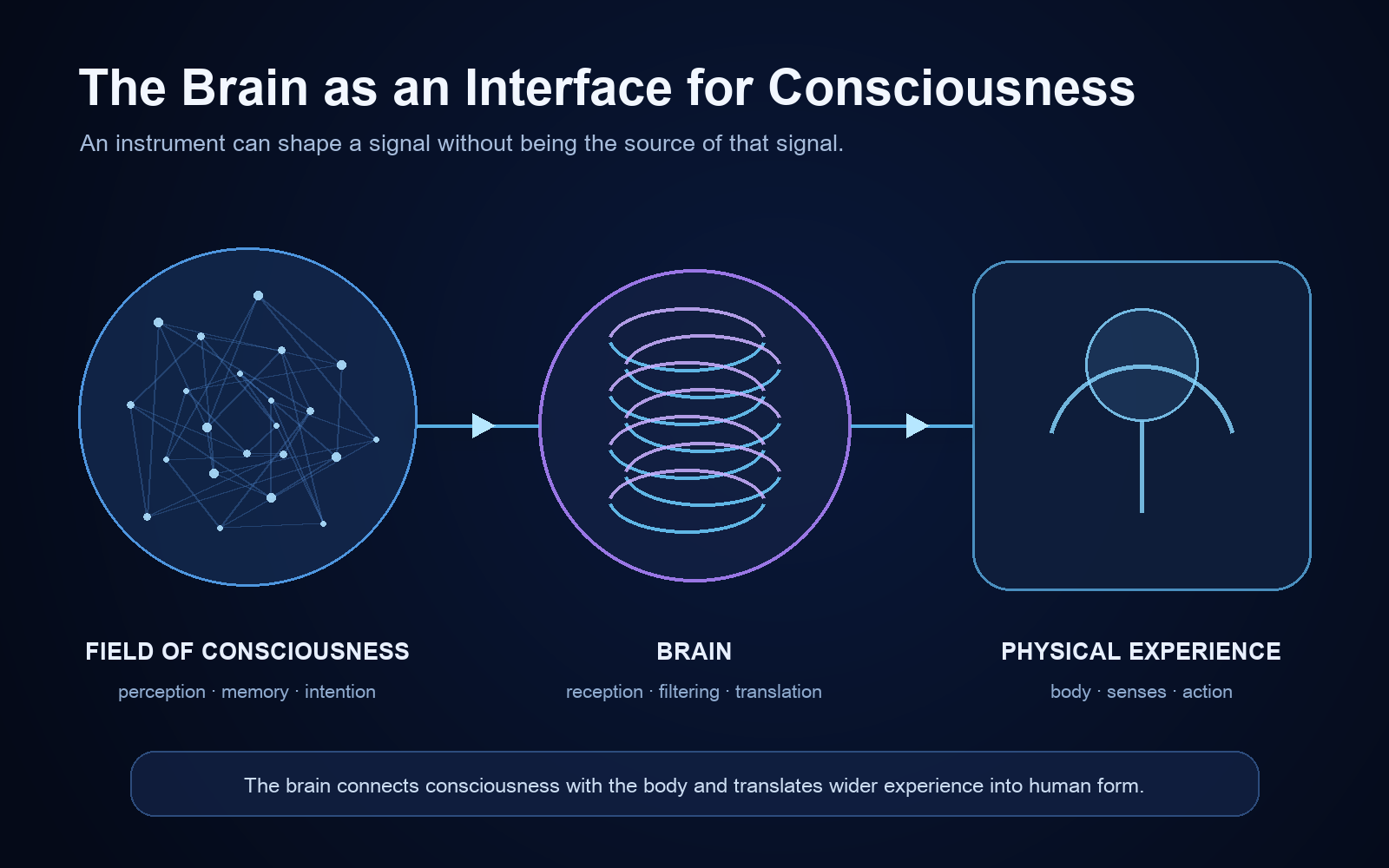
The first part of that argument is true: the state of the brain clearly affects the way consciousness expresses itself in the physical world. Injury, illness, exhaustion, alcohol, medication, and severe stress can alter memory, personality, and perception. But the fact that an instrument affects a signal does not prove that the instrument is the source of the signal.
A damaged radio distorts the music, but it does not create the music. A broken screen alters the image, but the image is not born in the glass. In the same way, the brain may receive, limit, and translate the experience of consciousness into forms available to a physical human being.
My experience has led me to a model in which the brain functions as the soul’s biological interface. It connects consciousness to the body, anchors attention in material reality, processes sensory input, and records part of what is experienced in human memory. At the same time, it acts as a filter, preventing the earthly personality from perceiving all the information available to the soul.
Consciousness is vastly greater than what the waking brain can contain.
Why This Question Remains at the Margins
Science is commonly described as a fully independent search for truth. In practice, scientific research exists within systems of grants, universities, corporations, government programs, career incentives, and social fashion. What gets studied is, above all, what receives funding, institutional support, and permission to be treated as a “serious subject.”
This does not mean that scientists are dishonest. A great many researchers are sincerely devoted to knowledge and perform work of immense value. But the system itself establishes the boundaries of what is acceptable long before an experiment begins. Some questions receive laboratories, teams, and decades of funding. Others are ridiculed before anyone has had the opportunity to develop an appropriate method for studying them.
Consciousness beyond the body is inconvenient to the materialist worldview. If consciousness can exist independently of the brain, then we must reconsider our ideas about the human being, death, memory, morality, and the structure of reality itself. This would not be a minor revision to the existing model. It would change the foundation.
A person who sees himself as nothing more than matter is convenient for any system of power. If he believes he is a temporary biological mechanism, he is easier to control through fear of death, deprivation, judgment, and the loss of security. He looks outside himself for meaning and permission. He is more likely to submit to those who promise to protect his body and define reality for him.
A person who recognizes himself as a soul becomes inwardly more independent. He understands that power over the body is not power over consciousness. He begins to question, to recognize manipulation, to take responsibility for his own choices, and to fear less those who demand unconditional obedience.
That is why the study of consciousness is connected not only to science, but to freedom.
Inner Freedom Demands Responsibility
Freedom does not mean rejecting everything official, believing every extraordinary account, or declaring every fantasy a revelation. That would only be another form of captivity—a dependence on our own desires and fears.
Real inquiry demands discipline. We must observe ourselves, record our experiences, compare states, recognize the failures of memory, distinguish expectation from event, and be willing to correct the details of our model. I remain open to new knowledge and ready to learn. A strong argument or a precise observation does not threaten my path; it helps make that path clearer.
But openness does not require endless self-doubt. I know what I experienced. I know how often it recurred and how deeply it changed me. I can revise my explanations, but I am not required to deny the reality of my own experience for the comfort of others.
My position is simple: personal experience matters. It does not replace every other form of knowledge, but it is a legitimate source of questions and discovery. Every major inquiry begins when someone notices something the existing model cannot explain.
What Changes When We Stop Believing We Are Only a Body
First, our relationship to death changes. Death no longer appears to be the absolute destruction of the individual. The physical body reaches the end of its path, but consciousness continues in another form of perception.
This understanding does not diminish earthly life. It makes life more important. If life is part of the soul’s longer development, then every choice leaves a mark. We cannot hide forever from the energy we create, the consequences of our actions, or the quality of consciousness we shape each day.
Our relationship to other people changes as well. If every individual consciousness exists within a greater living whole, then the harm we cause another person does not end at the boundary of that person’s body. Cruelty, fear, and humiliation enter the shared field just as dignity, compassion, and love do.
And finally, hope becomes possible—not the passive hope that waits for a miracle, but the deep recognition that human beings have not been abandoned in an indifferent universe. We are part of a living reality. Our consciousness has meaning. The loss of the physical body does not erase the experience we have gained. Inner work is not wasted. Love and the bonds between souls reach deeper than a single human lifetime.
This hope does not weaken a person. It releases the energy that fear once consumed.
Why This Site Exists
This site is not a neutral catalog of other people’s opinions. It is my personal research platform—a place where I will speak openly about my understanding of reality.
Here you will find essays, ideas and chapters from my books, discussions of research, videos, audio, practical observations, and projects. I will place personal experience in conversation with the work of scientists, philosophers, researchers of altered states, and spiritual traditions. But independent thought will remain central: no famous name, institution, or ancient text should replace a person’s own consciousness.
I am not trying to create a new religion, and I do not ask anyone to accept my conclusions blindly. What matters to me is restoring the human right to investigate the deepest questions without fear of ridicule, exclusion, or being declared irrational.
We will speak about the nature of the soul, the structure of consciousness, levels of reality, transitional states of perception, memory, the fear of death, inner transformation, and collective consciousness. We will examine the ideas of others without hiding behind them. I will clearly distinguish facts, other people’s hypotheses, and my own conclusions—and I will speak in my own voice, without artificial caution.
My Invitation
I am not asking you to trade one ready-made worldview for another. I am asking you to stop surrendering the right to a final answer to someone else.
Observe the states of your own consciousness. Learn to sustain your attention. If a clear, conscious experience occurs, record it immediately after you return, while the memory remains precise. Compare experiences, look for recurring patterns, and separate direct perception from expectation and fantasy. Read those you agree with, and those who compel you to argue. Do not be afraid to ask questions for which no officially sanctioned answer yet exists.
Every person possesses the essential instrument for investigating reality: consciousness itself. We may only be beginning to understand what it can do.
I have devoted twenty years to this path, and I am still learning. On this site, I will share what I have seen, what I have understood, and what I am still trying to understand.
Because reality is deeper than we were taught. Consciousness is greater than the body. And human beings are freer than they have learned to believe.
This is where our inquiry begins.
Go Deeper
This manifesto is the beginning of the inquiry. In my book The Phenomenon of Consciousness Outside the Body, I share the experiences, observations, and conclusions that emerged from twenty years of exploring consciousness beyond the body.
Continue with the book on Amazon: Kindle Edition or Paperback.
Leave a Reply