
If you can already relax deeply and experience unusual sensations or vibrations, but separation still does not happen, you probably do not need to start over. You need to identify the stage where the process breaks down and strengthen that specific skill.
Many beginners encounter the same situation. They have learned how to relax, meditate, and hold their attention. Sometimes they feel vibrations, changes in the perceived size of the body, or a sense that they are approaching an inner threshold. It seems as if only one final step remains, yet separation never happens.
The person then begins to doubt himself. He assumes that he lacks the necessary ability, that the technique does not work, or that out-of-body experience is available only to a select few.
Most often, the real reason is something else entirely.
If you can already reach deep relaxation, feel a shift in your state, and approach the vibrations, then you are completing a large part of the process correctly. You do not need to start from the beginning. You need to determine where the sequence stops and develop the corresponding skill separately.
Practice is like tuning a radio
Imagine an old radio receiver. At first, you hear only static. As you turn the tuning dial, isolated sounds, voices, and fragments of music begin to emerge through the noise.
The signal already exists. You are close to the correct frequency, but the tuning is not yet precise enough.
One more small adjustment—and the static disappears. The music becomes clear and distinct.
Something similar happens in out-of-body practice. The first unusual sensations, a change in body perception, vibrations, and a sense of inner movement all indicate that the process has begun. But for full separation to occur, the necessary elements must connect in the correct sequence.
Sometimes a person does not need a new technique. He needs to fine-tune the practice he already has.
The chain breaks at its weakest link
Out-of-body practice consists of a sequence of stages, and each stage requires a specific skill.
You may be good at relaxing but unable to sustain attention. You may have strong visualization but move to separation too early. You may reach the vibrations without knowing what to do next. You may complete almost the entire process correctly, only to begin analyzing at the last moment and return to your ordinary state.
The practice resembles a chain. If one link is too weak, that is where the entire process stops.
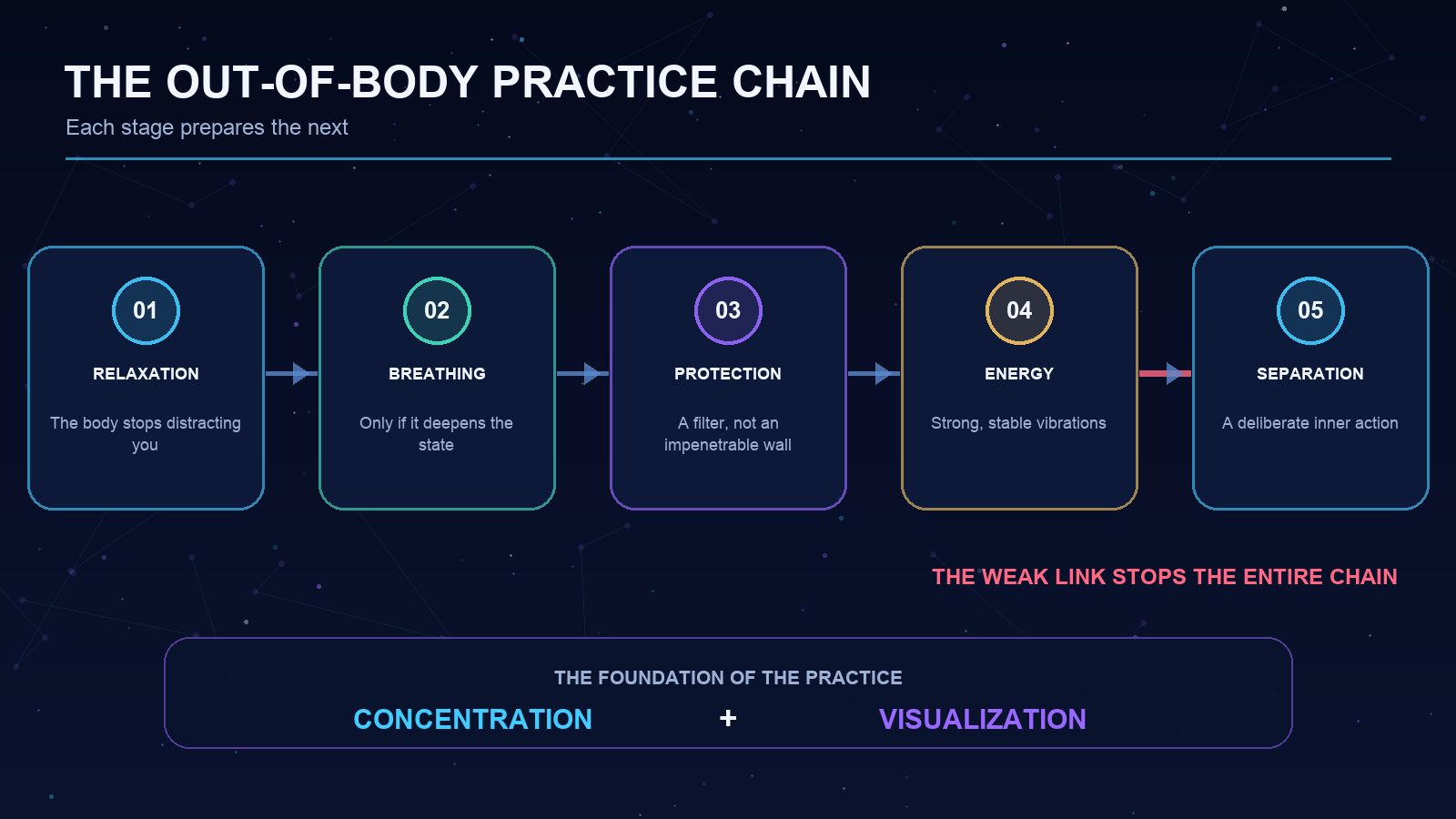
After an unsuccessful attempt, it is more useful to ask a precise question instead of asking, “Why can’t I do this?”
At exactly which stage did the process stop?
That question turns failure into diagnosis.
The two foundational skills
Two main skills lie at the foundation of out-of-body practice: concentration and visualization.
Concentration
Concentration is the ability to hold your attention on one image, sensation, or action without allowing the brain to keep switching to unrelated thoughts.
If your attention jumps every few seconds to a sound, the position of your body, tomorrow’s plans, or an evaluation of what is happening, the process loses stability. The energy of attention becomes scattered, and the required state has no time to form.
Concentration develops gradually. You can train it separately without attempting a full exit every time. Choose one image, sound, sensation, or point of focus and learn to remain with it for as long as possible.
Visualization
Visualization is the ability to create an inner image and fill it with sensation.
Many people believe that visualization always means seeing a vivid, detailed picture with closed eyes. That is not true.
Visualization may appear as:
- a sense of movement;
- a memory of the body’s position;
- a feeling of touch;
- an impression of weight or lightness;
- a sense of rotation;
- the direction of movement;
- an inner knowing of where you are.
For practice, the beauty of the image matters far less than how convincing it feels to your perception. You should not merely picture movement. You must experience it internally.
Concentration sustains the action you create, while visualization gives that action substance. Together, they become a powerful instrument.
The complete practice sequence
In my practice, the main sequence looks like this:
relaxation → breathing practice, if it helps → creating protection → building energy and raising vibrations → separation.
Each stage prepares the next. You cannot complete one step mechanically and expect everything else to happen automatically.
Move forward according to your state, not only according to elapsed time. You must learn to recognize when the current stage is truly complete.
The first mistake: the body is not ready
The first stage is deep relaxation.
Its purpose is not simply to get some rest. The body must stop constantly drawing attention to itself, while the brain becomes less active and stops running the same thoughts in circles.
Relaxation usually takes about fifteen to twenty minutes. Some people need more time; others need less. The number is not what matters. The state you reach is what matters.
If you want to turn over, move a leg, scratch an itch, change the position of an arm, or adjust the pillow, the body is still actively involved. It is too early to move to the next stage.
In sufficiently deep relaxation, the body becomes heavy and almost motionless. Its boundaries feel less distinct and may disappear from perception altogether. You no longer want to move because the physical body has stopped occupying your attention.
There is also an opposite mistake.
If you remain in relaxation too long, you may simply fall asleep. You need to find the point where the body has withdrawn from active perception but attention remains clear.
Do not rush this stage, but do not prolong it indefinitely.
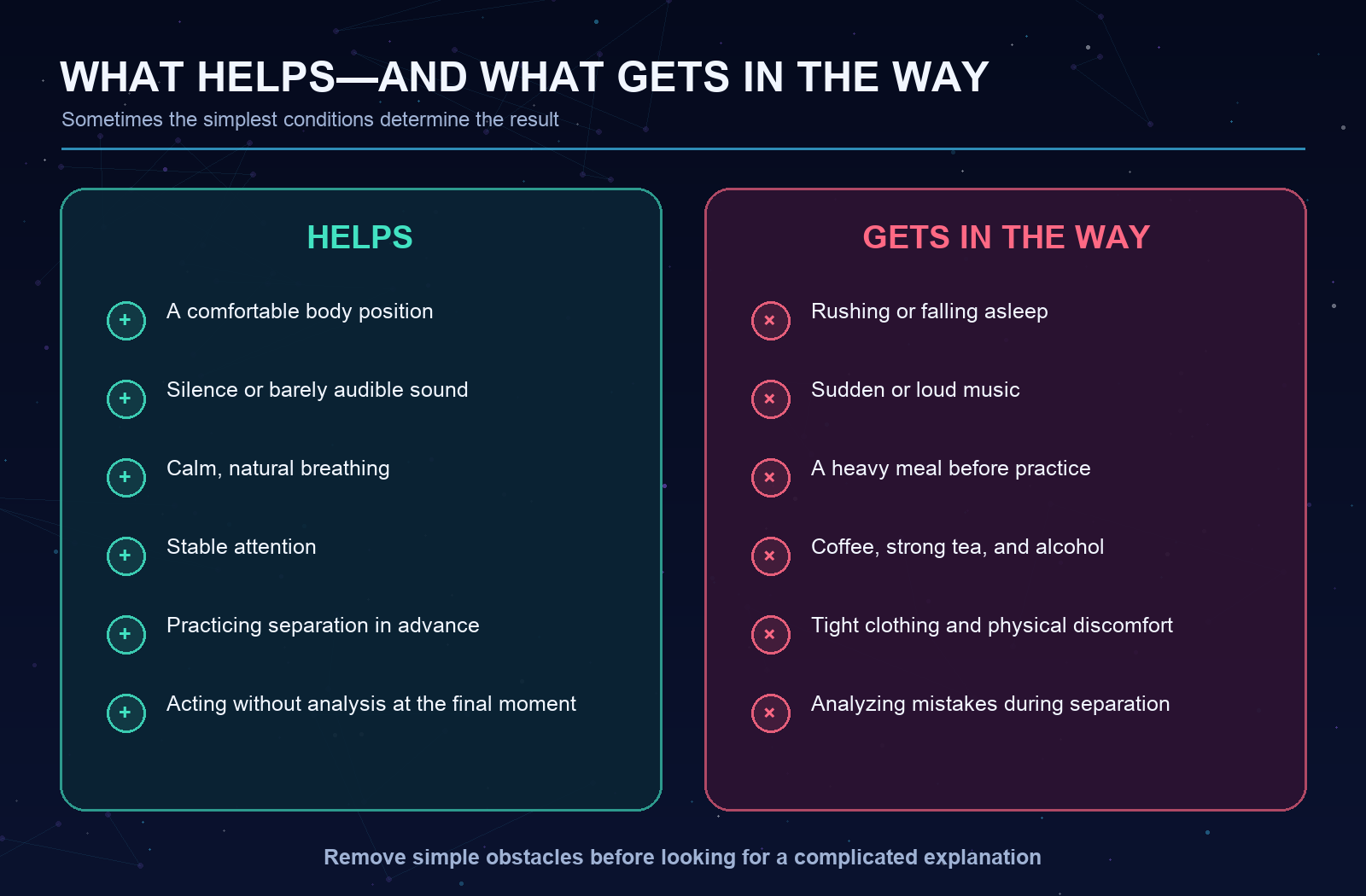
Music can also interfere
Some practitioners use relaxing music. It can help, but the wrong soundtrack becomes another distraction.
Potential problems include:
- sudden sounds;
- loud transitions;
- percussion;
- a prominent melody;
- piano or guitar passages that pull at your attention;
- unexpected changes in volume.
As you enter an altered state, sensitivity to sound increases. Music that seemed quiet at first may begin to feel extremely loud.
If you use music, make it so quiet that you have to listen carefully to hear it clearly. It should provide a background, not direct your attention.
If music continues to distract you even at that volume, try practicing without it.
Breathing practices are not for everyone
Breathing is a supporting tool. It is entirely possible to reach an out-of-body state without it.
If a breathing exercise relaxes you, deepens the trance, and helps you maintain attention, include it in the sequence. If it energizes you, creates tension, or makes you control the body too closely, leave it out.
A common mistake is spending too long on breathing. The relaxation achieved in the previous stage then begins to disappear.
In my practice, two or three minutes are enough. I first breathe slightly more deeply than usual. After several breaths, I hold the breath comfortably at the top of an inhalation. There should be no struggle with the body, no strain, and no attempt to hold the breath for as long as possible. After several calm cycles, I return to natural breathing.
This is only one possible method. The main criterion is simple: breathing should deepen the state, not destroy it.
Protection should be a filter, not a wall
The next stage is creating protection.
In my understanding, the space of the second energy level responds to a person’s thoughts, expectations, beliefs, and fears far more quickly and precisely than the physical world. If a practitioner enters that space with intense fear, the surrounding environment may reflect that fear and give it a perceptible form.
Protection reduces the influence of such states and helps make the experience cleaner.
I create a protective sphere of energy around myself and define its properties in advance. It should:
- protect me from outside influence;
- reduce the effect of fear and random thoughts on the surrounding space;
- support the stability of my state;
- allow pure energy to pass through;
- nourish and strengthen me.
There is an important potential mistake here. If you imagine protection as a completely impenetrable wall, it may block not only unwanted influence but also the energy needed for the next stage.
Protection should therefore work selectively. It filters out what may interfere with the practice while remaining open to the energy used to raise your vibrations.
A slight tingling sensation is not enough
After creating protection comes the stage of building energy and raising vibrations.
In my model of reality, different energy levels have different frequency characteristics. To shift perception from the physical level to a subtler one, you must change your own state and bring it closer to the frequency of the next level.
This is achieved through concentration, visualization, and work with energy.
One of the most common mistakes is attempting separation too early.
Light tingling, warmth, or faint waves indicate that the process has begun, but they do not always mean that you are ready. The energetic state must become strong and stable enough. Vibrations begin to intensify, fill your entire perception, and gradually separate it from the familiar sensation of the physical body.
Each person must learn to recognize his or her own degree of readiness. That comes with experience.
If there is not enough energy, a separation attempt may produce nothing. This does not mean the entire practice was wrong. You may simply have moved to the final stage a little too soon.
Separation does not necessarily happen on its own
This is one of the most important points.
A person may relax correctly, quiet the stream of thought, create protection, build energy, and feel strong vibrations. Even then, separation is not guaranteed to happen automatically.
Separation is a skill in its own right. It must be trained.
Many people reach the vibrations and simply wait. They hope that at some point they will be pushed out of the body automatically. That sometimes happens, but relying on chance is not a sound method.
Once the necessary state has been reached, you need to perform an inner action: rise, roll out, lift off, fall through, shift your point of perception, or use another suitable method.
If this skill has never been trained, the brain may interpret the command literally and attempt to move the physical muscles. The person rolls over with the ordinary body, and the state collapses.
The rolling exercise
You can practice separation independently of the full sequence.
Lie down in the position you normally use for meditation. Close your eyes and relax slightly.
Then physically roll onto your side. Notice every sensation that appears:
- how the movement begins;
- how pressure shifts across different parts of the body;
- how the weight moves;
- how the position of the head changes;
- what the turn feels like;
- the moment when the body comes to rest on its side.
Return to the starting position.
Now repeat the same movement inwardly while the physical body remains still. Recreate the remembered sensation of rolling without tensing the muscles.
The purpose of this exercise is to teach perception to perform a movement independently of the physical body.
One repetition is not enough. The movement must become familiar. Then, when the vibrations begin, you will not have to figure out how to separate. You will already know the required inner action.
Use several separation methods
If the first attempt does not work, do not stop.
You can try, one after another:
- rolling out;
- rising upward;
- lifting off;
- falling or sinking through;
- rotating;
- climbing an imaginary rope;
- moving your point of perception to another place in the room;
- trying to sit up or stand without engaging physical muscles.
You can test several methods within one or two minutes. One may produce no response while the next triggers separation immediately.
There is no single technique that works equally well for everyone. Even for the same person, different methods may work on different days.
Do not begin analyzing at the final moment
Imagine that you have completed the entire sequence, reached the vibrations, and tried to roll out. The first attempt does not work.
Then the brain begins:
“Why didn’t it work?”
“What did I do wrong?”
“Were the vibrations not strong enough?”
“I guess it won’t happen today either.”
As soon as analysis begins, the state changes. Attention returns to the physical body, the stream of thought becomes active, and you leave the deep phase of relaxation.
During separation, do not analyze.
If rolling does not work, try the rope. If the rope does not work, try lifting off. Then try rotation, falling, or shifting perception.
Move directly from one action to the next.
You can analyze the practice after it ends. Then you can calmly reconstruct the sequence and determine which stage needs additional training.
During the process itself, act.
Simple physical reasons for failure
Sometimes a person looks for a complicated spiritual or energetic explanation when the practice was interrupted by ordinary physical discomfort.
A heavy meal
Immediately after eating, a significant share of the body’s resources is directed toward digestion. Heaviness, sleepiness, and greater awareness of the body follow.
Do not begin practice when you are extremely hungry or immediately after a heavy meal.
Coffee and strong tea
Caffeine may interfere with deep relaxation and keep the brain in an active state. Coffee affects me so strongly that serious practice after drinking it becomes nearly impossible.
If you drink coffee, try avoiding it before practice and observe the difference.
Alcohol
Alcohol reduces clarity of perception and disrupts the energetic state. Conscious practice requires stability, attention, and inner discipline.
Uncomfortable clothing
Tight clothing, elastic bands, belts, buttons, and anything else that constricts the body will keep pulling attention back to it.
Everyday interruptions
Before practice, turn off notifications, remove unnecessary sources of sound, choose a comfortable temperature, and take care of the body’s basic needs.
A single phone alert can destroy a state that took forty minutes to create.
How to find the weak link
After each session, briefly record how far you progressed and what happened at each stage.
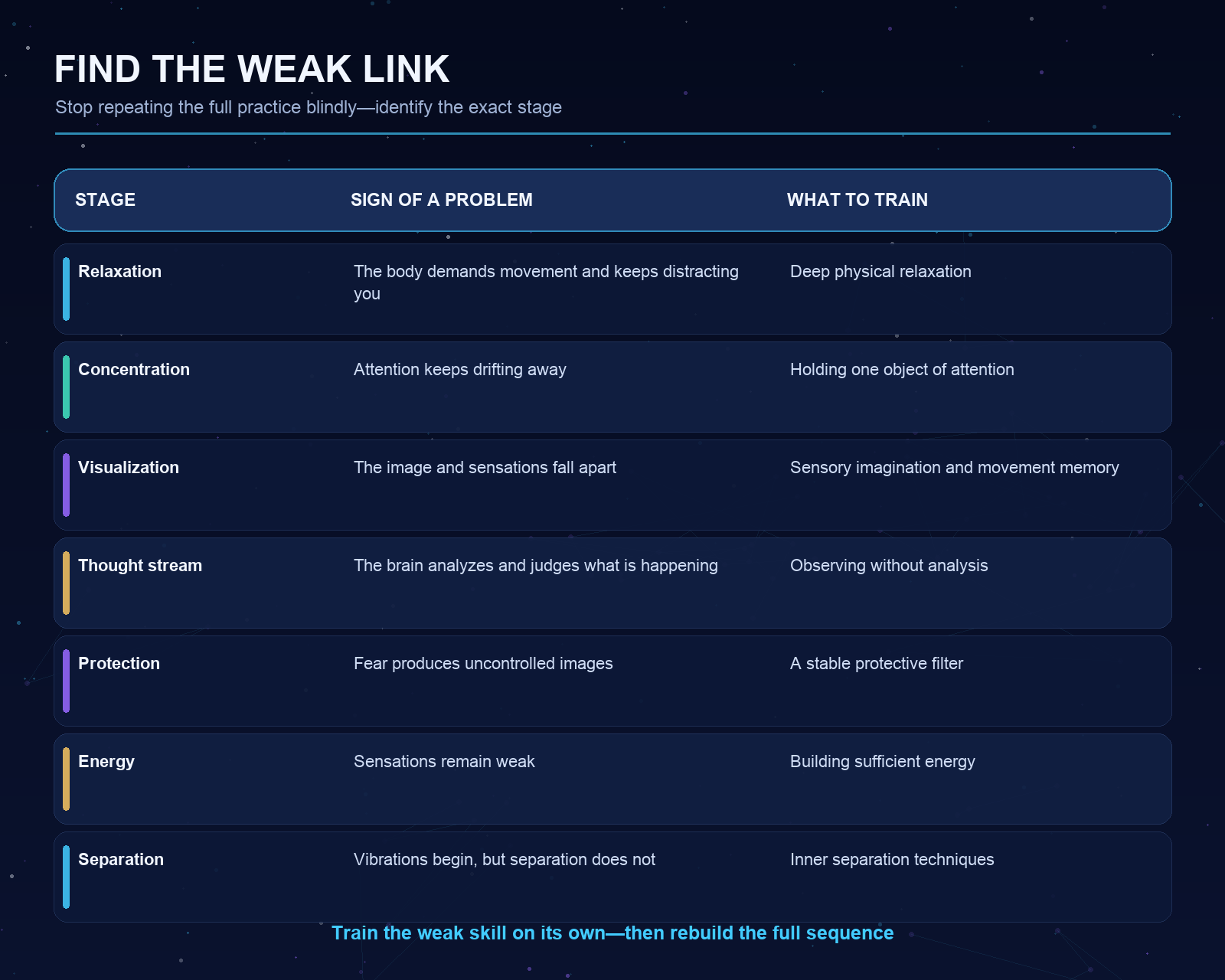
This kind of diagnosis helps you stop treating every unsuccessful attempt as defeat. Practice becomes a comprehensible system that can be studied and improved.
Train the elements separately
Once you have identified the weak link, you do not need to repeat the complete sequence every time.
If relaxation is the problem, spend some time training only relaxation.
If maintaining attention is difficult, work on concentration.
If inner movement does not happen, practice rolling, rotating, and rising separately.
If you reach the vibrations but do not separate, focus on separation techniques.
When each element becomes stable enough, connect them again into one sequence.
This develops the practice faster than repeatedly completing the same full routine with the same unresolved mistake.
Results come through preparation
In twenty years of practice, I have often seen people come very close to a result and stop because one skill was not developed enough.
They can already hear the signal, but it is still mixed with static.
In that situation, it is wrong to conclude that nothing is working. The first sensations show that the direction is correct. The process simply needs more precise tuning.
Out-of-body experience requires preparation, knowledge, discipline, and regularity. Every necessary skill can be developed. Every mistake can be identified. Every stage can be studied separately.
If your practice did not end in separation, determine exactly where the chain broke. Strengthen that link, then rebuild the full sequence.
An unsuccessful attempt does not close the path. It shows you what to work on next.
Author: Andrey Chsherbakov
Researcher of consciousness beyond the body and author of The Phenomenon of Consciousness Beyond the Body.
Leave a Reply