
“That is only personal experience” is often used as though it ends the discussion. A person reports an out-of-body experience, a meeting with a deceased loved one, or information received in an unusual state—and is told that a subjective observation means nothing.
That is a mistake.
Personal experience is not conclusive proof for another person. It is, however, a real fact in the life of the person who had it and the starting material for any investigation of consciousness.
For the person who lived it, experience can become knowledge
If you have never seen the ocean, another person’s story will not prove its existence completely. Yet someone who stood on the shore is not required to call the ocean a hypothesis merely because no measuring instrument was present.
I approach my experience of consciousness beyond the body in the same way. My conviction did not arise from one dramatic night or a desire to believe. It grew from hundreds of observations, repeated patterns, meetings, and experiments over twenty years.
For me, the independent existence of consciousness is not an abstract philosophy. I also understand that my internal degree of certainty cannot be transferred automatically to a reader.

Why an account does not become proof for everyone
Another person cannot enter my experience directly. He receives a memory translated into words and filtered through interpretation.
The account may be affected by:
- errors of memory;
- expectations and beliefs;
- mental constructions;
- the desire to give the event meaning;
- imprecise language;
- selecting only successful episodes;
- deliberate exaggeration.
An author’s honesty matters, but honesty alone does not solve the problem of verification.
Consciousness research inevitably uses subjective data
Pain, love, fear, meaning, and the sense of “I” cannot be observed directly from the outside. A scientist records brain activity, behavior, and physiological responses, but learns the content of the experience from the person’s report.
If we remove subjective experience entirely, we lose the subject of consciousness research itself. Only external correlations remain.
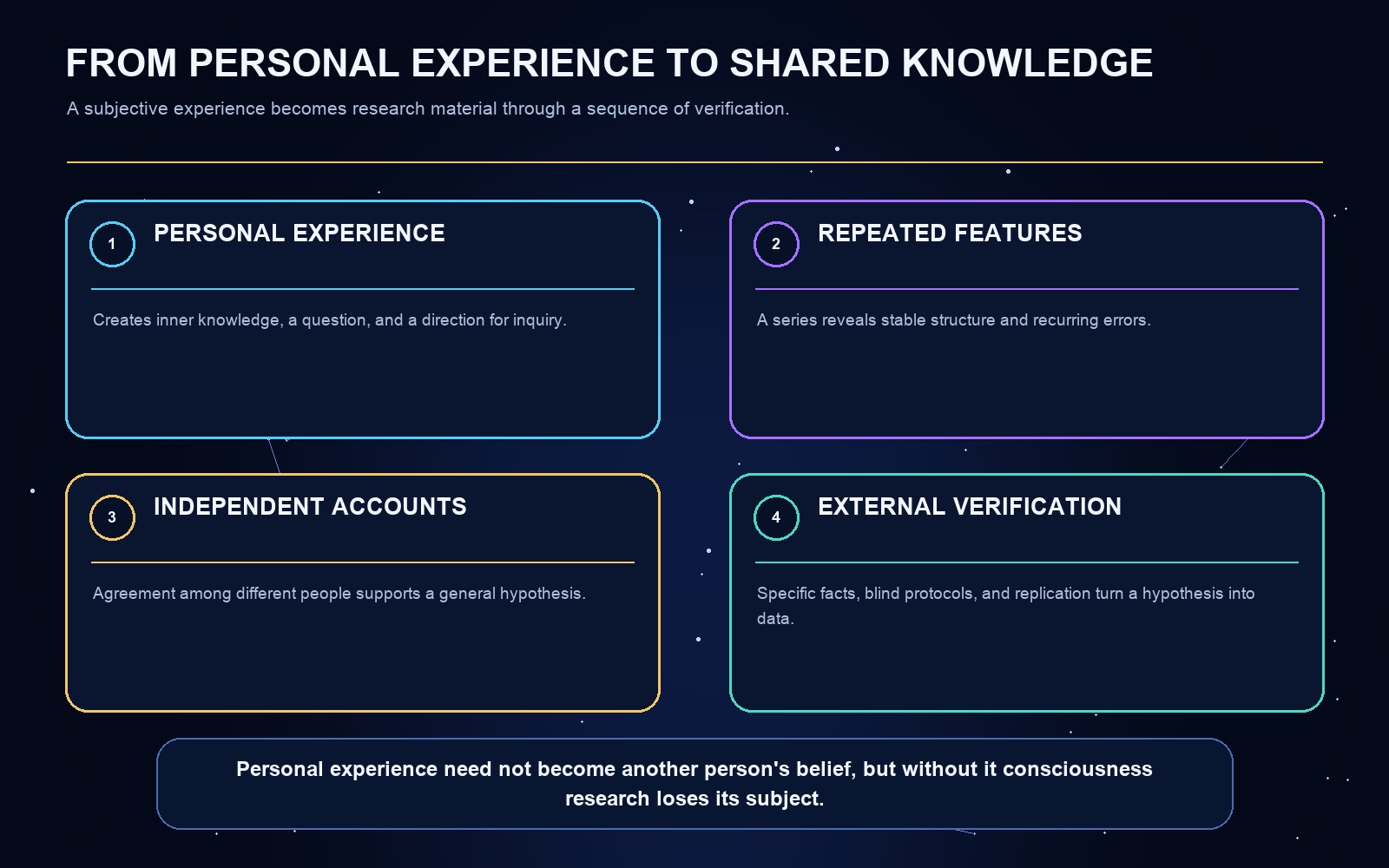
The answer is not to discard personal accounts, but to collect them according to clear rules: record conditions, compare characteristics, search for repetition, and isolate verifiable elements.
A body of experience is stronger than one story
One account may be an error. Thousands of independent accounts with a repeating structure demand an explanation.
This does not prove that every person visited the same objective region. Shared features may arise from the brain, culture, or similar transitional states. But dismissing the material as “fantasy” is not an adequate explanation.
We should compare:
- how experiences begin;
- degree of awareness;
- stability of the environment;
- bodily sensations during transition;
- the influence of thought;
- forms of consciousness encountered;
- verifiable information;
- changes in personality afterward.
An investigative model grows out of repeating patterns.
Transformation does not prove a worldview, but it reveals the power of the phenomenon
After a powerful out-of-body or near-death experience, a person may lose the fear of death, change values, and relate to life differently.
A profound change in personality does not prove the literal accuracy of everything perceived. A dream, book, or psychological crisis can also change a person. But a stable transformative effect shows that the phenomenon cannot be dismissed as insignificant noise in the brain.
Even an investigator who disputes the explanation should study the consequences.
Two extremes obstruct understanding
The first extreme declares every unusual experience an absolute truth. Personal interpretation then becomes dogma.
The second treats subjectivity as a synonym for meaninglessness. Science then closes itself to material it cannot yet measure directly.
I choose a third path: respect the experience and test the conclusions.
A person has the right to speak confidently about what he experienced. He also has a responsibility to separate observation from explanation. An investigator has the right to question the interpretation, but not to humiliate the witness or declare the phenomenon impossible in advance.
Institutional science also has limits
Research priorities are shaped by more than scientific curiosity. Funding, reputation, career risk, and organizational interests all influence them. Consciousness beyond the body has long remained outside the boundaries of scientific respectability, so it receives fewer resources and fewer well-designed experiments.
That does not make scientific method unnecessary. On the contrary, we especially need high-quality research. But a lack of funding and data must not be mistaken for evidence that a phenomenon does not exist.
Science develops when someone dares to investigate what an earlier worldview considered impossible.
Personal experience as the beginning of a path
A subjective experience performs several essential functions.
It creates a question. It reveals a possible direction. It helps formulate a hypothesis. It provides characteristics for comparison. It suggests a new experiment.
The next step is then required: recording, repetition, comparison with other people, and a search for external verification.
Personal experience thus becomes more than a private story. It becomes research material.
Hope also deserves honesty
People approach the subject of consciousness for more than curiosity. They fear death, grieve loved ones, and search for meaning in their lives.
I want to give them hope, but I do not believe hope should be built on beautiful promises. Strong hope grows from honest testimony: this is what I experienced, this is what I observed repeatedly, this is what I was able to verify, and these questions remain open.
My personal experience does not have to become your belief. Its purpose is to show that the familiar materialist picture may be incomplete and that consciousness deserves a far more courageous investigation.
Do not believe me automatically. But do not reject a possibility merely because a modern instrument cannot yet detect it. Investigate, compare, and preserve your right to arrive at your own knowledge.
You can read more about my twenty-year personal investigation of consciousness in my book The Phenomenon of Consciousness Beyond the Body.
Continue with the book on Amazon: Kindle Edition or Paperback.
Leave a Reply