
Channeling is usually described as receiving information from a being, teacher, Higher Self, deceased person, or representative of another civilization. A message may come in words, images, sensations, or as an entire block of meaning received at once.
I do not believe that this form of communication is impossible. Consciousness can perceive and transmit information outside our usual physical channels. I have observed communication without speech and encountered different forms of consciousness myself.
But the possibility of contact does not establish the identity of the speaker, and it does not guarantee that the message is true.
Different signals can travel through the same channel
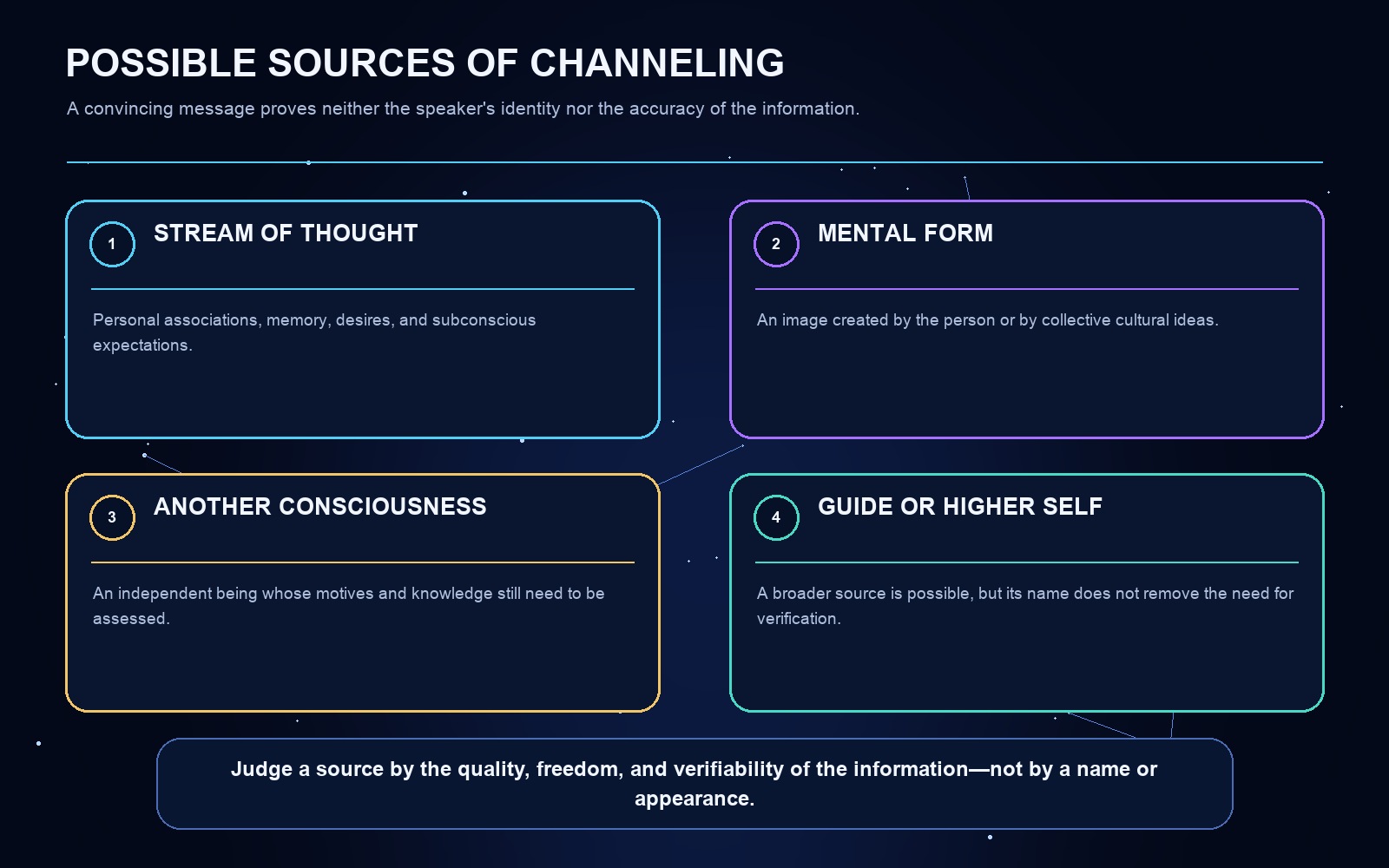
When a person hears an inner voice or receives unusual information, several sources are possible:
- his own stream of thought and subconscious associations;
- memory, expectation, and desire;
- a mental form created by the person himself;
- collective religious or cultural imagery;
- the consciousness of another being;
- a guide, teacher, or Higher Self;
- a mixture of several sources.
Subjectively, all of these can feel equally convincing. That is why saying “I heard it clearly” does not answer the central question: Whom—or what—did the person hear?

Why a source can claim any identity
In mental space, form readily adjusts to the observer’s expectations. An entity or thought-form may assume a recognizable appearance, adopt an impressive name, and speak with confidence.
A name is not identification. A luminous appearance is not proof of spiritual stature. Beautiful words about love do not guarantee wisdom.
The more strongly someone wants to meet a particular teacher, saint, or extraterrestrial being, the easier it is for the mind to create the corresponding form. And if contact is taking place with an independent consciousness, that consciousness may also use the person’s expectations to establish trust.
I therefore evaluate the quality of the information and the consequences of the contact, not the appearance of the messenger.
Warning signs
I approach messages cautiously when the source:
- repeatedly emphasizes its own greatness;
- declares the channeler a chosen savior;
- demands unconditional obedience;
- frightens people with an approaching catastrophe and offers the only path to safety;
- divides humanity into the spiritually superior and inferior;
- forbids the recipient to verify information;
- flatters, promises power, or grants supposedly exceptional abilities;
- makes endless predictions that cannot be tested;
- dictates decisions about money, health, or intimate relationships;
- becomes the central authority in the person’s life.
An advanced consciousness does not need worship. A genuine teacher helps a person become clearer and more independent; he does not turn that person into a dependent follower.
Why messages reflect their era
Throughout history, channeled sources have spoken in the language of their culture. In earlier centuries, people encountered angels, saints, and prophets. Later, cosmic teachers, star federations, and guardians of new frequencies became increasingly common.
This does not prove that every message is invented. It does show how strongly information is filtered through the recipient’s consciousness. Even a real meaning may assume a form that the channeler and his audience can understand.
A person is not a transparent wire. The brain, vocabulary, education, religious background, and expectations all take part in translating received meaning into human language.
How to evaluate channeling
The first rule is not to follow an important instruction merely because it supposedly came from a higher level.
Ask several questions.
Can specific information be checked? If the source makes a claim about the physical world, that claim must withstand ordinary verification.
Is the message logically consistent? Contradictions cannot be explained forever by a “shift in the timeline.”
Does information agree across independent sources? People who know one another repeating the same ideas is not independent confirmation.
Does the message preserve freedom? Mature knowledge can be offered without threats.
Where does the contact lead? Toward clarity, responsibility, and growth—or toward fear, superiority, and dependence?
Can the channeler question his own interpretation? If every doubt is treated as an attack by dark forces, investigation has already ended.
Valuable information does not make a source infallible
A source may offer one useful insight and be wrong about something else. A person may receive a meaning accurately and translate it poorly. A real contact may become mixed with personal expectations.
We do not need to choose between two extremes: “Everything channeled is true” or “It is all fantasy.” Reality is more complex. Knowledge, interpretation, and mental construction may coexist in the same stream.
The investigator’s task is to separate them.
The Higher Self does not speak through a torrent of random thoughts
A common mistake is to treat every unusual thought as a message from above. The brain continually produces associations, forecasts, fears, and desires. Most inner dialogue belongs to this stream.
Connection with a broader part of consciousness usually feels different. It brings clarity rather than verbosity. Information may arrive instantly, as a whole understanding, without pressure or drama. Even then, the experience still requires reflection and verification.
An inner voice should never be given authority over a person’s life merely because it calls itself the Higher Self.
My principle: listen without automatic obedience
I remain open to information from nonphysical sources. Without that openness, an investigation of consciousness would be impossible. But openness is not gullibility.
I treat every message as material for further work. I compare it with my experience, test its internal consistency, look for confirmation, and observe its effects.
Truth is not afraid of examination. A source that asks us to turn off reason is offering a new form of dependence, not knowledge.
You can read more about mental forms, guides, and communication beyond the physical body in my book The Phenomenon of Consciousness Beyond the Body.
Continue with the book on Amazon: Kindle Edition or Paperback.
Leave a Reply