I know the religious world from the inside. I spent seven years studying at a theological academy, was ordained, and served as a pastor for nearly a decade. I lived according to my faith, sincerely tried to help people, and believed that religion would give me answers to the most important questions: Who are we? Why are we here? What happens after death?
That path gave me a great deal. It taught me discipline, responsibility, and attentiveness to a person’s inner life. Over time, however, I began to see another side of it: a ready-made system of answers can guide us, but it can also confine us. At some point, a person may stop investigating reality and begin defending a worldview received from others.
That is when faith becomes religiosity—and religiosity becomes a cage.
Faith and religiosity are not the same
Faith can be a living inner trust in the world, in the Source, and in the meaning of life. It can sustain us through difficult periods, help us remain honest, and keep hope alive.
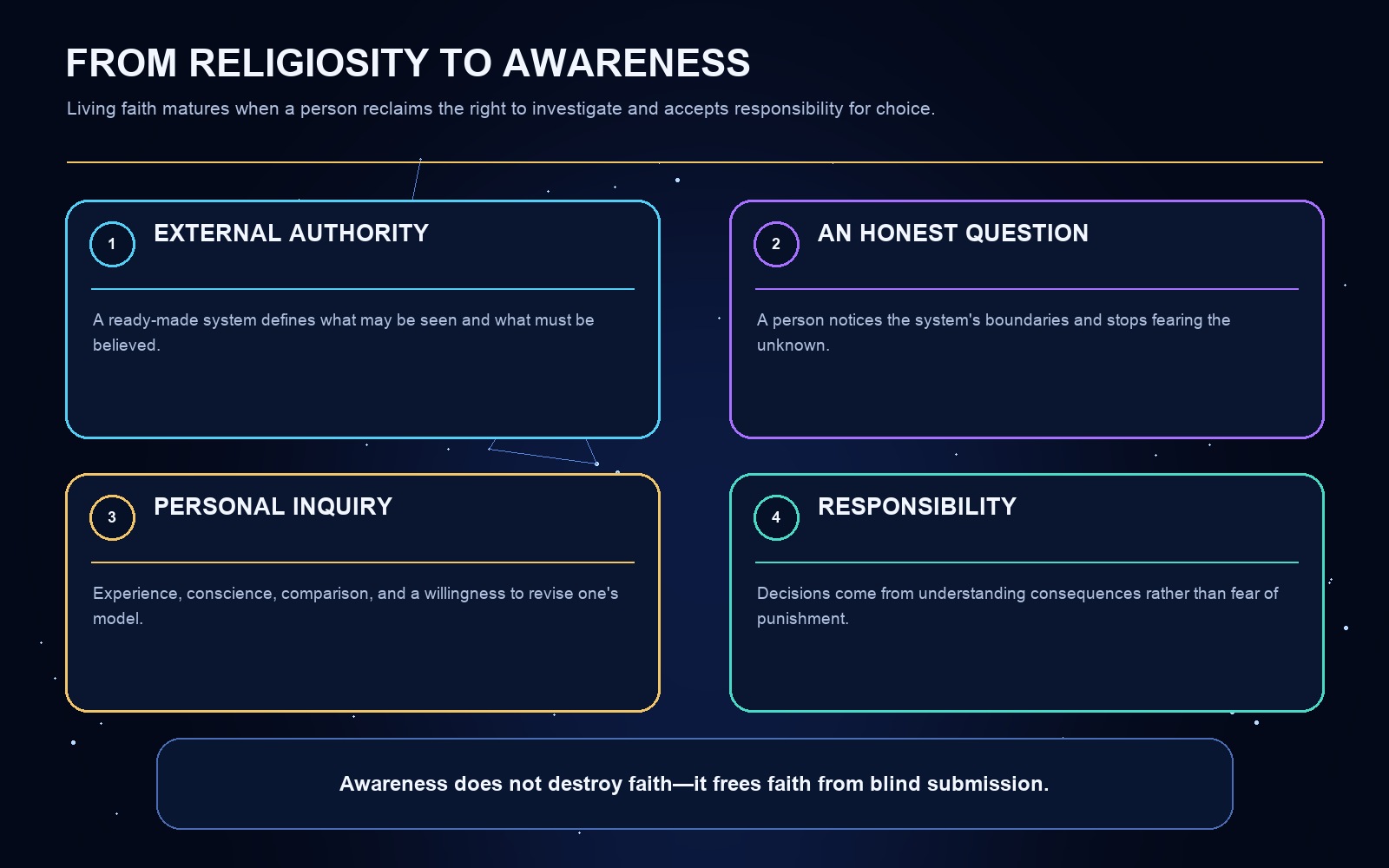
Religiosity, as I use the word here, begins when a person gives away the right to think and verify. He receives ready-made answers, a ready-made hierarchy, and a ready-made image of God. From then on, every personal experience is judged not by what it contains, but by whether it agrees with doctrine.
If an experience fits the system, it is accepted as spiritual. If it does not, it is labeled delusion, temptation, or danger. In this way, the system protects its own boundaries rather than the truth.
Awareness works differently. It does not require us to abandon faith. It requires us to take responsibility for what we believe and why we believe it.
Why a ready-made answer is so appealing
Uncertainty frightens people. It is easier to hear, “This is exactly how reality works,” than to admit that reality may be far larger than our ideas about it.
A religious system gives a person clear coordinates: what is good, what to fear, whom to trust, and what will happen after death. Along with answers, it often provides belonging and security. But the price of that security may be the surrender of one’s own investigation.
A person becomes accustomed to seeking truth not within consciousness or lived experience, but in an authoritative text, an office, or a tradition. Obedience is mistaken for spirituality, fear of punishment for conscience, and repetition of someone else’s words for inner knowledge.
Awareness begins with an honest question
An aware person may believe in God, the Source, the soul, and the continuation of life. The difference is that he does not hide behind those words. He asks questions and is willing to revise his understanding when new experience reveals that the old model was too narrow.
Inner knowledge does not grow out of a desire to feel chosen. It grows through observation, personal practice, comparison of facts, and the ability to admit one’s own mistakes.
That is why awareness is inseparable from personal responsibility. If I say that I have had a spiritual experience, I must ask myself:
- What did I actually experience, and what did I add later?
- Did fear, expectation, or a religious image shape what I saw?
- Can the observation be repeated?
- Does the experience help me see reality more clearly?
- Does it make me more responsible, or merely give me a sense of superiority?
These questions do not destroy spiritual experience. They refine it.
Fanaticism is not limited to religion
I did not leave a religious system in order to replace one set of dogmas with another. A person can believe with the same fanaticism in an esoteric teacher, a political ideology, or a materialist explanation of consciousness.
Fanaticism does not begin with a particular idea. It begins with the refusal to test that idea. The moment a person treats his worldview as final, he stops seeing what contradicts it.
Religiosity can therefore exist without a church. It appears wherever there is an infallible authority, a prohibition against doubt, and fear of stepping outside prescribed boundaries.
Conscience is stronger than an external prohibition
A religious person often looks to an external rule: permitted or forbidden, reward or punishment. Awareness moves the center of decision-making within the person.
This does not mean that anyone may justify any action by saying, “That is how I feel.” Real inner freedom demands more responsibility than external obedience. A person learns to see the consequences of his choices, to feel another person’s pain, and to act not from fear of punishment but from an understanding of the connection among all living beings.
Conscience is not a list of prohibitions. It is the soul’s ability to recognize what destroys life and what helps it grow.
Spirituality does not require an intermediary
A teacher, tradition, or book may illuminate part of the path. But each person must walk that path for himself. No one can become aware of reality on our behalf.
I am not calling on people to abandon religion. I am asking them to stop granting a religious organization the exclusive right to speak for God. If the Source truly lies at the foundation of all life, then a connection with it cannot belong to one denomination, one nation, or one intermediary.
A person has the right to investigate consciousness, ask uncomfortable questions, and build understanding from personal experience. He also has a duty to remain honest: not to mistake wishful thinking for reality or declare a personal impression to be a universal law.
A faith strong enough to be examined
I did not lose faith when I moved beyond the religious system. On the contrary, my understanding of the Source became broader. I stopped seeing God as an external ruler who distributes rewards and punishments. To me, the Source is a living consciousness of which everything that exists is a part.
Such faith is not afraid of questions. If an idea collapses under honest investigation, what has collapsed is not truth, but our limited model of it.
Awareness does not require us to know everything. It requires us not to deceive ourselves. It allows us to believe, investigate, question our explanations, and still move confidently toward what repeated personal experience confirms.
This is what I consider mature spirituality: neither blind submission nor the denial of everything unseen, but a living connection with the Source, tested through life, conscience, and one’s own consciousness.
You can read more about my path from religious ministry to the study of consciousness in my book The Phenomenon of Consciousness Beyond the Body.
Continue with the book on Amazon: Kindle Edition or Paperback.
Leave a Reply