
Out-of-body experience and death share an obvious similarity: consciousness stops perceiving itself only through the physical body and can observe reality from another point. That is why the practice of consciousness beyond the body can change a person’s relationship with death.
But the two experiences are not identical. A temporary separation occurs while the organism is alive and the connection with it remains intact. Death ends the functioning of the physical body and moves consciousness into another stage of existence.
The difference is not limited to whether a return is possible. The depth of separation, the amount of memory available, the stability of perception, and the direction of further movement all change.
What I mean by an out-of-body experience
For me, an out-of-body experience is a conscious separation from the body in which a person continues to see, hear, feel, and act while understanding that the physical organism is elsewhere.
The experience can feel so realistic that the person may not notice the separation at first. He moves through the room, perceives objects, and only later sees his own body or realizes that the ordinary laws of matter are operating differently.
The quality of these experiences varies. Sometimes the brain actively fills in what is happening and creates mental constructions. At other times, consciousness perceives a stable environment that does not obey its expectations. The feeling of leaving the body therefore does not guarantee that everything observed is objective.
During a temporary separation, the connection with the body remains
The central difference is that the physical body remains alive. The heart, breathing, brain, and nervous system continue to function. Even when a person barely perceives bodily signals, the connection has not been broken.
I have concluded that only part of consciousness separates during an out-of-body experience. Another part remains connected with the organism, supports its functions, and provides the basis for return. All parts of consciousness continue to exchange information.
That is why a change in breathing, a sudden sound, a touch, or danger can return a person to the body instantly. The physical organism retains priority and can demand attention back.
Why the return happens so quickly
The connection with the body acts like a constant pull. Maintaining the out-of-body state requires concentration and energy. As soon as attention disperses, a strong emotion appears, or the body becomes active, the separated part of consciousness returns.
The return is usually immediate. There is no need to find a route back to the body or remember its address. The connection never disappeared, so distance in the ordinary sense is not an obstacle.
After returning, a different problem begins: transferring the memory. The experience took place with reduced participation from the brain, and now it must be translated into the physical memory system. If this is not done immediately, details fade quickly.

What happens at death
At death, the body ceases to function as an instrument of consciousness. The nervous system no longer sustains stable interaction, and a return to the former organism becomes impossible.
According to my experience and the information I have received, the soul remains with the body until the final moment and helps reduce its fear and suffering. After physical processes end, consciousness may remain nearby for a time, understanding the transition and saying goodbye to loved ones.
The direction then changes. During a temporary separation, the body constantly pulls consciousness back. After death, the soul moves toward reunion with its greater self and a return home.
Does the person remain after both transitions?
During both an out-of-body experience and the period after death, a person retains a sense of “I.” He does not become an impersonal observer. Memory, intention, and the ability to make decisions remain.
During a temporary separation, however, the perspective of the earthly personality remains dominant. The person knows he has a body, a current life, and a need to return.
After death, that connection gradually changes. The recent personality remains at first, and then the wider memory of the soul returns. The person remembers other incarnations, kindred relationships, and his own condition before birth.
This expansion is almost inaccessible during an ordinary temporary separation because the physical brain and the need to return continue to limit the range of perception.
Why an out-of-body experience is not a rehearsal for death
The practice can show a person that perception is not limited to the body. It can reduce the fear of nonexistence and provide personal material for investigation. But it is wrong to treat a deliberate separation as a simulation of dying.
Death includes the complete end of a physical biography, the conclusion of the functioning union between soul and body, a transitional stage, and the restoration of broader memory. A temporary experience preserves biological life and the obligation to return.
Out-of-body perception can also be distorted by expectation and brain activity. A person may see a symbolic or mental scene and mistake it for an exact picture of the afterlife. Experience, awareness, and verification are therefore necessary.
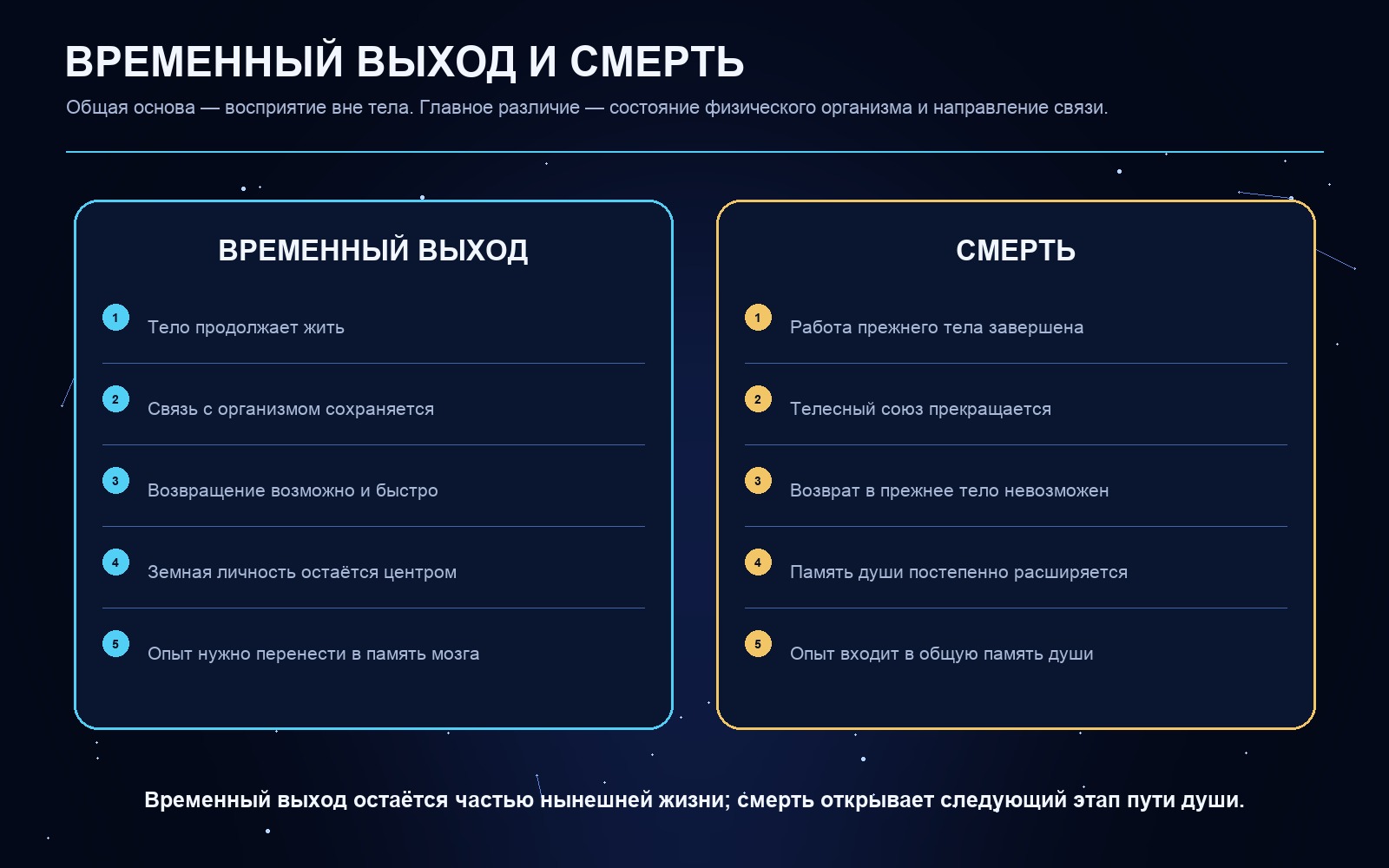
The main differences
| Temporary separation | Death |
|---|---|
| The body continues to live | The functioning of the physical body ends |
| Part of consciousness remains connected with the organism | Consciousness is released from the former bodily union |
| A rapid return remains possible at all times | A return to the former body is impossible |
| The earthly personality and current life remain the primary focus | Memory gradually expands to include the soul’s experience |
| Physical signals can interrupt the experience | The body no longer calls consciousness back |
| Memory must be transferred to the brain after returning | The experience enters the soul’s wider memory |
What a temporary separation can tell us about death
It reveals several important principles.
First, a sense of personal identity can continue while a person perceives himself outside the body. Second, the physical senses are not the only possible way to receive information. Third, thought and intention operate differently outside dense reality. Fourth, fear often decreases when a person directly experiences the continuity of his own “I.”
But an out-of-body experience provides only a glimpse through a partially opened door. It does not reproduce the full depth of death or make the practitioner all-knowing.
Why the difference matters
If we identify leaving the body completely with death, we may underestimate the complexity of the afterlife transition. If we treat them as entirely unrelated, we lose an important opportunity to study consciousness through experience.
It is more accurate to recognize a common foundation under different conditions. In both cases, consciousness demonstrates an ability to perceive itself beyond the familiar bodily point. But a temporary separation remains part of the present life, while death completes that life and opens the way toward restoring the soul’s wholeness.
For me, the practice is valuable neither as an escape from the body nor as a game with death. It is valuable as a research tool that allows a person to see that the body is an important part of the earthly personality but does not exhaust the nature of consciousness.
This understanding does not reduce the value of physical life. On the contrary, it makes life more responsible. We return to the body not because we have failed, but because the experience for which we came continues here.
For a fuller discussion of the forms of out-of-body experience, the division of consciousness, and the process of death, see my book The Phenomenon of Consciousness Beyond the Body.
Read the English edition on Amazon →
Additional English edition on Amazon
Leave a Reply