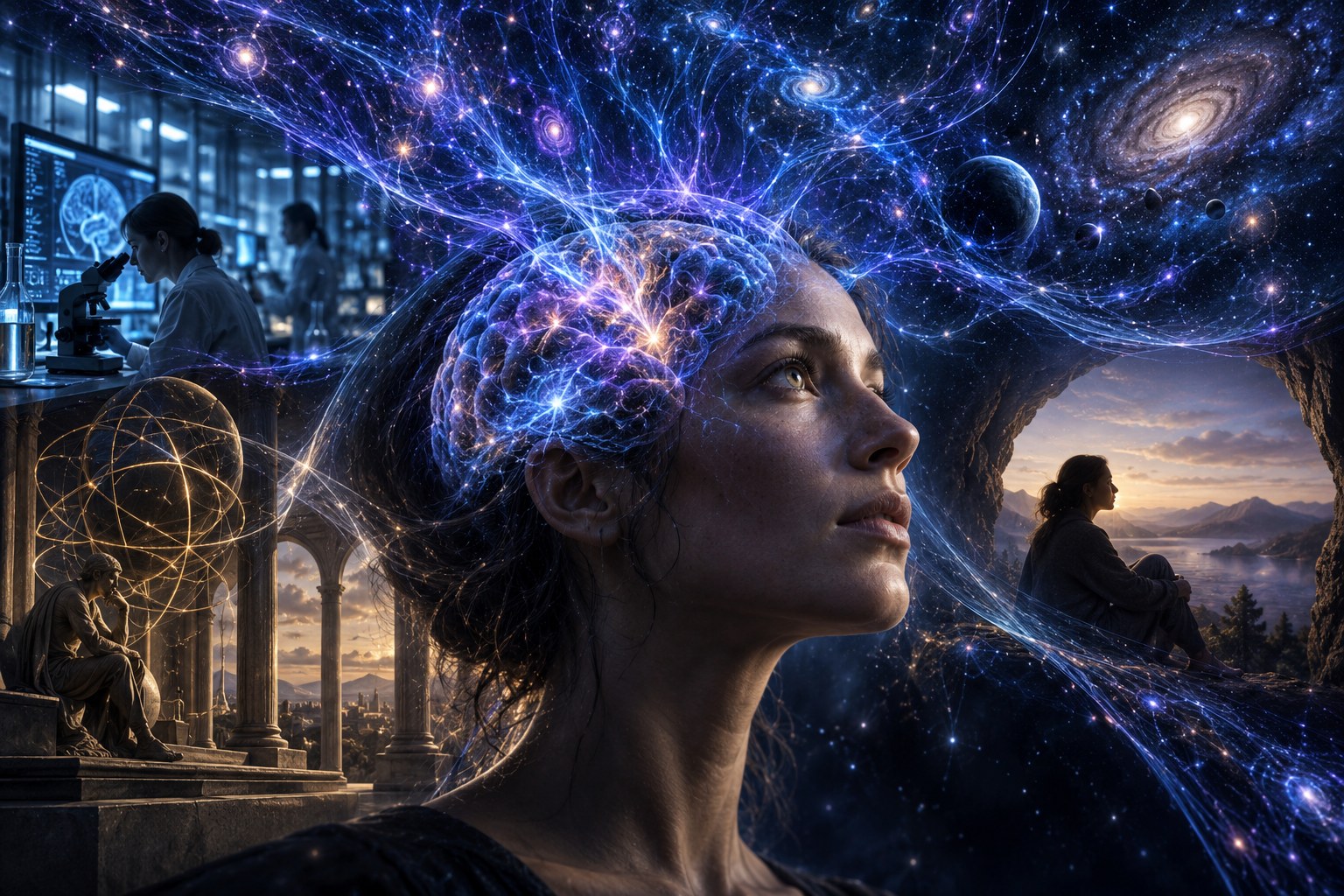
Why modern science still cannot explain the source of subjective experience—and what twenty years of my own research have taught me
By Andrey Chsherbakov Format: Research overview and author’s model
The Closest and Most Difficult Question
Consciousness is the one reality we know directly. Everything else reaches us through it. We see the world, hear sounds, feel the body, remember the past, make plans, and contemplate the universe. But every fact must first appear within our field of awareness. Without a perceiving subject, there would be neither experience nor any knowledge that experience exists.
And yet we still have no widely accepted answer to a simple question: What is it that is aware?
The brain can be examined with instruments. We can observe electrical activity among neurons, changes in blood flow, signal transmission, memory processes, and responses to external stimuli. But the one who experiences pain, love, fear, beauty, or existence itself never appears on a brain scan. The scan reveals processes. The experience itself remains available only to the person living through it.
This distinction lies at the heart of the consciousness problem. Science is becoming increasingly precise in describing the mechanisms associated with perception, attention, memory, and decision-making. Yet describing a mechanism does not tell us why its operation is accompanied by an inner life. Why does a person not merely process wavelengths of light but actually see red? Why does a biochemical reaction become pain? Where does the sense arise that “this is happening to me”?
I have spent twenty years investigating this question. My understanding grew from personal out-of-body experience, observation of transitional states, study of other researchers’ work, and a continual comparison between what I experienced and the theories already available. I came to the conclusion that the brain participates in the expression of human consciousness, but it does not create consciousness. Consciousness belongs to the soul, while the brain serves as an interface connecting the soul, the body, and the physical world.
This is my working model. I do not ask anyone to accept it on faith. I ask that we first examine what current scientific and philosophical models explain, where their limits lie, and why lived experience should not be excluded from inquiry simply because it is difficult to place inside a laboratory instrument.
Consciousness Is Not the Stream of Thought
People often use the word consciousness for everything happening in the mind: thoughts, inner dialogue, memories, fantasies, and emotional reactions. But the stream of thought is content. Consciousness is that within which the content appears—and that which can notice it.
A thought arises, changes, and disappears. The observer can see it appear. The observer can agree with it, reject it, redirect attention elsewhere, or let it pass. If a person can observe a thought, then the thought and the observing consciousness are not identical.
The same is true of emotion. I can experience fear while understanding that I am afraid. I can notice irritation before it becomes an action. I can recognize a habitual reaction and choose a different response. This ability to observe our own condition creates a space for freedom.
The brain forms and repeats familiar pathways. It compares new information with memory, predicts danger, proposes familiar solutions, and can keep thoughts moving in circles. All of this is necessary for life. But a person does not have to follow every impulse of the brain automatically. Consciousness can direct attention and choose which thought will become action.
The question of consciousness therefore cannot be reduced to the question of thinking. A computer also processes information, sorts data, and performs complex operations. But computation by itself does not explain the existence of a subject who knows that it exists.
What Neuroscience Has Learned to Explain
Modern neuroscience has established a deep relationship between the state of the brain and the experience available to a person. Damage to particular regions can disrupt speech, memory, facial recognition, the sense of owning a body, or the ability to sustain attention. Anesthesia alters communication among large-scale brain networks and temporarily removes ordinary access to experience. Sleep, medication, injury, oxygen deprivation, and neurodegenerative disease can also change conscious states.
These findings cannot be ignored. The brain is necessary for the normal expression of the earthly personality. Through it, a person perceives the physical world, retains memories, controls the body, and expresses inner decisions.
From this evidence, the materialist model takes one further step: if changes in the brain change consciousness, then the brain must produce consciousness. For many researchers, this is the most economical explanation. It does not require the introduction of a soul or another level of reality, and it lends itself to testable experiments.
But observed dependence is not the same as demonstrated origin. Altering an instrument always changes its output. Damage to a camera distorts an image; damage to a radio distorts sound. That does not mean the external object was created by the camera or that the broadcast originated inside the receiver.
This analogy does not prove that consciousness exists independently of the brain. It demonstrates something more modest but essential: the close relationship between brain and experience does not logically establish a single possible model. The brain may generate consciousness. It may function as an interface, filter, or converter. The relationship may be more complex than any concept currently available to us.
Research on anesthesia illustrates the present boundary of knowledge. Scientists are steadily improving their descriptions of the networks associated with wakefulness, information processing, and the recovery of conscious access, yet the authors of modern reviews continue to identify unresolved questions about the mechanisms of consciousness. We have learned to suppress and restore particular functions—an extraordinary practical achievement. But controlling the expression of a phenomenon is not the same as fully understanding its nature.
Theories of Consciousness Describe Different Parts of the Process
Contemporary neuroscience has no single accepted theory of consciousness. Several influential models exist, each emphasizing a different mechanism.
Global Neuronal Workspace Theory associates conscious access with the moment information becomes available to many specialized systems across the brain. While a signal is processed locally, it may remain outside awareness. When information is broadly distributed across brain networks, its content becomes available to memory, language, planning, and voluntary action.
This model helps explain why so much processing remains unconscious and why certain information suddenly enters attention. But it primarily describes access to information. It does not explain why the global distribution of a signal should be accompanied by an inner experience.
Integrated Information Theory begins with properties of experience itself: every conscious moment is unified while also containing differences. The theory attempts to connect the presence and structure of experience with a system’s ability to form an irreducible causal whole. It is a serious effort to derive measurable properties from phenomenology, but its conclusions and proposed measures remain contested.
In 2025, Nature published the results of a large, direct comparison between Global Neuronal Workspace Theory and Integrated Information Theory. The project combined functional MRI, magnetoencephalography, and intracranial recordings from 256 participants. Some predictions received support, while other central claims of both theories faced serious challenges. To me, the meaning of this result is clear: science is advancing, but it still does not have a complete theory of consciousness.
Other approaches associate consciousness with recurrent processing, prediction, attention, higher-order representation, or particular dynamic states of the brain. These models help us investigate the conditions under which information becomes available to a person. They create maps of correlations and produce testable hypotheses. But a map of the process and the source of experience are not the same thing.
The Hard Problem of Consciousness
The philosopher David Chalmers called this distinction “the hard problem of consciousness.” Some questions can be addressed by investigating functions: how the brain distinguishes stimuli, combines information, directs attention, generates reports, and controls behavior. But another question remains: Why should any of these functions be accompanied by subjective experience at all?
We can describe the passage of a light signal from the retina to the visual cortex in great detail. We can identify which regions become active when a person recognizes a face. Yet that description does not contain the experience of color, depth, recognition, or presence. An explanatory gap remains between an external account of brain activity and the inner life of the subject.
Sometimes this gap is closed by declaring that subjective experience simply is brain activity. But the word is does not explain the transition. It merely labels two very different descriptions as the same phenomenon. Future science may discover a convincing bridge between them. Today, no such bridge has achieved general acceptance.
The claim that “science has already proved the brain creates consciousness” therefore goes beyond what the evidence establishes. Science convincingly demonstrates that familiar human experience depends on the brain. It has not yet established how a physical process becomes a subjective experience or why there is anyone to whom that process is given from the inside.
Four Philosophical Pictures
Philosophy offers several major responses to the problem of consciousness.
Physicalism treats physical reality as fundamental and consciousness as something that emerges from the organization of matter or can ultimately be described entirely through physical processes. Its strength is its close connection with experimental science. Its difficulty is explaining how subjectivity arises from processes that are themselves described without any inner point of view.
Dualism holds that the mental and physical cannot be reduced to one another. Consciousness and the body belong to different categories of reality, even though they interact. This position preserves the independent status of inner experience, but it must explain how the two levels influence each other.
Panpsychism regards the mental as a fundamental and widespread feature of nature. Consciousness, on this view, does not suddenly emerge from matter that is entirely devoid of interiority. Its central difficulty is explaining how elementary forms of experience combine into a unified human self.
Idealism goes further and treats consciousness or mind as the foundation of reality. In its various forms, the material world is understood as the content, structure, or expression of a more fundamental consciousness. This picture comes closest to the idea of a living universe, but it must still explain the stability of a shared world and the relationships among individual subjects.
There are also intermediate positions: neutral monism, dual-aspect theory, and cosmopsychism. Their diversity shows that the debate is not simply one between “science” and “superstition.” It is a serious disagreement about what reality is made of and which facts a complete theory of the human being must explain.
What Twenty Years of Personal Experience Changed
Before my conscious out-of-body experiences began, the question of the soul was a matter of belief. I could read books, accept religious teachings, or doubt them, but I had no personal basis for a conclusion.
Practice changed the nature of the question itself.
In an out-of-body state, I did not stop being myself. I retained my sense of identity, the ability to observe, set an intention, make decisions, move, compare events with memory, and later analyze the experience. The familiar location of perception within the physical body disappeared, but the subject did not.
This was crucial for me. If personality were nothing more than the operation of the ordinary waking brain, I would expect clarity to break down when the connection to physical perception weakened. Instead, in some experiences clarity became stronger. I felt no less real than I do in everyday life and, at times, more focused and freer from the automatic stream of thought.
A single unusual episode can be explained in many ways. My conclusion does not rest on one event. It developed from recurring observations over twenty years: the preservation of self-awareness, intention, memory, the ability to investigate, the capacity to return to a chosen objective, and the comparison of different states.
I understand the difference between personal experience and laboratory proof. But an experience does not become meaningless simply because it is available from the inside. Pain, love, meaning, and the very existence of the self are also known directly before they are measured. A science of consciousness that excludes inner testimony removes the very phenomenon it is trying to explain.
Research into experiences during cardiac arrest shows how difficult this field is. In the multicenter AWARE II study, some survivors reported memories and experiences associated with resuscitation. No participant identified the visual target, and one identified the auditory stimulus. These findings do not provide definitive proof that consciousness exists independently of the brain. They do show that the boundary among life, the interruption of ordinary brain function, resuscitation, and conscious experience is more complex than the simple formula “the brain stopped, therefore the person no longer existed.”
Personal experience should not replace verification. But verification should not begin by forbidding the question.
My Model: The Brain as an Interface for Consciousness
My model proceeds from consciousness to matter, rather than from matter to consciousness.
At its foundation is the Source—a unified living consciousness from which all the diversity of reality arises and within which it exists. An individual soul is not separated from the Source by an absolute boundary. It is an independent center of experience and, at the same time, part of a larger whole.
The soul is individual consciousness with memory, a direction of development, and the capacity to accumulate experience. It is greater than a single earthly biography.
The Higher Self is the fuller dimension of the soul, not limited to one physical personality. An incarnated person receives only the range of memory and perception needed for a particular life. The connection with the Higher Self does not disappear, although it usually remains beyond ordinary attention.
The earthly personality forms through the interaction of the soul, body, brain, family, culture, upbringing, and personal choice. It is real and valuable, but it does not exhaust the whole human being.
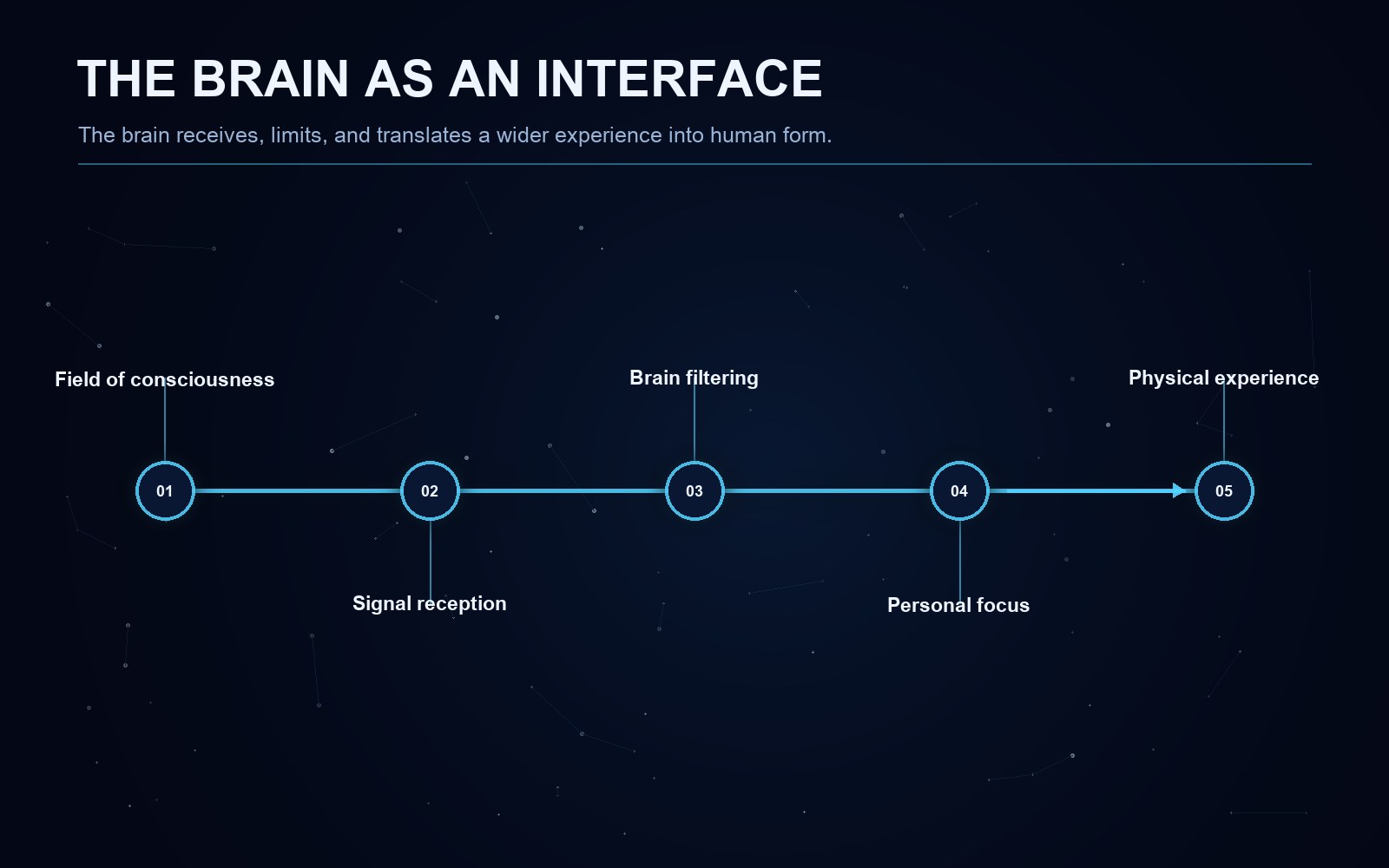
The brain and nervous system provide the working interface with the physical world. The brain receives sensory signals, controls the body, organizes the memories of earthly life, makes predictions, and limits the flow of information to what a person can use here and now.
The model can be represented this way:
Source → soul → Higher Self → earthly personality → brain and body → physical experience.
The arrow does not imply one-way control. Experience moves in both directions. The soul expresses intention through personality and body; physical life returns experience, choices, and new understanding to the soul.
In this model, the brain is not a disposable shell. It is as necessary for incarnation as a musical instrument is for a musician performing within physical space. The quality of the instrument shapes the sound. Damage to it may make expression almost impossible. But the musician and the instrument are not the same thing.
Why We Do Not Constantly Feel Our Greater Nature
If consciousness is broader than the brain, why does a person normally perceive only the physical world and a single biography?
Because the limitation of attention is a condition for fully participating in earthly experience. We could not live one specific life if we simultaneously perceived the entire experience of the soul, multiple levels of reality, and the consequences of every possible choice. Focus creates depth of participation.
The brain sustains this focus. It selects information, maintains a stable model of the world, and returns us to the needs of the body. Most events never reach conscious access because they are not required for immediate action.
But the filter is not completely sealed. During sleep, trance, deep meditation, transitional states, and out-of-body experiences, the brain’s ordinary control changes. At times, a person gains access to information and forms of perception that do not fit the everyday model.
I do not treat every unusual sensation as a message from the soul. The brain can create vivid imagery, distort memory, fill in missing information, and turn expectation into experience. This is why observation, repetition, inner discipline, and a willingness to revise interpretations are necessary. But caution should not become an automatic denial of everything that lies outside the accepted model.
The Limits of Modern Science
Science is one of humanity’s greatest instruments of knowledge. It has taught us to distinguish impressions from measurements, test claims, and correct mistakes. But every instrument has a domain for which it was designed.
Contemporary experimental science is especially strong when a phenomenon can be observed from the outside, repeated, measured, and compared among independent researchers. Consciousness has external expressions, but experience itself is given from the inside. An instrument records brain activity; a person experiences meaning, color, pain, and presence.
This does not place consciousness beyond investigation. It means the method must account for both sides: objective measurement and disciplined description of subjective experience. If one side is dismissed as irrelevant, we may build a detailed science of neural correlations without necessarily building a science of consciousness as lived reality.
The direction of research also depends on which questions society chooses to fund. Grant programs, medical priorities, technological interests, and institutional goals all influence what is studied, by which methods, and for how long. This does not mean all scientists are hiding the truth or following a single agenda. It means the scientific system, like every human system, allocates attention and resources selectively.
Questions that cannot be quickly converted into a technology, treatment, or measurable outcome receive fewer opportunities. Research into consciousness beyond ordinary states is particularly vulnerable: replication is harder, funding is scarce, and reputational risk is greater. The absence of a large body of evidence therefore sometimes tells us not that a phenomenon is impossible, but that few resources have been devoted to investigating it honestly.
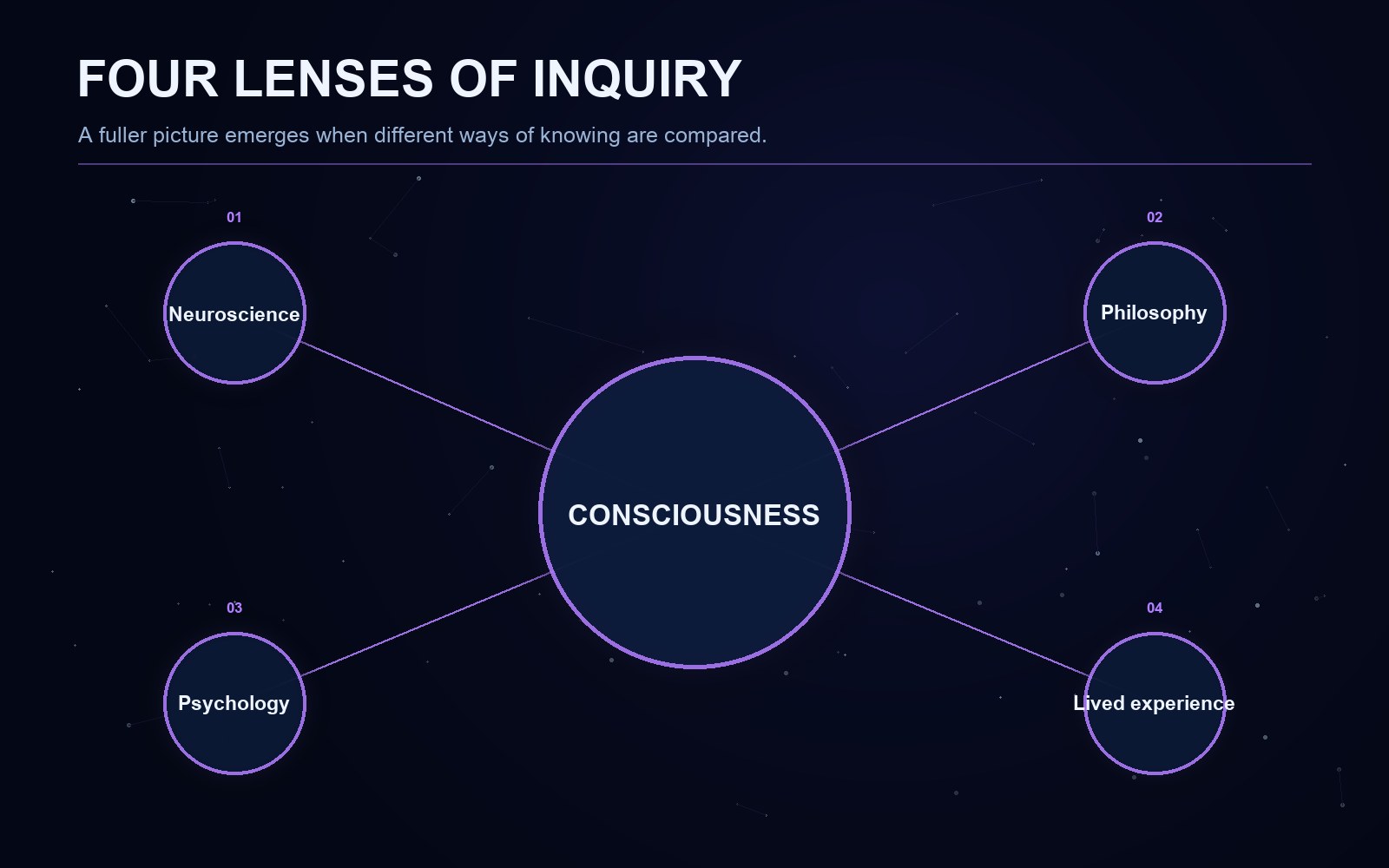
Lived Experience Is Part of the Data
Every study of consciousness begins with a person’s report: “I see,” “I feel,” “I remember,” or “I experienced nothing.” Even in a rigorous laboratory experiment, instruments are compared with the participant’s report. Without that report, researchers cannot determine whether a stimulus was consciously perceived.
Subjective experience can be mistaken. Memory distorts events, expectations influence perception, and language simplifies what was lived. But objective measurements also require interpretation, and theories change as new data arrive. Reliability is improved not by banning inner experience, but by developing better ways to record and compare it.
We need observation journals, clear criteria for distinguishing states, comparisons among independent accounts, physiological measurements, predetermined targets, and studies in which competing explanations are tested against the same evidence. This approach does not promise quick answers. It preserves both the courage of the question and the discipline of inquiry.
For me, personal experience is primary material, not the final authority. I trust recurring observations, but I continue to compare them with other accounts and models. Confidence in one’s understanding does not require closing oneself to new knowledge. Real confidence can withstand examination.
What Changes If Consciousness Is Greater Than the Brain
The nature of consciousness is not an abstract philosophical question. The answer changes how a person relates to life.
If someone sees the self as a temporary biological mechanism, meaning can easily become limited to survival, status, and the short interval between birth and death. If the earthly personality is the expression of a deeper consciousness, every choice becomes part of the soul’s continuing development.
This does not diminish physical life. It gives life greater responsibility. The body matters because we act through it. Relationships matter because they reveal the quality of consciousness. Another person’s pain matters because our separation is not absolute. Freedom matters because experience does not merely happen to us—we participate in creating it.
This understanding offers hope, but it is not an easy consolation. The continuation of consciousness does not release us from the consequences of our decisions. Development cannot be delegated, purchased, or replaced with the correct words. It occurs through choice, attention, honesty, and the willingness to become more aware.
For me, death ceased to mean the proven disappearance of the person. It became a transition whose nature humanity still has to investigate. Fear of the unknown may remain, but it no longer has to govern an entire life.
Investigating the Observer
We are accustomed to searching for answers in the outer world. We build telescopes to witness the birth of galaxies and microscopes to examine a cell. Yet the instrument through which we know all of this remains our greatest unanswered question.
Science demonstrates how closely earthly consciousness is linked to the brain. Philosophy shows that several different pictures of reality can be built from that relationship. Lived experience suggests that the limits of ordinary perception are not necessarily the limits of consciousness itself.
My position is clear: consciousness is primary. It is not a by-product of the brain. Individual consciousness belongs to the soul, the brain is the interface of physical life, and every soul exists within a greater living consciousness that I call the Source.
I remain open to research and willing to refine the language of this model. But twenty years of experience do not allow me to return to the idea that a human being is merely an accidental collection of neural processes. Behind thoughts, emotions, and biography stands an observer. It uses the brain, but it is not exhausted by the brain.
We will not understand consciousness while we study only the mechanism of its expression and avoid asking who is looking through that mechanism.
Continue the Exploration
- What Is Consciousness? The Soul, the Brain, and the Unified Field of Life — a fuller account of my model of the soul, subconsciousness, superconsciousness, and the relationship between individual consciousness and the Source.
- The Phenomenon of Consciousness Beyond the Body — read the English edition of my book.
- Alternative Amazon link for the English edition.
Sources and Further Reading
- David Chalmers. Facing Up to the Problem of Consciousness—the original formulation of the “hard problem” of consciousness.
- Stanislas Dehaene, Michel Kerszberg, and Jean-Pierre Changeux. A Neuronal Model of a Global Workspace in Effortful Cognitive Tasks—an early neuronal model of the global workspace.
- Lucia Melloni et al. Adversarial Testing of Global Neuronal Workspace and Integrated Information Theories of Consciousness—a direct experimental comparison of two influential theories, Nature, 2025.
- Giulio Tononi et al. Integrated Information Theory 3.0—a statement of the central principles of Integrated Information Theory.
- George A. Mashour et al. Conscious Processing and the Global Neuronal Workspace Hypothesis—a modern review of the Global Neuronal Workspace hypothesis.
- Sam Parnia et al. AWAreness During REsuscitation II—a multicenter study of consciousness and memory following cardiac arrest.
- Stanford Encyclopedia of Philosophy: Dualism, Panpsychism, and Idealism—overviews of major philosophical approaches to consciousness and physical reality.
Leave a Reply