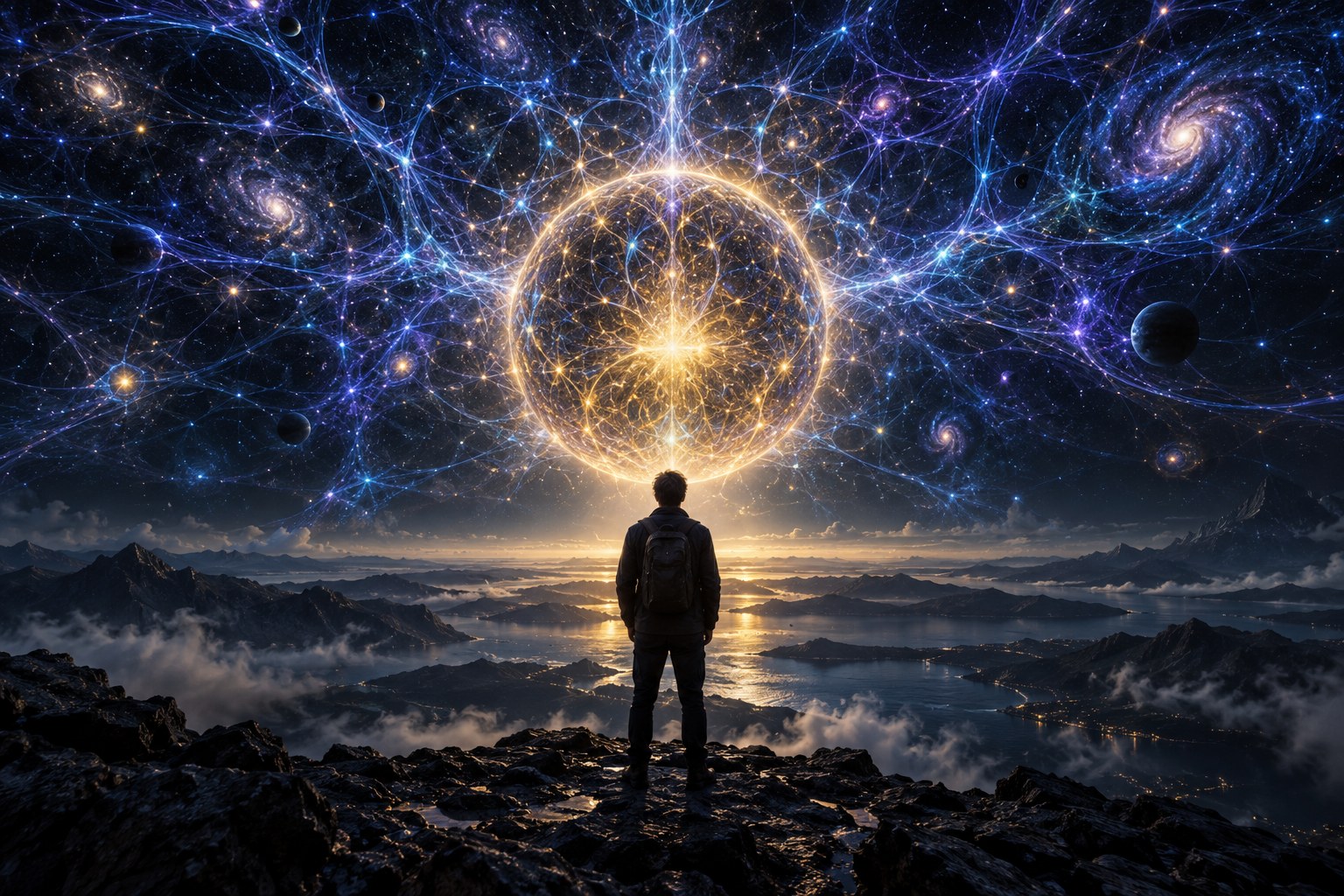
Andrey Chsherbakov’s personal story: early experiences, questions about the nature of matter, his departure from a religious system, and the first conscious experience that turned the study of consciousness into his life’s work.
In the summer of 2006, I returned home after a long drive. I had traveled about five hundred miles, and several days with my family lay ahead. I ate dinner, talked with my family, and lay down on the couch. The children were already asleep, and my wife was reading in another room. My body was tired, but my mind was still moving through the events of the day.
At some point, I felt a powerful vibration and a loud humming inside my head. Then it seemed that I had fallen from the couch onto the floor. I decided to get up and go to the kitchen for a glass of water—and in the next instant, I was already there.
My first thought was: How did I get here? I had no memory of standing up or walking across the room.
It was night outside. No lights were on, yet the kitchen did not seem dark. Everything was clearly visible, as though the objects were illuminated from within. I was still trying to understand whether morning had already come when I began to rise. My body passed through the ceiling, the floors above me, and the roof. I felt a strange vibration, and a moment later I found myself standing on top of an ordinary five-story apartment building.
My consciousness was completely clear. I knew who I was, where my home was, and that only moments earlier I had been lying on the couch. This was not a disjointed stream of images. I observed, thought, made decisions, and tried to test what was happening.
That night, my long search ceased to be only philosophical.
But it had begun much earlier.
An Experience I Did Not Yet Know How to Name
My first unusual experiences began when I was about ten years old. At times, I became aware of myself moving through our apartment. I saw members of my family, passed through walls, and, when I returned to my bed, saw my own body asleep.
These episodes were infrequent and stopped when I was around fifteen. At the time, I regarded them as unusual dreams. I did not search them for hidden symbols or predictions. I still see no reason to turn every dream into a message. Dreams too easily mix memory, emotion, expectation, and fantasy.
But those childhood states had a distinct clarity and a powerful sense of my own presence. I did not analyze them or build theories around them. I had neither the language nor the knowledge to understand what was happening. Their meaning began to reveal itself much later, when I encountered a similar state again as an adult.
Other questions occupied me during childhood as well. I grew up in the Soviet Union and attended an ordinary school. When we asked about the meaning of life, we were given a clear social answer: a person should serve the country, society, and the common good. I did not reject the value of work or responsibility toward others, but I felt that the question went much deeper.
I wanted to understand more than how one should live. I wanted to know what the world we live in actually is.
What Is Reality Made Of?
One day I approached my physics teacher and asked him what matter was. The question surprised him; until then, I had shown little interest in school physics.
He explained that matter is the substance that exists in space and time and makes up everything around us, including ourselves.
Then I asked: What is matter itself made of?
In response, I received a short lecture on the periodic table. I earned a top grade for my curiosity, but I did not receive an answer to my question. I was told which elements make up the objects around us, but I was asking something else: What lies beneath the elements themselves? What is the primary reality from which everything visible arises?
Today, anyone can find hundreds of explanations about atoms, elementary particles, and quantum physics in seconds. In the 1980s, an ordinary schoolchild had neither the internet nor open access to the world’s libraries. It took me about a year to find an answer.
Eventually, I arrived at an idea that made a profound impression on me: matter could be understood as a form in which energy appears.
The idea matched something I had already sensed intuitively. The world around me no longer looked like a collection of separate, solid objects. Beneath familiar forms, I began to perceive a deeper unity. A table, a human body, air, and light could all be different states of the same energy.
But one answer immediately produced new questions.
What is energy itself? Why does it take such complex and ordered forms? Why does life arise? Where does the ability to perceive the world and recognize oneself come from? Is order an accident, or is there intelligence behind it?
I had begun with a question about matter, but I was gradually approaching the question of consciousness.
When I Turned to Religion for Answers
After the collapse of the Soviet Union, the information available to us changed dramatically. In the early 1990s, books that had once been nearly impossible to find began to appear: works on philosophy, religion, esoteric traditions, and different understandings of the soul, life, and death. I read everything I could get my hands on.
At the time, I believed religion might possess the knowledge I was missing. Science described many processes of the material world with extraordinary power, but questions of meaning, the soul, and the source of consciousness remained open. Religion spoke about these subjects with certainty and offered a complete picture.
My search led me to a theological academy. After two years of study, I was ordained and began serving in the church while continuing my education by correspondence. I took my faith seriously, was willing to work hard, and lived according to my faith. Because of this, I advanced quickly within the organization. By the age of twenty-five, I held a senior position in my country’s church leadership.
With that position came access to a side of church life that ordinary parishioners rarely see.
In private conversations, I increasingly noticed that sincerity of faith did not always guide people’s decisions. Money, influence, status, and control were often more important than the spirituality we preached to others. This was deeply unsettling. I had entered the church in search of truth and was prepared to organize my life around it. Now I saw that the system could demand loyalty primarily to itself.
I began to examine the central teachings of my own faith more carefully. I listened to scientists, skeptics, and representatives of other traditions. I asked questions I had once considered almost forbidden. The more honest my search became, the more clearly I saw that I had been living inside a cage of religious fanaticism.
I had been trained to change the thinking of other people, and I had willingly become part of that system. I do not shift the responsibility onto anyone else. At the time, I wanted that life, believed I had chosen the right path, and accepted its rules. But a person also remains responsible for recognizing an error when it finally becomes visible.
When I began asking uncomfortable questions and speaking openly about my doubts, the leadership tried to return me to the accepted boundaries. I was expected to continue repeating the correct words even when my conscience could no longer affirm them.
During my final service, I stood before the congregation and suddenly understood with complete clarity: I could no longer say what I did not believe.
I left before the service ended and never returned.
The decision was not easy. I lost my familiar position, my community, and a ready-made picture of the world. But I regained the right to think for myself. Leaving religion did not end my search. It set the search free.
Life Without a Ready-Made System of Answers
After I left, a different life began. I had to support my family, find my place in the world, and learn to make decisions without the backing of a large organization. I met many people who had no interest in the questions that had occupied me since childhood. They did not understand why anyone would spend time thinking about the nature of matter, consciousness, or the meaning of life when practical problems were everywhere.
To a degree, I understood them. Everyday life demands time, money, and attention. But the question inside me never disappeared.
By 2003, I had begun to think that I might never find an answer. I had passed through a religious system, read many books, and listened to many explanations, yet none of them gave me a coherent picture. I wanted to stop struggling, abandon the search, and simply live as everyone else seemed to live.
I now understand that those years were not wasted. I needed to pass through other people’s systems of knowledge, believe in them, become disappointed, and find myself without external support. Only then was I prepared to investigate the unknown for myself.
The next turning point began with an event that seemed to have nothing to do with consciousness.
The Accident and My Fear of Falling Asleep at the Wheel
In 2003, I was involved in a car accident. I escaped serious injury and suffered only bruises and cuts. But afterward, I developed an intense fear of losing control of the car again, falling asleep at the wheel, and causing another crash.
At the time, I worked far from home. About once every two weeks, I drove roughly five hundred miles to see my family. The trip took nine or ten hours. Giving up the car was difficult, but drowsiness had become a real problem.
First, I tried energy drinks. They disrupted my sleep and left a fog in my head. Then I tried sports supplements that promised alertness. Their effect was brief and unpleasant: I alternated between feeling overheated and chilled. I stopped, moved around, sang, and constantly chewed something, but none of it helped for long.
During one trip, I began experimenting with my breathing. I had no training and knew nothing about breathwork. I was simply trying to become alert and stay awake. One combination produced an unexpectedly powerful effect. After about ten minutes, the drowsiness disappeared, the road became extraordinarily clear, and my attention sharpened.
I repeated the breathing whenever I felt tired. But along with alertness came changes I had not expected.
The world became brighter, though the change had nothing to do with sunlight. Space seemed transparent, as though it were glowing from within. Sometimes I felt as if I could see through two sets of eyes. One part of my attention continued watching the road while another simultaneously perceived unfamiliar places, people, and events. The two streams did not merge, yet both belonged to me.
My memory changed as well. I could reconstruct almost any scene from my life with surprising ease. At the same time, unfamiliar places, smells, people, and emotions appeared—none of them connected to my ordinary biography.
I need to state this plainly: experimenting in this way while driving was dangerous. I describe it as part of my history, not as a method anyone should repeat. At the time, I did not yet understand the nature of the state and was learning through my own mistakes.
Over the next several months, I became more familiar with this mode of perception. I learned to sustain it longer and to direct my attention instead of simply following random images. It seemed that consciousness could maintain several independent points of perception at once.
Then I saw something I remember to this day.
The Golden Sphere
During one of those long trips, I again began to feel drowsy and changed my breathing almost automatically. My consciousness divided. One part continued to perceive the road; the other stood before a scene unlike anything on Earth.
Before me was an immense, radiant sphere. It resembled the Sun, but it was so vast that I could not see its boundaries. Tiny droplets formed on its surface, separated from it, and traveled outward along streams of light. It looked like golden rain dispersing in every direction.
I felt wonder, recognition, and shock at the same time. The magnitude of what I saw could not be contained in ordinary language. The road demanded my attention, and the vision disappeared, but the impression remained with me for the rest of the drive.
Several weeks later, the scene returned. Again I saw the enormous golden sphere and billions of droplets moving away along rays of light. This time, the experience was even more powerful. I felt that what I was seeing was directly connected to me, though I did not yet understand how.
In my mind, I asked, “What is this?”
The answer came from within, clear and calm:
“This is the place where you came into being.”
Tears rose in my eyes, and I pulled over.
In that moment, I was certain that I had not been shown a random fantasy. I had touched a part of reality whose meaning I would have to learn gradually.
I did not immediately turn the experience into a finished cosmology. In the years that followed, I returned to the image of the golden sphere many times, compared it with other experiences, and gradually developed my own understanding of the soul, energy, and the unified field of life. But at that moment, something more immediate mattered: the search had come alive again. I understood that answers could come from more than books and other people’s teachings. Consciousness itself could become an instrument of investigation.
The Night on the Roof
About a year after these unusual states began, I had learned to direct the second stream of perception to some degree. I tried to reproduce it at home in a quiet setting, but nothing happened. Apparently, the long hours on the road, fatigue, and continuous motion created a threshold state that I did not yet know how to enter in any other way.
Several powerful experiences occurred during the drive on that summer day in 2006. But the most important event happened after I returned home and lay down on the couch to rest.
Standing on the roof, I first tried to understand what was happening to me. The most obvious explanation was that I might be dreaming. But the state was unlike any dream I had known. My thinking remained clear, the environment was stable, and my actions followed my decisions.
I considered whether I was in a trance, but this experience also differed from the trance states I had known. Before, there had been two streams of perception: physical reality and a second vision. Now there was no division. I was entirely there, on the roof, aware of myself as one undivided being.
My next thought was frightening: Was I experiencing a serious psychological breakdown? But I was able to stop the fear and focus on testing the experience.
I had heard stories about people flying in similar states. I had never been able to fly in ordinary dreams. I decided to perform a simple experiment: choose a distant point and deliberately try to move toward it.
I did not jump from the edge of the roof. Even within this extraordinary experience, I allowed for the possibility that I might be mistaken and might somehow be physically standing there. Falling from a five-story building would have been too high a price for a test.
Instead, I focused on a distant point. Before I had fully formed the command, I felt myself move.
I flew.
Houses and streetlights passed beneath me. Everything was visible with extraordinary clarity. I moved wherever I directed my attention. Then an overwhelming excitement seized me. I never reached the point I had chosen; the emotion brought me back instantly.
I was lying on the couch again.
The entire experience lasted no more than five minutes—from the sensation of falling off the couch to my return to the body. Yet those five minutes changed my life more profoundly than years of reading and debate.
For another half hour, I remained still and reconstructed the sequence in detail. I did not want to lose anything: the kitchen, the strange nighttime light, the ceiling, the roof, the tests of my own condition, the decision to move, and the flight itself.
The next morning, I knew I had to investigate this phenomenon.
Why I Refused to Accept Ready-Made Answers
I found the books available to me and spent the next month reading everything I could gather about out-of-body experience. Very quickly, I encountered a familiar problem. The authors contradicted one another. Some turned the subject into a mystical ritual. Others constructed elaborate systems without explaining how they had obtained their knowledge. Many described one part of the phenomenon and presented it as the whole.
I had already followed a path on which someone else’s system first promised final answers and then demanded that I trust it more than my own conscience. I had no intention of repeating that mistake.
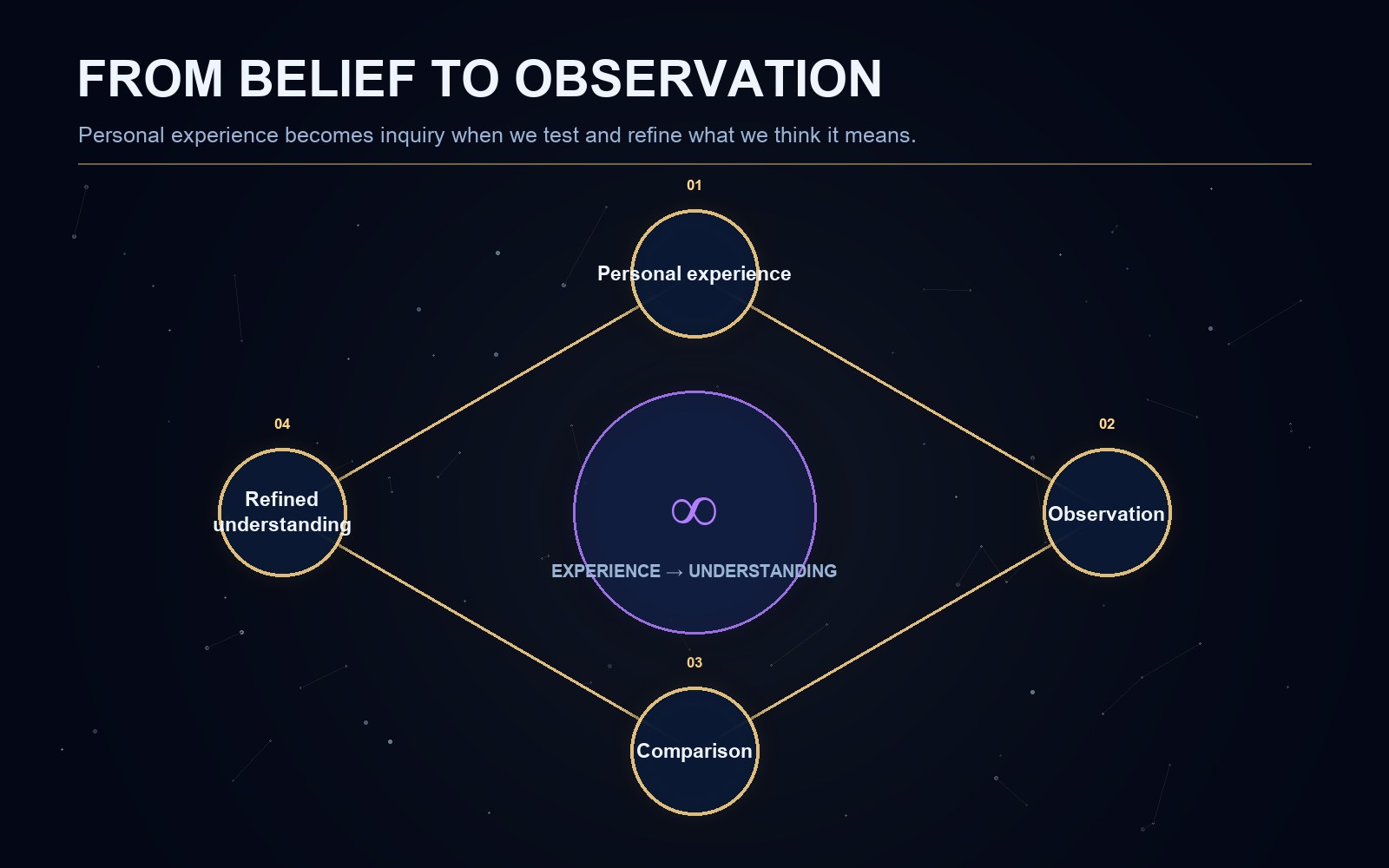
I made a decision: no book would become my final authority. I would take from available sources only what helped me begin a practical investigation. From there, I would observe for myself. I would learn to maintain clarity, repeat the experience, compare states, test my own memory, and gradually distinguish direct perception from the interpretation that followed it.
That was the beginning of the investigation to which I devoted the next twenty years.
My explanations changed. Some of my early conclusions proved too simple. I learned to recognize the influence of expectation, emotion, and familiar ideas. But the experience itself continued to recur, deepened, and opened new questions.
I could no longer regard consciousness as a byproduct of the physical body. For me, it had become an independent reality—capable of perceiving, acting, preserving memory, and existing beyond the ordinary bodily point of view.
Why I Am Telling This Story Today
I describe my path because I do not want to replace one system of belief with another. I know too well what happens when a person gives someone else the right to define truth on his behalf.
I do not ask readers to treat my experience as their own. But I insist on the right to speak about it directly and investigate it seriously.
My path led through a Soviet school, an independent search for knowledge, religious faith, a senior position within a church system, disillusionment, departure, years of ordinary life, and experiences that shattered my former boundaries of the possible. None of these stages was unnecessary. Each helped me release another ready-made answer and move closer to independent observation.
Today, I see the greatest value of studying consciousness not in unusual abilities, but in inner freedom. A person who learns to observe, ask questions, and take responsibility for his own conclusions becomes less dependent on someone else’s fear, authority, or control.
That is why this research platform exists. Here, I will share more than dramatic experiences. I will describe how my understanding changed, where I was mistaken, which patterns repeated, and how personal experience relates to philosophy, research, and the testimony of others.
I began by asking what matter is made of. That question eventually led me to investigate the one who perceives matter.
And the investigation continues.
Go Deeper
This article tells only the beginning of my journey. In The Phenomenon of Consciousness Outside the Body, I explore my out-of-body experiences, the development of my understanding of consciousness, and the conclusions that emerged from twenty years of investigation.
Continue with the book on Amazon: Kindle Edition or Paperback.
Leave a Reply