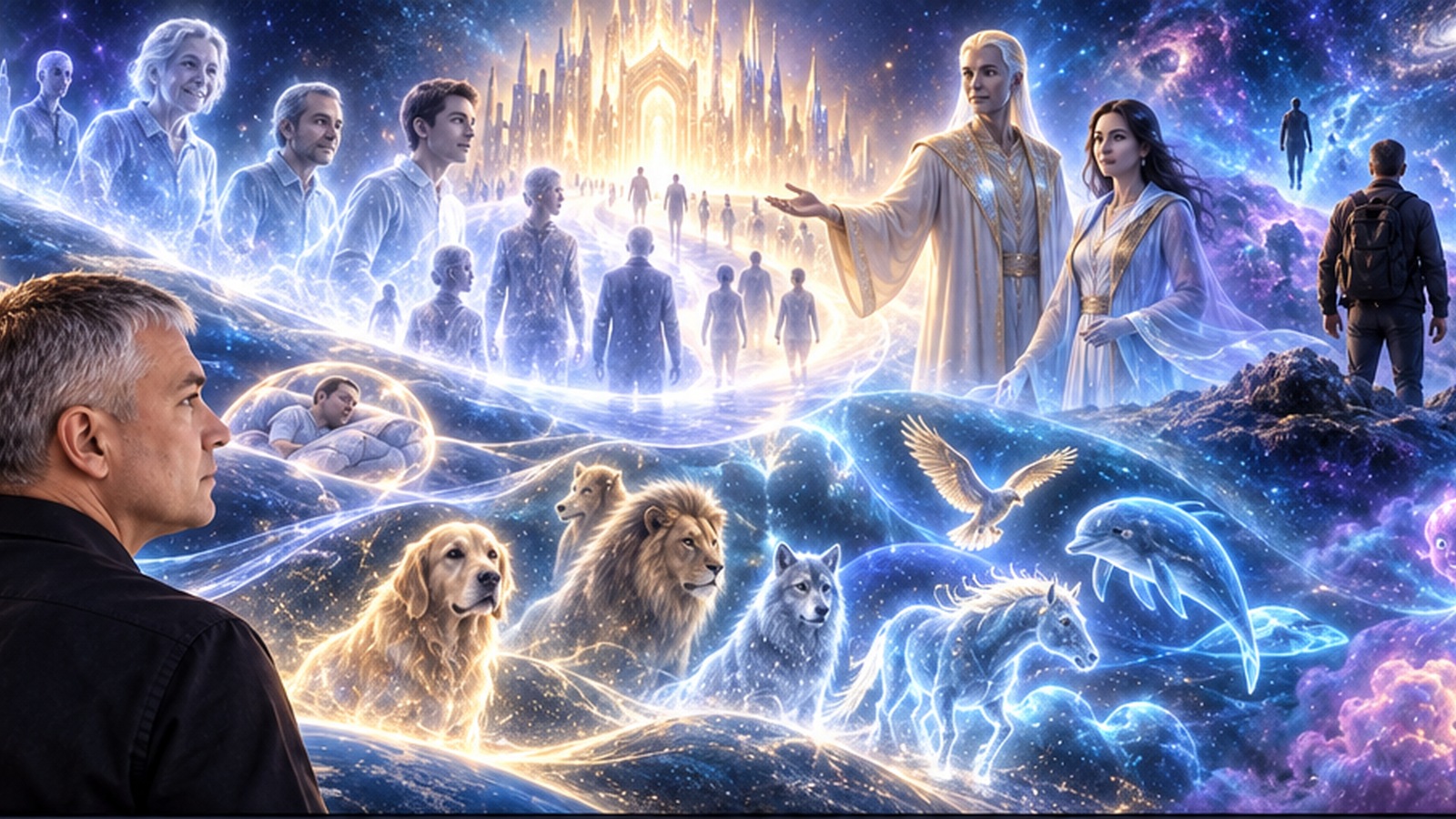
Nonphysical reality is not an empty space created only for individual journeys. During years of practice, I have met living people, the deceased, representatives of other worlds, guides, and many images that appeared alive but possessed no independent consciousness.
The central difficulty is not the encounter itself. It is understanding whom—or what—we encountered.
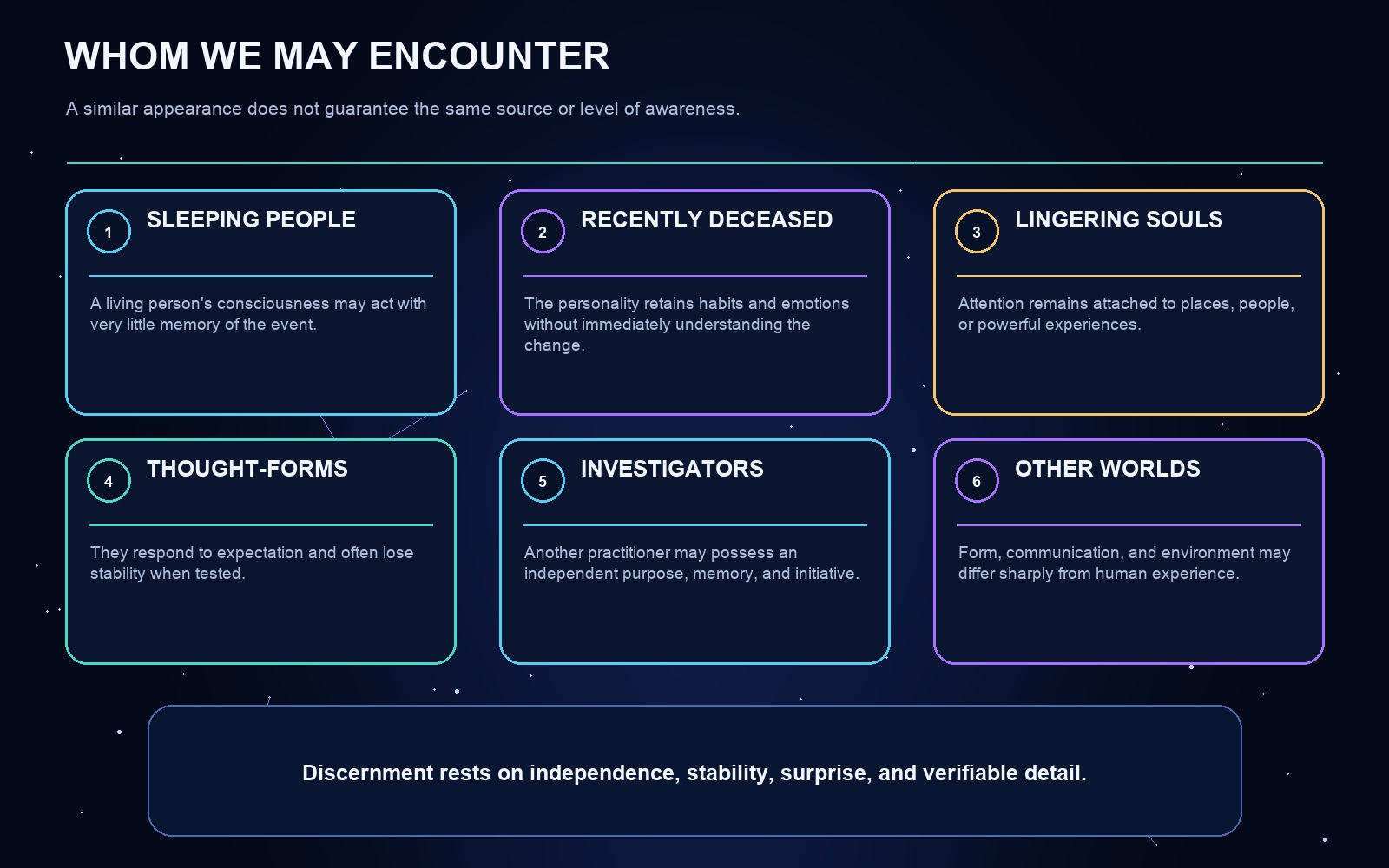
Sleeping people
On the second energy level, we may see a sleeping person beside the physical body or inside a scenario the person has created. Images of dreams, memories, fears, and fantasies unfold around him.
Contact with a person in this condition is rarely meaningful. He may fail to notice the visitor, answer incoherently, or disappear instantly when attention returns to the body. The earthly personality usually remembers nothing after waking.
This does not mean that consciousness is absent. It is simply operating with a very low degree of awareness.
The recently deceased
After death, a soul may remain for a time in the realm closest to the physical world. An encounter with someone who died recently often preserves familiar traits: appearance, manner of speaking, and emotional connection.
The soul's memory, however, may still be incomplete. That person is also making sense of what happened and may not be able to explain how reality is organized.
Death does not turn the personality into an all-knowing teacher.

Souls that remain close to the physical world
Some of the deceased do not accept the change in their condition for a long time. They continue to repeat familiar actions, worry, and try to solve earthly problems. Their experience resembles a difficult dream.
I do not regard them as “evil entities.” They are more often confused souls who are offered help but are not immediately prepared to accept it.
We should keep a boundary during such contact. Compassion does not require us to carry another being's fear.
Tricksters and false teachers
Some consciousnesses deliberately adopt an impressive appearance and introduce themselves as a famous teacher, an extraterrestrial, or a higher being. They may deliver a mixture of truth, fantasy, and deliberate play.
Beautiful form and spiritual language do not verify identity. On the second level, form is easily changed, and any name can be claimed.
If a contact demands worship, uses fear, promises special status, or forbids verification, I treat it as unreliable regardless of the status it claims.
Other practitioners
A conscious meeting between two living people outside the body is possible, but rare. Most people either remain within the domain of their own dreams or retain no memory after returning.
The main criterion for such a meeting is an independent match of specific details in the two participants' reports. Until both people record the experience separately, conversation about a shared event can easily alter memory.
Animals and plants
Pets can sometimes be seen near their human companions. Plants on the second level preserve an energetic reflection that may continue to exist even after physical destruction.
I have observed that a living being leaves a more complex trace than an ordinary object. It includes not only form, but an emotional condition.
This is one reason I do not see nature as a lifeless background to the human story.
Representatives of other worlds
On the second energy level, I have met beings that did not belong to the human world. Some observed, some avoided contact, and others possessed technology or an ability to conceal their presence.
They cannot all be placed in a single category of “advanced and benevolent beings.” Technological development does not guarantee moral maturity. Like human cultures, different civilizations may have different goals and different attitudes toward the freedom of others.
Inhabitants of higher levels
Guides and souls from the third level appear differently. Their presence is usually accompanied by clarity, inner recognition, and an absence of pressure. They do not try to impress through outward form and do not demand obedience.
Even here, I do not advise treating the first interpretation as final. The brain translates contact into familiar images and can give a recognizable face to something that did not originally have human form.
Thought-forms
The largest category of apparent “inhabitants” has no independent consciousness. These are images created by memory, expectation, fear, or the collective stream of thought.
A thought-form can speak and act convincingly because the mind itself is generating the scenario. It may seem alive until the investigator asks an unexpected question, changes the direction of the contact, or tests the stability of the image.
How I distinguish among sources
I look not for spectacle, but for signs of independence:
- Does the other being provide unexpected information?
- Does it preserve an intention of its own?
- Can it refuse or disagree?
- Does it remain stable when my attention changes?
- Is anything confirmed after I return?
- Does the contact recur in independent experiences?
No single sign offers an absolute guarantee. Together, however, they help distinguish an encounter from an internal production.
Not everything seen should become a cosmology
Nonphysical realms are inhabited more diversely than we are accustomed to imagine. Yet one contact reveals only a small fragment of reality.
I speak confidently about my encounters because I have experienced them many times. I continue, however, to test my explanations. Seeing a being is a fact of the experience. Understanding its origin and intentions is a separate task of investigation.
Detailed descriptions of the inhabitants of the second and third energy levels appear in The Phenomenon of Consciousness Beyond the Body.
Leave a Reply