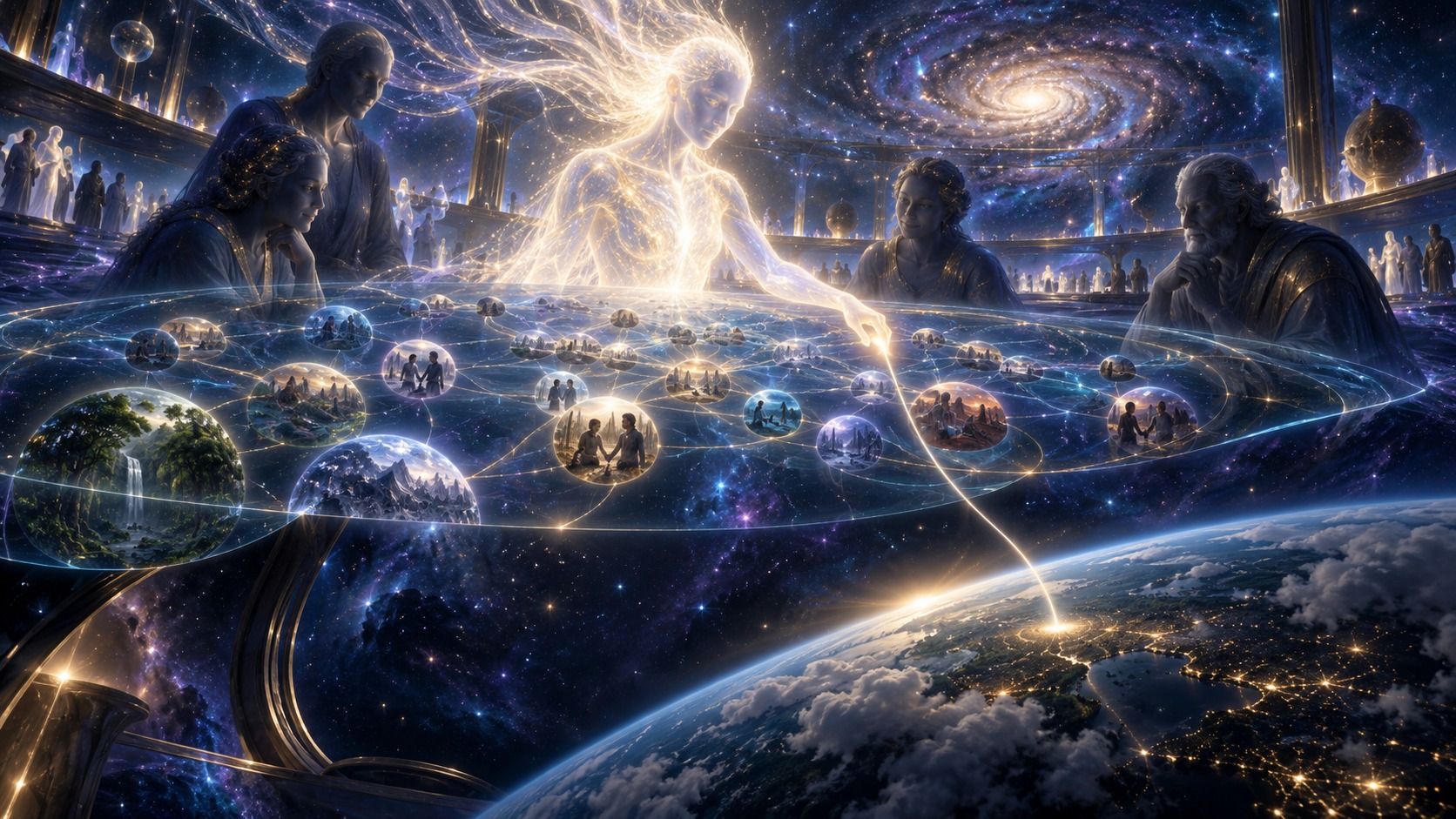
Birth appears to us to be the beginning of a person. We watch the body form, a child enter the world, and a personality gradually take shape. But if consciousness exists before physical life, then birth is preceded by another process: the soul’s preparation for incarnation.
In my understanding, the soul does not fall into a body by accident or suddenly awaken at the moment of birth. Preparation unfolds in stages: reviewing previous experience, learning, coordinating with the soul group, choosing the conditions of a new path, directing part of consciousness toward incarnation, and gradually connecting with the developing organism.
This is not like completing an earthly application or writing a detailed script for a future life. The soul prepares a setting for experience that cannot be gained while remaining in the world of the soul.
Returning home after a completed life
Between incarnations, the soul exists at the third energy level—the realm I call its home. After physical death, it reunites with its larger self and regains access to a broader field of memory.
The completed life must first be understood. The soul sees not only the events but also their consequences: how its decisions affected other people, which qualities it developed, where it acted automatically, and which questions remain unresolved.
This is not a trial in which someone else delivers a verdict. The soul itself perceives the life more completely than it could while embodied. Self-deception becomes harder because it sees the entire system of relationships and motives rather than one isolated scene.
A period of recovery, connection, and learning follows. In the world of the soul, there is no need to leave immediately for another life.
Preparation does not happen in isolation
The soul is connected with its soul group—those with whom it has shared many incarnations. Together with teachers, the group considers the experience it has accumulated and possible directions for further development.
My book describes a place where souls arrive as a group or individually to examine possibilities and coordinate roles. Human language makes this sound like a meeting, but the actual perception is far more expansive. Information may be received as a whole, together with an understanding of possible relationships, difficulties, and purposes.
Roles are neither rewards nor punishments. A person’s earthly position says nothing about the value of the soul. Wealth, fame, and power do not make an incarnation more successful, and a modest life does not indicate a lower level of development.
What matters is the quality of the experience and what the soul can unfold through it.
Choosing a world and a form of life
Incarnation is not limited to Earth or to a human body. In my view of reality, there are different worlds, levels of density, and forms of life. The soul chooses an environment suited to the experience it needs and to its readiness.
A dense physical world imposes strict limits. Matter changes slowly here, the length of life is limited, and memory of our immortal nature is almost entirely closed. That is precisely why earthly experience is so intense.
Other worlds may operate according to different laws, and embodied beings there may retain more memory and exert a stronger influence on the energy around them. Greater possibilities, however, require a different level of maturity.
The form of life is also chosen for experience rather than prestige. Human incarnation is only one possibility within the enormous diversity of the Universe.
Why the entire soul does not enter the body
According to the information I have received through my research, only part of the soul’s energy connects with the body during a human incarnation. In my book, I describe it as a small percentage of the whole—most often about five to ten percent, and no more than twenty percent.
These figures cannot be measured with a physical instrument, so I use them as a model of proportion rather than a laboratory measurement. The central point is that the earthly personality carries a real part of the soul, but not its full scope.
If the full power and memory of consciousness entered a dense body, the balance of the experience would be disrupted. A person would be able to influence physical experience too easily, and the new personality would not develop its own independence.
The larger part of the soul remains in the soul’s world and maintains an unbroken connection with the incarnated part. This is what we may perceive as the Higher Self.
Lowering frequency and approaching matter
To connect with a physical organism, the soul must bring its qualities closer to dense reality. I describe this as lowering the vibrational frequency of its energy. I am not referring to sound or to a reading from an ordinary instrument. I mean a change of state that enables consciousness to interact with matter.
This is a gradual process. The soul does not suddenly become trapped inside a completed body. It directs part of its attention toward the future incarnation and begins building a connection with the organism.
The part of the soul that remains outside the body does not disappear or continue an unrelated life as if no incarnation were taking place. It stays focused on its earthly part, maintains continuous connection, and receives the experience flowing from it.
When the connection with the body begins
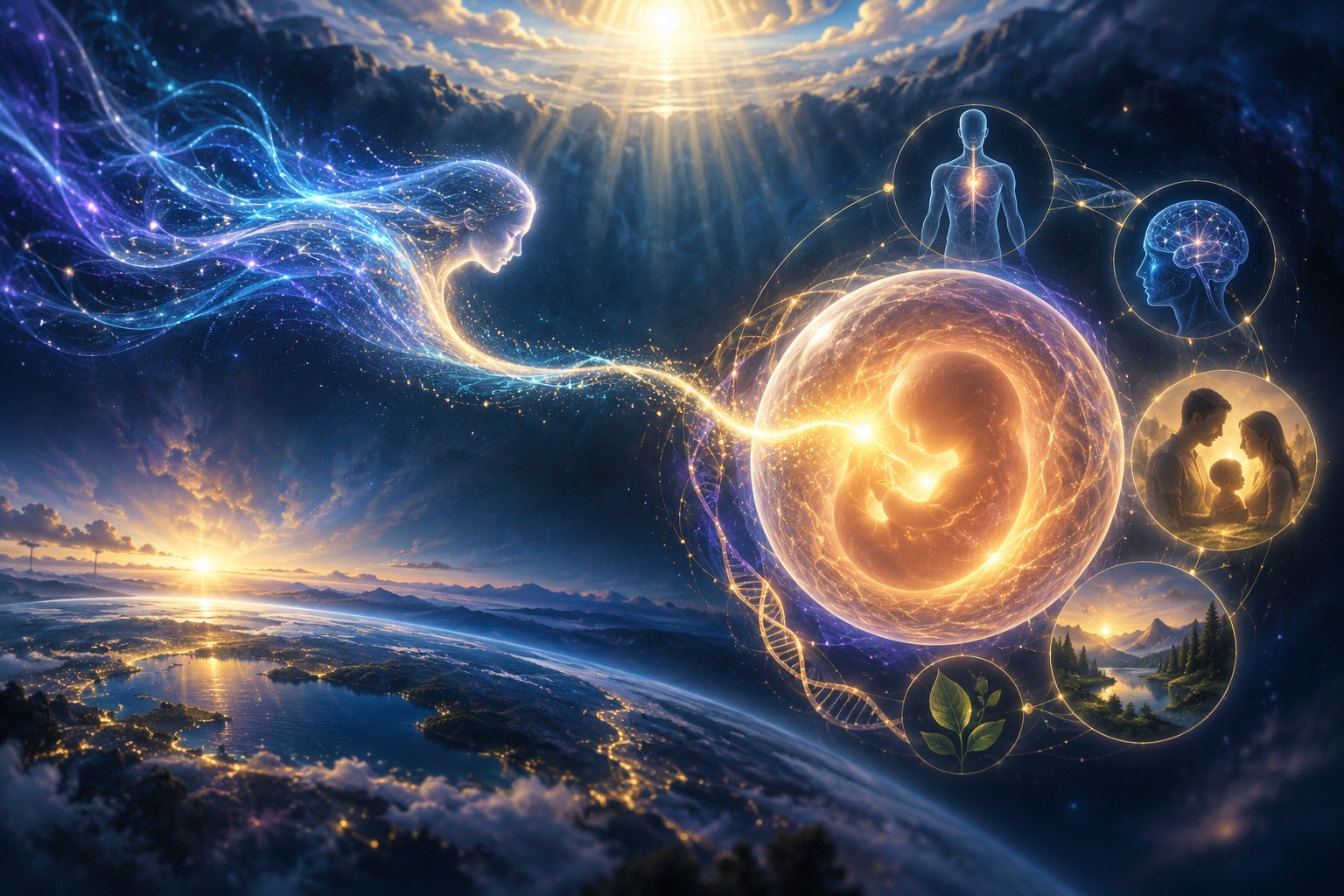
In my book, I wrote that the active connection begins as the embryo’s nervous system and brain develop. Before birth, the bond strengthens gradually. During the earlier stages, consciousness may move away from the organism more easily; as birth approaches, its presence becomes more stable.
This does not mean that life has no value before the nervous system develops. The forming organism is already a living system and part of a broader collective consciousness. I am speaking specifically about the gradual formation of an individual union between soul and body.
The process does not end at birth. The child learns to use the senses, movement, language, and interaction with the world. The soul learns to express itself through a particular brain and the body’s individual character, while the body becomes accustomed to the influence of consciousness.
A new personality is created
Incarnation is not an old personality changing into a new body. The meeting of part of the soul, a new organism, and a new environment gives rise to a person who did not exist before.
That person carries the soul’s accumulated qualities while also having an individual character, family history, culture, and capacity to choose. Two lives of the same soul are therefore never copies. Even when certain themes repeat, the experience is always unique.
This is the purpose of temporarily limiting access to memory. The new personality must truly enter the world rather than continually viewing it through the eyes of previous incarnations.
What the soul prepares
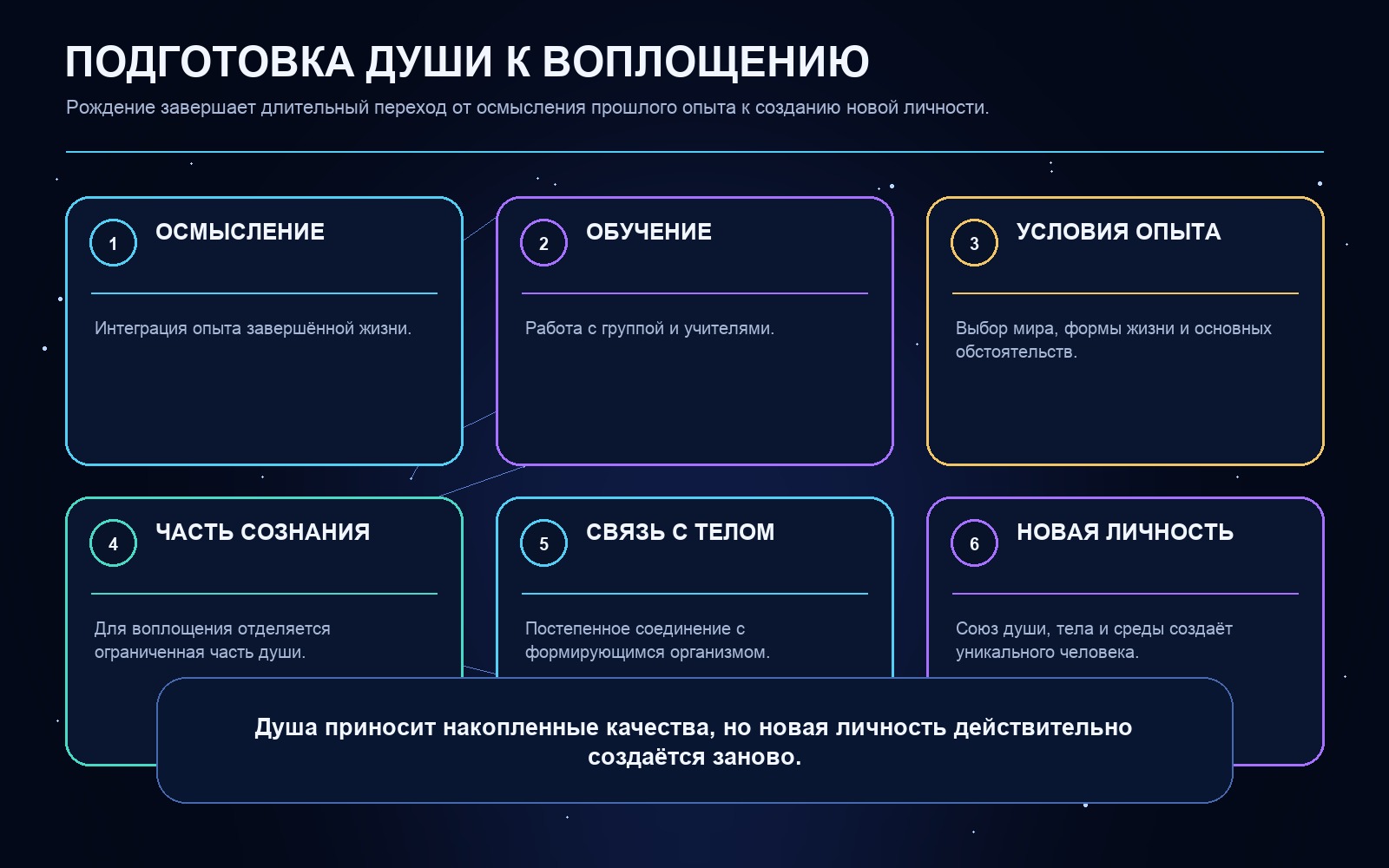
Preparation for incarnation involves several connected processes:
- Reviewing the experience of the completed life.
- Restoring memory and connection with the larger soul.
- Learning and working with teachers.
- Coordinating interactions with the soul group.
- Choosing a world, a form of life, and the basic conditions of experience.
- Directing part of consciousness toward incarnation.
- Gradually connecting with the developing body.
This does not mean that every ordinary detail of a future life is fixed in advance. The relationship among a life plan, circumstances, and human decisions deserves a separate discussion. The central point here is that the soul enters life prepared and remains connected with a wider level of itself.
Birth is a transition, not an absolute beginning
Before birth, we were not nothing. The soul already had a history, kindred relationships, accumulated qualities, and an understanding of the reasons for a new incarnation. But as it connects with the body, it limits access to that memory and begins building a new personality.
A human being is therefore both new and ancient. The earthly biography begins at birth, but consciousness brings into it the experience of a much longer journey.
We may not remember preparing for incarnation, yet traces of that preparation appear in our deeper qualities, our inner direction, and our ability to sense a connection with something larger than one physical life.
Birth does not create the soul. It opens a new way for the soul to exist within reality.
For a fuller account of the soul’s world, preparation for incarnation, and the connection between consciousness and the body, see my book The Phenomenon of Consciousness Beyond the Body.
Read the English edition on Amazon →
Additional English edition on Amazon
Leave a Reply