
If consciousness can truly perceive the world outside the physical body, it should sometimes obtain information that the person did not know beforehand. This is one of the central questions of the entire practice.
My answer is yes: such information is possible. I have encountered unexpected details, meetings, and knowledge that were confirmed later. Yet obtaining an objective result is far more difficult than having a vivid separation from the body.
Most experiences pass through the mental layer, expectations, and limitations of memory. Verifiable information therefore requires special conditions and rigorous honesty.
What “objective information” means
I do not use the term for information that sounds wise or produces strong emotion. I mean a specific fact that:
- was not known to the practitioner before the experience;
- existed independently of his wishes;
- was recorded before verification;
- can be confirmed by another person or a physical source;
- is described precisely enough to prevent free interpretation.
“I sensed an important energy” cannot be checked. A description of an unfamiliar object selected at random and hidden from the practitioner can be compared with the target.

Why the familiar number experiment is so difficult
A common proposal is to place a random number on top of a cabinet and ask the practitioner to read it outside the body. The idea appears simple, but it contains several separate tasks.
First, the person must produce a controlled separation during the required period. Then consciousness must remain near the physical body rather than move elsewhere. The practitioner must avoid the mental layer, remember the purpose, find the object, perceive the symbols accurately, remember them, and transfer that memory to the brain upon returning.
An error at any stage destroys the result. This does not prove that perception outside the body is impossible. It shows that the method must account for the nature of the state.
Main sources of error
Instability of separation. Even an experienced practitioner cannot always separate on schedule.
Arrival at the wrong target. After separation, consciousness may appear in another location or on another level.
Mental substitution. The expectation of a number generates its own symbols.
Change of interest. Without the ordinary influence of the physical brain, a task that seemed important beforehand may suddenly seem insignificant and be forgotten.
The behavior of text. Letters and numbers in a nonphysical state often change when viewed a second time.
Memory loss on return. An accurate perception may fail to become established in the brain’s memory.
Chance correspondence. The vaguer the description, the easier it is to find a similar fact.
Which tasks work better
The method should adapt to the nature of the experience instead of demanding that consciousness behave like a physical camera.
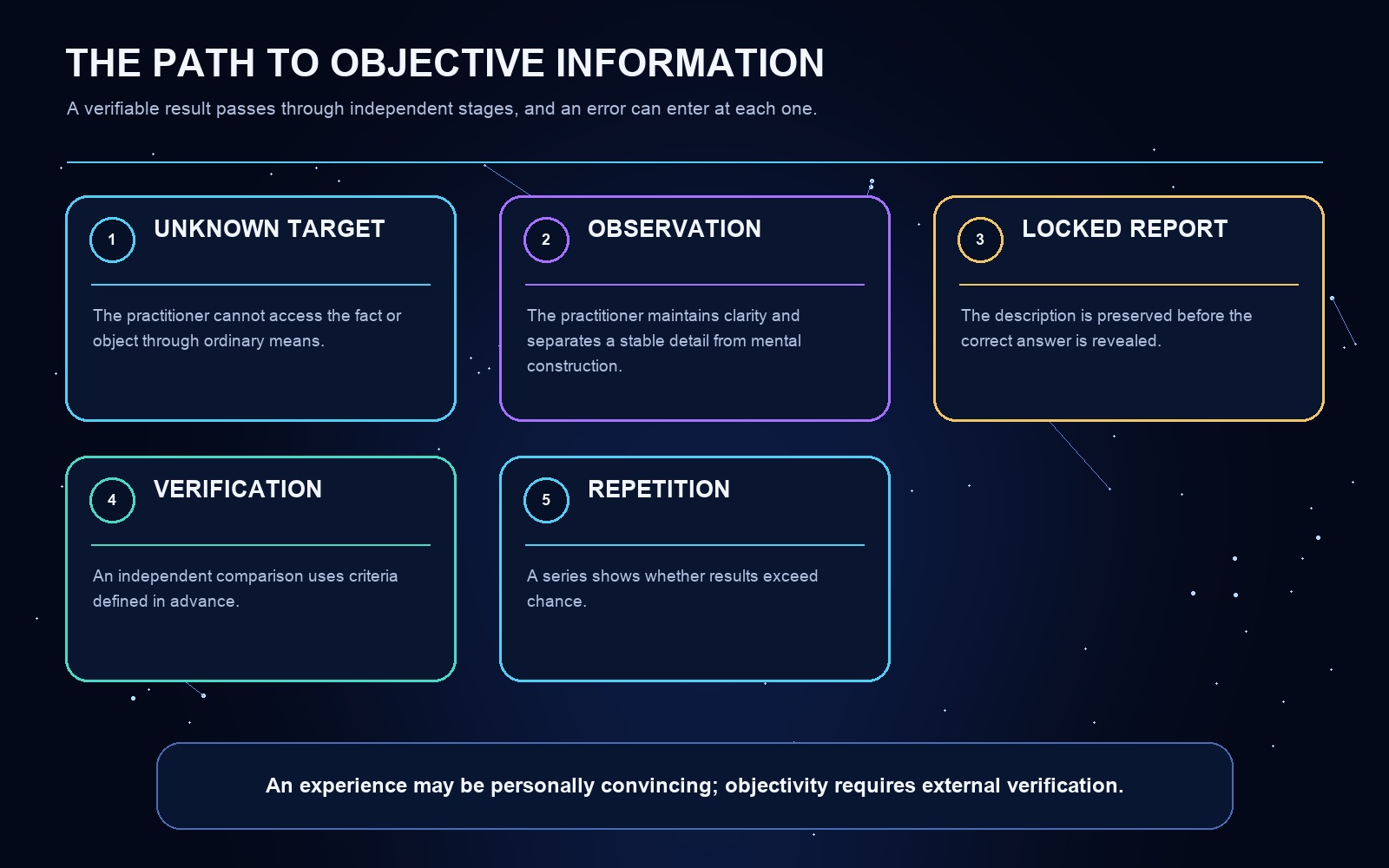
The practitioner should work at home in familiar, calm surroundings. The experiment should not require success on a particular night. The target should be simple and emotionally neutral. Its selection must be concealed, and the report must be recorded before the answer is revealed.
Instead of one number, use a set of substantially different images or objects. The assessment can then compare shape, color, function, and composition rather than depend on literal reading.
A series of attempts matters more than one success or failure.
Information from encountered beings
Verifiable information may come from another consciousness rather than from observing an object.
The standards should be even stricter in this case. Separate the being’s words from personal interpretation, record the exact message, and verify the fact independently.
If a message cannot be checked, it may still be valuable as personal guidance, but it does not become objective knowledge for other people.
How to handle a partial match
A result is rarely photographic. A practitioner may describe the overall image correctly while missing some details. It is essential not to select agreements after the correct target is already known.
Criteria should be defined before evaluation: Which properties count as a match? How many alternatives are available? Who will compare the descriptions? Ideally, an independent judge who does not know the target performs the comparison.
The result then depends less on the participant’s enthusiasm.
Why a negative result is also useful
Failure reveals the limits of a method. The practitioner may have entered a mental layer, chosen an unsuitable target, lost the memory, or used a kind of information that is difficult to perceive.
If every attempt is recorded honestly, not only the successes, a map of conditions gradually emerges: when accuracy improves, which errors recur, and which kind of task works best.
Investigation begins when a person stops hiding unsuccessful results.
The possibility is real, but the standard must change
Objective information during an out-of-body experience is possible. It cannot be demonstrated by the persuasiveness of a story alone. A specific target, a record made in advance, independent verification, and repeated trials are necessary.
I am convinced of the reality of consciousness beyond the body because of the totality of twenty years of experience. If we want to take the next step and communicate that knowledge to society, however, experiences are not enough. We need methods that distinguish an external fact from the power of our own mind.
You can read more about the obstacles to objective verification and the special features of perception beyond the body in my book The Phenomenon of Consciousness Beyond the Body.
Continue with the book on Amazon: Kindle Edition or Paperback.
Leave a Reply