
An investigator wants to see reality as it is. Yet before an experience begins, he already has a purpose, knowledge, fears, and an idea of the possible result.
Can that influence be eliminated entirely? I do not think so. As long as perception passes through the earthly personality and the brain, the observer remains part of the observation.
This does not make objectivity impossible. We can reduce the influence of expectation, notice when it intervenes, and build a method of verification in which personal desire does not determine the result.
Expectation begins before the experience
If someone decides in advance that he will meet a guide, he has already formed an image of the meeting. If he wants to prove that out-of-body experience is real, he will notice agreements more readily. If he is certain that everything is fantasy, he may dismiss even unexpected, verifiable information.
Bias works in both directions. Belief and denial are equally capable of obstructing observation.
Honesty therefore begins not with the claim “I have no expectations,” but with listing them.

Intention and expectation are different
Without intention, practice becomes chaotic. An investigator needs a purpose: visit a place, meet a person, examine an object, or obtain information.
Expectation paints the result in advance: the place should look a certain way, the person should say particular words, or a particular object should be behind the door.
Intention provides direction. Expectation replaces observation with a ready-made picture.
We can know clearly what we want to examine without deciding in advance what we must see.
Why “do not think about it” is not enough
The brain does not turn off on command. Trying not to think of a red ball keeps attention fixed on the red ball. Fear and expectation work the same way during an out-of-body experience.
It is more effective to recognize the thought than to fight it: “I expect to see this. Therefore, this image by itself will not count as evidence.”
Once named, an expectation loses some of its hidden power.
A protocol before the experience
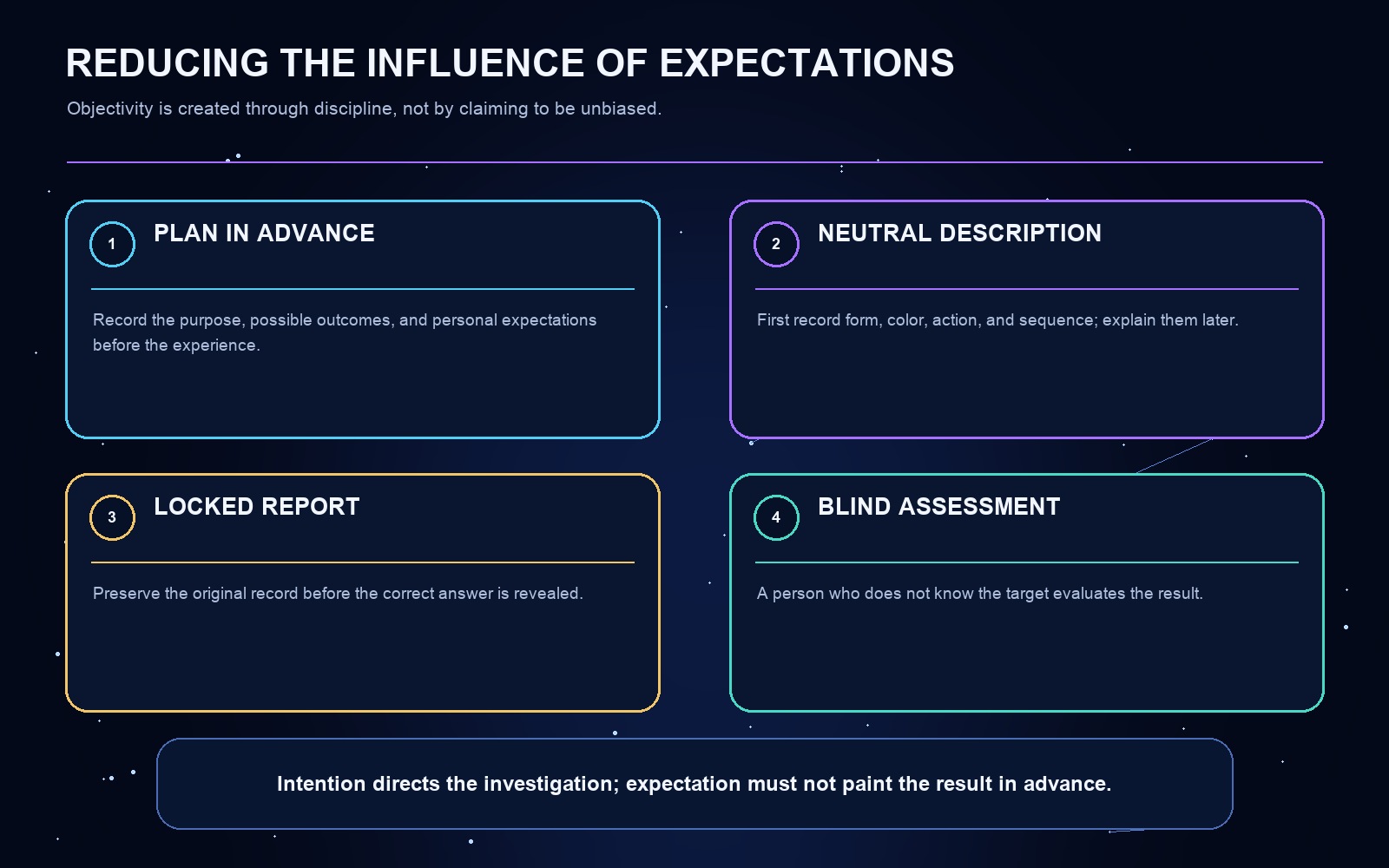
To reduce distortion, record the plan in advance.
- What exactly am I going to observe?
- Which results do I consider possible?
- Which result do I especially want—or fear?
- What can be checked in physical reality?
- Which signs would indicate that the environment has become mental?
A written plan prevents us from quietly changing the original purpose later to match the outcome.
Description before explanation
After returning, first record direct characteristics: color, form, location, sequence of actions, words, and sensations.
Add the explanation separately.
For example:
- observation: “A tall, dark figure stood near the entrance”;
- emotion: “I was afraid”;
- interpretation: “It seemed to be a guard”;
- conclusion: “The figure may have been limiting access.”
If the only record is “A guard would not let me enter,” four different layers have been compressed into one claim.
Surprise as an important characteristic
Independent reality can resist our script. I therefore pay close attention to details that I did not expect, did not understand during the experience, and was able to verify later.
Surprise alone is not proof. The subconscious contains an enormous amount of information and can produce unexpected combinations. A detail becomes significant when it accurately corresponds to an external fact that was unavailable beforehand.
Repetition is stronger than one coincidence
One correct result may be chance. A series of observations following the same protocol is much more valuable.
If a practitioner visits an unknown target ten times and records every report before receiving feedback, we can evaluate the stability of the matches rather than the beauty of the story.
Repetition also reveals personal filters: which images appear regardless of the target, which errors recur, and where clarity tends to be lost.
An independent person reduces self-deception
Ideally, another participant selects the target and a person who does not know the correct answer evaluates the report. This is a blind assessment.
It does not make the experiment perfect, but it removes some cues and some of the desire to make the result fit. That matters especially in consciousness research, where most information reaches us through a subjective report.
Objectivity is not the absence of personality
The observer can never be removed completely. Even a physical scientist chooses the instrument, conditions, question, and method of interpreting data.
Objectivity arises from discipline rather than emptiness: a transparent method, repetition, independent evaluation, and a willingness to accept an inconvenient result.
Out-of-body research adds the need to work with one’s own emotional and mental state.
I am not trying to prove that I never make mistakes. I am trying to understand where an error could have entered. That approach does not weaken the investigation. It makes it stronger.
We cannot separate observation from expectation completely. We can separate honest investigation from the desire to confirm a belief at any cost.
You can read more about clear perception, mental constructions, and the discipline of observation in my book The Phenomenon of Consciousness Beyond the Body.
Continue with the book on Amazon: Kindle Edition or Paperback.
Leave a Reply