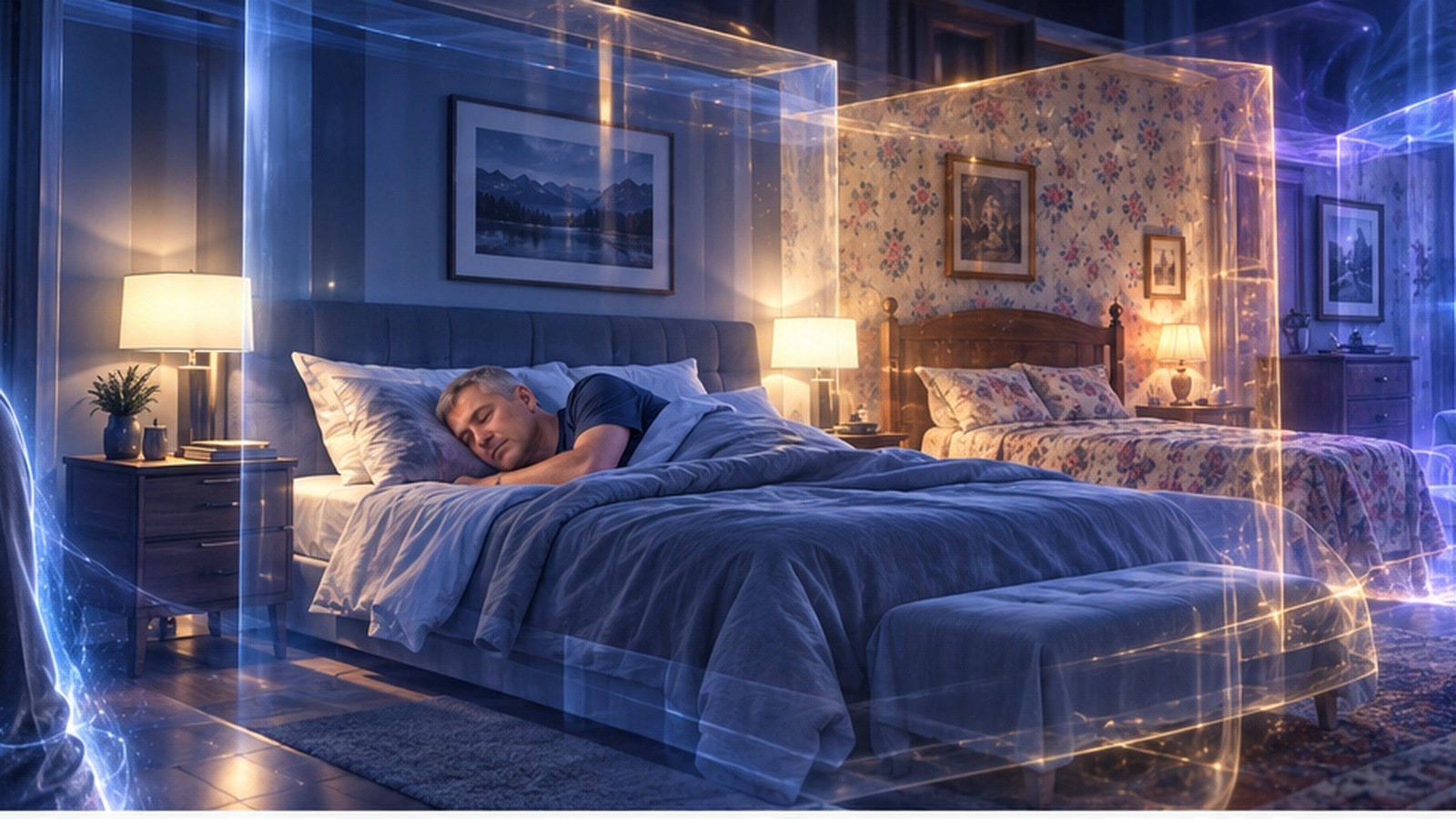
After a first conscious separation, people often expect to see an exact copy of their room. Instead, unfamiliar furniture may stand beside the bed, a doorway may be in the wrong place, or an entirely different city may appear outside the window.
The question is natural: If consciousness truly separated from the body, why does the environment differ from the physical one?
Because outside the body we do not always observe the same layer of reality, and we are not using physical sight.
We do not perceive with the eyes
The physical eyes remain closed with the body. Perception is produced by consciousness itself. It receives information about the surrounding space and translates it into a visual form familiar to the personality and the brain.
Intention can intensify this perception. A person may change focus, perceive space in greater depth, draw a distant object closer, or become aware of several directions at once. Sometimes vision does not appear immediately, even though position, movement, and presence are already clear.
The picture perceived outside the body is therefore not a photograph transmitted by the eyes. It is information translated into a form the person can understand.
Three sources of what we see
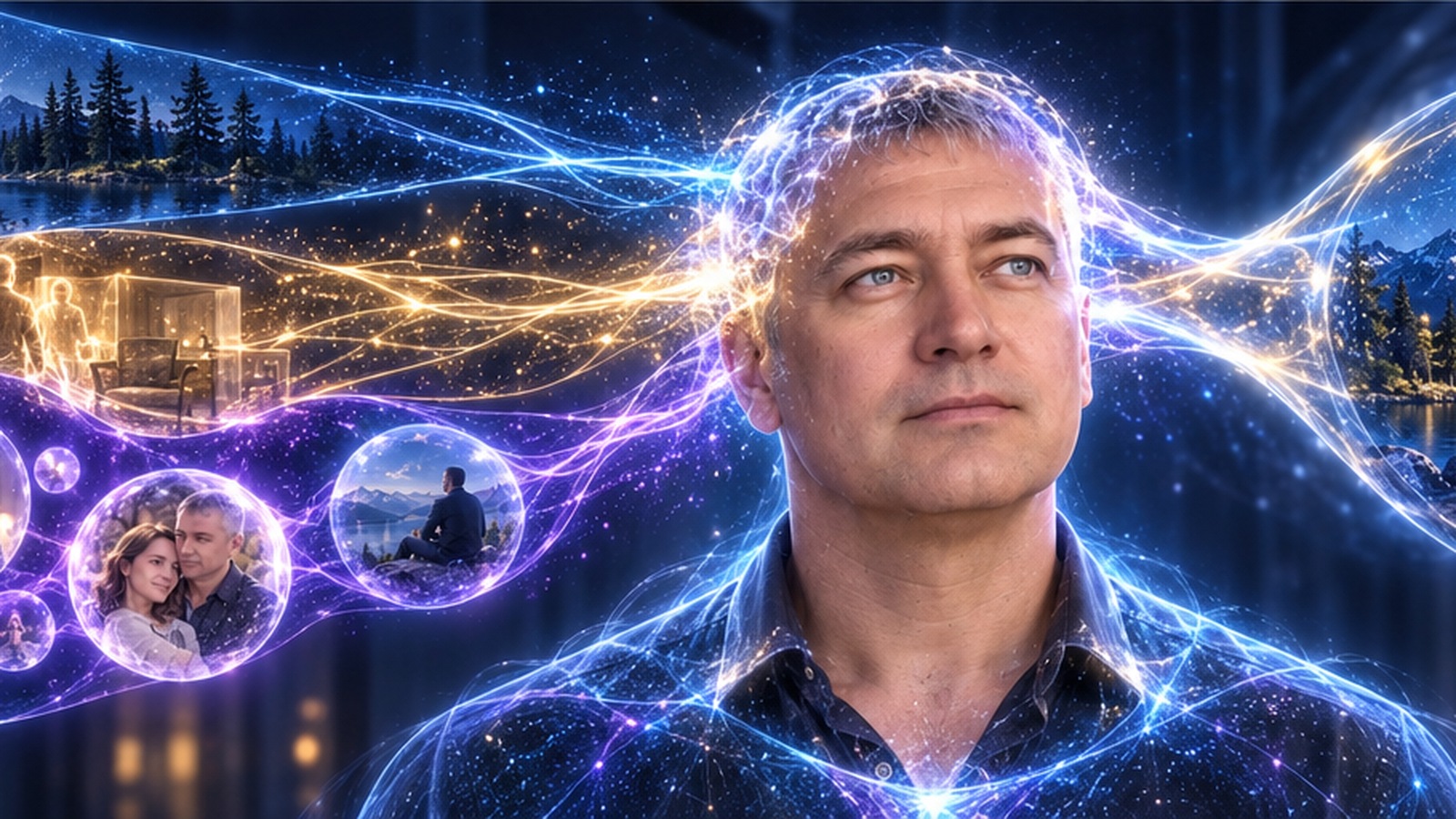
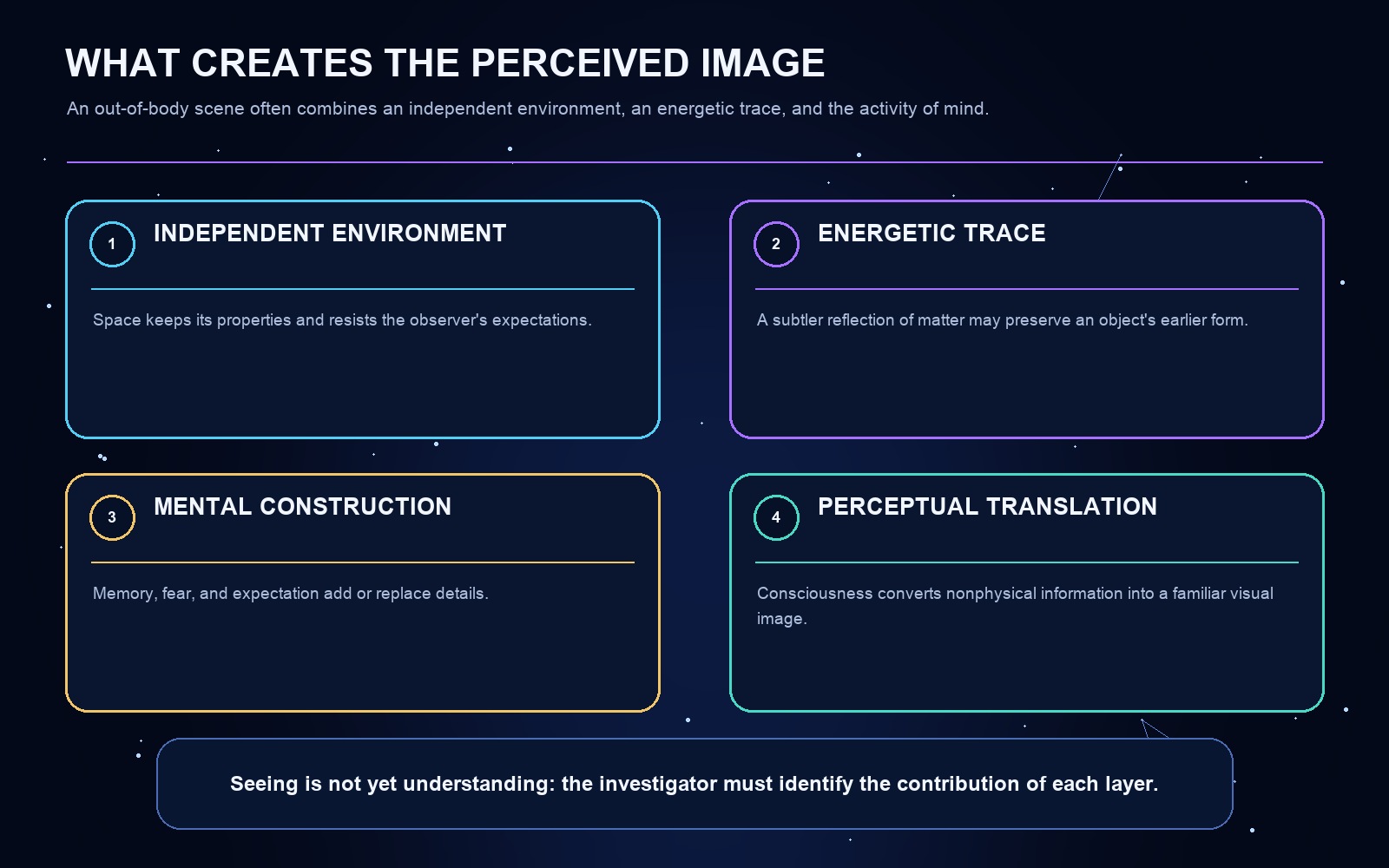
In my observations, the image may contain three principal components.
A real nonphysical environment. Consciousness perceives a space that exists independently of its wishes: an energetic reflection of the physical world or an autonomous region on another level.
The energetic trace of physical matter. Objects in our world produce a subtler reflection. That reflection may preserve an earlier form after the physical object has been changed or destroyed. A room may therefore contain old wallpaper, previous furniture, or an object that is no longer physically present.
A mental construction. The brain and mind add expectations, fears, memories, and familiar images. This construction may partially cover the actual environment or replace it completely.
Most often, a practitioner sees a mixture of all three layers.
Why your own room may look different
The energy level closest to us reflects physical reality without copying it mechanically. The energetic echo of matter follows its own laws and responds to consciousness much faster than a physical object does.
The reflection also does not update immediately. If furniture was moved or new wallpaper installed, the earlier image may persist for a while. Conversely, a practitioner’s thought may add an object that never existed physically.
A discrepancy does not prove that the whole experience was a dream. A familiar-looking room does not prove that the observation was objective either. We must examine how the space behaves.
How the mind completes reality
When information is incomplete, the brain fills the gaps with familiar imagery. It does the same in physical life, but we rarely notice it. In the mental layer, its influence becomes much stronger.
If a person expects a mirror, one may appear. If he fears a dark figure, an unclear shape may become a threat. If he believes he must meet a deceased relative, the mind may create a convincing image of that person.
This produces a central error: the observer mistakes the precision of the experience for the independence of its source.
Signs of an independent environment
I look for ways reality resists my expectations.
- The space remains stable when I redirect my attention.
- Not every intention takes effect immediately.
- Objects have consistent properties.
- Encountered beings demonstrate their own will.
- Details appear that I did not expect and could not have planned.
- Information is sometimes confirmed after I return.
Mental space is more fluid. Thought rapidly becomes form, scenes change easily, and events follow the practitioner’s emotional state.
Why people see different versions of the same place
Two practitioners may visit the same location and describe it differently. The quality of separation, degree of awareness, available range of perception, and mental filters all affect what each person sees.
One may perceive mainly a physical reflection. Another may see an older energetic trace. A third may add personal constructions. This is less like two witnesses arguing when one must be lying, and more like observing a complex object through different filters.
That explanation must not be used to excuse every contradiction. The fewer the shared and verifiable details, the more cautious the conclusion should be.
What we see when we encounter beings
The consciousness of another being may also create a form. It may present itself as it understands itself, or in a way that the observer can more easily comprehend.
A human appearance therefore does not necessarily imply human origin, and an unusual appearance does not prove extraterrestrial origin. We must look beyond form: at independent behavior, quality of communication, energetic imprint, and content of the information.
In nonphysical reality, appearance is much more closely connected to thought and self-perception.
Seeing is not yet understanding
Out-of-body vision offers extraordinary possibilities, but it also creates new opportunities for self-deception. A person may see a symbol clearly and mistake it for a literal object. He may encounter an energetic trace and believe he is observing the physical past. He may create a form through fear and declare it an independent being.
After returning, I ask more than “What did I see?” I also ask:
- On which level was consciousness operating?
- How dependent was the environment on thought?
- What remained stable?
- Which details were unexpected?
- Can anything be verified?
- Did the environment change after a strong emotion?
Vision outside the body is an instrument of consciousness. Like any instrument, it requires training and calibration.
We do not simply see “the other world.” We see the meeting of an external environment, energetic traces, and our own mind. The investigator’s task is to learn to distinguish the contribution of each.
You can read more about energetic reflection, the mental layer, and perception without physical senses in my book The Phenomenon of Consciousness Beyond the Body.
Continue with the book on Amazon: Kindle Edition or Paperback.
Leave a Reply