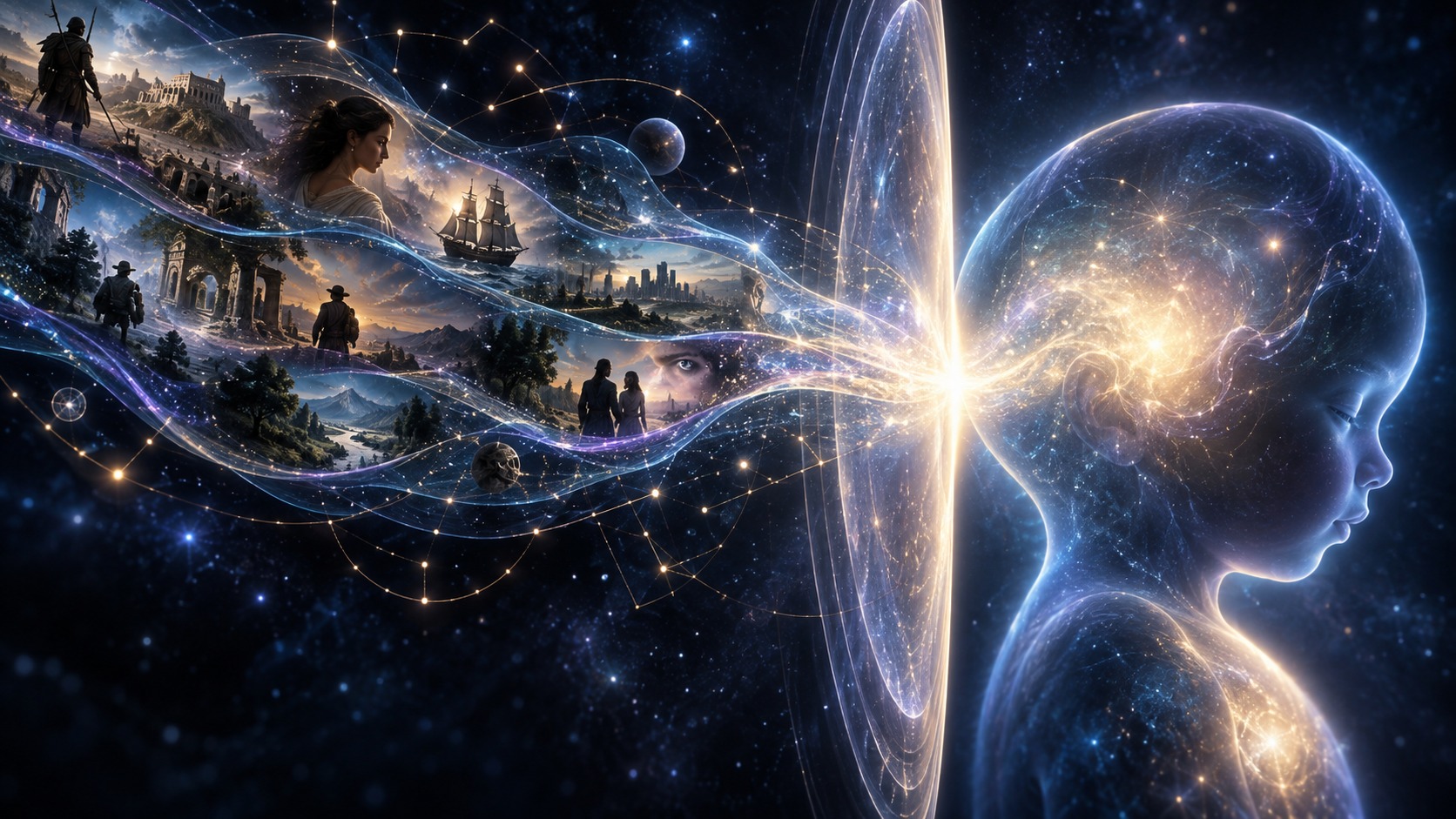
If the soul lives more than one life and retains the experience it has accumulated, why are we born without remembering who we were before? At first, this seems illogical. Would it not be easier to learn if we had access to all our previous knowledge, mistakes, and achievements?
I believe forgetting is neither a punishment nor the destruction of memory. The memory remains within the soul, but access to it becomes sharply limited when we enter physical life. We forget not because the past has been erased, but because a new incarnation requires a distinct and focused experience.
The Soul's Memory and the Brain's Memory Are Not the Same
Ordinary earthly memory is closely connected with the brain. It records the events of our present life, arranges them in time, and allows us to recall them in words and images. The soul, however, carries a far greater body of experience than our familiar memory system can contain.
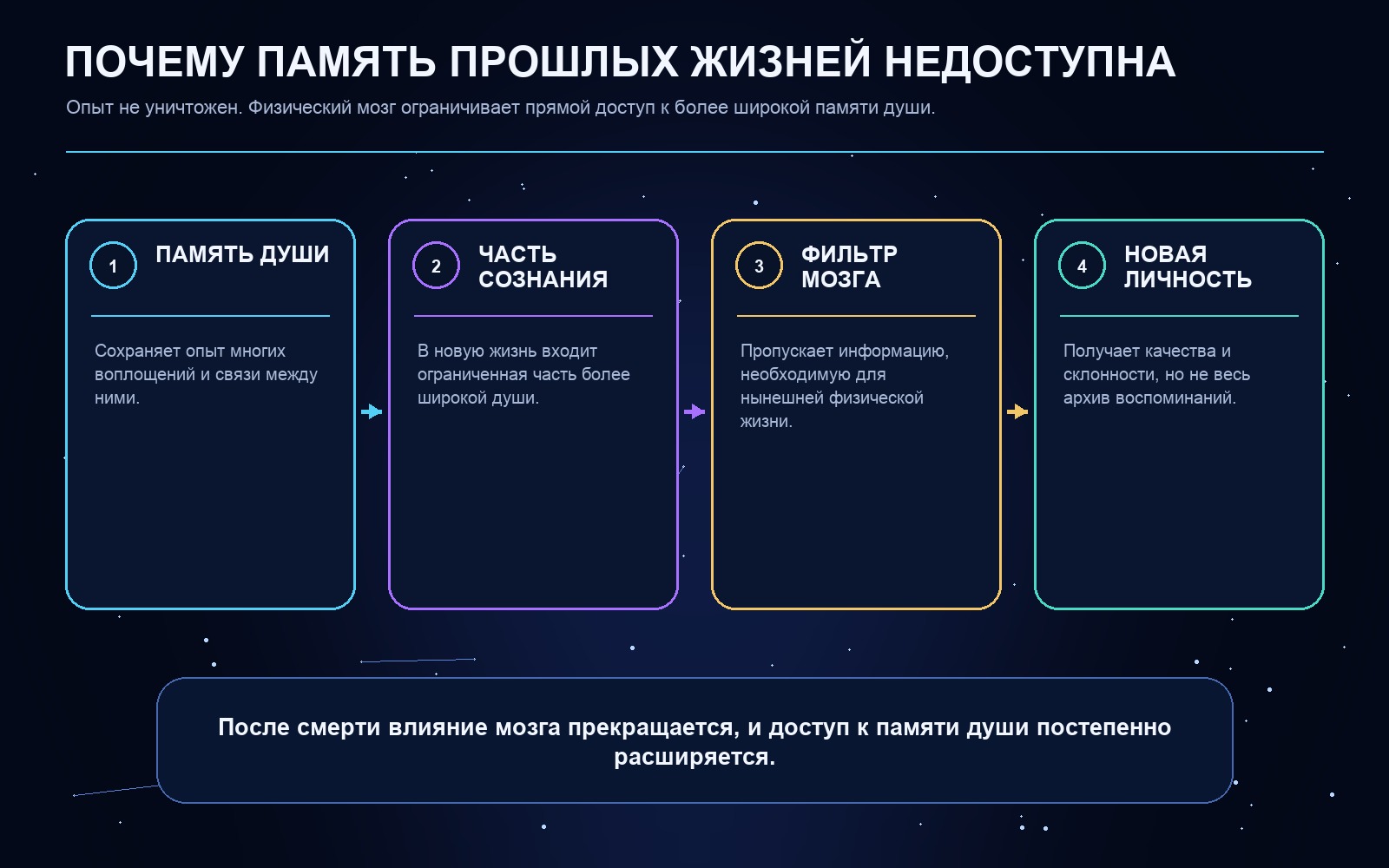
During an incarnation, consciousness interacts with the body through the brain and nervous system. The brain becomes both translator and filter: it admits the information needed for life in the physical world while limiting access to everything else.
The absence of a conscious recollection therefore does not prove that the memory itself is absent. We can observe a similar principle within a single lifetime. Much of what we have experienced influences our reactions even though we cannot reconstruct every scene or thought. Experience exists in more than the form of a story we can consciously retell.

Only Part of Consciousness Enters an Incarnation
One of the soul's central abilities, as I describe it in my book, is the capacity to divide. Each part can possess its own perception and memory while remaining connected with the whole.
The soul does not transfer its entire being into a physical body. Only the part of consciousness needed to create a new personality and gather experience joins the organism. The greater part remains beyond earthly life and continues to hold the soul's wider memory.
This helps explain why a person may experience deep inner knowledge, a powerful inclination, or an unaccountable sense of recognition without remembering the source as clearly as yesterday's conversation. The incarnated part remains connected with the whole, but the physical brain receives only a small portion of the available information.
Why a New Life Needs the Silence of the Past
Imagine a child who remembers, from the earliest years, many deaths, families, languages, conflicts, attachments, and unfinished relationships at the same time. Instead of freely discovering a new reality, that child would live under the weight of dozens of earlier personalities.
Each new life creates a unique relationship among soul, body, and environment. A person must learn to use a different body, acquire language, enter a new family, and encounter the world from a new point of view. The constant presence of earlier memories would interfere with this process.
Forgetting creates the inner space in which a new personality can truly emerge. We are not simply performing an old role on a new stage. We are given the opportunity to form a new perspective and experience relationships without ready-made answers.
This does not erase the experience. Instead, knowledge from earlier lives moves from direct recollection into the qualities of the soul.
Experience Remains Even When the Story Disappears
A person may not remember where or when they learned compassion, perseverance, or responsibility, yet those qualities appear in their decisions. In the same way, earlier fears, attachments, and unresolved inner conflicts may influence the present life without producing a clear biographical picture.
Experience from past incarnations may appear as:
- an ability that a person develops unusually early or easily;
- a deep inner rejection of a particular kind of behavior;
- an unexplained affinity for a culture, place, or field of activity;
- a persistent sense of familiarity upon meeting someone;
- an understanding that appears before it can be explained in words.
None of these experiences should automatically be declared a memory of a past life. Human inclinations can have many causes. Within my model, however, such patterns suggest that the soul enters a new life carrying the result of an earlier journey rather than arriving empty.
Why Memory Sometimes Opens Partially
The brain's filter is not completely sealed. Its control may weaken in altered states of consciousness, deep meditation, regression work, or out-of-body experience. A person may then gain access to fragments of memory that remain unavailable in an ordinary state.
This happened to me in trance states when I remained aware of physical reality while vivid scenes unrelated to my present life appeared at the same time. I experienced both streams as parts of myself, but I did not confuse one with the other.
Such experiences require careful judgment. The brain can complete images, combine expectations, and construct convincing stories. Emotional intensity alone does not guarantee accuracy. I look for repetition, internal consistency, the absence of prior suggestion, and, whenever possible, details that can be verified.
The real value of recovered memory is not the collection of extraordinary biographies. It should help us understand and live the present life more clearly.
Why We Do Not Need to Remember Everything
Interest in past lives can easily become an escape from the present. It may feel more appealing to imagine oneself as a famous ruler, priest, or warrior than to work honestly with today's relationships and weaknesses.
Yet the present incarnation already contains what we need for development. If a particular memory is truly necessary, access to it may open at the right time and in a form the person can bear. If it does not open, the current life is not incomplete.
We did not come here to spend our lives examining former roles. Memory has value only when it becomes awareness and helps us live more deeply now.
What Happens to Memory After Death
When physical life ends, the brain's influence ends with it. At first, a person retains a clear memory of the earthly personality that has just completed its life. Consciousness then reconnects with its larger part, and access to the soul's history expands.
This need not resemble watching an endless archive. The soul perceives the relationships among events, people, and its own decisions as a coherent whole. It recognizes what has repeated, what it has learned, and which qualities have become part of its nature.
In my book, I describe an experience in which I felt myself become part of my soul's history and perceived previous lives not as someone else's stories but as a single path. When I returned to the body, I understood that the brain could not retain the full volume of what I had received. Many details disappeared, but the central understanding remained.
This is how the boundary between the soul's memory and the brain's capacities works: the content is not destroyed, but the incarnated personality receives only what it can translate into human perception.
Forgetting Makes a New Experience Possible
We forget past lives so that a new life will not become a repetition dictated by old memories. The temporary limitation allows the present personality to develop independently, build relationships in a new way, and make decisions from within its own circumstances.
The soul does not begin from zero. It enters an incarnation with all its accumulated experience, expressed through qualities, inclinations, and deep understanding. The complete memory remains outside ordinary access, but our connection with it is never broken.
The goal, therefore, is not to recover the greatest possible number of former lives at any cost. What matters far more is to develop the qualities for which all this experience was gathered: clarity, love, responsibility, and the ability to live the life before us consciously.
For a deeper exploration of the soul's memory, the division of consciousness, and the return to a more complete state, see The Phenomenon of Consciousness Beyond the Body.
Leave a Reply