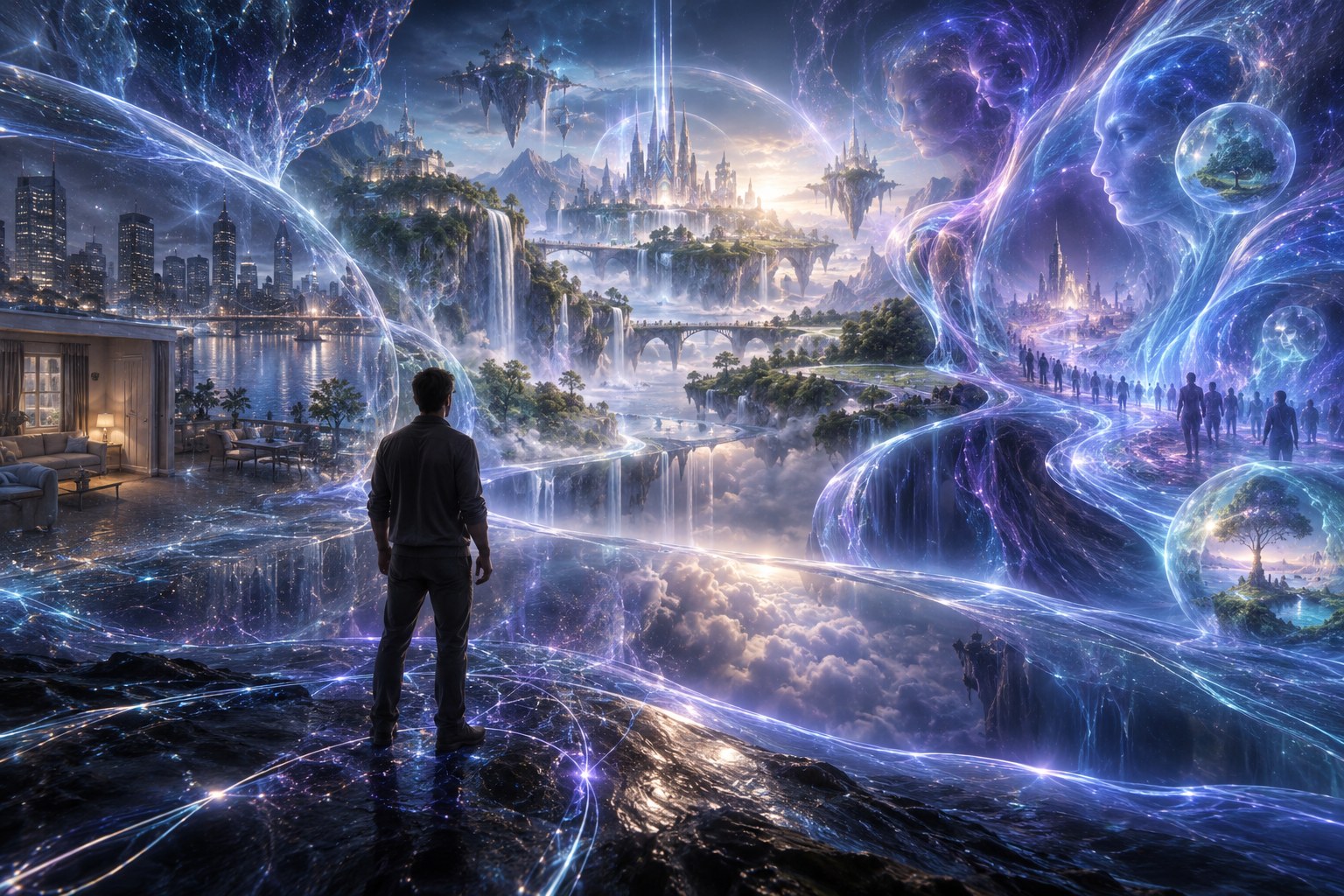
How the space that consciousness enters during sleep and out-of-body experiences is structured, why thought becomes an active force there, and how to distinguish what we observe from images created by our own minds.
A map of reality becomes meaningful only when we begin to examine each of its levels separately. We can draw an elegant diagram of the universe, name invisible regions, and offer persuasive explanations. But until that framework is supported by repeated observations and personal experience, it remains a philosophical construction.
For more than twenty years, I have explored states in which consciousness functions outside the physical body. During that time, I have experienced many conscious exits, returned to the same environments, tested my early conclusions, and gradually assembled a coherent picture. Some of my ideas changed. Others were confirmed again and again.
I call the realm closest to the physical world the second energy level. Traditional esoteric literature often calls it the astral plane, but that term has accumulated too many conflicting meanings. For some, the astral plane is the world of the dead. For others, it is the realm of dreams. Still others imagine it as a domain inhabited by fantastic beings. All of these ideas touch on aspects of the second level, but none fully explains its structure.
The second energy level is far more complex. It is not one uniform territory. It is an immense reality that includes an energetic reflection of the physical world, a realm of collective and personal thought-forms, and independent worlds that are not reflections of our universe.
In my understanding, this is where human consciousness goes during sleep. Most people do not remain aware and remember nothing in the morning. Sometimes, however, memory breaks through as an unusually vivid dream, a sensation of flying, vibrations, falling, or a sudden awakening accompanied by absolute certainty that the person had just been somewhere else. Some people see their sleeping body from the outside. For most, this remains a single unexplained episode. For me, such an experience became the beginning of a long investigation.
Not Another Place, but Another Level of Reality
When I speak of the second energy level, I do not mean a place above the clouds or somewhere at the edge of the physical universe. It is not “far away.” It exists beside us—effectively within the same space, but in a different state of energy and matter.
We are accustomed to treating as real only what our senses and physical instruments can detect. Yet our senses perceive only a narrow range of what is happening around us. We do not see radio waves, hear ultrasound, or sense most of the processes continually passing through space. That does not mean they do not exist. It means the human body is tuned to a particular range of perception.
In my model, the physical world is the first and densest energy level. The second level exists in the next range. The physical body cannot enter it, but consciousness can shift its perception and function there independently.
During a conscious exit, that shift feels completely real. A person is not merely imagining that they have left the body. They retain their sense of self, their ability to make decisions, and their capacity to see, hear, and analyze. At times, perception becomes even clearer than it is in ordinary life, while the physical body remains asleep.
For me, this is one of the strongest reasons to regard consciousness as an independent form of life and the brain as its instrument for interacting with the physical world. When that instrument is temporarily removed from the process of perception, consciousness itself does not disappear. It continues to observe, learn, and act.
Three Regions of the Second Energy Level
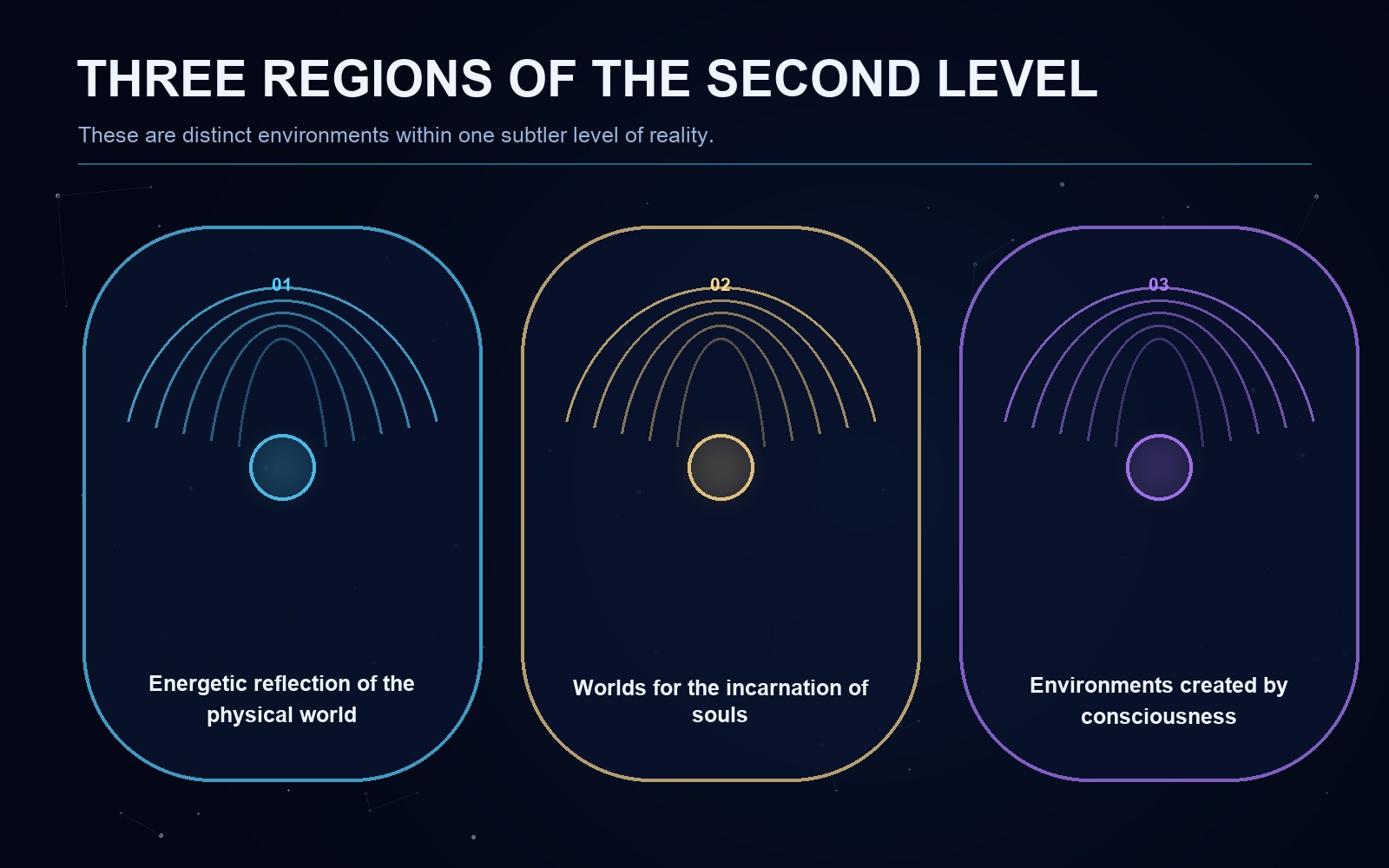
The second level is not uniform. Based on my observations, I divide it into three broad regions. There are no walls or official boundaries between them. They can overlap and intersect, which makes it difficult for an inexperienced explorer to understand exactly where they are.
The First Region: An Energetic Reflection of the Physical World
This region is an almost complete copy of the reality we know. It contains reflections of houses, streets, cities, nature, planets, and our entire universe. When a person finds themselves there near the physical body, they usually see a familiar room. The walls, doors, and furniture are in their usual places. The same city lies beyond the window, and the same Moon, Sun, and stars appear in the sky.
Yet this is not a photographically exact copy. A wall may be a slightly different color. A chair may have a different shape or texture. An object recently brought into the room may be missing, while something removed long ago may still appear in its old place. The more strongly an object is connected to people’s attention and habitual perception, the more stable its reflection seems to be. The less importance we give it, the more easily differences arise.
Early in my practice, these discrepancies confused me. If the environment was real, why did its details change? Over time, I came to understand that I was not seeing the physical world itself but its energetic reflection. It is connected to physical matter, yet it is also influenced by the perception, memory, and attention of the consciousnesses that interact with it.
By default, this reflection behaves much like familiar reality. The floor remains solid, walls seem impenetrable, and the body appears to have weight. A person keeps walking, opening doors, and moving around obstacles simply because that is how they have behaved throughout physical life. But as soon as they understand that they are outside the physical body, those familiar limits are no longer mandatory.
They can pass through a wall, rise into the air, or descend to the bottom of a body of water without needing to breathe. The laws of space do not vanish on their own. They yield to directed intention.
The Second Region: The Realm of Thought-Forms
This is the most fluid and deceptive part of the second level. Here, thoughts, expectations, memories, desires, and fears can become a complete surrounding environment.
By mental, I mean everything created by the mind—by our intellectual capacity to form thoughts, images, expectations, and inner scenarios. A mental environment is therefore a realm in which the contents of the mind can take on the appearance of external reality. An image created there can look convincing and be experienced as something outside us, even though its source is the person’s own mind.
In the physical world, thought usually remains within us. Turning an idea into reality requires action, time, and material resources. In the second region, the distance between a thought and its visible form becomes dramatically shorter. The moment a person becomes afraid, the environment can begin filling with what they fear. The moment they remember a familiar place, it may appear around them. Religious beliefs can generate corresponding settings and figures. Images from movies, books, and games can be perceived as living beings.
This is one reason accounts of out-of-body experiences differ so widely. Each person may be honestly describing what they saw, but that does not mean everything they saw existed independently of their consciousness. A person can enter their own thought and fail to recognize that they are helping create the scene around them.
Ordinary dreams unfold primarily in this region. Consciousness remains near the body while a fluid environment forms around it from memories, emotions, and unresolved experiences. The story appears external, although much of it is being generated by the person’s own stream of thought.
When someone becomes aware within a dream, they gain the ability to observe this process. Yet lucid dreaming does not always mean they have left the mental region. A person may clearly understand that the body is asleep while still remaining inside a reality created by the mind.
Serious exploration requires learning to stop the automatic flow of images. Calm attention makes the environment more stable. Emotional chaos can change the scene instantly. This is why control of thought on the second level is not merely an appealing spiritual concept. It is a practical necessity.
The Third Region: Independent Worlds
The most difficult part of the second level to access includes worlds that are neither copies of our universe nor products of an explorer’s personal imagination. They have their own forms of life, laws, civilizations, and paths of development.
Reaching them is far more difficult than moving to a familiar place. Movement in the second level requires a destination—an image, a memory, an energetic trace, or contact with someone who knows the way. We cannot simply decide to visit an unknown world when we have no information about it. Consciousness has nothing to connect with, so it returns us to familiar territory.
That changes after the first contact. A reference point now exists in memory, and the path can be found again, either independently or with help from that world’s inhabitants.
One of my most important contacts was with an explorer named Limiy. He introduced himself as an inhabitant of another world and showed me aspects of his civilization. The encounter lasted a long time and contained a great deal of information. It deserves a separate article because it concerns not only the structure of the second level, but also the capacities of other forms of life, movement between worlds, and their relationship to humanity.
The larger point is this: the second energy level does not end with a reflection of our planet or with human dreams. It opens into a reality whose scale is far greater than the familiar idea of the astral plane.
Thought Becomes an Active Force
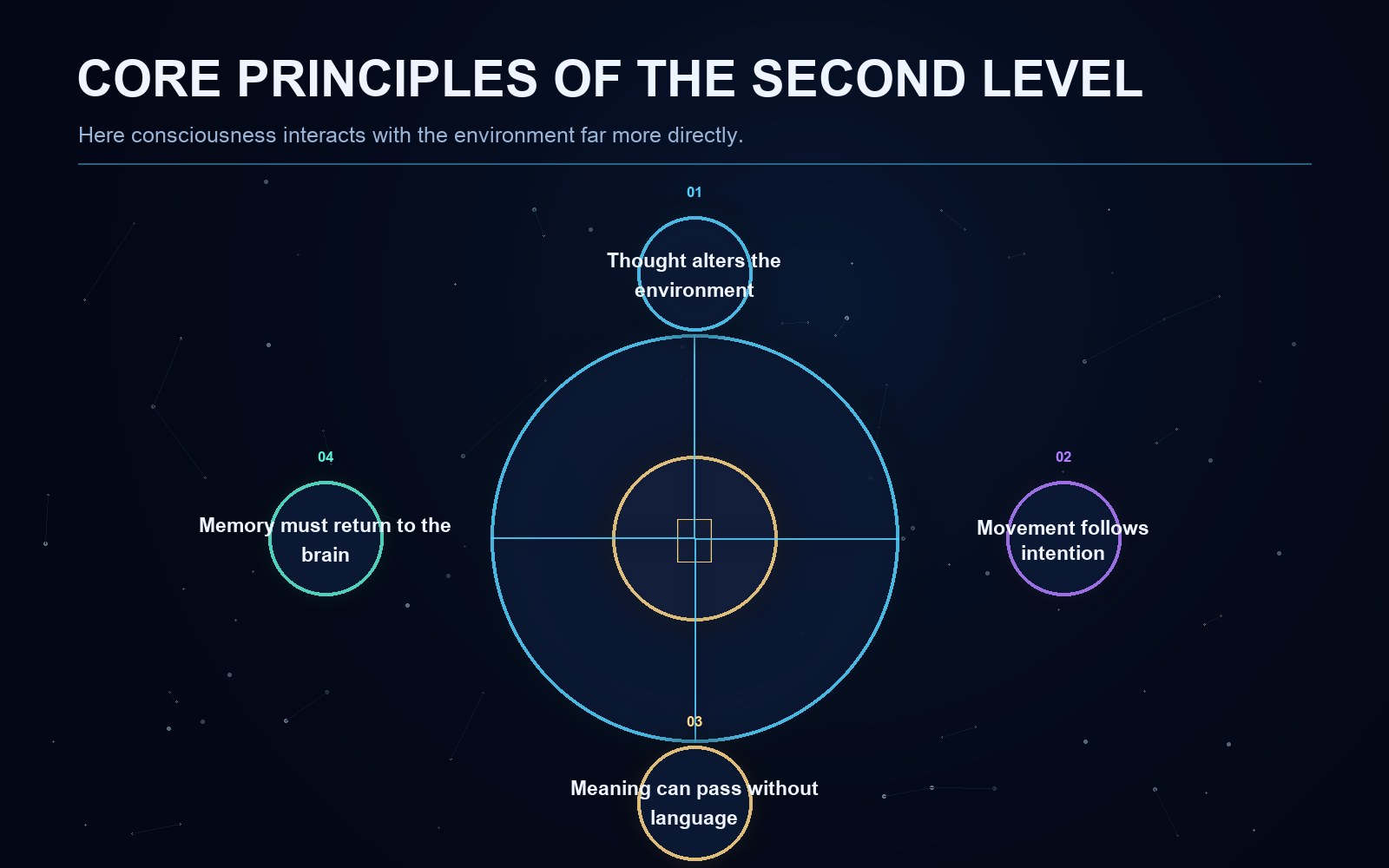
The central difference between the second level and the physical world is the role of thought. Here, thought can alter not only our mood, but the perceived environment itself.
If a person expects to fall, they begin to fall. If they are certain that a wall is solid, it stops them. If they remember the physical body and begin worrying about it, their connection to the body immediately strengthens and the experience ends. But when attention is calm and intention is clear, the environment becomes manageable.
This does not mean that a person gains absolute power over the entire second level. What they control first is their own point of presence and the part of the environment directly connected to their perception. An independent world or another consciousness is not required to obey their wishes. That is an important boundary between an independent reality and a personal thought-form.
Thought makes it possible to fly, pass through walls, sharpen vision, travel toward a chosen destination, and change the mode of perception. Yet the same power can turn the experience into chaos. Fear creates frightening images, emotional excitement disrupts concentration, and the desire to explain everything immediately replaces observation with a ready-made story.
Real preparation for exploration therefore does not begin with a technique for leaving the body. It begins with the ability to direct attention. Anyone who cannot quiet the inner noise of ordinary life carries that noise beyond the body as well.
How Movement Works
At first, almost everyone moves as though they were still in a physical body. We walk across the floor, use the stairs, and try to open doors with our hands. This is natural: consciousness reproduces familiar patterns of behavior.
Eventually, we understand that movement is determined by intention.
The first method is directed flight. I hold a destination in my attention and move toward it. The speed can be enormous, especially in space, but I must not lose the reference point. If my attention wanders, I may arrive somewhere completely different—usually a place that is deeply familiar. It is as though consciousness selects the nearest stable image and transfers the explorer there.
The second method is instantaneous relocation. I form a clear image of a place and join it with the intention to be there. The transition happens without any sense of crossing the distance between two points. Sometimes an exit begins this way: instead of finding themselves beside the body, a person immediately appears in a childhood home, on a familiar street, or in another emotionally significant place.
Physical distance matters far less in the second region than the precision of attention. A person can quickly approach the Moon or the Sun and still be unable to reach an unknown galaxy because consciousness has no coordinates for it. The decisive factor is not the number of miles, but the connection to the destination.
Sensation and Time
The absence of the physical body does not mean the absence of sensation. On the second level, I have felt touch, the resistance of water, moving air, scents, coolness, and warmth. I have heard sounds and seen colors. I could intensify or reduce perception through intention.
During one exit, I rose above Earth and traveled toward the Moon. On its surface, I scooped up brownish dust with my hand and felt it pass between my fingers. I saw a dark landscape, hills, and the blue Earth in the sky. A physical body would have needed protection and oxygen there. My consciousness experienced neither cold nor suffocation.
That episode showed me that sensation on the second level is connected not to physical organs, but to consciousness’s ability to perceive energy and translate it into an intelligible experience. Hands, eyes, clothing, and breathing remain as a familiar image of oneself, even though they are no longer physically necessary.
Time is experienced differently, but that does not mean we can freely travel into the past or future. A memory may unfold around a person as a complete scene, creating the impression of having returned to another time. But this occurs within the mental space of memory. Events on the second level still unfold in sequence, even though the duration of the experience and the amount of time that passes for the physical body may feel very different.
The Central Challenge: Bringing the Memory Back
Leaving the body is only half the work. The other half is preserving the experience after returning.
The physical brain did not participate in the journey, so the memories must be transferred into it. If I immediately open my eyes, get up, look at my phone, or begin thinking about daily tasks, much of what happened disappears within minutes. Only the feeling that something important occurred remains.
I have learned not to move or open my eyes immediately after returning. I first reconstruct the final event, then work backward through the memory and recover the entire route. After that, I replay the experience from beginning to end and only then write it down.
A single vivid episode can be impressive, but by itself it explains very little. A coherent picture emerges through repetition. When the same properties of an environment appear dozens of times under different circumstances, they can become part of a working model. This is how I came to divide the second level into three regions and understood how strongly thought participates in shaping perceived reality.
Who Is Present on the Second Level?
Most sleeping people remain unaware. Their consciousness stays near the body while dream narratives unfold around them. Trying to speak with someone in this state rarely produces meaningful contact: the person is absorbed in their own story and may become frightened or vanish instantly as they return to the body.
Conscious travelers are much less common. Rarer still are people who use out-of-body experiences not for entertainment, but for systematic exploration.
The recently deceased can also sometimes be encountered on the second level. In my observations, they do not remain there forever. The second level serves as a transitional region before the soul returns to the third level—the place where it lives between incarnations and gradually regains a fuller memory.
On one occasion, I rose through the roof of my house and saw a young man nearby. He noticed me and seemed surprised that I had not used the stairs. I made a joke, and he replied that he had assumed I was dead too.
He looked young, but he told me that he had lived a long life and was very tired. He was waiting for his funeral so he could say goodbye to his body; after that, he intended to go where his loved ones were already waiting for him. A few days later, I learned that my elderly neighbor—a man I had occasionally seen on his balcony—had died.
For me, this encounter became an important confirmation: the appearance of consciousness does not have to match the age of the physical body, and death does not always result in an immediate transition to the next level. For a time, the soul may remain close to the familiar world.
Communication Without Language
People can speak with words on the second level, especially when they share a language. But spoken language there is more a habit carried over from physical life. There is no need to move the lips, exhale air, or produce sound waves.
The more natural form of communication is through thought and a direct transmission of meaning.
A thought conveys specific content. A direct transmission communicates an entire state at once: meaning, feeling, imagery, intention, a question, and one’s relationship to what is happening. Something that would take minutes to explain in ordinary conversation can be understood instantly.
We sometimes experience faint traces of this kind of communication in physical life. People who are close may understand each other from a single look. We can sense someone’s mood before they speak. At times, we feel that someone is watching us. On the second level, this mode of perception becomes much clearer.
Yet the force of an impression does not guarantee that a message is true. A thought-form can also speak, answer questions, and behave convincingly. I therefore evaluate a contact not by how dramatic it feels, but by a combination of signs.
Distinguishing an Independent Reality from a Created Image
This is one of the most difficult questions in the entire field of exploration.
A thought-form usually depends heavily on expectation. It changes quickly under the influence of fear, desire, or a prepared scenario. Its behavior often repeats familiar religious, cultural, or personal images. When attention weakens, the scene may dissolve or transform into something else.
An independent contact behaves differently. The other being can respond unexpectedly, refuse to follow my scenario, and communicate something I did not expect to hear. The environment maintains its own internal continuity and does not change simply because I want it to look different. I encounter something with its own will and logic, not merely an extension of myself.
Even so, I do not treat these signs as a reason to declare every unusual image an external being. I preserve the details, record the conversation, compare it with later experiences, and only then draw conclusions. What distinguishes an explorer from a fantasist is not the absence of bold ideas, but the refusal to replace observation with a preferred explanation.
Safety and Responsibility
Many fears surround out-of-body experience. One of the most common is the fear of being unable to return to the body. Another is the belief that a foreign entity might take possession of it. In more than twenty years of practice, I have found no reason to regard these scenarios as a genuine threat.
The connection between consciousness and the body is extraordinarily strong. A thought of the body, a sudden emotion, or an external disturbance returns a person almost instantly. Even when I was far from a familiar location, I could end the experience with a single intention.
Most frightening beings arise in the mental region. Fear gives them form, and attention sustains their existence. The harder a person tries to escape an image they have created, the more convincing that image becomes. When the fear ends, much of the threat disappears with it.
This does not mean aggression or outside interference is impossible on the second level. But the best protection is not a magical ritual. It is clarity, calm, control of attention, and a readiness to end the experience immediately.
Ethics matter as well. The ability to travel outside the body does not give anyone the right to intrude into another person’s life. The practice should not be used for surveillance, pressure, the pursuit of power, or attempts to investigate loved ones without their consent. Expanding our abilities without expanding our sense of responsibility makes us more dangerous, not more evolved.
Sobriety matters in the most literal sense. Alcohol and psychoactive substances disrupt concentration, memory, and the ability to distinguish observation from fantasy. Altered perception is not the same as awareness. Exploration requires a clear mind, healthy sleep, emotional stability, and the ability to stop when one’s inner state becomes unstable.
Why This Level Matters
The second energy level is the nearest frontier of a much larger reality. It reveals that consciousness does not cease to exist when the physical senses shut down. It shows both the power of thought and the danger of an uncontrolled stream of thinking. It reveals a connection between the living and the dead, makes communication without language possible, and offers a first experience of a reality in which physical distance is no longer the primary limitation.
Yet its greatest lesson is not found in flight, extraordinary encounters, or journeys to other planets.
Its greatest lesson is responsibility for our own consciousness.
In physical life, we often fail to notice how fears, habits, and other people’s ideas shape our perception. The density of the material world conceals the consequences of inner chaos: a thought does not turn into an object before our eyes. On the second level, this process becomes visible. A person confronts the contents of their own mind and can no longer pretend those contents do not affect their reality.
This is why awareness matters more than technique. Anyone can leave the body by accident. Anyone can see a vivid scene. To explore, however, means remaining clear, asking questions, returning to one’s observations, testing conclusions, and being willing to revise an explanation when a new experience reveals a more complete picture.
The second energy level is not the final destination. It is the first door. Beyond it begins a far more complex system of worlds and levels in which humanity must rediscover the nature of life, death, memory, and our own origins.
In the next article in this series, I will examine the energetic reflection of the physical world in detail: why a familiar room can look slightly different, how human attention affects the stability of objects, and where the boundary lies between a reflection of reality and a thought-form created by the mind.
You can read more about these observations, personal experiences, and practical conclusions in my book, The Phenomenon of Consciousness Beyond the Body.
English editions:
Leave a Reply