
Why fear remains even after we gain experience—and how to stop letting it make our decisions
Fear can stop us before any real danger appears. We may be prepared, know exactly what to do, and possess every ability required to succeed. Then the decisive moment arrives, and the body seems to stop cooperating. Muscles tighten, breathing changes, attention narrows, and the brain begins repeating the same alarming scenario.
At that point, fear is no longer simply warning us. It is trying to make the decision for us.
I have observed this many times—in life, in sports, and in my exploration of out-of-body experience. I eventually reached a conclusion that may sound surprising: fear cannot be permanently defeated. Nor should it be. Fear is part of human nature, and it serves an essential protective function.
But fear can be brought under control.
It may remain in the body as nervous energy, tension, or a slight sensation in the stomach, yet lose its power over our actions. We can learn to stay clear, assess what is happening, and act even while fear is present.
That is what I call real courage.
My First Serious Lesson About Fear
When I was seventeen or eighteen, I had to speak in front of a group of people. The audience was very small—only about five people. There was no real danger. What was there to fear?
Yet the fear was so strong that I forgot what I wanted to say. My thoughts scattered, the words I had prepared disappeared, and the entire presentation fell apart. That was the first time I clearly understood how much power fear can have over us. It can cut us off from knowledge and abilities that were fully available only moments before.
Later, I learned to speak before audiences of several hundred people. I gained experience, learned how to prepare, and stopped allowing nervousness to destroy my presentations. That does not mean the fear vanished completely. I could still feel tension before walking onstage.
What changed was that the tension no longer determined my actions.
That experience taught me something important. Confidence does not always mean the absence of fear. Very often, confidence means being able to continue doing what matters while fear remains beside you.
Even Professionals Feel Fear
More than ten years of my life were connected with competitive tennis. I watched talented athletes perform brilliantly in practice. They moved freely, struck the ball with precision, and displayed an impressive level of skill.
Then a real match began, and the same athlete sometimes could not demonstrate even half of what they had shown during practice. Their movements became restricted. Their muscles seemed to stiffen. They made mistakes that almost never appeared in training. Their technique had not disappeared. Their physical condition had not suddenly changed. Their inner state had.
Fear of losing, fear of making a mistake, and fear of being judged had taken control.
I asked professional athletes whether experience eventually made the fear disappear. The answer was almost always the same: no. Even extensive experience does not completely eliminate nervousness. It teaches us how to act while feeling it.
Fear is therefore not proof of weakness. Beginners and professionals feel it. Ordinary people and accomplished masters feel it. The difference lies in who makes the final decision: the person or the fear.
Why We Need Fear
Fear is a natural response to danger, threat, or the unknown. It makes us stop at the edge of a cliff, look more carefully before moving forward, prepare for a possible problem, or reject an unnecessary risk.
Without this mechanism, human beings would not survive for long. We would fail to notice danger, ignore consequences, and continually make choices that threatened our lives.
Fear itself is not the enemy. The problem begins when a useful signal becomes the master. Instead of warning us, it begins dictating what to think, where to go, and what to abandon. It stops protecting life and starts making life smaller.
A person refuses to begin something new because of the possibility of failure. They remain silent because they fear judgment. They do not defend their interests because they fear conflict. They refuse to explore the unknown because they have already created an image of danger in their mind.
Fear gradually becomes a constant companion—and sometimes a cage the person carries everywhere.
Why Fear Does Not Need to Be Defeated
Many people pursue the wrong goal: they want to eliminate fear completely. They imagine that one day they will become so strong, experienced, or spiritually developed that they will never be afraid again.
I do not believe in that goal. In twenty years of personal investigation, I have never met anyone who completely lost the capacity for fear. Experienced practitioners may still feel it before an unfamiliar experience. Professional athletes still feel nervous before an important match. People accustomed to speaking before large audiences may still feel tension before stepping onto a stage.
When we demand complete fearlessness from ourselves, we begin fighting our own nature rather than addressing the real problem. Every new wave of nervousness feels like defeat: “I am afraid again, so I must not be ready.”
Readiness is not defined by the absence of fear.
It is defined by the ability to remain clear and act consciously.
My goal is not to make sure I never feel fear again. My goal is to stop fear from making decisions for me. Fear may be present in my body, but I choose the direction.
The First Step Is to Admit the Fear
We cannot control something whose existence we refuse to acknowledge.
People often hide fear even from themselves. They call it caution, lack of interest, bad timing, or a reasonable refusal. Sometimes those explanations are accurate. But sometimes one simple sentence stands behind all of them: “I am afraid.”
Saying those words is not surrender. It is the beginning of regaining control.
We need to identify exactly what we fear. Making a mistake? Losing money? Being ridiculed? Facing the unknown? Losing control of the body? Seeing something we are not yet prepared to see?
Without a precise answer, fear remains shapeless, and everything shapeless appears enormous. Once we give fear a name, it becomes a specific problem we can examine and address.
Accepting fear does not mean obeying it. It means that we stop wasting energy denying it and redirect our attention toward action.
Look Fear in the Eye
Many fears arise from rumors, other people’s stories, memories, and images the brain constructs on its own—not from an immediate danger. Nothing has happened yet, but we have already lived through dozens of catastrophic versions of the event in our thoughts.
The next step is therefore to use reason.
Ask yourself:
- What exactly am I afraid of?
- What facts support this fear?
- Have I seen verified examples of what I expect to happen?
- Am I merely repeating someone else’s assumptions?
- What could realistically happen?
- What will I do if it does happen?
Reason may not instantly remove the physical sensation of fear. But it breaks through the fog in which imagination disguises itself as reality.
At the same time, we should not declare every fear groundless. Sometimes fear points to a real risk. If a person is unprepared, does not understand what is happening, and has no idea what to do, the fear has a legitimate basis. The answer in that situation is not bravado. It is preparation.
Preparation Restores Your Grounding
Imagine someone sitting behind the wheel of a car for the first time. No responsible person would immediately send that student onto a crowded freeway. The student first learns the rules, becomes familiar with the vehicle, practices with an instructor, and only then moves gradually into more difficult conditions.
Every serious undertaking should be approached in the same way.
Knowledge reduces the empty space that the brain usually fills with alarming scenarios. Once people understand the sequence of events, they no longer feel completely helpless. They know what may happen, what sensations are possible, and how to respond.
Preparation does not guarantee that fear will disappear. It restores a sense of inner support.
Before exploring unusual states of consciousness, it is therefore important to study the subject, understand its main stages, learn to relax and direct attention, and begin with small steps. Attempting something far beyond our preparation can intensify fear and destroy the desire to continue.
Courage without preparation can easily become recklessness. Prepared courage becomes an instrument of investigation.
Experience Changes Fear More Than Theory
We can read dozens of books about swimming, but we cannot learn to swim without entering the water. Fear works the same way.
Theory explains what may be ahead. Practice gives us knowledge of our own.
During my first successful attempts to leave the body, I encountered not only fear but, at times, overwhelming terror. Unusual sounds, vibrations, a sense of someone’s presence, or the feeling of being touched can make it seem as though we have encountered something incomprehensible and dangerous.
The moment of separation itself can produce particularly intense fear. The brain has no familiar model for this experience, so it responds to the unknown with an alarm.
But every time I moved through that moment, I saw the same thing: the frightening sensations belonged to the transition. Once separation occurred, they stopped. I remained able to observe, make decisions, and return.
Every new experience weakened fear’s influence. This did not happen because I forced myself to feel nothing. It happened because the unknown gradually became familiar territory.
We cannot bring fear under control while remaining lifelong theorists. Practice, however, should be gradual and conscious. One small firsthand experience can create more confidence than hundreds of stories told by other people.
The Main Fears Surrounding Out-of-Body Experience
One of the most common fears is that we may not be able to return to the body. People worry that the connection could break, that they could become lost in an unknown space, or that the physical body could somehow cease to belong to them.
In twenty years of practice, I have never encountered a situation in which I was unable to return. My experience has led me to a firm conclusion: consciousness maintains its connection with the body. Sometimes simply remembering the body or directing attention toward it is enough for the return to happen almost immediately.
In fact, thinking about the body too early often ends an interesting experience sooner than I would have preferred.
Another fear is that while consciousness is away, someone or something else may enter the body. I do not consider this fear justified. In my model, part of consciousness always remains connected with the physical body. The body does not become an empty shell available to the first being that passes by. In my book, I explain in greater detail why I consider a complete replacement of consciousness or accidental “possession” impossible.
People may also fear unusual sounds, touch, presences, or images. Here it is especially important to understand that the brain tries to explain the unknown through ideas it already recognizes. The more strongly a person expects a threat, the more easily any unusual signal becomes proof of danger in their perception.
Fear can create its own picture of what is happening. An investigator must therefore remain attentive and distinguish the observation itself from the immediate interpretation placed upon it.
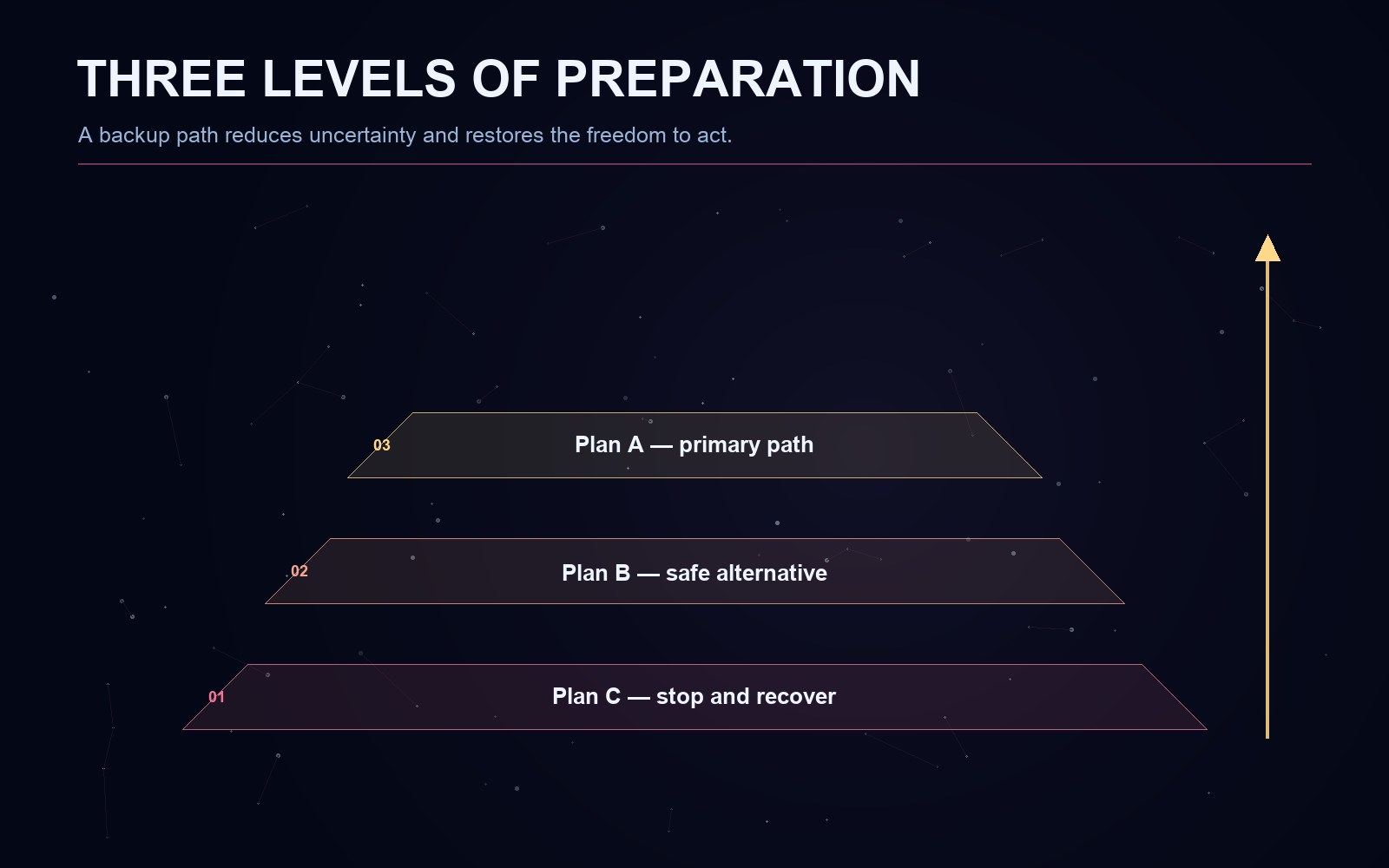
Plan A, Plan B, and Plan C
Helplessness intensifies fear. When we know what we can do, fear loses much of its power.
Before any serious practice, I believe we should have several responses prepared in advance.
Plan A—the protective sphere. If a situation creates anxiety, visualize a dense protective sphere around yourself and fill it with a clear intention that no unwanted influence will be permitted to enter.
Plan B—relocation. In an out-of-body state, attention can be directed toward another place. There is no obligation to continue interacting with something that produces fear.
Plan C—returning to the body. This is the simplest and most reliable way to end the experience. Remember the physical body, think about it, or decide to return. The investigation may end, but you will preserve your sense of control and can continue another time.
You can also ask your Higher Self, teachers, or kindred souls for help in thought. My practice has led me to believe that we are not left without support, especially when we sincerely ask for it.
This principle reaches far beyond out-of-body experience. We enter any difficult situation with greater calm when we know several acceptable ways out. A disrupted first plan no longer feels like a catastrophe because other options remain.
Caution Is Not the Opposite of Courage
Bringing fear under control does not mean ignoring danger, abandoning common sense, or trying to prove that we are fearless.
Caution and panic are different states.
Caution preserves our ability to observe and evaluate. Panic narrows attention and demands immediate escape, often before we have even understood what we are escaping from. Caution helps us choose an action. Panic chooses for us.
A real investigator does not have to continue every experience at any cost. We have the right to stop, change direction, return, and try again later. That decision is not a defeat. It is an expression of control.
My task is not to force myself through everything. My task is to remain the author of my decision.
What to Do When Fear Takes Hold
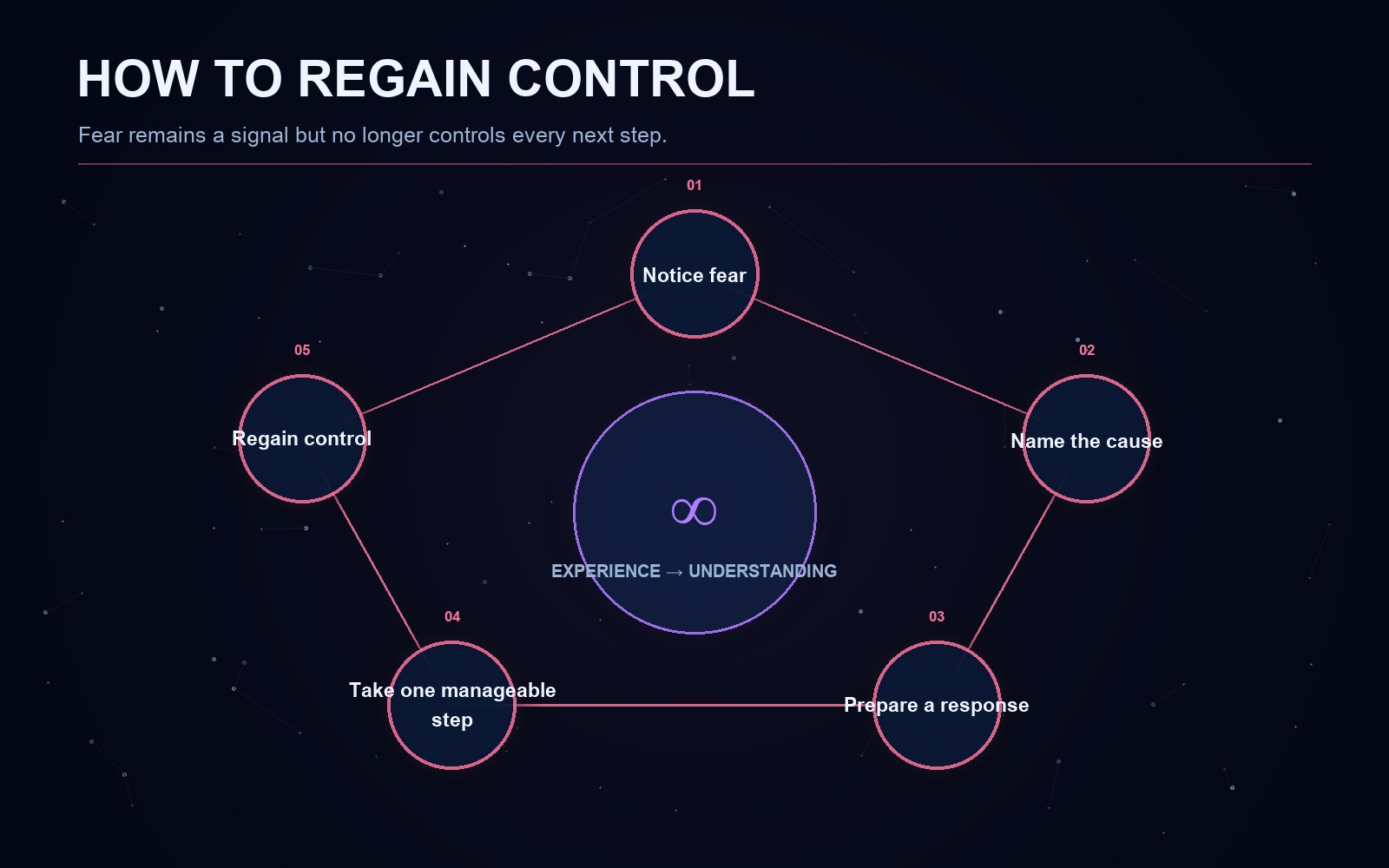
When fear begins taking control, move through this simple sequence:
- Stop and name the fear. Tell yourself honestly what you are afraid of.
- Separate facts from scenarios. Identify what has actually happened and what exists only in your imagination.
- Evaluate your preparation. Do you have enough knowledge and understanding? If not, step back and prepare.
- Choose one small action. You do not have to overcome the entire challenge at once. Take the next manageable step.
- Define Plans A, B, and C. Decide in advance how you will change or leave the situation.
- Keep the right to stop. Control includes the ability to continue and the ability to end an experience at the right moment.
- Review what happened. Once you are calm, identify what was real, what was expectation, and what the experience taught you.
This process will not destroy fear forever. It will do something more valuable: it will return control to you.
Do Not Wait for Fear to Disappear
Fear often stands at the edge of a new experience. It appears precisely where familiar territory ends and the unknown begins. If we retreat every time, that boundary will never move.
But when we proceed gradually, prepare, examine our assumptions, and accumulate direct experience, the territory of the known begins to expand. What seemed frightening and inexplicable yesterday becomes part of our personal map of reality tomorrow.
Fear may remain as a mild physical sensation, but it no longer has to block the road.
Do not wait for the day when you are no longer afraid. That day may never come. Begin acting while fear is still present but the decision once again belongs to you.
That is freedom: fear may speak, but you choose the direction.
Continue the Investigation
In my book The Phenomenon of Consciousness Beyond the Body, I explore my earliest experiences, the unusual sensations that can accompany separation from the body, preparation, the protective sphere, and methods for ending an experience safely. This article presents the central principles of working with fear; the book places them within the larger story of my experience and my model of reality.
Leave a Reply