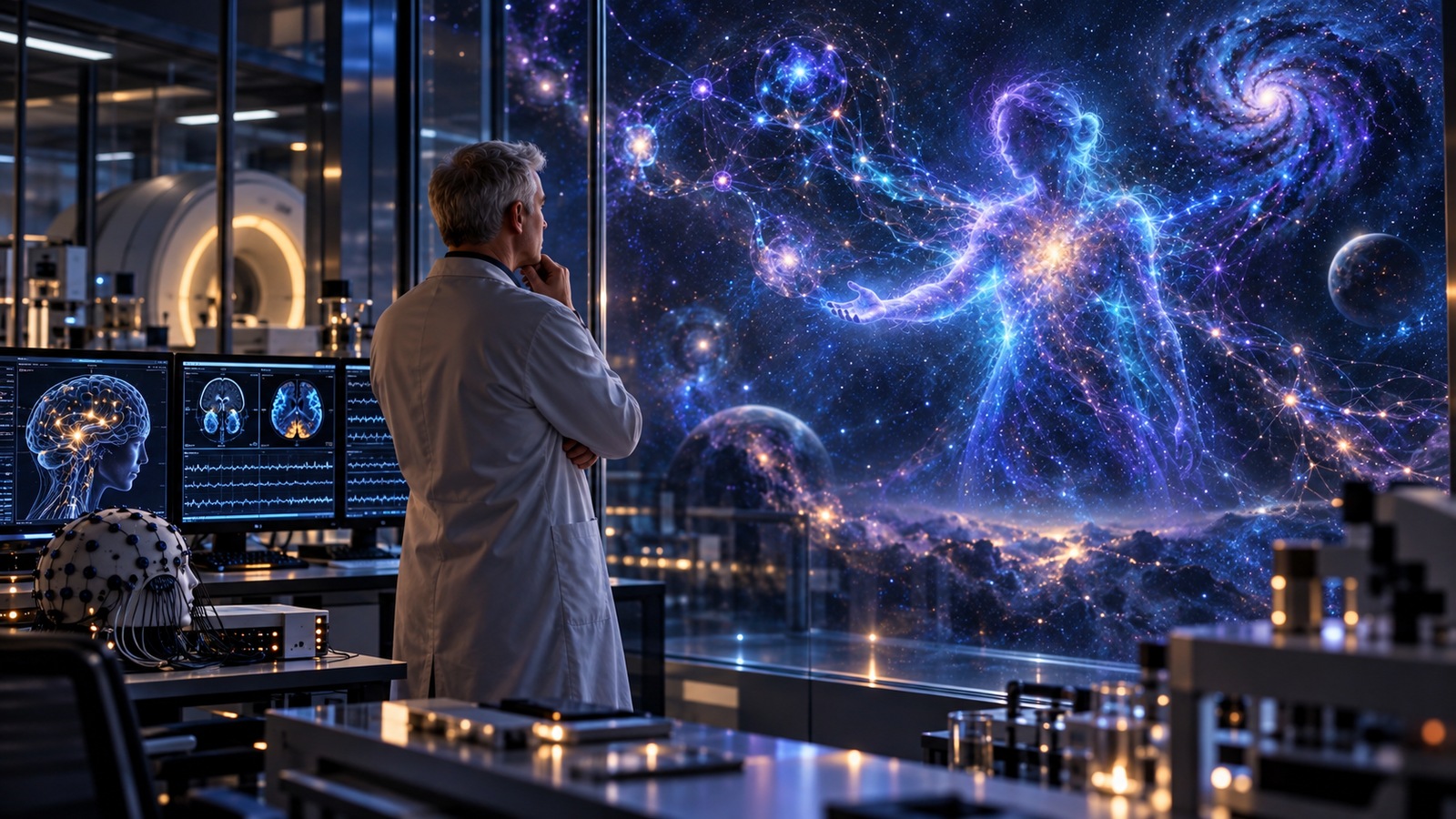
Millions of people describe out-of-body experiences, near-death states, encounters with deceased loved ones, and information they could not have obtained through ordinary means. These accounts appear across cultures and historical periods. They can completely transform a person’s relationship with life and death.
Why does modern science devote so little attention to this phenomenon?
The reason is not a lack of material. Consciousness beyond the body is difficult for the existing research system: it cannot easily be produced on schedule, it resists familiar instruments, and studying it can be risky for a scientific career.
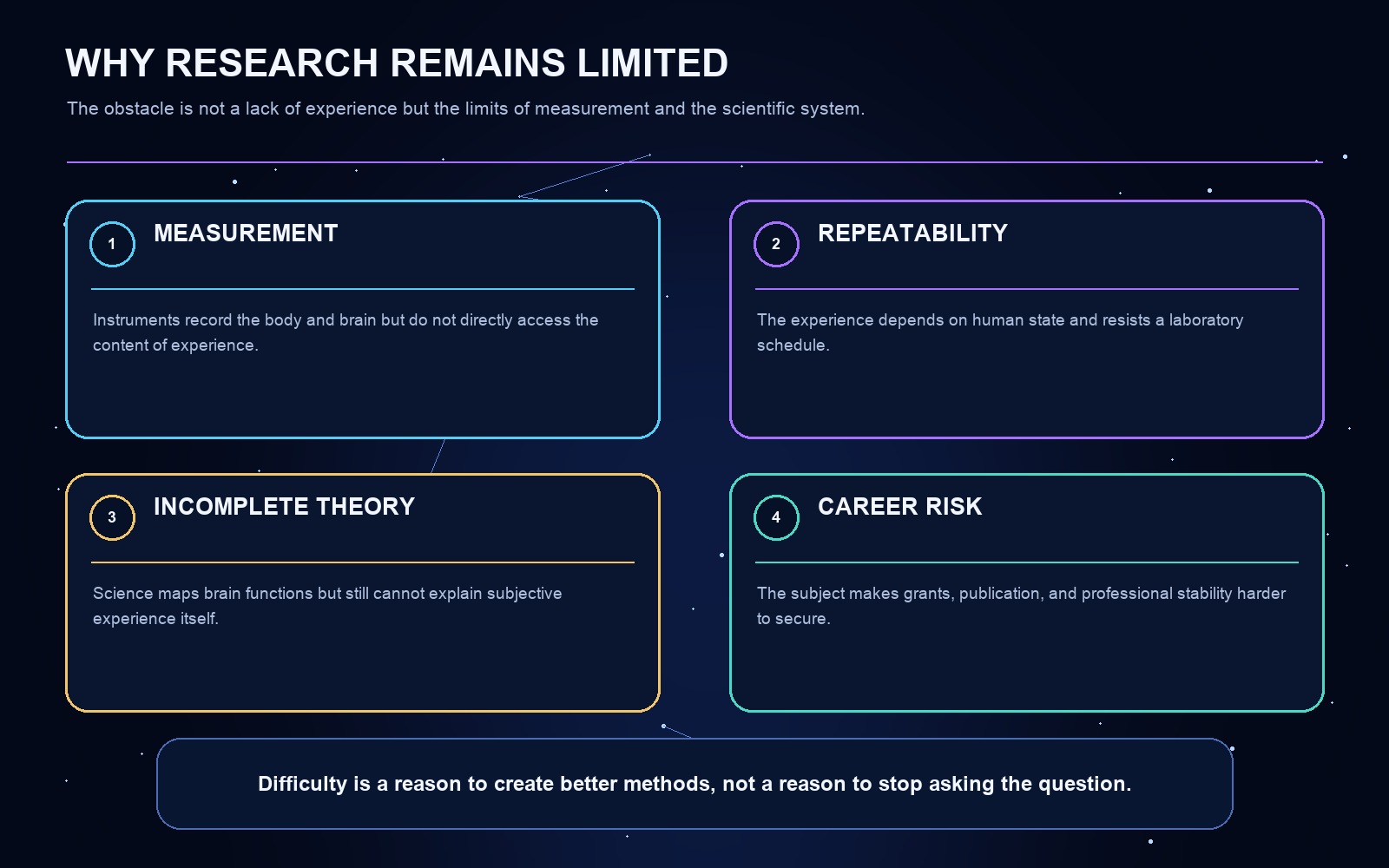
Instruments Measure the Brain, Not the Experience Itself
During an unusual state, researchers can record electrical brain activity, pulse, eye movement, breathing, and blood oxygen. These measurements matter. They show what is happening in the physical organism.
They do not answer the central question: Where is the perceiving person, and what exactly is that person experiencing?
A brain scan shows correlation. It connects a state of the brain with a participant’s report. That connection does not automatically prove that the brain fully created the content of the experience. A radio receiver changes its electrical activity when music plays, but measuring its circuitry does not describe the broadcast or prove that the music originated inside the receiver.
I am not claiming that the brain is merely a receiver. My point is narrower: present measurements alone do not resolve the origin of consciousness.
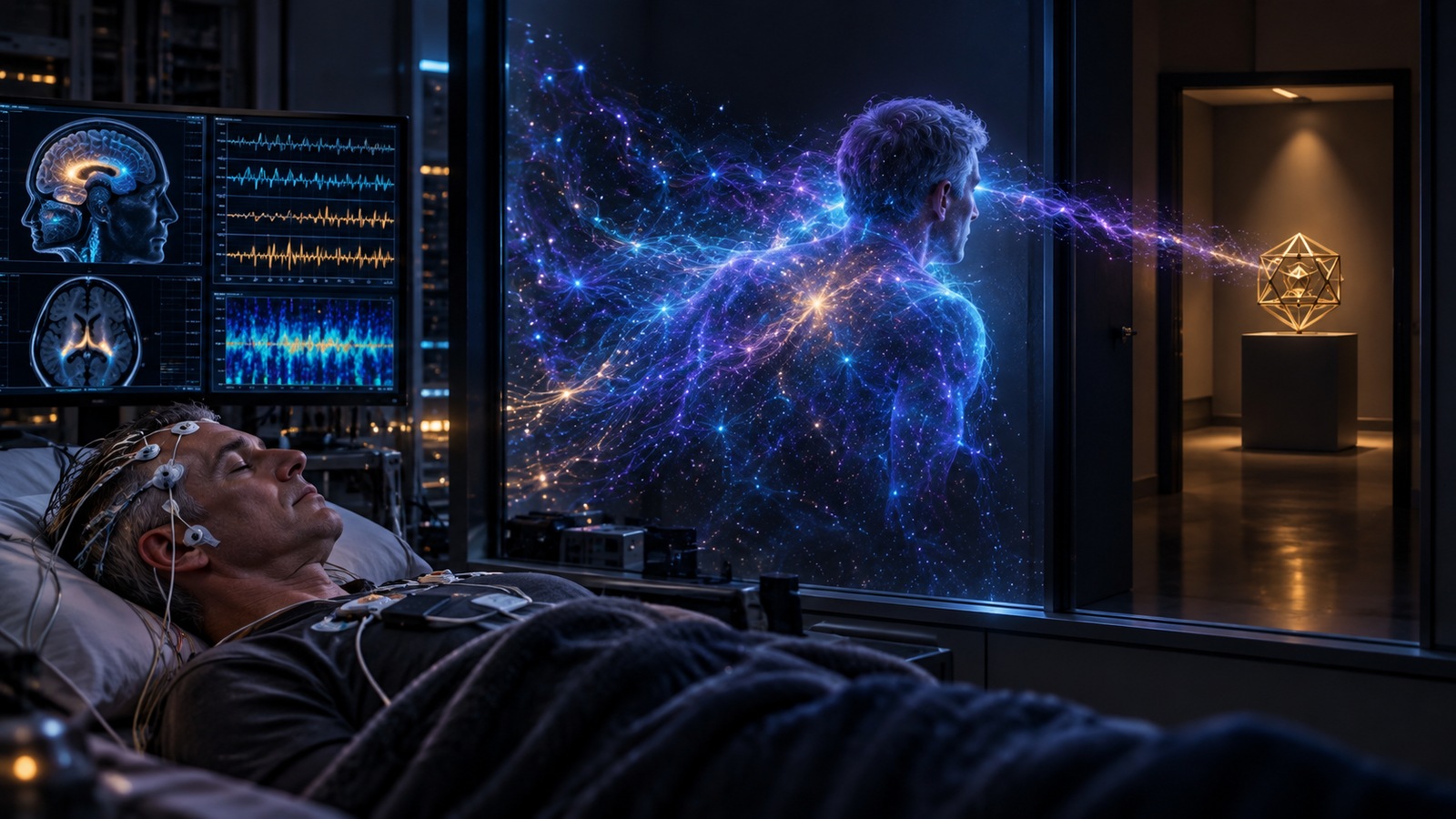
Science Still Has No Unified Theory of Consciousness
We can connect regions of the brain with speech, memory, attention, and perception. We still do not understand how physical processes become subjective experience—why a person does not merely process a signal but sees red, feels pain, and knows that they exist.
Without a satisfactory theory of consciousness, out-of-body experience is often explained within a model that does not yet explain the primary phenomenon.
A researcher may say, “It is brain activity,” and consider the matter settled. Yet brain activity accompanies every earthly experience. It does not explain why people report stable environments, similar stages of transition, and, at times, information that can be checked.
Out-of-Body Experience Does Not Obey a Laboratory Schedule
Science values repeatability. Ideally, a phenomenon appears at a specified time, under the same conditions, in different participants.
OBE depends on many factors: physical condition, energy level, sleep, emotional state, preparation, the ability to remain aware, and the strength of intention. Even an experienced practitioner cannot always reach the necessary depth at an appointed hour while unfamiliar people observe.
A laboratory adds pressure. Wires, cameras, expectations, and the desire not to disappoint the researchers alter the participant’s state. Failure to separate under those conditions does not prove the phenomenon impossible. It may show that the conditions were poorly designed.
Subjective Data Is Mistakenly Treated as Useless
Science already works with subjective reports. Pain, anxiety, quality of life, and therapeutic outcomes are assessed largely through personal testimony. Extraordinary experiences, however, are often dismissed before analysis begins.
Subjectivity certainly creates risks of memory error, expectation, and interpretation. The answer is better methodology, not the elimination of experience:
- precise documentation immediately after the event;
- standardized questions for all participants;
- a separation between observation and conclusion;
- comparison of independent reports;
- predetermined verification targets;
- publication of unsuccessful as well as successful attempts.
This is how subjective material becomes researchable.
Reputation Shapes the Questions Scientists Ask
Scientists do not exist outside society. They need grants, laboratories, publications, positions, and the respect of colleagues. Research on consciousness beyond the body can endanger all of them.
A young researcher understands that it is safer to study a narrow question inside an accepted model than to risk a career on a phenomenon colleagues already label pseudoscience. Serious studies remain scarce, and the scarcity is then used as evidence that the subject is not serious. The result is a closed loop.
This is not a conspiracy involving every scientist. Many researchers sincerely search for answers. The scientific system, however, rewards certain questions and makes others professionally expensive.
A Conflict of Languages Prevents Cooperation
Practitioners speak about the soul, energy levels, guides, and the Higher Self. Scientists speak about dissociation, sleep stages, neural networks, and body models. Sometimes different words describe different aspects of the same phenomenon. Sometimes the same word conceals opposing ideas.
Instead of translating between these languages, the two sides often ridicule each other. The practitioner sees a closed-minded materialist. The scientist sees someone without a method.
Progress begins with observable characteristics. What did the person feel? Was awareness preserved? Could the participant change direction? What was perceived? What could be verified? What was happening in the body and brain? These questions create common ground.
What We Can Study Today
We do not need to wait for an instrument that displays the soul on a screen. We can already:
- conduct blinded experiments with hidden targets;
- compare experienced practitioners with beginners;
- study memory before, during, and after transition;
- align physiological data with the precise timing of reported events;
- build large standardized databases of accounts;
- test matches between independent participants;
- study the long-term influence of the experience on fear of death and behavior.
No single experiment will settle the question. A sustained program can gradually distinguish stable patterns from error and imagination.
Science Needs to Recover Its Courage
The scientific method remains one of our best tools for testing claims. The problem does not begin when a scientist doubts. It begins when doubt becomes a prohibition against asking the question.
Twenty years of personal practice have convinced me that consciousness can exist and perceive outside the physical body. I do not ask science to accept my conclusion on faith. I ask it to do what it was created to do: investigate the phenomenon without fear of the consequences.
When an observation does not fit the current worldview, the observation is not the only thing that should be tested. Sometimes the worldview itself needs to expand.
For more about the nature of consciousness and my path as a researcher, see my book *The Phenomenon of Consciousness Beyond the Body*.
Leave a Reply