
Self-regression is appealing because it offers freedom. A person does not need to find a practitioner, explain a private question, or depend on someone else’s schedule. Inner memory can be explored at a convenient time and at a personal pace.
That freedom also creates the central difficulty: the same person asks the question, directs the process, receives the image, and interprets it. If expectation quietly replaces observation, no one else is present to point it out.
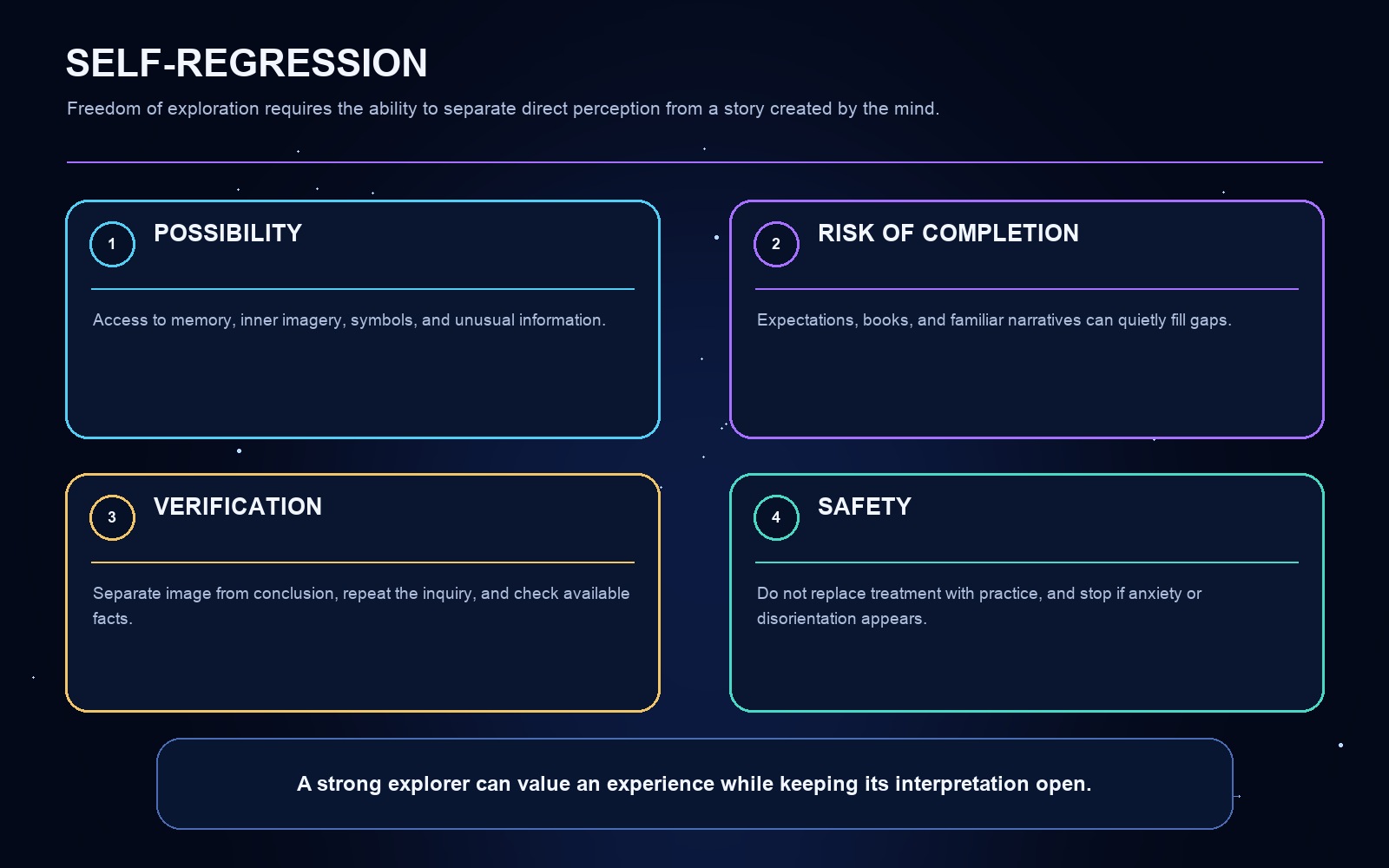
Self-regression is possible. I do not consider it useless or automatically imaginary. It should, however, be approached as an investigation rather than a factory for beautiful stories.
What Independent Practice Can Offer
In a lightly altered state, the usual control of the thought stream weakens. Unexpected images, emotions, physical reactions, and fragments of information can appear. Sometimes a person remembers a long-forgotten event from the current life. Sometimes a scene feels like an episode from another incarnation. Sometimes the person enters what appears to be the realm of the soul between lives.
The value of the practice does not always depend on the literal historical accuracy of every image. Even a symbolic story can reveal a hidden fear, a recurring pattern, or an internal conflict. But symbolic meaning and the memory of an actual event belong to different categories. They should not be confused.

Why the Mind So Easily Completes a Story
The mind dislikes gaps. It joins fragments into a coherent narrative using memory, movies, books, expectations, and suggestion. In ordinary life this ability helps us understand the world. In regression it can create an extremely convincing construction.
A person sees old clothing and immediately decides that the scene belongs to a particular country and historical period. The mind then adds a home, a family, an occupation, and a dramatic ending. The scene grows more vivid, but vividness says nothing about its source.
It is especially risky to begin with a predetermined answer: “I know I was this person,” “I am under an ancient curse,” or “My present relationship must be explained by a past life.” Such a question does not investigate. It demands confirmation.
How to Reduce Self-Deception
A useful question remains open. Instead of asking, “Show me why this person was my enemy in a past life,” ask, “What do I need to understand about this relationship?” Instead of searching for a famous identity, ask to see the experience that is genuinely relevant to the present issue.
During the practice, separate three layers:
- what appeared directly—an image, emotion, word, or immediate knowing;
- what was added through reasoning;
- what conclusion was formed only after returning.
If an answer matters, revisit it on another day with a differently worded question. Stable information may not return in the same pictures, but its central meaning should remain recognizable.
Whenever external verification is possible, use it. A historical detail, geographic name, or family fact becomes more meaningful after independent confirmation.
The Higher Self and the Researcher’s Responsibility
In my own practice, I address the Higher Self and set a clear intention to receive only the information that supports growth and that I am capable of understanding correctly.
For me, this does not mean abandoning critical thought. Even a powerful inner knowing passes through the perception of an earthly personality. I compare, repeat, and avoid building a major decision on a single episode.
The image of a spiritual guide does not remove personal responsibility. A beautiful appearance, impressive name, and confident voice are not proof of wisdom.
Where the Safety Boundary Lies
Self-regression should never replace medical care or psychotherapy. It is not a method for independently treating severe trauma, a psychiatric disorder, or a condition in which a person is losing contact with everyday reality.
The practice should be postponed during an acute crisis, panic attacks, severe insomnia, confused perception, or the use of mind-altering substances.
Stop and seek appropriate support if the following persist after a session:
- strong anxiety or disorientation;
- a feeling that ordinary life has become unreal;
- an obsessive urge to repeat the practice immediately;
- fear of the images that interferes with sleep or work;
- certainty that another person is guilty of something based only on a regression scene.
In those situations, restoring stability and consulting a qualified professional matters more than continuing the experiment.
When a Regression Practitioner Is Helpful
A practitioner is useful when a person struggles to sustain attention, repeatedly returns to analysis, or approaches emotionally difficult material. A responsible regression practitioner does not dictate the story. The practitioner preserves direction, asks neutral questions, and notices when the participant begins to construct an answer.
Professional support is also important when the purpose is research. A second person can record the wording of questions, note physical reactions, and separate the original account from later interpretation.
A Practice of Mature Awareness
Self-regression can become a valuable way to explore memory, consciousness, and the deeper structure of the personality. Its strength lies in direct personal access. Its weakness is the absence of an external observer.
The solution is not to reject the method but to develop research discipline: open questions, a written record, repeated sessions, external verification, and a willingness to admit uncertainty about a particular image.
True spiritual maturity is not the ability to believe every extraordinary scene. It is the ability to remain open without losing discernment.
For a deeper discussion of memory, mental constructions, and the exploration of consciousness, see my book *The Phenomenon of Consciousness Beyond the Body*.
Leave a Reply