
Out-of-body experience and regression are often treated as separate fields. Practitioners use different terminology, explain what happens in different ways, and rarely compare their results. Yet beneath those differences lies the same set of questions: What is consciousness? Can memory extend beyond a single earthly life? Can human perception receive information outside the ordinary senses?
I have spent many years practicing out-of-body exploration and studying regression. The longer I compare these methods, the more clearly I see that they are not competing schools. They are two points of entry into one vast area of reality.
Two Different Ways of Shifting Attention
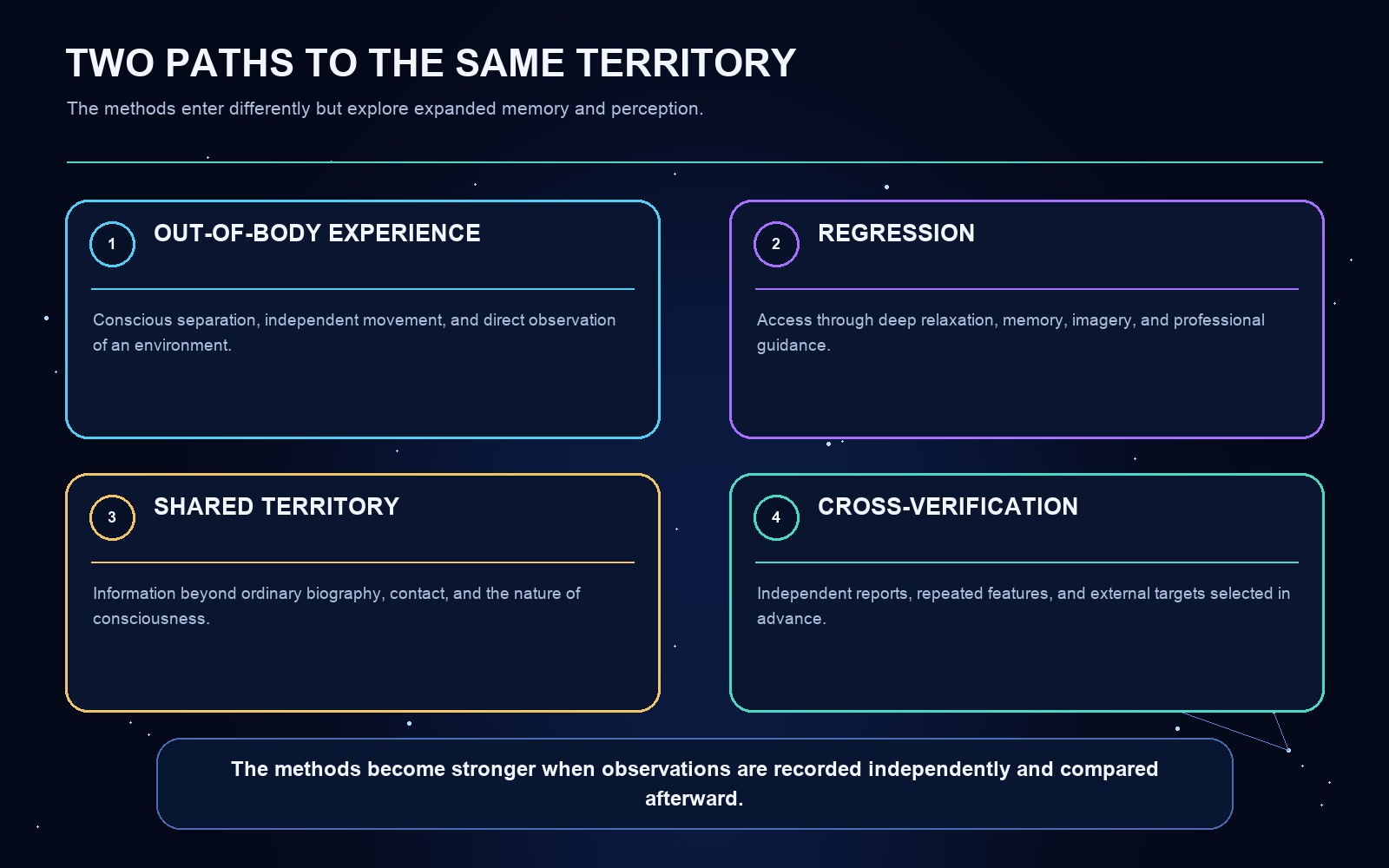
In an out-of-body experience, a person seeks to separate perception from the physical body. The individual retains a sense of self, moves through an environment, observes, encounters other beings, and can pursue predetermined verification tasks. When awareness is strong, the experience does not feel like a memory or an inner movie. It feels like direct presence.
Regression moves attention in another way. The person remains connected to the body and enters an altered state, either with a practitioner’s guidance or independently. Images, episodes, emotions, and knowledge may emerge that appear connected with childhood, possible past lives, or the period between lives.
In one method, the explorer steps into the field of experience. In the other, the explorer accesses information through memory, imagery, and inner perception.

The Shared Foundation
Both methods require physical relaxation, stable attention, and a temporary quieting of the ordinary stream of thought. In both, expectations can influence what a person perceives. A vivid scene does not automatically guarantee an accurate interpretation, whether it appears during regression or an out-of-body experience.
There is a deeper similarity as well. Both methods suggest that human memory and perception may extend beyond the boundaries of one familiar biography. People report information about unfamiliar places, experience themselves outside their current identity, meet deceased loved ones, and describe the organization of nonphysical realms. A single case can be dismissed as imagination. Repeating structures across many independent experiences deserve serious investigation.
The Main Difference: The Brain’s Influence
During regression, the connection with the body and brain remains stronger. Personal expectations, familiar narratives, a practitioner’s wording, and cultural imagery can therefore enter the experience more easily. The mind may fill gaps and create a coherent story where the original information was fragmentary.
In an out-of-body experience, the brain’s influence may weaken, especially after full separation. It does not disappear automatically. Habits of perception, fear, and belief continue to operate. A person can construct a mental environment and mistake it for an independent reality.
For that reason, I do not consider one method infallible and the other secondary. Each has distinctive possibilities and distinctive sources of distortion.
What Each Method Can Offer the Other
A regression practitioner knows how to guide attention, help a person remain engaged, and work through internal barriers. This can be especially useful for people who struggle to reach a deep state on their own.
An experienced out-of-body practitioner, in turn, knows how to test the stability of an environment, change the point of observation, search for a predetermined target, and distinguish a personal thought from an event that resists expectation.
Combining these skills creates a powerful research model. Regression can help a person approach the threshold of separation, while OBE methods can add awareness, independent action, and verification.
A Matching Answer Is Not Yet Proof
When a regression participant and an OBE practitioner obtain similar information, the overlap matters. It must still be evaluated carefully. People may have read the same books, absorbed the same cultural narratives, or unintentionally communicated expectations to one another.
Independent observations are stronger. A precise question is established first. Several participants then use different methods without discussing their results. Their reports are recorded before any group conversation. Only afterward are the details compared.
The most valuable information can be checked in ordinary reality: a description of an unknown location, the contents of a concealed image, a fact from a deceased person’s life, or a specific match that none of the participants knew in advance.
Why We Need a Shared Map
Each field currently tends to defend its own vocabulary. Some speak only of a field of memory, others of astral levels, and still others of the subconscious. As a result, potentially related observations can appear incompatible.
I suggest beginning with the experience itself rather than its label:
- How aware was the person?
- Did the person retain a connection with the body?
- Could the person independently change the direction of the investigation?
- How strongly did thought influence the environment?
- Was any verifiable information obtained?
- Could the result be repeated?
This type of map does not require us to accept one philosophy in advance. It allows us to compare phenomena by their observable characteristics.
Two Paths That Need to Meet
Out-of-body experience offers freedom of direct exploration, but it requires serious preparation. Regression is accessible to more people, but its reliability depends heavily on the quality of the guidance and the care used in interpretation.
Bringing the two together should not create a new dogma. Its purpose is to expand human possibility while making verification stronger. If two different methods lead into the same territory, we have a chance to see that territory in greater depth.
I am convinced that consciousness is far greater than the physical body and one earthly biography. Conviction, however, does not release a researcher from the need for precision. It demands bolder questions and methods capable of separating a genuine discovery from a compelling story.
That is exactly how out-of-body experience and regression can strengthen one another.
For a deeper account of my observations and twenty years of consciousness research, see my book *The Phenomenon of Consciousness Beyond the Body*.
Leave a Reply